This Chanukah Savor the Moment

Several studies have shown that adopting routines can make you more productive. Routine is a hallmark of efficiency and can also help harness your creativity. Many successfully creative people swear by the routines they formed: author Stephen King famously sits down at the same time every morning, which he believes allows his writing to “kick on.”  Routine is a hallmark of many big thinkers: Geniuses like Steve Jobs and Albert Einstein liked to wear the same thing every day in order to not expend mental energy on wardrobe decisions.


Perhaps that is why Yaakov wanted to finally settle into a routine.  Vayeishev Yaakov b’eretz m’gurei aviv, Yaakov settled in his father’s homeland.  Rashi quotes Chazal: Bikeish Ya’akov leishev b’shalva, Yaakov wanted to live with a quiet routine, he wanted to settle into a peaceful and stable life and lifestyle.  Until now, his whole life has been characterized by tension, conflict, living on the run and often in fear.  No two days have been the same.  All he wants is leishev b’shalva, he wants to retire, settle down, and develop a routine in life.


Yet, for some reason, Hashem saw this desire and goal as detrimental and inappropriate.  In fact, instead of giving Yaakov peace of mind and a stable routine, kafatz alav rogzo shel Yosef, the most tumultuous and stressful episode of Yaakov’s life ensues.  Somehow, craving a peaceful routine was so wrong it was actually served as the catalyst for Hashem mixing things up.  Why?


The truth is that while there are benefits to routines, when people are too settled in their routine, complacency and contentment result.  Complacency breeds apathy, one of the biggest obstacles to growth and progress.  It also leads to poor decision-making and being blind to new choices and possibilities that could benefit us. 


On Feb. 5, 2014, London Underground workers went on a 48-hour strike, forcing the closings of several tube stops. The affected commuters had to find alternate routes. When the strike ended, most people reverted to their old patterns. But roughly one in 20 stuck with the new route, shaving 6.7 minutes from what had been an average 32-minute commute. The closings imposed by the strike forced experimentation with alternate routes, yielding valuable results. And if the strike had been longer, even more improvements would probably have been discovered.


Researchers have long studied why people purchase name-brand items when the equivalent generic is available with a significant cost savings, which could compound to real money.  This phenomenon is noteworthy for drugs, when generics and branded options are chemically equivalent. Why continue to buy a name-brand aspirin when the same chemical compound sits next to it on the shelf at a cheaper price? Scientists have already verified that the two forms of aspirin are identical. The only difference is the label and the price.  And yet, most buy the name brand.  Why?  Habit, ritual, and thoughtless routine.


So on the one hand habits are powerful, they can help promote creativity and efficiency.  But on the other hand, habits and routines can deny us the openness and flexibility to learn, to see new things, to grow, experiment, adjust and make changes that will improve us and improve our lives. 


One study estimated that 47 percent of all our behaviors are the result of habits we have formed.  That can be leveraged in a positive way.  Just think about it – if we form the right habits—being on time, showing patience, extending generosity—we have half our day preprogrammed in a way we can be proud of.  The downside, of course, is that nearly half our lives is not the result of thoughtful consideration, mindful choices, but simply having settled into habits and routines mindlessly.  That is no way to live.


This week we begin the holiday of Chanukah and the mitzvah of lighting the menorah.  The mitzvah begins after sunset and the Gemara (Shabbos 21a) tells us, it extends עד שתכלה רגל מן השוק, until people are no longer walking around in the marketplace.  The goal and purpose of the light of the menorah is ,פרסומי ניסא to publicize God’s great miracles and so once there are no longer people present to see the lights, the mitzvah is no longer applicable.  In the time of the Gemara, and even the Shulchan Aruch, this time was relatively shortly after nightfall when people couldn’t function outside without natural light.  Today, with artificial light, the time is significantly later.


The Sefas Emes quotes his grandfather, the Chiddushei HaRim, who offers a homiletical interpretation of this measure, one that gives great insight into the essence of the holiday.  “עד שתכלה רגל מן השוק”, says the Sefas Emes, is not describing how long in time the candles must be lit, but how deep the light of the candles must penetrate into our hearts and our habits.  He suggested don’t read it רגל, but rather עד שתכלה הרגל מן השוק, we must experience the light of the candles and the richness of these eight days until it breaks our habits, jolts us from our routines, and enables us to take a step back and look at our lives. 


So many of us are caught in the hamster wheel of life.  We wake up, go to work, maybe exercise, brainlessly relax, go to sleep, wake up and start again. Or we wake up, make lunches, drive carpool, shop, cook, do homework, serve dinner, collapse, wake up and start again.  Or some combination of the two.  What these routines all have in common is being carried by inertia and momentum, moving at such a fast pace that there is no time or space, no margin or room to ever stop, look, assess, evaluate and mindfully determine if we are allocating our time, energy and resources in the most optimal way, or if we are just creatures of routines, products of habits that were somehow formed at some time and have become our default, our normal, our assumed.


There is a beautiful campaign for Chanukah called “Savor the moment.”  It calls for Jews across the world to go screen-free for 30 minutes after candle lighting, the minimum necessary time for the candles to burn.  For too many of us, being chained to our smartphone, tablet, laptop or TV has become routine. We desperately need this considering that the average American touches his or her phone 2,617 times a day


Chanukah can give us the energy to have the courage and will to תכלה הרגל, to break the habits and see the light, literally and figuratively. Imagine eight consecutive nights of half an hour screen-free time together lighting candles, singing Ma’oz Tzur, dancing to great music, sharing gifts, spinning the dreidel, sharing Divrei Torah, or however you want to spend it.  Eight nights of quality, uninterrupted family time.  You don’t have to imagine it – it can be our reality this Chanukah and beyond, if only we are willing to break free from the routine.


3 Keys to Being Happy

When the Founding Fathers included the pursuit of happiness as an American right and entitlement, it is almost as if they conceded that happiness can be pursued, but it is unlikely to ever be attained.  If you look around, you can’t help but notice that for many, the pursuit has grown tiring and indeed, many have given up.  In the last twenty years, there has been an astounding increase in antidepressant use by Americans. One might even suggest that the growing effort to legalize marijuana nationally is driven by a community eager to find pleasure and happiness, even if it is by escaping reality.


In 2006, Harvard psychologist Daniel Gilbert wrote a book called “Stumbling on Happiness.”  In it, he argues that the things and experiences we typically predict and imagine will bring us happiness, rarely do.  Rather, he says, happiness is elusive, and we should learn from how others have stumbled upon it.  The first part of his thesis is undeniable.  Study after study has concluded that money, fame, and power not only don’t contribute to happiness, but often are obstacles to and detractors from experiencing it.  So how do we finally attain it?


1)   Happiness is not an emotion; it is a decision.  Stop waiting passively to feel it and start actively choosing to be it.


In Parshas Ki Savo, the Torah says, u’vau kol ha’berachos ha’eleh, v’hisigucha, which literally translates as “All these blessings will come upon you and overtake you.”  What does it mean v’hisigucha, to be overtaken by blessing?  Rav Shlomo Yosef Zevin explains that Hashem gives each of us beracha, blessing in our lives.  That blessing can manifest itself in all types of form – material possessions, meaningful relationships, special skills, wonderful opportunities, family, and the list could go on and on.   The first blessing is the particular gift.  But even more important and an even greater blessing is v’hisigucha…to recognize, appreciate and acknowledge the blessing.


Simcha, happiness, occurs when we make the decision to focus on the blessings in our lives, no matter how challenging or formidable the struggles we face simultaneously.  If our happiness results from the blessings we already have, we can always find happiness because we always have at least something.  But if our happiness is determined by what we don’t have, “If only I had more money, a nicer house, a better job, a more loving spouse, more loyal children, etc.” we will never be happy because we can always have more.  Therefore, by definition, there will always be something we don’t have.


The decision to be b’simcha, happy, doesn’t only affect us but it can positively influence our environment and family. Dr. Nicholas Christakis, a physician at Harvard Medical School, authored a study that concludes that happiness, scientifically speaking, is literally contagious.  The same way a person yawning causes others to also begin to yawn, when one person smiles or is happy, it is infectious and draws smiles and happiness from others.


It has been suggested homiletically that the etymology of the word simcha comes from sam-mo’ach, focus your thoughts.  Make the decision to be happy and the feeling will follow.


2)   Happiness comes from giving, not from getting.  It comes from being a giver, not a taker.


After many years concentrating on what makes people depressed, social scientists are now beginning to study what makes people happy.  Their answer is counter-intuitive.  Paradoxically, it turns out the biggest obstacle to achieving happiness is our own pursuit of it.  When happiness is defined by our needs, our wants, and our desires, it will remain elusive and unattainable for we will never have everything.  Instead, studies show that people report better health and greater happiness when they volunteer for a worthwhile cause or spend time helping others.  Moreover, studies have shown the efficacy of volunteering and helping in combating depression.


Happiness does not result from a focus inward, but it results from the deep satisfaction and profound gratification of imitating God and helping others.  At the end of Hilchos Megillah (2:17), the Rambam makes an incredible comment.  He asks, if a person has limited funds and has to choose between having a more lavish and luxurious Purim meal, more extravagant and impressive mishloach manos, or giving more matanos l’evyonim, money to the poor, what should he do and why?


The Rambam codifies that the resources should be dedicated to helping the indigent and poor because Purim is about simcha and there is no greater happiness than bringing joy to others, especially the underprivileged.


Someone once wrote to the Lubavitcher Rebbe z’l in a state of deep depression and hopelessness.  The letter essentially said, “I would like the Rebbe’s help. I wake up each day sad and apprehensive. I can’t concentrate. I find it hard to pray. I keep the commandments, but I find no spiritual satisfaction. I go to the synagogue but I feel alone. I begin to wonder what life is about. I need help.”


The Rebbe sent a brilliant reply back that did not use even a single word. He simply circled the first word of every sentence in the letter and sent it back. The author of the letter understood, and he was on the path to greater happiness and hope.  The circled word at the beginning of each sentence was ‘I’.


A self-centered person, a taker, can never be happy in life because they could never take enough.  Givers find joy in doing for others and therefore have great access to happiness because there are always ample opportunities to give.


3)   Surrender control and let go, let God.


Several summers ago, on a visit to Israel, I decided to go skydiving and to appreciate our homeland from a new perspective.  After a comprehensive five minutes of instruction, I was taken up in a tiny plane that if I wasn’t crazy enough to jump out of, I was crazy to get into.  With a soft helmet on, and goggles on my face, they placed me with my feet dangling off the side of the airplane.  We were 12,000 feet in the air and the beautiful land of Israel was a fuzzy blur.  I vividly remember leaning over and looking down and feeling like I couldn’t breathe.


Before I could have second thoughts, I felt a nudge and out the plane I went.  I was heading towards Mother Earth travelling over 100 miles an hour.  The wind was rushing all around me, my arms and legs were extended, and I think I tasted my spleen.  For a brief moment, I felt panicked.  “This is absolutely nuts, what kind of crazy, insane person does this?” I thought to myself.  I started to get scared, worried and anxious and then I remembered.


Immediately behind me, attached by numerous metal latches and clips, was a big Israeli man who trains paratroopers in the Israeli army and who does these jumps around 8–10 times a day.  We jumped in tandem and the moment I remembered that he literally had my back, I felt the biggest relief and was able to enjoy the rest of this remarkable experience.


The difference between a miserable, painful, anxious experience and the experience of my life, was remembering there was someone who had my back and who knew what he was doing.  Six thousand feet and forty five seconds into the jump, he pulled the cord, the chute released, we sat up in the harness and for the next 10 minutes had the most extraordinary ride over Israel, checking out our magnificent homeland from the sky and giving Israel a huge virtual hug.


We need to take initiative, put forth our best efforts, and do everything we can to bring positive outcomes in our lives.  However, believing that we can control and manipulate every outcome and result places impossible stress and pressure that preclude our ability to experience happiness.  There is nothing more liberating, cathartic and joyful than doing our best, and then letting go of our need to control and allowing God do the rest.


No matter how hard we try and what kind of effort we produce, our lives are going to inevitably and invariably throw curveballs our way.  The difference between panicking anxiously or enjoying the ride is our ability to let go.  Perhaps this is what the pasuk means when it tells us, “Ivdu es Hashem b’simcha, serve Hashem with joy.”  The greatest service of Hashem is feeling the simcha that can only come by recognizing that He has our back so we can enjoy the ride.


Stop pursuing happiness and start experiencing it.

Are You an Earth Angel?

Prior to 1974, the standard practice for dealing with someone who was choking was to whack the afflicted person on the back. Dr. Henry Heimlich argued hitting them that way can force the obstruction further into the gullet, rather than dislodge it.  He worked on various theories attempting a better way before ultimately coming up with the technique of putting one’s arms around the person choking and exerting upward abdominal thrusts, just above the navel and below the ribs, with the linked hands in a fist, until the obstruction is dislodged.


Heimlich published preliminary findings from his experiments with anti-choking techniques in a US medical journal. Newspapers around the US quickly began picking up on examples where readers, including restaurant owners, had caught word of Heimlich’s article and had tried the maneuver on choking casualties, with successful results.


Word spread, and that summer the Journal of the American Medical Association published an editorial in which, with the surgeon’s permission, the technique was officially referred to for the first time as the “Heimlich Maneuver.” The technique became widely adopted nationally and internationally and today it appears on posters in most restaurants and is taught in many schools.


Despite introducing the technique, Heimlich had never actually used it the 42 years of its existence. In 2016, Dr. Heimlich was in the dining room of his retirement home in Cincinnati. A fellow resident at the next table began to choke.  Without hesitation, Heimlich spun her around in her chair so he could get behind her and administered several upward thrusts with a fist below the chest until the piece of meat she was choking on popped out of her throat and she could breathe again.


At 96 years old, Dr. Henry Heimlich had finally executed the Heimlich maneuver to save a life.  A short time later, the 87-year-old woman for whom Dr. Heimlich was an angel here on earth, wrote him a note saying she was so thankful that “God put me in this seat next to you.” 


Our Parsha begins with the description of Yaakov’s dream that included angels ascending and descending a ladder to heaven.  Many commentaries wonder why the passuk describes them as “going up and coming down”; shouldn’t angels descend from heaven and then ascend back up to it?  I would ask a more fundamental question: why do angels need a ladder at all, can’t they float or be beamed down to earth and back up to heaven?


The answer can be found by looking at other appearances of angels in Sefer Bereishis. When Yaakov is poised to reunite with his brother Esav, he first sends “malachim” to Esav. Rashi there interprets “malachim” as “מלאכים ממש,” real heavenly angels.   The Ibn Ezra disagrees.  He says Yaakov sent human messengers who came through for Yaakov and did just what he needed at that moment.   


Later still, when Yaakov sends Yosef out to look for his brothers, the Torah cryptically tells us someone appeared to Yosef and asked, “who are you looking for, maybe I can help direct you.”  Rashi says that person was none other than the heavenly angel Gavriel.  Again the Ibn Ezra disagrees and says, no, it was a human being who at that moment stepped up for Yosef and asked how he could help.


Based on the Ibn Ezra’s consistent explanation, perhaps we can suggest that the angels in Yaakov’s dream were not in fact heavenly angels but men.  Until that dream, Yaakov was an איש תם יושב אוהלים, a pure person who sat in the tent and studied Torah.  Now, he was bringing all of that learning, knowledge, wisdom, and insight into the world.  Perhaps through this dream and vision, Hashem was communicating that spirituality and angels are not made in heaven, but rather angels are made here on earth. Maybe that is why they are described as going up and coming down.


Yaakov’s mission—and ours—is to be the angel for others.  When we come through for others, when we ask how we can help, when we make the difference for them, we bring a piece of heaven down here to earth. Through our actions we build an actual stairway to heaven. 


Yaakov awakens from his dream and becomes dedicated to being an angel.  When he goes to the well, he sees lazy employees and he immediately says, אחי, my brothers who I care about, the day isn’t over, we have to keep working.  He sees a young lady who can’t access the well because of a huge boulder covering it and he spreads his angelic wings and lifts it for her.   He is Rachel’s angel.  He ascends to heaven.


When Lavan replaces Rachel with Leah on Yaakov’s wedding night, Leah must have panicked.  It will be humiliating when Yaakov is expecting his beloved and finds Leah instead.  What did Rachel do?  She had every right to expose the situation. Instead, to save her sister the embarrassment, she became her angel and gave her the simanim, the secret code that she and Yaakov had formulated.


We must not passively wait for angels to descend from heaven, to relieve pain, offer support, provide help, and bring salvation.  We must be those angels, proactively stepping up and stepping in to make a difference in the lives of others. 


For nearly  years, $100 bills with an identifying mark were randomly found all over Salem, Oregon, in markets, at stores, fairs and even on the street. They helped people pay their electric bill, make their rent, buy their prescription medication, and even provide them shelter for a couple of nights. At last count, the mystery philanthropist has anonymously given out of over $50,000 worth of $100 bills and has become the angel for so many.


In July of 2017, Rosie Gagnon laced up her sneakers for her daily run around the hills of Virginia’s Shenandoah County. When Rosie hit mile six of eight, the water she’d packed along was gone and her face was bright red. As she passed by one particular home, a man pulling down the driveway stopped and poked his head out the window.  He offered her a bottle of water and it was exactly what she needed.  He then asked her if she was the one he sees running past his house every day.  She answered yes.  The next day on her run at mile six out of eight again, there was a cold bottle waiting for her on a green telephone box at the edge of the road. And then again the next day, and the day after that.  Six months after leaving water each day she runs, Rosie was interviewed.  She explained that she packs along her own water, of course, but it never lasts as long as she needs. But there, with a huge hill looming in her final stretch, she always knows there’s help ahead.


There are countless stories of humans ascending and descending the stairway to heaven to be someone else’s angel.  Twenty-two years after inventing his technique, at 96 years old, Dr. Henry Heimlich became that choking woman’s angel.  When Rosie Gagnon had to face the daily run up a steep hill, Bruce Riffey was her angel who put out water that gave her the encouragement to make the climb. 


There are people all around us who are choking on life, facing steep uphill climbs, or stuck on the proverbial side of the road. They are struggling emotionally, financially, with loneliness or in despair.  Say hello, give the benefit of the doubt, offer a kind word or a kind gesture.  You might be somebody’s only angel of the day, their gift straight from heaven.


Thomas Edison’s Mother

The story is told that one day, as a small child, Thomas Edison came home from school and gave a paper to his mother. He said, “Mom, my teacher gave this paper to me and told me only you are to read it. What does it say?” Her eyes welled with tears as she read the letter out loud to her child: “Your son is a genius. This school is too small for him and doesn’t have good enough teachers to train him. Please teach him yourself.”


Many years after Edison’s mother had died, he became one of the greatest inventors of the century.  One day he was going through a closet and he found the folded letter from his old teacher. He opened it and found that the true message written on the letter: “Your son is mentally deficient. We cannot let him attend our school anymore. He is expelled.” Edison became emotional reading it and then wrote in his diary: “Thomas A. Edison was a mentally deficient child whose mother turned him into the genius of the Century.”


While the details of this story are likely not accurate, it is indeed documented that Edison was called “addled” by his teacher who determined that he should no longer remain in school. His mother became his most enthusiastic champion and only because of her encouragement, belief and constant kind words did Thomas Edison become the great inventor we benefitted from. 


I recently wrote about the Olympian Penny Oleksiak, whose teacher told her to give up swimming and focus on school.  Penny ignored that voice of negativity to become a decorated Olympian and I encouraged us to silence the voice of doubt in our own heads.  The article resonated for many who identified with debilitating feelings and thoughts of self-doubt, but it also struck a chord with some who shared their own stories with me of having to overcome hurtful and insensitive comments of influential people in their lives who doubted them. I share one of them with permission:


Rabbi:


I read with great interest your “MESSAGE TO THE DOUBTERS.”  Because I kept flunking algebra and geometry (6 times overall, even though I got the correct answers 80% of the time but did not do the required progressions) and was refused an academic diploma in high school and given a general diploma which I threw back at them, refusing the document and was thus advised by the school’s college advisor “not to waste my time applying for college, but instead join the Navy and maybe they will make something out of you.” I was so angry I slammed the door on my way out so hard that the glass insert in his door broke and I said “Never mind you Mr. Caster – I will get into college without your help and make something of myself”.


Shlomo HaMelech tells us (Mishlei 18:21) מָ֣וֶת וְ֭חַיִּים בְּיַד־לָשׁ֑וֹן, Death and Life are in the hands of the tongue.  We are given an extraordinary gift by God, the capacity to communicate and the ability to express our ideas, thoughts, and feelings.  Says Shlomo HaMelech, the power of speech is not just a gift, it is an awesome responsibility.  Words can be weapons that diminish and destroy, or they can be tools and instruments that create, encourage and uplift.


Teachers, parents and really all of us have to remember that using hurtful language can create injury and pain that last longer and do more damage than a physical punch or blow.  But the opposite is also true.  Complimenting, encouraging, expressing faith and belief in someone can give them the self-confidence they need to breakthrough and succeed.


The Gemara (Berachos 6a) states: אגרא דבי הילולא מילי – the reward that comes from attending a wedding is for the words one says to the chassan and kallah that bring them joy.  Bringing a gift is courteous and correct, but giving words of encouragement, complimenting the bride and groom to one another, offering praise is even more valuable. 


In his Reflections of the Maggid, Rabbi Paysach Krohn shares how teachers can build up students when they use their words to lift:


In the fall of 1999, the Jewish Image Magazine of Chicago asked eminent Jewish personalities to recall a memorable incident or comment from one of their rebbeim that left a lasting impression.


Rabbi Yisroel Reisman recalled that Rabbi Pam would often say, “There are teachers who teach subjects and teachers who teach students. While those who teach subjects may indeed impart a great deal of information, those who teach students make a great impact on their lives.” Rabbi Dr. Aaron Twerski recalled a comment his rebbi, Rabbi Nachum Sacks, made when he taught the ninth grade in Skokie’s Bais Medrash L’Torah. When a talmid asked a question, Rabbi Sacks would say enthusiastically, “You’re 100 percent right, but I’ll show you where you’re wrong!” (Dr. Twerski said that he uses this line today in his law classes.) It acknowledged the student’s logic and insight, yet allowed the rebbi to show him where he had gone wrong.


However, it was the incident that Rabbi Nosson Scherman recalled that left me spellbound. I used the incident in a lecture to principals and teachers at a Torah Umesorah convention, for it is a glowing example of the Talmudic credo, Let the honor of your student be as dear to you as your own (Avos 4:15, see also Rashi, Shemos 17:-9). An extraordinarily sensitive mechanech, Rabbi Hirsch Kaplan, taught the sixth grade of Yeshiva Torah Vodaath in the Williamsburg section of Brooklyn. If children misbehaved in class he would often put their names on the blackboard as an incentive for the boys to improve their behavior. When a boy behaved better, his name was erased.


One day Rabbi Kaplan had a few names on the “Bad List” when the beloved principal of the school, Rabbi Dr. David Stern, walked into the room unexpectedly. As Dr. Stern spoke to the class, Rabbi Kaplan slowly backed up until he was flush against the blackboard. As the principal spoke, Rabbi Kaplan shuffled his back from right to left against the chalk-written names on the board. When the principal finished his talk and turned to leave the room, Rabbi Kaplan escorted him to the door. It was only then that all the students clearly saw the back of Rabbi Kaplan’s black kapota (long jacket), which was completely white from the chalk of the “bad names” he had erased, so that Dr. Stern would not see them. That act displayed selfless love, as it preserved the dignity of 10 and 11-year-old children. It remains to this day one of the most inspiring sights that Rabbi Nosson Scherman has ever seen.


Of course, one does not have to be a teacher to make an impact like this. All of us interact with all kinds of people every day. Do we talk to them in a way that makes them feel encouraged, that boosts their confidence, that improves their day? Or do we cut people down, make them feel small or insignificant, and fill them with self-doubt.


Our Parsha reminds us of the power of our voice: “Hakol Kol Yaakov” the voice is the voice of Yaakov – let’s remember to use our own Kol Yaakov – to uplift, to nurture, and to inspire.


A Conversation with the Lord

Interview with Rabbi Lord Jonathan Sacks z”l

January 18, 2018


Several years ago, our community was privileged to host Rabbi Lord Jonathan Sacks, zt”l.  Before he addressed the over 1,000 people in attendance at BRS, I spontaneously asked him if I could record a short interview.  He graciously agreed, despite the last-minute request and the fact that he was about to give a major public talk.  That recording sat dormant in my phone until I was moved to share it after we tragically lost Rabbi Sacks last year. This week, to commemorate Rabbi Lord Sacks’s first yahrtzeit, here is a condensed and edited transcript of that conversation.

You are a beacon of faith – you promote faith, you teach faith, and you inspire faith, not only among the Jewish community and Jewish people but around the world. Do you ever struggle with faith? Do you ever feel that you confront doubt? And in those moments of uncertainty, what do you do to overcome it?


Let me be very blunt with you. I have had many crises of faith. But I have never had a crisis of faith in Hakadosh Baruch Hu. I have had many crises of faith in man. One crisis began as soon as I began to understand the Holocaust and to understand that this took place in the heart of civilized Europe, not some third world country in some medieval century.


The biggest question of faith I had was: knowing all this was going to happen, how come Hakadosh Baruch Hu had faith in us? But I never lacked faith in God because I never expected the impossible from Him. I know perfectly well that He placed each of us here for a purpose and we are supposed to discern that and to walk ahead.


For me, the critical moment that defined my faith was achieved when I learned Parshas Chayei Sarah. It begins with the death of Sarah. There is Avraham, having lost his life companion at the age of 137. At that point, he has received from Hashem three promises: Number one –  I will give you the land. He promised that to him seven times. Number two –  I will give you children – He promised that to Avraham four times. I will make you a great nation, they will be as many as the stars in the sky, as the sand on the seashore. And finally, I will make you not one nation but many nations.


But he has only one son.


Where was the father of many nations? Where was the infinite number of descendants? What did Avraham do at that moment when he should have had a crisis of faith?


He understood that God said “Walk on ahead of me” –  התהלך לפני והיה תמים. So, he bought the first plot of land. He then made sure his son got married so he would have Jewish grandchildren. Later, in a strange episode, he takes an additional wife named Keturah and has six more children, who become the fathers of many nations.


In other words, instead of expecting G-d to do it for him, Avrohom realized that God was expecting him to do the hard work for Him. Once I understood that I never ever had a crisis of faith.


What do you do when you run into a rough patch when you’re having trouble connecting with davening, when you feel distant, when it’s not flowing, and you don’t feel as much the presence of the Almighty?


There are several things one can do: Number one I try to listen as I’m davening and be surprised by one phrase or one sentence, and that will be my meditation for the day. I’ll daven on that. It may stay with me for a week.


For example, we say every day in Pesukei D’zimrah: מונה מספר לכוכבים לכולם שמות יקרא, God creates the cosmos and knows the name of every star. That’s God the Creator. Then it says בונה ירושלים ה׳ נדחי ישראל יכנס – God builds Jerusalem and ingathers the exiles. That’s God as the shaper of history. But in between those two verses is a middle verse: הרופא לשבורי לב ומחבש לעצבותם – Who heals the broken heart, administers to their wounds. There is Dovid Hamelech telling us that sometimes healing one person’s broken heart is as important as creating a universe or shaping history. You can live off that one sentence for a year.


Never try to find kavana for the whole of prayer. It doesn’t work, for heaven’s sake. One little thing at a time. The second point is that prayer has to be sung. I’ve said many times that when language seeks to break free of the gravitational pull of earth, it modulates from speech to song. I’ve spent a lot of time in my chief rabbinate encouraging chazzanim to write new liturgical music, to use songs to make the service more participative, and to encourage shul choirs. I’m not an expert in music but I made that a key element. We used a lot of musical creativity I think that music frees the spirit and if you are ever short of kavanah, you need to have the nigun, the song, to daven with.


Thirdly, something might just catch you if you create the silence in your soul to listen. When I’m at a critical point in my life, which is pretty much every day, I just listen: Hashem, what are You telling me? Somehow prayer orients you. I call prayer “Jewish cognitive behavioral therapy.” It changes the way you look at the world; it changes the way you feel about the world.


We are always promoting more Talmud Torah and chessed opportunities. We are involved in activism on behalf of Israel and Israel relationships. Some are involved in social action and social justice. What do you think that the Orthodox community can be spending more productive time promoting that is being overlooked? Are there initiatives and emphases that the Orthodox community should be focusing on that we are neglecting?


I think there are two that are being neglected. The first is, all that goes with the affective dimension of Judaism, the emotional life. There’s some nice Jewish music here, but some of the most popular music is actually non-Jewish pop music set to Jewish words or acapella, which is great. I love it. The Maccabeats – I’m their biggest fan. But I like to see music coming from the Jewish soul. I think we haven’t done enough with the affective dimension, and music is probably the most important.


We write everyone else’s music. Irving Berlin wrote “I’m Dreaming of a White Christmas,”, Mahler’s eighth symphony, Catholic mass. Where do we write our music? I think we are missing the aesthetics of it and music is the most obvious example. Cinema, too, isn’t used enough in this regard. There’s just been a film called Menashe, a very moving film about Charedim in New York. I think we haven’t done enough with that to tell people what the life of faith does for you. I have so many stories that I think ought to be made into film. Stories of ordinary people I know who have done extraordinary things.


Second, I absolutely think the Modern Orthodox community is missing out badly on kiruv. The difference between material possessions and spiritual possessions is that the more you share material possessions the less you have. But when it comes to a spiritual possession, the more you share the more you have. That is why Chabad can send out people all over the world where there is no Yiddishkeit whatsoever, and you or I would lose our Yiddishkeit overnight because there’s no support system. Yet, they are able to keep it, because they share it.

The Modern Orthodox community should be going out on campuses. Do you know how many Jews we lose on campus? 90% minimum! Yet we’re not going out there. Every campus should host a nice modern Orthodox minyan, davening three times a day, Daf Yomi, and everything lemehadrin. But they aren’t taking it out to people who don’t have it. When you don’t give, something in your spirit dies.


A personal question: When we look at your life and productivity, whether the trajectory of ascending to the chief rabbinate, publishing 30 books, 17 honorary degrees, being named a Lord, etc., it just seems that you have had success after success, triumph after triumph. Have you ever experienced failure? Have you ever had any challenges that you couldn’t overcome and what gave you the tenacity to persevere?


Ha! Have I ever experienced failure?! My goodness me! Oooh! [Laughter.]


I nearly failed my first year in university. I nearly failed my second year in university. I was turned down for virtually every job that I applied for. Since I was a kid, I wanted to write a book. I started when I was 20 and I gave it every minute of spare time that I had. Even when Elaine and I went to a concert I would be writing notes during intervals or between movements during a symphony. Yet, I failed for 20 years! From 20 to 40 I had a whole huge file cabinet of books I started and never finished.


What changed is I happened to be reading the preface to “Plays Unpleasant” by George Bernard Shaw. It opens by saying that if you’re going to write a book, write it by the time you’re 40 or forget it. I thought it was Min Hashamayim. Someone is telling me something because I had no idea why I happened to read that passage by that writer at that time. I thought to myself that it was my last chance. So, I wrote my first book at 40 and then I wrote a book a year ever since.


Winston Churchill put it beautifully –  success is going from failure to failure without loss of enthusiasm. The secret was marrying someone who believes in you and then to just keep going. Never stop! All of the things that came much later, most of them unexpected –  very moving but not the עיקר –  it’s just “keeping on going” day after day.


That wonderful Medrash in hakdamah of Ein Yaakov asks what is the main pasuk in the Torah? One [Tanna] said that it’s loving your fellow man, ואהבת לרעך כמוך. A second said שמע ישראל, it’s about accepting the yoke of Heaven. Then, Ben Pazzi says את הכבש אחד תעשה בבקר… bringing the daily sacrifice in the morning and in the evening. It’s about Shacharis, Mincha, Ma’ariv. That’s life! You keep hammering away and eventually you’ll get there.

The only thing that is absolutely necessary is that you have to key into your mental satellite navigation system, your destination. Because if you don’t know where you’re trying to get to, you’ll never get there. I knew I wanted to write a book. It took 20 years of failure until I finally succeeded in the twenty-first year.


Are there specific moments that you felt Hashem’s guiding Hand in your life, that things could have gone in different directions, and those moments specifically stand out that it guided you to where you are now?


I feel that way most of the time! I nearly drowned on my honeymoon. I couldn’t swim and I had just gone under for the fifth time. We were in Italy and there was no one near me. I remember thinking just before I was about to die –  what a way to begin a honeymoon. And, what’s the Italian word for help?


Every day מודה אני – שהחזרת בי נשמתי. I’ve twice suffered life threatening medical conditions, two forms of cancer. Both times I met the people that I needed to meet at the right time. My father a”h, who never had an education, left school when he was 15. But he had an emunah peshutah – a simple faith. He just believed that Hashem would take him where he needed to be. I think I learned that from him. You put your trust in Hakadosh Baruch Hu; He knows better than you. I feel that every single day –  without exaggeration. It’s a mental exercise. I will constantly say to myself or to Elaine –  why did that happen?


I’ll give you the weirdest example: In 2010 I received from Princeton Theological Seminary an award called the Abraham Kuyper Prize, awarded to somebody who has made a significant contribution to Dutch Neo-Calvinist theology. I don’t know how many Rabbeim have such a thing. I was thinking then –  what does Hashem want me to have this for? Two years later the Dutch parliament banned shechita. The Dutch community is quite small, and they asked me to address the Twin Houses of Dutch Parliament. Abraham Kuyper, whose award I won, was Prime Minister of Holland a century ago. He was also Minister of Religion. So, I began my speech by saying that you might be asking what a member of the British Parliament is doing addressing the Dutch Parliament? But I may be the only rabbi that has the prize for his contribution to Dutch Neo-Calvinist theology. It gave me a kind of visiting card and I said, ‘Thank you, Hashem –  now I understand why that happened’.

But it’s a constant discipline.


It takes the simple question – what can I do, or what am I being called on to do, given that this has happened? We are sitting here now in your wonderful community of Boca Raton. And I’m asking myself –  why did I davka have to come to Boca Raton?


I found out the answer only about twenty minutes ago, shortly before we began this conversation when I was given a lift in a car by someone who was telling me all the wonderful ways in which you’re bringing the community together. I suddenly realized that I had to be in Boca Raton because Boca Raton is showing the rest of the Jewish world how it’s done. This is not mindfulness. This is l’havdil Yosef Hatzaddik saying –  why have I been sold as a slave? Why am I here in prison? Eventually he is able to say to his brothers לא אתם שלחתם אותי כי אם אלקים –  I worked it out. It wasn’t you who was doing this to me. It was part of Hashem’s plan. That’s a mental discipline.

A Message to the Doubters

With seven gold medals, including three at the recent Tokyo Olympics, swimmer Penny Oleksiak is Canada’s most decorated Olympian.  But not everyone always believed in her.  Following her recent success, she tweeted, “I want to thank that teacher in high school who told me to stop swimming to focus on school (because) swimming wouldn’t get me anywhere. This is what dreams are made of.” She followed it up by sharing, “Also in reference to my last tweet – no shade at all towards teachers in general, my sister is a teacher and I see her inspiring kids every day. Most of my teachers saw the vision and pushed me towards it. That one who constantly dragged me down though, WOAT (Worst of All-Time).”


A friend of mine recently shared with me that in high school, he had an administrator who didn’t believe in him and regularly made that known. When he told the administrator that he was going to study hospitality, he asked, “Do you plan on being a bartender for the rest of your life?”  Today, my friend doesn’t tend bar, he tends to the Jewish people and is a successful Jewish communal professional making a difference every day.  I shudder to think of what he and we would be missing out on had he listened to this educator instead of those who encouraged him.   


Many of us have a WOAT influence in our lives. If it’s not a teacher, a family member or a colleague, it is a voice of negativity and doubt in our own head.  It tells us, “You are imperfect, you have shortcomings and deficiencies, you aren’t the smartest, you are not the best looking, the most creative, and will never be the most successful.  You have made mistakes, underachieved, set goals that you failed to realize, and you will never amount to anything.”


That voice can weigh us down, hold us back, or cause us to give up on our dreams and aspirations. But here is the catch.  That person or that voice only holds us back if we listen to it, give it attention or consideration. Like Penny Oleksiak or my hospitable friend, we can replace the WOAT with a GOAT (Greatest of all Time) person or inner voice to listen to instead, one who believes in us, propels, and pushes us and lifts us to aspire to become the best version of ourselves.  


In our Parsha, just moments before Sedom is destroyed, the angel says to Lot, “Run for your life. Do not look behind you, nor stop anywhere in the Plain; flee to the hills, lest you be swept away.” Despite the warning of the angel, Lot’s wife couldn’t help herself.  She looked and became a pillar of salt.  In fact, the Jewish historian Josephus claimed to have seen the pillar of salt which was Lot’s wife.


Why were they warned not to look back? The classic answer is that Lot and his family weren’t righteous and in truth deserved to suffer the same punishment as Sedom.  They weren’t worthy of witnessing the downfall and were therefore told not to look.


The Divrei Shmuel, Rav Shmuel Weinberg of Slonim, gives a different perspective.  In telling Lot and his family, “Don’t look back,” the angel was teaching a fundamental lesson in life.  When you have made mistakes, when you underachieved or came up short, don’t look back, always look forward.  Don’t focus on your past and beat yourself up, doesn’t listen to voices of negativity and defeatism, look to the future and the opportunities it presents.  Obviously, we need to understand what drove the mistakes we made and feel remorseful for them, but we cannot and must not ruminate on them.


Lot’s wife turned around. Whether she was nostalgic for her sinful past or simply felt guilty about it, either way she turned into salt.  Salt was not a random vehicle for this punishment. Salt, by its very nature, preserves and keeps what it is spread on intact.  It inhibits the ability to grow, to change, or to move forward.  Lot’s wife literally got stuck in her past.  She couldn’t move past it, couldn’t look forward, and didn’t let herself start again. 


This is the classic methodology of our yetzer harah, the self-destructive voice we all confront.  We tend to harp on our mess-ups and mistakes, and we tell ourselves we are incapable, unworthy. We therefore experience yeiush, we give up on becoming better at whatever we want to improve.  Indeed, we spend a lot of time dwelling on the failures from our past.  Research shows that at least 70% of the time we think about the past, we only relive the negative aspects of our lives.


But according to psychologists at Yale and the University of California, obsessing over a mistake not only won’t change the past but it will make it worse.  Their study shows that living a mistake over and over impairs our problem-solving abilities. It leads to increased negative thoughts and depression. It even erodes our support network because no one wants to hear from the person who can’t let things go.  Essentially, dwelling on past mistakes puts us in, and keeps us in, a bad state, which is of course the very thing we’re trying to get out of.


But moving on and silencing the WOAT in us sounds easier than done.  Many who would never bully someone else still bully themselves with negative thoughts.  We tend to beat ourselves up and harp on things we could have or should have done differently.  But that thinking sabotages our very future and forfeits our present. 


This is what we daven for every evening when we ask Hashem in Maariv, haseir Satan milfaneinu u’mei’achareinu, remove the Satan from before us and from after us.  Why would we confront a Satan from behind us?  It is critical to pray that we not only find the strength and will to overcome our urges and temptations when we confront them, but that if we do fail, we can put it behind us and move on, not harp or get stuck. Each night, as we reflect on the day that was, including bad choices or uncomfortable mistakes, we pray to have the strength and conviction to hear the GOAT in us, not the WOAT in us.

Be a Blessing For Those in Recovery

While we have been focused on fighting and managing a historic pandemic, another epidemic continues to rage.  Substance abuse and addiction don’t discriminate based on religion, economic class, gender, or ethnicity.  And, as we have come to learn all too well, the Torah community is not immune.


Experts will tell you that addiction is not about the substance or behavior, but rather what pain, discomfort or ache the users are trying to escape, what hole in their hearts they are trying to fill, or what aspect of their lives they desperately want to be numb to. 


Earlier this year, I moderated a discussion that included two courageous young men in recovery.  Each described how when they were young, they didn’t feel they were like everyone else, they weren’t comfortable in their own skin and didn’t feel like they belonged.  They described living with a persistent sense of being an outsider. 


One of the participants shared that he was at a friend’s house when the two of them discovered the friend’s father’s alcohol collection.  He took his first drink and after several sips felt something he had never felt before: a sense of calm, an inner peace.  Finally, the “noise” of the ever-present uneasiness was quiet.  Who wouldn’t want to return to that reprieve, and so he kept being drawn back to what felt like a magic elixir, what he believed was the antidote.  The problem, of course, was that it would inevitably wear off, and the pain, loneliness and sense of inadequacy and irrelevancy would return. 


His story is not unusual.  Addiction is almost never about substance or behavior.  People’s perpetual discomfort and unease could be driven by social anxiety, religious competition or guilt, financial pressure, or mental health challenges. The common denominator is living with an inescapable disquiet, an ache that won’t let up and doesn’t go away. The substance or addictive behavior becomes the escape, the way out. It offers respite and refuge, a bit of relief and a break from the struggle. 


But, alcohol, drugs, gambling, shopping, working, or acting out are not the solution.  In fact, they only lead to more problems.  Therapy, support, and love are critical ingredients to authentically fill in the hole in the heart, to quiet the noise, and to find a sense of belonging and purpose. 


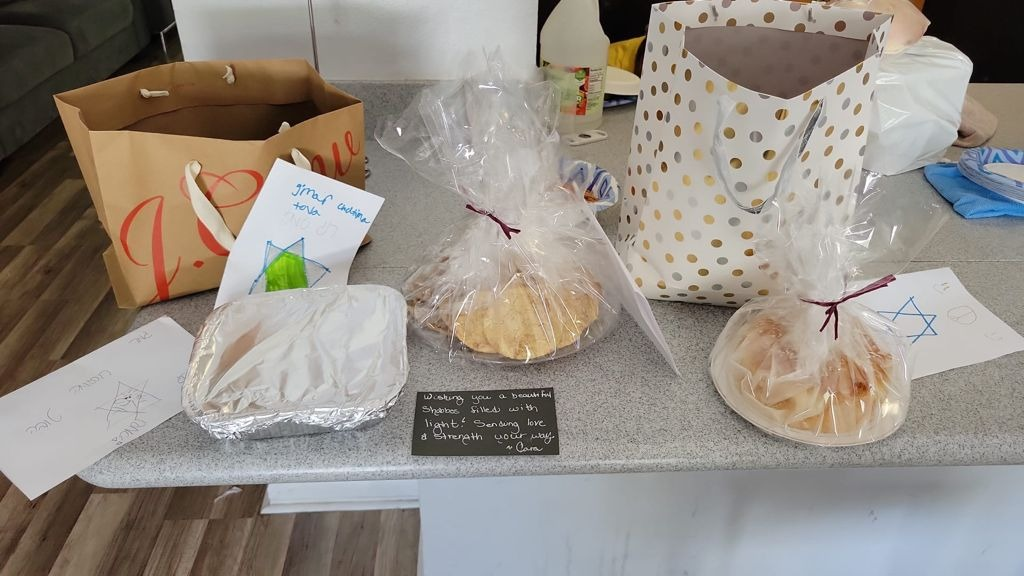
After losing their son Jonathan to the illness of addiction, the Wijnperele family generously dedicated a program called Adopt, a collaborative project of Boca Raton Synagogue and Onward Living.  Over the last few months, we have paired up several families in our community with men from the Onward recovery center.  They enjoy comfortable Shabbos meals, fun BBQ’s and simply getting together to schmooze. This component of recovery is critical.  Many people in recovery weren’t privileged to see or experience healthy and functional family and communal dynamics.   Being invited to and forging relationships with BRS families who have no motive or agenda other than to share a genuine and non-judgmental relationship, is not only refreshing but a critical example and experience.   


More recently, we have expanded our Adopt partnership. Our BRS chesed coordinator, Simone Broide, has arranged for members of our community to regularly cook and deliver meals to men in Onward Living.  Unlike the pairing component, in dropping off meals, anonymity is maintained.  Those cooking and baking don’t know who is receiving their Shabbos gift package.  And those who receive the loving delivery don’t know from whom it came. 


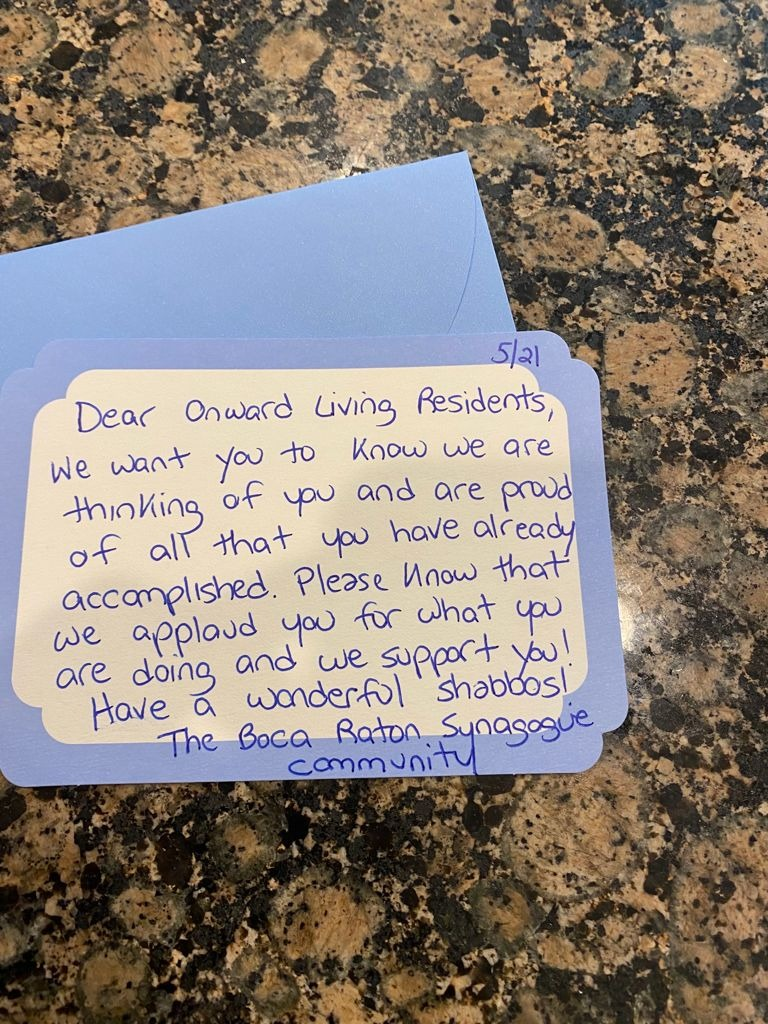
Messages are attached such as, “Dear Onward Living Residents – We want you to know we are thinking of you and are proud of all that you have already accomplished.  Please know that we applaud you for what you are doing and we support you!  Have a wonderful Shabbos.”


The recipients have shared how much it means to them and the difference it makes in their recovery and in their life.   One said, “It’s nice know that people actually care” and another commented, “The home baked goods means someone took the time to think of us and that is very special.”


For the people cooking, it is an extra challah, a cake or a babka, but for the recipient, it is a lifeline, a declaration that they aren’t invisible, that they matter, that there are people who care.  The Shabbos food doesn’t just fill their stomachs, it helps plug a hole in their heart.  A minimal expense and a modest effort go an enormous way.


Hashem charges Avraham this week, v’heyei beracha, which can’t be a promise that he will be blessed because Avraham was already told va’avarechecha, I will bless you.  So what does it mean?  Rav Shamshon Raphael Hirsch explains that there are two types of people – those that live life looking to receive blessings and those that lead their lives trying to be the blessing. To be progeny of Avraham is to take whatever blessing we have and to use it to become a blessing in other people’s lives.  We don’t live with a sense of entitlement to be blessed, we instead live with a sense of obligation to be a blessing.  


We are looking to expand our anonymous Shabbos box program to deliver to Jewish residents of others recovery centers in our area and hope we can count on your help.  Contact simonebroide@yahoo.com to get involved. And you don’t have to live in Boca to be a blessing.  Anyone reading this knows people who feel invisible, lonely, question if they matter or if anyone cares.  What for us is a challah or flowers or sometimes even a phone call or heartfelt email for them is a life preserver. 


Every day we recite the beracha of Magen Avraham, acknowledging that Hashem has preserved the character of Avraham within us.  Don’t wait to receive your next blessing, go out and be that blessing for others.  Nothing will make you feel more blessed. 

100 Billion Messages a Day

Most of us have become accustomed to using WhatsApp to communicate and in some cases manage our family, social, and professional lives.  Indeed, WhatsApp is used to send more than 100 billion messages a day (although most of those are just in the group my wife and I have with our children).  To give you a sense of how dependent we are on WhatsApp for working for and with the BRS community, for example, Rabbi Moskowitz and I are currently in 206 groups together including our BRS staff group, groups for organizing shiva minyanim and chesed, sharing Torah, and much more.


A year and a half ago, a virus forced us to socially distance, quarantine, and lockdown physically. This past week, a bug in technology, at least temporarily, put a wedge between us and kept us apart from one another for several hours. Both were terribly unpleasant, uncomfortable, and even painful.  But they also both presented opportunities to reflect, reset and recalibrate, the former on our connection with people and the latter on the role and dependance on technology in our lives.


While our generation is struggling to navigate the unprecedented proliferation technological breakthrough, we are not the first to confront what progress should mean, how it should impact how we spend time, and what our ultimate goals should be. 


The central story of our Parsha is the “hard reset” that God performed on the world, undoing all that He had created and restarting the world anew.  Hashem took such a drastic measure because, the Torah tells us, the world had become filled with corruption and moral depravity. 


The Gemara (Sanhedrin 108a) makes a mysterious comment – “the generation of the flood became corrupt as a result of the great blessing that God had bestowed upon them.” Which blessings are the rabbis referring to and how did they corrupt humanity?


The great Rav Avraham Pam zt”l suggests that the key to understanding this Gemara and what happened to Noach’s generation can be found in his very name.  The Torah tells us that Lemech named his son Noach saying, “This one will bring us rest from our work and from the toil of our hands from the ground which Hashem had cursed.”  Rashi explains that until that time, the world had continued to suffer from the curse that God gave Adam, “b’zeias apecha tochal lechem, you will have to work with the sweat of your brow to draw bread from the ground.”  Until Noach was born, man labored from morning to night and worked tirelessly with his bare hands just to have food to eat, leaving no recreational or down time. 


Lemech saw prophetically that Noach was destined to invent the plow and other agricultural tools that would make man much more efficient and would ease his burden.  Lemech therefore named him Noach from the root nuach, to rest, because his Noach would provide tremendous relief to an overworked population. 


Rav Pam explains, the inventions of the plow and other tools were the great blessing that rabbis referenced.  Yet, instead of becoming empowered, liberated, or enriched by these innovations, they became corrupt.  These inventions, these gifts from God increased productivity, improved efficiency, and yielded more free time.  This time could have been used constructively, productively, and meaningfully.  Instead, the generation used their newfound downtime for corrupt activity.  The breakthrough and advancement could have brought spiritual ascent, instead they brought moral decline.


We are blessed to live in the greatest era of technological breakthrough of all time.  Simple tasks that used to eat up our time can now be accomplished in seconds, or through automation or even speech recognition, in no time at all.  We long ago became accustomed to the washing machine, dishwasher, bread machine and microwave, but we now even take things like GPS navigation systems, or the ability to Facetime or WhatsApp video with multiple people in multiple destinations across the world, for granted.


Every single day, something is invented which is meant to make our lives more noach, easier.  They are designed to free up precious time.  The question is, do they? Do we fill that time meaningfully and mindfully or is that time squandered on mindless behavior?  Perhaps it is no coincidence that Facebook, Instagram, and WhatsApp were first wiped out and then flooded with messages in the week we read Noach as a reminder that a generation is defined by what it does with the blessing of progress it experiences and the free time it discovers.


The Mishna in Pirkei Avos (3:1) quotes Akavya ben M’halalel who teaches that a person should always keep in mind, “Before Whom he will have to give Din V’cheshbon, judgment and reckoning.”  What is the difference between din and cheshbon?


The Vilna Gaon explains that din refers to judgment for mistakes, indiscretions, and poor decisions we made.  Cheshbon is not about what we did wrong with our time, but what we could have done right during that time.   We will have to give din for mistakes we made but we will also be held accountable even for the cheshbon, the calculation of what we could have accomplished if we had only taken advantage of the time we claimed we don’t have.


Do we use the gift of greater time to binge watch, to pursue frivolous activities and to indulge in hedonistic experiences? Or, do we use the time we are gaining with each breakthrough for meaningful, productive, and constructive activities?  Are our greater comfort and expanded time leading to moral decay and decline or moral development and progress?


Technology can either enslave or liberate, free up time or eat up our time, move us forward, or take us backwards.  Moments like a worldwide outage can and should be opportunities to consider our own relationship with technology and time, and hopefully inspire us to bring us closer to a place of true, earned noach.

Stay on the Straight and Narrow, Don’t Cut Corners

The Torah begins with a description of creation. Of course, we learn of heaven and earth, sun, moon, stars and constellations, the animal kingdom, birds, fish, the earth, vegetation and of course the creation of a human being in the image of God.  But, if we look closer, there are other creations, other unprecedented phenomena that are introduced in Bereishis. 


For example, our parsha introduces us to the first incident of “sin,” of poor judgment in human history.  When Chava eats from the eitz ha’daas, the tree of knowledge, and encourages her husband Adom to join her, they create for the world the concept of “sin,” the precedent of disobedience, rebelliousness and insurrection. 


Soon after that concept is introduced, it gets repeated by Adom and Chava’s son Kayin, but this time with even greater consequences.  Kayin and Hevel each offer their own sacrifice to God.  Hashem accepts Hevel’s and rejects Kayin’s korban.  Kayin gets jealous which leads him to murder his own brother.


An amazing conversation then ensues between Kayin and the Almighty.  Va’yomer Hashem el Kayin ei Hevel achicha? God says – Kayin, any idea where your brother Hevel might be?  Kayin gets wise with God and says “lo yadati, ha’shomer achi anochi, I have no idea, am I my brother’s keeper?”  At this point, God gets angry.  “Meh asisa, kol dmei achicah tzoakim eily min ha’adamah, what did you do, your brother’s blood is calling to me from the earth.”


What is going on in this conversation?  Why was God toying with Kayin by asking rhetorically, do you know where Hevel is?  And did Kayin really think he would be exonerated with the defense of “Am I my brother’s keeper”?  And why doesn’t God just say, I know you killed Hevel and you will now be accountable?  Why does He phrase it as “what did you do, your brother’s blood is screaming to me?”


The Kli Yakar, Rav Shlomo Efraim Lunshitz, who lived in the early part of the 17th century in Prague, has a magnificent and novel interpretation.  Adom was the first to be disobedient and to defy God.  He was explicitly told to refrain from the tree of knowledge and he did so anyway.  Kayin, however, was the very first to do a different type of sin.  If you think about it, nobody, including Kayin, was ever told not to murder. 


Indeed, the Kli Yakar says, that is exactly what Kayin told God in his defense.  Of course Kayin understood what God was saying when He asked where is Hevel.  Kayin wasn’t pretending that he didn’t know where Hevel was, he was pleading innocence on the basis of ignorance:  I was never told that murder is wrong.  “Lo yadati – I did not know that I wasn’t allowed to kill him.  Ha’shomer achi anochi – when did you tell me that I have to protect my brother and that I am not allowed to end his life?” 


God responds to Kayin, your brother’s blood is screaming for me.  The Kli Yakar explains that God is telling Kayin there are some things you don’t need to be told. Yes, there are mitzvos that we would never know unless we were commanded.  But there are aspects of life and of ethical conduct that should be obvious to us and that we don’t need to be explicitly instructed.  Adom violated the first, Kayin introduced the latter. 


My friend and colleague Rabbi Kenny Schiowitz suggests that this is what the Talmud means when it sometimes says – lamah li kra, sevara hu, why do I need a pasuk to learn a law when I can arrive at it through my own logic.  A verse is superfluous and unnecessary if it can be intuited from nature.


The Gemara (Avoda Zara 25a) calls Bereishis “Sefer Ha’Yashar,” often translated as the book of the righteous.  But the truth is yashar means straight, upright, honest and mentschlich.  The Netziv in his introduction to Bereishis explains that it is the Avos who are called “Yashar” because they practiced kindness and compassion with the Almighty, with their family and with strangers.


But perhaps the lesson of Sefer HaYashar begins with the story of Kayin.  Ignorance may be bliss, but it is no defense for morally corrupt, unethical and inexcusable behavior. From the mistake of Adom and Chava we learn not to defy God and His commands.  From Kayin we learn that there are some things that are wrong even if we aren’t explicitly instructed against them. Finding a loophole, an out, or claiming technically this isn’t wrong, is not a legitimate way to live a Torah life. 


The Torah tells us (Devarim 6:17) “V’asisa hayashar v’hatov b’einei Hashem, Do what is right and good in the eyes of Hashem.”  What does this generic statement mean?  How do I fulfill this command? 


The Ramban explains:

This is a great concept, for it is impossible to mention in the Torah all of the modes of behavior for a person to follow with his neighbors and acquaintances, and all of the details of his business dealings and all the regulations for the betterment of society and of states.  However, after mentioning many of them such as don’t gossip, don’t take revenge…it goes on to say here in a general manner that one should do what is good and right in every situation.


In other words, the Ramban is telling us that as limitless as the Torah is, it is impossible to imagine and legislate for every single scenario man is destined to confront.  Therefore, in addition to the detailed laws, the Torah charges us to always ask ourselves a simple question: I may not know if there is a passuk about my situation, or a specific Halacha in Shulchan Aruch that tells me the direct answer, but is what I am about to do right and good?  Would God want me to do it?  Would I do it if I could see God standing next to me?


We spend a tremendous amount of time studying, analyzing, and focusing on the rules and laws.  We have too often neglected to teach and model the essence of a Torah way of life, which is to engage every decision in our lives by asking, is this what God wants me to do?  Am I bringing Him nachas, joy and pride?  Am I advancing His vision for society?  Does this pass the test of ha’yashar v’hatov, the right and the good?


The first lesson of the Torah is to be yashar, don’t be an operator.  Be straight and honest and do what is right, even when it doesn’t say explicitly anywhere that this is wrong.   The lack of a source in Shulchan Aruch identifying this as assur is not a good enough reason to say it is mutar.  One must always ask themselves, what is the yashar thing to do and do it.

Breaking Barriers in our Lives

Last year, Eliud Kipchoge of Kenya ran a marathon in 1:59:40, breaking the two-hour barrier  for the first time ever. To put it in perspective, he ran a mile in 4 minutes and 33 seconds — 26 times in a row. He ran at a pace of 13 miles per hour, for two hours in a row. When he finished, Mr. Kipchoge compared what he’d just accomplished to man walking on the moon.  How did he do it?


וּלְקַחְתֶּ֨ם לָכֶ֜ם בַּיּ֣וֹם הָרִאשׁ֗וֹן פְּרִ֨י עֵ֤ץ הָדָר֙ כַּפֹּ֣ת תְּמָרִ֔ים וַעֲנַ֥ף עֵץ־עָבֹ֖ת וְעַרְבֵי־נָ֑חַל וּשְׂמַחְתֶּ֗ם לִפְנֵ֛י ה׳ אֱלֹקֵיכֶ֖ם שִׁבְעַ֥ת יָמִֽים׃ 

On the first day you shall take the product of hadar trees…


The Midrash wonders, what do you mean bayom harishon, take a lulav and esrog on the “first” day? It isn’t the first day of Tishrei, it is the 15th?  So what is the Torah alluding to by describing the mitzvah as beginning on the first?


The Midrash offers a cryptic answer – ראשון לחשבון עוונות, it is in fact the first day, the first day to be accountable for the mistakes and bad decisions.  But how is that?  Yom Kippur was over five days ago.  There have been five days to go back to the way things were, to resume our poor behavior and bad habits.  How is Sukkos the day our misbehavior “begins”?


The Shemen HaTov explains that from Yom Kippur until Sukkos, who has time to sin? We are so busy running to pick our lulav and esrog, to build and decorate our sukkah, to cook for Yom Tov.  We remain on such a high from Neilah and we pour that energy and excitement into getting ready for the holiday.  


But then Sukkos comes and somewhat paradoxically, when we finally encounter those mitzvos we were so excited for in anticipation, we lose steam, run out of energy, and hit a wall.  Maybe we are excited for a brief moment entering the sukkah but then it is hot, uncomfortable, and inconvenient. There was such joy and fun in inspecting our arba minim but it wasn’t much fun having to carry them to shul and balance them with our siddur while walking in a circle for Hoshanos.  


So Sukkos comes, the work is done, the high is over, and now we have an opportunity to sit with family and friends, we have long Yom Tov days.  How will we spend them?  Will we become the people we caught a glimpse of in Elul and over the Yamim Noraim, will we fulfill the pledges and promises we made ourselves about who we could become and the lives we could live?  Will we be the best versions of ourselves and continue the growth spurt of coming more on time, talking less in shul, singing more, being better to others and to ourselves?  Or, will we simply be relieved that the marathon of the High Holidays is over, pat ourselves on the back, take pride in getting through it and go back to exactly who we were, the habits, patterns and behavior, back to the unlived life, underachieving who we could become?  


Rishon l’cheshbon avonos – Sukkos is the time we truly take an accounting about the year we are going to have.  Was it all lip service, pipe dreams, and empty aspirations? Or are we implementing and executing on what we promised ourselves, promised those around us, and most of all, promised the One above? 


The true test of a person is not if he or she is satisfied with what they have accomplished, but whether or not they continue to push forward, to set goals, to implement resolutions.  


Here is the amazing thing about Eliud Kipchoge.  He already held the record for the fastest marathon. Two years ago, he finished the Berlin Marathon at 2:01:39. So what made him push himself harder?  Before the marathon in which he broke his own record, he said, “I don’t know where the limits are, but I would like to go there.”  He wasn’t satisfied with what he had already done, he was focused on what was yet ahead.  


You likely recall, just a few days ago, on Kol Nidrei night when we got up to Shema we all proclaimed Baruch sheim kevod malchuso l’olam va’ed out loud.  Why? As we know, it is because we were on the level of angels.  Yet, moments after Neilah, just after screaming Hashem hu ha’Elokim, we said Shema in Maariv and we went right back to whispering baruch sheim.  I ask you – when are we more like angels, at Kol Nidrei when our bellies and bladders are full, when we roll into Shul at the very beginning of the Holiest day, or Motzei Yom Kippur when we have just spent 25 hours free of physical needs and pleasures, unencumbered by the trappings of this world, having spent most of the day in deep prayer and song?  Shouldn’t we say Baruch sheim out loud just after Yom Kippur instead of at its very beginning?


Rav Avigdor Neventzal explains so beautifully that being an angel is not about celebrating what you have just done, what you finished.   Rather, being angelic means making a pledge and promise for what we are about to do, starting out on a noble and holy journey.  True, on Motzei Yom Kippur we have completed something extraordinary, but it is over, we have finished.  Kol Nidrei night, we are just getting started, we are at the very beginning, but we are about to execute and implement a commitment, and that is when we are on the level to say baruch sheim out loud.  


Sukkos is not a celebration of what we have accomplished, it is not the relief that the Yamim Noraim are over.  The joy of Sukkos comes from what we are about to achieve.  It is a focused opportunity to implement all that we had promised, to follow up on everything we committed to do.  It is the beginning, not the end.  It is prospective, not retrospective.  When we sit in our sukkah and host others, when we have meaningful conversations, spend quality time, when we continue to implement the promises and resolutions we made just a few days ago, we feel the greatest simcha, the highest joy.  


The happiness of Sukkos, the v’samachta b’chagecha is not from the relief of being finished, of having persevered or survived, but rather it is the satisfaction of pushing ourselves further, of knowing we aren’t done, of believing that our best—our best at being a spouse, our best parenting, our best learning, our best davening, our best volunteering, our best in our profession—it is yet to come.  


One of the most amazing parts of the story of Eliud Kipchoge breaking the record was the description of what happened towards the end of the marathon.  When it got particularly tough, when he had to push himself to beat his own record, he started to smile.  The greatest simcha comes not from reflecting on what we have already done, but from the authentic satisfaction of pushing ourselves to fulfill what we have pledged to yet do.  


On Hoshana Rabba we will resume the Yamim Noraim nusach, the chazzan will wear a kittel.  While Neilah may have felt like the finish line, it was only the halfway mark. The verdict on our aspirations and efforts comes not from how we behaved when standing in shul all day davening, but from who we are and how we use our time over the week of Sukkos.  Are the changes we made permanent or were they just a fleeting fad?  The minimum measure of a sukkah is big enough to hold rosho v’rubo, your head and most of your body.  The Sefas Emes explains homiletically, we have to get our rosho b’rubo in the Sukkah, we have to get our head into what we are doing, to be present, to fully experience this Yom Tov.


Like Kipchoge, we don’t know where our limits are, how much Torah can we learn, how must kindness can we show, how much better can we be.  But like Kipchoge, let’s be driven to go there and find out.  We may just find ourselves smiling during the toughest parts.  

Rabbi Efrem Goldberg

Join Our Community

Subscribe to our newsletter or connect with us on WhatsApp.