“My Son Needs Therapy. My Husband Says No”

In the May 31, 2022 issue, Mishpacha Magazine posed the following question and invited me and others to respond:


Question:

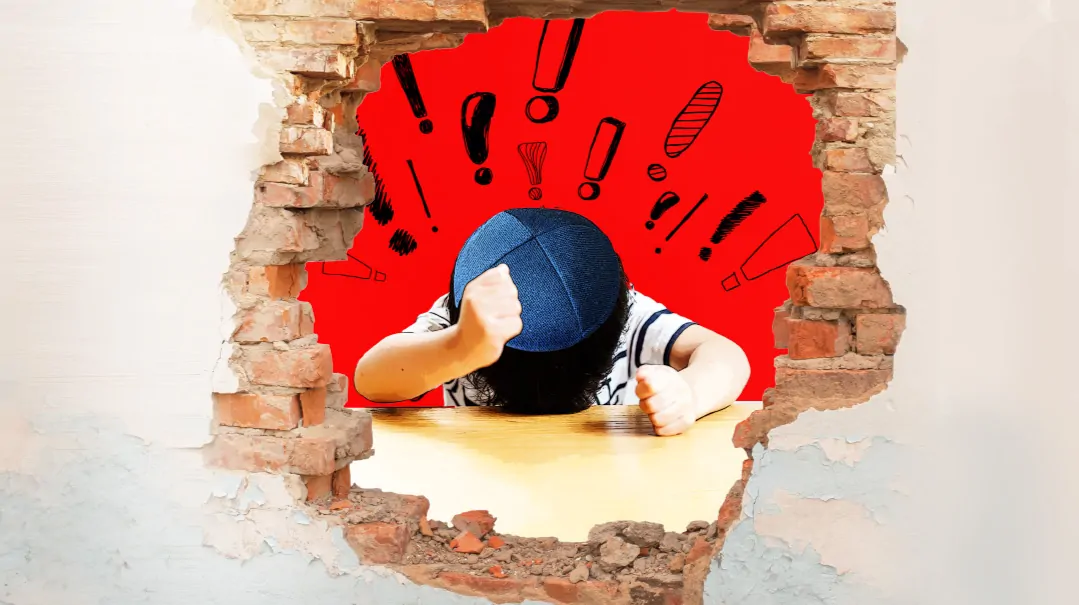
My oldest son is a smart and energetic eight-year-old. He does well in school, and his rebbi says the boys in the class like him. But at home he acts very differently. He has a hair-trigger temper, often having meltdowns when things don’t go his way, and lashing out at me or his younger siblings. The intensity of his tantrums frighten me.

I want to send him to therapy to help him learn healthier ways to respond when frustrated and to discover if there’s anything more worrisome at the root of all this anger.


But my husband is completely unfazed by our son’s behavior. He tells me that many boys get angry easily, and he’s adamant that his son does not need therapy. When I point out examples of my son’s inappropriate reactions, he just shrugs and tells me he’ll grow out of it.


I’m worried that without help, this will spiral into even more dysfunctional behavior as he gets older.


Do I force the issue and have it become a conflict between my husband and me, or should I just hope his behavior will change as he gets older?


My Answer:

Rav Yaakov Kamenetsky once ran into a talmid and inquired about how he was doing. The young man gave a krechtz, explaining that his child had kept him up several nights in a row. “Tzaar gidul banim,” he sighed. The great gadol turned to his talmid and said, “That isn’t tzaar gidul banim, the pain of child rearing, it is just gidul banim, child rearing.”


The essential question, the point of debate between the two of you is: When do behaviors, thought patterns, or phobias rise to the level of a clinical diagnoses, and when are they normative and regular? When do they need intervention and treatment, and when do we assume the person exhibiting them will grow out of them? When are they gidul banim, and when are they tzaar gidul banim?


The line between outlier behavior that should be cause for concern and more standard behavior, where there’s nothing to be particularly worried about, is often very fine and difficult to see. But here’s the thing that I believe you must try to communicate to your husband: If you observed your child frequently losing his balance or experiencing dizziness, would you dismiss it as a growing pain, something he will grow out of? Or would you — at minimum — seek the opinion of a physician, asking a qualified and trained person to make that judgment?

What is true for physical imbalance or spatial dizziness is equally true for mental imbalance and emotional dizziness. Though shalom bayis is a core value and you correctly should be committed to harmony with your husband, when it comes to your child’s physical, mental, and emotional health, there must be no shame, no stigma, and no hesitation in impressing upon him the importance of asking an expert and deferring to the guidance you receive.


The Torah tells us (Shemos 21:19) “verapo yerapei — and shall cause him to be healed,” from which the Gemara (Berachos 60a) learns, “mi’kan she’nitein reshus l’rofei l’rapos — from here we learn that permission is granted to a doctor to heal.” In other words, the practice of medicine, seeking out the treatment of a doctor, is consistent with the will of Hashem. Why would we think it isn’t? Rashi (Bava Kama 85b) explains, “I might have thought that if someone is ill, physically or mentally, that is what Hashem wants, and we are obligated to accept it. So the Torah tells us no, Hashem has given doctors license and responsibility to heal.”


The Shulchan Aruch (Yoreh Dei’ah 336:1), goes even further and writes, “The Torah has given permission to the doctor to heal. It is a mitzvah to do so and part of pikuach nefesh. If a doctor refuses to do so, he is guilty of bloodshed.” Many poskim, including the Tzitz Eliezer (12:18:8) and Rav Asher Weiss (Minchas Asher 2:134), apply the halachic principles and rules of physical health to mental health.


So, in the case of your question — are these ordinary tantrums, incidents of adolescent impetuousness, or is there clinical anger and rage? — a competent doctor must make that determination. Even if it is awkward or outside your comfort zone, for your son’s well-being, you should get to the bottom of the behavior.


How should you convince your husband? You should communicate in a non-adversarial way, engaging and positioning your husband as your partner, on the same side and part of one team, equally devoted to your son’s wellbeing. You should implore him to help. Follow your maternal instinct on this issue; though your husband may be right that this is something your son will grow out of, it is fair and reasonable for you to want a professional to endorse that. After all, if he’s right, there is no harm in having an expert say there is nothing more to do. But if he is wrong, your son will pay a price by his indifference and passiveness. You should calmly communicate that you’re asking him to partner and respect you on this, not only for the sake of your son, but also for the sake of you shalom bayis, to preserve the harmony that is good for you, your son, and the whole family.

If or when he goes along, your husband must not let your son know he’s doing so begrudgingly or under protest. The ben sorer u’moreh, the rebellious child, is described by the Torah as einenu sho’meiah b’kol aviv u’v’kol imo, he doesn’t listen to the voice of his father and the voice of his mother. Why doesn’t the Torah simply say he doesn’t listen to the voice of his father and mother? Why does it repeat the word “voice” for each? Commentators explain that part of what contributes to a rebellious child is inconsistent messaging from his parents. When a child hears different voices from his father and mother, when he perceives daylight between them, he is often lost, confused, and becomes rebellious.


Confronting potential challenges with our children can push us apart or make us grow closer together. The choice of having parenting problems or compounding them with marital strife is up to us. If we are committed to speak with one voice, to respect each other’s opinions but defer to outside guidance when we don’t agree, we can not only do what is best for our children but develop a better marriage in the process.




Lag B’Omer & Gratitude

Years ago, someone gave me a Tony Robbins cd to listen to. I was excited to hear what one of the most inspirational people of modern times would have to say and how it could change my life for the better. He started his talk by saying that he has the secret to both happiness and success. If you follow his advice and begin each and every day of your life exactly as he prescribes, he can all but guarantee you will find yourself both happier, and achieving your goals and dreams.


I was very eager to hear what his secret is.


What Tony Robbins said is correct, but for me, and for you, and for Jewish 3-year-olds around the world, it was nothing new. The secret to happiness and to achieving success, he said, is to start every day of your life by expressing gratitude. As soon as you wake up, before doing anything else, say thank you. Be grateful and appreciative for being alive, having a roof over your head, having your health if you are lucky, your family, etc.


He continued that it isn’t enough to think appreciatively, but you need to start your day by verbalizing and actually saying thank you out loud. If you wake up with an attitude of gratitude, the rest of your day is guaranteed to be successful and happy.


What Tony Robbins is teaching in the 21st century, Judaism has taught since its inception thousands of years ago. From an early age, we teach our children to wake up saying Modeh ani lefanecha, I am grateful to you God for the fact that I woke up, that I am alive to see another day, for the wonderful blessings in my life and for my relationship with You. It has been inculcated within us from our youth that we don’t wake up feeling entitled, deserving and demanding. Rather, we wake up with a deep and profound sense of gratitude, appreciation and thanks.


In my experience, Tony Robbins is right. How we start our day has an incredible impact on how the rest of it will go. This week we will celebrate Lag B’Omer, the 33rd day of the Omer. Each day of the Omer is characterized by another kabbalistic attribute. Lag B’Omer is Hod sh’b’hod, the glory of glory, reflecting our appreciation of God’s greatness and glory. The Hebrew word hod can be understood as coming from the same word as hodu, or modeh, meaning thanks. Lag B’Omer is a day characterized as “thankfulness within thankfulness,” or a day to celebrate gratitude.


Lag B’Omer is a day characterized as “thankfulness within thankfulness,” or a day to celebrate gratitude.


The Chassam Sofer, Rav Moshe Sofer says that the miraculous manna that fell from Heaven began to descend on Lag B’Omer. On the first day, the manna was undoubtedly greeted with great enthusiasm and appreciation, but as time went on and there was an increasing expectation the heavenly bread would descend, it became much easier to take it for granted and to forget to be appreciative for it at all. Therefore Lag B’Omer is a time that we identify and say thank you for all of the blessings that regularly descend into our lives, but unfortunately, like the manna, that we take for granted.


It is so easy to fall into a sense of entitlement and to forget to be grateful. Why should I thank my children’s teachers? They’re just doing their job. Why should I be so appreciative to the waiter, or the custodian, or the stewardess? Isn’t that what they are supposed to do? When was the last time we said thank you to whomever cleans our dirty laundry? Do we express gratitude regularly to our spouse who shops, cooks dinner, or who worked all day to pay for dinner, or in some cases did both?


As we celebrate Lag B’Omer, let’s not just say modeh ani in the morning and then quickly transition to feelings of entitlement. Let’s remember to say thank you to the people who do extraordinary things in our lives. But even more importantly, let’s especially express gratitude to the people who do the ordinary things that make our lives so filled with blessing.


Smile, Everyone is Watching

Earlier this week, four Israelis were killed, and several others were injured, in a terrorist stabbing attack at a shopping center and gas station in Be’er Sheva.  Beautiful, innocent souls, guilty only of being Jewish and living in the one and only Jewish homeland, were murdered in cold blood, reminding us yet again how our brothers and sisters in Israel live daily with threats and dangers.


One would think a country whose citizens face terror regularly and are surrounded by hostile enemies who seek their extermination would be paralyzed by fear and would be debilitated by distress.  Instead, despite the daily dangers, Israelis are remarkably happy.


According to this year’s World Happiness Report that was just released, Israel has climbed to its highest ranking yet, breaking into the top 10 happiest countries in the world.  Finland came in first for the fifth year in a row, while Afghanistan placed last at No. 146.  At No. 9, Israelis are happier than Canadians (No. 15), Americans (No. 16) and the people of the United Kingdom (No. 17).


When the Founding Fathers included the “pursuit of happiness” as an American right and entitlement, it is almost as if there was an inherent concession that happiness can be pursued, but it is hard to ever attain.  For many, that pursuit has grown tiring and indeed, they have given up.  In 2006, Harvard psychologist Daniel Gilbert wrote a book called “Stumbling on Happiness.”  In it, he argues that the things and experiences we typically predict and imagine will bring us happiness, rarely do.  Rather, he says, happiness is elusive, and while there are efforts we can make, our best bet is to hope to stumble upon it. 


Judaism doesn’t agree.  Happiness, simcha, is not something that we stumble or trip upon by accident.  It is the result of a conscious decision, a determined attitude.  In his Mesillas Yesharim, the Ramchal writes that simcha is ikkar avodah, being happy and joyful is not a luxury or simply preferable, they are critical components of a meaningful life of serving Hashem. 


We tend to think that when we are happy we smile, but it turns out to be the opposite.  Science has shown that the mere act of smiling, engaging the micro muscles involved, can lift your mood, lower stress, boost your immune system, and even prolong your life.  When you smile, your brain releases neuropeptides to help fight stress. Dopamine, serotonin, and endorphins are released that relieve pain and bring pleasure. 


As a result, choosing to smile is choosing happiness, not only for you but for the people around you.  Nicholas Christakis, a professor at Harvard Medical School, found that misery is not alone in liking company; happiness is also contagious.  Knowing someone who is happy makes you 15.3% more likely to be happy yourself. A happy friend of a friend increases your odds of happiness by 9.8%, and even your neighbor’s sister’s friend can give you a 5.6% boost.


In Pirkei Avos (1:15) Shammai teaches: שַׁמַּאי אוֹמֵר…וֶהֱוֵי מְקַבֵּל אֶת כָּל הָאָדָם בְּסֵבֶר פָּנִים יָפוֹת.  Shammai used to say, receive all people with a pleasant countenance. Rav Ovadia Bartenura provides a powerful interpretation: “When you bring in guests to your home, do not give to them while ‘your face is buried in the ground;’ as anyone who gives and ‘his face is buried in the ground’ – even if he gave all of the gifts in the world – it is counted for him as if he did not give anything.”  If you give someone, even generously, but you don’t smile, it is as if you gave nothing.  The smile is more valuable than the resource you shared. 


Simcha, happiness, occurs when we make the decision to focus on the blessings in our lives, no matter how challenging or formidable the struggles we face simultaneously.  If our happiness results from the blessings we already have, we can always find happiness, because we always have at least something.  But if our happiness is determined by what we don’t have—“If only I had more money, a nicer house, a better job, a more loving spouse, more loyal children”—we will never be happy because we can always have more and therefore by definition there will always be something we don’t have.  


In a recent Living with Emunah shiur, I challenged everyone, men and women, adults and children, to make the conscious effort to smile more, even—or especially—when we don’t feel like it.  Smile before walking into the house.  Smile when the children come into the car at carpool.  Smile when greeting your family at the end of the day.  Be intentional, create the habit and routine of smiling in the moments that will create the mood and introduce the energy. 


After the shiur, I received several emails about how smiles changed people’s lives:


Since the end of the Emunah class today was about smiling, thought I’d share this with you. I was at a Shabbat meal when I was single and wasn’t in the best mood. I guess dating was getting to me. A bunch of single guys were there at that meal and the lady of the home told my Rebbetzin that I need to smile more, especially if I’m looking for a shidduch. So on Simchas Torah weekend as I walked out of shul I started to smile going down the stairs with hundreds of singles around, and my future husband saw me smiling. He came over to me because I was smiling. 


Another person wrote:


Your story in the Emunah shiur brought me joy (and a smile). Twenty-plus years ago as a young, single college graduate, I went for a Beracha from the Kaliver rebbe. After four hours, I was called in. The rebbe said to be happy. I said rebbe, I am happy. He said be happy. I was like wow. If this is all that rebbe said to me it must be a very deep Torah concept. I am generally a very happy, positive person. Optimistic, smiley… but those words stuck with me and I turned my relationships, especially with Hashem, to focus on happiness. I smiled much more. Then Hakadosh Baruch Hu sent me my zivug. I was on the women’s side at a kiddush in shul and my now husband saw me smiling and asked a friend to find out who I was and set us up. The power of a smile and emunah…we were married that Adar! Now a gazillion sleepless nights later, several children, thousands of rides to school, mishmar, sports, etc, I do it with a smile. Each carpool. A smile is the first thing people notice externally.


Don’t stumble on happiness, choose it by smiling more. 

Taking Stock of TikTok Torah

“Raunchy TikTok Talmud Tidbits Spark… Heated Discourse”


This recent headline caught my attention (as it was designed to) and intensified a question that has been weighing on me:


The internet in general, and social media in particular, has catapulted Torah learning options in our time in ways we could never have envisioned.  It is hard to imagine how we could have navigated Covid lockdowns without the benefit of technology to access Torah.  Countless websites, apps, and platforms like Zoom enable us to learn individually or come together as a community and tap into Torah anytime, 24/6, in countless languages, on innumerable topics, and with opportunities geared towards every level. 


I personally am a great believer in and beneficiary of using technology to teach and promote Torah.  Long before Covid, I took advantage of social media to share articles, links to shiurim, and (hopefully) inspirational thoughts and ideas.  When the pandemic struck, like many others we pivoted online. Streaming classes on YouTube continues to facilitate people to join from anywhere in the world to watch live or at any later time that is good for them. 


And yet, with all the positive, there is a much more concerning side to technology and Torah, an unintended consequence of the ability to connect and share so easily, spontaneously, and often anonymously.  Social media has certainly driven a culture of sharing and conversing meaningfully on Torah topics. But it has also generated a culture of people competing for cute, witty memes, gifs, and jokes, often invoking Torah themes and ideas. While many of these are creative and by and large harmless, they do not always reflect the sense of awe and reverence our Torah deserves.  I have watched and wondered if people are being enriched and inspired, if the Torah itself been elevated as a result of this proliferation, or is our Torah being used as just another vehicle to entertain and to compete for attention and popularity.


While I think there is a healthy debate to be had about “Frum Twitter” and more generally some of the unintended consequences of communicating Torah in casual ways on casual platforms, I would hope all would agree that the TikTok posts referenced in the headline at the top of this article are not only beyond the pale, but they are downright offensive. 


A self-proclaimed atheist has taken to studying Daf Yomi and producing short videos of her “Daf Reactions.”  These reflections are designed to be provocative.  The poster doesn’t hesitate to use profanity when crudely referring to our greatest sages, the ambassadors, and transmitters of our sacred Torah She’b’al Peh.  Make no mistake, just because her posts are popular or her intentions may be sincere doesn’t mean they are appropriate; just because they have gone viral doesn’t mean they add value.


It is tempting to be excited or even proud that the Talmud and Daf Yomi are cool, they are popular, and that an unlikely source has found a way to promote and share it in a way that speaks to the younger generations.  Several in the Orthodox community have jumped on the bandwagon of praise and excitement.  But I think that is a terrible mistake.  When someone doesn’t just express doubt but openly rejects the existence of Hashem, uses profanity and vulgarity to talk about His holy gift to the Jewish people, it is not something positive, it is the definition of a desecration.  It is an appropriation of the very text and truths that she rejects. 


How could one simultaneously claim to love Hashem and somehow be excited by, promote, or celebrate Torah learning propagated by someone who denies He exists?  To be clear, I write this not to attack the particular person but to challenge our Jewish social media culture that is the platform for such a phenomenon and the ease with which one can mindlessly and thoughtlessly get swept up in celebrating the very content that we should be finding deeply offensive and disturbing. (Though this should go without saying, I would be equally and unequivocally critical of a man using profanity when talking Torah or who rejects Hashem but claims to be sharing His Torah.) Put another way, my concern is less about the poster and her “Reactions,” but the overwhelmingly positive and supportive reaction to her “Reactions.”


The Torah is described as being given with trembling and fear. The Gemara (Berachos 22a) teaches: “It is written ‘You shall make them known to your children and children’s children,’ and following that it is written: ‘The day that you stood before the Lord your God at Chorev.’ Just as at Chorev there was dread and awe, trembling and fear, so too here, with respect to the study of Torah, it must be done with dread and awe, trembling and fear.”


Commenting on these words, Rav Soloveitchik (Chumash Mesoras Harav) writes:


Why should Torah study call for fear and dread? Isn’t Torah to be learned to gain insight and understanding? Isn’t the ultimate goal of Torah study to assimilate the Torah’s worldview into one’s personality? Why the need for awe, for trembling?


These emotions are appropriate because the study of Torah is a reenactment of the giving of the Torah, and the teacher is but a mouthpiece for the Giver.  For this reason, both Torah and prayer are Avodah Shebalev. Both involve standing before God. Prayer—because man’s need-awareness is so acute that he cannot keep himself from addressing the King of Kings in prayer. Torah study—because God alone is our Teacher, the melamed Torah le’amo Yisrael.


The study of Torah constitutes continuous revelation. The purpose of reading the Torah aloud in the synagogue is not solely to teach the congregation, but also to arrange an en­counter with God, as experienced by our ancestors at Mount Si­nai. Every act of reading from the Torah is a new giving of the Torah, a revival of the wondrous stand at the foot of the flaming mountain. The reading of the Torah is a “staging” of the giving of the Torah and a renewal of the awesome, sublime experience. The revelational experience is reenacted whenever the Torah scroll is removed…


Torah is not simply an academic pursuit.  It cannot be divorced from belief in Hashem.  It is intrinsically connected with the experience of revelation, it is meant to inspire a sense of contact with the Divine.  Prayer is us speaking to Hashem; learning Torah is Hashem speaking to us.  Sharing Torah while denying the existence of the author and authority of Torah is profaning and desecrating our sacred Torah. 


Consider, in contrast, a ruling of the Rama (o.c. 48:1), Rav Moshe Isserlis, who teaches us the proper posture when learning Torah.  He writes that to recall that the giving of the Torah was with people trembling, the custom is to shukel or sway when studying Torah.  We are meant to bring the highest level of reverence and respect to the study of Torah, to invoke and emulate the awe and trembling from when it was first given.  We must be mindful and demonstrate that learning or sharing Torah is not a casual exercise or experience. 


Once, Rav Elyashiv zt”l had not yet reviewed shanayim mikrah v’echad targum, he hadn’t completed his study of the parsha.  When his grandson asked him what he was waiting for, he replied, “how could one review the parsha without wearing his jacket?”  The grandson brought Rav Elyashiv his formal garment and only then did he return to reviewing the parsha.


I am not saying that we have to dress formally when studying or posting Torah, nor am I opposing the brilliant efforts of many people around the globe who make Torah approachable, relatable, and come alive for audiences who need an extra push or who are not instinctively drawn to it. On the contrary, modern technology, including graphics, videos, and all manner of multimedia, has added incalculable amounts of learning and value to the Torah world. But it is critical that no matter the forum or medium, we must at all times have respect, dignity and pride.


By design, it is hard to take a moment of reflection before posting, liking or following on social media. But I encourage anyone engaging with Torah on technology to really consider as they scroll: is this content kosher and its messaging meaningful and inspiring, or is this just entertaining and amusing?  Am I contributing to kavod HaTorah, elevating the respect and veneration of Torah, or God forbid dumbing it down? Am I posting to connect people to Torah, or promote myself? Am I contributing to making Torah a gimmick or shtick, or am I demonstrating the proper reverence for our most sacred authority?

Five Compliments for Every One Criticism

Many years ago, I took my children to the Museum of Natural History in Manhattan. A guide took us around and was patiently describing the history of the world, showing us fossils with great enthusiasm, and talking in detail about prehistoric times. About 15 minutes into the tour, one of my daughters, four years old at the time, raised her hand and asked if she could ask a question. With a gleam in her eye and a big smile on her face, eager to interact with a young child taking an interest in her life’s work, she said, absolutely, ask me anything. I, too, was very curious what fascinated my little girl so much and what question she would ask. I will never forget, my daughter looked up and said, “Um, I love your earrings, where did you get them from?”  I wanted to hide behind the tyrannosaurus rex, but while it wasn’t exactly the question she was looking for, the guide couldn’t help but smile from the compliment.


March 1 is international compliment day. First initiated in the Netherlands in 2001, this holiday has gained in popularity and spread across the world, with people making a concerted effort to offer others compliments specifically on that day. The founder of international compliment day explained why he started it: “Nothing stimulates more, gives more energy, makes people happier and, as far as business is concerned, increases productivity and commitment faster than sincere appreciation. So why not use it a little bit more?”


Our Parsha describes how the Kohen Gadol wore a robe that had bells and woven pomegranates along its hem. In 2011, archaeologists in the City of David found one of the little golden bells from the end of the Second Temple period. 


Chazal tell us that the bells atoned for lashon hara, the misuse and abuse of the power of speech. Indeed, there were seventy-two of these bells in total, not coincidentally the same number of possible shades of white that could make someone a metzora, the result of speaking gossip.


If you were trying to bring awareness to the importance of not misusing speech and inspiring people not to gossip and speak lashon hara, wouldn’t it be more fitting to institute a moment of silence in the Beis HaMikdash each day, rather than design a garment filled with bells that make noise?


Perhaps we can answer based on an insight from the Shemen HaTov, Rav Bernard Weinberger. Later in Parshas Metzora, the Torah says that the process of purification for one who suffered tzara’as as a result of speaking gossip is to offer two birds. If the offering is an atonement for abusing speech, why not simply bring one bird for the one violation? The Zohar explains that there are two because one bird corresponds with bad speech and one with good speech. What does that mean?


The Shemen HaTov explains that sometimes we have the opportunity to offer positive reinforcement, to give a compliment or say something nice, and yet we remain silent. You might think – what have you done wrong by staying silent? You didn’t say anything negative, you didn’t put down or criticize. The Torah is teaching this important lesson. The lack of positive reinforcement, the failure to offer a compliment or say something nice, can be just as demoralizing as negative speech, or sometimes even worse. One bird atones for saying the wrong thing, and the other sacrifice, equally important, atones for remaining silent and failing to say the right thing.


The garment that atoned for speech specifically had bells because the answer to wrong speech is not to remain silent, rather it is to use the power of speech to positively impact people’s lives. Our compliments should ring like bells, our appreciation, recognition, admiration, and positive words should reverberate like chimes. Being positive should be the default and be effortless, not the opposite.


If we want to inspire our spouse, our children, co-workers, or friends, they will respond much more positively to positive words than to criticism and reproach. A Harvard Business Review article asked – Which is more effective in improving team performance: using positive feedback to let people know when they’re doing well, or offering constructive comments to help them when they’re off track? 


Obviously, as Torah Jews, we believe in both. We don’t engage in false flattery, and we do subscribe to the mitzvah of tochecha, sometimes giving rebuke or reproof. The question isn’t which, the real question is in what proportion?


The article quotes researchers who studied sixty leadership teams and measured them based on profitability, customer satisfaction, and 360-degree feedback ratings of the team members. They found the factor that made the greatest difference between the most and least successful teams was the ratio of positive comments (“I agree with that,” for instance, or “That’s a terrific idea,”) to negative comments (“I don’t agree with you,” “We shouldn’t even consider doing that”) that the participants expressed to one another.


The average ratio for the highest-performing teams was 5.6 (that is, nearly six positive comments for every negative one). The medium-performance teams averaged 1.9 (almost twice as many positive comments than negative ones.) But the average for the low-performing teams, at 0.36 to 1, was almost three negative comments for every positive one.


They concluded that the ideal ratio of positive feedback to negative, to have the most effective, motivated, and inspired teams is 5.6 to 1.


The Chasam Sofer suggests that Hashem understood the importance of offering positive words and compliments in getting the most out of the people around you.

Speak to those wise and talented artisans and tell them: “Asher meelaisiv ruach chochmah.” Tell them that they are people who are filled with a Godly wisdom. Give them that positive reinforcement… And if you do that and give them encouragement then, “Vasu es bigdei Aharon l’kadsho l’chahano li.” – Then they will be able to accomplish and create great things, the clothes of the Kohen Gadol.


Compliments matter. They motivate people to continue doing the right things they are doing and to grow more. They show appreciation and draw people closer. Dr. John Gottman has spent his career studying healthy marriages and has scientifically identified the behaviors that contribute to dysfunctional ones. He can spend a short time with a couple and predict with over 90% accuracy if they will still be married in 5 years from that point.


He found that the single biggest determinant to a happy and healthy marriage is the ratio of positive to negative comments the partners make to one another. And the optimal ratio is amazingly similar—five positive comments for every negative one. For those who ended up divorced, the ratio was 0.77 to 1—or something like three positive comments for every four negative ones.


What is true for leadership teams is true for marriage and is true in parenting. On a given day, we say stop procrastinating from doing your homework, pick up your shoes, stop fighting. But how often do we say, you were playing so nicely, thank you for doing that without being asked, good job carrying your plate to the sink, or I love the way you are so loyal to your friends. Constructive criticism, feedback, honest feelings are all important and necessary, but for healthy marriages and motivated children, they need to remain at a ratio of one time for every five compliments or positive things.


Finally, be sincere with your compliment, and don’t exaggerate or go overboard. Be specific: “I admire way they handled a situation, I am impressed by your patience or generosity, I appreciate the delicious meal or the wonderful way you interacted with the children.”  Be creative, look to compliment, offer a positive word and it will bring out the best in others and make you feel good about yourself.


We don’t have to wait for March 1 to make it compliment day. Before the end of the day, offer the people you love at least five compliments or positive words for any negative feedback you might give. If you need help, you can always ask where they got their earrings.


Oversharing

Despite what you may have been told as a child, sharing is not always caring.


We are living in a transparent generation where the trend is towards sharing in the extreme. Over coffee with friends, at the water cooler with co-workers, and increasingly on social media, people are revealing more and more about their personal lives, their innermost thoughts and feelings, and their most private experiences.


In theory, the movement towards greater sharing should yield better relationships, closer connections, and improved capacity for emotional intimacy. After all, being open with a person is a fundamental part of connecting with that person. And yet, more and more research confirms that in fact it is doing the opposite. An obsession with sharing and a proclivity for being revealing actually damages relationships, hurts self-esteem, increases anxiety, lowers self-control, and breeds narcissism.


In Judaism, the more valuable and treasured something is, the more private and protected we keep it. The more it is accessible, revealed, and exposed, the cheaper it becomes. Indeed, the Torah’s perspective is that genuine intimacy is achieved when something is private, exclusive, and inaccessible to others. This is true physically, emotionally, and spiritually. The less we practice privacy and modesty in each of these arenas, the greater the challenge we have achieving authentic intimacy in them.


A New York Times article on privacy and sharing on the Internet began, “Imagine a world suddenly devoid of doors. None in your home, on dressing rooms, on the entrance to the local pub or even on restroom stalls at concert halls. The controlling authorities say if you aren’t doing anything wrong, then you shouldn’t mind. Well, that’s essentially the state of affairs on the Internet. There is no privacy.”


The article continues by quoting research that confirms what the Torah has known all along: “The problem is that if you reveal everything about yourself or it’s discoverable with a Google search, you may be diminished in your capacity for intimacy. This goes back to social penetration theory, one of the most cited and experimentally validated explanations of human connection. Developed by Irwin Altman and Dalmas A. Taylor in the 1970s, the theory holds that relationships develop through gradual and mutual self-disclosure of increasingly private and sensitive personal information.


‘Building and maintaining an enduring, intimate relationship is a process of privacy regulation,’ said Dr. Altman, now an emeritus professor of psychology at the University of Utah. ‘It’s about opening and closing boundaries to maintain individual identity but also demonstrate unity with another, and if there are violations then the relationship is threatened.’”


Our parsha, Terumah, introduces us to the layout and floor plan of the Mishkan, the holy Tabernacle. The outer courtyard hosted the altar where sacrifices were offered. The Kodesh, or the holy section, housed the menorah and the shulchan. The last section was the Kodesh Ha’Kadashim, the Holy of Holies that housed the Aron and was only entered by the Kohen Gadol on Yom Kippur. Our sacred ark which held our sacred luchos and the original Torah scroll was in the most private and inaccessible part of the Mishkan.


Rabbi Soloveitchik suggested that we model our personal lives after the structure and layout of the Mishkan:


From the time I was young, I learned to restrain my feelings and not to demonstrate what was happening in my emotional world. My father would say that the holier and more intimate the feeling, the more it should be concealed. There is a hidden curtain that separates between one’s interior and the exterior: “and the dividing curtain shall separate for you between the Holy and the Holy of Holies.” What location is more sanctified than the inner sanctum of one’s emotional life?


In this world “devoid of doors” we need to be all the more mindful to keep our paroches, our curtain up, and protect the Holy of Holies of our lives. This is not to suggest that one should not share his or her emotions and feelings at all and keep them bottled up; obviously that is unhealthy and potentially dangerous. But the Holy of Holies was seen by a selective audience, only the Kohen Gadol.


Share your strong feelings, innermost thoughts and personal emotions with your spouse, or a family member you trust, or a close friend or confidant. But, not every thought or feeling needs to be made public. Not every personal experience or event merits sharing. Not every moment of frustration or point of pride with your job, with your children, or with your experience at a restaurant needs to be fodder for Facebook or with friends.


Failing to be judicious and thoughtful in what and how we share profanes our lives and makes achieving intimate relationships difficult. Preserving our paroches, maintaining the capacity for privacy and mystery, ultimately protects our Holy of Holies and elevates all the relationships in our lives.

Selfie World

Our local mall has a new store called Selfie World.  What do they sell?  They don’t sell merchandise or even a service.  They sell the opportunity for you to pose in front of one of their backdrops to take the best selfies in the world. You can’t make this up. An entire business, indeed a franchise, all designed to profit off the modern urge for selfies.

Our Parsha contains the decalogue, the holy aseres ha’dibros that command us to focus on a different self: אָֽנֹכִ֖י֙ ה׳ אֱלֹק֔יךָ אֲשֶׁ֧ר הוֹצֵאתִ֛יךָ מֵאֶ֥רֶץ מִצְרַ֖יִם מִבֵּ֣ית עֲבָדִ֑ים. “I, Hashem, am your God who brought you out of the land of Egypt, the house of bondage.”

Rav Sa’adya Gaon asserts that all six hundred and thirteen mitzvos are contained in these ten, and that these ten are all contained in the opening commandment, and the entire opening commandment is contained within the opening word – anochi, I. All of Halacha, all the mitzvos, the entire system of Torah is a platform to promote an awareness of, and connection with, Hashem. 

Our day is regulated by many mitzvos: we wake up and daven, we go to work and are expected to be honest, we are careful with what we eat, to make a beracha before we do, to avoid gossip, to learn Torah, volunteer, give tzedakah, and so on.  Our day is filled with countless Jewish activities.  But at their core, at the center of it all, is the Ribono Shel Olam waving at us and saying, Anochi – Hi!  Here I am! Notice Me, connect with Me, turn to Me, lean on Me, be appreciative to Me, be frustrated with Me, just recognize I am here. I not only know about your life, I am intimately involved and invested in you and in your life.   

Later, when Moshe delivers his final monologue to the people and recounts the seminal moments of the people’s short history until that point, of course he reviews the experience of Matan Torah.  But before he recounts the iconic words of the Ten Commandments, he reminds the people that he stood between them and Hashem and he was Hashem’s agent to deliver His Torah.

אָ֠נֹכִי עֹמֵ֨ד בֵּין־ה׳ וּבֵֽינֵיכֶם֙ “I stood between Hashem and you.  The Ba’al Shem Tov homiletically suggested that we read this pasuk, “anochi omeid,” do you know what stands between a person and Hashem?  “Anochi,” the person’s sense of self, their ego, their “I,” their insatiable appetite for literal and metaphorical selfies.

Someone once wrote the Lubavitcher Rebbe a letter that said the following: “I am in a state of sadness. I wake up each morning dreading the day ahead. I find that nothing lifts the clouds of gloom. I try various distractions, but nothing seems to work. I pray, but inspiration does not come. I need the rabbi’s help and advice.”

The Rebbe sent him a brilliant reply without using a single word. He simply circled the first word of each sentence of the letter and sent it back. The word was “I.”

The second of the ten commandments decrees that we must not have any other god.  The Gemara (Shabbos 105b) asks which alien, foreign god lives among you that you are instructed to avoid?  The Gemara answers, the yetzer ha’rah, the ego, the inflated and distorted sense of self, the urge and drive to only care about our happiness, our pleasure, our material possessions, our honor, to live for selfies.  Serving our Anochi gets in the way of serving His Anochi. 

Is our life informed by the true and authentic Anochi, Hashem, or the alien Anochi, the foreign god, the idol found inside us?  Do we measure our lives by His Anochi, His expectations of us, or by our Anochi, what we want to do, what brings us fleeting pleasure?

The difference of which Anochi we are serving is the difference between meaning and emptiness, happiness and disappointment, serenity and anger, contentment and jealousy. The source of almost every argument we have is the worship of our Anochi, the unchecked ego.  It incites our jealousy and envy of others, it inflames our anger, it generates impatience, it fuels lust and desire, it drives us to pursue honor.  This Anochi that stands between us and Hashem, while it feels so familiar, so comfortable and catering to it comes so naturally, it is our biggest enemy, it causes us to self-sabotage and to forfeit the joy and meaning that is so available, if only we would turn in one Anochi for another. 

Instead of Selfie World, let’s make a world filled with selflessness, love and faith in Hashem.

A Time to Speak and a Time to Remain Silent

Martin Luther King, Jr., whose birthday we will mark this Monday, spoke powerfully about the danger and potential damage of silence.  He once said, “Our lives begin to end the day we become silent about things that matter.”  On another occasion he said, “In the end we will remember not the words of our enemies, but the silence of our friends.”  Both of these insights, individually and the combination of the two together, resonate deeply for me these days.


Whether Avraham Avinu speaking truth to the ultimate Power when he protested the impending destruction of  Sedom, Moshe challenging Hashem about why bad things happen to good people, Moshe and Aharon confronting Pharaoh, Esther and Mordechai taking on Haman, the Chashmonaim standing up to the Syrian Greeks against all odds, or countless other examples, we come from a tradition of not being silent when injustice is being perpetrated against anyone, and certainly not when it is directed against our people. 


That is why this week nearly 1,000 people came together to raise our unified voice in support of Israel. In August 2014 during the war between Israel and Hamas, just two hours after Hamas agreed to a ceasefire sponsored by the United States and the United Nations, Hamas terrorists emerged from a terror tunnel, shot Hadar Goldin, a Lieutenant in the Israeli Defense Forces, and killed two other Israeli soldiers. Hadar Goldin did not survive this attack, and Hamas continues to hold Hadar and the body of another Israeli soldier slain during the 2014 Gaza war, Oron Shaul, for ransom.


Seven years have passed, and the families of these fallen soldiers are still struggling to obtain the release of their loved ones for return to Israel. Currently, a huge aid package to rebuild Gaza is making its way through Congress. Any US aid packages earmarked for the reconstruction of Gaza be expressly conditioned on the return of Hadar, Oron to Israel and their families as a non-negotiable pre-condition to the award of such aid. 


There is a moral imperative to bring them home.  International humanitarian law requires the repatriation of missing soldiers and civilians; Jewish law requires us to make all efforts to bring the dead to their final resting places. Click here to find out how you get do more to get the bodies of our brothers home. 


These are moments that demand we not remain silent.  Abuse, agunahs, antisemitism and other injustices demand we speak up and speak out.  Hashem has blessed us with voices, with influence and with access.  We must generate outrage, the most powerful commodity these days, and the only one that draws attention and demands action and reaction.  


But while there are moments to overcome our silence and to express outrage, there are other times in which we would do better to be quiet than to react with indignation.


When the Jewish people miraculously cross the sea and emerge safely on the other side, they erupt in spontaneous song – Az yashir Moshe u’Vnei Yisroel.  In that song that we recite each morning in our prayers, we describe Hashem:

מִֽי־כָמֹ֤כָה בָּֽאֵלִם֙ ה׳ מִ֥י כָּמֹ֖כָה נֶאְדָּ֣ר בַּקֹּ֑דֶשׁ נוֹרָ֥א תְהִלֹּ֖ת עֹ֥שֵׂה פֶֽלֶא׃

“Who is like You, Hashem, among the celestials; Who is like You, majestic in holiness, Awesome in splendor, working wonders!”


We typically understand the song as praising Hashem’s unique power.  For example, the Seforno writes: “Hashem’s incomparable stature consists in His ability to change the nature of phenomena in the universe which had previously been considered as indestructible, inviolate, impervious to any attempt by man to influence their nature in any way.”


But the Gemara understands our praise and awe of Hashem differently.  When the wicked Titus entered our Holy Beis HaMikdash and desecrated the Holy of Holies in unspeakable ways, Hashem was silent, He was passive and failed to react.  Why would the Almighty, the infinite, omnipotent, omniscient, all-powerful Hashem, do nothing when He could do anything?  Our rabbis explain (Gittin 56b):

דבי רבי ישמעאל תנא מי כמוכה באלים ה’ מי כמוכה באלמים

Do not read “Who is like You God b’eilim,” among the celestials, but “Who is like You b’ilmim,” among the mute.  Hashem modeled for us the greatest strength, the most potent response – doing nothing. God showed us His power not by manipulating nature and controlling the world, but by self-control and discipline, to remain silent in the face of insult, defamation and even blasphemy. 


He taught us that our greatest strength, too, is not in overreacting to being insulted— it is not acting at all.  Chazal teach (Shabbos 86) we should train ourselves to always be min ha’ne’elavim v’einam olvim, from those who when insulted don’t insult back; shom’im cherpasam v’einam m’shivim, hear the wrath against them, but don’t respond.  


Save your outrage and indignation.  When it comes to a personal slight, a hurtful insult, let it go, walk away.  But how?  We get that nasty text, that hurtful email, the  aggressive comment we feel we cannot ignore. How do we stay silent?  How can we find the resolve to walk away, press delete, not match or escalate what has been cast our way? 


The answer is found in something we say every day, three times a day.  We say at the end of the Amida – “v’limkalelai nafshi sidom, to those who curse me, may my soul remain silent.”  Why do we invoke nafshi, our soul? Perhaps we mention our soul because it is the source of our strength, our self-control.  We each have a tzelem Elokim, a Godly spirit, and just as Hashem shows His greatness by seeing His name and dwelling place desecrated and choosing not to respond, we can similarly find the inner strength and discipline to not respond and match the volume and vitriol, no matter how poorly we are mistreated.


The Zohar says that Hashem’s chariot has four legs, the first three are Avraham, Yitzchak and Ya’akov, and the fourth is Dovid HaMelech.  It is understandable that the patriarchs represent the first three legs, but why Dovid over Moshe, Aharon, and so many worthy others?


The Chafetz Chaim, in his Shemiras Ha’Lashon, explains that David Hamelech became the fourth leg of Hashem’s Chariot when Shimi ben Geira hurled insults at him in public, and Dovid just ignored it.  Even when Dovid’s servants wanted to respond, Dovid told them, he couldn’t be cursing me and embarrassing me if Hashem didn’t want it to happen, so leave it.  There is a master plan, no need to respond.


Rav Pam says there are times we are meant to experience yesurin, suffering.  It can come in many forms – illness, financial collapse, relationship crises.  When it comes in the form of someone insulting us, we should sing and dance with joy that with all the options and alternatives, being insulted is our form of suffering.  What a gift and a blessing.  Lean into that insult, embrace it, and gladly take it and remain quiet. 


Finding the capacity to remain silent, even when insulted, is an expression of true gevurah, of great strength.  When we dig deep and find that ability, it creates a very special moment. We have a tradition that when being insulted, instead of responding, escalating or matching the vitriol, we should take a deep breath and offer a prayer, ask for something in that propitious and providential moment in time.  That is when we are at our best and most worthy.  Don’t waste it by shouting or insulting back; prove your strength and take advantage of the opportunity to be worthy by asking for something important.


We seem to have it backwards sometimes.  We are outraged when we should be quiet, and when we should be screaming from the rooftops, somehow, we remain silent. 


When it comes to antisemitism against our people and injustice against others, let’s vow to never be silent, but to stand up and speak out. Let’s hold our elected officials accountable. Not the ones in the other party, that’s easy. But calling up and calling out those in our party, the ones we identify with and voted for.  Object to the elected officials saying the wrong things and call up those who are remaining silent while their colleagues cross important boundaries.


But when it comes to being personally insulted, to absorbing a slight against ourselves, let’s learn to let it go, to show our true strength and be like Hashem, to be counted among the ilmim, those that are silent, and among the ne’elavim, those that are insulted but never insult back. 


Pandemic Profanity

CleanSpeak profanity-filtering software, which is used by companies that host online communities and other discussion forums, says the volume of filtered inappropriate words has more than tripled in the past 18 months.  Use of profanity and curse words on Facebook rose 41% from 2019 to 2021 and 27% on Twitter.  Undeniably, people are cursing much more lately and according to an article this week in The Wall Street Journal, the pandemic is to blame.


Researchers note that stress levels are through the roof, personal and professional lives are blending together, and there is an increased culture of casualness. The combination is making people swear more. The increased pull towards profanity may be explainable, but is it excusable? 


In 1952, an episode of I Love Lucy was deemed “controversial” television because it centered around Lucy telling her husband that she was expecting. The CBS executives thought using the word “pregnant” was too risqué and so they had her simply tell him they were “having a baby.”


In 1961, comedian Lenny Bruce faced his first charge for obscenity after swearing in a stand-up comedy set. After being released and arrested several more times, he was finally detained, charged, and found guilty of obscenity in 1964.


While some relics of this era still exist (in Virginia, “Profane swearing“ is a Class 4 misdemeanor punishable by a $250 fine), the world has radically changed and, with it, the environment we live in. Obscenity has gone from a crime to a legitimate form of communication.


The FCC still defines profanity as language that’s so “grossly offensive” to “members of the public” that it becomes a “nuisance.” The problem is who defines “grossly offensive,” who are the “members of the public,” and what qualifies as a “nuisance”? The goalposts on all three are moving rapidly and not towards traditional or modest definitions.


Remember when people in positions of leadership and distinction were held even more accountable for carrying themselves with dignity and class?  GovPredict, a political analytics firm, tracked an unsurprising yet shocking trend regarding politicians and social media.  In 2014, there were 83 instances of lawmakers using profane words online. In 2017, this grew to a whopping 1,571 instances and in 2018 there were 2,409 instances.  The last couple of years has put that to shame.  According to the firm, politicians have been swearing up a storm and using words that used to make us blush at campaign stops, in press conferences, at debates and on their social media.


The result is it is no longer safe to watch an interview with an elected leader or watch a debate in front of children.  We can’t take for granted that public places will be profanity free. And the media has drastically lowered its standards. CBS, the same network that once refused to air the word “pregnant,” recently featured a show whose title was a cleaned-up swear word. Popular radio stations regularly play songs with words that as recently as 10 or 15 years ago would never have cleared censors.


Why is it so bad?  What is wrong with cursing?  Doesn’t it reflect passion, feeling, emotion?  Isn’t cursing a healthy way to find release, to respond to pain or frustration? Shouldn’t we believe the research that says cursing has positive benefits?


The answer is no.  Giving in to the urge to use a profanity is to forfeit our very humanity and indulge an animal impulse.  Our sacred Torah tells us the ability to speak, the art of communication, is what differentiates man from animal.  When we elevate it, we are acting more God-like, and when we lower ourselves to use vulgarity or obscenity we are expressing the animal part of ourselves.


In “What Swearing Reveals About Our Language, Our Brains, and Ourselves,” Professor Benjamin K. Bergen shares the research behind cursing.  For example, he describes how some stroke victims can still swear fluently even if their other language abilities are severely impaired.  Advanced language comes from the more sophisticated parts of the brain while swearing taps into much more primal neural hardware in the basal ganglia.  Similarly, Tourette’s syndrome, which involves dysfunction of the basal ganglia, can cause an overwhelming urge to swear.  The animal part of us wants to curse.  When we hold back, we are expressing our very humanity.


That is why our rabbis (Shabbos 33a) were so opposed to what they call nivul peh, vulgarity of the mouth. When we express self-control and discipline, we are imitating Hashem and we thereby exhibit dignity and class.  When we fail and give in to a natural urge to curse or swear, it is demeaning, we are diminishing ourselves.


Fighting this urge is not always easy, particularly when something upsets us, frustrates us or we are physically hurt. In today’s age, it can be particularly challenging when much of our communicating takes place through typing or texting, where we may allow ourselves to use words digitally we wouldn’t use verbally. Yet, the capacity to preserve dignified language even in those moments and those mediums is in some ways the very measure of our humanity and Godliness.


The Midrash (Vayikra Rabbah 24:7) understands the “evil matter” in the passuk “When you go out to war guard yourself from every evil matter,” as referring to cursing or using nivul peh.


The Maharal explains that nivul peh, engaging in obscenity, is so severe, even more so than other forms of negative speech like gossip, because it is used even when nobody is around; it is articulated even when there is no audience to hear.  Compromising oneself when there is no benefit is in fact the most degrading and therefore the most severe.


Using or listening to vulgarity is taking a pure, beautiful gift, the power of communication, and contaminating and spoiling it.  Whenever I hear someone curse to try to make a point, I can’t help but think if they were more intelligent they would find a more effective way to communicate that point without needing to distract with the shock value of using an obscenity.  I am always less impressed, not more, less focused on what they are saying and more focused on why they said it like that. I am less persuaded, not more.  Most of all, I am disappointed that they have chosen to transmit their contamination to me, to compromise my environment and to harm the climate that we share.


Whether online or offline, the words we say and how we say them reflect the essence of who we are and who we aspire to be.  If we make the “members of our public” judge all obscenity and vulgarity a “nuisance” and “grossly offensive,” we can demand clean speech that won’t leave emissions that negatively impact our environment for our generation and generations to come.  The pandemic is no excuse to not elevate our power of speech.  We have lost so much, let’s not lose our dignity and class.


Still Giving Me Goosebumps: Our Shabbos With Rav Hershel Schachter

Non-human mammals get what we call goosebumps, the constriction of skin surrounding hair follicles, when they feel threatened or attacked. Only human beings get goosebumps for a different feeling: awe. Awe is the feeling of being in the presence of greatness, of being exposed to that which is transcendent or extraordinary. 


I will never forget the goosebumps and feeling of awe I felt when I first heard shiur from Mori V’Rabi, Rav Schachter, at YU twenty-seven years ago.  His encyclopedic knowledge, capacity to weave together sources from the width and breadth of Torah, his stamina to give shiur daily for two hours straight without so much as a pause, a hesitation or a need to think, simply blew me away.  Without exaggeration, I vividly remember often getting goosebumps in shiur, the result of feeling I was in the presence of someone extraordinary. 


Being in Rav Schachter’s shiur then, and continuing to listen and learn from him ever since, has not only giving me access to an enormous wellspring of Torah, it provides something else that is special and critically important: contact with, and access to, greatness. 

The Navi (Yeshayahu 30:20) teaches, “V’hayu einecha ro’os es morecha, Your eyes shall see your teachers.” Though the pasuk is talking about God, our rabbis have interpreted it as an encouragement to look at and see the face of our great Torah teachers.  Watching a righteous and great person can be life-changing.  This was the case for Elisha after he came in contact with Eliyahu. Reish Lakish was changed forever after meeting Rav Yochanan (See Bava Metzia 84a).  The Talmud (Eruvin 13b) quotes Rebbe Yehudah HaNasi who said, “I was sharper in Torah study than my friends because I saw Rabbi Meir from behind, and had I seen him from the front I would have been even sharper.”


Boca Raton Synagogue has been hosting Rav and Rebbetzin Schachter for many years, enabling and inviting our community to be exposed to greatness and the opportunity to get goosebumps.  As the years have passed, our awe has not dulled, it has only grown.  We were privileged to host Rav Schachter last Shabbos and it was our best one yet. 


I recorded some highlights to serve as personal inspiration for me, and I’m sharing them here so you can get goosebumps too:


·      Stamina: Rav Schachter celebrated his 80th birthday this year, bli ayin harah.  When others are slowing down, or retiring altogether, he seems to only be picking up.  Traveling, being hosted by others, and being “on” for days at a time can be exhausting, leaving many scholars in residence only willing to speak a few times on their visit.  By contrast, Rav Schachter asks us to line up as many opportunities as possible, from the moment he lands until he leaves, to maximize his Torah teaching and justify his leaving Yeshiva.  On this trip, aside from his shiur on Thursday night delivered soon after he arrived, he spoke seven times on Friday and six times over Shabbos and Motzei Shabbos.  His energy, clarity, and comprehensiveness were as strong in the last slot of the day as the first.  His strength and stamina that come from his love for and commitment to teaching Torah are simply mindboggling.


·      Mindfulness: The Zohar (3:29a) says that Talmidei Chachamim, Torah scholars, are called “Shabbos.”  In his Menuchas Ha’Nefesh, Rav Chaim Friedlander explains that our righteous scholars are able to experience Shabbos all week long because they are in a perpetual state of focus, of not being connected to that which distracts or diverts attention and mindfulness.  One of the most impressive things about Rav Schachter is his capacity to be fully immersed and engrossed in whatever he is doing at that moment.  There were countless people lined up to speak to him after each presentation and he gave each of them, including many young children, his full attention, making them each feel like the most important person in the world at that moment.  It didn’t matter if it was late at night or he hadn’t yet made kiddush or eaten anything, he patiently waited until each had their turn, making them feel it was his privilege, not a burden.


·      Hasmadah: Most others with such a rigorous and grueling schedule would crave down time to recover or relax.  Rav Schachter’s version of down time is to learn diligently, fully taking advantage of every single moment to be further connected to Torah.  In between talks, after a long and exhausting day, or early in the morning, he can be found with a sefer, entirely absorbed in whatever he is learning in those moments.  On a previous visit, when Rav Schachter arrived I asked him how the flight went.  He answered, with complete sincerity, “It was great.  When I got to my seat, I opened my Gemara and the next thing I knew, they announced we were landing.  I didn’t realize we had taken off.”  Another time he had a very early flight to go home.  I came out to make sure he was awake and found him in my study engrossed in a teshuva of the Nodah B’Yehudah.   Yes, Rav Schachter is blessed with a brilliant mind and supernatural memory, but make no mistake, his greatness in Torah is the result of his hard work and tenacity.


·      Davening: I have always felt that a measure of whether someone’s Torah knowledge is academic or abstract or rather has molded and shaped their character is the way they daven.  Though he knows Shas and poskim by heart, Rav Schachter davens slowly and methodically like he doesn’t know Hebrew well or it is his first time reading the words.  When he says he will daven for someone, be it family, talmidim, or complete strangers, he means it.  All those people are added the litany of names he thinks about each time he sincerely pours his heart out to the Ribono Shel Olam.  Each morning, he asked if we can leave twenty minutes before davening started so that he could have a fifteen-minute head start in order to reach Borchu at the same time as everyone else.  Despite his enormous responsibilities, obligations, and packed schedule, when Rav Schachter davens, it is clear he has nowhere else to be, nothing else to be doing, and nothing else on his mind.  There is no sefer on his shtender, no looking around—he is completely locked in to the conversation he is having with Hashem.  When the Prayer for the courageous members of Tzahal was being said on Shabbos morning, I heard someone choking up.  It was Rav Schachter who doesn’t just say or hear those words, he feels them to his core and thinks about our heroic and valiant soldiers and their wellbeing. 


·      Humility:  Rav Schachter is a world-famous Rosh Yeshiva and Talmid Chacham and an incredibly sought-after Posek deciding halacha for OU Kashrus and countless other organizations, efforts, and individuals.  And yet, he is enormously humble, modest, and unpretentious.  Over his Shabbos here, he put the same energy and effort into his meeting with middle school boys and with the Vaad HaRabbonim, the same passion came across in his Dvar Torah to Avos U’Banim and his shiur to the advanced Chabura.  When we walked out of the Tisch late Friday night and had taken a few steps past the entrance, Rav Schachter stopped, turned back and made sure to greet and thank the security guard who was still on duty.  When the guard saw the “big rabbi” who was visiting the shul took a moment to acknowledge him, it was clear from the smile on his face how much it had made his day.  Rav Schachter inquired about a 97-year-old member of ours and when I explained that he hasn’t yet been back to Shul, he suggested we go visit, which we did on Motzei Shabbos.  Those few minutes didn’t just give enormous chizuk to our beloved member, they inspired me deeply.


I offer this incomplete profile in greatness not because Rav Schachter needs it or would even enjoy it, quite the opposite.  Rather, I share it to capture and communicate how blessed we should feel to have a rebbe and leader worthy of our awe and how grateful we are for a Shabbos that left us with goosebumps. 


Rabbi Efrem Goldberg

Join Our Community

Subscribe to our newsletter or connect with us on WhatsApp.