Taking the Plunge: Ice Baths, Neuroplasticity, and Rosh Hashana

A little over a year ago, I got an ice bath and I am proud to say I hardly miss a day of spending three minutes immersed in 45-degree water.  Many studies now show the health benefits of cold exposure, from cardiovascular to controlling inflammation, from muscle recovery to increasing metabolism. When you get into an ice bath your body goes into a fight or flight, knows it can’t stay there forever, and the cold exposure causes a significant release of epinephrine or adrenaline and dopamine in the brain and body. These neurochemicals make us feel alert, awake, and energized. Each day after my “plunge,” I feel like I drank three cups of coffee and can lift a truck.  All of that is nice, but it isn’t what inspired me to buy it or why I use it. 


Science used to believe that our brains were hard-wired, rigid, fixed, finite. But more recently, neuroscience has discovered that the brain is “plastic,” which means that it can change, it can be molded, and we can rewire.  We aren’t born with specific personalities, feelings, thoughts, capabilities, skills, strength, focus, and that is it, we are fixed and stuck that way. Rather, we are blessed with the gift of neuroplasticity.


Neuroplasticity describes the brain’s ability to change throughout our lives.  According to Dr. Norman Doidge, a neuroscientist at Columbia University, in his book, The Brain that Changes Itself, the brain plasticity exists from the cradle to the grave.  New neural pathways can open, we can rewire our brain based on our habits, our behaviors, our choices, our efforts.  Scientifically, a 100-year-old person, like any 10-year-old or 1-year-old, can still mold their brain, it is never too late.  We can literally be reborn, we can recreate and rewire if we want to, if we choose to. 


Rosh Hashana corresponds not with the first day of creation but with the sixth day, not with when heaven and earth came to be, but when we, humanity, were introduced to the world. This is because only then did the world have meaning and purpose and could be considered complete.  On Rosh Hashana, we don’t say היום היה הרת עולם, today was the creation of the world. It isn’t just a birthday or an anniversary, we aren’t commemorating a historical event or something that happened in the past.  Indeed, we aren’t even being judged for what we have done with our time since our creation until now; judgement is not for our past. 


We say, הַיּוֹם הֲרַת עוֹלָם – today, YOUR new world is BEING conceived…and therefore, הַיּוֹם יַעֲמִיד בַּמִּשְׁפָּט, TODAY, you and I, we will be judged for what we do with the opportunity to be born again, to restart, to reset and to reboot.  We cannot change the past, we cannot go back in time and make different choices.  Of course we must take responsibility for the past, feel remorse and regret for it. But its real significance is what we learn from it, how we make changes to not repeat it, how we create a new future with our fresh start.


Chazal say (Rosh Hashana 16b) אין דנין את האדם אלא לפי מעשיו של אותה שעה, we aren’t judged for the past, we cannot change it.  We are only responsible for the present, who we are right now, at this moment. We are evaluated based on what we do not with our birthday, the anniversary of our birth, but our “birth-day,” the day we are reborn, we get to start again. 


Rosh Hashana as a gift of new beginnings, fresh starts, and clean slates is not only a metaphysical truth, it is evident in the physical world, too.  We are evaluated not for what we have done since creation, but if we are choosing to embrace creation, the power to create again and again, to remold, rewire, to shape our brains and ourselves. 


Rosh Hashana we are asked: Are you fixed or are you growing? Are you a finished product or a work in progress?  Are you stuck in the past or improving for the future?  Are you neuro-stuck or neuro-plastic?


Every single time I get into the ice bath I don’t want to.  But I do it anyway and when I do, I am rewiring and changing my brain, not metaphorically or symbolically, but literally.  There is a part of our brain in the cortex that controls willpower called the Anterior Mid-Cingulate, the AMC, and it turns out, when we perform an action or task even when we don’t want to, the AMC actually grows in size, it gets bigger and stronger and becomes more capable of completing tasks and actions out of our comfort zone. The challenge is that it only works one day at a time and needs to be renewed daily.  If you return to your comfort zone, if you don’t push your limit, the AMC shrinks and goes back to its original size.


We live in an age of life hacks, shortcuts to accomplish things.  But here is the thing:  there may be hacks in technology and home improvement, but not in life. The only hack in life is to do the hard thing and when you do the hard thing, you become more capable of doing more hard things.  We can sit in 45-degree water for three minutes.  We can rewire ourselves to be selfless instead of selfish, to be calm instead of angry, to be patient instead of rushed, to be a giver instead of a taker, to live the life we have dreamt of living.


There is someone from another community who is looked up to for his generosity and volunteering, but also his religious commitment and practice. He doesn’t miss minyan, learns daily and inspires others.  But it wasn’t always that way.  In 2014, on Erev Yom Kippur, he wrote to his children:


My Dear Children,


Yesterday was an important day for me. For the first time in 25 years, I started to wear Tzitzis again. That is my commitment for the New Year.  I just wanted you to know that the three of you were my inspiration to do it. Each of you in your own way and at different times made me think about how I can improve myself. 

He then went on to spell out how each of his children’s growth motivates him.
He concluded: “So, in summary you three are my inspiration.  Mom and I love you more than anything and wish you all an easy fast and the most unbelievable year. We are so proud of you. Words cannot describe.”


This grown man who hadn’t put on tzitzis in 25 years but he took the plunge and with it he rewired his brain. He grew his AMC stronger to add more and more to his life. 


This Rosh Hashana should be a neuroplasticity day. Take some time to reflect and decide how will you rewire, what will you reprogram, which challenge will you take on, which comfort zone will you breach, will you take a plunge, will you have a change of mind and allow your mind to change.



Who is Sitting Next to You?

Our hearts were broken by the news that two evil terrorists indiscriminately opened fire on a crowd of innocent people waiting at a bus stop in Yerushalayim earlier this week. The lives of the family members of the six beautiful souls (in addition to 4 precious solders) who were murdered will forever be different, and the futures of the twelve people who were wounded—six of them seriously—are forever changed.

 
The scene was horrific, filled with panic, dread, sadness, and grief. The wicked terrorists who perpetrated the atrocity, and the organization and society that sent and applauded them, were successful in casting a shadow of darkness not only over that intersection, but in truth, over all Israel. The central victims of this event were of course the kedoshim who were murdered, those injured, and those directly in harm’s way that day. But in truth, all of Israel became victims of terror that day and beyond. The goal of terrorists and terrorism is to terrorize. Two of my daughters in Israel called me that day, worried about taking the bus. They, and nearly ten million people, are now (or, in some cases, once again) looking over their shoulders, increasingly mindful of their surroundings, braced for what to do if an attack occurs.
 
If you look at that scene, you see darkness, hate, and evil. But if you look closer, you can also find light, love, and goodness. Naturally, countless people ran away from the scene, fleeing for their lives. But, as is often the case in Israel, several ran toward the gunmen, risking their lives in an effort to protect total strangers. Indeed, many lives were saved because an IDF soldier from Chashmonaim and an armed civilian were successful in neutralizing the perpetrators before they could claim more lives. While understandably most people were focused on saving themselves, one particular taxi driver could be seen ignoring bullets being shot mere steps from him while helping an elderly woman exit his cab and get out of harm’s way.
 
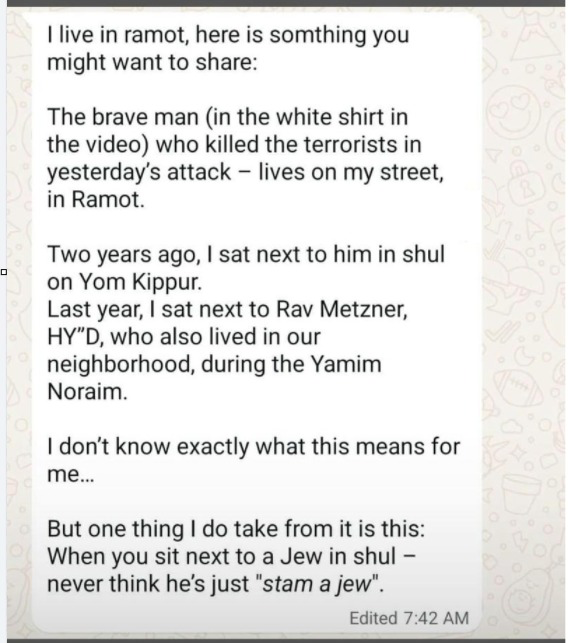
A day after the attack, I saw a message from someone who lives near where the attack occurred that left me deeply moved:


People will sometimes refer to themselves as “stam a Jew, just a simple Jew.” There is no such thing as “just a Jew.” Every person you encounter carries an entire world within them, a unique mission, an irreplaceable neshama, and a story, a history, and a destiny only Hashem fully knows. If you knew that in the coming year the person you were sitting next to would be murdered, would you not cherish him a bit more? If you knew that in the coming year the person you were sitting next to would display heroic courage and save countless lives, would you look at him the same way?
 
As we prepare for the Yamim Noraim, it’s natural to become absorbed in ourselves—our situation, our status, our tefillos, and our success. We open our selichos or machzor, look down at the words, and focus on our personal struggles, our hopes, our fears. These are important concerns that deserve our heartfelt prayers. But the Yamim Noraim are not meant to be experienced in a silo. They are not private retreats of the soul; they are communal pleadings of Am Yisrael standing together before our Father in Heaven.
 
The great Rosh Yeshiva of the Mir Yeshiva, R’ Nosson Tzvi Finkel zt”l, was once asked by a student on Rosh Hashana what he should prioritize in his davening. Success in Torah? Good health? A proper shidduch? What is the most important thing to daven for? The Rosh Yeshiva answered him with two words: “Someone else.”
 
When you sit in shul this Rosh Hashana and Yom Kippur, take a moment—not to interrupt your davening, but to expand it. Look around. Who is sitting next to you? Who is behind you? Who is in front of you? Don’t assume you know their story. That elderly man may have carried the weight of unimaginable suffering and still comes faithfully to minyan. That young father may have risked his life to protect others. That quiet neighbor may be enduring an invisible struggle you can’t see.
The person beside you is not “stam a Jew.” He or she is a precious child of the Ribbono Shel Olam, with infinite worth and unique greatness.
 
So as you pour out your heart in prayer, include them. Daven not only for yourself and your family, but for the family sitting two rows behind you, for the widower across the aisle, for the single struggling mother, for the child fidgeting beside you. And just as importantly, trust that they are davening for you, too.
 
This year, may we enter the Yamim Noraim with the awareness that there is no such thing as “stam a Jew.” Every Jew is extraordinary. Every Jew is worth knowing, worth caring about, and worth davening for. And when we recognize that—when we see the greatness and holiness in each other—then perhaps Hashem will see the greatness and holiness in us all, and inscribe us together for a year of blessing, health, and peace.
 

Coldplay, the US Open & Being Caught on Camera: Spiritual Lessons of a Surveillance World

Each year, our shul coordinates a men’s Mevakshim trip to New York to meet diverse Roshei Yeshiva, Rabbanim, and community leaders—to listen, learn, challenge, and grow. Before each interaction, I ask for permission to record the conversation. Some say absolutely, others are more hesitant, and many say it’s okay but only for the group and not for public distribution.


When we sat down at ArtScroll headquarters with my friend, Rabbi Gedaliah Zlotowitz, I asked for permission to record. He not only allowed it, but he also used the question as an opportunity to tell a story he heard from his father and to transmit an important message.


Each summer, the Zlotowitz family would go on a trip with the Feinsteins. One summer, they went to Niagara Falls. As is customary and necessary, on the Maid of the Mist boat tour, the Rosh Yeshiva, Rav Dovid zt”l, was wearing a poncho and hood to stay dry. Given his attire, Rav Meir Zlotowitz z”l asked the Rosh Yeshiva if it was okay to take a picture together.


The Rosh Yeshiva said it was fine and went on to explain: “I don’t do anything in my life that, if someone took a picture, I would be embarrassed. If you wouldn’t want a picture taken of it, don’t do it.” He added, “And I don’t say anything that would get me in trouble if it got out. If you wouldn’t want it to get out, don’t say it.”


Long before the advent and ubiquity of technology, our rabbis cautioned:

הִסְתַּכֵּל בִּשְׁלשָׁה דְבָרִים וְאִי אַתָּה בָא לִידֵי עֲבֵרָה, דַּע מַה לְּמַעְלָה מִמְּךָ, עַיִן רוֹאָה וְאֹזֶן שׁוֹמַעַת, וְכָל מַעֲשֶׂיךָ בַסֵּפֶר נִכְתָּבִין

Be mindful of three things and you will not come to sin: Know what there is above you—an eye that sees, an ear that hears, and all your deeds are recorded.


For all of history, our ancestors had to imagine what it meant for everything you say and do to be recorded. Our generation needs no imagination. We live in a time in which, whether we give permission or not, we are being recorded. In the aisles of the supermarket, at the airport, everywhere we go—even just stepping outside—cameras are tracking our every move. Our emails, texts, and phone calls are not truly private or confidential. Our online activity and browsing are never fully anonymous or incognito.


If the Rosh Yeshiva’s message was true before this reality, it is all the more true now. If you wouldn’t want a picture taken of what you are doing, don’t do it. If you wouldn’t want what you are saying to be made public, don’t say it.


Last week at the US Open in New York, after a five-set thriller, Polish tennis pro Kamil Majchrzak had the best victory of his life. Before leaving the court, he walked toward the stands to interact with fans. Noticing a boy waving, he took off his hat, signed it, and went to give it to him. But before the boy could take it, a man grabbed the hat, stuffed it into his wife’s bag, and walked away—leaving the boy heartbroken.


The internet went to work identifying the man as a Polish tycoon and successful CEO, then proceeded to publicly shame him for his deplorable behavior. Despite going viral, rather than apologizing, he doubled down and issued a statement: “Yes, I took it. Yes, I did it quickly. But as I’ve always said, life is first come, first served… If you were faster, you would have it… I remind you that insulting a public figure is subject to legal liability. All offensive comments, slander, and insinuations will be analyzed for the possibility of taking the matter to court.”


In July, at a Coldplay concert, the CEO and Head of HR of a technology company learned the lesson of “an eye sees, an ear hears, and all our actions are recorded” the hard way. Their relationship, caught on camera, went viral and cost them their jobs—and his marriage.


These very public stories, among others, should not only shock or amuse us. The awareness that what we do is seen and recorded—down here and Above—should also sober us.


But, the knowledge that what we do matters doesn’t only have to scare us; it can and should also motivate and inspire us.


In 2007, an employee of a New Jersey Dunkin’ Donuts named Dustin Hoffmann (not the actor) made news when the store was nearly robbed by a serial thief who jumped on the counter, grabbing cash from the register. The twenty-something Hoffmann fought back. Grabbing the man’s arm with one hand and a large coffee mug with the other, he repeatedly smashed the crook’s head with the mug and successfully thwarted the crime.


When later asked about the incident, Hoffmann said that what galvanized him into action was YouTube: “What was going through my mind at that point,” he said, “was that the security tape is either going to show me run away and hide in the office, or whack this guy in the head. So I just grabbed the cup and clocked the guy pretty hard!” He then added, “There are only a few videos like that on YouTube now, so mine’s going to be the best. That’ll teach this guy!”


The Midrash on Ruth teaches:


The Torah teaches us Derech Eretz—that when a person does a mitzvah, he should do it with a happy heart. For if Reuven had known that God would write about him, “And Reuven heard and saved him (Yosef) from their hands,” he would have brought Yosef back to his father on his shoulders. If Aharon had known that God would write about him, “Behold, he will come out towards you and be happy in his heart,” he would have come out with drums and musical instruments to greet Moshe. If Boaz had known that God would write about him, “And he picked for her roasted corn,” he would have served her fatted calves.


Rav Yaakov Kaminetzky zt”l explains that the Midrash doesn’t mean to imply that the prospect of going viral would have changed their behavior. It wasn’t ego that was the issue—it was the opposite: their extreme humility. These great men thought of themselves as small, insignificant personalities on the great world stage. They saw their behaviors as small acts of kindness, no big deal, not worth noticing, and certainly not worthy of recording. They failed to recognize the cosmic impact and lasting influence our small deeds can have, and how they are documented for posterity.


We correctly think of Elul, Rosh Hashanah, and Yom Kippur as days of judgment—a time to recognize that all of the mistakes we have made have been recorded and we are accountable for them. But it is also a time to remember and focus on the fact that our good decisions, kind deeds, and positive moments matter. We aren’t small or insignificant.


An eye sees, an ear hears, and all of our actions are recorded. Don’t do anything you wouldn’t want recorded. But also know that our best moments and deeds are going viral right now in Heaven. Keep them coming.

The Real You: Overcoming Imposter Syndrome This Elul

Have you ever felt like a fraud—as though you’re just making it up as you go, and one day the world will discover you aren’t as capable as they thought? This feeling can appear in professional life, family life, religious life—or in all three.


I’ll admit something personal. For several years after I graduated, I had a recurring nightmare: the registrar’s office called to demand my diploma back because I hadn’t really earned it. Even now, after more than twenty years serving as a rav, I catch myself thinking, “Who am I to give this derasha, officiate at this wedding, answer that halachic question, or give that shiur?”


If you’ve ever felt this way, you are not alone. Studies show that as many as 70% of people experience what psychologists Pauline Clance and Suzanne Imes in 1978 coined “imposter syndrome.” It’s the conviction that your accomplishments aren’t truly earned—that success comes from luck, timing, or having somehow fooled others into thinking you’re competent. A feeling of faking it on the outside while imprisoned by a gnawing feeling of unworthiness on the inside.  Doctors feel it. Lawyers feel it. Parents feel it. Rabbis feel it.


And our greatest leaders felt it too.


When Aharon was called to serve in the Mishkan on its opening day, the Torah describes him hesitating. Rashi explains that Aharon felt unworthy, like a fraud. Moshe, who once resisted his own calling by insisting he wasn’t a speaker or a leader, reassured him: “Why are you ashamed? You were chosen for this.” That moment reframes imposter syndrome. It is not weakness—it is part of the human experience, even for the greatest among us.


We have begun the month of Elul, the countdown to Rosh Hashanah and the start of a new year, a new beginning. The Talmud teaches that Rosh Hashanah not only marks the creation of humanity, but also the day Yosef HaTzadik was released from prison. Why highlight that event? Because Yosef’s liberation mirrors the opportunity given to each of us. New beginnings, a fresh start, begin with being freed like Yosef—freed from prisons of self-doubt, from the false narratives we tell ourselves, from the limitations we impose on who we can be.


That is why the Navi Amos calls us “she’eiris Yosef”—the remnant of Yosef. This time of year, we too are invited to walk out of our prisons, to prepare for our new beginning.


A couple of years ago, I met with a tzaddik in Beit Shemesh, Rav Avraham Zvi Kluger, who gave me a total paradigm shift in how to experience this time of year. He explained that Elul and Rosh Hashanah are not about our failures but our potential. Hashem sees not only where we fall short, but He knows the best version of ourselves—the moments when we rose above, when we were patient, loving, disciplined, and strong. He knows that is our true self, the real us. The slip-ups and shortcomings, the failures, are the aberrations, not the other way around.


We mistakenly think the real us is the one who loses our cool with our spouse or children, the one who looks at the wrong things when nobody is looking or indulges the urge to say the wrong thing to curry favor with the listener. We mistakenly think that when we show up despite our shortcomings, when we occasionally get it right, that makes us imposters.


But that is wrong! The truth is that when we are able to stay calm and be patient with those we love, when we have the discipline to do the right thing despite being tempted to follow our urge, that is who we really are, that is the true us, it is who we really are.


When the shofar sounds each morning of this month and on Rosh Hashanah, it doesn’t call us to wallow in guilt. The Rambam writes that it awakens us to look into our souls, to remember who we really are and what we are capable of. Rosh Hashanah’s teshuvah is not about confession—that comes on Yom Kippur. Rosh Hashanah’s teshuvah is about recognition: remembering our best selves and realigning with them.


As Rav Kook wrote in Oros HaTeshuvah, “The primary role of teshuvah is to return to one’s true self, to the root of one’s soul.”


We are defined by our strength, not our weaknesses; we are our best moments, not our worst. While we have to take ownership and responsibility for our failures, we deserve the success and achievements we have earned.


In 1977, Laura Schultz, 63, was in the kitchen of her home in Tallahassee, Florida, when she heard her 6-year-old grandson screaming from the driveway outside. Schultz ran to the door to find her grandson pinned beneath the rear tire of a full-size Buick. Giving no consideration to limitations or barriers, Schultz ran to the car, used one hand to lift the rear of the vehicle, and used the other hand to drag her grandson to safety.

For years, Schultz refused to speak about the incident. After finally agreeing to an interview with peak performance coach Dr. Charles Garfield, Schultz was asked why she had remained silent about her miracle. Schultz revealed that the incident had scared her and reminded her that she had wasted most of her life living far beneath her true potential. If she had that strength inside her all along, why hadn’t she realized it or utilized it more often or more fully?


With a little coaching from Garfield, Schultz returned to college, earned her degree, and went on, at nearly 70 years of age, to fulfill her long-held dream of becoming a college professor.


Like Schultz, we often dismiss our best moments as exceptions, flukes, or lucky breaks. But those moments are the real us. They reveal what Hashem already knows—that we carry extraordinary potential inside. Don’t ignore the strength that is inside you. Your best moment as a mother or father, as a husband or wife, as an eved Hashem—that is the real you. Believe it, embrace it, nurture it, repeat it, and grow it.


Spend Elul overcoming your imposter syndrome and seeing and believing in the real you. This year, instead of just limiting our challenges, let’s challenge our limits.


667 Days Without a Day of Their Own: Building B’Yameinu

667 days.  


Of course, we daven from the bottom of our hearts that by Tisha B’Av the hostages will all be home, our soldiers will all be with their families, and our enemies will all be defeated. 


But if not, Tisha B’av will mark 667 long days since October 7.  667 days in which innocent people, guilty only of the crime of being in Israel, will have been held by cruel, evil terrorists.  667 days that heroic IDF soldiers have been fighting on several fronts, leaving their families and risking their lives for our people and our land.  667 days with an entire country of 10 million people constantly remaining aware of where a bomb shelter is and needing to think about it each time they leave their home.  


For 667 days—granted in very different ways—hostages, soldiers and the people in Israel have not been able to call any day fully their own. 


The Talmud (Yerushalmi, Yoma 5) tells us Kol dor she’eino nivneh b’yamav, ma’alin alav k’ilu hu hecherivu, any generation in which the Beis HaMikdash isn’t built in its days, it is considered as if that generation itself destroyed it. 


Why didn’t the rabbis just say kol dor she’eino nivneh, any generation in which the Beis HaMikdash isn’t built? What is added by the word b’yamav, in their days?   We use this same word daily in our davening when we ask Hashem u’vnei osah b’karov b’yameinuAgain, why not just ask Hashem to build Yerushalayim and the Beis Ha’Mikdash, what is added by b’yameinu, “in our days,” when this is inherently the request?


In his Zera Kodesh, the first rebbe of Ropshitz, Rav Naftali Tzvi Horowitz, explains that “B’yameinu” isn’t a prayer for when we want redemption and rebuilding, it is the formula and blueprint for how to bring it.  The letter Beis, when used as a prefix, can mean two different things. B’yameinu can mean in our days, but it can also mean with our days. 


The building blocks, the materials for a generation to build the Beis HaMikdash and bring redemption, is “b’yamav,” to use its days meaningfully, productively and as fully as possible.  Doomscrolling, mindless binge watching, criticizing, fighting and sowing division are exercises in squandering our days.  If we waste them, misuse them, fail to appreciate the gift of “our days,” it isn’t only that we failed to rebuild the Beis HaMidkash, but by destroying our most precious commodity, our days, k’ilu hechrivo, we destroyed what we could have done with them, what we could have built with them. 


For 667 days the hostages haven’t had “y’mayheim.”  Their days haven’t been their own.  They haven’t had control over their time or their lives. They haven’t had their freedom or seen their families.  Maybe they haven’t even seen the light of day. For 667 days they haven’t been able to decide for themselves what they want to do, where they want to be, what they want to achieve. 


We daven daily that Hashem finally changes our condition in the world, that He brings a genuine and lasting peace, that He builds the Beis HaMikdash b’karov. How? B’yameinu, by using our days to heal instead of harm, to create connection instead of separation, to compliment instead of criticize, to build instead of destroy, to unite instead of divide.   


In Eicha we describe the unbearable pain of yashva badad, of feeling alone, a malady and condition that too many continue to suffer from today.  If loneliness is the problem, the antidote and the answer is to be nosei b’ol im chaveiro, to bear the burdens of our friends and our people, to feel their pain, to empathize with their plight and to become part of their suffering. 


To be nosei b’ol im chaveiro means to not only feel bad for, but to feel pain with those who are struggling and to focus on filling our days with providing relief, support, and love. 


If we want to change what is happening to us in the world, we have to be thoughtful and mindful of what we do to and for each other.  We must fill yameinu, our days, with standing with and davening for the hostages, our soldiers, and all our brothers and sisters in Israel.  We must ensure nobody is dreading the countdown to Shabbos wondering if they will get invited or will once again be eating alone.  We must make sure that nobody in our community can’t sleep at night because they aren’t confident they will cover their bills.  We can’t allow an Agunah to feel she is all alone or a victim of trauma or abuse has been abandoned. 


If you own and control your days, you are not only blessed but bear an awesome responsibility to fill it with meaning, purpose, care, and concern.  If we use the days leading up to Tisha B’Av well, we will merit to no longer sit on the floor and mourn but to celebrate the building of the Beis HaMikdash, constructed b’yameinu, with our days. 

The Pulpit Must Not be a Political Podium… Most of the Time

The IRS announced it will break with a long-standing rule and now allow houses of worship to endorse candidates for political office without losing their tax-exempt status.  Since 1954, a provision in the tax code called the Johnson Amendment mandates that nonprofit organizations could lose their tax-exempt status if they participate in or intervene in “any political campaign on behalf of or in opposition to any candidate for public office.”


The rule was violated regularly in some houses of worship, but the IRS rarely enforced it. In explaining the change, the agency advised that when a house of worship, “in good faith speaks to its congregation, through its customary channels of communication on matters of faith in connection with religious services, concerning electoral politics viewed through the lens of religious faith,” it neither participates nor intervenes in a political campaign.


This means rabbis can now legally endorse candidate from the pulpit.


But should they? 


I don’t believe so.  In many or even most elections, reasonable people can come to a reasonable conclusion in either direction.  Sure, it is fair, maybe even constructive at times, to try to persuade others to see things as you do, but if you can’t, the best practice is to acknowledge that not only is the other person entitled to his or her perspective, but their opinion is reasonable, legitimate, and fair. The fact that they arrived at a different conclusion, even one you are convinced is wrong, doesn’t mean they have corrupt character, less patriotism, compromised commitment to Israel, or less devotion to Torah.


Rabbis and shuls should be spaces where people with diverse opinions can congregate, connect, learn together, daven together and work together on the issues that unite us.  If rabbis begin to offer public endorsements, especially from the pulpit, will those who disagree with his conclusion still feel comfortable being part of that shul?  What will the impact be on public discourse and debate within the community if the rabbi publicly weighs in endorsing one side, particularly invoking his Torah authority in doing so? 


Will those who disagree with the rabbi’s endorsement and choice continue to turn to him for direction, guidance, and support?  Will they ask him their halachic questions, want him to officiate at their simchas and lifecycle events, trust him to advise on sensitive matters?  


If the answers to these questions is no, even if it is a small percentage of the shul/community who will feel alienated, is the endorsement worth it?  Rabbonim are shepherds, charged with loving and caring for their flock.  If some will be driven from the herd or who walk away feeling unwanted, the shepherd has failed in his mission. 


Ultimately, as Shlomo HaMelech taught (Misheli 21:1) “פַּלְגֵי־מַ֣יִם לֶב־מֶ֭לֶךְ בְּיַד־ה’ עַֽל־כּל־אֲשֶׁ֖ר יַחְפֹּ֣ץ יַטֶּֽנּוּ – The heart of a king is like a stream of water in the hand of God, wherever He wishes, He will direct it.”  We say every single day in our prayers, “Al tivtechu b’nedivim, don’t place your faith and trust in princes and diplomats.”


As God-fearing Jews, we recognize that it is the Master of the Universe who orchestrates domestic, foreign, and of course all policies and their consequences. To be a student of Torah and of Jewish history is to recognize the Almighty’s guiding hand. His hand guided our history and ultimately, it is His hand that is guiding our destiny.


I said above that in most elections reasonable people can come to a reasonable conclusion in either direction, but like almost every rule, there are exceptions and we are living through one.


One group of clergy didn’t wait for the IRS to change its rule before making a public endorsement.  In an article titled, “We are NYC rabbis who support Zohran Mamdani – Here’s why,” they write:

My co-authors (listed below) and I are among many New York City rabbis who voted for and proudly support Zohran Mamdani in the race for New York City mayor. Our religious tradition calls us to pursue justice and invokes our responsibility to bring it into the world. For many of us, the campaigns of Mamdani and mensch co-endorser Brad Lander marked the first time in a long while that we witnessed the Jewish call for justice clearly reflected in the platforms and character of mayoral candidates. We are confident that Zohran will carry those values forward – we hope, all the way to Gracie Mansion.


Supporting Zohran and Brad was, for us, an explicitly Jewish act, and we’re kvelling over our contribution as Jewish New Yorkers to Mamdani’s historic victory…


We believe that rent is too high, buses are too slow, and New York should be a welcoming, safe home for everyone – no matter where we came from or how long we’ve been here. Like Mamdani, we believe…that the Israeli government’s treatment of Palestinians in Gaza and the West Bank is horrific and cannot be ignored. These convictions reflect a shared political ethic – not identical political beliefs – and they are strong enough to support both real coalition and real community.


The blatant smear tactics we see used against Mamdani are frequently deployed against Muslim elected officials and leaders of color who dare to criticize Israel. These accusations are not about protecting Jews. They are about shutting down necessary reckoning with our city and country’s complicity in Israel’s occupation…


We believe that Jewish safety will not be secured by demanding unconditional support for Israel or imposing litmus tests on public officials around language. It will be secured through effective policy, education, solidarity, and shared struggle. That is what Mamdani offers…


Absurd, dangerous, and deeply disturbing articles like this one make this New York mayoral election an exception in which reasonable people should not be able come to certain conclusions and rabbis should be vocally opposing this article and this candidate.  But let’s be clear about the parameters. Mamdani’s socialist views, calls to defund the police and dishonesty on his college application don’t, in my opinion, justify rabbis issuing an endorsement for his opponents. We should, however, call out and voice opposition to a candidate who is openly against Israel in the clearest possible terms and who proudly stands with antisemites.


I recognize that people will disagree about where to draw the line and when to make the exception, but I hope that reasonable people can agree that stopping the election of a candidate who is undeniably and objectively anti-Israel and by extension antisemitic is not a violation of a rabbi’s responsibilities but the fulfillment of it. 


Mamdani has refused multiple times to recognize Israel’s right to exist as a Jewish state, and he has supported the BDS movement against Israel. While he hasn’t himself used the phrase, “Globalize the Intifada,” he has refused to condemn those who do and defends their right to use the expression.  As the intifada is actually being globalized with Jews suffering attacks around the world in growing numbers, in no place more than New York City, defending the expression is egregious and incites violence against Jews. The founder of the Students for Justice in Palestine (SJP) at his alma mater, Mamdani has accused Israel of “genocide” and “apartheid,” and has vowed that as mayor he would arrest Benjamin Netanyahu.  


Despite the IRS’s rule change, don’t expect to see political endorsements from the BRS pulpit. But stopping Mamdani isn’t a question of politics, it is about self-preservation and the safety and security of the Jewish community. 

Antisemitism Uncensored: Let Them and Let Us

Last week, Piers Morgan, whose show has over 4 million subscribers on Youtube, hosted virulent and unapologetic antisemite Candace Owens.  Seething with hate for the Jewish state and the Jewish people, Candace opened by calling Israel a terrorist state and falsely accusing Israel of perpetrating a genocide and a holocaust by indiscriminately and intentionally murdering innocent children in Gaza.  She described AIPAC as owning American policy and claimed that American soldiers have died and will continue to die for Israel. 


“I would say as an American that if we’re going to get behind a regime change it should be in Israel first… I think [that would be] the position of a lot of people who are waking up to the fact that Zionism has brought us nothing but grief in America.  Can you name one positive thing that Zionists have contributed to America?”


At the conclusion of the interview, Piers closed by saying, “Candice, always good to have your views on Uncensored. You know that I appreciate you coming on.  Thank you.”


Good to have your views?! Would it be good to have the views of a white supremacist, a member of ISIS, a blatant racist, or anyone else filled with hate for a particular people and lies about an entire nation?


Someone shared this clip with me and I only watched a few moments, but it was enough to make me want to jump through the screen, correct the lies, and set the record straight to both the antisemitic guest and the host who has sold his soul for views by platforming such heinous individuals. Hearing them even for such a brief period of time, and then catching that conclusion about it being “good” to have her views, made my blood pressure rise, my pulse quicken, and my stomach turn.


When I calmed down it quickly struck me – why in the world did I watch that?  Why did I allow them to take up space in my head and heart?  They certainly didn’t impact my beliefs or opinions an iota and obviously, being a passive spectator, I didn’t influence their views either.  All that was accomplished was giving them another online “view” and causing me to get terribly upset.   In retrospect, there couldn’t be a worse use of time.


Hearing the distortions, lies, hate, and fake news about Israel on podcasts, viral clips, social media and even some mainstream news programs is infuriating, maddening, and ultimately unproductive.  If we care about our beloved people and our people’s homeland, the truth is that there are much better ways to use our time.


In her bestselling book, “The Let Them Theory,” Mel Robbins describes an almost universal phenomenon of wanting to control everyone and everything around us.  We want to dictate what people say, believe, and do, and when we can’t, it frustrates us enormously often leaving us feeling stuck.  The Let Them Theory teaches how to stop wasting energy on what you can’t control and start focusing on what you can: YOU.


The theory is made up of two parts, Let Them and Let Me.  When you find someone speaking, behaving, or believing things that bother you, frustrate you or disappoint you, say to yourself – Let Them.  Let them think that, let them say that, let them do that.  Let them.  But the theory only works when followed by Let Me.  Let Me focus on myself, my life, my happiness, what I can control, what I am supposed to do, who I am supposed to be. 


Robbins writes: “When you say Let Them, you make a conscious decision not to allow other people’s behavior to bother you. When you say Let Me, you take responsibility for what YOU do next.”  Let Them: Have their opinions, judge your choices, think what they want, talk behind your back. Let Me: Live authentically, focus on growth, find happiness.  The brilliance of the theory is its simplicity and in the book she provides science-backed evidence for why it works. 


Reflecting on the recent Israeli triumph over Iran and its success fighting on seven fronts over the last almost two years, one marvels at Israel’s capacity to practice Let Them and Let Me.  Shutting out all the noise from around the world, Israel has focused on what it needs to do and the results are stunning.  By saying “Let them,” let the haters make noise and “Let us,” let us eliminate our enemies, neutralize existential threats, and take a leadership role in providing security for the Middle East and the world, Israel has earned both the fear and respect of unlikely sources.  We hope and pray that it comes to fruition but even the prospect and rumor of several countries that were previously hosts to Israel’s enemies now open to joining the Abraham Accords is welcome great news. 


Rav Soloveitchik commented that slavery and subjugation come in two different forms – both the physical component and also a mentality.  Physical slavery means that a person is literally under the control of somebody else who decides what he can and cannot do.  The Jewish people who were under the rule and control of the Egyptians were released from this form of bondage at the time of Yetzias Mitzrayim.  Nevertheless, they still were not freed from their slave mentality.  They still felt inferior, subservient to the opinion and perspective of other people.  They not only assumed that others viewed them as “grasshoppers,” as small and inferior, they allowed that projection to overwhelm them with fear, hold them back, and ultimately keep them from the Promised Land.


For 2,000 years we have been fighting to survive, subjugated by our host countries who orchestrated pogroms, attempted to exterminate us, or expelled us.  Today, with endless gratitude to Hashem, though we remain in a state of galus, we are physically and religiously free.  Yet, the long conditioned galus mentality breeds a feeling of inferiority, a concern for what others think of us.  We seek validation for something as simple as a right to exist.  The truth is, the opinion we should be most obsessed about is that of Hashem and the question of if we are fulfilling His vision and mission for us. 


In the beracha with which we conclude the maggid section of the seder on Pesach, we express our hope to experience our final redemption, when we will praise Hashem al ge’ulaseinu v’al pedus nafsheinu – “for our redemption and the redemption of our souls.”  Rav Soloveitchik explained that we anticipate the time when we will experience not only ge’ulaseinu, physical redemption, freedom from those who oppress and exert control over us, but also pedus nafsheinu – mental freedom, the freedom from our insecurities and our sense of inferiority, so that we will have the confidence to act as we are supposed to act without worrying how we will be perceived and what others are thinking and saying.


When Hashem summoned Moshe back to the top of Mount Sinai to receive the second set of tablets, He commanded, v’ish lo ya’aleh imach – “and no man shall ascend with you” (Shemos 34:3).  The Degel Machaneh Efrayim, grandson of the Ba’al Shem Tov, comments that whenever we “ascend,” seeking to grow and lift ourselves higher, we should not bring anyone else with us; we should not be worrying about what other people are thinking or saying about us.  What others think about us is their problem, not ours.  We should live with the freedom to “climb the mountain,” to rise to the greatest heights we can, without worrying at all what people are thinking.


It is true that we rely on the help and support of others and therefore it is critical to engage in lobbying and advocacy with those in elected office. If we are in a position to have our voices heard, we must use those voices as much and as loudly as possible. But when it comes to watching, listening and reading the news, we must be judicious and mindful in distinguishing between staying informed and aware of the news, and becoming aggravated and infuriated by the lies.  


Let them! Let them make noise and spew hate. 


And let us!  Let us climb higher and higher in our unity, our love, or faith, fighting for our people and spreading Hashem’s light. 

The Triumph of Israel and the Spirit of the Jewish People

Israelis, Jews, and decent people around the world breathed a great sigh of relief and were filled with euphoria at the news that the spectacular American military, at the courageous order of President Donald Trump, had bombed and obliterated Iran’s nuclear program.  As of now, the 12-day war with Iran has reached a ceasefire with a stunning Israeli military victory, one that experts already say surpasses the Six Day  war.  We would all be remiss if we didn’t follow the example of President Trump and Prime Minister Netanyahu, who both publicly and proudly thanked God for the success of their efforts. 


It is truly extraordinary that for nearly fifty years, an evil regime, the world’s largest state sponsor of terror, has wreaked havoc, murdering innocent Americans and Israelis while threatening its Arab neighbors.  The danger and threat to the world of a nuclear Iran has been articulated by the last five American presidents and by countless world leaders.   


History will show that President Trump and the United States didn’t just talk about eliminating that threat, they acted.  But the US, the world’s greatest superpower, didn’t do it alone, they had the help of only one other country.  If you looked only at a comparison of countries by populations, land mass, economy, how long they have existed, their role among nations, would you ever guess that the other country that not only assisted but paved the way and set the stage was smaller than New Jersey, is only 77 years old and has a total population of just 10 million? 


I got goosebumps when President Trump thanked Israel: “I want to thank and congratulate Prime Minister Bibi Netanyahu. We worked as a team like perhaps no team has ever worked before, and we’ve gone a long way to erasing this horrible threat to Israel. I want to thank the Israeli military for the wonderful job they’ve done.” 


The role and contribution of the State of Israel in protecting the world and keeping it safe is nothing short of a Kiddush Hashem, a fulfillment of the Jewish people’s mission in the world. 


I was sitting at a beautiful Chuppah on Sunday, thinking about and reflecting on this achievement.  The seventh beracha was recited and the Chuppah was about to conclude but instead of turning to the singing of Im Eshkacheich, we were all invited to rise as something else was sung first, the Mi’Shebeirach for Tzahal, the prayer for the IDF.  I have attended dozens of weddings since October 7, and at every one of them, a prayer for our brothers and sisters in Israel and for the heroic and courageous members of the IDF was included, sometimes as the IDF prayer and other times as Tehillim.


As we all stood and focused on the heartfelt Tefillah, a thought occurred to me.  In America’s wars, in Afghanistan, Iraq and elsewhere, was any wedding of the average American interrupted to include a prayer for the American military?  Were the weddings of any Americans paused to pray for American troops? Unless an immediate family member of the bride or groom was serving in active duty, I can’t imagine a prayer was included, even right here in America.  And yet, for the last year and three quarters, around the world, thousands of miles from Israel, Jews everywhere have refused to celebrate without also pausing to pray for the IDF.  The Jewish people are unique in this way.  Wherever we are around the world, we feel connected, and our wellbeing is intertwined.


In several places (Yevamos 61a, Bava Metzia 114b, Kerisus 6b), the Gemara says, “You, the Jewish people are called אדם, Odom, but the nations of the world are not called Odom.”  Read simply, it sounds like a terribly prejudiced and biased statement. 


Rav Frand shares a story that offers a deeper understanding:  In 1912, in Russia, Mendel Beilus was accused of killing a Christian child and using his blood to bake Matzahs. This slander or variations of it were unfortunately prevalent in Europe for many, many years. They were known as blood libels. Beilus’ lawyer was afraid that to buttress their case, the accusers would make the argument that Jews considered non-Jews less than human. He was in fact afraid that they would cite the above-quoted Talmudic reference to prove this very point.


The lawyer therefore visited the Chortkever Rebbe and asked him how he could respond if the opposing lawyers would throw that Gemara at him. The Rebbe said as follows: If an Italian was seized and put on trial, we would not witness a scenario where all Italians were congregating in their churches to pray for this one Italian. The same can be said about the French for a Frenchman, and so too about all other nations. However, when a Jew is seized and put on trial, the solidarity that Jews have toward each other will make every Jew throughout the world stop and pray for the welfare of that other Jew.


This is how the Chortkever Rebbe explained Chazal’s statement that “You are called Odom.”  The Hebrew language is extremely precise in terms of the different connotations of apparent synonyms.  Other words for “man” has a singular and a plural – ish, anashim, gever, gevarim.  However, the word Odom is the same whether  referring to one or many.  The singular term “Odom” fits the Jews. All Jews are considered as a single entity. There is no dichotomy. We are all in this together. The reason why the word “Odom” is employed referring to Jews is because this is the only term for humanity that has no plural and the Jewish people are a singular people.


This is not a racist or bigoted interpretation. It is a unique attribute of the Jewish people that has been demonstrated time and time again in ancient times and we are experiencing it right now.  If one Jew is held hostage, Jews around the world feel the pain and storm the heavens.  When heroic soldiers of the IDF are fighting, Jewish weddings around the world are interrupted with a prayer on their behalf. 


With Israel’s victory against Iran, we hope and pray that Hamas surrenders, releases the hostages, and Jewish people around the world can live with the peace and tranquility we deserve.  But until they do, we will always feel a sense of responsibility for and oneness with one another.

A Nation Rising and Roaring Like a Lion

Several times over the last few days, I was talking to someone in Israel—my daughter, sister or a friend—and they nonchalantly interrupted to say, “I need to hang up, the sirens is sounding and we need to head to the bomb shelter.”  To be clear, though this is commonplace, there is absolutely nothing normal about ever having to utter the sentence, “I am gathering my family and going to a bomb shelter because ballistic missiles are headed our way.” 


Is it really any wonder that Jews suffer disproportionally from gastrointestinal disease?  How could the stress, anxiety, and trauma of two thousand years of running and hiding from pogroms, attempted exterminations, and expulsions not be absorbed into our people’s kishkes?


Eighty years after the Holocaust, Jews are once again running to take shelter from those attacking them.  In Gaza and Lebanon, our heroic soldiers have been on the front lines risking their lives for the future of our people.  But in this war with Iran, all of Israel, 10 million people, find themselves on the front lines, running for shelter and bracing for potential impact.  This includes waking sleeping babies, carefully escorting the elderly, stocking up space, packing people in, and going long periods without sleep. 


Mi K’amcha Yisroel – Nobody Like the Jewish People


I am in absolute awe of my family, friends and all in Israel whose lives have stopped and have been turned upside down.  Many are doing it with spouses serving in miluim or stuck out of the country or without family around to help them.  The entire country is now bearing the brunt of the hatred of Iran who want to wipe out the whole Jewish nation globally but are taking it all out only on those in Israel.  And yet, somehow, our people carry on with positivity, faith, hope, tenacity, resolve, and a healthy sense of humor.


This is the story of our people.  They, our brothers and sisters in Israel, are why we are unstoppable and undefeatable. 


There is much uncertainty that remains, but as of now we know that Israel has pulled off an operation that makes the Hezbollah beeper episode look modest and, according to some experts, is on par with the miracle of the Six Day War.   On June 13, 6/13, an auspicious date, Israel launched a pre-emptive strike to take out Iran’s nuclear capability, a country that has pledged to destroy Israel and wipe out the Jewish people. Earlier that same day, the Prime Minister davened at the Kotel, a seemingly innocuous gesture as he hosted a foreign leader.  Together with the announcement he was going on vacation and attending a celebration, and the coordinated statements by President Trump, Secretary Rubio, and Steve Witkoff telling Israel not to attack, Iran was caught by surprise. 


Mindbogglingly, the Mossad had been operating in Iran for years, setting up a base with drones that were smuggled in. Having eliminated the air defense, Israel’s extraordinary air force operated with impunity, flying more than 1,100 miles to relentlessly pound missile sites, attack nuclear sites and, in pinpoint strikes, eliminate Iranian nuclear scientists and military leaders all while brazenly refueling over Iran.


Israel orchestrated events that they knew would cause Iranian military leadership to gather and then took them out. Israel is the size of New Jersey and has 10 million people. Iran is more than twice the size of Texas and has 93 million people.  We are witnessing nothing less than a modern-day version of David defeating Goliath. 


This courageous action, in defiance of some world opinion and world leaders, is a gift to the world, just like it was when Israel took out Iraq and Syria’s nuclear programs. Thankfully, despite the public posture designed to distract, in truth, President Trump and the United States stand with Israel, are coordinating with Israel and are helping defend Israel.


Gratitude and Angst


On Thursday night, when Israel launched its preemptive strike, we were filled with gratitude and elation, pride and joy in the unprecedented and heroic success.  But those feelings were quickly tempered as Iran began to retaliate and launch waves of barrages of ballistic missiles, most of which have been intercepted but too many of which have gone through, taken lives, and caused scores of injuries.


There have been countless, extraordinary miracles and achievements.  As this war with Iran continues to unfold, we are filled simultaneously with boundless gratitude and pride on the one hand but also profound concern, worry, and angst on the other.  How do we balance these conflicting feelings?


Once, in the early years of his leadership, Rabbi Shneur Zalman of Liadi told his chassidim: “One must live with the times.” What he meant is that every day a Jew should “live with” and interpret everything happening through the messages and prism of Torah.  The timing with which we read the weekly Parsha is not random but by design from Above and there is always a connection.


It is no coincidence that Israel courageously attacked Iran in the week the Torah portion tells us: “When you are at war in your land against an aggressor who attacks you, you shall sound short blasts on the trumpets, that you may be remembered before your God and be delivered from your enemies.”


This is the same Parsha that contains the promise: “Va’yehi binsoa ha’Aron…v’yafutzu oyvecha, v’yanusu misanecha mipanecha.  When the Ark was to set out, Moshe would say: Advance, Hashem! May Your enemies be scattered, And may Your foes flee before You!”


Rashi explains: “Your enemies,” a phrase we address to Hashem, means that anyone who hates the Jewish people hates the Creator of the universe. Iran has targeted the Jewish people and in so doing has targeted our Father in Heaven. Iran has started up with the wrong enemy.  


When the Aron sets out, when the Torah leads us, when we are proud Jews, God makes a promise that He will help us defeat our enemies. When the Prime Minister, the political leader of the Jewish state, the Commander in Chief of the Israeli military, goes to the Kotel to pray before launching an attack, the Ark is leading, our fighting is informed and inspired by our faith.


When the government chose a name for the operation, they didn’t use a military code word or a reference to a weapon, they quoted a pasuk from our sacred Torah – Hein am k’lavi yakum, we are a nation that rises like a lion.  That is leading with the Aron, fighting for our people and our Torah. 


With Faith and Fortitude


The Gemara (Berachos 12b) relates that at one time our rabbis contemplated adding the parsha of Balak, which includes the words of the wicked Bilam, into the seder to be said together with Shema.  Why would we think it appropriate to quote daily a villainous prophet who hated our people, and why would we couple it with the iconic and central words of the Shema? 


The Gemara itself tells us that what makes the words of Bilam so special are that they contain a pasuk comparing the Jewish people to a fearsome lion:  “The Jewish people crouches; he lies like a lion and a lioness. Who dares rouse him?” 


Rav Kook in Ein Aya explains that Bilam poetically compared the Jewish people first to a lion that rises and then to a sleeping lion that none dare disturb. Everyone who sees it rise and roar then fears the formidable powers of this majestic creature, even when it sleeps.   Our people have survived against all odds, defying all the laws of history.  We rise and rest like a lion so that we can continue to declare Shema.  When we accept the yoke of Heaven, when we declare the unity of Hashem, we are indestructible. 


In a world of variables, there are two constants.  In a world that is temporary, there are two things permanent: Hashem as expressed through Shema, and the Jewish people, the lion who roars and rises when awake and who remains and is even feared when asleep. 


We feel boundless gratitude to Israel’s heroic soldiers and the members of Israel’s air force.  We recognize the selfless dedication of the Mossad agents who have lived for years in Iran undercover, forfeiting their Jewish identity and Jewish practice to protect the Jewish people.  We appreciate the courageous leadership of Prime Minister Netanyahu.  They all deserve credit, praise, admiration, and gratitude. Yes, they have dismantled Hezbollah, Hamas and pulled off amazing feats against Iran.  But none of them could or would succeed without Hashem leading the way. We must never forget or fail to credit God with our survival, our existence and our future.


And that is why we can simultaneously be grateful to God and His agents for the success so far and also manage our concern and worry for the future. When we recognize and realize that God got us here, He enabled and empowered our success and He promises us that we will be here forever, that we will persevere and triumph, that He is fighting by our side.


Our people have not only survived but thrived against all odds, against the laws of history, despite countless attempts to annihilate and exterminate us.  We have persevered with faith and fortitude, resilience and resolve. When our enemies try to destroy us, we our protected by Hashem.


To our lions in Israel, not only the courageous members of the military but each and every one of the 10 million living on the front line – we are giving you the biggest hug, sending the greatest love, and thanking you from the bottom of our hearts. 


From Printing Press to X, When Instant Can Become Insidious


It was a clash between two respected and prolific people with elevated positions. Nobody knew what to expect next, and everybody was shocked by how intense and at times vicious this back-and-forth was.


Rav Yaakov Emden (1697-1776), also known as the Ya’avetz, was one of the greatest halachic decisors of his time, and his opinions continue to be quoted every day around the world.  In 1728, he answered the call to serve as the Rabbi of Emden, the German city from which he ultimately took his surname. In an effort to preserve his independence and ability to speak freely, he resigned after only four years and moved back to his hometown of Altona, refusing to take another official rabbinic position ever again.  Soon after, he obtained permission from the King of Denmark to own a printing press, which he established in his home and used to publish his countless writings.


Rav Yonasan Eibshutz (1690-1764) was a child prodigy and became the head of the Yeshiva of Prague at only twenty-one years old.  He became well known for his brilliance, scholarship, and oratory ability and ultimately became the Chief Rabbi of the “Three Communities” of Altona-Hamburg-Wandsbek.


At the time, Rav Emden was dedicated to opposing and fighting the growing movement claiming that the recently deceased Shabtai Tzvi was the messiah.  In the early 1750s, amulets prepared by Rav Eibshutz were presented to him with the claim that its author was secretly a Sabbatian and had embedded heretical messages in them.  Rav Emden examined them and concluded that indeed, the author of the amulets was a follower of Shabtai Tzvi, a heretic who must be opposed.  Rav Eibschutz denied the allegations and accused Rav Emden of misreading and misinterpreting the amulet. 


An enormous controversy erupted throughout Germany and beyond, creating a major split, with the greatest rabbis of the generation taking sides.  Rav Yaakov Emden wrote and published relentlessly, leveling suspicions and accusations against Rav Yonasan Eibshutz, not only about following Shabtai Tzvi but of other outrageous and deviant behavior.  In addition to many letters and pamphlets, in 1753, he published Lema’an Da’as, a collection of letters and evidence about Sabbateans in general and Rav Eibshutz in particular.  In 1755, he published a polemic called Vayakem Edus B’Yaakov.  In 1759, he published Sheviras Luchos HaAven, a refutation of Rav Eibshutz’s defense. (Our own Rabbi Yosef Kassorla once gave a wonderful class at BRS that delved into a detailed history of this famous episode, click here to listen to it.)


In the cemetery of Altona, Germany, only four headstones apart, are the graves of Rav Yaakov Emden and Rav Yonasan Eibshutz.  Vicious public adversaries in their lifetime, these two Torah giants are buried for eternity, essentially side by side.  It is said that before he passed away, members of the Chevra Kaddisha saw Rav Emden greeting his ancestors before he joined them in the Olam Ha’emes, the world of truth.  And then, to the astonishment of the members of the Chevra Kaddish, he continued and said, “And Shalom Aleicha, Rav Yonasan Eibshutz.”  The man whom he had opposed so vocally and vociferously had passed away twelve years earlier and was now coming to greet him and welcome him into the next world.  When he learned about this, the Noda B’Yehudah, Rav Yechezkel Landau, instrusted the Chevra Kaddish to find the closest grave possible so the two who had made up and reconciled in the next world, would forever lie together in this one. 


While this controversy has a heartwarming end, it threatened to tear apart the Jewish community while it raged. The conflict had grown so intense, the Emperor Frederick of Denmark, the kingdom which controlled the relevant cities, got involved. At first, he sided with Rabbi Yaakov Emden and removed Rabbi Yonasan Eibschutz from his position, but he later reversed himself, and restored him. The controversy lasted for years and led to a series of excommunications and counter-excommunications.


Much of the controversy and conflict was the result of the published polemics that spread widely.  It has been pointed out that if only Rav Yaakov Emden didn’t have a printing press in his home, perhaps the harshness of the controversy could have been mitigated or avoided.  If he had to enlist a publisher, have his works edited and taken time to publish, it is likely that the whole story wouldn’t have been.  Instead, each time Rav Emden had a thought, a reaction, something he wanted to say, he was able to write and share almost instantaneously.  Time to think, reflect, and consider would have been helpful in avoiding a conflict that continues to reverberate until today.


To be clear, Rav Emden and Rav Eibshutz were Torah giants, leaders whose words we continue to study and whose lessons we continue to learn.  Their machlokes was certainly l’shem Shomayim, sincerely driven, and their places in the cemetery testifies to how much more in common they had than that which separated them and their shared legacy and place among our people.  We must not trivialize this episode or minimize their greatness with comparisons to others, particularly to those who shouldn’t even be mentioned in the same sentence as them.


Yet, I thought about the particular observation of the role of the printing press as we all watched the unravelling of the partnership and bromance between the wealthiest man in the world and the most powerful man in the world in real time.  Disagreeing with President Trump’s “Big, Beautiful Bill,” Elon Musk took to X to express his criticism.  It didn’t take long for their public spat to escalate with each side responding in real time with insults, accusations, and behavior that frankly we might expect more from dueling children than from the most high-profile people in the world. 


For now, it seems the spat has simmered, with Musk publicly supporting President Trump’s actions supporting ICE raids in Los Angeles.  But the conflict brought us (and may still bring us again) dangerously close to impacting politics, policies, and the economy.   As the tweets were flying, all I could think to myself was how this could have been avoided if they didn’t each have keyboards, phones, and internet access at their fingertips.  Imagine if they had to convene their public relations teams, work with their PR experts to decide if they should issue this statement and publish this response?  Surely they would have been counseled to slow down, catch their breath, express themselves maturely and productively. 


There is no question that technology, including AI, have brought enormous blessings and gifts in the dissemination of Torah, in connecting us, and in a variety of productive ways.  This spat, however, is a startling reminder of how these innovations have a much darker side: they can be dangerous and damaging and wreak havoc.  As they are developed and in choosing how to engage them, one must be tremendously judicious, careful, thoughtful, and guarded. 


The Kotzker Rebbe was once asked, if Shlomo HaMelech was truly the wisest of all men, the most brilliant of all time, why didn’t he invent the train?  The Kotzker’s answer is penetrating and prescient.  He said that surely Shlomo thought of the train and could have introduced it to the world but he understood the downside, the risk, how it could be used negatively, and he determined it wasn’t worth it, better to keep it to himself.


AI can expedite efficiency and productivity, but it can also introduce endless deceptions and lies, leaving us all wondering which correspondence, image, and video are even real. 


Of course this hypothetical is too late, but knowing what we know now about the negative impact of the internet and social media on mental illness and happiness, how it is used to spread hate, would we bring it to the world anyway or would we have concluded the world is better without it? 


The conclusion is not clear or black and white.  The answer is debatable but as we plow forward with technological innovation, the question must be asked and considered.


The Chafetz Chaim, R’ Yisrael Meir HaKohen, (Shem Olam, Volume I) writes that while technology adds efficiency, ease, and comfort to our lives, its ultimate purpose is to serve as a metaphor that can strengthen our Emunah, our faith in Hashem and in His hashgacha, His providence in the world and in our lives.


Writing a century ago, and relating to the new inventions of his time, the Chafetz Chaim says they can help us understand and apply the Mishna (Avos 2:1), “Contemplate three things and you will not come to make mistakes: Know what is above you: a seeing eye, a listening ear, and all your deeds being inscribed in a book.” 


Earlier generations were stronger in their basic Emunah and didn’t need these illustrations to bolster their faith but in the last few hundred years, he writes, when our faith has weakened and our doubt has increased, Hashem sends us these amazing technologies, each designed to help us connect with another aspect of living with Emunah. 


For example, the telescope enables us to understand that Hashem sees and observes everything we do here on Earth, even though He may be very far away.  The wonder of the phone enriches our belief in prayer.  Just like we can talk in the phone on one side of the world and be heard on the other, Hashem hears all our prayers, even though there is a great distance for them to travel.  Says the Chafetz Chaim, the photograph is a recorded picture of someone who may not even be aware they are being watched or that their picture is being taken.  It lasts long after the person is gone.  One day, we will appear before our Creator, Who will review the recorded life we led that exists even after we are gone.  The phonograph, which is the recording of a person’s voice that can be captured and played back later, is a metaphor for how one day we will be accountable for all the ways we used our speech inappropriately to gossip, criticize, or slander. 


In many ways we are beneficiaries of the printing press, the internet and AI but the controversies of the past and l’havdil, the present are reminders to be thoughtful and judicious in how we use them and to always ask ourselves how they can enhance our relationship with Hashem. 

Rabbi Efrem Goldberg

Join Our Community

Subscribe to our newsletter or connect with us on WhatsApp.