Someone
in my Shul growing up loved to say, “I don’t repeat lashon hara… so listen
carefully the first time.” While witty,
the quip also reflects our tension between simultaneously feeling uncomfortable
gossiping and yet also feeling the insatiable appetite to share when we have
something juicy. Our two parshiyos, Tazria and Metzora, describe the
consequence and rehabilitative process for someone who could not sufficiently
guard their tongue.
Tzara’as,
spiritual leprosy, could strike an individual or clothing, and it could also
infect a house. Rashi
quotes the Midrash: “this was good, because the Emorim who lived there for the
forty years while the Jewish people journeyed through the desert hid their gold
and silver in the walls of their houses. Now, through this tzara’as affliction
and the need to demolish the walls, the Jews would find the treasure that was
buried there.”
Isn’t this a peculiar way to deliver a
treasure? If Hashem wanted to reward the
people with wealth, why hide it in the walls only to later be discovered
because of a condition the house suffers from?
Rabbi Mordecai Mayer was the rabbi of
Sha’arei Shomayim on the Lower East Side for 20 years. (You may recognize his name because for 18
years, he conducted a twice-a-week program on Jewish topics on the radio
station WEVD.) In 1949 he published a
book called “Israel’s Wisdom in Modern Life” in which he offers a fascinating interpretation
of this Midrash.
Some suffer the
plague of the skin, being uncomfortable with who they are and the consequences
of the choices they make. Others suffer nigei
begadim, the plague of the clothing, consumed by what to wear and with whom
to identify. And yet others are afflicted with the plague caused by the “walls
of their house,” the relentless pursuit of material possessions.
When our house
defines us and we invest disproportionate time, resources, energy, care, and
concern into what we have and the effort to keep up with others, we become
afflicted by the walls of our house. Our
house introduces a plague into our lives – jealousy, anxiety, stress, conflict,
arrogance, competitiveness, and an attachment with what we have, not what we
experience and who we are.
Rabbi Mayer writes, “The physical home becomes a “nega,” an
affliction, when it becomes an obsession, an ideal into itself that drains a
person’s energy, resources and spirit.”
He continues by describing how after suffering tzara’as of the home, we
actually find a besura tova, a treasure.
“The ‘treasures’ of life are sometimes found specifically within the
ruins of the home, of the physical building that had until now overtaken the
owner’s life and denied him contentment and fulfillment. The laws of tzara’as
ha-bayis warn us to focus on what we do in the home rather
than how it looks, on the values practiced within it rather than the monetary
value of its furnishings. If we seek the
true ‘treasures’ of life, then we must look not to our material assets, but
rather deep beyond the superficial ‘walls,’ behind the decorative trimmings and
luxuries that are incapable of providing the fulfillment and gratification that
we desire.”
The treasure we find is the discovery that what matters most is not in
fact the size and impressiveness of our house, but what matters is the home we
have built. What memories have we
formed? What relationships have we
created? What values have we
transmitted?
Consider: the Torah’s account of yetzias
mitzrayim repeatedly refers to the concept of “bayis,” the
home. The word bayis appears in
the section describing Pesach no fewer than 12 times. The very name of the festival, Pesach,
derives from Hashem passing over the battim, the homes of Bnei
Yisroel. The Torah contrasts
Hashem’s striking the Egyptians with His saving the Jewish battim. Even the pascal lamb is designated as se
l’veis avos, se labayis, a lamb for each father’s bayis, a lamb for
the entire bayis. What is a bayis
and why does it play such a central role?
The Tolner Rebbe explains that a bayis
is a home, not a house. What is the
difference between a house and a home? A
house is the physical structure within which I live. It is the bricks, mortar, wood and cement
that form that which I dwell within and that protects me from the
elements. The home, by contrast, is not
physical at all. It is comprised of the
people with whom I live, from whom I receive emotional and spiritual protection,
and on whom I can rely and depend upon with consistency. The Gemara tells us that Rebbe Yossi never
referred to his wife as ishti, my wife, but rather as beisi, my
home. The Chizkuni explains that battim,
or bayis, refers to children. A
Jewish home is never a matter of four walls, a roof, and furniture. Bayis consists of the family within,
and the dedication of that family to follow Hashem as the Jews did when they
gathered with their families to eat the Pesach sacrifice on that night.
It is therefore,
not coincidental that Bnei Yisroel left Mitzrayim and specifically lived
in sukkos, temporary, flimsy, impermanent houses. By living in such provisional and makeshift
houses, the people would learn to identify with their home and not their house.
For the last month and for an undetermined amount of time going forward, we have been constrained to our houses. Certainly, at this time, there are legitimate reasons to be concerned with how we will continue to afford them and the necessities within them. Nevertheless, during this crisis we have discovered a treasure by being reminded that ultimately what matters is not our house, its size or décor, but our home, the people, their health and well-being, and the relationships that we cherish.
May we all truly merit a bayis ne’eman, a reliable house and a healthy and enduring home.
Resilience and Tenacity: Finding the Strength to Split our Sea
The phrase is practically a cliché at
this point, but it is inescapably true that we find ourselves in very difficult
times. These are times that challenge
those who have lost a loved one in the most unimaginable ways and circumstances
that challenge us all to adjust to a new “normal,” one that leaves us confined,
concerned, and in some cases unemployed.
Even those fortunate not to be grieving that which is irreplaceable are
all grieving so much that we took for granted that is unavailable to us now and
for an unknown and undetermined amount of time.
This is a time we are all being challenged to dig deep, not only into
our wallets but into our faith, and into our character. This is a time that demands tenacity,
resiliency, and forbearance, but it isn’t the first time.
The last days of Pesach are a celebration
of the culmination of the miracles of our exodus when we were stuck between the
Egyptians and the sea, the proverbial rock and hard place. The Midrash
describes that when Hashem told the sea to split, the sea protested and said, “What
do you mean split! God, You created me
and designed me to flow to the lowest point and to be one sea. Splitting would violate the nature with which
you created me.”
The Midrash relates that Hashem responded,
“Do you see that coffin on the shoulders of Moshe standing on the shore? It holds the remains of Yosef. I created him, too, with a natural instinct, with
impulse and desire, and yet when the wife of Potiphar orchestrated things so
she could be alone with him, when she did everything in her power to seduce
him, though he was ready to give in, he transcended his nature, said no,
stopped himself and, as the pasuk says, Va’yanas ha’chutza, he fled
outside.” The sea was thus convinced it,
too, could overcome its nature and as we now say in Hallel, hayam ra’ah va’yanas,
the sea saw and it fled. It saw the coffin
of Yosef and then, like Yosef, va’yanas, it went against its nature and
split.
Though it was convinced it was ready
to split, the sea still needed something or someone to be the catalyst. When everyone else was standing there dejected,
hopeless, or perhaps deliberating what to do, one Jew, Nachshon ben Aminadav,
didn’t feel down, he didn’t debate, he didn’t give up; he started walking. As the water reached his nose, he shouted, “הושיעני כי באו מים עד נפש, save me because the
water is covering my soul,” but he kept walking. He went against his instinct to freeze, to
wait for a miracle, or to give up altogether.
The sea saw Yosef go against his nature, felt Nachshon go against his
nature, and the sea, too, agreed to go against its nature and split.
The Tzemech Tzedek says the last
days of Pesach are the Rosh Hashanah for mesirus nefesh, the new year
and days of judgment with regard to our willingness to sacrifice and for our
courage to overcome, to rise to the occasion.
These are the days that we remember the strength of Yosef Ha’Tzadik, the
courage of Nachshon ben Aminadav, the miracle of the sea transcending its
nature and we recall our capacity to be moseir nefesh, to overcome our
natural instinct and inclination and show the strength and character to do what
is right, to do what is expected of us, to bring out the best in us.
Mesirus nefesh
doesn’t only mean the willingness to die or endure something devastating or
catastrophic. It also means taking time during
our everyday decisions to consistently ask ourselves what does Hashem want me
to do right now, what is ethical, moral and correct, what does this situation
demand—and then staying committed to doing it, even if it takes compromise,
effort or sacrifice, even if it is inconvenient or uncomfortable.
A few years ago, I read a story
that disturbed me deeply at the time, and reading it now highlights an absurd
contrast to what so many were asked to give up for their sedarim this year. The author writes:
I love spending Passover with my family. I love the seder. I love the homemade seder guides that my family uses… I even love matzah. So it was a total no-brainer when I booked tickets back in January to come home for Passover. But this year, I learned, will be different from all other years. Why? Because this year, the first night of Passover happens to fall on opening night at Wrigley Field — where, for the first time in 108 years, the Chicago Cubs will play on their home turf as World Series champions.
So instead of hard-boiling massive amounts of eggs and hiding the afikomen in the piano bench, my parents and I will be making the trek to the Friendly Confines for a different kind of spring festival — one that may not be religious in the traditional sense, but just as significant to my family’s spirituality and identity.
Last fall, as the Cubs made their historic run to the World Series, I became even more aware of just how integral Cubs fandom is to my family’s culture — and how much being a Cubs fan is a lot like being a Jew. From the superstitions we habitually follow to the rituals passed down from generation to generation, one tribe starts to look a lot like the other. And so, when we realized the Cubs-Passover scheduling conflict this year, my parents and I didn’t think twice about “doing the right thing.” For us, the choice was clear.
My dad admitted to feeling just a smidge of guilt. “I hope God understands as I dine on hot dogs at Wrigley Field with Theo Epstein,” he said.
I wonder if the author now
reconsiders or regrets her decision from just a few years ago. Missing a Cubs game is not, and was never, mesirus
nefesh. Having children and
grandchildren, in some cases only a few towns or even a few blocks away, and
yet sitting alone, experiencing a seder by oneself, is sacrifice and
commitment.
If we are honest with ourselves,
while we may not publish essays about our failure to be moseir nefesh, all
of us, too, sometimes put our own desires, wants, needs, or cravings ahead of
what is right, what is expected of us, or what we should be doing. These last days of Pesach are the Rosh
Hashanah of mesirus nefesh. It is
the time that we admit we can do better and we accept that we have the capacity
to do what is right, even when it demands that we go against our nature.
Where did Yosef get the strength to
resist? After all, he was alone,
abandoned by his family, working as a slave in a foreign, unfamiliar land. Day after day, this beautiful woman literally
threw herself at him and circumstances were such that on this day, nobody was
around, nobody would ever know. He thought about it, he was tempted by the
opportunity, he was stirred to act, and suddenly, at the last minute, he found
the strength to be moseir nefesh, to resist and overcome. How?
Chazal say demus deyukno shel
aviv, at that moment Yosef saw the image of his father, he heard his voice
echoing in his ears teaching him right from wrong and reminding him of who he
could be. The Izbitzer Rebbe adds that
while his father’s lessons indeed were powerful and stayed with Yosef all throughout
his time Egypt, Yosef’s real strength came from remembering his mother. After all, it was Rachel Imeinu who performed
one of the greatest acts of mesirus nefesh of all time. She was scheduled to be married to the love
of her life for whom she had waited seven years. To avoid being tricked by her father, she had
devised a series of signs with Yaakov so he would know it was her. And yet,
when she learned how embarrassed her older sister would be, Rachel graciously
and generously gave her the signs and allowed her sister to take her place
under the chuppah, not knowing in that moment if she would ever be able to
marry her beloved.
When Yosef faced his battle, when he
confronted his moment to do the right thing, it was his parents who gave him
strength. Yosef heard his father’s
voice, but he also undoubtedly remembered his mother’s amazing mesirus
nefesh and the combination of the two convinced him that he could overcome
whatever challenge lay in his path.
This past month, to preserve and
promote the health and wellbeing of the many, we have been asked to be moseir
nefesh, to make sacrifices. We have
gone without our beloved shuls, our school campuses have been closed, many have
shut their businesses. Many have been
asked to serve in roles and capacities they didn’t train for and never felt
capable of, such as partnering with teachers to supervise children at home all
day. We are living for extended periods
in close quarters that try our patience and test the limits of our
forbearance. This is our moment to
shine, this is when we can and must discover strengths and capacities we didn’t
know we have.
We have been able to succeed in
being moseir nefesh before this crisis. For example, until this pandemic
began, many struggled with sleeping in and getting to shul late, or missing
minyan altogether. We thought it is just
who we are, but it doesn’t have to be.
Yosef planted within each of us, his progeny, the ability to overcome
our instinct and to be in control. He
passed onto us the tenacity, resolve and will to overcome, to endure, to rise
to the occasion and to be our best when the situation demands it. And now that
we are currently unable to be moseir nefesh to get to shul, or be on
time, or talk less during davening, we have the opportunity to apply our mesirus
nefesh to these new, challenging circumstances.
We must be moseir nefesh to daven
more genuinely than ever before, despite not having the tools and instruments
that normally enable and promote it. (Others
who may be tempted to organize a backyard or driveway minyan must overcome their
temptation, even if well-intentioned, and be moseir nefesh to daven
privately.) We must be moseir nefesh to continue to learn, grow and
achieve even while out of our normal routines and patterns. This is when we must be the most patient
parents, most devoted spouses, most loyal friends, most faithful servants of
Hashem, even when for some it has never been harder.
We all have battles, challenges, temptations, conflicts and moments of truth that we face. Doing what is right and doing what we must do is not always compatible with doing what we want. The right choices are not always consistent with what are the most convenient choices. Like Yosef, we can find the strength when we remember those who came before us.
We won’t be saying Yizkor together,
but as you say it individually or even if you don’t say it at all, as you
remember the loved ones who came before, feel their fingertips on our back,
pushing us forward to persevere and do the right thing. The fingertips of Mama Rochel and Yaakov
Avinu, but also those of our mothers and fathers, Bubbes and Zaydas who
confronted great obstacles and formidable challenges and exhibited tremendous mesirus
nefesh in their lives and give us the courage to know we can in our lives
as well.
As we enter Rosh Hashanah for mesirus nefesh, let us take to heart the lessons of Yosef and Nachshon, spend some time reflecting on what urges and natural inclinations we need to work to overcome in these circumstances, what changes we want to see in ourselves in the “new year,” and how we can use this period to emerge stronger and more resilient than ever.
“You May Not Leave Your Home” – Pesach Derasha Digest
Just as it was at the birth of our people, our mission, job, and holy command yet again is to stay home and focus on ourselves, not in a selfish, self-centered way, but in a healthy, meaningful, and productive way so that we can emerge as a people healthy and holy.
Mindful that
we won’t be gathering in Shuls this year and Klal Yisroel won’t be hearing derashos
this Pesach, I am honored to share with you a Derasha Digest with sermons I have been privileged
with Hashem’s help to deliver at Boca Raton Synagogue during Pesach over many
years. How I wish we could print them
and make them available for you to pick up on your way into Shul. I hope you will consider printing them to
enjoy over Yom Tov, perhaps even before davening Mussaf each day of the Chag.
REG Virtual Classroom
Time Awareness – Making Sefiras Ha’Omer Count Monday, April 13, 8pm
Essential vs. Non-Essential: A Pesach Lesson of the Pandemic
This past weekend, the City of Boca Raton
issued a “Stay Home, Stay Safe” emergency order for everyone
living within City limits. The order asks people to remain in their
homes or on their own property. The city does, however, allow individuals to
leave their homes for certain “essential activities,” which includes grocery
shopping, picking up pet supplies, or going to the gas station or bank. The city also is permitting outdoor
activities like walking, hiking, running or cycling while maintaining social
distancing. The order emphasizes that
only “essential retail and commercial activities” are permitted and only
“essential” business can stay open
The dictionary definition of “essential”
is “absolutely necessary; extremely important.” Synonyms are “crucial,
necessary, key, and vital.” Non-essential
means “not completely necessary.” Synonyms include “dispensable, gratuitous,
inessential, needless, and unnecessary.”
Reading the recent order got me thinking
about what we consider essential. Each
of us is the executive of our own lives, we give the orders and we define what
is essential, crucial, and vital versus what is non-essential, what is
dispensable and gratuitous, and what we can live without.
Obviously, none of us can live without our
health or without the well-being of our loved ones. For those who are suffering or have
experienced a loss, there are no words or platitudes, only our heartfelt
empathy and love. And to those
financially devastated by this pandemic, in addition to our commitment to help,
provide and support, know that we care deeply and we are thinking about you.
For those fortunate to have their health
and financial stability, the consequences and impact of this pandemic are still
extremely challenging. So many aspects
of this new normal can’t help but frustrate, disappoint, aggravate and worry
even the most even-tempered, confident, competent, and capable person.
Even if we are blessed not to be grieving
loved ones, we are all grieving the loss of innocence, of certain assumptions
and realities we took for granted and came to expect. Honor that feeling, lean into that pain, express
that frustration in a healthy way, and then let it go and work to feel a sense
of dayeinu.
The Rambam does not have Dayeinu in
his Hagaddah, but for us it is almost impossible to imagine the Seder night
without the singing of Dayeinu. Everyone from young children to
octogenarians look forward to this section of the Hagaddah, not only because it
indicates that we are finally approaching the meal, but because it is a
centerpiece of the Hagaddah and a highlight of the Seder experience.
Dayeinu’s message is straightforward –we
need to know how to say “enough,” not in a caustic tone, but in an appreciative
one. On this evening of the journey from slavery to liberty, we achieve our
very freedom. By saying dayeinu, we will focus on what we have, not what
we don’t: we have enough, we are satisfied enough.
Dayeinu means it is enough to enjoy this
moment, to be present in this experience, to savor this gift and to cherish
this opportunity without having to already look forward or crave the next
one. Of course, each stage and each stanza
of this song is incomplete, each is imperfect, but nevertheless, dayeinu;
each is still enough. Enough to prompt
us to say thank you and even enough to make us happy.
Like the stanzas of Dayeinu, our
lives are often incomplete, they are imperfect. For most of us, this Pesach is different from
all others. There is so much missing, so
many people absent from our table or people feeling our absence from theirs. Yet, if we focus on what is missing, what we
don’t yet have or may never have, we become debilitated, deprived of
happiness. On the other hand, if we find
the capacity to sing Dayeinu, to focus on what is, not what isn’t, to
enjoy what we have, not long for what we don’t, we set ourselves free to find
happiness.
Chazal (Koheles Rabbah 1:34) tell us a
basic human quality – Mi she’yesh lo mana, rotzeh masayim – he
who has one hundred desires two hundred. Ambition, aspiration and
determination are admirable qualities, they push us towards greatness. But they come with a great cost. An insatiable appetite for more, a voracious
need for the latest, being unsatisfied without the newest, the best, the most, robs
us of serenity, denies us happiness, and often distracts us from what matters
the most.
We live with unprecedented freedoms:
freedom to practice our religion, freedom of speech, freedom to pursue
happiness. And yet, with all those
freedoms, our generation remains enslaved.
We are slaves to needing “more.” We are dominated by needs. Our need for more money, more time, more
things, the latest things, a better seat, a better room, more power, more
friends, the need to have the last word, even our need to be needed.
Our needs, wants, and lack of contentment
become our taskmasters. They occupy space in our head and in our hearts, they
hijack our thoughts, they dictate to us how to feel and they command us to say
things and do things that are self-destructive.
This pandemic has forced us to redefine “essential”
and “non-essential.” With the proper frame of mind, many of us can be empowered
in unprecedented ways to sincerely and genuinely sing Dayeinu from the
essence of our being.
If my children have dedicated teachers and inspired Torah to learn, even if they are missing their campus and its amenities, dayeinu. If we have each other, feel connected and part of a community working together, even if we can’t get our haircuts, manicures or upgrade our wardrobes, dayeinu. If we have simchas to celebrate, babies born and couples entering a sacred bond, even if they can’t be marked with the usual pomp and circumstance, dayeinu. If we can observe Pesach, the holiday of Emunah, remembering that Hashem runs the world and brings redemption, even if it isn’t at a hotel or where we normally go or with the people we are normally with, dayeinu. Above all, if we can breathe easily, if we and those we love have our health, even if we can’t enjoy our full lifestyles, dayeinu.
On Pesach we set ourselves free by singing Dayeinu. We are happy to pause to
reflect on what we have and say thank you. Living with limits, finding
happiness within what we have, maintaining the capacity to say “enough” is
liberating, empowering, and enriching.
When we always want more, we never pause to enjoy what we have, and we
forfeit what is in the pursuit of what is next. Tal Ben-Shahar, the Harvard
expert on happiness, says, “When you appreciate the good, the good
appreciates.”
Over this Yom Tov, take a few moments to
reflect. Look around your table, take
stock of your life and don’t notice what isn’t, what is missing, what you wish
was there. Instead, sing Dayeinu,
say “enough.” Letting go of that which is truly non-essential and holding
tighter onto that which is, is a critical theme of Pesach. This Pesach, find a
way to say “I have enough” and set yourself free.
Trump’s Peace Plan: A Historic Day, No Matter the Outcome
Prime Minister Netanyahu touted the
unveiling of President Trump’s peace plan, including its position on Judea and
Samaria, as a historic moment, almost as great as May 14, 1948, when President
Truman first recognized the State of Israel.
Whether it indeed proves to be historic or simply a footnote to history
has yet to be determined.
To me, though, sitting in the East Room of
the White House with goosebumps watching the president deliver his message and
then the prime minister respond, there was something else that felt historic. Though it wasn’t referenced, there was a
different date that I couldn’t stop thinking about as I looked around the room
at the group gathered. Included in this group were prominent and powerful
Jewish leaders and senior officials, many of whom are welcomed regularly in
those hallowed halls, something unthinkable only a few decades ago.
The event in the White House took place
one day after January 27th, which marked the 75th
anniversary of the liberation of Auschwitz.
More than 1 million people were killed in the gas chambers at
Auschwitz, the overwhelming majority of whom were Jews. Ninety-four-year-old Bat-Sheva Dagan spoke next to the iconic
railway tracks at Auschwitz. She described having her head shaved and arm
tattooed upon her arrival and how she was forced to sort the belongings of
those sent to their deaths. “Where was
everybody?” she asked. “Where was the world, who could see that, hear that, and
yet did nothing to save all those thousands?”
The skeletons who walked out of Auschwitz,
barely clinging to life, could never have imagined that just 75 years later,
there would be a Jewish state, a return to our biblical homeland, and a place
of refuge for Jews throughout the world.
Would they have believed that just 75 years later, almost to the day,
the president of the most powerful nation would pledge his support to the
safety of the thriving Jewish state, committing to continued military
cooperation, and promising borders that would always keep it secure?
Larry Weinberg, a past president of AIPAC, would relate that in 1944, he was a soldier in the U.S. 100th infantry division. They were in combat in the Vosges Mountains when a fellow soldier came to tell him they had found a Jewish man hiding in the woods who wanted to know if any of the American soldiers were Jewish. He describes running to meet the man, finding him gaunt and unshaven. As he got closer, he was filled with emotion, feeling as if he was somehow part of this man’s liberation. He reached out to the man who he asked in Yiddish if he was a Jew. Larry responded enthusiastically, “Yes, I am a Jew!” The man came closer, spit in his face and said, “You came too late,” and walked away. Larry never saw him again, but he pledged then and there that he would spend the rest of his life doing all that he could to make sure that when our people are in need or are in danger, we will never be too late.
The most powerful moment of the day for me
was when Prime Minister Netanyahu addressed Jared Kushner and said, “I know how
much the Jewish future means to you and to your family. Well, Jared, today you
have helped secure that future. The Jewish State owes you and it owes President
Trump an eternal debt of gratitude.”
Jared’s grandparents, Joseph and Rae
Kushner, were survivors. They came to America in 1949, determined not only to
survive, but to thrive. They were among
the builders of the community of Elizabeth, New Jersey, and were great
philanthropists involved with many Jewish causes. Seventy-five years ago, could they have
dreamt that their grandson would not only be the son-in-law of the president,
but credited with securing the Jewish future and the Jewish state, fulfilling
our collective promise to never be too late again?
None of us know if this peace plan will
pan out and prove to be historic. But
what felt historic already was listening to the Prime Minister of the Jewish
State with the President by his side quote Pirkei Avos to capture the moment – אם לא עכשיו אימתי, if not now, when,
and if not us, who? What felt historic
was to be comfortable in a building that previously Jews were denied entry to,
to be among leaders whose predecessors wouldn’t meet with us in our darkest
days. On the day after we marked the
liberation from Auschwitz, a time in which the world showed up too late, it
felt historic that a grandson of survivors was recognized for showing up to
protect our Jewish homeland.
This potentially historic event took place
the day after Rosh Chodesh Shevat. We
have a tradition that Shevat is an acronym for “She’nisbaser Besuros Tovos,” may
we hear only good news and good tidings.
May this day and this plan bring the news
of peace, safety and prosperity for our brothers and sisters in Israel and may
they continue to have the love, friendship and support of the United States of
America.
It is Time to Grow Impatient
Just when you thought our society could
not get more morally depraved, on January 12th, the annual No Pants
Subway Ride took place in cities across twenty-five countries around the world.
This outrageous “tradition” began in 2001 and was introduced by the group
“Improv Everywhere,” who thought it would be funny and entertaining for people
around the world to ride public transportation without pants, no matter the
weather and without concern for the sensitivities of fellow passengers.
There is a story told of a fascinating
19th-century science
experiment, (which may be more of a metaphor than a true experiment)
in which researchers found that when they put a frog in a pan of boiling water,
the frog quickly jumped out. On the other hand, when they put a frog in
cold water and slowly put the water to boil over time, the frog stayed in the
pan and ultimately boiled to death. The hypothesis is that
when a frog is introduced to boiling water, it senses the danger and avoids
it. When a change in temperature is gradual, however, the frog does not
realize it’s boiling to death and stays put.
At the risk of sounding melodramatic, it
seems to me that when it comes to striving for holiness and wholesomeness, we
are boiling to death. We find ourselves wearing, watching, listening to,
reading, speaking, and emailing things that just a few years ago we would have
blushed and been ashamed to do.
We are living in a world with fewer
boundaries and the disintegration of limits. People are fighting for the
right to walk around in whatever state of dress or undress they please and to
engage in any public act of affection they crave. Billboards, posters,
signs, advertisements, and banner ads relentlessly place images before our eyes
that are designed to be enticing, alluring, and tantalizing. Television shows
that include themes, relationships, language, and images that once upon a time
would have be relegated to seedy cable channels and appear in the middle of the
night, are now part of mainstream TV that families watch together and whose
reruns play during dinner time. This didn’t happen overnight; it is the product
of a slow but steady moving of “the line” over decades.
Society around us is changing, and unless
we conscientiously distinguish ourselves in our pursuit of sanctity, we are
going to spiritually boil to death.
In pledging to redeem us from the
servitude of Egypt, God promises to extract us from sivlos mitzrayim,
classically translated as “from under the burdens and bondage of Egypt.”
However, the Chiddushei Ha’Rim explains that sivlos comes
from savlanut. Being taken from tachas sivlos
mitzrayim means, I will redeem you from your patience and from a
willingness to endure the hedonistic and decadent culture of Egypt.
Redemption came through reaching a place
of being disgusted and repulsed by the degradation and defilement of
Egypt. When we no longer had savlanut, patience and tolerance
for the culture of Egypt, is when we were on your way to redemption and to a
life of kedusha, holiness.
Patience is a virtue and there are many
things we must be patient about. But it is time to be fed up with
allowing ourselves and our standards to be defined by pop culture, the fashion
industry, advertising agencies, Hollywood writers, and segments of society that
tout progressiveness, when in fact, they are bringing society backwards, not
forwards. If we are going to save ourselves and our children from boiling to
spiritual death, we need to lose patience with the unhealthy viruses that have
been introduced into our moral system and elevate ourselves above them.
In his book “The Road to Character,” David
Brooks writes, “We don’t live for happiness, we live for holiness.” The
world around us keeps telling us we deserve to be happy and to do whatever we
want towards that end, as long as it doesn’t hurt others. But as Brooks
says, people who subscribe to this philosophy are missing the key ingredient
for a life of virtue and character. It isn’t happiness we live for; it is
a life of holiness.
We currently find ourselves in a time of
the year that has been designated for centuries to work on our striving for
greater kedusha, holiness. The verse in Yirmiyahu (3:14)
says, “shuvu banim shovavim, return my wayward children.” The
great Kabbalist, the Ari, had a tradition that the word shovavim is
an acronym for shemos, va’eira, bo, beshalach, yisro, mishpatim.
Since his time, these forty-two days have been designated for reflection,
introspection, and commitment to work on seeking holiness in our lives.
During this time of the year, we are
called upon to sanctify ourselves and revisit the temperature of the water in
our pot and how it is affecting our souls and our lives. Permanent
promises are difficult to keep, but we can all pledge to be more careful about
how we dress, what we look at and how we speak for the remainder of these
forty-two days.
Shemiras ha’einayim, guarding our eyes and protecting ourselves from vulgarity, has always
been a challenge, but it has never been nearly as difficult as it is today. It
is not just the ease of access to graphic material due to the explosion of
electronic devices and the proliferation of the Internet, but it is the larger
issue that we live in a society that has utterly erased the taboo and stigma
once associated with possessing and viewing it.
We are all human, we
all have moments of weakness and areas to work on. But what happened to being
embarrassed or ashamed of doing things that are beneath us? What happened to
keeping it private, personal, and to ourselves? Our moral compass in this area
has become so mis-calibrated that social media is full of devotedly observant
men and women unabashedly linking to articles, referencing books, and reviewing
movies that they should be humiliated for anyone to know they saw or plan to
see.
In his Orot Ha’Kodesh, (3:296) Rav Avraham
Yitzchak Kook writes of a time when the world will look with great admiration
and awe at the Jewish people’s quest for purity, particularly during the period
of Shovavim. We have given the world great technological
advances and medical breakthroughs. The time has come to give an example
of what it means to participate in and contribute to the world around us,
without compromising or conceding our standards of and pursuit of holiness and
wholesomeness.
We Can Have it More Often Than the Siyum Ha’Shas
The excitement and anticipation leading up to the recent Siyum HaShas has been matched only by the enormous follow-up coverage that followed it. There were many take-a-ways, including the great kiddush Hashem that took place. From New Jersey to London, Los Angeles to South Florida, countless testimonials have come in describing the respectful, courteous behavior of the thousands of Jews who attended throughout the world.
Rosemary Yacono, a guest services
representative at MetLife Stadium, posted online:
There have been only a handful of events at MetLife Stadium that have so totally moved me emotionally during my tenure since 2001; today definitely qualified. Despite the horrific hate crimes as of late, Jews defied fear and chose to rise above what would have been the natural instinct to postpone–and they did so with a real joy, the likes of which I probably will not see again. While I love my faith and would never look elsewhere, there is a sense of community that these people truly embrace which can’t help but be envied by its counterparts. It was a genuine pleasure to be part of this experience that only occurs every 7 years. In all likelihood I will probably not be employed by the Stadium for the next round; however, it is extremely likely I will be attending as a spectator. Yeah… one for sure, for the Bucket List.
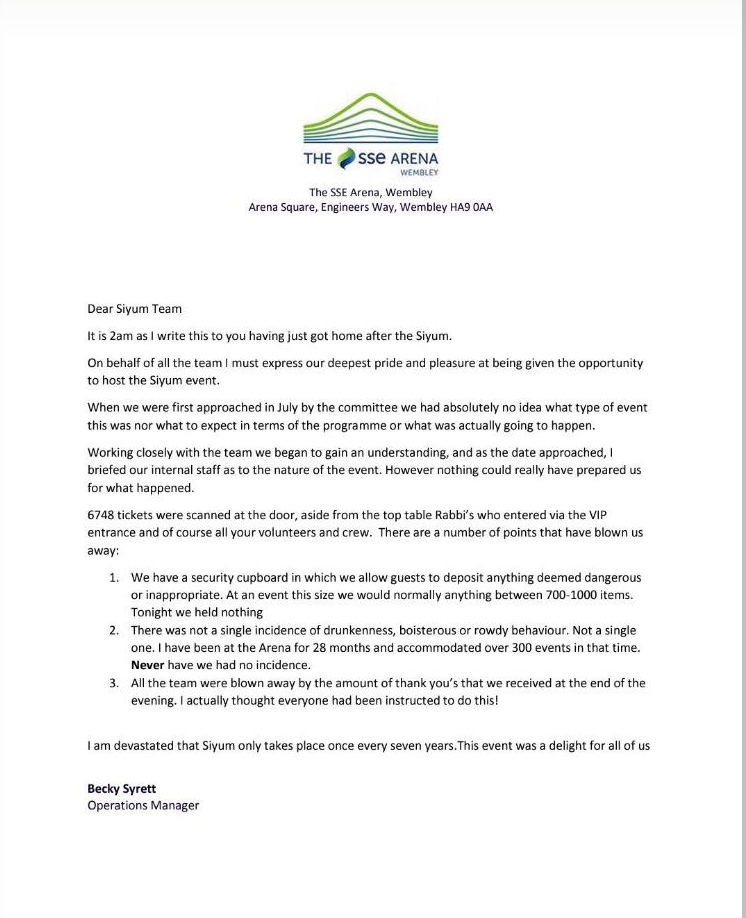
Becky Syrett, Operations Manager of
London’s Wembley Arena, wrote a letter following the Siyum held there that
hosted over 7,000 participants. She
wrote that the stadium staff was “blown away” that there was “not a single
incident” of “drunkenness, boisterous or rowdy behavior,” during the event,
which she says in her 28 months of working at the arena at over 300 events, has
never happened before with a crowd that size.
She also pointed out that not a single dangerous item was confiscated at the event and that her team was very impressed by the amount of “thank yous” they received at the end of the evening. She concluded her letter by saying, “I am devastated that Siyum only takes place once every seven years. This event was a delight for all of us.”
Clearly, our people rose to the occasion
and put our best feet forward. Our mission is not just to study Torah as an
intellectual or academic exercise, but to be molded and shaped into Torah
personalities, representing its ideals and living its values. Our rabbis emphasize that
the highest level of learning is ללמוד על מנת לעשות,
learning for the purpose of practicing.
As much as the study of Torah deserves to
be celebrated, the living of Torah, the implementation of Torah values,
deserves our greatest celebration.
I only hope and pray we can continue to
rise to this level of positive behavior consistently, and not only in
association with an event that happens every seven- and-a-half-years.
Personally, there is something else I am thinking
about as I take in the vast celebrations of the Siyum. Nearly every single article, post, video or
interview about the massive event at MetLife Stadium highlighted the exhilarating
experience of being with over 90,000 Jews gathered together in one place and
sharing one experience. While people reflected positively about the speeches
and program, it was unquestionably the 90,000 people davening, saying Tehillim
and dancing together that left the strongest and most indelible
impression.
What if instead of the huge gathering at MetLife stadium, ten venues had been chosen that would host 10,000 people each. Certainly, being together with a group that large would be a positive experience, but not nearly as special as being close to one hundred thousand together. By extension, if you have one hundred venues in the tri-state area that had 1,000 attendees per venue, it would be a great display of kavod haTorah, but those who participated would not walk away with the transformational experience of filling a whole massive stadium together.
Just a few days after the Siyum HaShas, 25,000 people
marched
across the Brooklyn Bridge and held a rally to protest the rise of antisemitism. One of the participants commented to me that
he was very moved to be part of such a large gathering of people, all moved
towards working on the same cause. What
was particularly meaningful, he noted, was seeing how many young people were in
attendance and how charged they seemed on this issue. He shared that he hadn’t felt this way or
seen a young people engaged in a movement in this way since the Soviet Jewry
rallies of many years ago.
Now imagine, instead of 25,000 people
marching together, 25 different communities held a gathering with 1,000 people at
each gathering. It would make a
statement, but it wouldn’t generate a feeling, a sense of a movement that was
achieved by their all being together.
The Siyum doesn’t happen each week and
protest rallies don’t occur with regularity, but there is a gathering we hold
daily and in an even more highly-attended way on weekends. It is called davening and it happens at
Shul. When we gather as many people
together as possible in one space, it generates an energy, a feeling, and sense
of a movement. And when we divide up and
host private minyanim across the community in homes or breakaway settings, while
combined it may include the same number of people who davened, the experience
cannot be compared, and the impact is totally different.
The pasuk in Mishlei (14:28) describes an
axiom of Halacha: B’rov am hadras melech, the larger the gathering,
the more glory and honor we give God. With this in mind, the Shulchan
Aruch (Orach Chaim 90:9) records that one should always try to daven in
Shul. Indeed, the Gemara (Berachos 8a), recorded by the Shulchan Aruch
(90:11), describes that contributing to attendance at Shul and its quality of davening
is the very definition of being a good neighbor.
The Noda B’Yehudah (Tzlach drush 23) adds:
“Whoever has a Shul available to daven in, but chooses to daven at home, is
called a bad neighbor. Even if there is a quorum of ten people, it still
cannot compare to tefillah in Shul. A Shul is a Mikdash and Hakadosh
Baruch Hu resides there… The holiness there is similar to the kedusha of Eretz
Yisrael. The prayers go up to Heaven…When one davens at home, he
loses out on all these benefits.”
While not at the magnitude of filling a
stadium or populating the whole Brooklyn Bridge, the powerful feeling of being
together, connected and energized is available to us regularly, we just have to
show up to be part of it. When we do,
not only does it impact us, but it is also noted by those around us.
Rav Yisroel, the famed Ruzhiner Tzaddik,
points out that when hinei, behold we act as an am Bnei Yisroel,
one, unified, united people, then we appear as rav v’atzum, powerful and
mighty. The word am, nation,
comes from the word im, together.
We are truly a people when we are interconnected, sharing not only one
history, but one destiny, not only one past, and one future, but also being in
the present together.
I am suggesting that you not let your
attendance at Shul be as infrequent as the Siyum HaShas. Your shul and community need you, and you
need to join them to tap into the special energy that comes from being
together.
What Brings a Reform and Orthodox Synagogue Together? Giving Israeli Combat Veterans Some Peace of Mind
As American Jews or Jewish Americans, even if we don’t formally have dual citizenship, we unapologetically feel loyalty, appreciation and devotion to both America and Israel. But make no mistake, the freedoms we enjoy, both in America and Israel, don’t come without a cost.
It is no secret that America and Israel have enemies, adversaries who seek the demise of these two great countries, their people and the values they have in common and hold dear. It is only because of those who risk their lives protecting and preserving those freedoms that we have the luxury of enjoying the religious lives and the lifestyles that we do.
Each time I have visited the VA hospital in West Palm Beach I am struck by a sign at the entrance that puts so much in perspective: “The price of freedom is visible here.” The hospital is filled with those who carry physical, emotional, and spiritual scars created by witnessing, experiencing, and perpetrating unimaginable things.
About 20 American veterans commit suicide each day, irreparably broken by the PTSD, the post-traumatic stress disorder that haunts them. Last year we hosted an extraordinary program called Heroes to Heroes, which brings American veterans to Israel to find healing, meaning, and support. The program has had remarkable success in helping veterans find hope and faith and empowering them to turn their lives around.
One of the visiting veterans who suffered before going on the trip described his PTSD as experiencing a life-threatening car accident every single day for a year. A local veteran has been unable to drive on Palmetto Park Road over the Turnpike overpass because it reminds him of an overpass in Iraq in which he engaged in a fierce battle.
This week, once again, in collaboration with Temple Beth El and the Helping Israel Fund, Boca Raton Synagogue is hosting another exceptional program called “Peace of Mind.” Nineteen Israeli veterans of the IDF, together with two of their therapists, are spending a week in our community, continuing their intense therapy, participating in community programs and events, and enjoying much-needed and well-deserved relaxation and recreation. This extraordinary program helps combat soldiers who saw a lot of violence transition back into civilian society. Last year, our inaugural time hosting this program left an indelible impact on our community.
Each Shabbos, we say a Mi SheBeirach in Shul for the members of the US military and for members of the IDF. Some people use this opportunity to step out of shul, others’ minds are wandering, and still others engage in conversation. It seems evident that given all the soldiers do for us, we should all use those moments each week to remember that we and our children have not been drafted nor did we or they raise our hands to volunteer and enlist. Both in America and in Israel, our lives have been protected and defended by those who have volunteered and the least we can do is pray on their behalf with our full attention and concentration.
The Peace of Mind project is particularly meaningful for two reasons. First, it enables us to do our very small part to fulfill the slogan of the Friends of the IDF – “Their job is to look after Israel. Ours is to look after them.”
But it is not just the project that is special, it is the partnership we are engaged in to make it happen. We are living in an increasingly polarized world, divided by religion, politics and more. We have lost not only the capacity to engage on things we disagree about, but even to remember there are things we have in common.
Temple Beth El, a local reform synagogue, and BRS have important and significant differences. Nevertheless, our love of the Jewish people, Israel and the IDF is something we very much have in common. It has been an honor and pleasure collaborating with their rabbinic and lay leadership who have been incredibly accommodating and sensitive to ensure the program is inclusive and compatible with BRS needs and standards.
Our sincere hope is that the soldiers will gain from their time in our community. But there is no doubt that the greatest benefit will be felt by our gracious host families, by our Shul and by the whole Boca community who are proving that we can work together with a spirit of partnership, collaboration, and love on the things we both care passionately about and have in common.
Torah Is Food for the Soul: Remarks from the Siyum Hashas
Adapted from my remarks at the South
Florida Siyum Hashas in memory of Brian Galbut –
Baruch Tzvi ben Reuven Nosson – held on January 1, 2020
הודו לה׳ כי טוב כי לעולם חסדו
What a magnificent
venue. What a beautiful day. And what a momentous occasion. Today is
special not only because we join Jews around the world celebrating the
completion of the 13th cycle of Daf Yomi, but because today, we, the
South Florida Jewish community join together from diverse shuls, yeshivas and
schools, diverse backgrounds, ages, and perspectives, all gathered for one
reason, for one purpose, for that which has always united us and that which
will continue to bind us together – the centrality of Torah.
When Rav Meir Shapiro
zt”l, the founder of the Daf Yomi, was 7 years old, he found his mother crying
and he asked her why. She explained that
she was terribly sad because his melamed was scheduled to come that day but
didn’t show up. The young boy didn’t
understand why that moved her to tears.
She explained, “You don’t understand Meir’l because you are too young,
but my son, I want you to always remember, if you miss a day of learning, it
cannot be replaced, it cannot be made up.”
Rav Meir Shapiro’s
mother understood something so fundamental, so basic and so core to our people
– כי הם חיינו ואורך ימינו, Torah is not
information, it is not a set of facts, laws, or history. Torah learning is not just a way of life, it
is what provides life, sustains life and nourishes life. Without it we simply cannot live.
Rav Meir Shapiro’s
mother’s tears left an indelible impression and when the opportunity presented
itself, he introduced a system and initiative which would ensure we would never
miss a day of learning in our lives. It
is estimated that today there are more than 300,000 people around the world who
learn the Daf Yomi daily. Rav Meir
Shapiro and his wife didn’t have biological children, but make no mistake, each
blatt of gemara learned is his continuity and legacy, each of the members of
the daf his progeny.
Much of the credit
for the Daf Yomi, for the countless people who learn it daily, for the tens of
millions of blatt gemara learned in the last seven and a half years, goes to his
mother. She, and Jewish women since then,
have inspired, supported, promoted and sacrificed to ensure that a day of
learning is never missed. They, too, are
heroes of the daf who deserve recognition and appreciation this morning.
כי הם חיינו ואורך ימינו – In the golden age of the
Jewish people, Torah informed and inspired us, and in some of our darkest
periods and bleakest moments, Torah learning is what gave us not only courage,
faith and hope, but it gave us life.
My friend and colleague Rabbi Moshe Hauer
shared a story that his father only told him near the end of his life. During the war, he was exiled with Jews from
Romania to a place called Transnistria in the Ukraine. They were forced into slave labor and lived
in miserable and meek conditions. During
that time, though he was a young boy, he had the privilege to study Torah daily
with R’ Yosef Naftali Shtern zt”l, a true gadol b’yisroel. His father shared that often, when they would
finish studying, the great rav would tell the young boy, “Close your Gemara and
go home for supper.” Then he would look
at the boy and ask, “Tell me, do you have anything at home for supper?” His
father would respond, “No, not really.” So
Rav Shtern would open the Gemara and say, “let’s have another blatt Gemara for
supper” and they would continue learning.
His father told him, those extra blatt Gemara, that continued Torah
learning is what sustained him and nourished him through those dark days.
In the 5th perek of Tanya, the Alter Rebbe
writes: התורה היא המזון לנשמות שעסקו בעולם הזה בתורה לשמה, Torah is the nourishment for the soul who learns it
sincerely. המצות
הן לבושים לבד והתורה היא מזון וגם לבוש, mitzvos are
garments, they enable us to make contact with the Divine by doing them, but
Torah is the spiritual food we ingest. We digest it and it becomes absorbed by
us, part of us, informing us, inspiring us and enabling us to not only touch
the Divine but be of one mind with Him, integrated as one. When we learn Torah we are feeding our soul,
hydrating our spirt. כי הם חיינו ואורך ימינו.
Today, we are going
to recite the Hadran from a very special Gemara. The Nazis had stolen, looted, and burned all
the seforim belonging to German Jews.
Not one complete set of Shas could be found in Western Europe. Rabbi
Samuel Snieg and Rabbi Samuel Rose, both survivors of Dachau, had an idea to
print an entire full-size set of Shas in Germany. They printed 50 sets of what
became known as “The Survivors’ Talmud” on the exact printing machines the
Nazis had used to produce their propaganda during the war. The survivors in the DP camps were starving
for food, but many were also desperate to feed their souls, eager to resume
learning the Daf Yomi.
Today, almost 75
years later, as we once again face a rise of those who want to harm us, heinous
attacks by those who want to eliminate us, we will celebrate the completion of Shas
with a statement of defiance, of triumph over our enemies. With this siyum, we once again declare נצח ישראל לא ישקר. We
will read the Hadran from a volume of the Survivors’ Shas, a testament to the
immortality of our people and to the central role of Torah in sustaining us – כי הם חיינו ואורך ימינו.
Shortly, we will hold
that volume and proudly declare הדרן עלך,
we will return to you. No matter what,
no matter when, הדרן עלך, we will return to
you. Some will try to cause us להשכיחם תורתך, to forget you, but we will be back. Others will burn you and destroy you, but we
will be back. Yet others, even today,
will try to destroy Torah in Shuls in Har Nof, Pittsburgh, Poway, or Monsey,
but we will keep coming back, because nothing can keep us away. This is our mission as Jews, this is core to
who we are and remains an essential part of our mandate.
In davening we
recite, שכן חובת כל היצורים…להדר, our obligation is להדר, to approach our Yiddishkeit, our
relationship with Hashem and our commitment to Torah with passion, dedication,
love, and affection. We are a people of הדר and of הידור, a people of הדרן עלך,
we glorify Hashem by our commitment to come back again and again.הדרן עלך , a love of Torah is not just for Talmidei
Chachamim, Yeshiva bochrim, those with a strong background, or those with
brilliant minds.
Torah is for every
single one of us. The Shulchan Aruch
records that when the Torah is lifted for hagbah, one should make an effort to
see the text of the Torah and to recite the pasuk, וזאת
התורה. The Arizal takes it a
step further and encourages moving up close to be able to actually read the
words during hagbah. Others quote a beautiful custom of not looking at random words
but using hagbah to find the letter that begins your name. We find our letter, we
see ourselves in Torah, we point and proclaim, וזאת התורה,
this Torah is for me, I can learn it, I have a portion in it, it speaks to me. I, too, can tap into its timeless messages
and inspiration. It has something to say
to me and it is waiting for me to say something novel about it.
כי הם חיינו ואורך ימינו – none of us can afford to be
too busy, too distracted, have too much insecurity or too little interest to
learn Torah. It needs us and we need it and nobody understood that better than the extraordinary
person whom we dedicate this siyum to today.
When our dear friend, my yedid nefesh, Rabbi Dr. Brian Galbut, ברוך צבי בן ראובן נתן, was diagnosed with a devastating brain
tumor, he knew that as important as any medicine, treatment or therapy was for
his health and wellbeing, it was Torah learning and the learning of others in
his merit, that would give him life.
Brian cherished the Daf
Yomi. He refused to learn it from an
Artscroll or Mesivta and insisted on using a regular Gemara, even if it meant
breaking his teeth over a difficult sugya.
Daf was only a part of his rigorous learning schedule that included
exploring topics that interested him and preparing high-level chaburas that he
delivered. The wear and tear of his
seforim, the notes in their margins and the underlines on its pages all testify
to his hasmadah, diligence, and commitment to learning Torah, all while earning
a reputation as an outstanding physician and being one of the most hands-on
fathers I ever saw.
When he got sick, the Daf in particular took on special significance for Brian, not only for what it meant for himself but as the perfect project to recruit others to join in his merit. When people wanted to visit while he was recovering from surgery, he suggested learning the Daf together. He got his uncles, brothers-in-law and cousins to learn it with him and for him. He called friends and acquaintances and asked them to take it on for him. As his illness progressed, understanding the Daf became harder and harder but you wouldn’t know it. He smiled and laughed, even while he struggled. He was never fatigued, never defeated. He kept plugging away until he literally, physically couldn’t learn the Daf anymore, and even then, it continued to play in his ears.
In anticipation of this siyum in his
memory, several people shared with me the experience of being recruited by
Brian to learn the Daf. I will just
share what one person wrote:
I will never forget the call. It was a Friday afternoon in July. I was driving home from work. When I first saw the name on the caller ID my jaw practically dropped: “Brian Galbut.” This was two weeks after Brian had been diagnosed and undergone brain surgery. It shocked me to see that he was calling me now. I picked up the phone and said hello. After answering my “How are you doing” with his trademark “Baruch Hashem, feeling great, everything’s great,” he told me he wanted a favor. “You’re smart, you’re capable, you can learn…. I was wondering if you could start learning Daf Yomi in my merit?” I didn’t hesitate to agree.
Those few minutes literally changed my life. I started Daf Yomi the next day. And that learning, but most of all the source behind it – Brian putting himself out there to personally ask me to do it – sparked something in me… Until then, I could check off every box as someone “frum” — but I wasn’t connected in a serious way to learning or davening or in my connection with Hashem. Seeing how Brian immediately reacted to his illness, calling people like me, trying to get us to commit to learning, inspired me to re-evaluate my life and consider what I could do to be more like Brian, someone I had always admired as a model of a true Eved Hashem. …
There is literally no area of my life that has not improved because Brian picked up the phone and called me one July day and solicited the initial commitment. Among other things, my Torah learning and davening are better, qualitatively and quantitatively, than they have ever been. We weren’t close friends and yet not a day goes by that I do not think about Brian and what he did for me with one short phone call. I cherish his memory and I will continue to learn Torah in his memory every day.
כי הם חיינו ואורך ימינו – Rav Meir Shapiro’s mother
understood that Torah is vital to truly live each day. Rav Hauer’s father literally consumed Torah
for dinner, sustaining his life during hard times. The Holocaust survivors in
the DP camps were starving for the Daf understanding it would restore their
lives. And Brian Galbut knew that if he
could get others to learn Torah in his merit, it would not only extend his life,
but it would give them eternal life.
In Pachad Yitzchak (Sukkos, 57), Rav
Hutner shares a story from the Chiddushi HaRim of two Talmidei Chachamim who
were dancing on Simchas Torah. One of
them got tired before the other and needed to rest. When asked why, the Chiddushei HaRim
explained that one was dancing in celebration of the Torah he had already
learned and the second was dancing in anticipation of the Torah he was about to
begin. The Torah of the past has
boundaries and limits and so one becomes exhausted celebrating, but the Torah
that is before us is limitless and therefore when we celebrate it, we never run
out of energy.
Many here are marking the completion of Shas,
an enormous accomplishment. I wish you
all a huge mazel tov and bless you that Hashem should continue to grant you energy,
good health and the wherewithal to continue learning. But those who finished Shas are only half the
reason we are celebrating. We are also
here to celebrate those who are about to embark on this extraordinary journey,
whether of learning Daf Yomi, or anything else.
If you are moved by this event and by this time to imbibe the sweetness
of Torah, this celebration is for you.
If you are determined to go from today and incorporate Torah study into
your life in a real and consistent way, the joy we feel with you today knows no
limits.
You don’t have to wait for hagbah to find
your place in Torah. Make a plan
today. Join the movement of those who
realize כי הם חיינו ואורך ימינו and take upon
yourself a commitment for Torah learning.
It could be the Daf or Amud Shevui, it could be Mishna or Tanach, it
could be listening to a shiur or having a chavrusa but everyone, absolutely
everyone here, men, women and children must nourish our souls by feeding them
Torah.
Antisemites are once
again trying to destroy us. Of course,
we must fight them in the halls of Congress, in the court of public opinion,
with greater measures of safety and with security. But, we ultimately fight their nefarious plan
when we double down on our Jewish identity, when we recommit to our Jewish
mission and when we promise to keep Torah the centerpiece of our lives. We defeat them not only when we embrace Torah
stronger ourselves, but when we dedicate ourselves to share it with our
brothers and sisters who have never been introduced to Torah before. This large gathering is extraordinary, but
for each person here, there are literally 100 Jews living in our area who are
spiritually malnourished, dehydrated and on the brink of spiritual death.
Take something upon
yourself right now, right here. May
yourself a promise. Do it for Klal
Yisroel, do it l’iluy neshama of Brian, ברוך צבי בן ראובן
נתן, most of all do it for yourself.
Join Our Community
Subscribe to our newsletter or connect with us on WhatsApp.