Be Grateful for the Essential & Make Yourself Essential

Originally delivered as a derasha in Boca Raton Synagogue, Rosh Hashana 5781

Recently, an undisclosed customer of Israeli jewelry company Yvel reached out to its owner, Isaac Levy, with an unusual request.  The clearly wealthy client ordered a special, custom-made Covid-19 mask but only if it met three criteria:  it had to incorporate N99 filters, be completed by the end of the year, and it had to be the most expensive mask in the world.  

Twenty-five of Yvel’s artisans went to work on a mask made of 18-karat white gold with 3,600 white and black diamonds. They produced a mask worth $1.5 million that weighs over half a pound. 


זכרנו לחיים מלך חפץ בחיים וכתבנו בספר החיים למענך אלוקים חיים

Remember us for life, King Who desires life, and inscribe us in the book of the living, for your sake, living Hashem.


In this simple yet deeply moving sentence, we beseech Hashem to inscribe us in the book of life.  Again, in the second addition to our Aseres Yemei Teshuva, מי כמוך אב הרחמים, we ask Hashem to remember us לחיים ברחמים, mercifully for life.  In the third insertion, though we add a word to chaimוכתב לחיים טובים כל בני בריותך, now we ask Hashem to inscribe us for a good life.  And then again in the last insertion we reference בספר חיים…לחיים טובים ולשלום.


Why is good life mentioned only in the last two insertions and not the first two? Why not ask for חיים טובים, a good life, from the start? 


The Vilna Gaon explains that the first three berachos of Shemoneh Esrei are about life in the World to Come.  In the future, in the עולם האמת, the world of truth, the world of complete revelation, there is no good or bad, there is no distinction between life and a good life.  By definition, life in the next world is good and so we don’t need to specify טובים it in our tefillah.  However, says the Gaon, the last two insertions refer to our request for life in this world, in the here and now.  In this world, which could go either way, we specifically want a good life so we ask for חיים טובים.


But I would like to offer a different suggestion, one that these past six months have taught us all.  Perhaps the reason we begin by simply asking for חיים, for life, is because we cannot and must not take life itself for granted.  Before we can ask for חיים טובים, for the wonderful and beautiful joys and pleasures of life, before we can dream, wish, fantasize, and hope for exactly what we want our life to include, it cannot and must not be lost on us how fragile, tenuous, and unpredictable life is altogether.  


If last Rosh Hashana I would have stood up here and said, “Chevra, we need to daven hard, we need to dig deep and pray from the bottom of our hearts because I have a premonition, I fear in this coming year the entire globe will be struck by a plague, we will have to shut down the economy, the country, our shul, we will all wear masks, distance from one another, many won’t be able to leave their homes and many, way too many will lose loved ones almost overnight from this horrific plague,” it might have been my last speech.  You would say, “Rabbi, talk about something real, something relevant, something that could actually happen.” 


And yet in the last half of the past year, חיים טובים, the indulgencies and luxuries of life, have not been the priority.  חיים, our very survival, our family’s safety, our community’s health and wellbeing, staying alive and keeping those we cherish healthy have consumed our thoughts and dictated all of our actions, policies, and practices.


The distinction between two categories – “essential” and “non-essential” – has always been part of living a Torah life.  Remarkably, these words have dominated the world’s conversations this past half a year.  Essential workers and businesses were allowed to operate even when non-essential ones were asked or ordered to lock down.  We went out for essential items and activities, even when we were asked to remain at home and forego that which was unessential.  People everywhere continue to struggle to determine what is essential and important to do or go to, and what is unessential and worth skipping in an effort to mitigate risk. 


For almost seven months now we have been preparing for today, for coming before our Creator knowing the difference between חיים and חיים טובים, between essential and non-essential.  Now don’t get me wrong, we miss the non-essential. The “normal” parts of our lives we took for granted—socializing, playdates, vacations, kiddushes, simcha dancing, travel, and so much more—were not only enjoyable and fun, these were important and significant parts of life.  Yet, as badly as we crave their return, we have learned to live without them, at least for the time being.  We have realigned our priorities, refocused our values, and we have come to appreciate the gift of חיים, even before we get to חיים טובים.


Before Corona most people were inclined to feel invincible, indomitable, that all would continue the way it was, that we could and should expect to wake up tomorrow, to experience next week, to fully live next year and to enjoy the next decade and beyond.  And yet, an invisible and pernicious virus has taught us that nothing could or should be taken for granted, nothing, not our lives or anything in them, is predictable or certain.  The default and expectation should not be forחיים טובים or even חיים at all.  Each day we wake up, each moment we live is a gift from above.


The Shulchan Aruch (OC 225:1) rules based on the Gemara (Berachos 58b) that one who sees a friend after a year of not seeing him or her recites the beracha of ברוך מחיה המתים, Blessed is He Who revives the dead. The Maharsha wonders, just because you have been locked down, quarantined, distancing and haven’t seen others doesn’t mean they were dead and have been revived, so why does the beracha upon seeing a long-lost friend invoke literal resurrection?  The Mishna Berura quotes the Maharsha’s answer.  He explains that every year on Rosh Hashana and Yom Kippur, our lives hang in the balance, our future is not certain, it is not secure. If we emerge successfully, it is as if we have been recreated and so when you see someone you haven’t seen in over a year, after a Rosh Hashana and Yom Kippur have passed, you make a beracha acknowledging that Hashem has revived them for another year, granted them חיים.


With this in mind, firstly, we must not take life for granted. We cannot skip to asking for חיים טובים without first thinking about the gift of חיים.  I was once talking to a mother in our community who has several significant challenges in her family.  I asked her how she was doing or how was her day and her response has stayed with me ever since.  She said, “Rabbi, any day which ends with the same head count in my home as it began is a good day, no matter what else is going on.”   Let us pour out our hearts this morning to ask Hashem for the same head count in our homes at the end of each day, each month and each year as we had at the beginning.


This morning, on the anniversary of the creation of man, of first receiving life, let’s pause and be grateful to be alive and to pray that we and those we love merit long lives.  Let’s take a moment to declare we know what is essential and it isn’t a $1.5 million mask, but it is our health, our family, a roof over our heads, food in our mouths, meaning, purpose and Torah and our lives.


Secondly, the Gemara (Rosh Hashana 32b) says that on Rosh Hashana Hashem sits on His throne and the books of life and death are open before Him.  Why does He need a book of life, isn’t it enough to not be inscribed in the book of death?  Perhaps we earn חיים, life, by simply not being inscribed in the book of death.  But what kind of life?  A life of loneliness and solitude, a life of lockdown and quarantine, a life of retreat, of fighting to survive?  Or, a life of vibrancy, dynamism, a life of company, companionship and community, a life of activity and activism?  Our Creator opens two books because we don’t just want to be inscribed not to die, we want to be given the chance to fully live, to live a good life, a life filled with joy, pleasure, nachas, companionship, and happiness.


We begin by asking for חיים, but we don’t hesitate to also ask for חיים טובים.  My dear friends, this morning, let’s not be satisfied with just not dying, let’s aspire to live again, to sit in shiur together again, to hug our friends again, to hold our grandchildren again, to dance together again, to enjoy Shabbos and Yom Tov meals together again.  These days are Yemei Ratzon, special days to pour out our hearts to daven, to plead. Let’s together, collectively storm the gates of Heaven and ask Hashem to not only spare us from being written in the book of death, but to inscribe us in the book of life, of good life.


And lastly, when we think about the difference between essential and non-essential, we can’t just think about how we define the things in our lives, but we must ask ourselves how others define us in their lives.  Are we essential or non-essential?  Do we matter to others, do we make a difference in their lives, do we prove ourselves essential to our family and friends, to our colleagues, to our community and most of all to Hashem? 


The Mishna (Sanhedrin 4:5) teaches us, “כל אחד ואחד חייב לומר בשבילי נברא העולם”, every one of us is obligated to say “The world was created for me”. How do we balance this with the famous declaration of Avraham Avinu, “אנכי עפר ואפר” (Bereishis 18:27) “I am but dust and ash”?


Rav Noach Weinberg z”l, the founder and Rosh Yeshiva of Aish HaTorah, used to explain: We are not supposed to say the world was created for me in a self-centered, self-absorbed, narcissistic way. Rather, “The world was created for me” means it falls to me to take care of the world.  I see myself as essential, I am prepared to step up, to serve and to be of service, to matter, to make a difference, to pursue my mission. 


You can be essential by sharing love with those who desperately need it, you can prove essential by helping others or volunteering. You are essential when you make choices not based on comfort or convenience, rather what you can do for the community. You are essential when you consistently add your unique voice to davening and learning.  You are essential not only if you donate your kidney, but also when you donate your time and your resources. 


I recently read the story of a Satmar Chassid from Williamsburg whose mother, who is in her early seventies, was having trouble breathing. Her oxygen levels were not good and she was rushed to one of New York City’s major hospitals.  She was subsequently put on a respirator as her condition worsened. For several weeks, she was in an induced coma and all her son could think was that please God she will awaken and what will she find, how startled will she be.  She will be totally disoriented after weeks of being unconscious and no family will be there to comfort and support her.  He asked if he could visit for just a half hour after she regained consciousness, but, as was the case with virtually everyone at the height of Covid in New York, his request was denied.  Only essential personnel were allowed in the hospital, absolutely no non-essential visitors could enter. 


He soon discovered that the hospital had a longstanding contract with a company that supplies personal nursing care.  The man hired a private nurse to care for his mother but then he had an idea.  He approached the owner of the company and asked to be admitted to his mother’s room under the auspices of the private nursing company.  The owner thought he was crazy and told him it simply wasn’t possible; if he sent someone who didn’t have credentials, he could lose his license and his business.  The son, this chassid, had another idea. He asked what would be necessary to acquire appropriate nursing credentials.  It turns out, as a consequence of the severe nursing shortage caused by the pandemic, New York state had enacted a law creating an expedited procedure for certifying licensed practical nurses (LPNs). One needed to only take a series of online courses and pass a written exam.


This chassid happened to be a long-time Hatzolah volunteer and an emergency medical technician (EMT). So for three straight days he locked himself in a room and listened to the online courses for LPN certification. He then took the exam and passed with flying colors.  Armed with certification, he persuaded the company to let him join their staff as a regular scheduled nurse for the night shift in his mother’s hospital room.  When she came out of the induced coma, he was there. And during her remaining weeks in the hospital, because he refused to accept that he was non-essential and went to great lengths to be deemed essential, he was there to offer support, care, and love. 

As we coronate Hashem today, let’s not take life for granted, let’s not be satisfied with not dying, but let’s truly live and let’s promise and prove that we are essential to the people around us and to our Father in Heaven. 

Geshmack or Shver: Are You Willing to Sacrifice Or Must it All Come Easy?

A few summers ago, Yocheved and I were in a remarkable supermarket.  The supermarket was larger than our local Publix.  It had all the same sections as any other supermarket – meat, poultry, fish, fresh produce, prepared foods, groceries, frozen items and much more.  What made this supermarket incredible is that it is entirely under kosher supervision. There was a complete aisle of kosher vitamins.  There was even a keilim mikvah in the supermarket so that if you buy any vessels that need immersion you could do it on the spot.  As I stood in the enormous store with an endless variety of kosher food, Jewish newspapers, kosher vitamins and even a board game called “Monseyopoly,” I thought to myself we are living in a time in which it is more comfortable than ever to be an observant Jew.  

Every aspect of Jewish living has been rendered easier, more comfortable and requiring less sacrifice.  We have pop-up Sukkahs and pre-packaged hadassim and aravos.  We purchase complete Chanukah sets already pre-assembled and ready to use.  Endless potato recipes for Pesach have been replaced by kosher l’pesach bagels, cereal and pancakes.  We buy ten pieces of bread labeled for bedikas chametz. 


Artscroll has revolutionized learning, making what were once closed texts accessible to the masses for study.   We have diverse kosher restaurants, an app to help us find minyanim within proximity to our exact location.  We have Shabbos clocks and Shabbos lamps and Shabbos alarm clocks.  In some ways, fidelity to Halacha requires less sacrifice, less compromise and less effort than ever.


And it is not just halachic conveniences, it is simply easier to function in the world today than it ever was.  Remember Disney’s “Carousel of Progress”?  It had a display showing inconceivable technology like programmable refrigerators and ovens, voice command, video conferencing, and inconceivable video games.  I remember seeing it as a child and thinking how creative this showcase was and how unlikely it would or could ever come true.  Well, somewhat sadly Disney has not updated that carousel, and when I saw it with my family a couple of years ago, my children wanted to know why things that exist in their past are being described and celebrated as the future. 


We now FaceTime with people around the world, program our smart houses, and some are already relying on our self-driving cars. The increasingly comfortable world, Jewishly and technologically, is making us progressively uncomfortable with discomfort.  Even now, when a global pandemic forced us to adapt, we got used to everything being conducted over Zoom, from shiurim to board meetings to parent-teacher conferences, in a way that makes us consider whether we want to return to those things in person. We expect everything to be easy, compatible, pleasant, and convenient. 


To be honest, I am worried about our generation, a truly privileged generation’s capacity for mesirus nefesh.  To be clear, there is nothing wrong with all of the wonderful progress.  We should enjoy and celebrate the abundance of options and the ease of being an observant Jew and a blessed member of the 21st century.


But, what happens when we encounter that which is inconvenient, uncomfortable or incompatible?  Do we have the interest let alone the strength to persevere, to overcome, to endure?


On Rosh Hashanah we use a horn of the ayil, a ram, for a shofar.  The Shulchan Aruch writes (586:1), “It is best when the shofar of Rosh Hashanah is from an ayil…although all shofros are kosher.”  The Gemara (Rosh Hashanah 16) wonders, “Why do we blow shofar specifically with a ram’s horn?”  It answers, “Hakadosh Baruch Hu says, ‘Blow for Me with a ram’s shofar so I will remember akeidas Yitzchak and I will consider it as though you were bound on the akeida before Me.’” 


When we want to persevere and triumph in judgment, when we want to be worthy of being written and ultimately sealed for a year of prosperity and blessing, we think about and invoke the story of the akeidah.  It is what we literally read for Kerias HaTorah on one of the days, and it is the reason we use the shofar of a ram on both days: “Vayehi achar ha’devarim ha’eileh v’ha’Elokim nisa es Avraham, va’yomer elav Avraham, va’yomer hineini.  And it happened that God tested Avraham and said to him, ‘Avraham,’ and he replied, ‘Here I am.’”


I would like to suggest to you that the akeida and Rosh Hashanah go together because it is the power of “hineini,” of being tested and answering the call, that should be on our minds as we prepare for judgement.  As we think about coronating God as our King, we are to consider – Have we answered the call like Avraham?  Have we been prepared to make sacrifices in our lives and lifestyles?  Have we passed the tests that we have confronted and persevered in the face of the adversity, temptation, and seduction that has come our way?


Some are tested with maintaining faith during a health crisis or a financial collapse or infertility or a failing marriage.  Some are tested with being loyal to the Torah’s view of the world when it conflicts with Western culture and values and others are tested observing Jewish laws that are inconvenient or even incomprehensible to them.  Some are tested with coming to shul while others are tested with paying attention while there.  Some are tested when submitting their income taxes and others are tested when surfing the web. And of course, while we all face a variety of tests every year, there is surely not a single person in the world who has not been tested in some way this past year by the coronavirus and all that has come with it.


When it is our turn and our time, when v’ha’Elokim nisa es…, when God tests us, do we care enough and are we strong enough to say “hineini,” I am here, I am prepared to sacrifice, to struggle, to compromise, to forfeit and to submit?  Or do we believe that life should be comfortable, easy and convenient, so when we encounter conflict we disappear, we check out, we drop whatever necessary to get our comfort level back up?


Rav Moshe Feinstein zt”l famously said that we must not tell our children “t’iz shver tsu zeyn a yid,” it is difficult to be a Jew, but instead, we must tell them “it’s geshmak to be a yid,” it is amazing to be a Jew.  He was right and remains right.  We need to show our children the beauty of our tradition, how it enriches and enhances our lives and brings deep meaning and great joy. 


But with that said, let’s admit for a moment that it isn’t always geshmak to be a yid.  It is sometimes shver.  When you have to wake up early for selichos and you are exhausted, when you lose a business opportunity because of Shabbos, when you are stuck somewhere with nothing kosher to eat, when the Torah law doesn’t fit neatly with the mores of the time, it is shver, it is difficult.  And yet, at those times, in those moments, are our “hineini” opportunities.  That is our chance like Avraham to say, I don’t only show up for a Judaism which I perceive as pleasant and pleasurable, but even when it is hard and challenging and makes me work – “hineini!” – I am here, I am in, I am ready.


Willingness to compromise, sacrifice and submit is a critical part of religious experience.  We like to show how compatible Judaism and Torah are with science, with our liberal values, with the world we live in.  But religion is not about compatibility with what is convenient for us to believe and with how we prefer to behave.  At its core it is about a willingness for submission.  Rosh Hashanah is about being mamlich Hashem, coronating God as our King and with it, kabalas ol malchus shamayim, accepting and surrendering to the will and dominion of our King, even when it takes sacrifice and submission.  On the Day of Judgment we coronate God with our words but we truly coronate God not in shul but in our homes, our work places, our gyms, and our recreational activities, by standing the tests we face.


In a famous footnote in Halakhic Man, Rabbi Soloveitchik wrote:


This popular ideology contends that the religious experience is tranquil and neatly ordered, tender and delicate; it is an enchanted stream for embittered souls and still waters for troubled spirits…This ideology is intrinsically false and deceptive.  That religious consciousness in man’s experience which is most profound and most elevated, which penetrates to the very depths and ascends to the very heights, is not that simple and comfortable.  On the contrary, it is exceptionally complex, rigorous and torturous.


If we use the ram to invoke Akeidas Yitzchak why do we specifically use the horn?  If our goal is to remind Hashem of Akeidas Yitzchak, couldn’t we have used any part of the ram that was ultimately brought instead of Yitzchak?  Why specifically the horn?


Perhaps we can answer with an insight from R’ Meir Shapiro in his Imrei Da’as.  The passuk says he set out on the first day and arrived on the third.  What happened in between?  The Midrash (Tanchuma, Vayeira #22) says that when Avraham set out to bring his son as a sacrifice, along the way the Satan, the dissuading voice tried numerous times to discourage Avraham from going through with his mission. Avraham persevered each time and ignored the voice seeking to dissuade him.


When he finally raised his hand to strike his son Yitzchak, an angel instructed him to stop.  Wonders Rav Meir Shapiro, how did Avraham know that the voice of the angel was authentic and legitimate?  How did he know it wasn’t the Satan one last time?  He answers that the text tells us that Avraham notices the ram ne’echaz basvach, struggling in the thicket.  Only upon noticing the ram struggling was Avraham convinced to in fact put down the knife.  Explains Rav Shapiro, falsehood and temptation come easy.  Truth and meaning are connected to struggle and effort.  Avraham noticed the struggle of the ram after hearing the angel’s voice.  When he saw struggle, he knew he was in the presence of truth.


Perhaps we specifically use the horn of the ram because it was the horn that was entangled and caught.  The ram struggled to escape but its horns were caught in the bush and it couldn’t get out.  The shofar represents challenges and struggles.  It was chosen because Hashem cherishes our struggles.  He values our efforts and cares deeply about each and every moment of perseverance.


A few years ago I got to know a family living on an island in the Caribbean that wanted to convert to Judaism.  They were mentored by their local rabbi and studied diligently with a rabbi in Israel.  I ultimately met them in person and visited their small local Jewish community.  A few weeks later I got an email from him:

We have made a lot of changes in our lives just to be a part of HaShem’s people. These changes have not been easy but have been worthy, and even more when we complete the process. You saw our commitment, as you expressed that you were impressed.


Our desire to finish the process is not just for the sake of getting to be called  Jews. Being a Jew is very hard, takes courage and dedication. We are willing to continue to make sacrifices and take this path all the way. For this we need your help. 


When we welcome someone to the Jewish people they stand in the mikvah about to undergo an enormous transformation and we ask them a series of questions.  One of them, the Gemara tells us, is do you know that it is really difficult to be a Jew?  Are you aware that keeping Jewish law is complicated, keeping kosher and Jewish schools are expensive, anti-Semites want to kill us?  Are you prepared to make the necessary sacrifices to be a Jew?  Only when a candidate says yes do we welcome them to our people.


The ram’s Shofar asks us those same questions.  Do we answer the call of the akeida like Avraham Avinu?  In the coming year, are we willing to remember that avodas Hashem is called “avodah” for a reason, because it takes work and effort. 


Robert Browning, the 19th century English poet, put it well when he said, “When the fight begins within himself, a man’s worth something.”  Let’s make our lives worth something. When inevitably called upon to struggle spiritually or theologically or in our lifestyle, let’s determine, as we approach this great day of judgment and awe that we will answer hineini, here we are. 

3 Things That We Can Still Control, Even When We Feel Powerless

The story is told of a young couple that moved into a new neighborhood.  The next morning while they were eating breakfast, the young woman saw her neighbor hanging laundry outside. “That laundry is not very clean; she doesn’t know how to wash correctly. Perhaps she needs better laundry soap.”  Her husband looked on, remaining silent.

Every time her neighbor hung her wash out to dry, the young woman made the same comments.  A month later, the woman was surprised to see a nice clean wash on the line and said to her husband, “Look, she’s finally learned how to wash correctly. I wonder who taught her?”


The husband replied, “I got up early this morning and cleaned our windows.”


I have been thinking about this story lately while observing and even feeling some of the tensions and judgment this moment in time has created.  History will undoubtably record the data – how many casualties, how many confirmed cases, how many recoveries, how many long-term illnesses, how many positives for anti-bodies.


But what will measure or tell the story of how many friendships were strained, how many engagements were broken?  What will quantify the sustained anxiety, both from fear of contracting the illness and from watching how others took it either too lightly or too strictly?  How can history accurately record or capture the months- long toll of high emotions and its ultimate impact on our physical, mental, emotional and spiritual well-being?


When Covid first raged and our community, along with much of the country, was shut down, in a sense life was fairly straightforward.  Being compliant was responsible and respectful and those who weren’t were risking their lives and the lives of others.  But in the months of phased reopening and fluctuating numbers, we must admit that the reality is profoundly confusing.  To be clear, that is not to say this pandemic is over by any stretch or that we can let down our guard.  Vigilance, caution and compliance remain critical, in many cases to save or preserve lives. Nevertheless, by any measure, while we are far from at the end, we are also not where we were at the beginning. 


Certainly there is behavior that, even now, all would agree is irresponsible and dangerous.  But where exactly to draw the line between reckless and ruthless is much less clear.  Was sending children to camp (and now to school) fair or foolish?  Is it time for playdates and Yom Tov meals with distancing and precautions?  Should minyanim be held indoors, outdoors, or maybe not at all?


As a result of inherent ambiguity and competing or nonspecific guidance, “corona shaming” abounds.  Some are indignant at the carelessness of friends and neighbors, while others are appalled by how extreme the people around them are acting.  Given the stakes involved with nearly every aspect of this, it is hard not to expect and demand everyone to have the exact same attitude you do to this dreaded virus and the proper behaviors to avoid its spread. It reminds me of a famous comedian’s brilliant observation: “anybody driving slower than you is an idiot, and anyone going faster than you is a maniac.” 


While we as a community have adopted and continue to encourage safety protocols and policies, ultimately, we would do well to realize that as individuals there is so much we cannot control.  Communally, we must continue to emphasize, promote and demand compliance with safety policies, but as individuals, let’s not compound the challenges of this time by forfeiting our serenity over things and people we can’t control, rather choose to focus instead on that which we can.  Here are a few suggestions:


·      In describing the fifth habit of his Seven Habits of Highly Effective People, Stephen Covey writes, “If I were to summarize in one sentence the single most important principle I have learned in the field of interpersonal relations, it would be this: Seek first to understand, then to be understood.” Before criticizing or judging the choices of others or the decisions of your Shul or children’s schools, first take the time to try to understand where they are coming from, how decisions were arrived at, and what informed them.  The Gemara (Eruvin 13) tells us that we follow the opinion of Beis Hillel over Beis Shammai because Beis Hillel would always listen to what Beis Shammai had to say and entertain their opinion before coming to their own conclusion.  You don’t have to agree with everyone or with every institution.  Constructive criticism is fair and should be welcomed, but only after first hearing and entertaining the thought process of the other side; as the Mishna in Pirkei Avos teaches, one of the 48 ways that wisdom is acquired is shemi’as ha’ozen, active listening.


·      What we see when watching others depends on the cleanliness and clarity of the window through which we look.  Before reacting incredulously to the behavior of others, ask yourself, how consistent are you with all your choices and actions?  Are you not making your own determination as to what is essential and what is non-essential? Do you not rationalize your exceptions to your own rules?  The Gemara (Bava Basra 60b) tells us, “Keshot atzmecha v’achar kach keshot acheirim,” which is usually translated as, “Correct yourself first and only then correct others.” Rav Samson Raphael Hirsch suggests an alternative translation. The word keshot appears a number of times in the tefillah of Berich Shmeih — as in Oraisei keshot u’neviohi keshot — and it is translated there as “truth.” Based on this, Rav Hirsch explains, the mandate of our rabbis is to be truthful with yourself and only then examine others. It is said that when you point a finger at someone else, three more point back at you. 


·      We may be powerless to control others, but we can control ourselves.  We don’t have to feel or react with anger, anxiety, frustration, resentment, helplessness or hopelessness, no matter what is happening or how people are behaving around us.  The Torah tells us u’vacharta ba’chaim, the choice regarding how we spend our time, what attitude and demeanor we have, what we focus on, is up to us.  Never stop realizing that we control our thoughts and we regulate our emotions.  Don’t ever give the key to your happiness and serenity to others. 


·      With all the uncertainty and powerlessness, we can and must redouble our focus on prayer.  In addition to fundamentally believing that Hashem craves our prayers and responds to them, even if the answer isn’t always yes, there are also measurable health benefits to praying regularly.  Dr. David H. Rosmarin, assistant professor of psychology at Harvard Medical School, says that research conducted on prayer shows it can calm your nervous system, shutting down your fight or flight response. It can make you less reactive to negative emotions and less angry.  Channel the frustration with others and the anxiety over what feels like an endless pandemic into drawing closer to Hashem, talking to Him, leaning on Him and even objecting to Him.  These Yamim Noraim, our davening will be more abridged, our singing more muted, and many won’t be able to participate in minyan at all.  But no matter where we are, now is not a time to be more casual or cavalier about prayer, it is a time to increase our fervor, intensify our concentration, and to dig deep to compensate for what is missing so that our tefillos can pierce the gates of Heaven. 


When looking out at the world, make sure to clean your windows first.  Do all you can to keep yourself and your family safe.  And then, make the decision that instead of perseverating over what you can’t control, you will focus on what you can. 

4 Recommendations For Raising Kinder Children

Ralph Waldo Emerson once said, “What you do speaks so loudly that I cannot hear what you say.”  When we say one thing and communicate a different message through our actions, priorities, and values, we drown out our own voices.  There is no instrument more finely calibrated to detect hypocrisy and duplicity than a child.

Our Parsha tells the story of the rebellious son.  Our Rabbis teach us that the criteria to qualify for this label have never been and will never be met and that such a child exists only theoretically.  Yet a series of pesukim are dedicated to this subject because there is so much to learn and glean about parenting and education nonetheless. 

Rashi tells us the term soreir comes from sar, he has drifted from the path, he is not meeting our expectations and hopes.  The Torah tells us he does not and cannot hear kol aviv u’kol imo, the voice of his father and the voice of his mother.  The Torah never wastes a word and yet it could have said b’kol aviv v’imo, he doesn’t listen to the voice of his father and mother.  It must be that the second use of kol, voice, is not redundant or extraneous at all.  Rather, there is in fact a separate kol aviv, a message and values of the father, and a kol imo, a message and values of the mother. 

When children receive mixed messages, inconsistent and contradictory values, everything becomes incoherent.  They then stop paying attention and begin to be soreir, drift, until it ultimately leads to moreh, rebellion.  It is not only parents that influence and raise a child but it is the grandparents, the school, the shul, and all the adults in the community to whom they turn for modeling and for inspiration.  We must be on the same page and project a consistent message of what our values are, what we are all about, and what we expect from them. 

The Ohr HaChaim Ha’Kadosh, Rav Chaim ben Attar, notes that the passuk does not say eino sho’meiah but einenu sho’mei.  There is a big difference between the two.  Eino means he doesn’t, einenu means he can’t, there is a blockage preventing the message from penetrating.  Our children and grandchildren literally cannot hear what we say when our contradictory actions are much louder. 

If your child or grandchild ask you – do you care more about my being happy and successful or my being kind – what would you answer?  I would hope they would hear us answer being kind.  And yet, though our voices may be saying that, we are clearly articulating another message.  According to a recent study done by researchers at the Harvard Graduate School of Education, when asked if their parents care more about achievement and happiness or if they were kind to others, 80 percent of children said their parents care more about achievement or happiness.  In the same study, children were far more likely to rank “hard work” above fairness. 

The study concludes: “But when youth do not prioritize caring and fairness over these aspects of personal success — and when they view their peers as even less likely to prioritize these ethical values — they are at greater risk of many forms of harmful behavior, including being cruel, disrespectful, and dishonest. These forms of harm are far too commonplace. Half of high school students admit to cheating on a test and nearly 75% admit to copying someone else’s homework.  Nearly 30% of middle and high school students reported being bullied during the 2010-2011 school year. 

“At the root of this problem may be a rhetoric/reality gap, a gap between what parents and other adults say are their top priorities and the real messages they convey in their behavior day to day… And here’s the irony: the focus on happiness, and the focus on achievement in affluent communities, doesn’t appear to increase either children’s achievement or their happiness.”

Dr. Richard Weissbourd, one of the authors of the studies, states, “We should work to cultivate children’s concern for others because it’s fundamentally the right thing to do, and also because when children can empathize with and take responsibility for others, they’re likely to be happier and more successful, they’ll have better relationships their entire lives, and strong relationships are a key ingredient of happiness.”

Rav Shamshon Raphael Hirsch notes that the Torah describes the ben sorer u’moreh not only as a rebellious child, but as one who is zoleil v’sovei, gluttonous and indulgent in meat and wine. Rav Hirsch explains that the inappropriate emphasis in the home on food and drink, success and indulgence, leads to rebelliousness. Parents, he says, must be much more concerned with their child’s values, behavior, sensitivity, and kindness than with the quantity and quality of the food their child is eating.  We focus on our children being well-fed, well-dressed, and happy, all of which are important. But we must focus even more on who they are and how they behave than on their happiness.  They need to know that we care more about their concern for the happiness of others than for their own happiness.

Weissbourd provides four recommendations to raise and cultivate kinder children:

1.     Children and youth need ongoing opportunities to practice caring and helpfulness, sometimes with guidance from adults. Learning to be caring is like learning to play an instrument – it needs daily repetition.  Encourage your children to help a friend with homework, pitch in around the house without a connection to a reward (like allowance), and to volunteer in some capacity.  When you speak to your child or grandchild at the end of the day, don’t just ask how they are doing on their grades and tests but ask them if they did anything kind that day for someone else.


2.     Children and youth need to learn to zoom in and zoom out.  They need to listen closely and attend to those in their immediate circle like family and friends but they also have to learn to zoom out and look for those who are too often invisible like a new kid in the class, or the school custodian who is largely ignored and feeling isolated.


3.     Children and youth need strong role models.  Veshinantem levanecha v’dibarta bam, b’shivtecha b’veisecha u’velechtecha baderech… The Torah obligates us to teach our children and we usually assume it is fulfilled with v’dibarta bam, by articulating and verbally communicating our values.  However, the truth is they learn much more from b’shivtecha b’veisecha, how we carry ourselves at home, the type of conversations we have, and activities we engage in.  They learn from b’lechtecha ba’derech, what we do on the road.  We should seek opportunities to share moments in our day when we were kind to another or when we were the recipients of the kindness of another and how it made us feel.  If our deeds match our words our ideals will come across loud and clear.


4.     Children need to be guided in managing destructive feelings. Anger, shame, envy and other negative feelings arise and we need to teach children that those feelings are ok but must be dealt with constructively if they are to be resolved and not overwhelm their ability to care for others.


As our parsha emphasizes, Hashem cares as much – if not more – about our behaving with righteousness, justice, and kindness as He does about our observing His laws.  The best gift we can give our children is not making them believe the world is about them, but helping them learn the world is about helping others. 


The parsha concludes with the laws of having honest weights and measures and describes one who doesn’t as a to’eivah, an abomination.  However, the verse uses two phrases – kol oseh eileh, kol oseh aveil, one who does “these,” and one who does “iniquity.”  Rav Menachem Bentzion Zaks, in his Menachem Tziyon, offers a novel interpretation.  The abomination, he explains, is when someone is oseh eileh, learns Torah and does mitzvos and yet, oseh aveil, is dishonest, lacks integrity, and is unkind.  God has no tolerance for such a duplicitous person.  To Hashem, it is repulsive and despicable to appear as a religious, observant individual and yet be rotten to the core when it comes to honesty and righteousness.


Wearing a kippa and going to Jewish school provide tremendous information, knowledge, and lessons.  Nevertheless, our children are ultimately molded most by what they think that we, their parents and grandparents, value most.  When our children are asked if their parents care more about achievement and happiness or being kind, let us do all we can to ensure that they know the right answer.


In and Out, Quick and Easy Judaism: Can We Do Better, Even in a Pandemic?

Shortly after BRS shut down in March, someone said to me, almost half-jokingly, “Imagine if things are still like this for Rosh Hashanah.”  I vividly remember dismissing the sentiment saying there is no way, this shutdown will only last a few weeks at most, and it will most certainly be figured out by Rosh Hashanah. 

Well, here we are welcoming in the month of Elul and, with it, the launch of the Yamim Noraim season. While we know more now than we did then and things are a bit more under control, this pandemic continues to grip the globe and to significantly hamper our lives, lifestyles and, in all likelihood, our High Holidays.


Planning, providing and coordinating meaningful shiurim, classes, programs, and most of all minyanim this year is extraordinarily complicated and challenging.  The questions and dilemmas of what to do are not limited to decision-makers at institutions like Shuls and schools. These questions are also very real and present for the stakeholders of those institutions who have to decide comfort level, safety threshold, personal risk factors and more before determining if, what, where and how to participate. 


I fear that when considering how hard it is to access inspiration in this unprecedented climate, many people will simply write off this Elul and Yamim Noraim, take the spiritual loss, and move on hoping to make it up when this all passes. Such an attitude is understandable, even enticing.  After all, who doesn’t have corona fatigue, who isn’t done with Zooming?  Many are lonely, most are emotionally spent, all are very tired of this. 


While there has been lots of learning over Zoom and amazing chesed efforts that have been creatively coordinated, there is also a sense of spiritual apathy, a sentiment of trying to survive religiously, rather than to thrive.  This complacency manifests itself in several ways, including in participation in minyanim—both outdoors and in Shul.


Even now, some people are continuing to stay home or daven in a local development minyan because of genuine health concerns, and these people are doing the absolutely correct thing. Let me be clear: Someone who davens alone or outdoors near their home out of safety considerations should not feel at all guilty, ashamed or hesitant and they should continue until they feel it is safe to do otherwise. 


That said, let’s be honest.  Many people are also not coming to shul or staying home entirely out of sheer convenience.  That becomes evident when the level of personal comfort and concern when it comes to sharing meals, playdates, shopping and socializing is radically more permissive and lenient than it is when it comes to joining davening. 


I understand the attraction of davening on the block.  After all, it is more conducive to dressing in whatever is most comfortable, it is condensed, there is no Torah reading or Haftorah, no speech or announcements.  One person recently commented that he is very comfortable coming back to shul from a health perspective, but he doesn’t want to because the davening on his block is in and out, quick and easy.   


In and out, quick and easy.  Is that what our Judaism has been reduced to?  Does living through a pandemic mean we can’t have spiritual ambitions or aspirations, that we can’t push ourselves beyond our comfort zone or stretch to do what is right, not what is easy, what is virtuous, not what is most convenient, what will give the greatest nachas ruach to Hashem, not necessarily what is most expedient or convenient for me?


Some will counter that davening at shul isn’t normal either.  We are making compromises in the minyanim at shul: we start at a different place in the davening, singing is reduced, the derasha is shortened, there is no socializing, no Kiddush, no place for young children. For some people, some or all of this contributes towards the desire not to come back.  Honestly, I hear that, I really do.  I miss those same things terribly and ache from their absence. 


But let me ask you this – if your loved one were convalescing and you were told you can start visiting them again but you have to wear a mask, you cannot hold their hand or come too close, you cannot stay long and you can only talk to them from the doorway, would you say, “Well that isn’t the normal way or the ideal way to visit so I am just going to continue waving from outside the window”?  Of course not. You would take what you could get, grateful for the opportunity to come just a bit closer, to feel more in their presence, to communicate how badly you want to draw close once again.


Yes, this year is dramatically different from all others.  In most years, we can rely on others to generate our inspiration.  We attend the talk of the speaker who motivates us, listen to the chazzan who inspires us, join the tzibbur who lifts us.  This year, for those who must daven alone and even for those who can attend shul, we won’t have the same support system, the same external drivers of inspiration.  But I plead with you: do not write off this season. Do not take a loss on the Yamim Noraim this year.


Inspiration, motivation, growth, and change are all readily available to us this year as much as any other when we realize that ultimately, these things must come from within ourselves.  They don’t depend on others and we can experience them if only we are determined to.


Indeed, even in normal times, many who have yet to make needed changes in their emotional, physical or spiritual health say, if only I had someone to inspire me, if only I read the right book, attended the perfect seminar.  If only my spouse were on the same page, if only my children were more obedient and compliant, if only my rabbi was more available, if only my boss was more supportive, if only my parents were more encouraging, if only…


But those are excuses, they are deflections and distractions.  Of course, supportive surroundings help us but if we are not motivated, inspired, or driven to make changes they will never happen no matter who we are married to, how our children behave, what DNA our parents gave us or what virus is plaguing the globe. 


Elul and the holidays present us with a list of questions to consider – who are we, who do we want to be, what difference are we meant to make, how are we thought of by others and by Hashem, how do we ultimately want to be remembered?  The word teshuva literally means an answer or answers as in she’eilos u’teshuvos – questions and answers.


The truth is that every single year, the answers we are looking for are not found in others, they aren’t available or provided by anyone or anything other than us. The Yamim Noraim are a large mirror held up to us, covered with these questions and others.  Sometimes the teshuva is easy, a minor adjustment, a tweak. Other times the teshuva, providing meaningful answers, may involve a large overhaul.  If we are sincere and genuine in the process of responding to the questions, then we have done teshuva, we have provided teshuvos, meaningful answers.


The most valuable, satisfying, gratifying and meaningful things in life are never in and out, quick and easy.  They take effort and struggle, they often demand sacrifice, but they are worth it. 


Whether you can come back to shul, can only daven in an outdoor minyan, or need to daven alone, don’t sell yourself short, don’t underachieve or write off this time spiritually. Persevere, fight through, and push yourself. Set goals and make resolutions to achieve them.  Inspire yourself and your family to not only survive but to thrive, to make choices now that will allow you later to look back and see how much you grew, how you were transformed by the lasting meaningful changes you made during the pandemic Yamim Noraim.


For the forty days from the beginning of Elul through Yom Kippur take on a challenge.  Perhaps it can be to start wearing tzitzis or putting on tefillin each day, maybe a promise to turn your cell phone entirely off each time you daven, perhaps to listen to a shiur or learn on your own a little more each day. Consider pushing yourself to exercise or to eat in a more healthy way.  Resolve to interact better with a specific family member or friend. You choose the challenge, but understand that no matter your environment, only you can provide the teshuva, the answer. 


If you accept this challenge, these forty days likely won’t be quick and easy, but I guarantee you that the results will be well worth it.

#MeToo, Davening and Family Time: The Blessing of Boundaries

I recently encountered an engaged young man, a friend of my son-in-law, and asked him where his kallah is.  He responded, “We are not seeing each other today, because you know, the gedarim.”  Ah, the gedarim.  If you are unfamiliar with the term, “gedarim” are the boundaries suggested by contemporary rabbonim and kallah teachers that prescribe how often an engaged couple should see and communicate with one another. 


When I first heard of the gedarim, I must admit I reacted with cynicism and skepticism.  I didn’t have gedarim when I was engaged, why are they necessary now? When this couple is soon married, will anyone put restrictions on how often they see each other and speak then? Aren’t communication and spending time together the cornerstones of a healthy marriage? Why would anyone seek to regulate or minimize such fundamental parts of a relationship?


Yet, the more I thought about it and discussed this practice with young people, the more I came to realize the reality today is radically different than when I was engaged. With the gift of technology, nowadays there are no true goodbyes, no disconnecting, no time a couple needs to feel apart.  Of course, the engagement period is an important stage, a time to celebrate commitment to one another, to look towards the future, to transition to building a home together.  But it is also not marriage, halachically or civilly, and many things permissible in marriage remain out of bounds during engagement. Hence gedarim, boundaries, to remove the pressure to be together or connected constantly and to reinforce the awareness that while engagement is more than dating, it is not yet marriage.


Gedarim are not halachically obligatory and do not even rise to the level of minhag.  They aren’t for everyone.  I mention them not as a global recommendation but because the concept strikes me that they are a metaphor for what coronavirus is bringing to the broader world.


Six months ago, could you imagine countries outright closing borders to one another?  If I told you that states in America would be monitoring their borders and literally tracking people coming in from other states, you wouldn’t believe me.  If I described how even in the most progressive and permissive segments of society, not only would nobody greet others with a kiss or hug, but not even a handshake, you wouldn’t even be able to imagine it. 


And yet, here we are. For the last five months, coronavirus has brought us unwanted gedarim, greater boundaries, to the world. Something invisible is forcing us to regulate our time together, limit our contact with one another, and deny our ability to fully come face to face. 


Many parts of these gedarim are difficult and unwelcome, and we anxiously await the time when they are lifted. But this moment also presents us with an opportunity to take a step back and recognize that some of these gedarim are indeed very welcome, refreshing and positive, and I for one hope they will last a long time. 


In a world of #MeToo, and no shortage of stories involving gross violations of personal space, is there not something to be said for only those closely related to one another having physical contact or even coming within six feet of another?  Having guests and connecting socially with others are wonderful, but is setting a boundary to compel more time with our immediate family not a positive development?  We desperately long to resume davening in Shul together the way we once knew. But has the perfect decorum that has resulted from distanced davening not been so beautiful and welcome?


As we continue living in a world with forced boundaries, take the time to evaluate which of these boundaries you can’t wait to be free of, and which you would not mind keeping around. Of course, we want to travel again without boundaries, to enjoy time in each other’s houses, to sit next to each other in shuls, schools, and restaurants.


Nevertheless, when please God, we turn a corner and resume normal activities and interactions, let’s not just do away with all the gedarim, the boundaries and rules that this pandemic has introduced to our world.  Some boundaries restrict and hold back but let’s strive to preserve the ones that liberate us and grant us newfound opportunities to live morally, daven intensely, and spend time with our family. 

The Most Important Thing to Never Bring Into Your Home

In 2001, Indra Nooyi was named president of PepsiCo.  Five years later, she would be promoted to CEO and, in 2007, she would become chairman of the company as well.  She once spoke about the day she was appointed president and put in charge of running the $166 billion company.  That night her parents happened to be visiting.  Here is how she described that night:


I’ll never forget coming home after being named President of PepsiCo back in 2001. My mother was visiting at the time.  “I’ve got great news for you,” I shouted. She replied, “It can wait. We need you to go out and get some milk.”  So I go out and get milk. And when I come back, I’m hopping mad. I say, “I had great news for you. I’ve just been named President of PepsiCo. And all you want me to do is go out and get milk.” 


Then she says, “Let me explain something to you. You may be President of PepsiCo. But when you step into this house, you’re a wife and mother first. Nobody can take that place. So leave that crown in the garage.”


In our Parsha, the Torah commands us not to bring toeiva into our homes.  The word toeiva, abomination, is generic and can refer to many things.  The Torah describes inappropriate illicit relations as toeiva.  Non-kosher food, inexact weights and measures, and dishonest business practices are also identified as toeiva.  So what does it mean here?  What exactly are we warned from taking into our house and into our lives? 


The Rambam and Ramban understand that idols themselves are a toeiva, an abomination, and the Torah is prohibiting the deriving of any benefit from an idol or its accessories.  The Sefer HaChinuch extends this prohibition to another form of idolatry, the worship of money, and says our passuk is a prohibition from earning any profit from funds that were obtained in an unethical manner.


According the Gemara in Sotah (4b), the toeiva, the abomination that we cannot and must not bring into our homes, is ga’ava—arrogance, hubris or conceit.  You may have made a great business deal, given a great shiur, had a killer workout, or made world peace, but no matter what you accomplished or achieved, lo savi toeiva el beisecha, don’t bring a sense of pride or arrogance into your home.  As Indra Nooyi’s mother said – leave that abomination in your garage.


When you find success, Moshe cautions his people, you will be tempted by arrogance and conceit.  Your ego will entice you to feel that you and you alone are responsible for achieving and accomplishing greatness.  Moshe enjoins them strongly to remember it is Hashem who gives ko’ach.


Our Parsha seeks to communicate a simple message.  Success is not the result of our talents, skills, or wisdom.  It reflects the will of Hashem Who grants us that success.  Indeed, Unkelus interprets this pasuk in a very interesting way: “It is He who gave you the advice to purchase property.”  Unkelus understands that not only does Hashem allow our success, He even plants the ideas and decisions in our heads that bring about those positive results.  From Unkelus it sounds like we are essentially passive spectators and bystanders to our destiny that is in reality shaped and molded by the Almighty alone. 


Yet this position feels at odds with one of our fundamental beliefs.  In a few weeks we will read “u’vacharta ba’chayim, choose life.”  Clearly, we are given the power to make choices in our lives and those choices matter and matter greatly.  The concept of bechira chofshis, free will, is axiomatic to our faith and indeed, gives purpose and meaning to our lives.  So which is it, are we responsible for our success?  Is it the result of our choices, our talents, skills, wisdom and judgment?  Or, did Hashem plant those ideas in our head and all of our success belongs exclusively to Him?


Rabbeinu Nissim (Derashos Ha’Ran #10) is bothered by this very question and shares a very fundamental insight:


The meaning of this is as follows: The truth is that people have different talents in different areas. For example, certain people are predisposed to receive wisdom, whereas others are predisposed to devise strategies to gather and amass wealth. On account of this, the wealthy man can truthfully say, from a certain angle, “My ability and the might of my hand made me this wealth.” Nevertheless, insofar as that ability was implanted within you, be sure to remember Who gives you the ability to make wealth.


Moshe did not say, “V’zacharta ki Hashem Elokecha nosein lecha chayil, remember that Hashem is the One Who gives you wealth,” for if he had said that, he would be minimizing the ability implanted within the person, which is an intermediate cause in the accumulation of that wealth – but this is not the case. Therefore he said “Hu Hanosein lecha koach la’asos chayil –  Although your own ability is what made you this wealth, you must remember Who gives you that ability.”


In truth, says the Ran, it is our talents and skills that achieve positive results.  We can be proud of our efforts, hard work, prudent judgment, and wise decisions.  The Torah doesn’t demand that we deny what we are good at or that our being good matters.  What it does demand of us is to always remember who gave us those skills, talents and abilities. There is nothing wrong with being proud of our intelligence, decision-making, or prodigiousness in a given field.  But we must recognize that those gifts are on loan from the Almighty and never owned by us.  Arrogance is thinking we control our gifts, they are part of a permanent collection.  It is thinking we are autonomous and we are the sole arbiters of our destiny. Transferring the deserved credit and recognition from God to us is essentially worshipping ourselves and denying God’s involvement in our lives.


Self-confidence should not be confused with arrogance.  A confident person can yet be humble as long as they know that their success or gifts are from Hashem and can be fleeting.  Humility is not denying what you are good at.  It is identifying it and then using it to be an instrument of Hashem.  The moment we feel independent and immune that arrogance takes over and our downfall begins. We are accordingly warned: Do not bring that despicable, vile, abominable character trait into your home.  Check your ego at the door.  As you enter that threshold into the home you earned, with the possessions you purchased and with the family you created, you may be tempted to feel slightly arrogant, superior or proud.  But you must check it at the door.


One of the many lessons to incorporate from the last few months is how much humility we must have despite whatever abilities and strengths we are blessed with. We may be smart, yet we must feel humbled by how much we have come to realize we do not know. We cannot bring arrogance to the kitchen table, we cannot be condescending to spouses or children or friends.  Don’t bring arrogance to the phone and have conversations that disregard or diminish others.  Don’t bring arrogance to your Shabbos table and sit in judgment of your neighbors, your family members and your community leaders.  And don’t bring that arrogance to the keyboard of your computer and express definitive, authoritative opinions about issues you likely don’t know everything about.


You may not be able to throw a slider 95 mph, but we can all be like the Hall of Famer greatest closer of all time, Mariano Rivera of the Yankees, who said in an interview upon retiring: “Everything I have and everything I became is because of the strength of the Lord, and through Him I have accomplished everything. Not because of my strength. Only by His love, His mercy, and His strength.”


As you walk into your home, the boardroom, operating room, courtroom or any other room, always remember, all that we have, the things, the skills, the talents and the blessings are on loan, never part of our permanent collection. May He continue to lend them to us and give us the strength to use them well. 


Becky Overcame Her Fear and it Saved Thousands of Lives – The “What Ifs” of Life


Jay Feinberg is one of the most soft-spoken and humble people I know.  Even at an event for Gift of Life, the organization he founded and serves as CEO of, he likes to blend in.  While he is modest and would never tell you directly, it is not an exaggeration to say that he is personally responsible for saving thousands of lives. 


Jay is the visionary behind Gift of Life, an organization that has conducted over 10,500 bone marrow drives in 49 countries, has 374,855 registered donors, has found 17,888 matches (including several amazing BRS members, Avi Amsalem, Perel Hande, Matthew Hocherman and Jonathan Struhl) and has facilitated 3,645 transplants. 


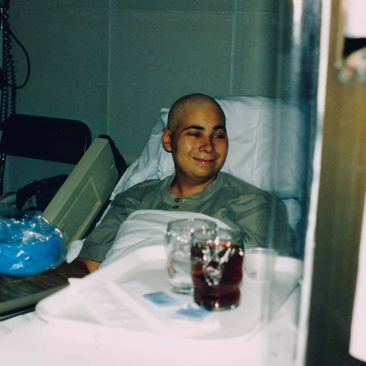
But all of that almost didn’t happen.  In 1991, during his first year of law school, Jay was diagnosed with leukemia.  His family was told he would need a bone marrow transplant to survive, but there were no matching donors in his family or in the entire national registry.  For four years, while they watched Jay’s health deteriorate, his tenacious family conducted drives around the globe.  They tested 60,000 donors and found matches for hundreds of patients along the way.  Finally, they found one for Jay. 

When he recovered, Jay was determined to ensure others wouldn’t have to wait as long for a transplant or risk not finding a match at all. Instead of returning to law school, he used his own experience to found an organization dedicated to educating and encouraging people to add themselves to the bone marrow registry and to improve the efficiency of finding matches and coordinating transplants within the Jewish community and beyond.


This week marks the 25th anniversary of Jay’s transplant, his new lease on life.  Not only is he personally celebrating and feeling grateful to be alive, we should all be appreciative of the gift of Jay to humanity and the Jewish people.


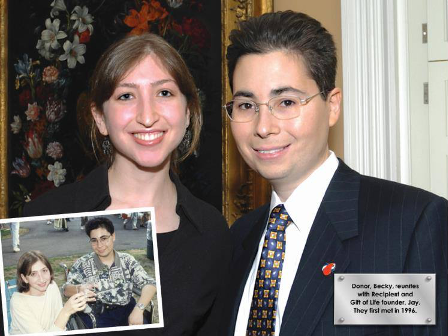
While Jay and his story are extraordinary, there are other remarkable people without whom this story wouldn’t have a happy ending.  Jay’s condition had worsened terribly, but friends of his in Milwaukee, Benjy Merzel and R’ Amir Gutman (now of Boca), refused to give up hope and organized one last drive. A young lady from Illinois, Becky (Faibisoff) Keller, volunteered at the drive, but due to her fear of needles decided not to get tested herself. 

The drive was packing up at the end of the day having tested 130 new people, hopeful one would be Jay’s lifesaving match.  In the last moment, Becky said to herself, it is silly to have come and helped out but not get tested myself.  She overcame her fear and was the last of 60,000 people tested, at the very last drive for Jay.


You guessed it – she turned out to be Jay’s perfect match and the transplant took place a short time later at the Fred Hutchinson Cancer Research Center in Seattle.

A determined family set out to find Jay a match. Two friends refused to give up hope.  And one young lady overcame a fear to do an act of kindness that not only saved Jay, but by extension has now saved the lives of thousands and given hope to leukemia patients around the world. 


We are currently observing the darkest period of the year, mourning the tragedies, atrocities, suffering and loss throughout the millennia. Our rabbis tell us that what precipitated it all was baseless hatred, a lack of kindness, a self-centeredness that corrupted our world to the extent Hashem essentially disbanded and destroyed it, dispersing us around the globe.


The antidote, the key to rebuilding that world, to hastening redemption is to do the opposite, acts of selflessness, baseless kindness.  Dovid HaMelech wrote (Tehillim 89:3): Olam chesed yi-baneh – the world is built on kindness. 


On Shabbos Nachamu we transition from mourning and destruction to comfort and consolation.  Yet our Beis HaMikdash remains unbuilt, our holy city still incomplete. Where is the comfort when nothing that we mourned has changed?  Perhaps our comfort stems from using the struggles of the past to inspire and motivate a future filled with kindness, goodness and selflessness. 


What if Jay’s family hadn’t tried? What if Jay’s friends didn’t run one more drive? What if Becky hadn’t overcome her fear?


Who knows the consequences, the “what if” created, by neglecting whatever act of kindness that we can do next?  Who may desperately need a phone call, a checking in, someone to shop for them or cook a meal, send flowers to for no reason or offer to learn on the phone.  There are no limits to the possible acts of kindness that can enrich or even save the lives of others, even when physical proximity is difficult or impossible.


Overcome a fear or inhibition, leave your comfort zone and reach outside yourself to do something kind for another.  Who knows what life you might not only touch, but save, and by extension how many thousands of other lives too. 


*Find out more about Gift of Life at www.giftoflife.org

The Bad Habit We All Need to Eliminate

There is a good chance at various points in the hours before you read this, you have engaged in lots of judgment.  You may have judged how someone looks or dresses, judged how he speaks, what he says or even how he eats.  Maybe you judged someone for running late, for the position she has taken on something or for something she has failed to do. 

While judgement is a daily phenomenon, this pandemic has understandably brought out even more judgment from us in ways and about things we never imagined.  It is hard not to judge those in leadership on all levels and on all sides for their responses.  It is difficult not to judge friends and family for their level of commitment to observe guidelines.  In a way it reminds me of a comedian’s observation: “Have you ever noticed that anybody driving slower than you is an idiot, and anyone going faster than you is a maniac?”

Being judgmental is not only unfair to others, it is also terribly unfair to ourselves.  Research shows that being judgmental feeds anxiety and depression, and negatively impacts overall wellbeing.  When we are judged, we reflexively feel it has been unfairly with a failure to see the whole picture or understand our side of the story.  If we want others to give us the benefit of the doubt, we must be willing to reciprocate.

In our Parsha, as Moshe recounts the short Jewish history up to that point, he reminds the people of the appointment of judges.  “I instructed your judges at that time saying, listen among your brethren and judge righteously between a man and his brother or his litigant.” Moshe encourages those who serve as judges not to rush to conclusions or to make assumptions, but rather to listen attentively, discerningly, and thereby arrive at the truth.

The Talmud in Sanhedrin (7b) takes this verse and goes a step further –  azhara l’beis din she’lo yishma divrei ba’al din kodem she’yavo ba’al din chaveiro, there is a prohibition for a judge to listen to one of the parties in a dispute when the other party is not present.  (The American legal system has similar prohibitions against these “ex parte communications.”) I remember once sitting in on a din Torah where a litigant was extremely late.  The other party was getting more and more aggravated and appealed to the head of the beis din to at least begin the hearings and allow him to present his side.  The Dayan, in keeping with this halacha, refused to budge and insisted on waiting until both parties were present before the hearing would commence.

This rule seems to be terribly inefficient and can lead to a great waste of time.  What is the great risk of meeting with the parties one by one or allowing one party to begin talking even though the other is not in the room?

The Maharal in his Nesivos Olam (Nesiv HaDin) explains that first impressions are very powerful.  When we listen to one side of a story, it penetrates and leaves an impression upon us.  That position becomes our default and now the burden rests on the other person to undo the assumed truth and accuracy of the first position.  Of course, there is no way to avoid one person speaking at a time.  Nevertheless, when both parties are present before the judge, the judge is less likely to presume the first side he hears is automatically the truth.  Moreover, the parties themselves will be more careful with their words when in the presence of their adversary.   

When I spent a summer in Kellogg’s Advanced Executive Program we took a class on negotiations.  The most important rule of negotiations, we were taught, is anchoring.  Whoever lowers the anchor controls the conversation and controls the negotiation.  For example, if you are purchasing something from me and I mention a price, now you are responding to my proposal and the negotiation will revolve around the number that I set.  I have laid the anchor. 

Dr. Thomas Mussweiler, of the Institute of Psychology at the University of Wurzburg in Germany, had customers approach German mechanics—individuals expected to be knowledgeable about the true value of cars—with a used car that needed numerous repairs. After offering their own opinion of the car’s value, the customers asked the mechanics for an estimate. Half the time, the mechanics were given a low anchor, with the customer proposing 2,800. The other half were given a high anchor, with the customers proposing 5,000. Sure enough, the mechanics estimated the car to be worth 1,000 more when they were given the high-anchor value.

While anchoring may be a critical tool in negotiations, in the area of conflict it serves to pervert justice.  The Maharal explains that to hear one side when the other is not present sets an anchor for the judge and the burden placed on the other side is rendered unfair and unjust.  The impartiality necessary to arrive at true justice demands that no anchors are lowered and that both sides are heard as close to simultaneously as possible.

While most of us are not judges in the legal sense, we sit in judgment all the time.  We judge the people we meet, the institutions, organizations and schools we are connected with, the stories we are told, and the motivations and intentions of those around us. 

We may not be literal judges but our judgment must not be perverted by only hearing one side.  We do a disservice to others and to ourselves when we accept as truth and as fact our first impressions, or what one side tells us, or what we assume to be true.  Like true judges, we must make sure not to arrive at conclusions without both parties’ perspectives being ‘present’ in the room.

It is well known that in the disputes between Beis Hillel and Beis Shamai, we follow the opinions of Beis Hillel.  The Gemara tells us that in truth, the students of Beis Shamai were sharper in their thinking and yet we embrace Beis Hillel.  Why?  The Gemara in Eruvin (13b) says because Beis Hillel always listened to and studied the position of Beis Shamai before announcing their own position.

In a few short days from now we will sit on the ground, unshaven, sad, melancholy and in mourning.  Through our exploration of the Kinnos we will review and revisit the tragedies of Jewish history – the destruction of the two temples, the inquisition, the expulsion from Spain, the Crusades, and the most horrific atrocity known to mankind, the Holocaust. 

Our rabbis, in seeking to understand why these things happened, encouraged us to examine how we treat others.  Do we sit in judgment, do we draw unfair conclusions, and do we reject people who disagree with us or think differently than we do?  When we are critical of community institutions like the shul or school, are we like Beis Hillel, first seeking to understand before trying to be understood?  When we are told unfavorable and unflattering information about people we know, do presume the version we heard is correct, accurate and the truth?  Or like the judges in our Parsha, are we careful to make sure all sides are metaphorically represented in the room before arriving at a decision?

When we see public leaders trying to balance concerns for public health, economic distress, and mental and emotional wellbeing of adults, children, and everyone in between, will we seek to understand policies and decisions before reflexively criticizing? And while we certainly must not tolerate anyone who knowingly endangers others, can we seek to be less judgmental of the guidelines people have chosen to follow for themselves while still strongly advocating for safe behavior from all? 

If we truly and genuinely yearn for a Beis HaMikdash, and for a time of peace, tranquility, and prosperity, than we must work on judging fairly and accurately.  We must be more like Beis Hillel listening and hearing others position before arguing our own. 

The Word a Holocaust Survivor Said He Would Never Use Again


The older I get the more I have come to believe that people can essentially be divided into two categories: connectors and dividers. 


Connectors look for commonalities, dividers focus on differences.  Connectors give the benefit of the doubt, dividers look to find fault.  Connectors let things go, dividers bear grudges.  Connectors look to compliment, dividers look to criticize.  Connectors feel good through (not surprisingly) connecting, and dividers thrive by fostering division.


Dividers spew hate, bully, call names, and practice discrimination, bias and injustice.  Connectors share love, fight for equality, stand up to justice, protect the vulnerable, and love even those they struggle to like.  Dividers often disguise their predilection for conflict as fighting for principles.  This is a smokescreen. Connectors have values and ideologies and are genuinely principled, but they are committed to find a commonality with others who may not share the same values and principles without compromising what they themselves believe.


Over the last few weeks, the national conversation has focused on racism and more recently on anti-Semitism and that will hopefully bring positive progress. Our own national conversation during these weeks, not just this year but each and every year, focuses on a similar phenomenon and, unfortunately, the tragedy of how little progress we have made.


The Talmud (Yoma 9b) tells us that the second Beis HaMikdash was destroyed because of sinas chinam, baseless hatred.  The people at that time observed Torah laws and performed mitzvos but grossly mistreated one another.  They were Torah-observant dividers instead of connectors.


What is baseless hatred?  Isn’t there hatred that is warranted, justified, that has a strong basis?  When I dislike someone who believes, observes, votes, or lives differently than I do, when I hate someone who sees things differently, there is a real basis and reason for my hatred, why is that called chinam, baseless?


We are coming up on the first yahrzeit of my dear friend, Rabbi Dr. Brian Galbut z”l, one of the most extraordinary human beings many of us have ever known.  Earlier this week, at the bris of Brian’s first grandson, poignantly named in his memory, Brian’s father spoke.  He described Brian as an amazing connector in every direction, with his wife, with parents, grandparents, aunts and uncles above, with siblings and cousins to his side, with children, nieces and nephews below, with friends, co-workers, and neighbors, those to the left and to the right of him religiously and politically, with those in front or behind him in life. 


Leading up to his yahrzeit, I have spoken with several of his friends of diverse backgrounds, lifestyles, and levels of religious observance.  One of the commonalities of them all is each feeling that Brian was their best friend.  Brian found something in everyone to connect with. He was a talmid chacham who took Torah learning and living incredibly seriously and connected with so many who shared that passion and identity.  He was an athlete who excelled in basketball, golf and running and could relate to so many teammates, competitors, friends and acquaintances who enjoyed playing and following sports.  He was a brilliant physician who didn’t just provide top medical care but paired it with outstanding human care, genuinely devoted to his patients and beloved by his colleagues, nurses, and staff.  His warm smile, contagious laugh and singular focus while he spoke to you could win anyone over, people with whom he had great similarities and those who on the surface he seemed to have so little in common.


I once asked Brian how he kept that positive disposition and attitude all the time, how he got along with anyone and everyone and how he managed to be the eternal optimist no matter what reality was presenting.  We were walking on a golf course at the time and he stopped, paused, and said, “I have been working on it since I was young.”  Living with faith, he continued, seeing good in others, feeling happy, hopeful and positive are all choices, they are not feelings.  It isn’t easy but we can choose to be positive, choose to be faithful and choose to be connectors, not dividers.


The Torah endorses loving people, v’ahavta l’reiacha kamocha.  On the other hand, it condones hating evil, ohavei Hashem sin’u rah.  How do we reconcile these two imperatives?  Rav Shneur Zalman of Liadi, the founder of Chabad, writes in his Tanya (32): “It is a mitzvah to hate them, and it is a mitzvah to also love them. Both are true. You hate the yetzer hara, the evil inclination that’s in them, and you love the goodness that is concealed in them, which is a spark of Godliness.”


Any hatred directed towards a person is considered baseless on its face because it rejects and ignores the core and base of the person, the tzelem Elokim with which we can find connection or commonality.  That doesn’t mean we don’t confront, debate and challenge the ideas and actions in people that we cannot tolerate; it means we love people, even when we reject and can’t love something they say, think, or do.  


In his excellent book, Baseless Hatred, Dr. Rene Levy writes, “Hate is triggered because our primitive neural system reacts to events from the perspective of our own preexisting insecurities, because we make generalizations (which may be positive or negative) and confuse associations (additional but not necessarily relevant information) with causality.”  Essentially, when we hate someone, we reveal a lot more about ourselves than we do about the subject or object of our hate. 


Norman Frajman is one of very few individuals who went to hell and back not once, but twice.  He survived both the Warsaw Ghetto and Majdanek.  I had the honor of twice accompanying him to Poland as he took hundreds of teenagers to those places on March of the Living.  As we walked through Majdanek, a concentration camp so well-preserved it is said it could be up and running again in days, Norman identified to the teenagers his former barracks, showed them where the daily lineup took place, and detailed the horrific things he witnessed.  At one point, one of the teenagers asked him, “Do you hate the Poles and the Germans for what they did, do you hate those countries today?” 


In a moment I will never forget, Norman stopped walking, turned to the huge group of teenagers walking with him, and without hesitating said, “No, I don’t hate them.  I don’t hate anyone.  I greatly dislike, I condemn, I criticize, and I will confront what I think is wrong, but I will never use the word hate.  I don’t hate, because hate is what started it all.”


What should be a powerful and jarring word, hate, has lost its meaning and impact because of its overuse.  “Hater” is sometimes used to describe someone who simply objects to something. In this period of the three weeks in which we are working to repair the damage from baseless hatred, let’s make a concerted effort to use the word hate more judiciously, thoughtfully, and appropriately.  You don’t hate your least favorite food or the hot weather, or when your internet is slow or the person you are waiting for is running late. Above all, you can never and should never hate people, even when you reject what they are saying or doing. 


Rav Avraham Yitzchak Ha’Cohen Kook (Orot HaKodesh vol. III, p. 324) famously wrote that there is only one antidote to baseless hatred.  “If we were destroyed, and the world with us, due to baseless hatred, then we shall rebuild ourselves, and the world with us, with baseless love — ahavas chinam.”


For Rav Kook, ahavas chinam was not just a theoretical idea.  There are countless stories of Rav Kook’s profound love for all Jews, even or especially those far removed from a Torah lifestyle. When questioned why he loved such Jews, he would respond, “Better I should err on the side of baseless love, than I should err on the side of baseless hatred.”


If we want this mourning to end, we need to be more like Brian and Rav Kook. Choose to connect instead of divide, choose to live with baseless love over baseless hatred, for these three weeks, and then hopefully the rest of the year too. 

Rabbi Efrem Goldberg

Join Our Community

Subscribe to our newsletter or connect with us on WhatsApp.