Have You Contributed to the BRS Global Campaign? If Not, Why?

Imagine someone found your credit card statement and reviewed it.  What would they conclude about your values, priorities, what you consider essential and nonessential? Does your actual spending match your expressed values?  How much do you spend a month on streaming entertainment and how much on streaming shiurim? 


During the pandemic we were painfully precluded from offering shiurim and programs in person. Right from the start, BRS pivoted to bringing our programming online—at first for our members, but, we soon discovered, for many outside Boca Raton who connected with our values, vision and Torah, as well.   


There are thousands of people each week, on Zoom, Youtube, Whatsapp groups, Facebook, and more, who benefit from our shiurim, classes, programs, conversations, writings, and posts.  While our core community of course remains our local BRS members, Corona created a BRS Global Community learning together, being entertained together, and sharing values and vision together with our local members.  It is tremendously gratifying and rewarding that in February alone, our youtube channel (youtube.com/rabbiefremgoldberg) had over 32,300 views.  


This week we are once again running a campaign inviting non-BRS members to show appreciation and to partner and enable us to provide these learning opportunities beyond Boca.  (Please visit brsonline.org/global to find out more)  We pour our hearts and souls into all we do, we regularly hear the most heartwarming and gratifying feedback and encouragement.  Does the response to the campaign reflect the number of people who watch, listen, read and tell us they enjoy? 


The truth is, am I any different?  Can I possibly even put a dollar amount on the value I receive from YUTorah.org, Sefaria.org, Wikipedia, and other free resources that I use regularly?  And yet, I am embarrassed to confess that most often, when the annual pop-up opens saying that the website is free and relies on voluntary donations, I simply X out and proceed to take full advantage of what is being offered. 


When I came to this realization, I went to these websites to do my part, but it got me thinking, why wasn’t my first instinct to give? 


Last week we begin the first of four special readings, Parshas Shekalim.  Every man over twenty was obligated to give one half-shekel weight of silver, approximately nine grams of silver, worth about $7.86 today, which was used to operate the Beis HaMikdash and which rendered the animals purchased with these funds truly communal sacrifices.  This required gift had an unusual condition:


הֶֽעָשִׁ֣יר לֹֽא־יַרְבֶּ֗ה וְהַדַּל֙ לֹ֣א יַמְעִ֔יט מִֽמַּחֲצִ֖ית הַשָּׁ֑קֶל

“The rich shall not pay more and the poor shall not pay less than half a shekel…”


Why not let the rich pay more and cover the entire cost of the communal sacrifices?  Wouldn’t it make sense to let the poor preserve their money to support themselves and allow the wealthy to underwrite the communal activity?  And why is this command even necessary? Wouldn’t each individual want to contribute to be counted among the community and be among those supporting the communal sacrifices?


The tendency of people to assume “someone else will take care of it” is not new.   Someone else will pay, someone else will volunteer, someone else will lead.  The Torah reminds each individual that it is not someone else’s responsibility or obligation but our own.  To be counted among the community, it isn’t enough to speak about values, one must act on them.  It isn’t enough to say one cares, one must exhibit commitment.


The more our benefit is anonymous, cloaked by our device, the less we feel obligated to contribute or show appreciation for the value added to our lives.  It is easy to X out of the appeal and move on to the website, there is no shame, no embarrassment. But that doesn’t make it right. 


In Judaism, gratitude is not a debt we pay, it isn’t simply a means of making the one who gave us whole.  Gratitude isn’t just for the recipient; it is for the one who gives it to express humility and a recognition of being dependent on one another.  Moshe was not allowed to strike the Nile, an inanimate river, because he needed to show appreciation, even if the Nile wouldn’t have missed it had he not.  


Contributing, even when it isn’t required, giving, even when it isn’t demanded, is a great expression of appreciation, a statement of who we are, even more than how much we value the one we are giving it to.   


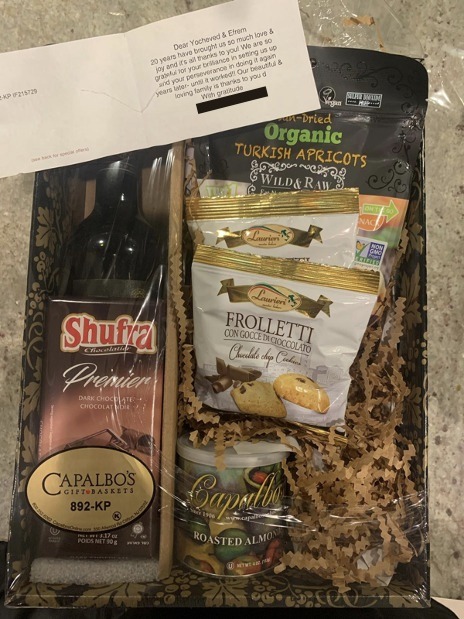
Last year, Yocheved and I received a gift basket delivered to our home with a beautiful note.  It was from a couple we set up who were celebrating their 20th wedding anniversary and wanted to acknowledge our role in their introduction.  They have said thank you many times, we didn’t expect or need anything.  (Frankly, I had no idea it was their anniversary.)


Have we thanked those who contributed to the lives we are blessed to live? Imagine if our kindergarten teacher got a note from us, decades later, thanking her for nurturing us with love. Imagine if our high school principal, our childhood pediatrician, our housekeeper growing up who cleaned our room, out of the blue got a gesture of gratitude showing that we cared enough to track them down and say thank you after all of these years. Did we express enough appreciation to the person who set us up with our spouse, gave us our first job, safely delivered our children?


In 1943, Eric Schwam arrived in Le Chambon-sur-Lignon, in southeast France, with his parents and a grandmother.  During the Holocaust, a pastor of this town and his wife led calls to protect Jewish refugees from the occupying Nazis.  The village became a center of resistance and ordinary residents took in and hid those who fled, including Schwam and his family. 


Last year, Schwam passed away at 90 years old.  The town’s mayor revealed that he left the town that had saved him $2.4 million dollars.  One of the town’s workers said, “He was a very discreet gentleman and he didn’t want a lot of publicity about his gesture.”


Seventy-eight years later, with no obligation or responsibility, Eric Schwam showed gratitude, not just with words but with resources.  He didn’t do so for honor, fame or attention, he didn’t do it because he was asked to, he did it because he felt it was the right thing to do. 


We are tremendously grateful to all those who have already given to our campaign.  We remain hopeful that others who benefit from BRS will yet contribute.  Either way, I am grateful for what this campaign has taught me, not about others, but about myself. 

(If you enjoyed this article, I invite you to show it at brsonline.org/global.  Thank you in advance!)
 

You Are In a Unique Position to Help

Mike Esmond, owner of a construction company in Gulf Breeze, Florida, wrote a check this month for $7,600 to pay off overdue utility balances for 114 residents of his city.  All of them were at risk of their gas and water being turned off before his magnanimous gesture.  His community in the Panhandle has been hit hard, not only by the pandemic but because they haven’t yet recovered from Hurricane Sally in September. 

This isn’t the first time he showed such generosity to total strangers for seemingly no reason at all.  In November of 2019 Mike walked into City Hall in Gulf Breeze and cut a check for $4,300 to pay for 36 local residents whose utilities bills were overdue and about to be disconnected.  Joanne Oliver, the utility billing supervisor for Gulf Breeze, told the NY Times, “I’ve been in customer service more than 20 years, and this had never happened.” 


What would motivate someone to give money that they worked so hard for to people they have never met? 


Last year at this time, Mr. Esmond opened his own utility bill and his memory flashed back to the winter of 1983, when he was broke and his own gas and water service was shut off over his holidays. He described, “I had three young girls at home at the time, and the temperature got down to 6 degrees, with ice and frost on the inside of the house.  I’ve lived that where I didn’t have a dollar in my pocket to care for my family, so I know what it’s like to really be broke and in need.  I wanted to see if I could help people that might be experiencing the same thing — where they couldn’t pay their bills and their utilities were going to be shut off around [holiday] time.”


When asked if he plans to continue this practice next year, Esmond said, “I’m 74 years old and I don’t even know if I’m even going to be here next year, but I can guarantee you one thing: If I am, I’ll do something to help people out.”  After the story of Esmond’s generosity went public, others began to give in the same way.  As of this week, his city has received additional anonymous donations to cover utility bills totaling several thousand dollars. 


Mike’s generosity launched a wave of generosity from others and it all began with his transforming his own personal experience and pain into a way to prevent others from going through it. 


When Yosef reveals himself to his brothers in this week’s Parsha, he tells them, don’t be upset and don’t be scared, I have no desire for revenge and I am not upset.   Your selling me to Egypt put me in a position to rise to power and to be able to help you and others.  In his Eish Tamid, Rav Yisroel Meir Druk asks, Yosef’s attitude is understandable with regard to the ten years he was viceroy in charge of the economy, but not all twenty -two years of their separation had been the same.  What about the twelve years he had languished in prison unjustly?  How could he reflect positively on that painful period?


Explains Rav Druk, Yosef didn’t see his time in prison as different than his time in the palace.  He credited his empathy, care and concern for those who were hungry, underprivileged and feeling alone to his time in prison when he felt that way himself.  Yosef understood that he never would have had the ten years of prosperity in Egypt without first enduring the twelve years of suffering that taught him, prepared him, and inspired him to help others avoid what he had felt. 


When I saw the story about Mike Esmond it reminded me of a similar story I have shared before.  Each year at the Rabbinical Council of America convention, an award is given to a chaplain.  A few years ago when the award was given to Rav Zvi Karpel, he described what had driven him to work in chaplaincy:


I lost my father when I was five and a half years old. This coming yahrzeit will mark his 60th. Put in other terms, by the time I was Bar Mitzvah, I had been saying yizkor for half of my life. My mother z”l raised me on her own. She herself became seriously ill my junior year in high school, and passed away my sophomore year in college. I relate these events because in retrospect, I feel that losing both my parents as I did had a tremendous impact on my life and my decision making.


I grew up in Rockville Centre, New York, a town on Long Island void of any Orthodox presence. I attended the public schools there, and received my religious education at an afternoon Hebrew school in the Conservative synagogue. My first real exposure to Orthodoxy was spending a Shabbos at my Kitah Bet teacher’s home in Far Rockaway, Queens.


For college studies, I went away to the State University of New York at Albany. It was that fall that I decided to become Shomer Shabbos, at least as far as I knew how to be one. I emerged as one of five yamulka-wearing students on a campus that arguably boasted 4,000-5000 Jewish students.


I knew that I needed a plan as to what I was going to do after graduation. Since my yiddishkeit is what most prominently drove my thoughts, feelings and actions, I decided I wanted to become a Rabbi. In addition, I realized that having never gone to yeshiva, I needed to accelerate my Jewish education, so I decided to go learn in Israel. When I returned here to the States, I was accepted into the semicha program at RIETS. Overlapping with the learning in the yeshiva, I matriculated into the Wurzweiler School of Social Work, and earned my MSW in conjunction with my semicha.

After working as a social worker for a couple of years in a day program for a Jewish nursing home, I began working as the full-time Rabbi at the Daughters of Israel. There I have remained for the last 32-plus years.


If I were to relate to you the single most significant aspect of my work, I would say it’s providing the spiritual and pastoral care to family members when their loved one is dying. In thinking way back to the experience with my own mother, I can tell you that when I heard her voice over the telephone and sensed she was close to the end, without hesitation I made the decision to leave the university to be with her. It turned out that I was to be at her bedside for her last week.


In reflecting back on that time, I know that I could have really used the support of a chaplain; I also know that I was not only a son at the bedside, I was my mother’s chaplain, walking with her during her final journey. The Shulchan  Aruch tells us in hilchos kibbud av v’aim, “Chayav l’chvodo, afilu achar moso”. A person is obligated to honor one’s parents, even once they have passed. I would like to think that my work with residents and their family members at the end of life provides some measure of kavod to my parents, may their memories be blessed.


Hashem tells Avraham, היה ברכה, don’t just be blessed, be a blessing to others.  Yosef remembered what it was like to be hungry and in pain and used those feelings to be inspired to feed others.  Orphaned at a young age, Rabbi Karpel knew what it was like to face loss alone and he turned it into decades of helping support people in their time of loss and need.  Mike Esmond appreciated what it means to be cold and scared without water or power and he used it to be motivated to pay off the utility bills of those who were about to have them shut off.


We have all gone through challenges and struggles, be they financial, physical, emotional or spiritual.  We can look back at them with resentment and bitterness or try to forget them altogether.  Or, we can invoke those memories to be moved to make a difference in someone’s life to help them avoid the pain we know well and to be their blessing.


Think about people going through something you might be able to relate to. Did you receive a scholarship as a child? If you have the capacity now, help makes sure others can get the help they need.  Have you overcome an illness? Perhaps those going through it now could benefit from your experience and your support.  Did you struggle with infertility, loneliness, or painful loss? If so, you are in a position to guide and help those going through that now.


Let’s all try to be like Mike.  What have you gone through in your life and how will you use it to help others?

The Virus of Playing God

Last Shabbos, at the early Mincha at BRS, the Torah rolled off the bimah and onto the floor.  Like many shuls that have adjusted during the pandemic, we currently don’t position Gabbaim on either side of the bimah, so the ba’al koreh is up there alone, with only those who receive aliyos standing on the other side of a plastic divider.  The Torah normally remains still but for some reason, in this case, one of the sides began to roll and it wasn’t detected in time.  Though I wasn’t there when it happened, if anyone is at fault it is me for not arranging to modify the bimah with a bracket on either end to prevent this from happening.


Those present were understandably shaken.  Indeed, as soon as Mincha ended there were knocks at both my back and front doors from people who were there and desperate to know what it means and what they need to do.  In this particular circumstance, Rav Shlomo Zalman (Halichos Shlomo 1:12:39) and others write that a public fast is not necessary since the Torah was not dropped by any individual, nor was there any action or event that seemed to precipitate its fall.  (You can read more about the laws of when a Torah falls here.)


Feeling traumatized by witnessing a Torah fall is appropriate.  As believing Jews, we know that everything that happens comes from Hashem and that He is communicating with us through events that we participate in, witness, or are otherwise part of.  Asking oneself why I was meant to observe this, what can I learn from it, and how can the experience inspire me to grow as a result, is fitting and commendable.


One rabbi from outside of Florida decided that he knows why this happened. Referring to BRS and its rabbis, he wrote on Facebook:


Of course, the traumatized congregants were all wearing masks, so no one could see their pained expressions when the Torah fell to the floor. Not a single unmasked face has been seen at that synagogue for many months. And everyone stood far apart from one another in fastidious observance of social distancing. Consequently, no one was standing close enough to catch the falling Torah.


In fact, this congregation is rather extreme in its enforcement of “public health policy.” Even before covid, the rabbis at this shul were most fanatic in enforcing total compliance to mandatory vaccine schedule. Children who hadn’t been vaccinated… were banned from attending local Jewish schools under the guidance of these rabbis, and families who hadn’t complied with vaccine requirements were banned from synagogue…


Once covid started, this synagogue went to extremes to comply with every single dictate and recommendation of the CDC. Congregants who weren’t in total compliance were banned from shul and in some cases, banned from ever joining the shul again!…


Is it a coincidence that the Torah fell off the bima in THIS shul?

Is the holy Torah trying to tell them something?

Is the Torah’s sudden fall an act of Heavenly protest?


By ousting children from Talmud Torah and banning Jews from shul or even from congregating in their own homes, have they effectively defiled, betrayed, and neglected the holy Torah… to such a degree that the Torah no longer feels comfortable on their bima?


How can we help this deeply-misguided congregation repent from their wicked ways? How can we impress upon this errant community to demand competent Torah leadership from their rabbis? Who can explain to them that their “covid policies” are an egregious violation of Judaic law, and that every Jewish man, woman, and child, must be welcome in every shul, with or without a mask… and if not, then the Torah doesn’t feel welcome there either? When will they wake up to the reality that covid policy is a modern-day idolatry, an unprecedented assault on G-d and His Torah?


Let’s pray that the Torah’s shocking fall will rouse them from their reverie of indifference and indoctrination.


I don’t know what is more disturbing, that someone would think this and write it, or how many people agreed with it, liked it, and shared it.  I wonder if he also tells the family of each person who died of coronavirus why their loved one was taken from this world or if he can explain the Holocaust to our survivors. 


To be honest, when I read it, I was somewhat relieved.  A friend had told me that a rabbi had written about why the Torah fell at our Shul.  To state the obvious, I am imperfect and so is BRS so I feared highlighting one of my or our faults would be profoundly embarrassing and humiliating.  When I read it, rather than feel shame, I felt proud of our community’s efforts to be compliant, to be safe, and to protect the health and wellbeing of our members in a manner consistent with accepted science and medical guidance.


So what does the falling of the Torah mean for our community and for those who were present?


The Mishna in Pirkei Avos teaches: “Histakeil b’shelosha devarim v’ein atah bah liydei aveira: dah mah l’maaleh mimecha, ayin ro’eh, v’ozen shoma’as, v’chol ma’asecha b’sefer nichtavin – Look at three things and you will avoid misbehaviors – know Who is above you: an eye is watching, an ear is listening and all of your actions are being recorded.”


The Baal Shem Tov interpreted this teaching differently.  He said, know what is above you – there is a God, an omnipotent, infinite Being controlling the universe.  Therefore, ayin ro’eh – what you see, you were meant to see.  V’ozen shoma’as – and what you hear, you were meant to hear.  V’chol ma’asecha b’sefer nichtavin –how you react and how you respond to what you see and what you hear will be recorded and reflect who you are.  


We certainly have a tradition of learning from all that we experience and encounter, particularly the most unusual experiences and interactions.  However, the onus and responsibility are on us to introspect, reflect and determine what we want to change or improve as a result of what we have seen or experienced.  Even among those who consult rabbis and rebbes about what particular events mean, the response is to consider taking on something new or to improve a personal practice, not to correlate the two in the form of blame. (For example, if someone receives bad news, the appropriate response is not, “This happened because I didn’t daven with enough consistency or focus,” but an appropriate response would be, “Now that I have received this news, I should respond by working on davening with more consistency or focus.”)


Whether reacting to a fallen sefer Torah in a community or someone’s personal illness, we are never in a position to tell people why things are happening to them.  To do so, particularly with confidence and surety, is not only arrogant, it is to play God and compete with the Divine. It borders on heresy, even if you have “rabbi” before your name.


At the same time, to casually dismiss or ignore Hashem’s messages to us is to mute the Divine, to ignore the One Who is speaking to us, which is cruel both to Him and to ourselves. 


Perhaps the message of a Torah falling in BRS is to be stricter with coronavirus guidelines, not less.  Maybe it is a message about paying closer attention to Torah reading, showing great honor to Torah, being more punctual to davening, or treating others with more sensitivity, respect and love.  It is up to us to take time to reflect.


Let’s use the Torah’s fall to inspire all of us to rise. 

This Scares Me More Than Antisemitism and It Should Scare You Too

Several years ago, I was standing with our new assistant rabbi, who had just moved here from South Africa, when a stranger came over and engaged us.  In the course of our conversation, the man mentioned something about his non-Jewish wife.  When he walked away, I looked over and the new rabbi was visibly shaken.  I asked what was wrong and he told me it was the first time he had ever met someone who is intermarried.  Coming from a Jewish community in South Africa where even those who aren’t observant are overwhelmingly traditional, he had never personally encountered someone who married out of our faith and it left him startled and shaken.


While my colleague was startled by meeting someone who “married out,” I, too, was startled that day, but for an altogether different reason.  I was startled by how not startled I was. Intermarriage has become so “normal” and “mainstream” in America that we meet or hear about someone married to a non-Jew and we don’t flinch. 


Indeed, I thought about this story recently when I saw a headline, “Kamala Harris and Douglas Emhoff made history for interfaith families. All Jews should celebrate that.”  Politics aside, many have expressed excitement over Kamala’s step-children calling her “Momala” and how Doug broke a glass at their wedding.  Others have kvelled that all of President-Elect Joe Biden’s three children, who are Roman Catholic, married Jews


According to a 2013 Pew survey, 44% of married Jewish respondents, and 58% of those who have married since 2005, are married to a non-Jewish spouse. Shockingly, the rate of intermarriages among non-Orthodox Jews, who make up the majority of the American Jewish population, was a staggering 71%. This data is seven years old and I shudder to think what the numbers look like today.


Correctly, we are all outraged by and concerned with growing antisemitism.  This week, the FBI published its 2019 hate crime report, which found that antisemitic hate crimes rose by 14% last year and once again comprised the overwhelming majority of hate crimes based on religion. (60.2% of all hate crime victims were targeted because they were Jews; next on the list were victims of anti-Islamic bias, who comprised 13.2% of the total.) Last year saw a series of lethal antisemitic attacks in Poway, Jersey City, and Monsey that created understandable concern and worry. 


Nevertheless, as disturbing as these horrific incidents and troubling trends are, when it comes to Jewish continuity, the statistical threat of antisemitism pales in comparison to the damage we are doing to ourselves and our contributions to the disappearance of our people.


In his blueprint for sustainable synagogues, Rabbi Rick Jacobs, president of the Union for Reform Judaism said, “Interfaith families are now the majority of the movement. Audacious hospitality says, ‘You know what? We’re not going to be just nice and let them in. We’re going to say we can’t be who were meant to be without them.’”


“Majority of the movement.”  That phrase is not only exceedingly upsetting, it is terribly scary. Make no mistake, I am not suggesting we make those who choose differently feel rejected, alienated, or marginalized, or believe that they have no place or future in our people.  Perhaps there was a time that such an attitude served to disincentivize and put artificial pressure to marry within the fold, but those days are over, not only outside of orthodoxy, but within it as well.  We should continue to make all Jews feel loved, welcomed, and secure with the knowledge that they always have a place within our people.  We should not only leave the door open but welcome them to walk through it. 


At the same time, we must not provide hospitality by diluting our values, distorting our principles, or worst of all, compromising on our continuity.  The rampant assimilation and growing intermarriage won’t be solved by moving the goal posts, offering a new and convenient definition of who is a Jew or what is a Jewish family, any more than an accountant can solve a bad quarter by cooking the books.  We must find a way to simultaneously be hospitable to all Jews while inhospitable to some decisions. 


We shouldn’t literally or figuratively tear keriah for the purpose of discouraging others; we should do it to sensitize ourselves.  We love all Jews and don’t want them to be hurt by our attitude towards intermarriage, but we must also love the Almighty, feel His pain, fight for His values and vision and pursue His blueprint for the Jewish people in His world. 


In the beginning of our parsha, Toldos, the Torah tells us that Yitzchak was the spitting image of his father Avraham, something divinely designed to respond to the cynics of the generation who challenged Yitzchak’s true parentage. In a talk delivered to Mizrachi and recorded in his Chameish Derashos (3:3), Rav Soloveitchik suggests that the cynics didn’t doubt Avraham’s physical ability to father a child.  Rather, they were doubtful that an old man could successfully communicate his old ideas and lifestyle to a young person from a new generation.  


The leitzanei hador, cynics and skeptics of his time, saw Avraham’s philosophy and ideology as a passing fad, a short-lived trend.  How could an old man with extreme ideas inspire a son who would embrace his legacy and perpetuate his lifestyle?  Instead, they whispered, Yitzchak must be the son of Avimelech, the offspring and follower of the modern society and culture and popular trends. Yitzchak must surely be carrying the legacy of Avimelech rather than the outdated ideas of his biological father.


The Rav writes:


People laughed at the event. They did not believe that Isaac would inherit Abraham. That he, a young lad of the new generation, would continue to carry Abraham’s visions and laws, and that he also would engage in building altars and calling on the name of God. They laughed at Abraham’s dreams that his son would give his life for Torah and fight for the sanctity of Abraham’s house.  The scoffers said: ‘Sarah conceived from Avimelech.’  Others claimed ‘They brought themselves a foundling from the market place.’  It is impossible to pass on Abraham’s outlook, the mitzvot of Abraham, his statutes and laws, to the modern generation, to young Isaac who fights with a rifle, works in laboratories and thinks in modern categories of thought.


When Abraham dies, people said, his entire philosophy will perish, his altars will be dismantled, his Shulchan Aruch will be eaten by moths and all trace of his life will vanish, just as the grass will grow over his grave.


Rav Soloveitchik sees this theme appearing later in the parsha when Yitzchak re-dug the wells of his father and gave them the exact same names in an effort to keep the legacy of his father alive and to declare that rather than abandoning his father’s ways, he was embracing them fully and wholeheartedly. 


Intermarriage is not a Reform or Conservative challenge, it is not the problem of the “unaffiliated” or “secular.”  Too many Orthodox parents have reached out to me about their children who have gone through a robust Jewish education and grew up in observant homes who have met someone non-Jewish and are building a life with them. We are one people, one nation, and we are watching our family hemorrhage.  


This is a time for all of us to dig deep, to draw from the wellsprings of our heritage and our timeless Torah.   The parsha begins by telling us that “Yitzchak is the son of Avraham” but then continues, “Avraham bore Yitzchak.”  Yitzchak didn’t just emerge, Avraham was invested in him, spent time with him, exposed him to the beauty of his values and the meaning and joy of his lifestyle.  We must return to the wells of our forefathers, to bringing God back into the conversations in our homes, to celebrating the joy of being Jewish, and to be willing to sacrifice in our dedication and devotion to Torah lifestyles. 


To be clear, there are parents who are excellent role models, who are deeply and profoundly devoted to Jewish life and living and whose children nevertheless make their own choices about life and about religion.  There are no guarantees in life.  I share these thoughts not to assign blame or promote guilt or cast aspersions on anyone, but to motivate action and inspiration.


Someone once asked me to meet with a man and his son whom I didn’t know.  The son was in a serious relationship with a non-Jew and the father was devastated.  He was hoping I could meet and “talk some sense” into the son.  I will never forget the conversation in my office.  The father began by describing how betrayed he feels, how pained he is and what a mistake his son is making.  When he was done, the son turned to his father and said, Dad, you speak so self-righteously, you claim to care so much about Judaism and Jewish continuity, but what sacrifices are you making for your Judaism?  You have a casual attitude towards Jewish law, you pick and choose as you see fit, you are not consistent about praying or study.  You aren’t willing to give up the foods you love, the things you want to do, your time or energy and you want me to give up a girl I have fallen in love with who will make a wonderful wife and mother?


I was absolutely floored.  The son had made an articulate and compelling case, not in defense of his tragic choice, but rather as an indictment of a father he believed had no right to be surprised or upset.


If we have a casual and selective attitude towards our Judaism, what can we expect from our children and grandchildren.  We need to return to the wells that have sustained us and kept us hydrated throughout our history. We must double down on lifestyles of deep commitment to Jewish law, Jewish life, Torah study, character development and lovingkindness.  We must work to share our treasured Torah with Jews around us making outreach a priority, not only for outreach professionals but the responsibility of every concerned Jew. 


Hearing about intermarriage, whether in the highest office in the land, or anywhere else, is not something to “celebrate” or admire, it is something to grieve, to be pained by, but most of all, to be driven to do something about.  


As an Orthodox Rabbi…I will Not Tell You How To Vote & Neither Should Anyone Else

This election cycle has brought us headlines such as, “Leading Orthodox rabbi endorses Trump for reelection” and “Leading Israeli Modern Orthodox rabbi condemns Trump.” 


We have orthodox rabbis publishing articles telling us, “Why (Orthodox) Jews Must Vote for Joe Biden,” and “The Case for President Trump.”


Ask most people if rabbis should endorse candidates or parties and they will say no. Ask them if they want their shul to be a place that clearly supports one candidate or party over the other and they will say no.  And yet, some of the same people will say that while those rules apply in ordinary times, these are extraordinary circumstances, there is so much on the line and it would be inappropriate to not speak out. 


Those encouraging rabbis to take positions, or the rabbis themselves, will defend weighing in on politics by saying this election is the most important of our time.  But my question is, when wasn’t it?  A quick look at news archives will show you that every single presidential election is referred to by many as “the most important election of our lifetimes.” Some will no doubt say, “but this election has enormous consequences,” to which I wonder, which election did not?  Most amazingly, the same people who will bemoan or react critically if a rabbi takes a position supporting the candidate they don’t, will happily share or point to an article or quote of a rabbi who takes the position that matches their own. 


Make no mistake, I appreciate as much as anyone how significant the issues of our day are.  This election could shape the character of our nation, and will surely result in meaningful policy implications for the economy, healthcare, pandemic response, race relations, the threat of Iran, the US-Israel relationship, Israel’s prospects for peace and much more. Like many of you, I have strong feelings about the importance of these issues and which candidate I believe is more likely to pursue them in the ways that I feel are best.  But here is the critical point—none of these are simple issues, these aren’t predictable times, and there are countless other variables at play. 


If the last eight months of this pandemic have taught us anything, it should be humility: how little we know, how little we control, and how little we can even predict.  While this is certainly true about coronavirus, it applies to every other issue as well. People who speak with certainty about how the next four years will go based on what candidate or party is in power would do well to keep this in mind. That isn’t to say we can’t have healthy and respectful debates, that we can’t advocate or campaign for the candidate, party, or policies we think will be best.


But what it does mean is that we should do it with a sense of humility, not hubris, with concern, not overconfidence, with hope and not  certitude.  The issues and personalities in this election, and the intersection of the two, are sufficiently complex that it shouldn’t be hard for anyone supporting either side to be able to say this simple statement: reasonable people can come to a reasonable conclusion in either direction. 


Imagine what our dialogue and debate would look like if it took place against the backdrop of subscribing to that statement as both the introduction to the conversation and the conclusion.  Reasonable people can come to a reasonable conclusion in either direction. Sure, it is fair, maybe even constructive at times, to try to persuade others to see things as you do, but if you can’t, acknowledge that not only is the other person entitled to his or her perspective, their opinion is reasonable, legitimate, and fair. The fact that they come to a different conclusion, even one you are convinced is wrong, doesn’t mean they have corrupt character, less patriotism, compromised commitment to Israel, or less devotion to Torah.


I am an orthodox rabbi, and let me be clear, as an orthodox rabbi, I am not telling you who you must vote for.  If Torah interpretation has 70 faces and Halacha is driven by the principle that Eilu V’Eilu divrei Elokim Chaim, contradictory opinions are both the word of the living God, then certainly in politics, l’havdil, reasonable, thoughtful, and respectful people can come to opposing conclusions. 


But this is a matter of life and death, you will say. My answer to that is you should research some of the Halachic disputes involving brain death, a quite literal life-and-death issue. On this sensitive, critical issue, some of our greatest Halachic decision-makers held opposing opinions, yet greatly respected each other, respected the other’s opinion, spoke of each other in the most dignified ways, and were genuinely close to one another.


While I will continue to defer to and submit to great Roshei Yeshiva and Talmidei Chachamim on matters of Halacha and Hashkafa, I don’t want them, no matter how “prominent” they may be, to decree whom I must vote for, diagnose the mental status of either candidate, tell me they know with certainty who is better for the Jewish people or Israel, or to oversimplify what is a truly complicated choice.  


What disturbs me most about rabbinic declarations dictating how we vote and articulating with complete confidence what will happen if we don’t is not just the unfair denial of people to think for themselves and draw their own legitimate conclusions, but I believe it is also a significant departure from an important Torah principle.


Long ago Shlomo HaMelech (Mishlei 21:1) taught us, “Palgei mayim lev melech b’yad Hashem, al kol asher yachpotz yatenu, the heart of a king is like a stream of water in the hand of Hashem, wherever He wishes, He will direct it.” We say every single day in our davening, “Al tivtechu b’nedivim, don’t place your faith and trust in princes and diplomats.”


As believing Jews, we recognize that it is the Master of the Universe who orchestrates domestic, foreign, and of course all policies and their consequences.  To be a student of Torah and of Jewish history is to recognize the Almighty’s guiding hand.  His hand guided our history and ultimately, it is His hand that is guiding our destiny, no matter the outcome of an election, even “the most important one of our time.”


Our rabbis tells us (Bamidbar Rabba 18a), “Harbei sheluchim la’makom, Hashem has lots of agents and messengers.” While we must make choices based on our finite and limited perspective, the vision of the Ribono Shel Olam is limitless.  We don’t know why He chooses to employ any particular person or leader in a given situation or time.  When the dust settles and the final votes are counted, the candidate that wins any election not only reflects the will of the people, but much more importantly, the will of our Creator. 


In this final week and perhaps even more importantly, in the aftermath of this election, I beg you to approach people with humility, to make room for those who conclude differently, and most of all, to daven and put our faith in the One who is truly the Highest of every land, Hashem. Daven for a peaceful reaction to the election, for unity and civility in our community and our country and for the ability to see Hashem’s hand in this and every other part of our lives.

Do You Come When Davening in Shul is Just Davening, in Shul?


I spoke to several rabbinic colleagues across the country this week who have all noticed a similar phenomenon.  Despite shuls having re-opened in safe and cautious ways, only a fraction of those “eligible,” i.e., those without specific vulnerabilities, secondary conditions, and are not considered “high risk,” have come back.  Some rabbis are panicking about what this means for the future and what our communities look like post-corona.  Personally, I do not share that fear.  I have confidence in our community, the people who comprise it, and what being together has to offer. 


There are likely many factors contributing to decreased participation since re-opening, which includes people who are not “locking down” in other areas of life, but it occurs to me that one of the fundamental reasons is that davening at shul has been reduced to, well, just davening at shul.  Let me explain.


There are many reasons people came to shul, all legitimate and meaningful, even if not equally so.  Some, of course, come to connect and open their hearts to Hashem, others to socialize, others to be part of community, yet others to enjoy kiddush or shalosh seudos.  With significant distancing, mask requirements and no food, the only reason to come to shul right now is to daven.  The beautiful byproduct, of course, is essentially no talking during davening whatsoever.  The awful unintended consequence is missing so many of our beloved members. 


While I am sure that the people who are not returning to shul are davening either at home or elsewhere, I believe the absence of a desire to come back to a shul that lacks anything other than davening is a sign that people are struggling with connecting to davening itself.


I am saddened not only to miss so many friends and members of our BRS family, but truly devastated by the reality check of how many people seem to be dealing with this struggle, to get enough out of davening that they would continue to come to shul even if the basic prayer services are all that is happening currently.  To be clear, I am not blaming anyone or issuing judgment as much as sharing this observation in hopes we can bring a change.


I recently listened to an interview with Naval Ravikant, an Indian-American entrepreneur and the co-founder, chairman and former CEO of AngelList. He was reflecting on how doing daily meditation has radically improved his life.  His description jumped out at me for several reasons:


You sit there for 60 minutes. So unfortunately, not less than an hour at a time, because it takes 30 to 40 minutes to sink in past the initial chattering. So you get to the good part or the so-called runner’s high equivalent. And you sit for 60 minutes every day and you do it for at least 60 days. And you do it first thing in the morning. When your mind is clear and you’re alert and you’ve had a good night’s sleep.


And you sit up with your back straight and you can use cushions, or you can use a chair or whatever. There’s no magic position. And just whatever happens, happens, whatever your mind wants to do, you just let it do. If it wants to talk, you let it talk. If he wants to fight, you let it fight. If it wants to be quiet, you let it be quiet. If it wants to chant the mantra or pay attention to breathing, you can do that, but you don’t force anything.


You just kind of let it happen. And so you don’t fight it. You don’t resist it. You don’t argue with it. You don’t double down on it. You just kind of let things happen. And when you do that for at least 60 days, my experience has been that you kind of clear out your mental inbox and all the craziness that was going on. All the chattering will come out. Some problems will get resolved. You will have some epiphanies. You will make changes to your life.


Some will be self-examination, some of it, you just get tired of, some of it just needs to be heard once, and then it goes away. And eventually you will get to a mental state of inbox zero, where now you’re just thinking about what happened yesterday. You’re kind of caught up and your mind is relatively clear and just your anxiety level goes down. You’re living more peacefully. And I’ve been doing this for about two and a half years now.


And I’ve probably missed about a dozen days total. But there are some days where I’ve done two hours a day or more. And I will tell you that is the single most important thing that I do. It is a sheer joy. Much of it is highly entertaining, pleasurable. Sometimes it’s just flat. It’s nothingness. I can’t even tell you why I do it. I can’t even tell you what’s going on in that state, but I will tell you that time spent by myself is the most important time that I have.


And thanks to that, I am now much more self-contained. I don’t feel like I need other people. I don’t need external sources of pleasure or happiness all the time. I drink less. I’m not attracted to trying any drugs whatsoever. It’s just, life is easier. It’s more pleasant. I don’t take things as seriously. I’m not afraid of my mortality as much anymore. I don’t fear aging. I don’t lust after things.


I don’t have this constant pervasive need to find something outside of me to make my life better. When the best hour of my day is spent by myself, then the world has very little to offer me and I can still participate in it, but it doesn’t have that grip on me that it used to. I don’t fear solitary confinement. And I think that is a superpower. And I think everyone should have it. Everyone does have it. It’s easy.


It requires doing nothing. It’s your birthright. You can’t fail at it. There’s no way to fail at it. Literally all you have to do is just sit down and close your eyes and just be by—give yourself a break for an hour every day. Just take the time off from the world.


I appreciate that davening is meant to be very different from meditation.  But it is a misnomer to think the entire davening is spent talking to Hashem.  In fact, only during the Amidah are we standing before our Creator in conversation.  For that conversation to be meaningful, intimate and effective, we spend the rest of “davening,” both before and after the Amidah, in conversation with ourselves about Hashem and about His role in our world and our lives. 


Ideally, we should be present with our thoughts and feelings for every word of davening from beginning to end.  Nevertheless, the Shulchan Aruch (Orach Chaim 1:4) writes that it is preferable to daven less with more meaning than to daven the entire text without any concentration or mindfulness.  We are meant to be transformed from davening, enriched, invigorated and elevated. 


For many people, davening is the only time of day not connected or attached to technology, anything or anyone else.  It is our alone time, lost in our thoughts, in the words that are designed to calibrate our priorities and to stimulate us to think about what matters most and evaluate who we are and how we are doinig.  Shemoneh Esrei is called the personal Amidah because each one says it privately, on their own, adding their own words and coming from their own specific place.  


When I shared Naval’s words from the interview with a friend, he wrote back, “1 hour, wow.”  I reminded him that if you add up Shacharis, Mincha and Ma’ariv daily, we are already there, we just don’t think of it in that way or sadly anticipate getting that benefit from it. 


Wearing a mask for davening is miserable, but it also provides an opportunity.  Even in a room filled with people, it enables a sense of privacy; nobody knows when your lips are moving and when they are still.  Behind the mask, we can stand or sit with our eyes closed,  with only our thoughts, dreams, hopes, aspirations, concerns, needs and wishes.  The mask eliminates the inhibition and awkwardness of being lost in true prayer, while not saying any words. 


If safety and health are not holding you back from coming to shul regularly and yet you have not returned, ask yourself why not, and what does it mean about your relationship with davening for davening’s sake?  If you are coming back, you are already allocating significant time each day to not only fulfill a mitzvah but engage in an activity meant to meaningfully impact us.  Why not figure out how?


I long for and look forward to the time we will all be back together, on campus, as a unified community.  I sorely miss the symphony of voices produced from sections of our orchestra noticeably absent, including children and our older population.  We and our davening are simply not the same without you. 


Until then, let’s pass this most unwelcome litmus test about why we daven at shul with flying colors and transform our davening into the type of experience that leaves us inspired. As Naval said, “It’s your birthright… give yourself a break for an hour every day. Just take the time off from the world.”

3 Things That We Can Still Control, Even When We Feel Powerless

The story is told of a young couple that moved into a new neighborhood.  The next morning while they were eating breakfast, the young woman saw her neighbor hanging laundry outside. “That laundry is not very clean; she doesn’t know how to wash correctly. Perhaps she needs better laundry soap.”  Her husband looked on, remaining silent.

Every time her neighbor hung her wash out to dry, the young woman made the same comments.  A month later, the woman was surprised to see a nice clean wash on the line and said to her husband, “Look, she’s finally learned how to wash correctly. I wonder who taught her?”


The husband replied, “I got up early this morning and cleaned our windows.”


I have been thinking about this story lately while observing and even feeling some of the tensions and judgment this moment in time has created.  History will undoubtably record the data – how many casualties, how many confirmed cases, how many recoveries, how many long-term illnesses, how many positives for anti-bodies.


But what will measure or tell the story of how many friendships were strained, how many engagements were broken?  What will quantify the sustained anxiety, both from fear of contracting the illness and from watching how others took it either too lightly or too strictly?  How can history accurately record or capture the months- long toll of high emotions and its ultimate impact on our physical, mental, emotional and spiritual well-being?


When Covid first raged and our community, along with much of the country, was shut down, in a sense life was fairly straightforward.  Being compliant was responsible and respectful and those who weren’t were risking their lives and the lives of others.  But in the months of phased reopening and fluctuating numbers, we must admit that the reality is profoundly confusing.  To be clear, that is not to say this pandemic is over by any stretch or that we can let down our guard.  Vigilance, caution and compliance remain critical, in many cases to save or preserve lives. Nevertheless, by any measure, while we are far from at the end, we are also not where we were at the beginning. 


Certainly there is behavior that, even now, all would agree is irresponsible and dangerous.  But where exactly to draw the line between reckless and ruthless is much less clear.  Was sending children to camp (and now to school) fair or foolish?  Is it time for playdates and Yom Tov meals with distancing and precautions?  Should minyanim be held indoors, outdoors, or maybe not at all?


As a result of inherent ambiguity and competing or nonspecific guidance, “corona shaming” abounds.  Some are indignant at the carelessness of friends and neighbors, while others are appalled by how extreme the people around them are acting.  Given the stakes involved with nearly every aspect of this, it is hard not to expect and demand everyone to have the exact same attitude you do to this dreaded virus and the proper behaviors to avoid its spread. It reminds me of a famous comedian’s brilliant observation: “anybody driving slower than you is an idiot, and anyone going faster than you is a maniac.” 


While we as a community have adopted and continue to encourage safety protocols and policies, ultimately, we would do well to realize that as individuals there is so much we cannot control.  Communally, we must continue to emphasize, promote and demand compliance with safety policies, but as individuals, let’s not compound the challenges of this time by forfeiting our serenity over things and people we can’t control, rather choose to focus instead on that which we can.  Here are a few suggestions:


·      In describing the fifth habit of his Seven Habits of Highly Effective People, Stephen Covey writes, “If I were to summarize in one sentence the single most important principle I have learned in the field of interpersonal relations, it would be this: Seek first to understand, then to be understood.” Before criticizing or judging the choices of others or the decisions of your Shul or children’s schools, first take the time to try to understand where they are coming from, how decisions were arrived at, and what informed them.  The Gemara (Eruvin 13) tells us that we follow the opinion of Beis Hillel over Beis Shammai because Beis Hillel would always listen to what Beis Shammai had to say and entertain their opinion before coming to their own conclusion.  You don’t have to agree with everyone or with every institution.  Constructive criticism is fair and should be welcomed, but only after first hearing and entertaining the thought process of the other side; as the Mishna in Pirkei Avos teaches, one of the 48 ways that wisdom is acquired is shemi’as ha’ozen, active listening.


·      What we see when watching others depends on the cleanliness and clarity of the window through which we look.  Before reacting incredulously to the behavior of others, ask yourself, how consistent are you with all your choices and actions?  Are you not making your own determination as to what is essential and what is non-essential? Do you not rationalize your exceptions to your own rules?  The Gemara (Bava Basra 60b) tells us, “Keshot atzmecha v’achar kach keshot acheirim,” which is usually translated as, “Correct yourself first and only then correct others.” Rav Samson Raphael Hirsch suggests an alternative translation. The word keshot appears a number of times in the tefillah of Berich Shmeih — as in Oraisei keshot u’neviohi keshot — and it is translated there as “truth.” Based on this, Rav Hirsch explains, the mandate of our rabbis is to be truthful with yourself and only then examine others. It is said that when you point a finger at someone else, three more point back at you. 


·      We may be powerless to control others, but we can control ourselves.  We don’t have to feel or react with anger, anxiety, frustration, resentment, helplessness or hopelessness, no matter what is happening or how people are behaving around us.  The Torah tells us u’vacharta ba’chaim, the choice regarding how we spend our time, what attitude and demeanor we have, what we focus on, is up to us.  Never stop realizing that we control our thoughts and we regulate our emotions.  Don’t ever give the key to your happiness and serenity to others. 


·      With all the uncertainty and powerlessness, we can and must redouble our focus on prayer.  In addition to fundamentally believing that Hashem craves our prayers and responds to them, even if the answer isn’t always yes, there are also measurable health benefits to praying regularly.  Dr. David H. Rosmarin, assistant professor of psychology at Harvard Medical School, says that research conducted on prayer shows it can calm your nervous system, shutting down your fight or flight response. It can make you less reactive to negative emotions and less angry.  Channel the frustration with others and the anxiety over what feels like an endless pandemic into drawing closer to Hashem, talking to Him, leaning on Him and even objecting to Him.  These Yamim Noraim, our davening will be more abridged, our singing more muted, and many won’t be able to participate in minyan at all.  But no matter where we are, now is not a time to be more casual or cavalier about prayer, it is a time to increase our fervor, intensify our concentration, and to dig deep to compensate for what is missing so that our tefillos can pierce the gates of Heaven. 


When looking out at the world, make sure to clean your windows first.  Do all you can to keep yourself and your family safe.  And then, make the decision that instead of perseverating over what you can’t control, you will focus on what you can. 

The Word a Holocaust Survivor Said He Would Never Use Again


The older I get the more I have come to believe that people can essentially be divided into two categories: connectors and dividers. 


Connectors look for commonalities, dividers focus on differences.  Connectors give the benefit of the doubt, dividers look to find fault.  Connectors let things go, dividers bear grudges.  Connectors look to compliment, dividers look to criticize.  Connectors feel good through (not surprisingly) connecting, and dividers thrive by fostering division.


Dividers spew hate, bully, call names, and practice discrimination, bias and injustice.  Connectors share love, fight for equality, stand up to justice, protect the vulnerable, and love even those they struggle to like.  Dividers often disguise their predilection for conflict as fighting for principles.  This is a smokescreen. Connectors have values and ideologies and are genuinely principled, but they are committed to find a commonality with others who may not share the same values and principles without compromising what they themselves believe.


Over the last few weeks, the national conversation has focused on racism and more recently on anti-Semitism and that will hopefully bring positive progress. Our own national conversation during these weeks, not just this year but each and every year, focuses on a similar phenomenon and, unfortunately, the tragedy of how little progress we have made.


The Talmud (Yoma 9b) tells us that the second Beis HaMikdash was destroyed because of sinas chinam, baseless hatred.  The people at that time observed Torah laws and performed mitzvos but grossly mistreated one another.  They were Torah-observant dividers instead of connectors.


What is baseless hatred?  Isn’t there hatred that is warranted, justified, that has a strong basis?  When I dislike someone who believes, observes, votes, or lives differently than I do, when I hate someone who sees things differently, there is a real basis and reason for my hatred, why is that called chinam, baseless?


We are coming up on the first yahrzeit of my dear friend, Rabbi Dr. Brian Galbut z”l, one of the most extraordinary human beings many of us have ever known.  Earlier this week, at the bris of Brian’s first grandson, poignantly named in his memory, Brian’s father spoke.  He described Brian as an amazing connector in every direction, with his wife, with parents, grandparents, aunts and uncles above, with siblings and cousins to his side, with children, nieces and nephews below, with friends, co-workers, and neighbors, those to the left and to the right of him religiously and politically, with those in front or behind him in life. 


Leading up to his yahrzeit, I have spoken with several of his friends of diverse backgrounds, lifestyles, and levels of religious observance.  One of the commonalities of them all is each feeling that Brian was their best friend.  Brian found something in everyone to connect with. He was a talmid chacham who took Torah learning and living incredibly seriously and connected with so many who shared that passion and identity.  He was an athlete who excelled in basketball, golf and running and could relate to so many teammates, competitors, friends and acquaintances who enjoyed playing and following sports.  He was a brilliant physician who didn’t just provide top medical care but paired it with outstanding human care, genuinely devoted to his patients and beloved by his colleagues, nurses, and staff.  His warm smile, contagious laugh and singular focus while he spoke to you could win anyone over, people with whom he had great similarities and those who on the surface he seemed to have so little in common.


I once asked Brian how he kept that positive disposition and attitude all the time, how he got along with anyone and everyone and how he managed to be the eternal optimist no matter what reality was presenting.  We were walking on a golf course at the time and he stopped, paused, and said, “I have been working on it since I was young.”  Living with faith, he continued, seeing good in others, feeling happy, hopeful and positive are all choices, they are not feelings.  It isn’t easy but we can choose to be positive, choose to be faithful and choose to be connectors, not dividers.


The Torah endorses loving people, v’ahavta l’reiacha kamocha.  On the other hand, it condones hating evil, ohavei Hashem sin’u rah.  How do we reconcile these two imperatives?  Rav Shneur Zalman of Liadi, the founder of Chabad, writes in his Tanya (32): “It is a mitzvah to hate them, and it is a mitzvah to also love them. Both are true. You hate the yetzer hara, the evil inclination that’s in them, and you love the goodness that is concealed in them, which is a spark of Godliness.”


Any hatred directed towards a person is considered baseless on its face because it rejects and ignores the core and base of the person, the tzelem Elokim with which we can find connection or commonality.  That doesn’t mean we don’t confront, debate and challenge the ideas and actions in people that we cannot tolerate; it means we love people, even when we reject and can’t love something they say, think, or do.  


In his excellent book, Baseless Hatred, Dr. Rene Levy writes, “Hate is triggered because our primitive neural system reacts to events from the perspective of our own preexisting insecurities, because we make generalizations (which may be positive or negative) and confuse associations (additional but not necessarily relevant information) with causality.”  Essentially, when we hate someone, we reveal a lot more about ourselves than we do about the subject or object of our hate. 


Norman Frajman is one of very few individuals who went to hell and back not once, but twice.  He survived both the Warsaw Ghetto and Majdanek.  I had the honor of twice accompanying him to Poland as he took hundreds of teenagers to those places on March of the Living.  As we walked through Majdanek, a concentration camp so well-preserved it is said it could be up and running again in days, Norman identified to the teenagers his former barracks, showed them where the daily lineup took place, and detailed the horrific things he witnessed.  At one point, one of the teenagers asked him, “Do you hate the Poles and the Germans for what they did, do you hate those countries today?” 


In a moment I will never forget, Norman stopped walking, turned to the huge group of teenagers walking with him, and without hesitating said, “No, I don’t hate them.  I don’t hate anyone.  I greatly dislike, I condemn, I criticize, and I will confront what I think is wrong, but I will never use the word hate.  I don’t hate, because hate is what started it all.”


What should be a powerful and jarring word, hate, has lost its meaning and impact because of its overuse.  “Hater” is sometimes used to describe someone who simply objects to something. In this period of the three weeks in which we are working to repair the damage from baseless hatred, let’s make a concerted effort to use the word hate more judiciously, thoughtfully, and appropriately.  You don’t hate your least favorite food or the hot weather, or when your internet is slow or the person you are waiting for is running late. Above all, you can never and should never hate people, even when you reject what they are saying or doing. 


Rav Avraham Yitzchak Ha’Cohen Kook (Orot HaKodesh vol. III, p. 324) famously wrote that there is only one antidote to baseless hatred.  “If we were destroyed, and the world with us, due to baseless hatred, then we shall rebuild ourselves, and the world with us, with baseless love — ahavas chinam.”


For Rav Kook, ahavas chinam was not just a theoretical idea.  There are countless stories of Rav Kook’s profound love for all Jews, even or especially those far removed from a Torah lifestyle. When questioned why he loved such Jews, he would respond, “Better I should err on the side of baseless love, than I should err on the side of baseless hatred.”


If we want this mourning to end, we need to be more like Brian and Rav Kook. Choose to connect instead of divide, choose to live with baseless love over baseless hatred, for these three weeks, and then hopefully the rest of the year too. 

An Open Letter From the Bottom of My Heart

To my dear, precious, and sacred
Synagogue:

For the last ten weeks I have missed you so. I have longed to be together with our shared friends, united in prayer in your sanctuary, joined in learning in your Beis Medrash, celebrating beautiful simchas in your social hall.  I have yearned to bring our children to youth groups in your classrooms and to play on your playground.  For ten weeks I have pined to spend time with friends in your hallways, to shmooze on your front lawn, and to linger in your lobby. 

For over two months now I have dreamt of kissing your Torahs, of singing along to the sweet melodies coming from our wonderful chazzanim standing on your bima. My finger aches to point at the Torah being lifted during hagbah for all to see and my hand hurts from not giving out candies to the countless children who come to say “Good Shabbos” on Friday night. My feet yearn to dance with Bar Mitzvah boys upon receiving their first aliyah and my head hankers to get hit by candies thrown at young men celebrating their aufruf.  My office sits empty, absent the people who come to meet with me, but as much to encounter you, to find solace, strength, meaning and support in your walls, in the symbols and holy objects your furnishings contain.

Every day for over seventy days I have
wondered, when?  When can we come back?
When will this exile end?  When will this
isolation expire?  When will we be
together again? When will we finally feel the comfort and confidence you
provide? We have never needed you more than when we can’t have you. We have
never wanted you more than when you are inaccessible to us. 

Davening simply hasn’t been the same.  What I would give to hear those who sometimes
daven so loudly they distract me.  Things
just don’t feel right without the pacers, the shukelers, the stragglers,
the whisperers, the screamers, and I dare say, even the talkers.  Maybe we weren’t all getting it entirely
right, but we were there, we showed up, we were together.  And now we are so far apart, so alone, so
distanced.  Our davening is too quiet, too
isolated, too far away from you, our holy space and sanctuary.  Just being with you brought out our best,
helped us concentrate and focus, and now we feel so lost, so displaced, so out
of sorts.

To be completely honest with you – it certainly has been refreshing to automatically be on time, to be able to daven at our own pace or to slow down for the sake of children we now daven with, to not have to fight for a parking spot or a seat.  But we would trade those comforts and conveniences in a heartbeat just to be with you again.  

My beloved and cherished shul, I have
missed walking behind your Torah to and from the bima, shaking hands and
hugging friends along the way.  My soul
screams to have the privilege and honor to transmit our tradition’s timeless
teachings from your shtender to a packed room, men and women, young children
and Holocaust survivors, most of whom are thirsty to drink from the fountain of
our Torah’s wisdom and even to those whose eyes are closed as they are “deep in
thought.”

Just a few months ago, your worn-out
carpet and areas that need a coat of paint jumped out at me as I focused on
your blemishes and flaws, but now I couldn’t notice such things because you are
beautiful to me, perfect as you are, and I just want us to be together
again. 

To be clear, our separation is not your
fault or ours.  You heroically sacrificed,
shutting down long before you were legally obligated to, all to protect us,
even though it meant you would sit alone, empty and maybe even looking abandoned.

My darling BRS, for months I have
fantasized about our reunion. I have visualized our first time back together,
the palpable joy, the unbridled happiness, the affectionate hugs, the sincere seudas
hoda’ah
and the emotional birchas shehechiyanu. I have pictured how
we would decorate you, how we would sing and dance with your
Torahs, kiss your siddurim, embrace your chumashim.  We would settle into your chairs, breathe a
sigh of relief, and feel a surge of strength, faith, and hope. We would be back
where we belonged.

And now that this day is finally here, we
feel so close and yet we must remain so far apart. 

This coming week, if all continues to go
well, we will return to your campus, but we still cannot enter your
premises.  We will be together in
makeshift minyanim, but we will still be separated by at least 8 feet.  Instead of hugs or handshakes, we will be
lucky to say hi.  Instead of a reunion,
we will experience a tease.  Instead of
feeling we are back, we will still feel like we don’t know where we are.  Instead of dancing, we will be distancing.  Rather than see into each other’s hearts we
will be staring at one another’s masks.

As badly as we want things to return to
normal and to be familiar, my dear shul, we accept that this simply isn’t an
option just now.  Last week we completed
the third book of the Torah and declared “Chazak.”  We couldn’t scream it with you, but
nevertheless we meant it more than ever when we turned to one another and said,
“Be strong, be strong, and together we will be strengthened.”  And this week, as we begin the fourth book of
the Torah (we will have so much rolling to do when we finally come home to you),
we acknowledge that a person has to make himself or herself a midbar, a desert,
to truly receive Torah. We have proven our willingness to live with barrenness
and spiritual homelessness and now, in that merit, we desperately hope to come
home. 

Our dear shul, our love and longing for you will never fade.  While we still can’t step inside, we will soon be one step closer to being together. We hope you understand that while that will have to do for now, it still isn’t enough. 

With love and longing,

Your dear friend,

Efrem

Extraordinary Times, Extraordinary People

While we might be starting to see a light at the end of the tunnel, it remains unclear when we will reach it. For now, we remain homebound, maximizing distancing and finding ourselves in roles and having responsibilities many of us are not used to. These are no ordinary times and yet, there are countless stories emerging of extraordinary people who, rather than focus on themselves and this challenging crisis, are performing spectacular acts of kindness for others.

Those on the front lines are risking their own well-being to treat those who are ill.Those who were previously sick, rather than hibernate in recovery are donating plasma to pay it forward. Some at great personal expense and pain have pledged to continue to pay workers. A
group of Chasidic men delivered 1,000 tablets to coronavirus patients in New
York City hospitals to let them connect to their families who are not allowed
to visit. In our community, on Seder night a young family set up a table and
hosted their seder outside the window of an elderly Holocaust survivor so he
wouldn’t be alone. All around us, there are ordinary people doing extraordinary
things at this time.

In her recent article, The
Science of Helping Out, Tara Parker-Pope writes: “At a time when we are all
experiencing an extraordinary level of stress, science offers a simple and
effective way to bolster our own emotional health. To help yourself, start
by helping others. Much of the scientific research on resilience — which is our
ability to bounce back from adversity — has shown that having a sense of purpose,
and giving support to others, has a significant impact on our well-being.

What science is teaching now,
the Torah has endorsed for us all along.

לא תשנא את אחיך בלבבך…לא תקם ולא תטר את
בני עמך ואהבת לרעך כמוך אני ה״

“Do
not hate your brother in your heart….you shall not take revenge and you shall
not bear a grudge, you must love you fellow as yourself, I am Hashem.”

This passuk contains one of
the most famous commands in the entire Torah, and the Ramban is bothered by the
same question as everyone else – is it really possible to love someone as much
as you love yourself?  We have been
designed and programmed to naturally be inclined to take care of ourselves,
look out for ourselves, and prioritize our well-being.  We know ourselves better than anyone in the
world, and we give ourselves the benefit of the doubt, judge ourselves
favorably, see the best in ourselves, and are quick to justify and explain any
shortcomings in ourselves.  Can we really
meet that standard for others including mere acquaintances and even strangers?

The Ramban explains that in
truth it is impossible to love someone as much as we love ourselves and, accordingly,
this is not actually the threshold of the mitzvah.  In fact, says the Ramban, to actually put our
love for someone on equal footing with ourselves is a violation of the Halacha
which demands that in a conflict between saving our own life or saving that of
another, חייך קודמים, our life comes
first.  So what, then, is the mitzvah and
how is it fulfilled?

The Ramban says it is human
nature to wish well for others but in reality want them to have less than
us.  We want someone to make a good
living and be happy… as long as they earn less than we do.  We want them to have a nice house… as long as
it isn’t as big as ours; or drive a nice car… as long as it isn’t as fancy as
the one we drive.  Comes the Torah, and
demands, ואהבת לרעך כמוך, while you cannot
truly love others as you love yourself, you can want others to have כמוך, as much or more than you.  You can be happy for them.

Nechama Leibowitz z”l quotes an
opinion that holds we are, in fact, absolutely obligated to love another כמוך; however, we need to re-think our
understanding of the word. כמוך doesn’t mean love
someone as much as you love yourself. 
Not only is that standard impossible, but we cannot fully control or
regulate our emotions or how much we love someone.  So what is כמוך
and how do we fulfill this mitzvah?  To truly
understand כמוך, we must look to where it is used earlier
in the Torah.  When Yosef hides his
identity from his brothers and holds Binyamin hostage, Yehuda steps up and
approaches his brother:

 וַיִּגַּ֨שׁ אֵלָ֜יו יְהוּדָ֗ה
וַיֹּ֘אמֶר֘ בִּ֣י אֲדֹנִי֒ יְדַבֶּר־נָ֨א עַבְדְּךָ֤ דָבָר֙ בְּאָזְנֵ֣י אֲדֹנִ֔י
וְאַל־יִ֥חַר אַפְּךָ֖ בְּעַבְדֶּ֑ךָ כִּ֥י כָמ֖וֹךָ כְּפַרְעֹֽה:

Parshas Vayigash opens with
Yehuda telling his brother: “if you please, may I speak a word in your ears and
let not your anger flare up at me because you are like Pharaoh.”  כמוך  here means “you are similar to.”

ואהבת
לרעך כמוך
doesn’t mean love your
neighbor as you love yourself.  It means
love your neighbor. Why? כמוך –
because he or she is similar to you.  You
both possess the same spark of life, the same Godly soul, you both have
strengths and weaknesses, you both have virtues and faults, you both have
things to be proud of and areas to work on. 

We cannot love others,
certainly not all others, as much as we love ourselves, but we certainly can
learn to love.  Why should we and how can
we?  כמוך – because if you can cut away their different type of
kippa or their lack of a kippa altogether, if you ignore that they dress
differently, act differently, think differently, if you cut away their
idiosyncrasies and habits that drive you crazy you will find they are כמוך, just like you. 

Rebbe Akiva witnessed the
failure of thousands of his students to learn this lesson.  They focused on their differences rather than
choosing to embrace their similarities and the result was that they couldn’t
see themselves in one another, they could not relate or identify.  They saw their fellow student as different,
the other, and this caused them to disrespect one another.  Rebbe Akiva attended thousands of funerals
and delivered thousands of eulogies as his students were cut down by a punitive
plague and he turned around and taught, ואהבת לרעך כמוך
is the כלל גדול בתורה, the primary
principle of the Torah. 

It is not a coincidence that
the same Rebbe Akiva is quoted in Pirkei Avos as teaching us חביב אדם שנברא בצלם, precious is every person because we were
all created in the image of God.  Knowing
and internalizing that concept is the secret of loving everyone.

We may not have the capacity
to love others as much as ourselves but we can do a whole lot better at loving
others, especially those who are different than us, by focusing on the כמוך, that as different as they seem, they are
in truth just like us.  Loving those who
are just like you in hashkafa, Halacha and are your dear friends is wonderful,
but it is not real ahavas yisroel.  Genuine
ahavas yisroel means peeling back the layers of that which separates us from
others until we find common ground and that which connects us.  

But how do we express that
love? Is loving a fellow Jew just about tolerating them?

R’ Moshe Leib Sassover used to tell his chassidim
that he learned what it means to love a fellow Jew from two Russian peasants.
Once he came to an inn, where two thoroughly drunk Russian peasants were
sitting at a table, draining the last drops from a bottle of strong Ukrainian
vodka.  One of them yelled to his friend,
“Do you love me?” The friend, somewhat surprised, answered, “Of course, of
course I love you!”  “No, no”, insisted
the first one, “Do you really love me, really?!”  The friend assured him, “Of course I love
you. You’re my best friend!”  “Tell me,
do you know what I need?  Do you know why
I am in pain?”  The friend said, “how
could I possibly know what you need or why you are in pain?”  The first peasant answered, “How then can you
say you love me when you don’t know what I need or why I am in pain.”

R’ Moshe Leib told his
chassidim that he learned from these two peasants that truly loving someone
means to know their needs and to feel their pain. 

Real love is not lip
service, it is not just tolerating one another. 
Love is noticing someone is having a bad day, it is feeling their pain,
it is showing someone you care, even when that person is someone you barely
know or don’t know at all. 

The blessings of
Birchos HaShachar are said in the plural – פוקח עורים,
מלביש ערומים, etc. There is one exception – שעשה לי כל צרכי thank you God, who fulfills all of my
needs.  Why is this blessing written in
the singular?

The same R’ Moshe Leib
Sassover, who taught us what it means to love a fellow Jew, explains that when
it comes to ourselves, we should have an attitude that I have everything I
need.  We should feel content and
satisfied.  But, when it comes to others,
we must be thinking – he or she doesn’t have everything they need.  What are they lacking?  How can I help them?  What can I do for them?

There are people
around us hurting, lacking, or in pain.  While
this is unfortunately true year-round, it is especially true in this moment in
time. If we claim to love these people them, we cannot fail to notice.  While for many of us Shabbos these days is
the happiest, most restful day of the week, for others, it is filled with
stress, anxiety and pain.  Imagine living
alone and each week as Shabbos approaches finding yourself dreading the 25
hours away from the phone, the computer, any meaningful social interaction. With
the days getting later, imagine the prospect of a long Shabbos day by
yourself.  How much of a nap and how much
reading can you do before you feel lonely? 
This is one example of many people and populations we claim to love, but
we aren’t doing a great job of showing it. If you love them you reach out
during the week, maybe set up a time to check in with them on Shabbos
consistent with social distancing policies and the guidelines we have
previously sent out. If we love the people whose businesses or livelihoods are
taking a significant hit from this crisis, how are we creatively and sensitively
finding ways to help them, support them, or just let them know we are thinking
about them?

The sefer Kavanas Ha’Ari advises that
before beginning davening in the morning, one should say: הריני מקבל עלי מצות ואהבת לרעך כמוך, I hereby accept upon
myself the positive commandment to “Love your fellow as yourself.”  Based on R’ Moshe Leib Sassover’s insight, we
can understand this in a new light. Before we can pour out our hearts to Hashem
for all of our needs, we must pause to think about our fellow man and their
needs.  Before we ask Hashem to be there
for us, we must commit to be there for others. 

Rabbi Efrem Goldberg

Join Our Community

Subscribe to our newsletter or connect with us on WhatsApp.