Trump’s Peace Plan: A Historic Day, No Matter the Outcome
Prime Minister Netanyahu touted the
unveiling of President Trump’s peace plan, including its position on Judea and
Samaria, as a historic moment, almost as great as May 14, 1948, when President
Truman first recognized the State of Israel.
Whether it indeed proves to be historic or simply a footnote to history
has yet to be determined.
To me, though, sitting in the East Room of
the White House with goosebumps watching the president deliver his message and
then the prime minister respond, there was something else that felt historic. Though it wasn’t referenced, there was a
different date that I couldn’t stop thinking about as I looked around the room
at the group gathered. Included in this group were prominent and powerful
Jewish leaders and senior officials, many of whom are welcomed regularly in
those hallowed halls, something unthinkable only a few decades ago.
The event in the White House took place
one day after January 27th, which marked the 75th
anniversary of the liberation of Auschwitz.
More than 1 million people were killed in the gas chambers at
Auschwitz, the overwhelming majority of whom were Jews. Ninety-four-year-old Bat-Sheva Dagan spoke next to the iconic
railway tracks at Auschwitz. She described having her head shaved and arm
tattooed upon her arrival and how she was forced to sort the belongings of
those sent to their deaths. “Where was
everybody?” she asked. “Where was the world, who could see that, hear that, and
yet did nothing to save all those thousands?”
The skeletons who walked out of Auschwitz,
barely clinging to life, could never have imagined that just 75 years later,
there would be a Jewish state, a return to our biblical homeland, and a place
of refuge for Jews throughout the world.
Would they have believed that just 75 years later, almost to the day,
the president of the most powerful nation would pledge his support to the
safety of the thriving Jewish state, committing to continued military
cooperation, and promising borders that would always keep it secure?
Larry Weinberg, a past president of AIPAC, would relate that in 1944, he was a soldier in the U.S. 100th infantry division. They were in combat in the Vosges Mountains when a fellow soldier came to tell him they had found a Jewish man hiding in the woods who wanted to know if any of the American soldiers were Jewish. He describes running to meet the man, finding him gaunt and unshaven. As he got closer, he was filled with emotion, feeling as if he was somehow part of this man’s liberation. He reached out to the man who he asked in Yiddish if he was a Jew. Larry responded enthusiastically, “Yes, I am a Jew!” The man came closer, spit in his face and said, “You came too late,” and walked away. Larry never saw him again, but he pledged then and there that he would spend the rest of his life doing all that he could to make sure that when our people are in need or are in danger, we will never be too late.
The most powerful moment of the day for me
was when Prime Minister Netanyahu addressed Jared Kushner and said, “I know how
much the Jewish future means to you and to your family. Well, Jared, today you
have helped secure that future. The Jewish State owes you and it owes President
Trump an eternal debt of gratitude.”
Jared’s grandparents, Joseph and Rae
Kushner, were survivors. They came to America in 1949, determined not only to
survive, but to thrive. They were among
the builders of the community of Elizabeth, New Jersey, and were great
philanthropists involved with many Jewish causes. Seventy-five years ago, could they have
dreamt that their grandson would not only be the son-in-law of the president,
but credited with securing the Jewish future and the Jewish state, fulfilling
our collective promise to never be too late again?
None of us know if this peace plan will
pan out and prove to be historic. But
what felt historic already was listening to the Prime Minister of the Jewish
State with the President by his side quote Pirkei Avos to capture the moment – אם לא עכשיו אימתי, if not now, when,
and if not us, who? What felt historic
was to be comfortable in a building that previously Jews were denied entry to,
to be among leaders whose predecessors wouldn’t meet with us in our darkest
days. On the day after we marked the
liberation from Auschwitz, a time in which the world showed up too late, it
felt historic that a grandson of survivors was recognized for showing up to
protect our Jewish homeland.
This potentially historic event took place
the day after Rosh Chodesh Shevat. We
have a tradition that Shevat is an acronym for “She’nisbaser Besuros Tovos,” may
we hear only good news and good tidings.
May this day and this plan bring the news
of peace, safety and prosperity for our brothers and sisters in Israel and may
they continue to have the love, friendship and support of the United States of
America.
We Can Have it More Often Than the Siyum Ha’Shas
The excitement and anticipation leading up to the recent Siyum HaShas has been matched only by the enormous follow-up coverage that followed it. There were many take-a-ways, including the great kiddush Hashem that took place. From New Jersey to London, Los Angeles to South Florida, countless testimonials have come in describing the respectful, courteous behavior of the thousands of Jews who attended throughout the world.
Rosemary Yacono, a guest services
representative at MetLife Stadium, posted online:
There have been only a handful of events at MetLife Stadium that have so totally moved me emotionally during my tenure since 2001; today definitely qualified. Despite the horrific hate crimes as of late, Jews defied fear and chose to rise above what would have been the natural instinct to postpone–and they did so with a real joy, the likes of which I probably will not see again. While I love my faith and would never look elsewhere, there is a sense of community that these people truly embrace which can’t help but be envied by its counterparts. It was a genuine pleasure to be part of this experience that only occurs every 7 years. In all likelihood I will probably not be employed by the Stadium for the next round; however, it is extremely likely I will be attending as a spectator. Yeah… one for sure, for the Bucket List.
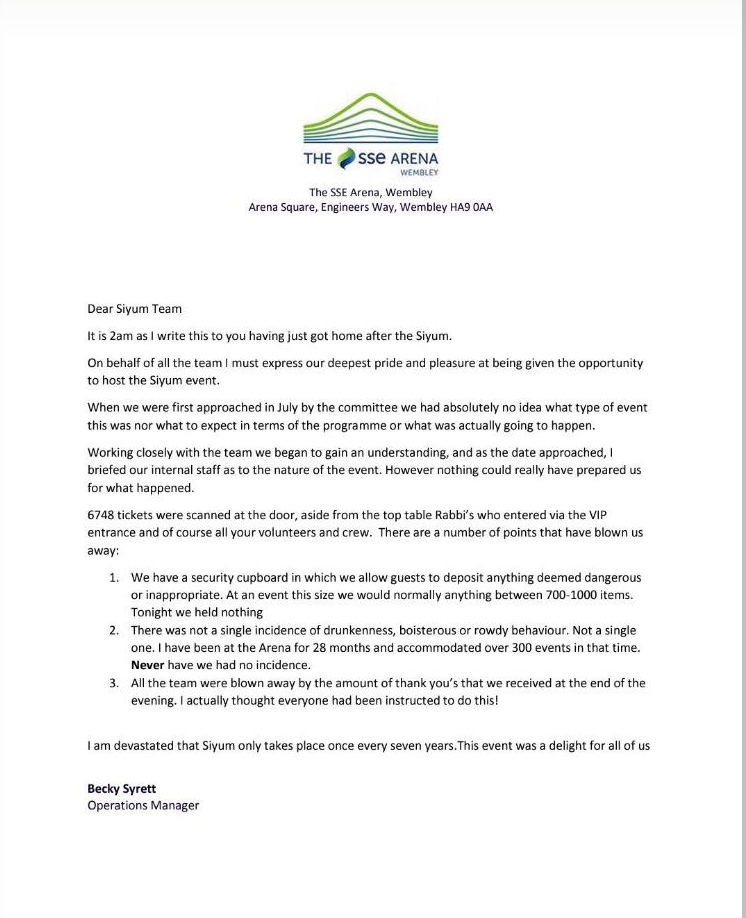
Becky Syrett, Operations Manager of
London’s Wembley Arena, wrote a letter following the Siyum held there that
hosted over 7,000 participants. She
wrote that the stadium staff was “blown away” that there was “not a single
incident” of “drunkenness, boisterous or rowdy behavior,” during the event,
which she says in her 28 months of working at the arena at over 300 events, has
never happened before with a crowd that size.
She also pointed out that not a single dangerous item was confiscated at the event and that her team was very impressed by the amount of “thank yous” they received at the end of the evening. She concluded her letter by saying, “I am devastated that Siyum only takes place once every seven years. This event was a delight for all of us.”
Clearly, our people rose to the occasion
and put our best feet forward. Our mission is not just to study Torah as an
intellectual or academic exercise, but to be molded and shaped into Torah
personalities, representing its ideals and living its values. Our rabbis emphasize that
the highest level of learning is ללמוד על מנת לעשות,
learning for the purpose of practicing.
As much as the study of Torah deserves to
be celebrated, the living of Torah, the implementation of Torah values,
deserves our greatest celebration.
I only hope and pray we can continue to
rise to this level of positive behavior consistently, and not only in
association with an event that happens every seven- and-a-half-years.
Personally, there is something else I am thinking
about as I take in the vast celebrations of the Siyum. Nearly every single article, post, video or
interview about the massive event at MetLife Stadium highlighted the exhilarating
experience of being with over 90,000 Jews gathered together in one place and
sharing one experience. While people reflected positively about the speeches
and program, it was unquestionably the 90,000 people davening, saying Tehillim
and dancing together that left the strongest and most indelible
impression.
What if instead of the huge gathering at MetLife stadium, ten venues had been chosen that would host 10,000 people each. Certainly, being together with a group that large would be a positive experience, but not nearly as special as being close to one hundred thousand together. By extension, if you have one hundred venues in the tri-state area that had 1,000 attendees per venue, it would be a great display of kavod haTorah, but those who participated would not walk away with the transformational experience of filling a whole massive stadium together.
Just a few days after the Siyum HaShas, 25,000 people
marched
across the Brooklyn Bridge and held a rally to protest the rise of antisemitism. One of the participants commented to me that
he was very moved to be part of such a large gathering of people, all moved
towards working on the same cause. What
was particularly meaningful, he noted, was seeing how many young people were in
attendance and how charged they seemed on this issue. He shared that he hadn’t felt this way or
seen a young people engaged in a movement in this way since the Soviet Jewry
rallies of many years ago.
Now imagine, instead of 25,000 people
marching together, 25 different communities held a gathering with 1,000 people at
each gathering. It would make a
statement, but it wouldn’t generate a feeling, a sense of a movement that was
achieved by their all being together.
The Siyum doesn’t happen each week and
protest rallies don’t occur with regularity, but there is a gathering we hold
daily and in an even more highly-attended way on weekends. It is called davening and it happens at
Shul. When we gather as many people
together as possible in one space, it generates an energy, a feeling, and sense
of a movement. And when we divide up and
host private minyanim across the community in homes or breakaway settings, while
combined it may include the same number of people who davened, the experience
cannot be compared, and the impact is totally different.
The pasuk in Mishlei (14:28) describes an
axiom of Halacha: B’rov am hadras melech, the larger the gathering,
the more glory and honor we give God. With this in mind, the Shulchan
Aruch (Orach Chaim 90:9) records that one should always try to daven in
Shul. Indeed, the Gemara (Berachos 8a), recorded by the Shulchan Aruch
(90:11), describes that contributing to attendance at Shul and its quality of davening
is the very definition of being a good neighbor.
The Noda B’Yehudah (Tzlach drush 23) adds:
“Whoever has a Shul available to daven in, but chooses to daven at home, is
called a bad neighbor. Even if there is a quorum of ten people, it still
cannot compare to tefillah in Shul. A Shul is a Mikdash and Hakadosh
Baruch Hu resides there… The holiness there is similar to the kedusha of Eretz
Yisrael. The prayers go up to Heaven…When one davens at home, he
loses out on all these benefits.”
While not at the magnitude of filling a
stadium or populating the whole Brooklyn Bridge, the powerful feeling of being
together, connected and energized is available to us regularly, we just have to
show up to be part of it. When we do,
not only does it impact us, but it is also noted by those around us.
Rav Yisroel, the famed Ruzhiner Tzaddik,
points out that when hinei, behold we act as an am Bnei Yisroel,
one, unified, united people, then we appear as rav v’atzum, powerful and
mighty. The word am, nation,
comes from the word im, together.
We are truly a people when we are interconnected, sharing not only one
history, but one destiny, not only one past, and one future, but also being in
the present together.
I am suggesting that you not let your
attendance at Shul be as infrequent as the Siyum HaShas. Your shul and community need you, and you
need to join them to tap into the special energy that comes from being
together.
What Brings a Reform and Orthodox Synagogue Together? Giving Israeli Combat Veterans Some Peace of Mind
As American Jews or Jewish Americans, even if we don’t formally have dual citizenship, we unapologetically feel loyalty, appreciation and devotion to both America and Israel. But make no mistake, the freedoms we enjoy, both in America and Israel, don’t come without a cost.
It is no secret that America and Israel have enemies, adversaries who seek the demise of these two great countries, their people and the values they have in common and hold dear. It is only because of those who risk their lives protecting and preserving those freedoms that we have the luxury of enjoying the religious lives and the lifestyles that we do.
Each time I have visited the VA hospital in West Palm Beach I am struck by a sign at the entrance that puts so much in perspective: “The price of freedom is visible here.” The hospital is filled with those who carry physical, emotional, and spiritual scars created by witnessing, experiencing, and perpetrating unimaginable things.
About 20 American veterans commit suicide each day, irreparably broken by the PTSD, the post-traumatic stress disorder that haunts them. Last year we hosted an extraordinary program called Heroes to Heroes, which brings American veterans to Israel to find healing, meaning, and support. The program has had remarkable success in helping veterans find hope and faith and empowering them to turn their lives around.
One of the visiting veterans who suffered before going on the trip described his PTSD as experiencing a life-threatening car accident every single day for a year. A local veteran has been unable to drive on Palmetto Park Road over the Turnpike overpass because it reminds him of an overpass in Iraq in which he engaged in a fierce battle.
This week, once again, in collaboration with Temple Beth El and the Helping Israel Fund, Boca Raton Synagogue is hosting another exceptional program called “Peace of Mind.” Nineteen Israeli veterans of the IDF, together with two of their therapists, are spending a week in our community, continuing their intense therapy, participating in community programs and events, and enjoying much-needed and well-deserved relaxation and recreation. This extraordinary program helps combat soldiers who saw a lot of violence transition back into civilian society. Last year, our inaugural time hosting this program left an indelible impact on our community.
Each Shabbos, we say a Mi SheBeirach in Shul for the members of the US military and for members of the IDF. Some people use this opportunity to step out of shul, others’ minds are wandering, and still others engage in conversation. It seems evident that given all the soldiers do for us, we should all use those moments each week to remember that we and our children have not been drafted nor did we or they raise our hands to volunteer and enlist. Both in America and in Israel, our lives have been protected and defended by those who have volunteered and the least we can do is pray on their behalf with our full attention and concentration.
The Peace of Mind project is particularly meaningful for two reasons. First, it enables us to do our very small part to fulfill the slogan of the Friends of the IDF – “Their job is to look after Israel. Ours is to look after them.”
But it is not just the project that is special, it is the partnership we are engaged in to make it happen. We are living in an increasingly polarized world, divided by religion, politics and more. We have lost not only the capacity to engage on things we disagree about, but even to remember there are things we have in common.
Temple Beth El, a local reform synagogue, and BRS have important and significant differences. Nevertheless, our love of the Jewish people, Israel and the IDF is something we very much have in common. It has been an honor and pleasure collaborating with their rabbinic and lay leadership who have been incredibly accommodating and sensitive to ensure the program is inclusive and compatible with BRS needs and standards.
Our sincere hope is that the soldiers will gain from their time in our community. But there is no doubt that the greatest benefit will be felt by our gracious host families, by our Shul and by the whole Boca community who are proving that we can work together with a spirit of partnership, collaboration, and love on the things we both care passionately about and have in common.
Torah Is Food for the Soul: Remarks from the Siyum Hashas
Adapted from my remarks at the South
Florida Siyum Hashas in memory of Brian Galbut –
Baruch Tzvi ben Reuven Nosson – held on January 1, 2020
הודו לה׳ כי טוב כי לעולם חסדו
What a magnificent
venue. What a beautiful day. And what a momentous occasion. Today is
special not only because we join Jews around the world celebrating the
completion of the 13th cycle of Daf Yomi, but because today, we, the
South Florida Jewish community join together from diverse shuls, yeshivas and
schools, diverse backgrounds, ages, and perspectives, all gathered for one
reason, for one purpose, for that which has always united us and that which
will continue to bind us together – the centrality of Torah.
When Rav Meir Shapiro
zt”l, the founder of the Daf Yomi, was 7 years old, he found his mother crying
and he asked her why. She explained that
she was terribly sad because his melamed was scheduled to come that day but
didn’t show up. The young boy didn’t
understand why that moved her to tears.
She explained, “You don’t understand Meir’l because you are too young,
but my son, I want you to always remember, if you miss a day of learning, it
cannot be replaced, it cannot be made up.”
Rav Meir Shapiro’s
mother understood something so fundamental, so basic and so core to our people
– כי הם חיינו ואורך ימינו, Torah is not
information, it is not a set of facts, laws, or history. Torah learning is not just a way of life, it
is what provides life, sustains life and nourishes life. Without it we simply cannot live.
Rav Meir Shapiro’s
mother’s tears left an indelible impression and when the opportunity presented
itself, he introduced a system and initiative which would ensure we would never
miss a day of learning in our lives. It
is estimated that today there are more than 300,000 people around the world who
learn the Daf Yomi daily. Rav Meir
Shapiro and his wife didn’t have biological children, but make no mistake, each
blatt of gemara learned is his continuity and legacy, each of the members of
the daf his progeny.
Much of the credit
for the Daf Yomi, for the countless people who learn it daily, for the tens of
millions of blatt gemara learned in the last seven and a half years, goes to his
mother. She, and Jewish women since then,
have inspired, supported, promoted and sacrificed to ensure that a day of
learning is never missed. They, too, are
heroes of the daf who deserve recognition and appreciation this morning.
כי הם חיינו ואורך ימינו – In the golden age of the
Jewish people, Torah informed and inspired us, and in some of our darkest
periods and bleakest moments, Torah learning is what gave us not only courage,
faith and hope, but it gave us life.
My friend and colleague Rabbi Moshe Hauer
shared a story that his father only told him near the end of his life. During the war, he was exiled with Jews from
Romania to a place called Transnistria in the Ukraine. They were forced into slave labor and lived
in miserable and meek conditions. During
that time, though he was a young boy, he had the privilege to study Torah daily
with R’ Yosef Naftali Shtern zt”l, a true gadol b’yisroel. His father shared that often, when they would
finish studying, the great rav would tell the young boy, “Close your Gemara and
go home for supper.” Then he would look
at the boy and ask, “Tell me, do you have anything at home for supper?” His
father would respond, “No, not really.” So
Rav Shtern would open the Gemara and say, “let’s have another blatt Gemara for
supper” and they would continue learning.
His father told him, those extra blatt Gemara, that continued Torah
learning is what sustained him and nourished him through those dark days.
In the 5th perek of Tanya, the Alter Rebbe
writes: התורה היא המזון לנשמות שעסקו בעולם הזה בתורה לשמה, Torah is the nourishment for the soul who learns it
sincerely. המצות
הן לבושים לבד והתורה היא מזון וגם לבוש, mitzvos are
garments, they enable us to make contact with the Divine by doing them, but
Torah is the spiritual food we ingest. We digest it and it becomes absorbed by
us, part of us, informing us, inspiring us and enabling us to not only touch
the Divine but be of one mind with Him, integrated as one. When we learn Torah we are feeding our soul,
hydrating our spirt. כי הם חיינו ואורך ימינו.
Today, we are going
to recite the Hadran from a very special Gemara. The Nazis had stolen, looted, and burned all
the seforim belonging to German Jews.
Not one complete set of Shas could be found in Western Europe. Rabbi
Samuel Snieg and Rabbi Samuel Rose, both survivors of Dachau, had an idea to
print an entire full-size set of Shas in Germany. They printed 50 sets of what
became known as “The Survivors’ Talmud” on the exact printing machines the
Nazis had used to produce their propaganda during the war. The survivors in the DP camps were starving
for food, but many were also desperate to feed their souls, eager to resume
learning the Daf Yomi.
Today, almost 75
years later, as we once again face a rise of those who want to harm us, heinous
attacks by those who want to eliminate us, we will celebrate the completion of Shas
with a statement of defiance, of triumph over our enemies. With this siyum, we once again declare נצח ישראל לא ישקר. We
will read the Hadran from a volume of the Survivors’ Shas, a testament to the
immortality of our people and to the central role of Torah in sustaining us – כי הם חיינו ואורך ימינו.
Shortly, we will hold
that volume and proudly declare הדרן עלך,
we will return to you. No matter what,
no matter when, הדרן עלך, we will return to
you. Some will try to cause us להשכיחם תורתך, to forget you, but we will be back. Others will burn you and destroy you, but we
will be back. Yet others, even today,
will try to destroy Torah in Shuls in Har Nof, Pittsburgh, Poway, or Monsey,
but we will keep coming back, because nothing can keep us away. This is our mission as Jews, this is core to
who we are and remains an essential part of our mandate.
In davening we
recite, שכן חובת כל היצורים…להדר, our obligation is להדר, to approach our Yiddishkeit, our
relationship with Hashem and our commitment to Torah with passion, dedication,
love, and affection. We are a people of הדר and of הידור, a people of הדרן עלך,
we glorify Hashem by our commitment to come back again and again.הדרן עלך , a love of Torah is not just for Talmidei
Chachamim, Yeshiva bochrim, those with a strong background, or those with
brilliant minds.
Torah is for every
single one of us. The Shulchan Aruch
records that when the Torah is lifted for hagbah, one should make an effort to
see the text of the Torah and to recite the pasuk, וזאת
התורה. The Arizal takes it a
step further and encourages moving up close to be able to actually read the
words during hagbah. Others quote a beautiful custom of not looking at random words
but using hagbah to find the letter that begins your name. We find our letter, we
see ourselves in Torah, we point and proclaim, וזאת התורה,
this Torah is for me, I can learn it, I have a portion in it, it speaks to me. I, too, can tap into its timeless messages
and inspiration. It has something to say
to me and it is waiting for me to say something novel about it.
כי הם חיינו ואורך ימינו – none of us can afford to be
too busy, too distracted, have too much insecurity or too little interest to
learn Torah. It needs us and we need it and nobody understood that better than the extraordinary
person whom we dedicate this siyum to today.
When our dear friend, my yedid nefesh, Rabbi Dr. Brian Galbut, ברוך צבי בן ראובן נתן, was diagnosed with a devastating brain
tumor, he knew that as important as any medicine, treatment or therapy was for
his health and wellbeing, it was Torah learning and the learning of others in
his merit, that would give him life.
Brian cherished the Daf
Yomi. He refused to learn it from an
Artscroll or Mesivta and insisted on using a regular Gemara, even if it meant
breaking his teeth over a difficult sugya.
Daf was only a part of his rigorous learning schedule that included
exploring topics that interested him and preparing high-level chaburas that he
delivered. The wear and tear of his
seforim, the notes in their margins and the underlines on its pages all testify
to his hasmadah, diligence, and commitment to learning Torah, all while earning
a reputation as an outstanding physician and being one of the most hands-on
fathers I ever saw.
When he got sick, the Daf in particular took on special significance for Brian, not only for what it meant for himself but as the perfect project to recruit others to join in his merit. When people wanted to visit while he was recovering from surgery, he suggested learning the Daf together. He got his uncles, brothers-in-law and cousins to learn it with him and for him. He called friends and acquaintances and asked them to take it on for him. As his illness progressed, understanding the Daf became harder and harder but you wouldn’t know it. He smiled and laughed, even while he struggled. He was never fatigued, never defeated. He kept plugging away until he literally, physically couldn’t learn the Daf anymore, and even then, it continued to play in his ears.
In anticipation of this siyum in his
memory, several people shared with me the experience of being recruited by
Brian to learn the Daf. I will just
share what one person wrote:
I will never forget the call. It was a Friday afternoon in July. I was driving home from work. When I first saw the name on the caller ID my jaw practically dropped: “Brian Galbut.” This was two weeks after Brian had been diagnosed and undergone brain surgery. It shocked me to see that he was calling me now. I picked up the phone and said hello. After answering my “How are you doing” with his trademark “Baruch Hashem, feeling great, everything’s great,” he told me he wanted a favor. “You’re smart, you’re capable, you can learn…. I was wondering if you could start learning Daf Yomi in my merit?” I didn’t hesitate to agree.
Those few minutes literally changed my life. I started Daf Yomi the next day. And that learning, but most of all the source behind it – Brian putting himself out there to personally ask me to do it – sparked something in me… Until then, I could check off every box as someone “frum” — but I wasn’t connected in a serious way to learning or davening or in my connection with Hashem. Seeing how Brian immediately reacted to his illness, calling people like me, trying to get us to commit to learning, inspired me to re-evaluate my life and consider what I could do to be more like Brian, someone I had always admired as a model of a true Eved Hashem. …
There is literally no area of my life that has not improved because Brian picked up the phone and called me one July day and solicited the initial commitment. Among other things, my Torah learning and davening are better, qualitatively and quantitatively, than they have ever been. We weren’t close friends and yet not a day goes by that I do not think about Brian and what he did for me with one short phone call. I cherish his memory and I will continue to learn Torah in his memory every day.
כי הם חיינו ואורך ימינו – Rav Meir Shapiro’s mother
understood that Torah is vital to truly live each day. Rav Hauer’s father literally consumed Torah
for dinner, sustaining his life during hard times. The Holocaust survivors in
the DP camps were starving for the Daf understanding it would restore their
lives. And Brian Galbut knew that if he
could get others to learn Torah in his merit, it would not only extend his life,
but it would give them eternal life.
In Pachad Yitzchak (Sukkos, 57), Rav
Hutner shares a story from the Chiddushi HaRim of two Talmidei Chachamim who
were dancing on Simchas Torah. One of
them got tired before the other and needed to rest. When asked why, the Chiddushei HaRim
explained that one was dancing in celebration of the Torah he had already
learned and the second was dancing in anticipation of the Torah he was about to
begin. The Torah of the past has
boundaries and limits and so one becomes exhausted celebrating, but the Torah
that is before us is limitless and therefore when we celebrate it, we never run
out of energy.
Many here are marking the completion of Shas,
an enormous accomplishment. I wish you
all a huge mazel tov and bless you that Hashem should continue to grant you energy,
good health and the wherewithal to continue learning. But those who finished Shas are only half the
reason we are celebrating. We are also
here to celebrate those who are about to embark on this extraordinary journey,
whether of learning Daf Yomi, or anything else.
If you are moved by this event and by this time to imbibe the sweetness
of Torah, this celebration is for you.
If you are determined to go from today and incorporate Torah study into
your life in a real and consistent way, the joy we feel with you today knows no
limits.
You don’t have to wait for hagbah to find
your place in Torah. Make a plan
today. Join the movement of those who
realize כי הם חיינו ואורך ימינו and take upon
yourself a commitment for Torah learning.
It could be the Daf or Amud Shevui, it could be Mishna or Tanach, it
could be listening to a shiur or having a chavrusa but everyone, absolutely
everyone here, men, women and children must nourish our souls by feeding them
Torah.
Antisemites are once
again trying to destroy us. Of course,
we must fight them in the halls of Congress, in the court of public opinion,
with greater measures of safety and with security. But, we ultimately fight their nefarious plan
when we double down on our Jewish identity, when we recommit to our Jewish
mission and when we promise to keep Torah the centerpiece of our lives. We defeat them not only when we embrace Torah
stronger ourselves, but when we dedicate ourselves to share it with our
brothers and sisters who have never been introduced to Torah before. This large gathering is extraordinary, but
for each person here, there are literally 100 Jews living in our area who are
spiritually malnourished, dehydrated and on the brink of spiritual death.
Take something upon
yourself right now, right here. May
yourself a promise. Do it for Klal
Yisroel, do it l’iluy neshama of Brian, ברוך צבי בן ראובן
נתן, most of all do it for yourself.
Wearing Many Hats: The Balancing Act of Today’s Rebbetzin
Guest Post by Rebbetzin Yocheved Goldberg
Recently, when I mentioned to someone that
I was attending this year’s annual Rebbetzin Conference hosted by Yeshiva
University, she mockingly asked, “What do you do there, exchange potato kugel
recipes?”
Historically, a Rebbetzin had no
particular role and there were no real expectations of her. She gained her title simply by virtue of
being married to the Rabbi. Indeed, as
far back as the Talmud, our rabbis say (Shavuos 30b) אשת חבר כחבר, the wife of a Torah scholar is
due the same respect and honor as her husband.
It is told that when Rav Boruch Ber’s Rebbetzin entered the room,
the Chafetz Chaim stood up to show her honor.
Not every woman
married to a Rabbi wants to be a Rebbetzin.
But for those who do, our role, along
with its expectations and opportunities, has changed dramatically, and not from
potato kugel to yerushalmi.
It was a true privilege and pleasure to
join over one hundred amazing, devoted, selfless and talented women for the
annual conference this week. Participants spanned the spectrum of age,
background, experience and location but share a commitment to the primacy of
Torah, the authority of our mesorah, and a profound dedication to serve our
people. Many were from the New York
metropolitan area, but some traveled from as far as California and Canada to
partake in this special opportunity.
We spent two consecutive days engaged in sessions
that addressed diverse and timely topics, such as what we can do during times
of communal tragedy and individual suffering. For example, we considered whether
it is appropriate for the rabbi to share with his Rebbetzin when someone is
going through a crisis or hard time.
Should she assume her reaching out or getting involved would be
welcomed? What meaningful role is she
positioned to uniquely play and what difference and impact can she make?
We heard from Sivan Rahav-Meir (who will
be visiting BRS later this year) about what it’s like to be a Torah-observant journalist
in today’s day and age. With her trademark wit and wisdom, she painted a
picture of the daily struggle as a woman trying to balance drive and ambition
with a commitment to tradition and modesty.
The panel on “singling out singles” was
eye-opening and jarring. Hearing personal
examples of what it was like to be an “older” single trying to find a place in
the orthodox community and some of the insensitive policies and people they have
had to navigate was startling.
Certainly, we need to be both more accommodating and more sensitive to
this important demographic in all of our communities. Hearing the challenges in the shidduch and
dating system moved us to put together a Rebbetzin Shidduch WhatsApp group to
leverage our relationships to network and share ideas for shidduchim.
Other sessions dealt with rise of anxiety
in teenagers, tips to teach our chossons and kallahs, the importance of
self-care, and raising children who may not be following our “derech.” There
were talks on navigating all the relationships in our lives, balancing the many
roles we play, and how to be the best partner and source of support to our
husbands. These sessions were interspersed with high-level shiurim taught by
world-renowned Talmidei Chachamim and scholars.
The roundtable Rebbitzen’s Cafe discussions
are always a highlight of the conference for me. Meeting other Rebbetzins committed to the
same cause, and often struggling with the same issues, is a source of great chizuk
and support. I had the responsibility of
moderating a lively discussion on “communal expectations and responsibilities
when you are not the one being hired.”
Some pointed out how unfair it feels to be in a position that brings
pressure to meet the great expectations of the Rebbetzin, yet not be compensated
for her time, energy or expertise.
Others shared their struggle to balance wanting to and being expected to
“show up” for simchas, shiva calls, events and programs with responsibilities
at home. Still others discussed the
balance between community and career.
We all agreed that as difficult as these
balancing acts and tensions are, it is a great privilege and honor to be in our
roles and to enjoy the special relationships and special opportunities that
being a Rebbetzin provides. Many of us were
inclined to be involved, volunteer and be active in Jewish communal life, no
matter who we married. Being a Rebbetzin
enables and empowers us to do what we are predisposed towards and love in even
bigger, more impactful ways. In the end,
we can’t do everything all the time, but what we do is not a job, it is our
calling and our passion and we are grateful for the opportunity and the ways it
enriches our lives.
When the angels approach Avraham, they ask
איה שרה אשתך, where is your wife Sarah, to which
Avraham responds, הנה באהל, she is in the
tent. Rabbi Soloveitchik writes (Family
Redeemed pp. 111-112):
“These travelers were not ordinary people whose eyes see only the surface. They were the angels of God. Their glimpse penetrated and apprehended the image of the true leader, teacher, prophetess, to whom everything should be credit. Nonchalantly they remarked, where is Sarah, your wife? Without her, you could not play the part that God assigned to you. Where is she? Why do people not know the truth? Why has she been trailing behind you? Why does she not march in front of you? After all, the covenant cannot and will not be realized without her.
Avraham answered tersely, in the tent. Indeed, she is enveloped in mystery. Sarah, the Biblical woman, is modest, humble self-effacing. She enters the stage when she is called upon, acts her part with love and devotion in a dim corner of the stage, and then leaves softly by a side door without applause and without the enthusiastic response of an audience which is hardly aware of her. She returns to her tent, to anonymity and retreat. Only sensitive people know the truth.“
Rebbetzins don’t sit on the bimah, our
names most often don’t appear on the Shul letterhead and while there are
opportunities to teach or speak, we are for the most part not front and
center. I, for one, wouldn’t have it any
other way. Like our matriarch and role
model Sarah Imeinu, the world’s first Rebbetzin, we don’t measure our meaning
or establish our value by our public persona, our presence on the pulpit, but
by the partnership we share with our husbands and the work we do to positively
impact and influence our families, our communities and Hashem’s world.
Rabbi Soloveitchik
points out that while Sarah was described as staying in the tent, literally or
figuratively, she was the driving force behind their success.
“It is interesting that although Avraham survived Sarah by 38 years, his historical role came to an end with Sarah’s passing. Yitzchak leaves the stage together with Rivkah. Yaakov relinquishes his role to Yosef with the untimely death of Rachel. Without Sarah there would be no Avraham; no Yitzchak if not for Rivkah; no Yaakov without Rachel.”
I am proud to count myself among this cohort
of Rebbetzins who carved the time to learn more about a position that is not official
or part of our Shul’s budgets. Indeed
many of the participants at the conference do their Rebbitzen “job” at the same
time as mothering and working as mental health professionals, teachers,
administrators, lawyers, businesswomen, journalists, medical professionals or more. That Yeshiva University invests in what we
do, that over one hundred busy women took off the time to attend, and that our
husbands enabled us to do so, is itself testament to the importance and impact
of what we do.
Throughout the conference I was filled
with a sense of pride. Pride in the bright futures we have with these women at
the helm. I found today’s Rebbetzins are
strong, smart, hardworking, caring, competent and beautiful on the inside and
out. They are classy and chic while modest and understated. Their sincerity and
genuine desire to grow in their relationship with Hashem shines through in
everything they do. It was clear from the discussions and questions that came
up that their Judaism and their families will always be paramount in their
lives. Throughout the conference, I was
so inspired by what shining examples my fellow Rebbetzins are in their
communities and that with their leadership and impact, our future is indeed
bright.
—
And yes, there was a Rebbetzins cookbook
produced from our recipes and distributed at the conference, but having a
killer potato kugel is part of what we do and we won’t apologize for it!
You Don’t Know Who is At the Table
So Always Measure Your Words Carefully
What if you knew the person or people you
were talking to desperately wanted to have a child or would give anything to have
another child, but were struggling to make it happen? Wouldn’t you measure your words more carefully?
Wouldn’t you navigate conversations topics more thoughtfully? Wouldn’t you avoid
saying something insensitive or possibly hurtful?
12.5% of couples trying to have a child
struggle with infertility, or secondary infertility. Think about those
numbers. If you are at an event or
sitting with eight couples of childbearing age, statistically at least one of
them is struggling to have a baby and you almost certainly don’t know which one
it is because that couple likely hasn’t shared these private struggles.
Not only do insensitive words unintentionally
hurt those struggling, but even events, programs, or rituals on the Jewish
calendar can compound pain. Several years
ago, I heard from someone desperate for a child how she dreads Simchas
Torah and is filled with anxiety and angst the days leading up to it. You see, while
the Kol Ha’Nearim Aliyah is among the highlights of the year for those with
small children, for those yearning to be a parent, hearing and seeing parents
kvell at their children and grandchildren gathered under the communal Tallis is
a harsh reminder of what they don’t have.
In some ways, the Aliyah serves as a harsh reminder that they don’t belong
to a club they desperately want membership in.
(This can apply to singles, too, who also deserve our great sensitivity
and thoughtfulness.)
In an effort to channel that moment of
parental joy and satisfaction into an opportunity for prayer and petition on
behalf of all those wanting children, that year, we introduced a special
tefillah right before the Kol Ha’Nearim Aliyah.
Immediately before reciting the Tefillah, I quietly read a confidential list
of names submitted from around the world.
It was so gratifying when I got an email from someone I don’t know whose
unbridled happiness practically burst through the computer screen as he shared
that he had submitted a name to us the previous Sukkos and wanted to inform us that
he was now the father of a healthy baby.
I can only hope and pray for more follow-up emails like that.
Once again, we invite anyone who would
like us to direct our heartfelt prayers towards their merit to share their name
or the names of others by emailing reg@brsonline.org
As we get ready to spread our enormous world-record
tallis once again during Kol Ha’Nearim, let’s not only think about the children
sitting under the tallis, but also about those still absent from that special
moment. In their merit, let’s commit to
be more sensitive and thoughtful. Here
are some tips on what to say and not say to any couple, whether or not you are
aware of their particular situation. (The following are actual things that have
been said to people in our community suffering from infertility.)
Avoid the question, “How many children do you have?” This is difficult for those trying to conceive who have never gotten pregnant as well as those who have miscarried or those who have lost a child or children. A parent (especially a mother) will always remember how many children she has carried so this comment can be very hurtful to respond to. A child at any stage who has been lost will always “count” to a parent. Not sure how to approach this question? Let others volunteer information about their children if they wish first.
Avoid the questions, “How long have you been married…No children yet?” or “When are you going to have another baby?” Don’t assume you can question or comment on one’s plans to start a family or add to a family, as no couple will answer with, “We have been trying for [2, 4, 10] years and don’t have a child yet.”
Don’t assume that a couple who
doesn’t have children or has one child is “focused on their careers” and has no
time for children or doesn’t want children.
Don’t say, “You guys are so lucky
you don’t have children now – you can be free to do whatever you want.” Couples
who are struggling with infertility want nothing more than to be tied down with
a baby. Making light of the situation and brushing it off with a “you’re so
lucky” comment is extremely hurtful.
Never say, “You’re young, you have
time before you have to start trying,” “Don’t try right away,” “Give yourself
time to get to know one another,” or, conversely, “You should have a baby
before [such and such age].” The choice of when to start having children is
never a topic for a friend or family member (including a parent). It is the
couple’s choice when to start, and is a private discussion that occurs between
husband and wife. This is a sacred and private aspect of a marriage. In
addition, if someone has decided to open up to you and share their struggle, it
means that they are sharing something extremely private, making them extremely
vulnerable and exposed. Many need an ear, not an insensitive “wave it off”
comment.
If you know of a couple who has a
few children and are trying to conceive, have lost a pregnancy, or have had a
stillborn, a hurtful thing to say to them is, “Be glad for the children you
have – maybe you were only meant to have [1, 2, 3, etc.]” Such a comment
can cause irreparable damage.
Don’t ask another person’s child,
“Don’t you want a little sister/brother?” So many people ask young children
this question and children are usually unaware of the struggle parents go
through. This comment can hurt a child or cause the child to put pressure on the
parents who are already trying to do all they can as they deal with their
infertility issues.
Difficult as it can be, try not to
complain in any way about your children in front of a childless couple. Mentioning
how annoyed you are that they woke you in the middle of the night, how
frustrated you are with your crying baby, how your children drive you crazy,
how carpool is “the worst,” how you got no sleep and “miss the days you were
free like you guys,” how hard it is to be a parent, etc. is extremely insensitive.
Couples struggling with infertility would give anything to hold a crying baby
in their arms and have a sleepless night.
If possible, plan a night out with
a couple who doesn’t have children. Helping someone challenged by infertility
feel like they still “fit in” even though they don’t have children lets them
know they have your friendship even though they don’t share the common bond of
being a parent. A lot of pain comes from feeling left out and not having
anything in common with friends who are parents.
If someone you know has told you they are struggling with infertility, check in once in a while and say you are thinking of them and wondering how they are feeling. This is much better than saying, “Thinking of you and your struggle” or “How are your treatments going” or “When is your next fertility treatment?” If someone you really care about is struggling, let them know you are praying for them and that you are there no matter what – they will open up to you if they feel comfortable and ready to share the intimate struggles they are going through.
Some of the most hurtful comments are: “Why don’t you adopt?” or “We know someone who adopted and then got pregnant right after” or “There are so many children who need adopting” or “Maybe this is a sign from Hashem it’s not going to happen for you naturally.” The choice to adopt or expand a family in a variety of ways is deeply personal, and you can trust a couple is weighing all the options without needing such unsolicited advice from others.
Lifestyle suggestions such as what to eat or drink, going organic, putting one’s legs up, catching the next full moon, doing yoga, and avoiding things like trampolines are not helpful. Remember that you are not a fertility doctor. What worked for you or a person you know, or something you read online, is not always going to work for someone else. Many fertility issues need to be corrected with intense medical treatment, and some can never be corrected for various reasons. Your input is only another painful reminder of the struggle they are dealing with. If couples are looking for suggestions, they will ask for advice. Unsolicited advice is usually very unwelcomed and can have the opposite effect than what was intended.
The comment, “Just relax, it will happen,” can be offensive because it comes across as concluding the reason for the infertility being stress. Infertility is a medical issue and especially painful – a lot of stress stems from the pain of not being able to be a parent and less from the medical diagnosis. In addition, the couple will never not stress. Infertility is a daily struggle–everywhere a couple turns they are reminded of children (on Facebook, in shul, commercials, movies, at the mall, etc.). People struggling with fertility cannot escape it and every day these reminders add to their burden.
Religious suggestions such as “Get a bracha from this rabbi,” “Try this segula,” “Say this prayer,” or “God has a plan–stop worrying,” again, are unsolicited and unwelcome pieces of advice. Many people do all of the above for years and still have no child. These suggestions can, in fact, turn couples away from God. When prayers, blessings, or segulas don’t seem to be working, they can easily start to lose faith. Unless they ask, don’t offer your two cents. Instead, give them the honor of being “kvater” at a bris if you think it appropriate, ask for their Hebrew names so you can daven, say Tehillim, and bake challah with them in mind. If you are in your ninth month of pregnancy and go to the mikvah for the segula of an easy birth, offer the woman the honor of going into the mikvah right after you as a segula for them. These things may not work, but it’s less about trying to find a “magical potion” that gets them pregnant, and more about letting them know that you have their back and support them, are doing all you can to be there for them, and that their struggle is important to you.
The Heart of Orthodoxy is Healthy and Strong: Seeing the Opportunities Within Every Difficulty
“A pessimist sees the difficulty in every opportunity;
an optimist sees the opportunity in every difficulty.”
Winston Churchill
Lately, I have been thinking about this quote. There are significant and real “difficulties” all around us, as Jews and as Americans. Within our Orthodox community, we continue to confront scandals that should cause us to reassess our educational emphases and our priorities. We have injustices that need to be addressed in our policies and attitudes. As Americans, just this week, tragic mass shootings have again alerted us to the pressing need for revamping gun laws and meaningfully addressing mental health challenges, among other important issues.
Difficulties and problems should never get swept under the carpet, be excused, rationalized, or ignored. Our mandate as Torah Jews is to consistently work to repair and improve Hashem’s world, to protect the vulnerable, stand up for those with no voice, and pursue justice and righteousness, both within our own community and without.
Indeed, such activity is not only noble and virtuous, it is what God expects from us and it is what He values, even above ritual and sacrifice. In Mishlei (21:3), Shlomo HaMelech teaches, עֲ֭שֹׂה צְדָקָ֣ה וּמִשְׁפָּ֑ט נִבְחָ֖ר לַה׳ מִזָּֽבַח, “To do what is right and just is more desired by God than sacrifice.” Our great Prophet Yeshayahu gave us the exact formula to bring redemption: “צִיּ֖וֹן בְּמִשְׁפָּ֣ט תִּפָּדֶ֑ה וְשָׁבֶ֖יהָ בִּצְדָקָֽה׃, Zion will be saved through the practice of justice; Her captives released through righteousness.”
Yes, the problems surrounding us are very real. But when confronting them, the question remains are we optimists or pessimists, do we see opportunities or difficulties, are we focused on solutions or on challenges?
A recent article cogently and compellingly presented several real challenges that the Orthodox community faces, specifically with regard to Orthodox women. The author is passionately working to address them and to make important changes in policies and attitudes. While I don’t agree with all of the characterizations and conclusions, the message itself was valuable. The messaging, in contrast, was not. The author wrote, in reference to these challenges, “The heart of Orthodoxy is broken, splintered into a dangerous and gaping divide.” Not only do I believe that is an inaccurate diagnosis of the health of our collective heart, I believe this portrayal can be damaging and destructive.
The Orthodox community, or at a minimum segments of it, has never provided as many opportunities for women to study Torah, and to do so at high levels, as it does today. Women have never had as many opportunities for leadership within the community as they do today. Some wish the opportunities were broader, others wish that change would happen faster. And to be sure, there are segments of the Orthodox community practicing more restrictive policies, guided by what they consider issues of modesty, which offend and even harm. But should that alone determine the health of the heart of orthodoxy?
Work to make the changes you believe should happen. Fight to correct injustices, wrongs and damaging practices. But do so with the perspective that in many ways we are in the golden age of Orthodoxy in America, for men and for women. Don’t only see how far there is to go, see how far we have come. Don’t portray an Orthodoxy broken and divided, but one that is working to be whole, that is beautiful, warm, welcoming, passionate, and inspiring.
Do we want people to read about Orthodoxy, be turned off and walk away, or read that we have the courage to address our deficiencies and faults, but at the same time are proud to present and participate in a community that is filled with kindness, goodness, opportunity, love and spirituality? Do we want to present our difficulties as opportunities or see the opportunities as difficulties?
The great authority on healthy marriages, Dr. John Gottman, teaches about the difference in between what he calls “negative sentiment override” and “positive sentiment override” and their impact on relationships. Our overall perspective on each other and the health of our relationship influences our mindset towards one another when issues arise. When we invest quality time and meaningful communication and the overall framework of a relationship is healthy and strong, our positive sentiment can override suspicion, criticism, and negativity and enable us to address issues constructively and productively. When our relationship is malnourished, we bring a negative sentiment such that everything the other person does and says is interpreted through a negative lens, precluding us from breakthrough or reconciliation.
When it comes to our relationship with our Orthodox community, do we bring and promote a negative sentiment, or are we practicing positive sentiment override?
The same questions can be asked about the tone and tenor of current conversations in America. Hate, hateful speech and most certainly hate crimes, must be confronted and demand real action and change. But the response to hate can’t just be hate, the reaction to rhetoric shouldn’t be more rhetoric, and the answer to negativity is not more negativity. The problems in this country are real, they are significant, and they must be addressed with meaningful legislation and change. But don’t lose sight of the fact that it is still one of the greatest, safest countries, not only in the world, but in history. We hear about horrific, violent incidents too frequently, but are we aware or do we appreciative that violent crime in America continues to be on a sharp, steady decline over the last 25 years?
The Talmud (Makkos 24b) tells the famous story of Rebbe Akiva and his colleagues observing the Temple Mount after the destruction. They watched as a fox emerged from the Holy of Holies. The other rabbis cried at the sight of such devastation and desecration, but Rebbe Akiva laughed. When asked, he explained that just as the prophecy of destruction had now taken place, the prophecy of redemption and rebuilding will take place as well. Where they saw difficulty, Rebbe Akiva saw opportunity. When they saw sadness, he saw hope and possibility.
If we want to bring the redemption, we must have the courage to be willing to not only see the problems, but to address them seriously. But we must be careful to do so as students of Rebbe Akiva, optimists who see the opportunities within each difficulty.
Vigilance, Not Vigils: Responding to the Tragedy in Poway
The following is adapted from my remarks delivered on April 30 at the Boca Raton community gathering of prayer and unity in solidarity with the Chabad community of Poway, California
I want to thank Rabbi Bukiet and Chabad of West Boca for hosting tonight’s event. Tonight, we are all members of Chabad. I can’t tell you how proud I am to be with you tonight, an overflow crowd representing synagogues across our community from across denominations, together with our Federation, JNF, ADL and others, unified in our pain and united in our resolve. The speed with which this was put together and the spirit of cooperation is a testament to our community.
I want to thank our law enforcement representatives who are here this evening. While we run away from danger, Captain Moss and his courageous force run towards it. Thank you for always protecting us, for being so accessible and responsive to us and for all that you do.
We have just completed the “season of questions.” We are only a few days removed from a holiday that encourages us to challenge and to inquire. Pesach not only invites us to ask, but it provides answers as well.
But tonight, as we reflect on the murder of a precious soul, Lori Gilbert-Kaye, Leah bas Reuven, an extraordinary woman by all accounts, guilty only of being a Jew, we are reminded harshly that there are questions that don’t have satisfying answers.
Indeed, this week we mark Yom HaShoah, the observance of which elicits from us philosophical and theological questions that challenge the very fiber of our beings. But while Pesach has textbook answers, these questions, why such painful things happen to good people and how such evil can be perpetrated in this world, remain vividly on our minds and go disturbingly unanswered.
When tragedy strikes, there is in fact one question that is critical to ask, a question to which only we provide an answer. Rabbi Soloveitchik calls us not to ask, lamah, why, but le’mah, for what, how will we react, what will we do now, what will be different?
Rav Samson Raphael Hirsch says that the word aveil, mourner, comes from the word aval, however, because when tragedy strikes, when we suffer loss, we cannot help but say “however”: things are now different, they will never be the same. Our world, the world of our children, our synagogue life, changed this past Shabbos. We mourn the loss of life and we pray for those injured but we also grieve for the loss of innocence for our children who can no longer attend Shul without fear or worry, who have to practice lockdown drills and evacuations, because we live in a world of evil. Aval, however, now everything is different. But in that difference we don’t get stuck on lamah, why, rather we pivot to ask le’mah, for what. How will we be different, how will we doing things differently?
Certainly, we pause to grieve, mourn and stand in solidarity with our brothers and sisters in Poway and around the world. But that is not enough. This atrocity demands a greater response.
I want to briefly suggest three actions items for all of us to walk away with, three answers we can provide to le’mah, now what:
We will not be silent
Our Torah portion Acharei Mos begins with a reference to the death of Aharon’s two sons Nadav and Avihu. When they were struck down in their prime, abruptly, seemingly out of nowhere, how did their father Aharon react? “Vayidom aharon,” the Torah tells us. Aharon was silent. He had no questions, no collapse of his faith.
Towards the Almighty, we, too, are silent. We accept that we don’t understand. By contrast, we gather here tonight to declare that towards the world, towards antisemites, towards white supremacists, towards those who defend them, towards those who draw and publish antisemitic cartoons, towards those who practice or support BDS against Israel, towards those who promote antisemitic tropes or share antisemitic lyrics, we will absolutely not be silent. We will speak up and we will speak out and we will do so as often as necessary and to whomever needs to hear it. We will write letters and we will protest, we will shine a spotlight and we will hold accountable. We don’t want to gather for vigils and so we pledge to be vigilant, to monitor closely what people say, tweet, publish, and do and we vow that we will not tolerate hatred towards our people or any towards any people.
We will practice Judaism more proudly, more passionately and more publicly than ever before
The ADL published statistics from 2018 showing us that antisemitism is very much on the rise. More than almost ever in this country there are people who hate us not because of anything we have done or believe but simply because we are Jewish. Rabbi Goldstein of Poway has taught us that we must not become shy, embarrassed, ashamed, apologetic or reticent to practice our Judaism in public.
Antisemites, our enemies, want to extinguish Judaism. Our response is we are going to make it shine even brighter, have an even greater impact, be more driven to be mekadeish Hashem and repair His world in His image. Our response to evil is to share more light, to hatred is spread more love. Antisemites want us to be scared. Terrorists want us to be terrorized, they want you to put your kippa in your pocket, to hide your Jewishness. And so tonight we commit to literally and figuratively wear a bigger yarmulka, to display our Jewish practices publicly and proudly, to stand up for Jewish values and ideals unapologetically. This evil madman wants us to be scared to go to shul. Our response is to go to shul more often, more on time, for more davening, more learning, and more community events, now more than ever. The response is for shuls not to be emptier, but more packed, overflowing, active and vibrant. Antisemites want Judaism to disappear. Our response is to reach out to the unaffiliated or Jewishly uneducated and inspire more Jews to practice more Judaism and to make a uniquely Jewish difference in this world.
We Will Be United and Strong
The recent surge of antisemitism hasn’t happened in a vacuum. It has grown in a climate of rhetoric, vitriol and demonization. We can point fingers at others, but we must all take extreme ownership over lowering the temperature, being more careful with our words, and holding those filled with hate, discrimination or racism—on all sides, left and right—accountable. It is easy to call out those on the other side, but we need to demand that those on “our” side speak measuredly and moderately, that we disagree agreeably, that we maintain dignity and make space for those with whom we disagree.
In the Hagaddah we declared, “b’chol dor va’dor omdim aleinu l’chaloseinu, in each generation they rise against us to exterminate us”. We emphasize, “she’lo echad bilvad amad aleiynu l’chaloseinu,” which we normally translate as, “it is not only one who stands against us.” The Sefas Emes suggests an alternative reading: She’lo echad bilvad, when we simply are not united, when we are divided ourselves, omdim aleinu, that is enough to fuel our enemies to stand against us and makes us vulnerable to their pernicious plans. When we fight with one another, judge one another, marginalize, name call and promote venom, we are weak and vulnerable. Just like God is one, unified, unique, distinct and singular – we, the Jewish people, are at our greatest strength, undefeatable and impenetrable, when we are one, when we practice unity and togetherness.
Tonight, we mourn and we grieve, but we also resolve to both fight hatred against our people and to purge hatred from within our people.
Look around, my friends – there is no doubt that our Jewish community is diverse, but when it comes to fighting antisemitism and hate, we have no differences, we are united and we are one.
Lori Gilbert-Kaye, Leah bas Reuven, died al Kiddush Hashem, sanctifying God’s name. In her memory, let’s pledge to do more to live al Kiddush Hashem. Tonight we commit that we will not be silent, that we will practice our Judaism more proudly, more passionately and more publicly than ever before and that we will be united together as one.
Finding a Match is Already as Hard as Splitting the Sea: Are We Making it Unnecessarily Harder?
“Do you know if anyone in his family is taking medications and
what those medications are for?”
“Can you give me the name of a friend of her father and a different friend of her mother I can speak to about her?”
“What are the circumstances that led to his parents’ divorce?”
“Is anyone in her family currently receiving counseling or therapy and for what?”
“Does the father come to Shul during the week or only on Shabbos?”
By far, one of the most uncomfortable aspects of being a Shul Rav is fielding shidduch inquiries regarding members of our community of all ages by prospective mates or their parents. Yocheved and I remain eager to help singles we know however we can, and so we try to graciously answer all such calls, but they are often uncomfortable and awkward. Above are just a few of the actual questions I have received. Comprehensive investigations are not only taking place in the more “right wing” orthodox communities, but are becoming increasingly customary in modern orthodox circles as well.
As a parent who wants to protect and guard my children as much as anyone, I can only imagine the desire that will swell up in me when my children are dating, please God, to do forensic detective work and uncover absolutely everything about whomever might win the heart of my child and contribute to the spiritual and physical genetics of my future grandchildren.
And yet it seems to me that the increasing level of investigation, and some of the latest practices surrounding shidduch dating, are not only failing to yield greater effectiveness or the desired results, but they are compounding some of the existing challenges in the system and are contributing to an inappropriate tone to dating.
The Talmud tells us (Sota 2a) that finding one’s match is as difficult as the splitting of the sea. Why does it specifically use that metaphor? The Maharal of Prague explains that water naturally flows together. Water molecules stick one to another. To separate water and have it remain apart is not natural, it is supernatural. Similarly, people are naturally apart, we act as individuals pursuing our needs, wants and desires. For two separate people to act selflessly, prioritize another person and willingly blend their lives together and become one is as supernatural as getting water to become two.
Finding one’s match is hard enough to begin with, are we unnecessarily making it harder?
There is little disagreement that the modern shidduch system is flawed and in some ways broken. There is an inherent imbalance in the numbers and in the current system, that imbalance favors men and gives them the upper hand and the opportunity to be highly selective. While the process of shidduch dating is often filled with disappointment, loneliness, and frustration for both genders, the demographics make it especially difficult and sometimes acutely painful for young women in particular.
There is no clear way around the demographics and therefore no quick fix for the system. But at the same time, we need not compound the problems in the system by asking our eligible men and women to degrade themselves in order to be noticed. While admittedly I am neither single nor do I have children currently in the shidduch scene, I do have the perspective of a community rabbi who fields weekly phone calls inquiries and who hears from parents of young people, usually young women, who are struggling with a system that is frequently demeaning and inequitable and often challenges their self-worth.
I freely admit that I don’t have radical suggestions or transformative solutions. I do, however, feel compelled to share a few observations with the hope that we can collectively tweak the terminology we use and the standards we practice as we aspire to raise the bar, not lower it, and as we try to make the most of a difficult situation.
First things first: It is completely reasonable and understandable to feel entitled to know basic facts about the individual one is being set up with before agreeing to go out. The question, then, is what is reasonable? I was recently having a Yom Tov meal at someone’s home when they shared with me the album they curated out of memorabilia from their dating and courtship. It began with the scrap of paper upon which the now-husband jotted down a few facts he heard from the shadchan about the girl he was being set up with, his now-wife. Suffice it to say that while it included her education, hobbies and interests, it did not make reference to her medical records or her siblings-in-law.
In contrast, young people from a similar background as this couple are now told that if they want to enter the shidduch scene, they need to prepare a proper “shidduch resume.” Tips are offered as to how to make the resume look professional and impressive and what must be included, including not only a name, date of birth, height, education, camps, and extra-curricular activities of the prospective mate, but also their parents’ names, birthplace, occupations, and shul affiliation, as well as the siblings’ ages, educational institutions, and spouses’ names, if applicable.
To be clear, I have nothing against utilizing technology to produce a summary page that can be shared easily and efficiently. My issue is not with streamlining the information collection process; it is with the level of detail we are demanding and expecting on “resumes.” Why is the sibling’s occupation relevant to whether or not someone is a viable candidate to meet? Should those who have unemployed siblings, or older single siblings, or siblings who are “off the derech” automatically be rejected? If individuals list such information they are at a disadvantage, and if they omit the information, in the current resume climate it raises suspicions about why it wasn’t included.
One can’t help but wonder: Had Eliezer seen Rivka’s “shidduch resume” and investigated her father and brother, would he have gotten far enough or been open to see her extraordinary chessed, or would he have nixed the shidduch from the outset? Do you know what the resumes of Rebbe Akiva before he married Rochel or Rachav before she married Yehoshua would have looked like? Imagine the resume of Moshiach, do you know his lineage and family background?
Scrutinizing shidduch suggestions excessively and performing inquisitions on every recommendation not only precludes and prevents meeting what might have been one’s soulmate, but it does little to ultimately protect oneself or one’s children from someone who on the surface “has everything” going but in reality makes a poor spouse and parent. In my experience interacting with hundreds of families, I have come across many individuals who would have had “undesirable” resumes, including families that have dysfunction, illness, or disability, who emerge to become the most amazing, kind, sensitive, thoughtful, loyal and special spouse and parent. In counseling many couples, I have also discovered many individuals with “perfect” resumes—from the perfect family and with the perfect pedigree, appearance, education, and interests—who turn out to be cruel, selfish, and simply horrible spouses and parents.
It seems to me that our children don’t need detectives working on their behalf. They need us to model the balance between reasonable research and being nonjudgmental, open-minded, and encouraging. The demographic problem poses a great enough challenge without making each young woman feel inadequate if her “resume” cannot pass a forensic investigation.
Additionally, while I recognize that this is not the biggest issue in shidduch dating, nor will it provide a sweeping solution, I believe that language matters, and calling the intake form a “resume” is not only a semantic mistake but it frames dating negatively from the outset. A resume is what one produces when he or she is the applicant seeking entrance to a school or job. When one submits a resume, the understanding is that they are the candidate making a case for their worthiness to be accepted by the institution or employer.
Do we really want our children approaching dating and courtship as if they are applying and being interviewed for a job? Don’t we want the tone of their relationships to be defined by two equals engaged in the process of learning about one another through conversation, shared experience, and by observing how they each behave and react in diverse situations? Would they not be better served if we all called them “Shidduch Biographies” rather than “resumes?”
Dr. John Gottman, a world-renowned authority on healthy marriages and whose insights we have shared in our Shalom Bayis series, describes the importance of couples forming what he calls “love maps.” In his extensive research, he found that emotionally intelligent couples are intimately familiar with each other’s worlds, including their life goals, dreams, worries, hopes, fears, and aspirations. Love maps never appear on a resume. They are written and formed when a couple have enough in common to be willing to see if there is chemistry between them that transcends what it says about them on paper.
Sometimes, when being interrogated about a member of our shul, if I feel it is appropriate, I will stop the conversation and say, “I think he is an incredible young man, and if one of my daughters were old enough, I would be thrilled if she would go out with him.” It never fails to shock me, and frankly offend me, when the inquirer continues to proceed with their list of questions, revealing that “the rabbi’s” glowing endorsement that he would happily welcome someone into his family is not as important as getting through their often inappropriate questions.
The latest phenomenon is that many—mostly boys—won’t entertain a resume unless it includes a picture. Of course, physical attraction is a critical component of a successful marriage. In fact, the Talmud (Kiddushin 41a) forbids a man from marrying a woman without seeing her first, lest he insult her and hurt her by a lack of attraction.
Yet Chazal would never have endorsed the immodest practice of gazing at a still picture to determine attraction as a prerequisite to meeting someone in person. When asked about this practice, Rav Chaim Kanievsky responded, “that is nonsense! He will not see anything from the picture. One must meet her in person.” Rav Dovid Feinstein responded similarly, “Why are we making things more difficult? There is a certain chein that young ladies have that often does not come across in a photograph, and can only be seen in person. We are making the shidduch crisis worse with these new requirements.”
Don’t we owe our daughters, many of whom have a hard enough time with dating already, to not have to suffer the indignity of sweating over producing a comprehensive resume and attaching a striking picture? Why is it considered acceptable in some circles for the boy or his mother to ask about the girl’s dress size (yes, this happens), but one would be judged negatively for asking about the boy’s pants size or the receding pattern of his hairline, or even about how many masechtos he has completed or exactly how much income he earn?
Is it a surprise that in the current system, with the current expectations, one prominent author went so far as to suggest, “Mothers this is my plea to you: There is no reason in today’s day and age with the panoply of cosmetic and surgical procedures available, why any girl can’t be transformed into a swan. Borrow the money if you have to; it’s an investment in your daughter’s future, her life.”
Have these boys that are demanding pictures and dress sizes looked in the physical and metaphorical mirror lately? The Talmud (Sota 2a) tells us, “ein mezavgin l’adom elah l’fi ma’asav,” we are matched commensurate and in parallel with who we are and what we have to offer.
I recognize that like many others, I have highlighted some of the challenges without offering transformational solutions. I don’t offer them, as others have not, because they are not obvious or easily attainable. We many not be able to move the needle in large ways, but our sympathy and empathy for those stuck in a challenging system should minimally move us to refuse to participate in some of the latest trends. The least we can do within the system we are stuck with is preserve the dignity and self-esteem of our children and friends with small gestures such as not labeling their lives resumes, not forcing them to feel they need cosmetic surgery just to provide a picture to make their “resume” more compelling, and by not demanding more information than the FBI and CIA together could uncover.
Nobody is going to be the one person bucking the system, as repulsive as full participation may sometimes be, because they fear the consequences of being ostracized or ignored. If all of those in the “parsha” of dating, including those single and their parents, collectively refuse to play by the artificial rules, the system can improve. Shadchanim should prioritize the people they are representing by not asking for or providing pictures, and by collecting shidduch biographies, not resumes. If rabbis, shadchanim, and friends not only refuse to answer inappropriate questions, but call out and shut down those asking them, we can scale back the inquisitions and return to reasonable research. Perhaps more importantly, if every member of the Jewish community makes it his or her personal mission to advocate for their single friends, people can be set up by those who know them and therefore be more trusting and less scrutinizing.
The period of dating perhaps provides parents with their final opportunity to model and teach critical life lessons and values to their children while still living under one roof. If we use the opportunity to encourage them to be open-minded in dating and to bravely be part of a community not willing to stoop or cave to unreasonable pressures, we can not only help our children find appropriate spouses, but we can also help them become better people.
Someone We Don’t Know Needs Our Help; Can She Count on You?
(This article has been updated to remove the husband’s name as shortly after our rally, due to several efforts, the husband finally gave a get)
There’s a woman whom I have never met, and you have most likely never met, who desperately needs our help. Jill has been civilly divorced since October of 2009, but since then, her husband has refused to give her a get. For anyone who lived in the Boca community in 2007, this episode will no doubt being back memories of a similar painful situation.
Twelve years ago, the then-Sephardic Chief Rabbi of Israel, Rabbi Shlomo Amar, contacted me to discuss a woman in Israel whose husband refused to give her a get. Rabbi Amar had sent the head of his Agunah department to meet with the husband, but despite several attempts to coordinate a meeting or even talk on the phone, the husband refused.
It wasn’t the first marriage for either of them, they had no children together, had only been married a short time, and there were no financial claims in either direction. The husband, a child psychiatrist living and practicing in Boca Raton, was simply refusing to give a get and wouldn’t provide a reason.
The husband was not observant and had no membership or participation in any Shul, depriving us of the ability to exert pressure through denying him honors or membership. Rabbi Amar felt that the only option left was to assert communal pressure by organizing a rally outside of his office building, and was asking our community to lead it.
We did just that, and the tremendous turnout from our community was an affirmation of our commitment to help a fellow Jew, even one we had never met and probably never would, but who was being unjustly chained and deprived of the ability to move forward with her life. While the rally drew the husband’s attention, it didn’t move him to agree to give the get. We responded by organizing several more rallies. Amazing men, women and children from around our community showed up daily outside his office building waving placards and chanting for this man to let his wife go free. Though we did this with great discomfort, hesitating over airing our “dirty laundry” in public and drawing potentially negative attention to Judaism and Torah laws over such a painful issue, we were determined to continue to show up until in fact he gave the get.
Our relentless attention on him in a place his colleagues and all passersby would see started to look like it was finally paying off. I got a call from his lawyer that he wanted to meet to see how we could end these rallies. I came to the meeting with a copy of a Kisvu U’Tnu, a Jewish legal document that would essentially allow him to simply sign his name in front of witnesses and set the giving of the get, which wouldn’t require his attendance or any further involvement, in motion. But unfortunately, while his lawyer said that his client was prepared to sign his name, he added a stipulation that he would only do so for a payment of $100,000.
Without hesitating, I told the lawyer that his client would not be getting one penny, that neither his wife nor our community would be extorted. We resumed the rallies outside his building and even held one outside his gated community (until the sprinklers “coincidentally” went on). After several more rallies, he and his lawyer were ready to meet again. This time, he shared with me that his wife had spoken negatively about him to his family members and had hurt his reputation. I asked him, if she wrote a letter taking responsibility for her negative depiction, apologizing and telling anyone who would read it that she was mistaken and he is a good guy, would he give the get? He said yes. I communicated this to the wife, and suggested that even if it wasn’t entirely sincere, signing such a letter would be a small price to pay for freedom. She agreed and wrote up a text.
I made a meeting with him and brought the letter, but without her signature on it. I put it in front of him and he seemed satisfied. I then put the Kisvu U’tnu in front of him and said, if you sign this paper, she will sign the other one. He paused, looked up at me and said, “Forget it, I will never ever give her a get.”
We resumed the rallies, and while they eventually dissipated, our commitment to free this woman didn’t. I called him each week to try to engage him and even visited him with my young adorable daughter, hoping to soften his heart, but to no avail.
One day, out of nowhere, I was contacted by a woman who explained that she was a daughter of this man and his first wife, and had been estranged from her father for many years. As a child, when her parents divorced, her father had given an ultimatum: If you go with your mother, you are dead to me and I never want to see you or speak to you again. For many years she sent him birthday cards and tried contacting him, but with no response. Occasionally, she would search for him on the internet yearning for some information and still desperate for the possibility that they would reconcile.
She had come across our rallies and efforts and reached out to offer to help in a unique and shrewd way. She told me she had a son, a grandson this man never met. She sent pictures of her with him and said I can offer on her behalf that if her father would sign the document, she and her son would come visit and be in his life. There couldn’t be a better incentive. For just his signature, he could touch his immortality by connecting with future generations.
An envelope with many pictures arrived in the mail and I went to go see him. I will never forget that meeting for the rest of my life. I put a picture of his grandson whom he had never met in front of him and asked, “Do you know who this is?” He looked at it closely and said, “I can’t place the boy, but he looks so familiar to me.” I gave it a moment and told him, “That is your grandson, he wants to meet you and get to know you. All your daughter asks is for you to sign this paper and they will come visit and spend time with you.” I spread the rest of the pictures of his daughter and grandson all over his desk. His hands began to shake and he started to sob uncontrollably. He asked how I knew them, and I explained the connection. He said he was willing to sign and collapsed in his chair gripping each picture and studying it carefully.
Then something extraordinary happened. Our rabbis tell us that a whenever a person acts inappropriately it is because they have been overwhelmed by a ruach shtus, a wave of insanity. The doctor took a few deep breaths, gathered himself, straightened his back, threw the pictures at me and said, “I will never sign your paper.” It was as if he became a different person, taken over by an evil alter ego. I told him, “Don’t you understand what you are giving up?” He said his daughter was already dead to him and he didn’t care if he never met his grandson, he would never authorize the get.
Almost as painful as letting the wife know she still didn’t have her get was informing the daughter that her father’s hatred continued to supersede his love for her. Unfortunately, she wasn’t surprised; she shared that this man also hadn’t spoken to any of his brothers for over thirty years and was estranged from everyone in the family. I came to know the daughter through our communications and even met in person when she visited Florida. She is kind, caring, and has a gentle and good soul. She is clearly an amazing mother to her son. Rather than pay the hatred forward, she has chosen to be the exact opposite of her father.
For several months I continued to try to reach out but eventually, he stopped taking my phone calls and wouldn’t let me in his office. My heart broke for his wife who could not resume her life for no reason other than his pure cruelty. They had no dispute, no disagreement, there was nothing to mediate or negotiate. He was the cruelest person I had ever met, a man bent on torturing another person for no reason other than some masochistic pleasure it gave him.
Several years passed and while I would often think about him and wonder what more we could have done, I had essentially moved on, though his wife could not. And then, last month, his daughter contacted me. Her father had passed away. He had never been back in touch with her, and left no will or instructions on what he wanted. She was coming to Florida to make arrangements. Through the Rabbanut, I let the wife in Israel know that she was finally free, able to remarry and move on with her life.
The news of his death impacted me much more than I would have ever anticipated. We had invested so much time, energy and emotion in this episode and in his recalcitrance. My whole life I have always believed in the basic goodness of all people. I had always held out hope that he would one day do the right and decent thing, that someone couldn’t be so cruel, so evil.
The daughter came and started to go through his belongings, trying to piece together the years they were estranged. His neighbors actually had kind things to say about him and had asked her if there could be a memorial service. She reached out to me and asked if I would officiate at his funeral.
This was one of the hardest questions I have been asked as a rabbi. On the one hand, my heart truly went out to his wonderful daughter, someone who had been through a lifetime of pain over her father and who was desperate for closure. But on the other hand, Jewish law demands that someone who is mesareiv l’din, who dies in contempt of Beis Din and in cheirem, forfeits his or her right to a honorable Jewish burial and to being mourned. How could I officiate and give honor to such a dishonorable person? With great pain over the whole situation, I declined, and consistent with her gracious personality, she totally understood.
Since his passing, I can’t stop reflecting on how to think about this man. Should we assume that people are inherently good and decent and if they act cruel or evil, it must be the result of some type of mental illness or because of the cruel way they were treated in their own life? Do we explain away the behavior with pity and disappointment, allowing them an honorable sendoff from this world and a place in the next one? Or, can people be so wicked and malevolent through the choices they have made that they have essentially forfeited their Godly soul and cut themselves off from honor in this world and immortality in the next?
Was this person evil or ill, wicked or sick, or could he have been both? Ohavei Hashem sin’u rah, those who love God are to hate evil. It was easy to hate his actions when he was alive and we could hope that he would yet make the choice to do the right thing. But now that he had died, did he cement his status as evil for all time, or could we find compassion and choose to focus on any virtues or merits he might still have, despite never coming around to do the right thing for his wife?
While we struggle with these difficult questions, one thing we can be certain in is our commitment to not letting something like this happen again. Now, our community has once again been called upon to help someone we have never met. Mr. F has refused to give his wife a get for nearly 13 years, and she cannot move forward with her life. He moved to Florida a year ago and now the Organization for the Resolution of Agunos (ORA) has asked us to help encourage him to give a get by rallying outside of his home. Yet again, this option is the last resort after countless efforts have taken place over an extended period of time to help him make the right choice to give the get.
Whether someone who doesn’t give his wife a get is an evil person who may still have done some good, or a good person who is perpetrating evil is up to Hashem alone to decide. In the olam ha’emes, in the world of truth, Hashem doesn’t need our help. But down here on Earth, as long as wickedness continues to be perpetrated, we have work to do.
*Like many rabbis in the Rabbinical Council of America, I refuse to officiate at weddings unless a Halachic Prenup is signed. The Beth Din of America reports that in every single dispute it has adjudicated between a couple that has irreconcilable differences and seeks divorce, if the Beth Din of America halachic prenuptial agreement was signed, the get was delivered. This has been enforced by American civil courts. To learn more, visit www.theprenup.org
Join Our Community
Subscribe to our newsletter or connect with us on WhatsApp.