Who Took the Suitcase?

Early one morning shortly before Pesach, I went to Miami Airport to pick up my daughter and her family who had just traveled for 14 hours with two little children.  We quickly loaded the children and suitcases in the car and got back on the road, trying to beat the morning traffic.  We made good time to Boca, unloaded the car, and came into the house to huge greetings and lots of excitement.  After a few minutes, when it was time to put the suitcases away, my daughter began to panic.  


The large suitcases were all accounted for, but a small carry-on was nowhere to be found.  We went back to the car and it wasn’t there.  We looked around the entrance of the house and it wasn’t there.  The missing bag had more than just Bamba and Bisli.  It had a sheitel, Tallis and Tefillin, a laptop, jewelry, and other expensive and irreplaceable items.  My daughter called the airport but didn’t get through to anyone who could help so despite just having taken an arduous and exhausting journey, she got back in the car to head back to the airport to try to track down this lost bag.  


When she got there, it wasn’t on the curb where had last seen it.  She parked and went inside, and it wasn’t in the lost and found. She was told to file a police report, which she did. She asked if they could review the security cameras to see what had happened and maybe who had taken it, but they said that wouldn’t be possible for a few days.  Through actual tears, and a mix of dejection, exhaustion, and frustration, she made her way back to Boca, trying to reconcile herself to these lost and irreplaceable items being truly gone.  


After a few hours, they had all but given up hope of recovering their things when they remembered it wasn’t only the carry-on that was lost, there was a hat box sitting on top of it that was also left behind.  As a last-ditch effort, a true longshot, they had an idea and asked two people they know from Miami to post in group chats asking if anyone saw the bag and box at the airport.  One of them, an educator, happened to be on a plane herself and had already put her phone away for takeoff. But when she got a call and took her phone out to answer it, she saw the text asking her to post about the lost bag and hat box.  


A moment later, she received another call, from one of her students whom she hadn’t spoken to in a year. The young lady had just returned from seminary in Israel.  They made small talk for a bit and she shared how she wasn’t supposed to come home for Pesach but last minute had arranged to return.  The woman asked her, it is great to hear from you but why are you calling? 


The young lady said, the very last thing I learned about in seminary before our Pesach break was the laws of hashavas aveida, the responsibility to return a lost object. I just came back from Israel and I found something, I figured I should take it so I could try to return it but I am not sure what to do now.  The woman’s ears perked up and she asked, what did you find?  The young lady said, I found a small suitcase and I figured it belongs to a Jewish person because there was a hat box on top of it.  The woman was stunned, she said, what did the suitcase look like and when the young lady described what she had found, it was a perfect match with the description in the text message.  She knew exactly whom it belonged to and within a few hours, my children had everything back. 


The hashgacha pratis, the Divine Providence in getting everything back, was tremendous.  A girl who hadn’t planned to come back from Israel was on the same flight and happened upon the bag. She just so happened to have learned something right before that inspired her to take it.  She happened to call the very same person that my daughter had texted.


As extraordinary as the guiding hand of Hashem was, there was another thought that overwhelmed me while thinking about the story’s happy conclusion.  A Jewish girl saw a hat box and immediately concluded, I have no idea to whom these things belong but I am sure we overlap in some way, I am confident I can find them.  If a Christian or Muslim saw someone leave a suitcase behind, if an Asian or African American saw someone leave a suitcase who looked like or practiced the same religion as them, would they grab it and say there is no question I will find a connection with the owner?


This is what it means to be part of Am Yisrael.  We are one people, one family, all interconnected and intertwined. Mi k’amcha Yisrael.  We are Am Yisrael, the Jewish people. Rav Soloveitchik teaches that the word am, nation, comes from the word im, together.  We are only an am, when we live with an attitude of im, togetherness and unity. 


In Russia in 1913, in what was known at the time as the “Trial of the Century,” Mendel Beilis was tried for murdering a Christian child to use his blood for Pesach. The lawyer representing him was concerned that the prosecutor might quote particular Torah teachings as evidence that Jews are supremacists who discriminate against other religions and therefore would commit murder against them.  One such teaching comes from Rav Shimon bar Yochai who says that only Jews are called “adam,” other nations are not.  The lawyer visited the Chortkover Rebbe to ask what to do if the prosecution quotes the teaching.


The Chortkover told him, “If the prosecutor brings it up, ask the court to consider what would happen if an Italian man would be arrested and tried in court. Would all other Italians congregate and pray for his safety?  What about if a Frenchman was on trial — would all of his countrymen interrupt their lives to pray for his safety, would they even follow his trial?”  The Chortkover continued, “The Jewish people are unique in this regard: one Jew is arrested and put on trial, and Jews around the world stop their lives and pray for his safety.”  Explained the Chortkover, “This is what Rav Shimon bar Yochai meant.  We have many words for person in Hebrew.  Ish and gever have plural forms but the word adam has no plural. Only the Jewish people are called adam because we are united, and we can be accurately be described as one person.”

We are currently in the period of mourning for the 24,000 students of Rebbe Akiva who were struck down in a pandemic that occurred during this time of year.  Our rabbis teach that the cause was she’lo nahagu kavod zeh ba’zeh, they didn’t treat each other with respect.  Indeed, many explain that is why the Talmud tells us about 12,000 pairs of students rather than tell us 24,000 students. They were not acting like pairs, connected, or bound together as one, but rather they took the posture of adversaries, competitors, and rivals.

Our mission and mandate, the key to transform this period of mourning into joy is to honor one another, to recognize our unique designation as adom, one united entity.  Only when we are im together, can we truly achieve am Yisroel Chai.
The Most Important Thing You Need to Do to Prepare for Pesach

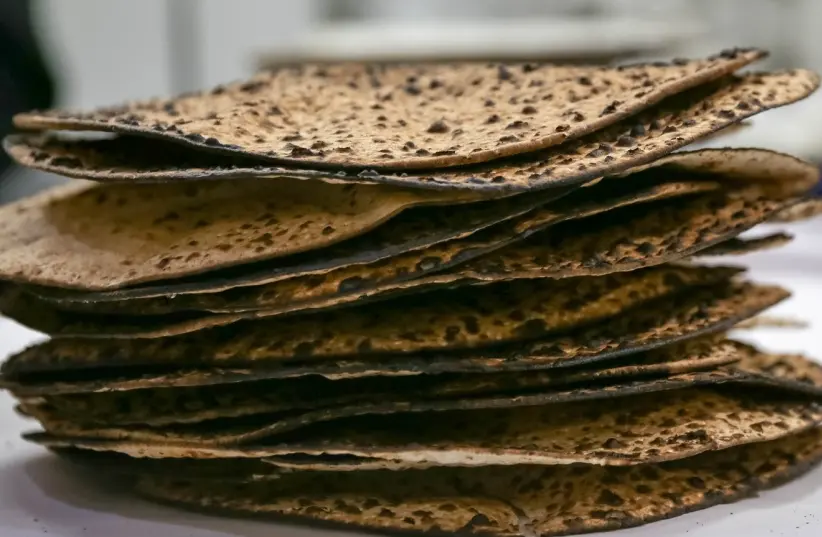
Given the current price per pound, it sure doesn’t feel like Matzah is lechem oni, the bread of the poor person. This year, 200,000 pounds of handmade shmurah matzah were baked and shipped from Ukraine to the United States, in addition to what is shipped to Europe and Israel. But, two hours before the last 20,000 pounds were loaded onto a ship in the port of Odessa, Russia invaded, and the matzahs have been stuck in limbo since.  Partially due to Putin, but also because of general supply chain issues and increased gas and shipping prices, the cost of matzah—and seemingly everything else for Pesach—is incredibly high.


More people than I can remember in any previous year have shared with me that they simply don’t know how they will afford Pesach this year.  Some have explicitly said that when they stand in the supermarkets and look at the prices, they calculate that they can buy matzah or meat but not both.


The bad news is that the prices this year are affecting more people than ever.  The good news is that there is a solution to enable everyone to have a beautiful and simcha-filled Pesach.


Since the creation of the luxury Pesach program, rabbis have been railing against them for their excessiveness, extravagance, and the forfeiting of many of the traditions involved in preparing and experiencing Pesach. Ironically, many of those same rabbis have later “eaten their words” and accepted invitations to serve as scholars in residence, bringing their families to the very type of five-star experience they had long condemned.


But internal contradictions aside, there is a more fundamental reason not to rail against such programs: there is nothing inherently wrong with them. True, kashrus can be complicated at these programs, and yes, not all the environments and activities at every program are appropriate for Yom Tov, or ever. But these are not intrinsic or inherent deficiencies and just mean that one must choose the program carefully.


Baruch Hashem, there are many large Jewish families that, for practical reasons, simply cannot experience a Yom Tov together if they are not at a program. In addition, there are those who are unable to make Pesach for themselves, don’t have family to go to, and rely on a program in order to experience a proper Pesach. And then there are those that can simply afford to experience the luxury of a Pesach program and, given that they are often generous with their support of charitable and communal institutions, why shouldn’t they?


But there is a caveat. There is no Jewish holiday and no Jewish experience that more divides the “haves” from the “have-nots” than Pesach. The contrast between those experiencing Pesach with endless menu options, midnight BBQ’s, quinoa sushi stations, and round-the-clock tea rooms, and those who literally don’t know how they will buy matzah or wine, let alone meat, is startling and staggering.


As a community Rabbi, I am exposed to both extremes.  When arranging for the sale of chametz, I like to ask what people’s Pesach plans are.  Often, I find myself meeting with someone who, with joy and excitement on his face and great anticipation in his voice, will describe the latest exotic location of the program he is attending this year or the newest amenity or entertainment being offered.  Literally moments later, someone will answer the same question with a tear in his eye and worry on his face and say I have no idea how I am going to afford matzah and wine this year because I am barely covering my bills day-to-day without these added expenses.


The Rambam writes (Hilchos Yom Tov 6:18):


When a person eats and drinks [in celebration of a holiday], he is obligated to feed converts, orphans, widows, and others who are destitute and poor. In contrast, a person who locks the gates of his courtyard and eats and drinks with his children and his wife, without feeding the poor and the embittered, is [not indulging in] rejoicing associated with a mitzvah, but rather in simchas kreiso, the rejoicing of his gut.


Though the Rambam is speaking of every holiday, there is a special practice of providing for others specifically before Pesach. The Rama (O.C. 429:1) quotes from the Talmud Yerushalmi, (Bava Basra 1:4) which states that residents of a city should give wheat or flour for matzah to those in their city in need. This is known as kimcha d’pischa, flour for Pesach, or maos chittim, money for wheat.


And yet, even with the widespread practice of giving to maos chittim, there remain far too many who struggle to keep up with the exorbitant cost of making even a basic, no-frills Pesach and are left having to cut back and sacrifice in other areas just to get through what should be a joyous holiday season.


And herein lies the caveat. There is nothing wrong with enjoying and indulging in the luxuries a Pesach program provides, or with making a beautiful, elegant Pesach at home, for that matter, so long as everyone from your community can afford to have the basic necessities. There is no set amount mandated for maos chittim, but I humbly submit the following proposal:


Just as with tzedaka, where we are instructed to give a percentage of our income, our maos chittim should similarly be calculated based on how much we spend on ourselves for Pesach. If all of those who attend Pesach programs gave proportionally to maos chittim, we could ensure that all members of our communities have what they need for Pesach without having to compromise or make trade-offs with other basic necessities. And in the spirit of Pesach, v’chol hamarbeh, harei zeh m’shubach – anyone who can and does give more is certainly worthy of praise.


True, many Pesach programs run fundraisers over Yom Tov for all kinds of worthwhile causes, but only a fraction of people participate, and by that point it is too late to help serve this particular, urgent need. It is instructive that the practice of giving to maos chittim is quoted in the context of the law that mandates that we begin preparations thirty days before Pesach.


Not knowing how one will afford to make Pesach for their family brings unimaginable anxiety, stress, and worry that compound an already difficult situation. The sooner people can be provided for and have the security that their family will indeed enjoy the amenities of Pesach, the less they will worry and fear.


A woman once approached the Beis HaLevi, Rav Yosef Dov Soloveitchik of Brisk, a few days before Pesach with a strange question. She wanted to know whether one could use milk instead of wine for the four cups of the Seder. The Rav asked her if she was ill, to which she replied that she was perfectly healthy. He then responded by giving her a large sum of money. After she left, the Rebbetzin asked her husband why he had given the woman so much money, when wine costs much less. He responded, “If she is asking about drinking milk at the Seder, it is obvious that she has no meat for Pesach, so I gave her enough to buy both wine and meat for the entire holiday.”


When we sit down for our beautiful, bountiful seder with our loved ones, our simchas yom tov should be enhanced by the knowledge that we have done what we can to ensure that none of our brothers and sisters is sitting down to a bare table where real tears substitute for salt water.


We are already well within thirty days of Pesach. Whether you are going to a Pesach program or making Pesach at home, please don’t wait to make sure that everyone can enjoy Pesach. When you are deciding how much to give, please consider what you are spending on your own Pesach for fine wines, delicious meats, and pounds of handmade shmurah matzah, and give commensurately to ensure a beautiful Pesach for all your neighbors as well.  Knowing that nobody in your neighborhood is struggling for Pesach will be more delicious, intoxicating satisfying, and simcha-generating than anything on your table.   


You can contribute to BRS maos chittim here.


Changing Ties

After davening this past Shabbos, a morning that included a fantastically energetic and joyful Aufruf of a boy from our Shul on the eve of his wedding to a girl from our Shul, someone sorrowfully said to me, “Rabbi, tomorrow two kids in our Shul will get married, and one will be buried.” That painful comment summarized what was a complicated and excruciatingly difficult day that included highs and lows and multiple life cycle events, not only for me, but for several people whose day was very full and very emotional.    


On Sunday afternoon, our community gathered to say goodbye to our beloved Corey Reichenberg a”h, a brave, tenacious, spunky, and special young man.  Since the age of three, Corey battled Duchenne muscular dystrophy. Shortly before his Bar Mitzvah, he began to need a wheelchair.  Corey never felt sorry for himself, never took advantage of his disability, and never let it bring him down.  He was funny, friendly, and focused on living life to its fullest.  He didn’t know how long he would have in this world, but he did know that whenever he left it, he wanted to have made it a more beautiful place, and he most certainly did. 


The funeral was heartbreaking, and the beautiful tributes offered by his father, sisters, and friends brought tears to everyone’s eyes.  The way the timing worked out, I needed to go directly from the cemetery to a magnificent wedding of two special souls from our Shul.  The black suit I wore worked for both the funeral and wedding; the only thing that needed to be changed was my tie.  (In semicha, Rabbi Lookstein taught us the art and importance of wearing a funereal tie)


Changing one’s tie is easy, but changing gears from a tragedy to a celebration, from the death of a young person to the celebration of a marriage between young people, is much harder.  When I arrived at the wedding venue and parked, I changed my tie but still couldn’t get out of the car.  I sat there trying to pivot my emotions.  To be honest, I was somewhat conflicted – Is toning down simcha in light of a tragic loss fair to the celebrants?  Is unleashing unbridled simcha respectful to the grieving family and to the honor of the neshama that was just lost?  How does one compartmentalize feelings? Is there a way to honor both the high and the low, the joy and the sorrow? 


I have had to compartmentalize countless times in the rabbinate, fluctuating between events, conversations, and meetings, but nothing was as intense as the contrast and immediate juxtaposition of these two occasions.  As I sat there struggling, it occurred to me that I had just heard the answer at the funeral, twice.


When Corey’s father Ed spoke, he shared:

I want to tell you that Thursday (when Corey died), as difficult and as painful as it was, it was not as bad as the day 21 years earlier when we received the diagnosis that our beautiful, sweet 3-year-old had an incurable disease, Duchenne muscular dystrophy. We were devastated, but it so happens that on that very evening our friends had an Upsherin for their son. We decided then and there that we would not shut off from the community but rather we would make our life with Corey as normal as we could. We went to that Simcha.


I had a strong suspicion I knew whose upsherin it was.  Twenty-one years prior, there had been a wonderful, elaborate celebration by someone I knew was their friend.  Immediately following the funeral, indeed that father gave Ed the biggest hug and said, “I had no idea, you were so happy for us that night, you added to our celebration. I had no idea what you were going through that very day.”   


It was the hardest day of their lives. They had received devastating news that radically changed their lives forever.  If ever there was an excuse, and if there was an event one could get out of, it was an upsherin on a day you learned your child that same age had a significant disability.  But Corey’s parents made the conscious and mindful choice to live life, to show up, to choose happy, even while still finding time to be sad.


It wasn’t just that day and for the event that night, it is who the Reichenbergs are.  In her eulogy, Corey’s sister Naomi shared:


The best story to describe my parents’ unwavering strength goes as follows. We were at a conference for muscular dystrophy in Baltimore, Maryland, and it was the final night of the conference. I was only about eight years old and the founder of Parent Project Muscular Dystrophy, Pat Furlong, was speaking. Pat had two boys who had passed away from Duchenne which is why she started the organization. She was speaking about her boys and she mentioned their deaths.


Naive little Naomi turned to her parents in disbelief. “Corey’s gonna die?” I uttered those words with the utmost shock. I ran out of the ballroom in tears and my mom ran after me. I went into a bathroom stall and she followed. She came in and I expressed to her how I wish I could have at least found out differently. She told me she wished the same.


She then went on to say, “Naomi, I know this is hard and you’re sad because he’s your brother and you love him but we can’t be sad all the time.” She said, “You’re gonna wipe your tears and you’re gonna go back out there and we are gonna give Corey the best life possible and the happiest life possible in the time he has because otherwise, it’s not worth it. Otherwise, life wouldn’t be worth living. If we aren’t giving him and everyone around us a fulfilled life, there is no point in this nisayon (test).” From that moment forward I was determined to bring happiness to everyone around me. All because of my mom’s superhuman strength, I was then able to realize what I love doing most, making others happy. Their strength specifically over these last few months has been unwavering.


Our Parsha describes the details of the laws of Tzara’as, the spiritual leprosy that can afflict a person, their garments, or their home.  If an article of clothing develops a questionable affliction, the Kohen quarantines it for seven days and then examines it to see if the blemish has spread.  If it has, the garment is burned, but if it hasn’t, it is washed and locked up for seven more days to see if the affliction has dimmed. 


The Torah describes that the Kohen looks at the garment to see if “hafach ha’negah es eino,” did the affliction change its color.  The Imrei Emes suggests that the Torah isn’t describing the garment or affliction, but is talking about the Metzora, the individual.  Did this person going through a difficult situation change his perspective?     


Rav Leib Lopian, Rosh Yeshiva of Gateshead, points out that the letters in the words “nega” – affliction – and “oneg” – pleasure – are identical. The only difference between them is where the letter ayin appears. Shlomo HaMelech, the wisest of all men, writes that “he’chochom einav b’rosho” – a wise person places his eyes in front (Koheles 2:14).  It has been suggested that on a deeper level, Shlomo was telling us that the wise person put the letter ayin in the beginning, chooses to live with oneg, happiness, even if they are struggling with a negah, a challenging time. 


Corey’s disability and so many other challenges people confront are certainly not negaim, they are not afflictions, but the insight remains relevant and inspiring nonetheless.  Like Corey’s family each of us have a choice of where to put the ayin: will we focus on the negah, what is going wrong, or on oneg, what is going right, even with the tests.  To be very clear, this is not to God-forbid judge, look down on, or be critical of anyone who is genuinely struggling with managing difficult challenges, or staying positive while facing trying life circumstances. Rather, we can admire and learn from people who are able to find the extraordinary strength to see the oneg while understanding and empathizing with those who are having a hard time seeing past the negah. (This lesson is particularly relevant for those a step removed, who aren’t themselves going through the challenging circumstances.)


And that is what I realized sitting in the parking lot outside the wedding. If the Reichenbergs could pivot on that day 21 years earlier, certainly I could transition to enjoy the wedding that evening.  The choice to compartmentalize is not disrespecting or being insensitive to a crisis or loss or to someone you love.  It is finding the resolve to push through, to choose to live life, to put the ayin b’rosh, to change not only our tie, but also our outlook.


Marking Our Two-Year Anniversary Since Shutting Down

This week marks the two-year anniversary of Boca Raton Synagogue, like shuls across the world, shutting down in response to the threat of the then-new Coronavirus.  I will never forget the meeting of rabbanim gathered in my office as we held a call with the head of our local hospital and he made a personal request that we announce a temporary closure and short lockdown to both slow the spread and preserve the critical, lifesaving resources. As desperately as we resisted, ultimately, we gave him our word, hung up the phone and convened for Mincha—what was to be the last minyan on our campus for over two-and-a-half months. 


Looking back over these past two years, there are many decisions we can be proud of and stand by, others that were the best decisions at the time and that we would make again with the knowledge and information we had at the time, and others we undoubtably could have made better (I have no doubt some reading are thinking in one direction, while others believe the opposite). 


This week, I happened to come across an open letter I had written to our Shul, the building and campus I missed so much.  Reading it moved me because it brought me back to how I had felt. But it also saddened me greatly, because I realized just how quickly so many of those feelings faded, and how fast I went back to taking so much for granted.


To my dear, precious, and sacred Synagogue:


For the last ten weeks I have missed you so. I have longed to be together with our shared friends, united in prayer in your sanctuary, joined in learning in your Beis Medrash, celebrating beautiful simchas in your social hall.  I have yearned to bring our children to youth groups in your classrooms and to play on your playground.  For ten weeks I have pined to spend time with friends in your hallways, to shmooze on your front lawn, and to linger in your lobby. 


For over two months now I have dreamt of kissing your Torahs, of singing along to the sweet melodies coming from our wonderful chazzanim standing on your bima. My finger aches to point at the Torah being lifted during hagbah for all to see and my hand hurts from not giving out candies to the countless children who come to say “Good Shabbos” on Friday night. My feet yearn to dance with Bar Mitzvah boys upon receiving their first liyah and my head hankers to get hit by candies thrown at young men celebrating their aufruf.  My office sits empty, absent the people who come to meet with me, but as much to encounter you, to find solace, strength, meaning and support in your walls, in the symbols and holy objects your furnishings contain.


Every day for over seventy days I have wondered, when?  When can we come back? When will this exile end?  When will this isolation expire?  When will we be together again? When will we finally feel the comfort and confidence you provide? We have never needed you more than when we can’t have you. We have never wanted you more than when you are inaccessible to us. 


Davening simply hasn’t been the same.  What I would give to hear those who sometimes daven so loudly they distract me.  Things just don’t feel right without the pacers, the shukelers, the stragglers, the whisperers, the screamers, and I dare say, even the talkers.  Maybe we weren’t all getting it entirely right, but we were there, we showed up, we were together.  And now we are so far apart, so alone, so distanced.  Our davening is too quiet, too isolated, too far away from you, our holy space and sanctuary.  Just being with you brought out our best, helped us concentrate and focus, and now we feel so lost, so displaced, so out of sorts.


To be completely honest with you – it certainly has been refreshing to automatically be on time, to be able to daven at our own pace or to slow down for the sake of children we now daven with, to not have to fight for a parking spot or a seat.  But we would trade those comforts and conveniences in a heartbeat just to be with you again.  


My beloved and cherished shul, I have missed walking behind your Torah to and from the bima, shaking hands and hugging friends along the way.  My soul screams to have the privilege and honor to transmit our tradition’s timeless teachings from your shtender to a packed room, men and women, young children and Holocaust survivors, most of whom are thirsty to drink from the fountain of our Torah’s wisdom and even to those whose eyes are closed as they are “deep in thought.”


Just a few months ago, your worn-out carpet and areas that need a coat of paint jumped out at me as I focused on your blemishes and flaws, but now I couldn’t notice such things because you are beautiful to me, perfect as you are, and I just want us to be together again. 


To be clear, our separation is not your fault or ours.  You heroically sacrificed, shutting down long before you were legally obligated to, all to protect us, even though it meant you would sit alone, empty and maybe even looking abandoned.


My darling BRS, for months I have fantasized about our reunion. I have visualized our first time back together, the palpable joy, the unbridled happiness, the affectionate hugs, the sincere seudas hoda’ah and the emotional birchas shehechiyanu. I have pictured how we would decorate you, how we would sing and dance with your Torahs, kiss your siddurim, embrace your chumashim.  We would settle into your chairs, breathe a sigh of relief, and feel a surge of strength, faith, and hope. We would be back where we belonged.


And now that this day is finally here, we feel so close and yet we must remain so far apart. 


This coming week, if all continues to go well, we will return to your campus, but we still cannot enter your premises.  We will be together in makeshift minyanim, but we will still be separated by at least 8 feet.  Instead of hugs or handshakes, we will be lucky to say hi.  Instead of a reunion, we will experience a tease.  Instead of feeling we are back, we will still feel like we don’t know where we are.  Instead of dancing, we will be distancing.  Rather than see into each other’s hearts we will be staring at one another’s masks.


As badly as we want things to return to normal and to be familiar, my dear shul, we accept that this simply isn’t an option just now.  Last week we completed the third book of the Torah and declared “Chazak.”  We couldn’t scream it with you, but nevertheless we meant it more than ever when we turned to one another and said, “Be strong, be strong, and together we will be strengthened.”  And this week, as we begin the fourth book of the Torah (we will have so much rolling to do when we finally come home to you), we acknowledge that a person has to make himself or herself a midbar, a desert, to truly receive Torah. We have proven our willingness to live with barrenness and spiritual homelessness and now, in that merit, we desperately hope to come home. 


Our dear shul, our love and longing for you will never fade.  While we still can’t step inside, we will soon be one step closer to being together. We hope you understand that while that will have to do for now, it still isn’t enough. 


With love and longing,

Your dear friend,

Efrem


As we reflect on the last two years, there is so much we are grateful to move on from but there is also so much to hold on to and to take with us.  Don’t put this extraordinary time entirely in the rear-view mirror.  Revisit and reflect on those feelings and experiences, and transform what was a difficult two years into the catalyst for transformation, growth, and breakthrough in our relationship with our shul, ourselves and those around us. 

Assimilation is Not the Answer to Antisemitism: Be an Ish Yehudi, a Proud Jew!

In its “Audit of Antisemitic Incidents,” the ADL recorded over 2100 acts of assault, vandalism and harassment  against Jews last year, a 12% increase from the previous year and the highest total since tracking began in 1979.  An  AJC survey found that 90% of Jewish Americans believe antisemitism is either somewhat or a very serious problem.  So, antisemitism is rising and overwhelmingly we claim to be concerned about it.  But what are we willing to do about it? 

When Haman approached Achashveirosh with his diabolical, genocidal plan to exterminate the Jews, he said, “there is a nation scattered abroad and dispersed among the nations.” The Talmud (Megillah 13b) expands on this conversation.


When Haman targeted the Jews for annihilation, he said to Achashveirosh, “Let’s destroy the Jews.” Achashveirosh replied, “Not so fast. I am afraid of their God, lest He do to me what He did to my predecessors.”


Haman relieved the King of that fear when he said, “Yeshno am echad,” which translates literally as “there is a certain nation.” The Talmud quotes Rava, who explains that Haman was telling the King something much more strategic and insightful. Not yeshno am echad, there is a certain nation, but rather yoshnu am echad, there is a sleeping nation. Said Haman, “They have been negligent of mitzvos, they are divided, fighting with one another. They are arguing amongst themselves but at the same time they are fast asleep as to what we want to do and how we threaten them.”


We were on the brink of extinction as a people because we were asleep.


We were vulnerable and literally on the brink of elimination and extinction as a people because we were asleep. Our eyes were closed to what was happening around us. We didn’t take the threats seriously and we didn’t stand up for our right to simply exist.


Haman recognized and took advantage that there is a nation that is sleeping. All he had to do was continue to lull the Jewish people into a false sense of security, to breed complacency and apathy, and at that moment he could accomplish his goal of ridding the world of our people.


Indeed, Rabbi Soloveitchik suggested that the true miracle of Purim is that an anti-Semite rose, threatened us, and we believed him. We didn’t excuse him, accept his bogus apologies or say he didn’t really understand what he was saying. We didn’t just reject his tropes, we confronted him, we took him at face value, and we were determined not to let him threaten our people.


Identifying an anti-Semite, taking him or her seriously and doing something about it is nothing short of a miracle.


So how did we survive? What spoiled Haman’s plan? Why did we ultimately triumph over Haman such that we are here today and he is a distant memory? The answer is simple: Mordechai and Esther.


We understand Esther’s heroism. She risked everything: her life, her family, her people, to go out on a limb and confront the king without permission. But what made Mordechai a hero? If you think about it, Mordechai may actually be a villain, a perpetrator in the story, responsible for initiating the decree to exterminate the Jews of Shushan and beyond.


Would it have been so terrible for him to just bow down? Just once? Not only does Mordechai refuse to bow down to Haman, he insists on antagonizing him by camping out on Haman’s route so that Haman would see him every day and be bothered by the one Jew who refuses to show him honor. Mordechai’s behavior provokes Haman and he responds by declaring his intention to destroy not only Mordechai, but all of Mordechai’s people, the Jews. Even after Haman’s plan has been pronounced, Mordechai continues to snub him.


When Achashveirosh remembers what Mordechai had done to save his life and sends Haman to reward him by parading around publicly, Mordechai could have declined the honor. Instead, he accepts, humiliates Haman and infuriates him further!


And this is the person we consider a hero of Purim? Why? A closer look seems to indicate that Mordechai’s ego put the Jewish people at risk. What was the source of Mordechai’s intransigence?


You might think it’s simple – bowing down was idolatry, one of the three cardinal sins for which we must give up our lives rather than violate. Indeed, the Ibn Ezra suggests that Haman was wearing idolatrous symbols. Rashi comments that Haman had declared himself a deity. Either way, it would seem Mordechai was right not to bow down, he was simply following Jewish law and it was his peers who were wrong for bowing, even if not doing so would mean risking their lives.


But that’s not the whole story. The Talmud (Sanhedrin 61b) says that the law of sacrificing your life rather than engaging in idolatry applies if in fact one is buying into the divine nature of the idol. If one is bowing simply out of fear, one is not liable.

So why didn’t Mordechai simply bow down in an effort to save the Jewish people?

Yes, Mordechai would have been entitled to bow down. To save his life, he could have been apologetic for his Jewishness and submitted to a virulent anti-Semite, bowing down to Haman and his worldview that wants a world without Jews. But Mordechai understood what was at stake.


Mordechai understood the antidote: To stand firm, to stand strong, and to stand as a proud Jew, a Torah Jew.


Mordechai, a humble scholar and righteous sage witnessed the growing antisemitism of Haman and his desire to see Jews and Judaism erased and he understood the antidote. If Jews were fast asleep, excusing away even the anti-Semitic “tropes” of their time, the answer was not to bow down, even if it was technically allowed. The answer was exactly the opposite. To stand firm, to stand strong, and to stand as a proud Jew, a Torah Jew.


The answer was to not apologize for being a Jew, but rather to be the proudest and most tenacious Jew, and that is exactly what he did. And this is how is Mordechai is known in the Megillah: “Ish Yehudi haya b’Shushan ha’bira – There was a Jewish man in Shushan the capital.” What do you mean a Jewish man; there was only one? There was a large Jewish population in Shushan!


The Megillah is telling us that true, there were many Jews, but some were abandoning their Judaism and others were failing to stand up for it. The Jewish community was asleep; there was only one Ish Yehudi, an unashamed, unembarrassed, unapologetic Jew.

What happens when Jews stand up for ourselves, when we call out and confront anti-Semitic song lyrics, tropes and yes, call out antisemites themselves? By the end of the story, the Megillah tells “fear of the Jew had fallen on them and so no man could stand up against them.” Why? “Because Mordechai, the proud, unashamed, unapologetic and fearless Jew earned the respect of his multitude of brothers, he sought the good of his people and spoke for the welfare of the next generation.”


One of the critical, but too often neglected, lessons of Purim is that the answer to our enemies is not to hide, apologize, or erase our Jewishness. To the contrary, it is to swell with and share our Jewish pride. When we act with confidence and pride, we gain respect. It is no coincidence that Mordechai emerges as a leader not only of the Jewish people, but a dignitary in the Persian government.


The mitzvah of Purim is to get to a point that we can’t tell between cursed is Haman and blessed is Mordechai. We are very good at the blessed is Mordechai. We look to explain, excuse, justify and see everyone as a blessing. But we need to get to a point of remembering that identifying a Haman and cursing him is as important as blessing a Mordechai. We have to call out an anti-Semite, hold them accountable, hold those whose silence makes them accomplices accountable.


This Purim, don’t just dress up like Mordechai; act like Mordechai.


If you share concern about growing antisemitism, the question is: what will you do about it? Certainly we have to write letters, make phone calls, attend rallies and hold antisemites and those who fail to condemn them accountable. But there is something else we must do.  I can’t help but notice that assimilation and intermarriage are at record highs, even as antisemitism is as well. Clearly blending in entirely and erasing our differences altogether is not only dangerously wrong theologically, it has no correlation to being safer and more secure.  It is as if just when Jews try to downplay their Jewishness, our enemies will not let us forget.


We must appeal directly to the American people, to carry ourselves with pride, but also with dignity, honesty, integrity and righteousness. If like Mordechai our neighbors come to know and respect us, they will be intolerant of leaders who dare promote anti-Semitic rhetoric or tropes. If we carry ourselves properly, those we work with, work out with, shop with, or live near will speak out and stand up to demand resolutions of condemnation and removal of voices of hate from critical committees.


This Purim, don’t just dress up like Mordechai; act like Mordechai.


Be an Ish Yehudi.


A Time to Speak and a Time to Remain Silent

Martin Luther King, Jr., whose birthday we will mark this Monday, spoke powerfully about the danger and potential damage of silence.  He once said, “Our lives begin to end the day we become silent about things that matter.”  On another occasion he said, “In the end we will remember not the words of our enemies, but the silence of our friends.”  Both of these insights, individually and the combination of the two together, resonate deeply for me these days.


Whether Avraham Avinu speaking truth to the ultimate Power when he protested the impending destruction of  Sedom, Moshe challenging Hashem about why bad things happen to good people, Moshe and Aharon confronting Pharaoh, Esther and Mordechai taking on Haman, the Chashmonaim standing up to the Syrian Greeks against all odds, or countless other examples, we come from a tradition of not being silent when injustice is being perpetrated against anyone, and certainly not when it is directed against our people. 


That is why this week nearly 1,000 people came together to raise our unified voice in support of Israel. In August 2014 during the war between Israel and Hamas, just two hours after Hamas agreed to a ceasefire sponsored by the United States and the United Nations, Hamas terrorists emerged from a terror tunnel, shot Hadar Goldin, a Lieutenant in the Israeli Defense Forces, and killed two other Israeli soldiers. Hadar Goldin did not survive this attack, and Hamas continues to hold Hadar and the body of another Israeli soldier slain during the 2014 Gaza war, Oron Shaul, for ransom.


Seven years have passed, and the families of these fallen soldiers are still struggling to obtain the release of their loved ones for return to Israel. Currently, a huge aid package to rebuild Gaza is making its way through Congress. Any US aid packages earmarked for the reconstruction of Gaza be expressly conditioned on the return of Hadar, Oron to Israel and their families as a non-negotiable pre-condition to the award of such aid. 


There is a moral imperative to bring them home.  International humanitarian law requires the repatriation of missing soldiers and civilians; Jewish law requires us to make all efforts to bring the dead to their final resting places. Click here to find out how you get do more to get the bodies of our brothers home. 


These are moments that demand we not remain silent.  Abuse, agunahs, antisemitism and other injustices demand we speak up and speak out.  Hashem has blessed us with voices, with influence and with access.  We must generate outrage, the most powerful commodity these days, and the only one that draws attention and demands action and reaction.  


But while there are moments to overcome our silence and to express outrage, there are other times in which we would do better to be quiet than to react with indignation.


When the Jewish people miraculously cross the sea and emerge safely on the other side, they erupt in spontaneous song – Az yashir Moshe u’Vnei Yisroel.  In that song that we recite each morning in our prayers, we describe Hashem:

מִֽי־כָמֹ֤כָה בָּֽאֵלִם֙ ה׳ מִ֥י כָּמֹ֖כָה נֶאְדָּ֣ר בַּקֹּ֑דֶשׁ נוֹרָ֥א תְהִלֹּ֖ת עֹ֥שֵׂה פֶֽלֶא׃

“Who is like You, Hashem, among the celestials; Who is like You, majestic in holiness, Awesome in splendor, working wonders!”


We typically understand the song as praising Hashem’s unique power.  For example, the Seforno writes: “Hashem’s incomparable stature consists in His ability to change the nature of phenomena in the universe which had previously been considered as indestructible, inviolate, impervious to any attempt by man to influence their nature in any way.”


But the Gemara understands our praise and awe of Hashem differently.  When the wicked Titus entered our Holy Beis HaMikdash and desecrated the Holy of Holies in unspeakable ways, Hashem was silent, He was passive and failed to react.  Why would the Almighty, the infinite, omnipotent, omniscient, all-powerful Hashem, do nothing when He could do anything?  Our rabbis explain (Gittin 56b):

דבי רבי ישמעאל תנא מי כמוכה באלים ה’ מי כמוכה באלמים

Do not read “Who is like You God b’eilim,” among the celestials, but “Who is like You b’ilmim,” among the mute.  Hashem modeled for us the greatest strength, the most potent response – doing nothing. God showed us His power not by manipulating nature and controlling the world, but by self-control and discipline, to remain silent in the face of insult, defamation and even blasphemy. 


He taught us that our greatest strength, too, is not in overreacting to being insulted— it is not acting at all.  Chazal teach (Shabbos 86) we should train ourselves to always be min ha’ne’elavim v’einam olvim, from those who when insulted don’t insult back; shom’im cherpasam v’einam m’shivim, hear the wrath against them, but don’t respond.  


Save your outrage and indignation.  When it comes to a personal slight, a hurtful insult, let it go, walk away.  But how?  We get that nasty text, that hurtful email, the  aggressive comment we feel we cannot ignore. How do we stay silent?  How can we find the resolve to walk away, press delete, not match or escalate what has been cast our way? 


The answer is found in something we say every day, three times a day.  We say at the end of the Amida – “v’limkalelai nafshi sidom, to those who curse me, may my soul remain silent.”  Why do we invoke nafshi, our soul? Perhaps we mention our soul because it is the source of our strength, our self-control.  We each have a tzelem Elokim, a Godly spirit, and just as Hashem shows His greatness by seeing His name and dwelling place desecrated and choosing not to respond, we can similarly find the inner strength and discipline to not respond and match the volume and vitriol, no matter how poorly we are mistreated.


The Zohar says that Hashem’s chariot has four legs, the first three are Avraham, Yitzchak and Ya’akov, and the fourth is Dovid HaMelech.  It is understandable that the patriarchs represent the first three legs, but why Dovid over Moshe, Aharon, and so many worthy others?


The Chafetz Chaim, in his Shemiras Ha’Lashon, explains that David Hamelech became the fourth leg of Hashem’s Chariot when Shimi ben Geira hurled insults at him in public, and Dovid just ignored it.  Even when Dovid’s servants wanted to respond, Dovid told them, he couldn’t be cursing me and embarrassing me if Hashem didn’t want it to happen, so leave it.  There is a master plan, no need to respond.


Rav Pam says there are times we are meant to experience yesurin, suffering.  It can come in many forms – illness, financial collapse, relationship crises.  When it comes in the form of someone insulting us, we should sing and dance with joy that with all the options and alternatives, being insulted is our form of suffering.  What a gift and a blessing.  Lean into that insult, embrace it, and gladly take it and remain quiet. 


Finding the capacity to remain silent, even when insulted, is an expression of true gevurah, of great strength.  When we dig deep and find that ability, it creates a very special moment. We have a tradition that when being insulted, instead of responding, escalating or matching the vitriol, we should take a deep breath and offer a prayer, ask for something in that propitious and providential moment in time.  That is when we are at our best and most worthy.  Don’t waste it by shouting or insulting back; prove your strength and take advantage of the opportunity to be worthy by asking for something important.


We seem to have it backwards sometimes.  We are outraged when we should be quiet, and when we should be screaming from the rooftops, somehow, we remain silent. 


When it comes to antisemitism against our people and injustice against others, let’s vow to never be silent, but to stand up and speak out. Let’s hold our elected officials accountable. Not the ones in the other party, that’s easy. But calling up and calling out those in our party, the ones we identify with and voted for.  Object to the elected officials saying the wrong things and call up those who are remaining silent while their colleagues cross important boundaries.


But when it comes to being personally insulted, to absorbing a slight against ourselves, let’s learn to let it go, to show our true strength and be like Hashem, to be counted among the ilmim, those that are silent, and among the ne’elavim, those that are insulted but never insult back. 


I’m Grateful I Can’t Understand

Chaim Walder broke onto the scene in 1993 with his first best-selling book, “Yeladim mesaprim al atzmam” (“Children Talk About Themselves”), translated into English as “Kids Speak.”  The series was translated into eight languages and the original became one of Israel’s all-time best-sellers.  He revolutionized children’s literature in Israel, giving voice to a population who were lectured to but too often didn’t feel heard.  His books were made up of stories, written in first person as reported by children, talking about their problems, feelings and experiences. Children found his books validating, comforting, and encouraging.


When a month ago, several women publicly accused Walder of assaulting them when they were minors seeing him for therapy, they weren’t the only victims.   Dozens of boys, girls, married women, and single women testified in front of the Beis Din of Rav Shmuel Eliyahu about abuse going as far back as twenty-five years ago to as recently as earlier this year.  Rather than participating in the Din Torah in an effort to prove his innocence, Walder ended the investigation by taking his own life, leaving behind a suicide note that asserted his continued denial and presented himself as the victim.


Our hearts go out to all those who were abused and assaulted.  They deserve our unequivocal loyalty and support.  Sadly, while they have suffered the most and will likely continue to confront the trauma of their experiences throughout their lives, they are not the only victims.  Children who read, enjoyed and felt connected to his series of books, are reeling in pain.  Parents who can’t understand, let alone explain, are devastated.  The pain of all these groups has only been compounded by the disturbing attitude of some rabbis and Jewish media who have not only failed to report on the abuse or stand up for the victims, but actually laud and memorialize the heinous perpetrator. 


There are so many questions surrounding this tragic story, each haunting in their own right.  Many are understandably confounded in trying to understand: how could someone who dedicated his life to giving children a voice silence them?  How could a storyteller deny others their story?  How could a person who was devoted to validating the feelings of children, systematically abuse and assault them?  Many will get stuck on the question, how could someone think the solution, the way out, or the answer is to take their own life?  What exactly was he thinking when he wrote the note, what was he feeling right before he pulled the trigger?  


I obviously don’t have answers to these questions but I am reminded of a powerful lesson I learned years ago when I was haunted by a similar question.  As a communal rav of a large shul, I have dealt with inexplicable heartbreaking traumas over the years.  Each circumstance is very different, each with its own story, background, and aftermath.  


Following one such tragedy, I was haunted, couldn’t sleep and was deeply disturbed.  I spoke to a therapist and explained that I had spent my life studying, analyzing, and trying to make sense of Torah, people, and events.  I generally felt a decent grasp on many things but couldn’t understand this.  I was obsessed with making sense of it. 


The therapist, a good friend, told me to not only stop trying to make sense of it, but to be grateful I couldn’t understand it.  I will never forget what he said: “If you could understand it, if you could relate to it or make sense of it, you would be capable of it.  Be grateful you are healthy and well adjusted.  Not being able to understand it should comfort you, not agitate you.”


Indeed, there are many questions surrounding this tragic episode and we should be content, maybe even grateful, if we can’t make sense of it. We gain nothing by trying to get into the head of someone who could write for children and abuse children. Trying to understand the internal motivations and calculations does not do any of us any good.


Instead of getting stuck on those that have no answers, we should focus on those that we can and must provide answers to.  How can we better protect victims, especially children?  What can we do to show support at this time to people impacted by these horrible events? How can we hold rabbonim and communal leaders who tolerate such behavior accountable?  What can we do to prevent such behavior in the future?


Finding answers to these questions may not be easy but they are critical to ask and pursue. If you are able to, don’t let yourself be haunted by the unanswerable and unknowable; instead, channel the angst and discomfort into productive and meaningful conversation and action.


The Most Effective Way to Have Influence

A couple of years ago, Bibi Netanyahu was quoted as saying there are only two men he considers fit to lead the State of Israel and one of them is Ron Dermer.  We had the great privilege of hosting Ambassador Dermer at Boca Raton Synagogue this week and after meeting him and hearing his insights, analysis, and reflections, it is clear why Prime Minister Netanyahu felt that way.  During his seven-and-a-half years as Israel’s Ambassador to the United States, Dermer wasn’t just a diplomat and outstanding spokesperson for Israel, he helped shape historic policies and nurtured major peace initiatives. 


Following his presentation, I had the chance to sit with Ambassador Dermer and my daughter Tamar to discuss ways young people can get involved in advocating for Israel in a meaningful way.  Not surprisingly, the ambassador made some excellent suggestions and gave tremendous encouragement regarding the long-term impact of influencing even one opinion, even when you don’t realize it right away.  He then shared a story to illustrate his message that had a tremendous impact on me. 


In 2015, while he was ambassador, he lobbied feverishly against the Iran deal that Congress was going to vote on.  He met with countless members of Congress, scheduling a half-hour with each one in an effort to persuade them to vote against what he felt was a deal that left Iran with a clear path to a nuclear weapon.  He went in to see a particular congressman and thirty seconds into the conversation, before he could even begin to make his pitch, the congressman said, “You don’t need to try to convince me, I plan to vote against the deal.” 


Somewhat startled, Dermer recalled thinking to himself, I have twenty-nine and a half minutes left, and so he naturally asked the congressman what made him take what was an unpopular position among his party. The congressman explained that he immigrated to America when he was fifteen years old and lived in a neighborhood of immigrants. Few people gave them the time of day, they were treated downright rudely and with hostility by others, and nobody allowed them to play on their basketball courts.  There was one exception. 


“There was a synagogue in our neighborhood,” explained the congressman, “and the members greeted us warmly and respectfully. They invited us to use their basketball court and they treated us with dignity.  Since I was fifteen years old, I have been determined to always stand with the Jews and to stand with Israel and that is why I am voting against the Iran deal.”


Ambassador Dermer then pointed out the members of that shul were enormous Israel advocates who influenced the US-Israel relationship without even realizing it, just by being good people. 


Those learning Daf Yomi recently studied a Gemara (Taanis 21b) that teaches how we may not appreciate the impact of our behavior and the merit it brings to others, even when we think nobody sees:


Once there was a plague of pestilence in Sura, but in the neighborhood of Rav there was no pestilence. The people therefore thought that this was due to Rav’s great merit. However, it was revealed to them in a dream that Rav’s merit was too great and this matter too small for the merit of Rav to be involved. Rather, his neighborhood was spared due to the acts of kindness of a certain man, who would lend his hoe and shovel to prepare sites for burial.


Rabbi Paysach Krohn tells the story of a Conservative Jew walking into an Orthodox shul in Dallas, Texas.  The man introduces himself to the rabbi and presents a large, unsolicited donation.  The rabbi was stunned by the unexpected gift and explained that the shul had a great need to renovate an educational wing but didn’t have the startup money.  “Your donation,” he said, “is going to turn this project into a reality, but I am very curious about who you are and why you chose to make a large gift to our shul?”


The man explained that he made his first trip to Israel a few months back and ended up at the Kotel. He said, “As I took in the sights around me, I noticed a Yerushalmi Jew standing and davening in silent devotion.  I had never witnessed someone praying so fervently or with such meaning.  I was mesmerized and entranced.  But even more, I was inspired.  I determined right then and there that when I got home, I was going to make a donation to a shul in honor of that Yerushalmi Jew.  When I returned I thought to myself, if that Jew were here in Dallas, where would he be comfortable praying, and I looked in the Yellow Pages for an orthodox shul and came up with you.”  That man ultimately became more observant and continued his generosity in building the Torah institutions of the community.


Reflecting on the story, Rabbi Krohn invites us to imagine what happens when the Yerushalmi Jew comes before the Heavenly court after 120 years in this world.  He will be greeted enthusiastically with a hero’s welcome.  He will be rewarded for transforming Judaism in Dallas, Texas and for all the Torah learned by thousands of people, and by all the davening that took place in the Shul that he supported. He will undoubtedly turn to the Heavenly Judge and say, there must be a mistake, I have never even been to Dallas, Texas.  I don’t even speak English.  He will only then learn the impact of the impression and inspiration he spread when he davened so sincerely and fervently at the Kotel that fateful day.


Our actions have cosmic implications. The small acts of kindness and virtue we engage in can make the biggest difference not only to ourselves, but to all of humanity. In 1963, meteorologist Edward Lorenz introduced what he called the “butterfly effect.” He showed that the flapping of a butterfly’s wing in Australia can cause a tornado in Kansas, a monsoon in Indonesia, or a hurricane in Boca Raton. Lorenz’s thesis is part of a greater theory called chaos theory that essentially posits that small acts can have large outcomes. Chaos theory is applied in mathematics, programming, microbiology, biology, computer science, economics, engineering, finance, philosophy, physics, politics, population dynamics, psychology, robotics, and meteorology.


Chief Rabbi Jonathan Sacks has applied chaos theory in one more realm. In his book “To Heal a Fractured World,” he coined the phrase “chaos theory of virtue,” demonstrating how small acts of kindness and virtue can have immeasurable consequences on the world. Sometimes, as was the case with the donor in Dallas and the synagogue that was the basis for a pro-Israel vote, we see the consequences and impact; more often than not, we don’t.


Our mission is to be kind, warm, welcoming and respectful, act with virtue and righteousness always.  Among many other reasons, you never know who is watching or how it will impact their attitude to Jews or Israel.

Be a Blessing For Those in Recovery

While we have been focused on fighting and managing a historic pandemic, another epidemic continues to rage.  Substance abuse and addiction don’t discriminate based on religion, economic class, gender, or ethnicity.  And, as we have come to learn all too well, the Torah community is not immune.


Experts will tell you that addiction is not about the substance or behavior, but rather what pain, discomfort or ache the users are trying to escape, what hole in their hearts they are trying to fill, or what aspect of their lives they desperately want to be numb to. 


Earlier this year, I moderated a discussion that included two courageous young men in recovery.  Each described how when they were young, they didn’t feel they were like everyone else, they weren’t comfortable in their own skin and didn’t feel like they belonged.  They described living with a persistent sense of being an outsider. 


One of the participants shared that he was at a friend’s house when the two of them discovered the friend’s father’s alcohol collection.  He took his first drink and after several sips felt something he had never felt before: a sense of calm, an inner peace.  Finally, the “noise” of the ever-present uneasiness was quiet.  Who wouldn’t want to return to that reprieve, and so he kept being drawn back to what felt like a magic elixir, what he believed was the antidote.  The problem, of course, was that it would inevitably wear off, and the pain, loneliness and sense of inadequacy and irrelevancy would return. 


His story is not unusual.  Addiction is almost never about substance or behavior.  People’s perpetual discomfort and unease could be driven by social anxiety, religious competition or guilt, financial pressure, or mental health challenges. The common denominator is living with an inescapable disquiet, an ache that won’t let up and doesn’t go away. The substance or addictive behavior becomes the escape, the way out. It offers respite and refuge, a bit of relief and a break from the struggle. 


But, alcohol, drugs, gambling, shopping, working, or acting out are not the solution.  In fact, they only lead to more problems.  Therapy, support, and love are critical ingredients to authentically fill in the hole in the heart, to quiet the noise, and to find a sense of belonging and purpose. 


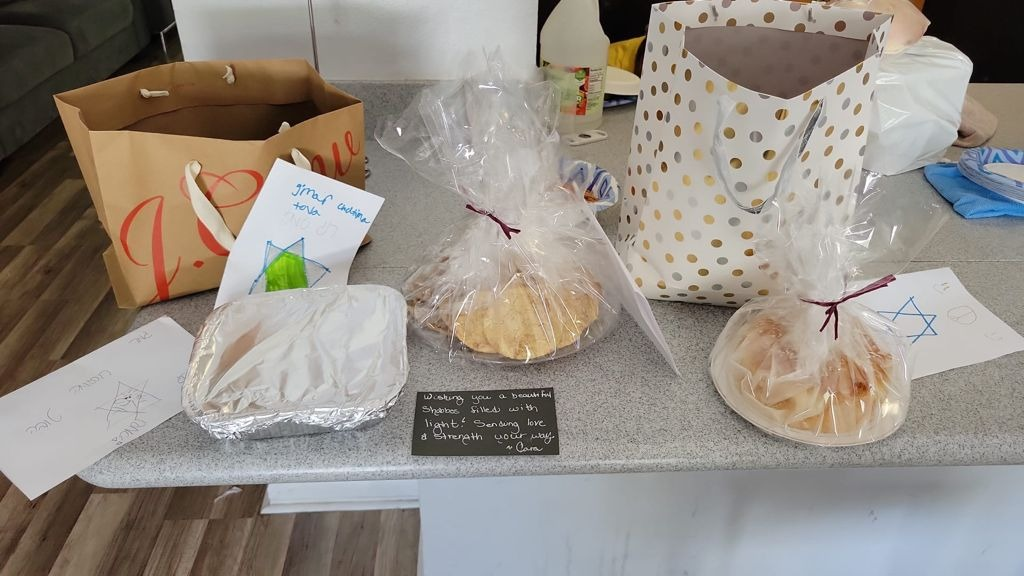
After losing their son Jonathan to the illness of addiction, the Wijnperele family generously dedicated a program called Adopt, a collaborative project of Boca Raton Synagogue and Onward Living.  Over the last few months, we have paired up several families in our community with men from the Onward recovery center.  They enjoy comfortable Shabbos meals, fun BBQ’s and simply getting together to schmooze. This component of recovery is critical.  Many people in recovery weren’t privileged to see or experience healthy and functional family and communal dynamics.   Being invited to and forging relationships with BRS families who have no motive or agenda other than to share a genuine and non-judgmental relationship, is not only refreshing but a critical example and experience.   


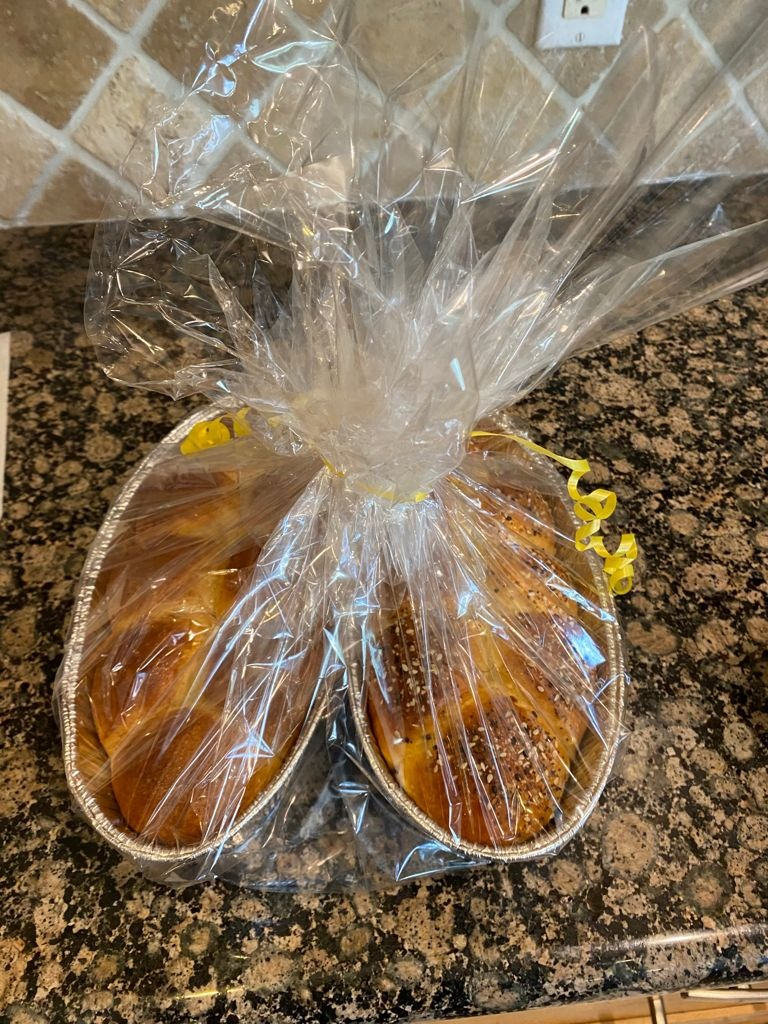
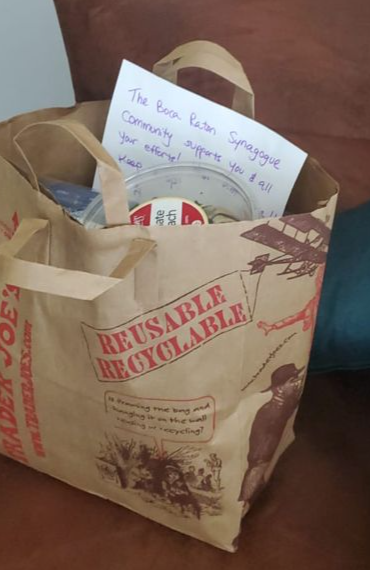
More recently, we have expanded our Adopt partnership. Our BRS chesed coordinator, Simone Broide, has arranged for members of our community to regularly cook and deliver meals to men in Onward Living.  Unlike the pairing component, in dropping off meals, anonymity is maintained.  Those cooking and baking don’t know who is receiving their Shabbos gift package.  And those who receive the loving delivery don’t know from whom it came. 


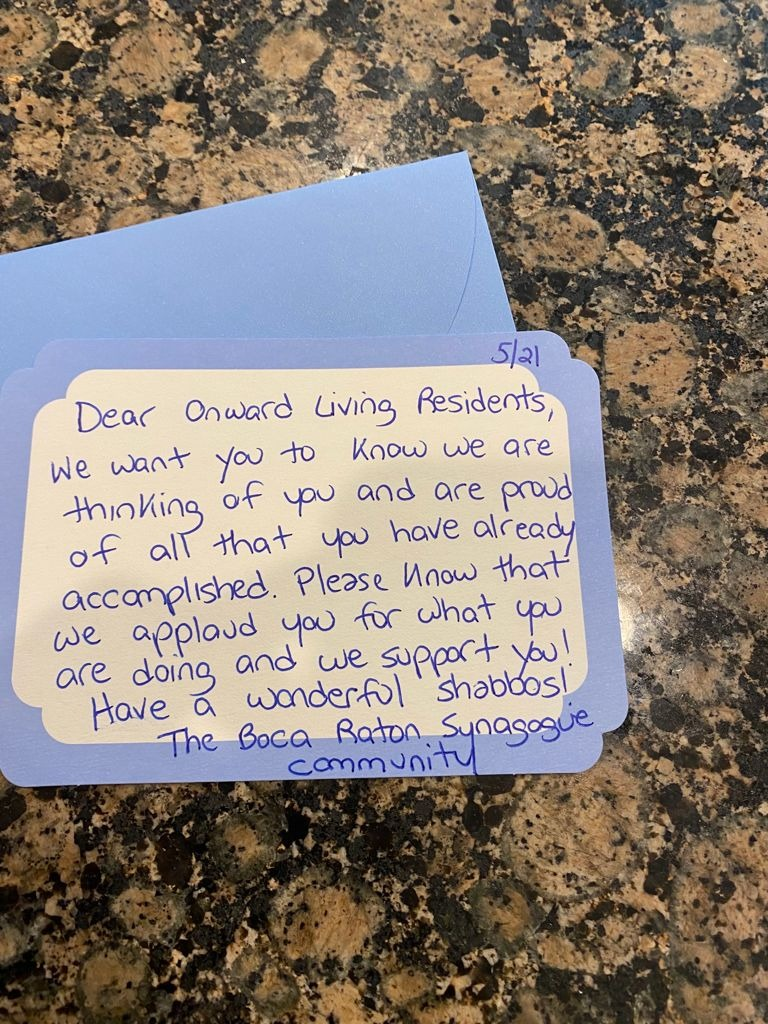
Messages are attached such as, “Dear Onward Living Residents – We want you to know we are thinking of you and are proud of all that you have already accomplished.  Please know that we applaud you for what you are doing and we support you!  Have a wonderful Shabbos.”


The recipients have shared how much it means to them and the difference it makes in their recovery and in their life.   One said, “It’s nice know that people actually care” and another commented, “The home baked goods means someone took the time to think of us and that is very special.”


For the people cooking, it is an extra challah, a cake or a babka, but for the recipient, it is a lifeline, a declaration that they aren’t invisible, that they matter, that there are people who care.  The Shabbos food doesn’t just fill their stomachs, it helps plug a hole in their heart.  A minimal expense and a modest effort go an enormous way.


Hashem charges Avraham this week, v’heyei beracha, which can’t be a promise that he will be blessed because Avraham was already told va’avarechecha, I will bless you.  So what does it mean?  Rav Shamshon Raphael Hirsch explains that there are two types of people – those that live life looking to receive blessings and those that lead their lives trying to be the blessing. To be progeny of Avraham is to take whatever blessing we have and to use it to become a blessing in other people’s lives.  We don’t live with a sense of entitlement to be blessed, we instead live with a sense of obligation to be a blessing.  


We are looking to expand our anonymous Shabbos box program to deliver to Jewish residents of others recovery centers in our area and hope we can count on your help.  Contact simonebroide@yahoo.com to get involved. And you don’t have to live in Boca to be a blessing.  Anyone reading this knows people who feel invisible, lonely, question if they matter or if anyone cares.  What for us is a challah or flowers or sometimes even a phone call or heartfelt email for them is a life preserver. 


Every day we recite the beracha of Magen Avraham, acknowledging that Hashem has preserved the character of Avraham within us.  Don’t wait to receive your next blessing, go out and be that blessing for others.  Nothing will make you feel more blessed. 

I am Not a Modern Orthodox Rabbi

Recently, an article referencing a conversation we had on Behind the Bima referred to me as a “Modern Orthodox Rabbi.” I was taken aback by that characterization and found myself badly wanting to correct it. 


To be clear, it’s not that I want to disassociate with modern orthodoxy as much as that I desperately don’t want to be reduced to just it.  I would have preferred a more accurate (although admittedly less catchy) description: a member of the post-ideological, broad and diverse Torah community. 


Now don’t misunderstand. I am proud to have received semicha from Yeshiva University and feel honored and blessed to enjoy a close relationship with several of its Roshei Yeshiva whom I consider my rebbeim and poskim. Among other philosophies associated with modern orthodoxy, I unapologetically and without hesitancy see the religious significance of the miracle of the Modern State of Israel and express my gratitude to Hashem for it. 


But these are only some components of who I am; there is much more to what I believe, how I live, the leaders and communities I connect with, and the values I hold dear. 


I certainly respect the right of others to fully identify with one particular hashkafa.  Minhagim, customs, and practices are important as are outlooks, perspectives, and approaches to life.  Some feel more comfortable, safer, locked in to one derech, one approach and view.  I understand both the tradition and temptation of such a life.  As examples, you will often hear Chabad rabbis who only ever quote the Rebbes of Chabad and Chafetz Chaim rabbis who largely quote the Rosh Yeshiva, Rav Henoch.  There are YU rabbis who limit themselves to quoting Rav Soloveitchik or Rabbi Lord Sacks.


Make no mistake, I am not saying these rabbis are doing anything wrong. I personally prefer to quote all these sources of Torah and many more, to learn and teach the Torah of diverse great scholars and righteous leaders, to incorporate aspects of the beauty, meaning and inspiration of the rich fabric of the Torah world, both that which I am most familiar with and pursuing new horizons. 


Among the many questions Jewish dating websites ask when you create a profile is how you categorize yourself religiously.  Possibilities usually include some variation of Modern Orthodox, Modern Orthodox Machmir, Modern Yeshivish, Yeshivish, Carlebachian, or Chassidish.  Perhaps it makes sense for a dating profile to allow you to choose one answer in order to achieve compatibility, but we don’t have to sign up or designate ourselves as one category for life. 


When Rav Asher Weiss visited our community, he challenged us to “have a litvishe head and a chasidishe heart, the honesty & integrity of a yekke and the temimus and purity of a Hungarian, the Kavod HaTorah of a Sefardi and the love of Eretz Yisrael of a tziyoni.”  He most certainly didn’t intend to promote stereotypes or suggest that any of these qualities can be found exclusively among one group and not the others.  He was simply encouraging us to take the best of what we tend to associate with each specific group and incorporate it all into our own complex Avodas Hashem.


The prophet Yechezkel tells us that there were twelve gates in the Beis HaMikdash.  According to Rav Chaim Vital (Pri Eitz Chaim, Shaar ha-Tefillah), correspondingly, each of the twelve tribes had its own nusach ha’tefillah, its own liturgy, and its own heavenly gate through which its prayers would ascend.  Almost two hundred years later, the Maggid of Mezeritch (Maggid Devarav le-Yaakov 141) added that if someone doesn’t know his or her tribe, there was a thirteenth gate.  He suggested that when it comes to davening, this corresponds to the nusach of the AriZal, which the Maggid called the “Sha’ar Hakollel, the universal gate.


What is true for nusach is true for life. There are those who are confident about what hashkafic tribe they come from.  They walk in and out of one narrow gate.  But I believe there are many of us, maybe even most of us, who see ourselves as part of the Sha’ar Hakollel of life, drawing from the richness of the Torah world, uncomfortable and unwilling to lock ourselves into a narrow gate, but instead embracing a vast and expansive entrance.  We don’t alternate between hashkafas or practices, we integrate them.


Members of the Sha’ar Hakollel have no specific yeshiva or shul. Our movement not only has no name or organization, it has unlikely ever been considered or called a movement.  We have no set minhagim or identifying uniform.  We live in Boca and Boro Park, in Teaneck and Lakewood, in Israel and America and all over the world. 


Data and anecdotal evidence show that there are many in “yeshivish” communities regularly listening to the shiurim of “YU” rabbonim and there are a growing number of “modern orthodox” young people finding meaning in chassidishe seforim and contemporary leaders like Rav Itche Meir Morgenstern, Rav Gamliel Rabinowitz, Rav Elimelech Biderman, and others.  There are Jewish magazines that may be perceived as “right wing” but have large readership in “modern orthodox” communities.  These magazines are not locked into one hashkafa, but they feature many, exposing their readership to great leaders across the spectrum of the Torah community.  The diversity of their growing subscription base testifies to the thirst and appetite to walk through the Sha’ar Hakollel, not just through one particular gate.


I had a rebbe who would say, “You can put me in a box when I am dead; until then don’t try to make me fit neatly into one of your labels.”  Perhaps others feel more comfortable in their position if they can either count you among their tribe or decide that you are part of the tribe they have rejected.  But while narrow vision serves them (and again, to be perfectly clear, I am not casting negative aspersions on any people who choose this path), it doesn’t have to be our way. 


The Almighty doesn’t limit us to what yeshiva, seminary or school we graduated.  He doesn’t only know us by what we wear on our head, how we voted, what nusach we daven, or if we eat gebrokts or kitniyos.  Hashem is complex, His Torah is multifaceted and has seventy faces, and our personalities and practices are made up of many parts.  We don’t alternate between them like someone with multiple personalities, but we synthesize, integrate, and weave them into a rich tapestry.  


Some in the Torah world, in many ways paralleling the divisions and partisanship in the culture around us, want us to line up and choose our camp, to see things in black and white instead of grey, as binary instead of pluralistic, as win/lose instead of win/win.  But we don’t have to listen, we don’t have to allow ourselves to be defined narrowly, or to sign up for a particular team competing with and to the exclusion of all others. 


Perhaps one day there will be a name, an organization or movement for the community who walk through the Sha’ar Hakollel. Or perhaps that itself would undermine and compromise the beauty of such a life.  For now, it is enough to know we exist, to draw strength from one another and to not feel pressured to pick a team.


A student of Rav Hutner zt”l once confided that he felt his secular career meant he was living a double life.  Rav Hutner responded (Pachad Yitzchak Iggeros U-Kesavim, pp. 184-185) that someone who switches between the room they rent in a hotel and the room they rent in a house is leading a double life.  However, someone who rents a house that has many rooms is leading one life. 


We don’t have to cram into one room.  We can spread out across the house called Torah.  It has many rooms, they are decorated and function differently and they complement one another.


If referred to in the future, I hope to be identified as a litvishe, chassidishe, yekke, Sefardi, tziyoni rabbi… with a great podcast. 


Rabbi Efrem Goldberg

Join Our Community

Subscribe to our newsletter or connect with us on WhatsApp.