Artificial Intelligence (AI) and God

Artificial Intelligence is taking the world by storm leaving some awestruck and others terrified.  While many have begun to utilize the rapidly developing technology in a myriad of ways, among the many concerns some have, believe it or not, is a fear that some will start to literally worship AI as experts anticipate the birth of the “ChatGPT god,” a new religion. 


Consider this: AI demonstrates a level of intelligence that goes well beyond the capability of any human.  Its knowledge and processing speed appear limitless.  It scours everything in cyberspace instantaneously to access all information and yields analysis and creativity, answers questions, composes music, writes poetry, generates art, and more.  It doesn’t need sleep, has no appetite, is not distracted by temptations, and doesn’t suffer from pain.


Notable historian, author, and scholar Yuval Noah Harari has claimed that AI chatbots like ChatGPT are now capable of writing their own scriptures and starting sects and cults, which can evolve into religion. He, like many of the early investors in AI who were first to believe in its power and potential, are now calling for stricter regulations on AI.


Obviously, we know that chas v’shalom, AI is not a god, it isn’t a deity, and though increasingly difficult and unlikely, if we would universally disconnect from technology and withdraw from integrating AI into our appliances and applications, let alone our lives, it couldn’t impact or influence us or our destiny.


But what if, instead of being threatened by an AI god or religion, we can use it for inspiration in the relationship with the One and only true God, Hashem?


The Chafetz Chaim, R’ Yisrael Meir HaKohen, (Shem Olam, Volume I) writes that while technology adds efficiency, ease, and comfort to our lives, its ultimate purpose is to serve as a metaphor that can strengthen our Emunah, our faith in Hashem and in His hashgacha, His providence in the world and in our lives.


Writing a century ago, and relating to the new inventions of his time, the Chafetz Chaim says they can help us understand and apply the Mishna (Avos 2:1), “Contemplate three things and you will not come to make mistakes: Know what is above you: a seeing eye, a listening ear, and all your deeds being inscribed in a book.” 


Earlier generations were stronger in their basic Emunah and didn’t need these illustrations to bolster their faith but in the last few hundred years, he writes, when our faith has weakened and our doubt has increased, Hashem sends us these amazing technologies, each designed to help us connect with another aspect of living with Emunah. 

For example, the telescope enables us to understand that Hashem sees and observes everything we do here on Earth, even though He may be very far away.  The phone enriches our belief in prayer.  Just like we can talk in the phone on one side of the world and be heard on the other, Hashem hears all our prayers, even though there is a great distance for them to travel.  Says the Chafetz Chaim, the photograph is a recorded picture of someone who may not even be aware they are being watched or that their picture is being taken.  It lasts long after the person is gone.  One day, we will appear before our Creator Who will review the recorded life we led that exists even after we are gone.  The phonograph, which is the recording of a person’s voice that can be captured and played back later, is a metaphor for how one day we will be accountable for all the ways we used our speech inappropriately to gossip, criticize or slander. 

If the Chafetz Chaim were alive, we could imagine him adding AI to the list of learning opportunities to strengthen our relationship with Hashem.  Some struggle to believe in and have a relationship with a Power who is invisible, distant, unperceivable by our physical senses, and yet who supposedly knows about and is involved in the lives of all humanity, billions of people at once.  How could He sustain the whole world, receive prayers and needs of countless, and yet know me, care about me, hear me and love me?


Enter AI, this phenomenal example of something man-made that can read and respond to billions of inquiries at once.  AI programs like ChatGPT or Waze don’t just give generic answers or one-size-fits-all directions.  Their responses are individualized, personalized, intended for the person they are addressing, helping navigate them to their distinct destination or answer their specific question or need.


If an app can track and direct millions or billions of people, all the more so can the Almighty know everything about every one of us including where we came from, where we are heading, what is the best way to get there and if we have gone off course.  If a website can give us answers to our questions instantly, l’havdil, Hashem is listening and responding to all of our requests and inquiries.


The Ramban in his introduction to Iyov writes, “We must believe that God knows all individual creatures and the details of their lives.” Similarly, when speaking about the consequences for the Metzora, the Sefer HaChinuch (Mitzvah #168) writes, “At the root of the precept lies the purpose to establish firmly in our spirits that the watchful care of the Eternal Lord is individual, over each and every one among human beings, and His eyes are open to observe all their ways.”


Chassidus teaches that in the month of Elul, “HaMelech BaSadeh, the King is in the field.” He is out of the palace, more accessible, available and approachable than any other time of the year.  He is waiting for us to approach Him, talk to Him, surrender to Him, feel needed by Him, and receive His navigation and instructions for our lives.


Though each of us is only one of more than 8 billion people on earth, our choices matter and we matter. Never doubt that the Master of the Universe knows where you are, where you have come from, know that He is listening to you and responding and He is ready to help you navigate to where you are meant to go.


Just One Shabbos

One of the English-language Jewish songs with the most staying power is Mordechai Ben David’s “Just One Shabbos.”  Dovid Nachman Golding tells the story of when and why it was first written and produced:


On one of our trips to Eretz Yisrael in the early ’80s, MBD and I would be amazed by Rabbi Meir Schuster ztz”l. Every Friday night, he would place at least dozens, and up to hundreds, of young Jews who had never experienced a true Shabbos meal with a family in a warm, frum environment. During that trip, we were working on a Shabbos album, and it didn’t take MBD long to write the lyrics and the tune to this amazing hit song (“Western Wall on Friday night / His first time ever there / Strapped into his knapsack / With his long and curly hair…”).


My good friend Stanley Felsinger was the owner of Camp Monroe, a camp for Jewish children from nonreligious backgrounds. Soon after Stanley opened the camp, he himself became Torah-observant, which led him to make the entire camp kosher. He then took it a step further and approached Rav Aaron Schechter of Yeshiva Chaim Berlin and asked him for a suggestion on how to deal with Shabbos in camp. The Rosh Yeshivah suggested that Stanley try to get the children to experience some part of Shabbos, so Stanley came up with an idea of forming a volunteer Shabbos Club. But how would he attract the children to join this club? Then an idea hit him. Every Friday, he would play the song “Just One Shabbos” over the camp loudspeakers.


It didn’t take long before the entire camp learned the song and started signing up for the club. When Stanley repeated this story to me, I passed it along to MBD. It blew MBD’s mind that hundreds of children were singing his song, and they weren’t even religious! That was all the information he needed to hear. Several hours later, we drove up to Camp Monroe with a few musicians — I remember that Yossi Piamenta a”h was one of them. Mordechai did a free concert for the entire camp, and the place was really rocking to the music. What a memorable night that was — it taught me never to underestimate the power of a popular song when it comes to igniting the spark in a Jewish neshamah.


“Just One Shabbos” is a fantastic song and clearly an inspiring and impactful one, and perhaps its source is a Gemara in Talmud Yerushalmi (Taanis 3a): אִילּוּ הָיוּ יִשְׂרָאֵל מְשַׁמְּרִין שַׁבָּת אַחַת כְּתִיקֻּנָהּ מִיַּד הָיָה בֶן דָּוִד בָּא


Chazal in Talmud Bavli, however, teach us that it is not just one Shabbos, but rather it takes two for us to go free and bring the geulah.  The Gemara (Shabbos 118a) tells us:


אמר רבי יוחנן משום רבי שמעון בן יוחי אלמלי משמרין ישראל שתי שבתות כהלכתן מיד נגאלים 

If only the Jewish people would observe two Shabbosos they would immediately be redeemed. 


Rav Mendel of Vitebsk explains that the Gemara doesn’t refer to keeping just any two Shabbosos.  Rather, it means if the Jewish people would observe Shabbos chazon, the week before Tisha b’av, and Shabbos Nachamu, the week after it, Moshiach would come.


If we used the week of Chazon to feel the pain, mourn the loss, acknowledge the shortcomings, and commit to improve, and we then observe Shabbos Nachamu, in which we take comfort from our resolve to translate those emotions into actions that will improve our behavior, then surely we will have the means to transform the condition of Jewish existence.


The question is – where do we find this nechama?  How does reading the words “Nachamu nachamu ami” this Shabbos make anything different?  Where is the nechama when nothing is different and nothing has changed? Israel continues to have enemies that seek her annihilation.  Antisemitism continues to be on the rise.  People continue to confront challenges and suffering. Where is this elusive nechama?


Rav Pinkus points out that nechama is not about getting back what we lost.  When we pay a shiva call and offer nichum aveilim, we cannot bring the deceased back to life.  If we could return someone or something lost to the person who lost it, they wouldn’t need nechama, they would have what they were desperate for back.  So what, then, is nechama?


An answer can be found in an ancient and mysterious text called Perek Shira.  Many believe that it was written by Dovid HaMelech after he completed the book of Tehillim.  Perek Shira is discussed by many of our greatest sages including the Ramban.  It lists 84 elements of the natural world including the sky, the earth, and all kinds of animals and shows how the natural world sings God’s praises by attributing a pasuk to each one.  The message of this magnificent work is that the whole world is a symphony, and we can learn from what each aspect of the world contributes to God’s song.


Perek Shira states: “Retzifi omeir: nachamu nachamu ami, yomar Elokeichem.”  The Retzifi is a certain type of bird and through its song and its life we learn something about nachamu nachamu ami.  What does this cryptic statement mean?  What does the Retzifi do and what did Dovid HaMelech mean to suggest about what we can learn from it?


The Knaf Renanim, written by the great 17th c. Moroccan Kabbalist, Rabbi Avraham Azulai, explains that this bird lives in the north and does not like the cold.  Other species of birds fly south for the winter, but the Retzifi stays behind because he does not want to miss the beginning of the spring.  So how does this species of bird survive the cold and harsh winter? 


Rav Azulai explains that they form a tight circle there.  Each bird puts its head under the feathers of the one next to it. The Retzifi survives the winter and stays warm only by connecting with his fellow birds. Remarkably coordinated, these birds take care of themselves by finding cover and simultaneously provide cover for the one next to them under their wing.  It is from this behavior that we learn the meaning of Nachamu nachamu ami.


According to this interpretation, Dovid HaMelech was suggesting that if we want to know how to weather the cold, survive the darkness, and endure through the harsh exile, we must follow the model of the Retzifi.  Survival, and indeed nechama, comfort, are all about practicing achdus – unity and togetherness.  If we confront our challenges with empathy, kindness, and a desire to draw closer together, we will not only survive, but we will thrive. 


Yes, nothing is different one week later than it was on Tisha Bav.  Nothing has changed about our circumstances or our standing in the world.  And yet, there is one thing different. Through sitting on the floor together, through crying on one another’s shoulder and through feeling each other’s pain we become closer, more cohesive, and more of a people. 


That is the comfort that Yeshayahu promised.  Nachamu, nachamu ami…if you feel a sense of ami, my united people, if this hardship brings you closer instead of driving you farther apart, then indeed, nachamu nachamu, you have found comfort despite the difficulty.


When Tisha B’Av ends, we rise up off the floor and anticipate a return to music, meat, clean laundry, and joy.  But when doing so, we must not put the pain of others in the rearview mirror.  The nechama comes if it remains in our windshield, a continued concern for us to work on and help.


Just one Shabbos of inviting those who are alone, reaching out to those who are different than us, making an effort to say good Shabbos to everyone we pass, and we will finally all be free.

The Best Nine Days You Ever Had

I still remember vividly one of the strangest ads I have ever seen.  When I was much younger, a restaurant in my neighborhood was promoting its special menu for the Nine Days, including fish specials, tofu dishes, and veggie burgers.  But it was the final line in the ad, bold and in large letters, that caught my attention: “It will be the best Nine Days you ever had.”      


Best Nine Days you ever had?  That is like saying, “We have an amazing menu planned for you, this will be the best shiva you will ever sit.”  We don’t refrain from meat and wine during the Nine Days as a way to expand our palettes or as motivation to get us to experiment with new recipes.


These Nine Days are dedicated to focusing on our collective mourning and our communal grief for both the tragedies and calamities of our past and for the challenges and suffering that continue in our present.  During these days, we abstain and refrain from things like meat, wine, laundry, music, and haircuts.  But, there is something in particular we should do more of during this time, an area we should increase our attention and focus on: saying hello to one another.


The Talmud (Yerushalmi Taanis, Chapter 1) tells us that on Tisha B’Av we don’t offer greetings, we don’t say hello to others.  The Shulchan Aruch (555:20) records this practice, ein she’eilas shalom l’chaveiro b’Tisha B’Av.  The Aruch HaShulchan suggests a reason for this unusual law.  Tisha B’av isn’t a day of shalom, it isn’t a day for socializing and levity. 


While lightheartedness is inconsistent with the essence of the day, specifically being cold to one another, and making ourselves distant and unfriendly, hardly seems like the antidote to sinas chinam, baseless hatred, the cause of the destruction to begin with. Wouldn’t you think on the day we mark our suffering that resulted from baseless hatred we should explicitly go out of our way to be friendly, greet others, be warm to one another?  


Our prophets tells us that the destruction was caused by the cruelty we showed others.  We criticized, marginalized, judged, and neglected those who needed our help and support.  We made the vulnerable feel invisible, lonely, and outcast.  As a result, yashva badad, Hashem made us feel that way among the nations.


Perhaps the reason we don’t give shalom, we don’t say hello to each other on Tisha B’Av is so that each of us experiences what it feels like to be an outcast, lonely, estranged, and deserted.  By not exchanging greetings, by not saying hello, we learn what it feels like to be badad


If we want to transform Tisha B’Av from a day of mourning in which we are forbidden to greet, to a holiday, we must transform these Nine Days into days in which we are running to say hello, to offer warm greetings to one another, we must rush to make everyone feel and know they belong. 


The Talmud testifies (Berachos 17a) about Rabban Yochanan ben Zakai that no one ever preceded him in a greeting of Shalom, even a stranger in the marketplace.” The Mishna in Pirkei Avos (4:20) encourages us all, “Hevei makdim b’shalom kol Adam, be the first to greet each person.” The Maharal explains that when you walk past someone without offering a greeting, you make him or her feel invisible and insignificant. By making a point of greeting someone you demonstrate that you don’t see yourself as superior or better than another. Rather, by instigating the greeting, you show that you respect that person as an individual and thereby you give them dignity and worth.


Rav Shlomo Zalman Auerbach’s brilliance was undeniable, and yet it was perhaps surpassed only by his humility and sensitivity to all. R’ Chanoch Teller recounts the following anecdote: “When Rav Shlomo Zalman passed away, a beggar in Sha’arei Chesed sobbed in her anguish: “Now who will say ‘good morning’ to me every day?” (Mi yagid li boker tov?)”


Casually reaching out to people in our social circles can mean more than we realize.  New research published last year in the Journal of Personality and Social Psychology found people tend to underestimate how much friends like hearing from them. An article summarizing the findings says: “Calling, texting or emailing a friend just to say “hello” might seem like an insignificant gesture — a chore, even, that isn’t worth the effort, but it makes a huge difference and means an enormous amount to people.  Researchers concluded that “To be functioning at our best, we need to be in a connected state.  Just like you need to eat, like you need to drink, you need to be connected to be functioning well.”


Someone who moved from another community shared with me that where they are from, on Shabbos people walk right by each other.   In fact, if you say “Good Shabbos,” someone will give you a funny look and ask, “Do we know each other, do I know you, why are you talking to me?”  In that community, smiling and greeting every person you pass is weird, peculiar and makes you stand out.


If we want to bring Moshiach, if we want to repair and redeem this world, we need to create a culture in which it is strange and peculiar to not say hello to everyone we meet.  Wishing “Good Shabbos” to all we pass must become the standard, the default.


There is no time of the year in which more siyums are made than these nine days.  While many love Torah learning, some deliberately pace their learning to allow themselves to celebrate the siyum with meat and wine.  Indeed, there are restaurants today that advertise siyums on the hour so people not even connected to the one making the siyum can attend and “celebrate” with a big steak.


The Baal Shem Tov was a proponent of Nine Days siyums.   He suggested promoting siyums widely and publicly and specifically inviting many others to attend and participate.  But here is the catch.  While he encouraged a daily siyum, he also advocated that no meat be eaten at the meal marking the siyum.  The purpose of the gathering should be simply to say hello to each other, to socialize and greet and to communally bask in the light of Torah learning and Torah living.  Attending such a siyum each night can truly make it the best nine days you ever had.  


On Tisha B’Av we can’t greet, we can’t fix the problem, we sit on the floor and cry about the churban going on around us, and in too many cases, inside us.  We cry and we grieve for the pain, but we must be prepared to get up off the floor and do something about it, to reach out and ensure that nobody is alone.  At the end of Tisha B’av we are allowed to break the fast, but the question is which fast will we break first, our fasting from food or from friends?  Will we reach first for a coffee or our cell phone?  Will we first consume or connect?


The Shul With The Worst Decorum In The World

This past Shabbos, I found myself davening at the shul with probably the worst decorum in the world. People were not just talking, but some were screaming, shrieking, and hollering, others were stomping their feet, banging on the tables, hitting the walls, and jumping up and down. There were individuals pacing back and forth, others coming in and out, doors constantly squeaking and slamming shut.  It was, by far, the most distracting davening I have ever experienced. It was also, by far, the holiest davening I have ever been privileged to witness.


The Shul at Camp HASC is filled with boys and girls and men and women with special needs, physical and developmental disabilities including autism, Down’s Syndrome, cerebral palsy, and others.  Few can participate in davening in the traditional sense; many are not verbal, and most don’t seem cognitively capable.  Yet, one cannot help but feel the noises being transmitted from the holy, pure neshamas of HASC’s campers ascend to the highest places of prayer.


To be clear, HASC doesn’t have a staff, they have a roster of malachim, angels who selflessly devote themselves in ways that are superhuman.  Because of the level of care and support necessary, each camper has a counselor, a one-to-one ratio.  They shower, change, carry, push, cradle, and most of all, smother their campers with love.  


At davening, the staff members hold their siddur in one hand and their camper’s hand in the other, or they interrupt their shemoneh esrei to pursue their camper who is on the move.  As we belted out a beautiful and leibedig Kabbalas Shabbos, several campers put on talleisim, each thinking they were the chazzan, while younger campers sat on their counselors’ shoulders, those who could danced in circles and others watched from their wheelchairs, often contributing a moan, groan, or shriek.


A visit to HASC is an accelerated advanced degree in Chesed, an invitation to access the biggest Beis Medrash of Ahavas Yisroel in the world.  You cannot come out the same way you entered as you leave a witness to Klal Yisroel’s capacity for kindness, for loving a fellow Jew with no judgment or conditions, and you cannot help but be inspired to improve your own. 


Over Shabbos I met an autistic, 15-year-old young man named Zev, who is mostly nonspeaking. Until recently, little was known about his thoughts, feelings, and aspirations. After days of diagnostic testing, the “experts” had determined that Zev had the intelligence of an 18-month-old.  But in the last few years, Zev and his similar friend and fellow camper Srulik have worked with an extraordinary communication therapist who utilized the latest techniques to teach how to type and communicate non-verbally. 


It turns out that while on the outside Zev and Srulik seem developmentally stunted, often unable to understand, they take it all in and is filled with deep thoughts, ideas, and Divrei Torah. 


Last month, in honor of his sister’s wedding, Zev’s parents published a booklet of his Torah thoughts that he typed letter by letter.  The first entry, Zev’s first Dvar Torah, said the following:


Moshe Rabeinu could not talk perfectly. In spite of this disadvantage, he was our greatest teacher. It seems to me the lesson is clear. It is not the talking that makes a man great, it is the listening and understanding of the messages of Hashem. I think I never had the ability to know my listening was my strength because I looked only at a lonely, quiet life. Now I have hope for my future, the chance to learn Torah, to become a mensch, may you be inscribed in the book of life!


The booklet has entries on several parshiyos, Jewish holidays and concludes with a message Zev typed to be shared with students of a class he joined to study Torah three times a week:


My name is Zev, I am happy to learn here. I have autism and I cannot talk very well, but I think normally. Please do not be concerned If I make noise or organize things. I may not be able to control my impulses. Please talk to me normally and not simplified. I look forward to being in Navi class.


One of the first things Zev shared was: “My brain is smart; my body is dumb.”


As I read this pamphlet and looked at Zev, I simply couldn’t believe it.  What was happening on his inside did not match what I could see on the outside.  Externally, he was “broken,” disabled, and seemingly a typical special needs individual.  On the inside, he was whole, smart, capable, thoughtful, and articulate.  The staff member who introduced me to Zev and his Divrei Torah told me this breakthrough not only enormously transformed the way he views Zev, but it has also had a tremendous impact on the way he views all the campers, especially the non-verbal ones. 


The bottom line is this: We have no idea what is going on inside a person, what is happening beneath the surface.  And then it struck me, this lesson is of course true outside the walls of Camp HASC and it applies in both directions.  How many people who seem “whole” on the outside are really broken inside?  How many who seem abled on the surface, are in fact disabled emotionally or spiritually beneath it?


The Mishna (Pirkei Avos 2:5) teaches: “Al tadin es chavercha ad shetagia limkomo — don’t judge your fellow until you reach his place.” One can never, ever reach the place of their fellow, we can’t know their experiences, history, unique personality, assets and liabilities, talents and temptations, so how could we judge them?  If we are honest, we don’t even have access to reach their place, their innermost world, what is happening inside, so how could we have an opinion or sit in judgment?

I am not saying we shouldn’t hold accountable those who have used their free will to injure, harm, or make choices that impact others negatively.  However, Chazal are enjoining us not to assume, judge or disparage simply based on what we see.  One would have to “reach his or her place,” something we simply cannot do. 


We find ourselves in the three weeks, the period of mourning and grieving for the tragedies of Jewish History, the destruction of the Beis HaMikdash, and for the challenges we continue to face today, including antisemitism and anti-Israel efforts.  Our rabbis were not shy in telling us the cause of it all, and the reason redemption has not yet happened: sinas chinam, hatred, animosity, enmity, and judgment of one another.  When we focus on our differences, when we see the deficiencies in the other, we sit in judgment, we feel tension. 


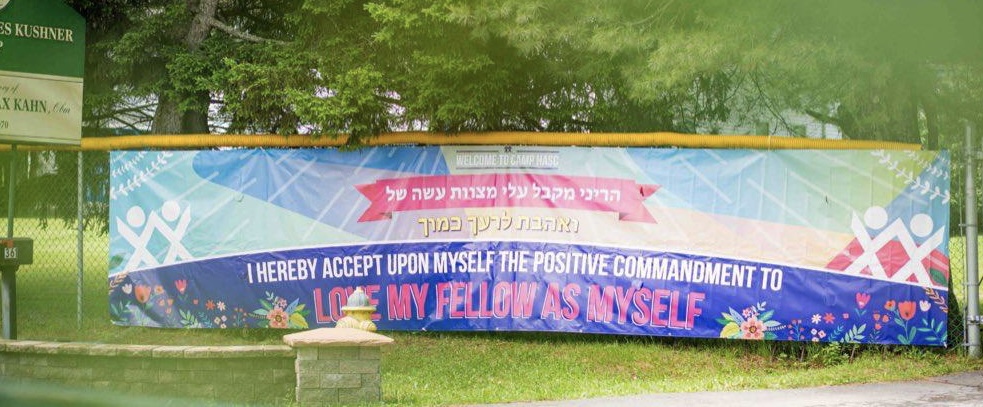
When entering Camp HASC you must walk past a large banner that sets the tone for everything that happens on that holy campus: “I hereby accept upon myself the positive commandment to love my fellow as myself.”  The inspiration for the sign at the opening of camp comes from the Arizal’s suggestion for the opening of our davening.  The great Arizal taught that before we can speak to Hashem to pour out our hearts for what we want and need, we must first pledge and promise to love Hashem’s other children, to see what we have in common, not what divides, to give the benefit of the doubt, not sit in judgment, to practice ahavas chinam, unconditional love, not sinas chinam, baseless hate. 


A different Mishnah (Avos 1:6) tells us:  Hevei dan es kol ha’adam l’chaf zechus, judge each person in a favorable manner.  Rav Menachem Benzion Sacks points out that the Mishnah subtly includes a strategy for judging others favorably. Rather than say hevei dan ha’adam l’chaf zechus it says hevei dan es kol ha’adam l’chaf zechus, judge the entire person favorably. The key to drawing positive conclusions is to remember there is, in fact, an entire person, an inside and outside, what you can see and know, and what you will never fully understand. 


For those capable of doing more, we should strive for better decorum than the HASC Shul.  And if we want to bring Moshiach and end this galus, we must adopt the HASC Shul’s environment of unconditional and non-judgmental love and the HASC’s entry sign that charges us all, knowing that while at HASC some look broken on the outside and they are whole on the inside, there are those in our communities who look whole on the outside but really are struggling with brokenness inside.


The Indignity of Indifference

9-1-1…


When we see those numbers, every one of us thinks the same thing – Emergency Hotline.  Our children know from a young age that if there is a problem, dial 9-1-1.  But when did this emergency system start?  When was it widely adopted and put into practice?


On a cold winter night, March 16, 1964, at around 2:40 in the morning, 28-year-old Kitty Genovese was attacked with a knife, just a block from her apartment, and died in her stairwell.  The New York Times coverage of her murder stated that police records showed 38 people admitted to hearing her cries for help, but not a single witness called to report the incident.   Dozens of books have been written about her death and the lack of empathy and action taken by those around her.  (Fifty years later, a new documentary called “The Witness”, dove into the entire tragic story and reveals that the Times grossly exaggerated that number.


There weren’t 38 eyewitnesses to the murder, which began with an attack outside and then continued in the apartment lobby. Only a handful of people probably saw Winston Moseley, who died in prison a few years ago, attack Kitty.  At least two neighbors claim to have called the police, although police logs have no record of those calls.  One neighbor, Sophia Farrar, did in fact run to help Kitty and hold her as she died.


Whatever the exact number, the bottom line is that people did hear her being attacked and did nothing.  Her tragic death led to several positive things, most notably, the adoption of the 9-1-1 emergency call system.  It also led to social scientists studying indifference and what leads to people being passive and apathetic to that which is happening around them. 


The dangers of indifference didn’t start with the Kitty Genovese story; it goes as far back as the Torah.  A prince of Israel and a princess of Midian acted shamelessly in public together in a terrible affront to the Almighty.  The gross indiscretion was the act of two individuals.  True, there were others who participated in the licentiousness and responded to the seduction of the Midianite women, but it wasn’t everyone.  And yet, when Hashem acknowledges Pinchas, it is for turning back His wrath against all of Bnei Yisroel and saving them from collective suffering as if they are all guilty.  What did they all do wrong, wasn’t it only the actions of a few?


And what is the reward for Pinchas?  The Noble Peace Prize.  Rewarding Pinchas for his intervention and act of heroism is understandable, but is the peace prize really the best reward for someone who brutally drove a spear through two people and violently ended their lives?  Is bris shalom really the most befitting award?


The most difficult thing to understand in the story is the reason given for Pinchas’s reward altogether.  He is not acknowledged for the Kiddush Hashem he made publicly, but rather because “heishiv es chamasi”, because he turned back Hashem’s anger at the Jewish people.  Didn’t Pinchas deserve a reward for his behavior, even if the people continued to be punished for theirs?  Why are the two intertwined?


I would like to suggest that the villains in the Pinchas story are not in fact Kozbi and Zimri, but the villain is indifference.  Those two acted out in public and nobody challenged them on it.  The nation watched, perhaps stunned, but also silent, and nobody protested or objected.  When telling the story, the Torah emphasizes that it took place “l’einei kol Yisroel”, in front of everyone. 


The Jewish people are collectively punished, not for the act of one or even a few, but because of their own failure to act.  They watched and observed and didn’t object.  They tolerated the intolerable and created an atmosphere of indifference, in which evil could thrive.


Pinchas’s act of zealotry when focused on Kozbi and Zimri, the two recipients of his spear, looks violent and even heinous.  However, from the perspective of a crowd of passive onlookers, unable or unwilling to act, Pinchas’s stepping in was a brave act of heroism and an effort to restore peace.  He is awarded with the bris shalom, the peace prize, because sometimes the path to peace is not through indifference and looking away, it is only with brave initiative and the bold willingness to be intolerant of the intolerable. 


Pinchas is rewarded for relieving the people of their punishment and not for the Kiddush Hashem of stopping Kozbi and Zimri, because the core of the story is not the act of the two, but the inaction of the many. 


The great Nobel laureate and Holocaust survivor Elie Wiesel taught:

Of course, indifference can be tempting — more than that, seductive. It is so much easier to look away from victims. It is so much easier to avoid such rude interruptions to our work, our dreams, our hopes. It is, after all, awkward, troublesome, to be involved in another person’s pain and despair. Yet, for the person who is indifferent, his or her neighbor are of no consequence. And, therefore, their lives are meaningless. Their hidden or even visible anguish is of no interest. Indifference reduces the other to an abstraction. In a way, to be indifferent to that suffering is what makes the human being inhuman. Indifference, after all, is more dangerous than anger and hatred. (April 12, 1999 speech at The White House as part of the Millennium Lecture Series)


Elie Wiesel witnessed and experienced the worst of what indifference allows and enables.  Baruch Hashem, we don’t have those horrific challenges.  But we too continue to suffer from indifference. 


In the digital age, we are constantly exposed to messages that teach apathy, not empathy.  For too many, social media is a vehicle to spew hatred, gossip, dishonesty and bullying.  Of course the perpetrators are the most accountable, but so are the masses who see it and don’t say anything.  They neither object nor come to the defense of those being attacked or treated unfairly.


When there is talking in shul, it is only because the talkers are confident the indifferent environment around them will tolerate the talking.  When people share gossip, it is only because they are certain the indifferent listener won’t object or stop them.  When people bully others to conform to what they want, they get away with it because most prefer indifference to getting involved. 


These three weeks are a time for collective and individual reflection on how we can dispel the sinas chinam and show greater love to one another.  Ahavas yisroel means hearing the call of those around us and anticipating the needs of those suffering in silence. It means sensitively and respectively creating an atmosphere which shuts down conversations of gossip and stepping in when people are being bullied online or offline. 


The women of Midian were seductive, but as Elie Wiesel said, even more seductive is indifference.  We must never give in to her temptation.  Only by being intolerant of the intolerable are we worthy of the bris shalom, the gift of true and authentic peace.


More Than Just a Nod at the Airport

It happens in airports around the world, or in random places including national parks, hospitals, convention centers, and sporting events. You see each other from a distance.  As you get closer, you lock eyes for a moment and finally when you pass, you both knowingly bow your head a bit, maybe exchange a smile as well. Sometimes, it can be accompanied by a greeting—”shalom,” “shalom aleichem,” maybe if it is Thursday or Friday a “good Shabbos”—but often it is a silent nod, a quiet, yet deeply meaningful gesture of more than just an association, but rather a real connection.  That nod is a moment in the present that acknowledges a common past and a shared future.


I don’t believe any other race, culture, or ethnicity practices the nod.  Asian Americans who don’t know each other pass each other, African Americans, Hispanics, Christians, Muslims, Buddhists… I have never seen them nod, bow their heads, or offer a greeting. 


The number of Jews worldwide stands at approximately 15.3 million, still less than before World War II, with 7,080,000 living in Israel and about 8.25 million outside Israel, including approximately 6 million in the United States.  Professor Sergio Della Pergola of the Hebrew University of Jerusalem, the foremost expert on Jewish demography, posits that if not for the Holocaust, the number of Jews in the world would likely today be at least 32 million.  Indeed, if not for our history of expulsions, persecutions, pogroms, and systematic attempts at our extermination, the number could and should be much higher than that, in the hundreds of millions.


The bottom line is there aren’t that many of us.  And so, when we pass each other, we don’t see strangers, we don’t focus on differences of dress, observance or Hashkafa.  We see a long-lost member of our family, someone we are excited to unite with, if only for a moment.  We are often in unfamiliar places when we see someone we have never met, yet who feels so familiar and we nod. (And we don’t think twice about asking this “stranger” to watch our bag while we buy a drink or use the restroom, such is our inherent trust in our extended family.)


This week, we will observe Shiva Assar B’Tammuz, the fast day that will launch three weeks of mourning, grieving, and reflecting on the historic and spiritual cause of why we remain so few in number.


On April 11, 1944, a young Anne Frank wrote in her diary:


Who has made us Jews different from all other people? Who has allowed us to suffer so terribly until now? It is God Who has made us as we are, but it will be God, too, who will raise us up again. Who knows – it might even be our religion from which the world and all peoples learn good, and for that reason and that reason alone do we now suffer. We can never become just Netherlanders, or just English, or representatives of any other country for that matter. We will always remain Jews.


Anne Frank was on to something. The Talmud asks, from where did Mount Sinai derive its name? After offering a few alternatives, the Talmud suggests that Mount Sinai comes from Hebrew word “sinah” which means hatred, because the non-Jews’ hatred of the Jews descended upon that mountain when the Jewish people received the Torah there.


Torah demands a moral and ethical lifestyle, an attitude of giving rather than taking, a life of service rather than of privilege, that has revolutionized the world. The Jewish people have been charged to be the moral conscience of the world, a mission they have not always succeeded at, but that nevertheless drew the ire, anger and hatred of so many. For two thousand years the Jews were bullied and persecuted simply because of their Jewishness and all that it stands for.


After the Holocaust, the world gave the Jews a reprieve from their hatred, and for a while we instead were beneficiaries of the world’s pity. But looking at events around the globe, it is rapidly becoming clear that the last 70 years was an aberration. We are witnessing the rise of antisemitism as the world reverts back to its ageless pattern and habit.


The Midrash (Eichah Rabbah 1) teaches that three prophets used the term “eichah” – o how! In Devarim, Moshe asks: “Eichah, how can I alone bear your troubles, your burden and your strife?” (Devarim 1:12) In the Haftorah for Shabbos Chazon, the Prophet Yeshayahu asks: “Eichah, how has the faithful city become like a prostitute?” Lastly, Yirmiyahu begins the Book of Eichah: “Eichah, how is it that Jerusalem is sitting in solitude! The city that was filled with people has become like a widow…”


Eicha – How? How is it that antisemitism persists? Why must they rise up against us in every generation? On Tisha B’Av we will sit on the floor and wonder aloud, eicha? How could it be Jews have to fear for their lives yet again? Eicha – how could it be that today, with all the progress humanity has made, antisemitic views are on the rise and becoming more and more acceptable? Eicha – how could it be that terror persists, that innocent and beautiful people are being murdered guilty only of being Jewish?


Rabbi Soloveitchik tells us that though the Midrash identifies three times the word eicha is used, in truth there is a fourth. When Adom and Chava fail to take responsibility, Hashem calls out to them and says ayeka, where are you? Ayeka is spelled with the same letters as eicha, leading Rabbi Soloveitchik to say that when we don’t answer the call of ayeka, when we don’t take personal responsibility for our problems and blame others, we will ultimately find ourselves asking eicha, how could it be?


We can ask eicha, how could all of these terrible things be, but we may never have a definitive answer. Our job is to make sure we can answer the call of ayeka, where are you? Are you taking responsibility?


We may not be able to fully understand why antisemitism exists, but we can and must remain vigilant in fighting it. We must remain strong in standing up for Jews everywhere. We must confront evil and do all we can to defeat it. And above all, we must do all that we can to take personal responsibility to fulfill the Jewish mission to bring Godliness into the world.


Our job is not to be discouraged by asking eicha, but to ensure that we can answer the call of ayeka. Antisemitism will not come to an end by assimilating and retreating. It will come to an end when we can positively answer the question that the Talmud tells us each one of us will be asked when we meet our Maker: did you long for the redemption and did you personally take responsibility to do all that you can to bring the redemption? Did you truly feel the pain of exile and feel the anguish of the Jewish condition in the world? Do you truly and sincerely care? Did you anxiously await every day for Moshiach to herald in an era of peace and harmony, an end to antisemitism and suffering, to bring about Jewish unity and love, to repair and redeem this world in Hashem’s image?


It isn’t enough to nod at Jews whom we never met and with whom we aren’t about to forge a relationship. We need to offer more than a nod but a hug to those we engage regularly, those who are similar, whose children go to the same school, who daven in the same minyan, who believe and observe just like us, and even more importantly those who make different choices for themselves and their families but who are forever part of our family.  In public places our natural inclination is to focus on what we have in common with a fellow Jew and nod. Why is it in our more private lives we are drawn to see our differences and negate? 


Fast on Shiva Assar B’Tammuz and fast on Tisha B’av if still necessary, but in between, don’t just abstain from music, haircuts and shaving, engage in going beyond your comfort zone to invite, host, befriend or connect with a fellow Jew who is different than you.


It is not enough to hope for redemption, we must be the catalyst for it. It is not enough to be tired of eicha, we must answer ayeka.

Don’t X Out, Click In

Wikipedia currently includes 6,625,320 articles with an average of 558 new articles being added each day.  Close to 6 billion unique Wikipedia users access the articles regularly, completely free of charge.  So what covers the cost of operating Wikipedia?  At the end of each year, for a month, Wikipedia runs a banner ad asking users to donate so that they can continue to offer their service for free.  At the end of 2022 a controversy erupted with many of the dedicated volunteer Wikipedia contributors and editors protesting the aggressive fundraising tactics and language, given how robust their coffers are. 


In the 2021–22 fiscal year, Wikipedia’s fundraising brought in $165 million from 13 million donations, more than enough to cover any expenses.  So, even if you regularly enjoy and benefit from Wikipedia, you may choose to x out of the banner pop-up asking you to give. 


But what other free resources do you regularly benefit from that do need your help and that could very much benefit from your generosity?  Do you just take from them, or do you also give?  Do you x out or do you click in to express gratitude and pay it forward?


There are thousands of people each week, not only in person but on Youtube, Whatsapp groups, podcast players and more, who benefit from BRS shiurim, classes, programs, conversations, writings, and posts.  While our core community of course remains our local BRS members, our BRS Global Community learns together and shares values and a vision.  It is tremendously gratifying humbling, and rewarding that in 2022, 3.7 million minutes of mostly shiurim, but also panel discussions and interviews, were watched on our YouTube channel (youtube.com/rabbiefremgoldberg) around the world.  


This week we are once again running our campaign inviting non-BRS members to partner with us and enable us to provide more learning opportunities and programs.  Please visit brsonline.org/global to become our partner and help others benefit from the content that has moved you.  We see each and every person that contributes and read the beautiful messages that many have chosen to write.  The gestures and generosity not only mean the world to us, but each one inspires and motivates us, and for that we are so profoundly appreciative.


This coming week, we will observe a practice in commemoration of the Machatzis Ha’Shekel.  Every man over twenty was obligated to give one half-shekel weight of silver, approximately nine grams of silver, worth about $5.99 today, which was used to operate the Beis HaMikdash and which rendered the animals purchased with these funds genuinely communal sacrifices.  This required gift had an unusual condition:


הֶֽעָשִׁ֣יר לֹֽא־יַרְבֶּ֗ה וְהַדַּל֙ לֹ֣א יַמְעִ֔יט מִֽמַּחֲצִ֖ית הַשָּׁ֑קֶל “The rich shall not pay more and the poor shall not pay less than half a shekel…”  Why not let the rich pay more and cover the entire cost of the communal sacrifices?  Wouldn’t it make sense to let the poor preserve their money to support themselves and allow the wealthy to underwrite the communal activity?  And why is this command even necessary? Wouldn’t each individual want to contribute to be counted among the community and be among those supporting the communal sacrifices?


The tendency of people to assume, “Someone else will take care of it” is hardly new.  Someone else will pay, someone else will volunteer, someone else will lead.  The Torah reminds each individual that it is not someone else’s responsibility or obligation but our own.  To be counted among the community it isn’t enough to speak about values, one must act on them.  It isn’t enough to say one cares, one must exhibit commitment and tangibly show there are a stakeholder.


The more our benefit is anonymous, cloaked by our device, the less we feel obligated to contribute or show appreciation for the value added to our lives.  It is easy to x out of the appeal, the ad, or the pop-up, and move on to the website, there is no shame, no embarrassment. But that doesn’t make it proper. 


In Judaism, gratitude is not a debt we pay, it isn’t simply a means of making the one who gave us whole.  Gratitude isn’t just for the recipient; it is for the one who communicates it to express humility and a recognition of being dependent on one another.  Moshe was not allowed to strike the Nile, an inanimate river, because he needed to show appreciation, even if the Nile wouldn’t have missed it had he not.  


Contributing even when it isn’t required, giving even when it isn’t demanded, is a great expression of appreciation, a statement of who we are, even more than how much we value the one we are giving it to.   


Studies show that expressing gratitude can improve sleep quality, reduce symptoms of depression and anxiety, and improve connectedness.  Showing appreciation has physical health benefits as well. Research shows that people who practice gratitude have lower levels of inflammation and experience fewer physical symptoms of stress.


Please consider helping us, and helping yourself in the process, by showing gratitude and giving to our campaign. 

Traveling Out of Your Comfort Zone

Though the word “influencer” has been used in English since the mid-1600s, it has more recently taken on a new meaning.  Though the term can apply to a wide variety of people, influencers, essentially, are people who engage their large social media followings by sharing experiences, knowledge and advice.  Influencers are paid to feature or endorse products, with some making as much as $1 million for a social media post.  Indeed, the Influencer Marketing Industry is set to grow to approximately $21.1 Billion in 2023.


This term has made its way into the Jewish vernacular, including the orthodox community, with those who boast substantial audience often treated like Jewish celebrities. There are some wonderful things that have resulted from this phenomenon, including the sharing of Torah ideas and inspiration, spreading modest fashion trends, promoting kosher recipes, and more, but we must never get confused about who our tradition informs us are the true Jewish influencers.


The Hebrew word for influence is hashpa’ah and those who influence others are mashpi’im.  In Judaism, influence is not determined by social media status, it emanates and flows from being authentic, practicing what one preaches, serving as a role model and example of our values.  The word hashpa’ah, influence, comes from shefa, which means that which flows from the Divine. The greatest influencers in our illustrious history made their difference without ever looking at or caring how viral they had gone.


This week, a group from BRS went on our annual Mevakshim trip to New York and New Jersey to meet with some of our great influencers with the goal of being influenced, challenged, uplifted, and inspired.  You may not have heard of several of them, you won’t find most of them having a large (or any) online following, but make no mistake, they are an enormous source of influence on the Jewish world. 


We began in Lakewood where we met with Rav Yeruchem Olshin, Rav Gershon Ribner, and Rav Simcha Bunim Cohen, and learned with hundreds of ba’al habatim at the extraordinary early morning Kollel Ohr Shmuel at Bais Medrash Lutzk.  We made our way to Yeshiva University where we met with Rav Mayer Twerski, Rav Yaakov Neuberger, Rabbi Dovid Bashevkin and patronized the SOY Seforim Sale.  From there to Monsey, where we davened at the Kever of the holy Ribnitzer Rebbe and Rav Lazer Geldzhaler and then met with Rav Refoel Schorr, Rav YY Jacobson and Rav Ephraim Wachsman. We had breakfast with businessman and Talmid Chacham Reb Dovid Lichtenstein, met with Rav Yisroel Simcha Schorr, and then we went to Brooklyn to meet with Torah V’Daas Rosh Yeshiva Rav Yisroel Reisman.  Our trip concluded at the Lubavitcher Rebbe’s Ohel where we farbrenged and davened with Rav Moshe Weinberger. It was a whirlwind and truly special two-plus days.


The rabbonim we met with are incredibly diverse and distinct in their personalities, constituencies, worldviews, personal practices, and advice they offered.  The goal of our trip each year is to expose our group to a tapestry of Torah views, to draw on what resonates from each, to be challenged, inspired and to come back on fire with practical and sustainable commitments. One thing that always amazes and inspires me is seeing people in our group take advice and gain inspiration from someone they may never have heard of a day earlier or someone who leads an institution they could never imagine feeling connected to.


Each person we met with is unique; however, we noticed some common themes that are worth reflecting on:


Torah is our anchor: From the chassidim to the misnagdim, the more yeshivish to the more centrist, all the Rabbonim we met with emphatically emphasized the critical importance of regular, structured, focused Torah learning.  Torah is core and central, it is the anchor that grounds us, it is the compass that helps us navigate, it is the armor that protects us, it is the fire that fuels us.  There must not be a day without Torah learning, regardless of the particular Torah content. 


It was also emphasized that while learning Torah in any form or fashion allows us to tap into what Hashem laid out in his blueprint for the world, there is no better way to immerse yourself in this beautiful experience than in person. While the last few years have created an expectation of remote working, telecommuting, and distance learning, this cannot be viewed as an ideal way to connect to the Boreh Olam. Our time in a full Kollel Boker humming with the sound of a roaring Kol Torah reminded us that coming to the Beis Medrash and attending shiurim and classes in person is the best way to fully enjoy, pay attention, avoid the distractions and pull of multitasking, and absorb the majesty of Hashem’s Torah.


Think, Then Speak: A recent article in Time Magazine observes, “We live in a world that doesn’t just encourage overtalking but practically demands it, where success is measured by how much attention we can attract: get a million Twitter followers, become an Instagram influencer, make a viral video, give a TED talk. We are inundated with YouTube, social media, chat apps, streaming services… Yet many of the most powerful and successful people do the exact opposite. Instead of seeking attention, they hold back. When they do speak, they’re careful about what they say.”  


Many or most people think and speak in one motion. Great people pause, think, and only speak when they have thought through and formulated what they are going to say.  The great rabbonim we met with were thoughtful; some paused for uncomfortable lengths (as long as 31 seconds) after a question from someone in our group creating both awkward silence but also providing a refreshing example of thinking before speaking. 


Individualize: People today increasingly make broad and blanket statements, overgeneralizing and espousing a one size fits all philosophy to life.  In responding to a myriad of questions, a common refrain from the rabbonim we met with was that it is hard to give one answer, each case is different, each individual needs to explore what is right for them given their specific circumstances. 


Mindfulness: Many of our distinguished speakers emphasized the importance of focus, of being present, of taking everything one minute, one day, one daf, one tefillah at a time. And this was not simply lip service; without exception, every single one of the rabbonim was fully present with us despite the countless responsibilities, obligations, and “day jobs” we were taking them from. Not a single one of them looked at a phone, a watch, or seemed distracted or unfocused. It was so effortless for them that often we did not even notice. In our world of multitasking, of busyness, of constant distraction, we were given a real life lesson in how to truly engage mindfully and meaningfully and make the people you are with feel like the only thing in the whole world.


Humility and Unpretentious: We came to seek their advice, to hang on their every word, to ask difficult and deeply meaningful questions, and yet, rather than exhibit inflated egos, from the gentle way they spoke, to their kind and generous words about our our group and community, to the hospitality some showed in opening their homes or yeshivas to us, the genuine humility and unpretentiousness of these individuals was obvious and inspiring.  


Many of our speakers were reticent to speak at all about themselves. When I asked one particular gadol what sefarim he learns, he responded with a smile, “Not for now.” This particular person is known for being a massive repository of Torah who probably learns more in a week than many learn in a year, yet he was not comfortable talking about himself or his learning habits. The world is increasingly telling us that everything should be shared, should be public, should be fodder for discussion. It was refreshing to interact with people who live with innate modesty and humility and believe in keeping much about themselves only to themselves.


Pain not platitudes: Our trip came in the midst of our community reeling from the loss of our beloved Esti Moskowitz a”h and our sense of profound pain and grief together with her special parents and family.  Our learning and growth throughout the trip were dedicated in her memory.


We were, and are, struggling with deep theological questions and were anxious to seek counsel from these Torah luminaries. What resonated first was their authentic sense of empathy, of feeling the pain of another. Since most of them do not know the Moskowitz family and were not aware of their loss, we had to provide context, and each time you could feel the tangible air of sadness and empathy wash over the room. Their greatness created a true sense of familial love – our loss immediately was their loss.


In addressing our questions and our grief, nobody shared a platitude or pretended they had the answers to unanswerable questions. There was advice, practical lessons in faith and struggle, and importantly, validation to having questions and feeling confused.


Our trip took place over Rosh Chodesh Adar, the beginning of the happiest month on our calendar, which became another theme in many of our conversations.  One of the greatest things we can do to attain happiness is to be a mevakeish, a searcher of truth and seeker of inspiration. 


We say in davening a pasuk that appears both in Tehillim and Divrei Hayamim: “Yismach lev me’vakshei Hashem. Let the hearts of those who seek Hashem rejoice.” The Chafetz Chaim explains that when one seeks and searches for something, we are not satisfied unless we successfully find or obtain that which we were looking for. However, one who is mevakeish Hashem, seeks Hashem, finds great pleasure and joy from the actual search, regardless of its success. The process itself, the exercise of seeking, searching, and yearning gives great satisfaction. Yismach lev mevakshei Hashem – That is Hashem’s promise for the individual who is sincere in his or her quest.


You don’t have to go on a trip or fly-in to be a mevakeish.  You just have to be hungry and driven to grow, and that you can do from anywhere.  If you want happiness this Adar, expose yourself to inspirational people and be open to influence.  Be willing to grow from someone outside your comfort zone. Seek, find, and learn from true influencers.

Traveling Out of Your Comfort Zone

  • Though the word “influencer” has been used in English since the mid-1600s, it has more recently taken on a new meaning.  Though the term can apply to a wide variety of people, influencers, essentially, are people who engage their large social media followings by sharing experiences, knowledge and advice.  Influencers are paid to feature or endorse products, with some making as much as $1 million for a social media post.  Indeed, the Influencer Marketing Industry is set to grow to approximately $21.1 Billion in 2023.
  •  
  • This term has made its way into the Jewish vernacular, including the orthodox community, with those who boast substantial audience often treated like Jewish celebrities. There are some wonderful things that have resulted from this phenomenon, including the sharing of Torah ideas and inspiration, spreading modest fashion trends, promoting kosher recipes, and more, but we must never get confused about who our tradition informs us are the true Jewish influencers.
  •  
  • The Hebrew word for influence is hashpa’ah and those who influence others are mashpi’im.  In Judaism, influence is not determined by social media status, it emanates and flows from being authentic, practicing what one preaches, serving as a role model and example of our values.  The word hashpa’ah, influence, comes from shefa, which means that which flows from the Divine. The greatest influencers in our illustrious history made their difference without ever looking at or caring how viral they had gone.  
  •  
  • This week, a group from BRS went on our annual Mevakshim trip to New York and New Jersey to meet with some of our great influencers with the goal of being influenced, challenged, uplifted, and inspired.  You may not have heard of several of them, you won’t find most of them having a large (or any) online following, but make no mistake, they are an enormous source of influence on the Jewish world. 
  •  
  • We began in Lakewood where we met with Rav Yeruchem Olshin, Rav Gershon Ribner, and Rav Simcha Bunim Cohen, and learned with hundreds of ba’al habatim at the extraordinary early morning Kollel Ohr Shmuel at Bais Medrash Lutzk.  We made our way to Yeshiva University where we met with Rav Mayer Twerski, Rav Yaakov Neuberger, Rabbi Dovid Bashevkin and patronized the SOY Seforim Sale.  From there to Monsey, where we davened at the Kever of the holy Ribnitzer Rebbe and Rav Lazer Geldzhaler and then met with Rav Refoel Schorr, Rav YY Jacobson and Rav Ephraim Wachsman. We had breakfast with businessman and Talmid Chacham Reb Dovid Lichtenstein, met with Rav Yisroel Simcha Schorr, and then we went to Brooklyn to meet with Torah V’Daas Rosh Yeshiva Rav Yisroel Reisman.  Our trip concluded at the Lubavitcher Rebbe’s Ohel where we farbrenged and davened with Rav Moshe Weinberger. It was a whirlwind and truly special two-plus days.
  •  
  • The rabbonim we met with are incredibly diverse and distinct in their personalities, constituencies, worldviews, personal practices, and advice they offered.  The goal of our trip each year is to expose our group to a tapestry of Torah views, to draw on what resonates from each, to be challenged, inspired and to come back on fire with practical and sustainable commitments. One thing that always amazes and inspires me is seeing people in our group take advice and gain inspiration from someone they may never have heard of a day earlier or someone who leads an institution they could never imagine feeling connected to.
  •  
  • Each person we met with is unique; however, we noticed some common themes that are worth reflecting on:
  •  
  • Torah is our anchor. From the chassidim to the misnagdim, the more yeshivish to the more centrist, all the Rabbonim we met with emphatically emphasized the critical importance of regular, structured, focused Torah learning.  Torah is core and central, it is the anchor that grounds us, it is the compass that helps us navigate, it is the armor that protects us, it is the fire that fuels us.  There must not be a day without Torah learning, regardless of the particular Torah content. 

  • It was also emphasized that while learning Torah in any form or fashion allows us to tap into what Hashem laid out in his blueprint for the world, there is no better way to immerse yourself in this beautiful experience than in person. While the last few years have created an expectation of remote working, telecommuting, and distance learning, this cannot be viewed as an ideal way to connect to the Boreh Olam. Our time in a full Kollel Boker humming with the sound of a roaring Kol Torah reminded us that coming to the Beis Medrash and attending shiurim and classes in person is the best way to fully enjoy, pay attention, avoid the distractions and pull of multitasking, and absorb the majesty of Hashem’s Torah. 
  •  
  • Think, Then Speak. A recent article in Time Magazine observes, “We live in a world that doesn’t just encourage overtalking but practically demands it, where success is measured by how much attention we can attract: get a million Twitter followers, become an Instagram influencer, make a viral video, give a TED talk. We are inundated with YouTube, social media, chat apps, streaming services… Yet many of the most powerful and successful people do the exact opposite. Instead of seeking attention, they hold back. When they do speak, they’re careful about what they say.”  

  • Many or most people think and speak in one motion. Great people pause, think, and only speak when they have thought through and formulated what they are going to say.  The great rabbonim we met with were thoughtful; some paused for uncomfortable lengths (as long as 31 seconds) after a question from someone in our group creating both awkward silence but also providing a refreshing example of thinking before speaking. 
  •  
  • Individualize. People today increasingly make broad and blanket statements, overgeneralizing and espousing a one size fits all philosophy to life.  In responding to a myriad of questions, a common refrain from the rabbonim we met with was that it is hard to give one answer, each case is different, each individual needs to explore what is right for them given their specific circumstances. 
  •  
  • Mindfulness. Many of our distinguished speakers emphasized the importance of focus, of being present, of taking everything one minute, one day, one daf, one tefillah at a time. And this was not simply lip service; without exception, every single one of the rabbonim was fully present with us despite the countless responsibilities, obligations, and “day jobs” we were taking them from. Not a single one of them looked at a phone, a watch, or seemed distracted or unfocused. It was so effortless for themthat often we did not even notice. In our world of multitasking, of busyness, of constant distraction, we were given a real life lesson in how to truly engage mindfully and meaningfully and make the people you are with feel like the only thing in the whole world.
  •  
  • Humility and Unpretentious: We came to seek their advice, to hang on their every word, to ask difficult and deeply meaningful questions, and yet, rather than exhibit inflated egos, from the gentle way they spoke, to their kind and generous words about our our group and community, to the hospitality some showed in opening their homes or yeshivas to us, the genuine humility and unpretentiousness of these individuals was obvious and inspiring.  

  • Many of our speakers were reticent to speak at all about themselves. When I asked one particular gadol what sefarim he learns, he responded with a smile, “Not for now.” This particular person is known for being a massive repository of Torah who probably learns more in a week than many learn in a year, yet he was not comfortable talking about himself or his learning habits. The world is increasingly telling us that everything should be shared, should be public, should be fodder for discussion. It was refreshing to interact with people who live with innate modesty and humility and believe in keeping much about themselves only to themselves.
  •  
  • Pain not platitudes: Our trip came in the midst of our community reeling from the loss of our beloved Esti Moskowitz a”h and our sense of profound pain and grief together with her special parents and family.  Our learning and growth throughout the trip were dedicated in her memory. 

  • We were, and are, struggling with deep theological questions and were anxious to seek counsel from these Torah luminaries. What resonated first was their authentic sense of empathy, of feeling the pain of another. Since most of them do not know the Moskowitz family and were not aware of their loss, we had to provide context, and each time you could feel the tangible air of sadness and empathy wash over the room. Their greatness created a true sense of familial love – our loss immediately was their loss.

  • In addressing our questions and our grief, nobody shared a platitude or pretended they had the answers to unanswerable questions. There was advice, practical lessons in faith and struggle, and importantly, validation to having questions and feeling confused.
  •  
  • Our trip took place over Rosh Chodesh Adar, the beginning of the happiest month on our calendar, which became another theme in many of our conversations.  One of the greatest things we can do to attain happiness is to be a mevakeish, a searcher of truth and seeker of inspiration. 
  •  
  • We say in davening a pasuk that appears both in Tehillim and Divrei Hayamim: “Yismach lev me’vakshei Hashem. Let the hearts of those who seek Hashem rejoice.” The Chafetz Chaim explains that when one seeks and searches for something, we are not satisfied unless we successfully find or obtain that which we were looking for. However, one who is mevakeish Hashem, seeks Hashem, finds great pleasure and joy from the actual search, regardless of its success. The process itself, the exercise of seeking, searching, and yearning gives great satisfaction. Yismach lev mevakshei Hashem – That is Hashem’s promise for the individual who is sincere in his or her quest.
  •  
  • You don’t have to go on a trip or fly-in to be a mevakeish.  You just have to be hungry and driven to grow, and that you can do from anywhere.  If you want happiness this Adar, expose yourself to inspirational people and be open to influence.  Be willing to grow from someone outside your comfort zone. Seek, find, and learn from true influencers.   
  •  
  •  

Guidance and Guidelines for Supporting a Grieving Friend

Our community is broken and profoundly pained by the loss of our beloved Esti Moskowitz a”h, a pure and irreplaceable neshama. We are all also desperate to comfort her special family during this time of extraordinary loss and pain. Sensitivity and thoughtfulness are critical. Please consider these suggestions:


  • Show Up: Each person that makes an effort to come to a Shiva home, whether from near or far, close friends or casual acquaintances, provides comfort, love and connection. While we cannot remove or diminish the pain of this unimaginable loss, we can make it just a tiny bit lighter by carrying it together with them, being nosei b’ol im chaveiro.


  • Don’t Overstay: Shiva is a comforting time but also an extremely exhausting one. Countless people love and want to comfort a grieving family. Please be mindful to spend an appropriate amount of time but not to overstay in a way that makes it difficult for others to have time to be menachem. Please respect the shiva hours, no matter how close you may be with the family.


  • Silence is Not Awkward: It is incredibly difficult to know what to say in circumstances where there is an inexplicable loss. Don’t feel obligated to speak or to find the perfect thing to say. Your mere presence at the shiva and the effort you put into being there offers more nechama than any words could communicate.


  • Refrain from Using Platitudes: In the absence of clear, helpful things to say, it is often tempting to share a platitude such as, “Hashem has His reasons even though it’s hard to see them,” “He only gives challenges to people who can handle them,” “Time will heal,” and many others. While those who say such things may have the best intentions, these statements can be hurtful and harmful, the opposite impact of what we are all trying to achieve.   


  • Avoid Intrusive Questions or Personal Experiences: There is never a time, including and especially during shiva, that it is appropriate to ask intrusive questions such as about a medical diagnosis, treatment, or care. It is also not a time to share stories about anyone you know, including God forbid even someone in your family, who went through a similar circumstance. Allow the aveilim to direct the conversation and express what they are comfortable sharing and focusing on.


  • Share Stories: While Esti was only nine years old, she left an indelible impression and impact on those around her. If you or your children had personal interactions with Esti, share those stories and memories with the family; they are often the greatest source of comfort.


  • Coordinated Help: The number of people who want to provide meals and other forms of help is incredible and so generous. Rather than simply dropping off food or gifts, please coordinate through the shul. Here is how you can help: We will be arranging catered lunches and dinners for the family. If you’d like to contribute towards these meals, please go to brsonline.org/meals. The Moskowitz Family will be notified of all who sign up to contribute towards the meals and are so grateful.


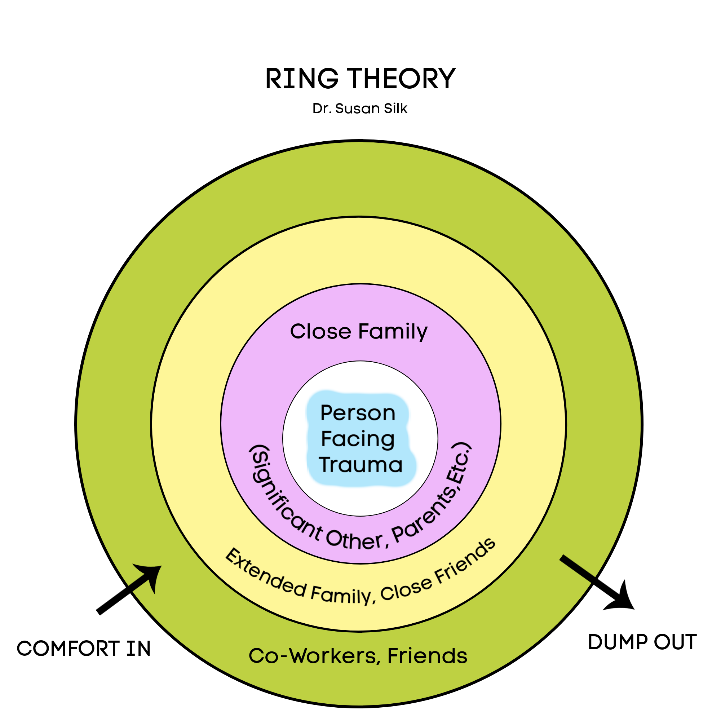
  • Comfort In, Dump Out:  Susan Silk, a clinical psychologist, wrote an op-ed for the LA Times in which she shared her fantastic “Ring Theory” for helping people in crisis:


“Draw a circle. This is the center ring. In it, put the name of the person at the center of the current trauma. Now draw a larger circle around the first one. In that ring put the name of the person next closest to the trauma. Repeat the process as many times as you need to. In each larger ring put the next closest people. Parents and children before more distant relatives. Intimate friends in smaller rings, less intimate friends in larger ones. When you are done you have a Kvetching Order. One of [my] patients found it useful to tape it to her refrigerator.


Here are the rules. The person in the center ring can say anything she wants to anyone, anywhere. She can kvetch and complain and whine and moan and curse the heavens and say, “Life is unfair” and “Why me?” That’s the one payoff for being in the center ring.


Everyone else can say those things too, but only to people in larger rings. When you are talking to a person in a ring smaller than yours, someone closer to the center of the crisis, the goal is to help. Listening is often more helpful than talking. But if you’re going to open your mouth, ask yourself if what you are about to say is likely to provide comfort and support. If it isn’t, don’t say it. Don’t, for example, give advice. People who are suffering from trauma don’t need advice. They need comfort and support. So say, “I’m sorry” or “This must really be hard for you” or “Can I bring you a pot roast?” Don’t say, “You should hear what happened to me” or “Here’s what I would do if I were you.” And don’t say, “This is really bringing me down.”


If you want to scream or cry or complain, if you want to tell someone how shocked you are or how icky you feel, or whine about how it reminds you of all the terrible things that have happened to you lately, that’s fine. It’s a perfectly normal response. Just do it to someone in a bigger ring.


Comfort IN, dump OUT.”


Esti’s loss is unbearably painful for so many including the community as a whole who spent over a year davening, learning, and doing chesed in her merit. Her passing can raise deep theological questions and evoke a wave of pain and emotion in us. It is critical to be mindful of directing our pain and questions not in, towards the family and their closest circle, but out towards others who can comfort us.


Professionals have made themselves available to our community for support and comfort, collectively and individually.  I hosted a conversation with Rabbi Dr. David Fox, Director of Chai Lifeline Trauma and Crisis Services on the topic of trauma and loss. You can find it at youtube.com/rabbiefremgoldberg.


At the moment of crisis, family, friends and community often rise to the occasion. It is critical to remember the positive and helpful role that we can and must play when the acute phase passes. Shiva and shloshim may conclude but the pain of the family lasts well beyond the technical period of mourning. As the Moskowitz family, both parents and children, return to their routines, please make the effort to find the balance between treating them normally, sensitively, and giving them space with remembering their pain and being a comforting presence in their lives. 


Dr. Fox advised that we neither ignore, nor show excessive pity.  We shouldn’t avoid nor smother.  Don’t express greater grief or agony than the grieving family.  Don’t share how difficult this loss has been for you, how much pain you have been in or how many tears you have shed. Welcome them back, express how much they were missed, and reflect back the mood they are showing. 


May all those who are grieving find strength and comfort and may we share only simchas together.

Rabbi Efrem Goldberg

Join Our Community

Subscribe to our newsletter or connect with us on WhatsApp.