A Personal Message and Request

BRS is more than a Shul, it is a community.  What is the difference?  A Shul is a place you come to daven, to learn, to say Kaddish, celebrate milestones, and mark lifecycle events. It is purely functional, pragmatic, transactional. Membership provides privileges, rights and entitlements.  “Members” are clients or customers.


A community, on the other hand, is a place of belonging, connection, shared mission, shared values, shared aspiration, shared history, and shared destiny.  Members of a community don’t only have rights, they have duties. They don’t just have privileges, they have responsibilities.  They aren’t customers or clients, they are stakeholders. 


When you have a membership at Costco, for example, you simply want to take advantage of the benefits and utility of the store but have no connection with the other members, no sense of real community among the shoppers.  There is no commonality other than a desire to buy things in bulk and at a discount. 


Some belong to a shul like a Costco.  It is a place to conveniently catch a minyan or Daf Yomi, to place one’s children in groups or to enjoy a kiddush, but there is nothing more that is binding the people there together.  There is no community that transcends the individuals. 


Sociologists define community as “a group of people who share a story that is so important to them that it defines an aspect of who they are.”  No matter how much you may like the people you meet at Costco or check books out next to at the library, you likely don’t define an aspect of who you are as a person by your membership in either place. 


Our goal has always been that people do not simply say or feel they are a member of BRS but rather, “I am a member of the BRS community who connects with the values and priorities of the community.  I share the love of all Jews. I am committed to the centrality of Torah learning and Torah living.  I feel profoundly connected to Israel and to my brothers and sisters who live there, serve there, and protect our home.  I am devoted to outreach and to making our sacred, timeless, and timely Torah accessible to all Jews.  I celebrate with my community, mourn with my community, and feel my identity intertwined with my community.”


To be part of a community is to ask not only what can I get, but what can I give.  Not only what are my rights and entitlements, but what our my duties and obligations. 


Nothing creates or bring a community closer than building together.  Indeed, Rabbi Lord Sacks z”l explains that this is the reason for the lengthy description of the campaign for and building of the Mishkan:


During the whole time the Tabernacle was being constructed, there were no complaints, no rebellions, no dissension. What all the signs and wonders failed to do, the construction of the Tabernacle succeeded in doing. It transformed the people. It turned them into a cohesive group. It gave them a sense of responsibility and identity.


Seen in this context, the story of the Tabernacle was the essential element in the birth of a nation. No wonder it is told at length; no surprise that it belongs to the book of Exodus. And there is nothing ephemeral about it. The Tabernacle did not last forever, but the lesson it taught did.


It is not what God does for us that transforms us, but rather what we do for God. A free society is best symbolized by the Tabernacle. It is the home we build together. It is only by becoming builders that we turn from subjects to citizens. We have to earn our freedom by what we give. It cannot be given to us as an unearned gift. It is what we do, not what is done to us, that makes us free. That is a lesson as true today as it was then.


As you may know or have seen, we are currently building, we are expanding, and will be almost doubling the size of our campus.  We are not building bricks and mortar or square footage. This is not about a physical footprint. We are expanding so that we can build the Jewish people, build Torah, build our connection to Israel, build our teens and youth and our future.   Our expanded campus will be even more of a destination for people from all over South Florida to catch a minyan at any hour, pull up a seat to sit and learn, use the women’s mikvah, men’s mikvah, meet with the Beis Din, learn in our Dr. Yitzchak Belizon Beis Medrash or Dannie Grajower Women’s Midrasha, invite an unaffiliated Jew to come daven or learn or have coffee, attend a concert, hear a speaker, come to a shiur, participate in an event, enjoy a simcha, and much more. 


While our primary community is our local, offline family, our BRS community is much broader and spans the globe.  All who listen, watch, read, follow, and feel connected to our values, our vision, our mission and our movement are part of our community, our family. 


If you love and believe in all Jews, if you value and draw from the wide spectrum of authentic Torah sources and personalities, if you have a growth mindset no matter what age and stage of life, if you see Israel as central to our people, Boca Raton Synagogue is YOUR community, whether you live in Florida or anywhere else in the world. 


Your community needs your help, wherever you are.  On Tuesday and Wednesday March 4 and 5 we will be launching our BuildeRS Charidy Campaign. Thanks to the incredible generosity of several significant donors, we have secured $3 million in matching donations—but we need to raise another $3 million to fully realize our dream for the campus and our community’s growth both locally, and the impact we can have well beyond. 


THIS IS WHERE YOU COME IN!


Here’s how you can help:


Financial Partnership: Your generous contribution will directly support the creation of new shiurim, additional minyanim spaces and options, and resources that will inspire greater learning and enrich our local and global community. To learn more about dedication opportunities or find out more details about our expanded campus and how you can help us, please contact Talia at tb@brsonline.org or donate directly here.


In addition to the dedications of spaces and larger gifts from local members, we are looking for 250 members from our Global community to give or raise $1,800. It can be paid one time or in installments.  You can give directly here. If you can commit to this, we have a special gift for you:


Members of our BRS Global Community who give or help raise $1,800 are invited to join me and the BRS Rabbis in New York, Israel or Florida for an exclusive celebratory dinner with an exclusive BRS giveaway.


Become an Ambassador: If you are able to directly give to the campaign, we are incredibly grateful. If you can’t directly give as much financial support as you wish you could, you can still play a critical role in the success of this campaign. By sharing our campaign with your network and taking on a personal fundraising goal, you will help build your shul and ensure it will have the proper facilities for everyone to learn and daven together and celebrate each other’s simchas. We need your help so we can expand our reach and ensure this project impacts even more lives.  Set up your page here.


If you can’t be one of the 250 helping us with $1,800, please consider giving or raising $1,000 to be acknowledged as a global pillar in our newsletter or $360 to be entered into a raffle for two domestic flights to Florida to join our BRS community for a special Shabbos of Unity.  Contribute here.


Even if you don’t live in Florida, make no mistake, you are part of OUR community, a community that loves and values every Jew, that is informed and inspired by Torah, that feels connected to Israel and that is devoted to growing throughout life.


Together, we’ll make this dream a reality and continue building a community of learning and growing in meaningful and lasting ways.


What Our Shuls and Communities can Learn from Disney

With my youngest child approaching his teenage years I thought my Disney days were over, but when my grandchildren came to me asking, “Zayda, can you come with us to Disney,” I couldn’t say no.  And so, I spent two days this week at the Magic Kingdom and Epcot.  As usual, I brought  a baseball cap so that nobody would be able to tell that I am Jewish.


As we pulled into the park, though, I decided not to wear it.  In a time when too many are trying to scare us, attempting to intimidate us into removing our symbols, hiding our practices or being ashamed of our identity, it is more important than ever to proudly wear our yarmulkas, show our tzitzis, or necklaces displaying Jewish stars, maps of Israel, or solidarity with hostages, and not cower from practices that are appropriate in public. 


A woman and her family came over to me at one of the parks to say how happy she was to see Jewish people not afraid to wear their yarmulka in public.  When I asked if she was Jewish, she told me she was and that she went to a Jewish school in Minneapolis as a child.   A man walking by stopped to say, “Shalom.”  I responded “Shalom” and asked if he was Jewish.  He told me he is a pastor from Alabama and that he and his congregation regularly pray for Israel and the Jewish people.  His wife quickly added, “and we have been praying constantly for the hostages.” 


We got a “boker tov” from one of the Disney employees and a few more “shaloms” and, I’m happy to report, no negativity or hostility.  The truth is, I would expect nothing more at the “Happiest Place on Earth.” It is hard to think of another place where such a large quantity of people all seem so courteous, kind, pleasant, and polite.


Generally speaking, one doesn’t find pushing or shoving, short tempers, a culture of criticism, or impolite and impatient people at Disney, despite having to wait on long lines, pay large fees, endure the hot sun, and spend hours on one’s feet.


As we observed the throngs of people with smiles on their faces and extraordinary consideration towards one another, I couldn’t help but think, wouldn’t it be amazing if our shuls were like Disney?  Wouldn’t it be wonderful if people thought of our campuses and communities as the happiest places on Earth, places that even if they had to stand for long periods, sometimes wait on lines, endure imperfect temperatures, it would not only be well worth it, they would be clamoring and counting down to coming back.


How does Disney do it and what could we learn regarding creating a culture of happiness? Many years ago, I participated in a behind-the-scenes tour of Disney to explore that very question. The design and layouts of the parks, the placement of vendors, and the timing of the shows are all meticulously and brilliantly strategized and arranged. But what struck me most from the tour was the culture and how the attitude of the Disney’s tens of thousands of workers impacts each and every one of their guests.


In every employee only area, there are signs highlighting the Disney credo, including: “I project a positive image and energy. I am courteous and respectful to all guests including children. I go above and beyond.” Disney understands a fundamental psychological principle supported by extensive research – happiness and joy are contagious. Just as if one person yawns others will follow suit, so too, if a person smiles, others around him will start smiling as well. A happy disposition, a positive spirit, and a pleasant countenance are quite literally contagious.


Whose responsibility is it to spread the smiles? Whose job is it to maintain the happiness effect? There are roughly 77,000 employees at Disney World in Orlando. All members of the staff, from custodial and maintenance, to the ride operators and people who wear the Mickey costumes, are all referred to as “cast members.” How many of the 77,000 cast members do you think are responsible for picking up the garbage? The answer is all 77,000. How many are responsible for helping someone with directions or return a lost child to their parents? 77,000. How many are required to smile and spread the happiness? That’s right, all 77,000. At Disney, the cast members know that they each have different tasks, but they are taught that they all have the same purpose: spreading happiness.


Disney has a regular contest among the employees to identify and reward “great service fanatics.” These individuals are nominated by their peers and are celebrated for going above and beyond in being kind, helpful, and spreading happiness and joy.


How do we go from a culture of complaining and criticism to creating the happiest place on Earth? Perhaps we can create a culture in which every single Jew, every participant of the community is a member of the “cast.” We must go from consumers, from members with entitlements and privileges, to stakeholders, cast members who feel a sense of personal responsibility, duty and obligation. 


If we want to be a place that attracts all, that inspires non-observant and disaffected Jews, that makes teens and youth excited about their Judaism, we ALL need to be leaders in making happiness, joy and meaning contagious in our institutions and homes. 


When speaking with a child, Disney cast members are trained to bend down and meet them at eye level.  I saw firsthand the subtle but powerful impact of speaking to someone, even a child, at eye level instead of making them look up at you while feeling small.  We need to speak to all the members and participants in our community at their eye level.  Sometimes that will mean bending down, ensuring nobody feels small, no matter what their Jewish education or level of observance. 


In complimenting and blessing Yehuda, Yaakov says, “His teeth are whiter than milk.” Of all virtues, why is Yaakov highlighting Yehuda’s teeth? The Talmud (Kesubos 111b) explains that Yaakov saw a quality in Yehuda he greatly admired and benefited from. Yehuda had a habit of smiling, of flashing the white of his teeth when seeing others. Indeed, the Talmud concludes when a person shows the white of his teeth to another by smiling widely, it is more beneficial than giving a cup of milk to drink. Why the comparison to milk?


Rav Shlomo Wolbe explains that milk nourishes and nurtures growth. What milk does for the body, a smile does for the heart and soul. He writes that just as plants require sunshine to live, converting the rays of the sun into nutrients, people convert smiles into energy and strength, and without it they wilt and perish. Dogs and cats can’t smile. Smiling at one another is part of what differentiates us as humans.


Make an effort to always have a smile.  Let’s all be active members of the Jewish people’s cast and convert our shuls and communities into the happiest places on Earth.

A Shul Built Thanks to a Rotisserie Chicken

One day in 2022, Azriel was minding his own business when he got a call from Charlotte.  She introduced herself as the president of Congregation Anshei Shalom, a large Conservative Temple in Century Village in West Palm Beach, Florida and she asked him to come to a meeting of her board.  Despite not having any idea why he was called, Azriel agreed to attend the meeting.


It turns out, CAS may have been a large temple in square footage but was shrinking and now fairly small in membership. They used to have 1,000 members but were now at the point that they couldn’t put a minyan together even counting men and women combined. There are 2,000 yahrzeit plaques on the walls and essentially that is where nearly all their membership is today.


The board was interested to find out if the growing orthodox population in the area was interested in renting space for their services.  The chapel has a separate entrance and separate bathroom facilities enabling two groups to simultaneously use the campus while maintaining their separate identity and function.


Azriel listened to the proposal and responded that he is just a simple Jew, not any sort of macher or leader in Century Village and that he lives a mile and a half away, probably too far to even be able to attend Shabbos services.  He said, “I love you with all of my heart, not as cousins but as my brothers and sisters.  However, the likelihood of Orthodox people renting space at the Temple is very remote.” He explained that they could try to work something out but that a long-term deal to share space was very unlikely. They ended the meeting with the possibility of continuing the conversation but pessimistic they would work something out. 


Azriel went to his Orthodox shul the next morning for davening and told some of the chevra there about this meeting.  One friend advised to go back to Charlotte and offer her 1 million dollars to purchase the shul and the campus.  The man said he would back up the finances.


Azriel called Charlotte and set up a meeting with the board for the following week. They sat down and he asked them how much would they want for the building. They explained that they had actually done an appraisal and it was worth $6 million.  Azriel turned to them and said, I don’t know about that but I will give you $500,000. Additionally, he told them that he would keep every single dedication plaque in the building and would maintain the yahrzeit lights on the thirteen memorial boards. The current temple would be able use the building through the end of the year and the new group would take over January 1. Lastly, he agreed that the large Israeli flag would continue to fly outside the building. 


A week later, Charlotte called Azriel to inform him that the board had accepted the offer.  Overjoyed, he was prepared to wire over the half million dollars and close the deal. 


If only it was that simple. The United Civic Organization of Century Village, where the campus is located,  held their board meeting.  The president of Century Village got up in front of the whole crowd and said that they have heard that some unknown guy by the name of Azriel has purchased the CAS building for $500,000 and that Century Village is opposed to this sale.  He proclaimed that they will do everything in their power to stop the sale and take over the building by themselves.  He insisted they will knock down the building and put up a shopping center there and to comply with the deed restriction set up by the original builder of all the Century Villages providing that there has to be a house of worship there, Century Village will put in a Presbyterian church in one of the storefronts. 


Charlotte and Azriel got wind of what happened and the efforts to interfere with the sale they had agreed upon. The two had the same exact thought.  Rather than conduct a sale that could be overruled, Azriel and his friends would all join CAS as members, he would then run for and get elected president, and CAS could keep its name and change its charter. Azriel, of course, had his motivations, but Charlotte, too, was devoted to the continuation of the shul, the yahrzeit lightings, the dedication plaques, and that all of the investment in Yiddishkeit that previous members there had put in for over 50 years.


At this point, Charlotte said to forget about the $500,000 and just give $100,000 to pay out CAS’s outstanding bills and obligations.  Azriel wired the money and he and his chevra officially took over the board.


At the next Century Village United Civic Organization meeting, Azriel took the microphone and explained to the crowd that he had been elected the President of the Board, there would be no sale of the CAS building, and that services and the shul would continue. Everyone clapped and that put that whole issue to rest.


In December, Azriel met with Charlotte for the handover of the keys to the building. She gave him the keys and told him that she only ended up using $45,000 of the money to pay the bills.  She then proceeded to hand him back $55,000.00.


In the end it cost a grand total of $45,000 for a campus that occupies over eight acres of land, includes a main sanctuary that seats 750, with two kitchens, a large social hall, and several offices.  There is a large library and beis medrash. 


The story of Congregation Anshei Shalom is extraordinary but there is one question that was still left to be asked.  Azriel wanted to know, why him?  How did Charlotte find him and why was he the one she called, seemingly out of the blue, about the possibility of an Orthodox congregation renting space?


Azriel moved to Century Village around ten years ago.  He met a neighbor, Janet, who told him about a kosher bakery at BJs on State Rd 7 in Royal Palm Beach.  Janet would buy her Shabbos challah there and, she added, once she’s there she would buy the rotisserie chicken for Shabbos from there as well.


Azriel couldn’t understand. Janet, at the time was close to 90 years old. She would shlep five miles for kosher challah and yet she had no problem eating treif chicken?  Azriel had an idea.  He would going to Glicks in Delray each Friday morning to buy food for Shabbos and food for the following week. He started picking up a chicken for Janet each and every Friday and leaving it on her door handle for Shabbos. 


Every Monday night, Janet played in the same mahjong game with Charlotte.  One week, Charlotte is describing how her temple is hemorrhaging members and in financial trouble.  She shares that since so many Orthodox Jews are moving in, maybe they would be interested in the space, she just wishes she knew someone to call about the possibility of renting.  Janet says, I know just the person, I have an amazing neighbor who is so kind and thoughtful, he picks up a kosher chicken for me each and every week.


For $45,000, a large Orthodox shul now hosts three weekday Shacharis minyanim, two weekday Mincha/Maariv minyanim, two Shabbos morning minyanim, Daf Yomi shiurim, and so much more… all because a simple Jew cared about his neighbor and brought her a chicken weekly.


The word Elul, the month we find ourselves in, is an acronym for many phrases and pesukim.  Perhaps the most famous, Ani l’Dodi v’Dodi li, I am to my Beloved and my Beloved is to me, reflects our special loving relationship with our Creator and the effort we are instructed to make during this time of year to come closer and closer with Him.  Less famous but as important is the acronym, taken from the words of Megillas Esther, “ish l’reiehu u’matanos l’evyonim, a person to their friend and generosity to those who need.”  This time of year is also dedicated to coming closer with one another, displaying care, concern, connection, and community.  How devoted are we to our neighbors, without caring if we are similar or different?  Are we generous with those who may feel isolated or alone? 


A single parent was recently telling me how few invitations he has received since his divorce and how alone the children and he feel. 


Caring about our neighbors is the right thing to do, but it is also what Hashem looks for and loves, His children caring for one another.  We describe Hashem as tzilcha, our shadow.  His attitude towards us is a shadow, a reflection of how he sees us act towards other.  If we want Him to judge us favorably and show devotion to us, we need Him to see us devoted to and caring about our neighbors.


For the cost of a rotisserie chicken, we can create and show love, to an entire community.    


What If?

When the peace and harmony of Shabbos concluded and we learned the the news of an assassination attempt on a former and current candidate for President, among my many thoughts was the question of, What If?


A series of anthologies titled, “What If? The World’s Foremost Historians Imagine What Might Have Been,” examines turning points in history and what might have been if particular moments had gone differently.  One moment that broke differently at Poitiers in 1356, at Gettysburg in 1863, or in Berlin in 1945, could have altered the entire tapestry of modern history.


So, what if? What if President Trump had not turned his head at the last moment and instead of being shot on the tip of his ear, was assassinated as the shooter intended?  Would a dangerous and irreparable division have resulted, with violent and grave consequences for the country? Who would have replaced Trump as the Republican presidential nominee and how would the election have been impacted?


Reflecting on his brush with death, Trump said it was “God alone who prevented the unthinkable from happening.”  Ultimately, it is likely less than one inch that will leave the world and history wondering, what if?


President Biden called on Americans to “lower the temperature” in politics and said that Americans “must stand together.”  President Trump, too, said that the miracle is motivation to pivot to a message of unity.  While the assassination attempt was the act of an individual, many are blaming the level of rhetoric and extremist language in politics on both sides.  Comparisons to the most evil men in history, descriptions of a threat to democracy, claims that the election is a matter of life or death, create an atmosphere that is not only toxic, but clearly dangerous.  


While Trump may be the highest-profile attempted assassination of late, there have been no shortage of shootings and attempts to kill both Republicans and Democrats.   Since the United States Congress was established in 1789, fifteen of its members have been killed while in office, and fourteen have suffered serious injuries from attacks.  Of those killed, 10 were Democrats, four were Republicans, and one was a Democratic-Republican.  Of the four members of Congress physically attacked since 2011, Gabby Giffords (D), Steve Scalise (R), Rand Paul (R), and Angie Craig (D), two are Democrats and two Republicans. 


Similar divisiveness, discord and dangerous demagoguery exist in Israel as well.  Many blame the 1995 murder of Prime Minister Yitzchak Rabin, the head of the Labor Party, on incitement from his political adversaries and their followers. Others are concerned today with the relentless inflammatory language leveled at current Prime Minister, Bibi Netanyahu, the head of Likud.


Both in Israel and America, each side points a finger at the other, blames the other, and calls on the other side to improve.  An honest and objective observer will conclude that the left and right in both countries have contributed to the poisonous and perilous polemics and that neither side adequately calls out their own for what they contribute to the noxious atmosphere, even while calling for unity themselves. 


Politicians and political parties profit off the industry of extreme and inflammatory language.  Anger and fear generate outrage. Outrage translates to dollars and to votes.  But it also leads to division, hate and as we were reminded this week, even to violence. 


As a result, our leaders, the very people entrusted to serve our interests and bring us together, simply cannot be counted on to turn down the temperature or bring unity.  Ultimately, it is up to each and every one of us to be sensitive to and regulate how we speak, what we say, and the tone we take.  We, the people, must recognize our own autonomy and take ownership over how we interact. We can and must model how to disagree agreeably, how to debate and discuss ideas and policies, and not repeat, promote or advance ad hominem attacks against people. 


Shlomo HaMelech’s insight in Mishlei (18:21): “Maves v’chaim b’yad ha’lashon,” death and life are determined by the tongue, feels particularly poignant this week.


Soon, we will begin to observe the Three Weeks culminating in Tisha B’Av, the most inauspicious day on our calendar marking the destruction of both Batei Mikdash and the countless calamities and suffering in our history.  Our rabbis taught that the cause of our millennia-long galus was sinas chinam, baseless hatred that can be traced all the way back to the dispute between Yosef and his brothers. 


The Torah tells us that Yosef’s brothers hated him to the point that v’lo yachlu dabro l’shalom.”  The Ibn Ezra explains, “v’lo yachlu dabro l’shalom – afilu l’shalom.”  It isn’t that they just couldn’t talk about the issues they disagreed about.  It isn’t just that they didn’t want to be close, loving brothers.  It isn’t just that they couldn’t debate respectfully.  “Afilu l’shalom” – they couldn’t even give each other a shalom aleichem.  The hatred and intolerance had grown so deep that they couldn’t stand to even extend greetings to one another or to be in a room together. 


Rav Yehonasan Eibshitz in his Tiferes Yonasan has an additional insight.  When we disagree with people, we withdraw from them and stop speaking to them.  We see them as “the other,” different from us and apart from us.  As our communication breaks down, the dividers rise up stronger and stronger and we can’t find a way to break through them. 


The antidote and answer is in our hands and we remind ourselves of it three times a day when we pray.  Our practice of taking three steps backward at the conclusion of the Amidah comes from a Gemara in Yoma (Daf 53) which states, “Hamispaleil tzarich she’yafsiah shelosha pesios l’achorav v’achar kach yitein shalom. The one who prays must take three steps back and only then pray for peace.” R’ Menachem BenZion Zaks (in his commentary on Pirkei Avos) explains that we cannot pray for, nor achieve, peace if we are not willing to step back a little and make room for others and their opinions, tastes, and personalities. After literally stepping back, we ask, “Oseh shalom bimromav, God, please bring peace,” and we then turn to our right and to our left. Explains R’ Zaks, achieving peace and harmony means bending towards those on the right of us and those on the left of us, acknowledging them, engaging them, and making space for them. That is a prerequisite to the shalom, the peace we crave.


In America and in Israel there are so many issues that deserve legitimate, vociferous debate. From elections to army service, from gun control to abortion, from judicial reform to religious coercion, there are complicated issues with multiple perspectives.  They elicit strong emotion and passionate positions, but they cannot and must not sow irreversible division.  We cannot allow our differences and strong opinions to make us unable to say hello to one another, or to see someone we disagree with as “the other.”  Many of us remember the groundswell of unity, togetherness and patriotism that developed after the terrorist attacks of September 11, 2001, and we remember how it dissipated and disappeared too quickly.  For too short a time we remained different politically and on policies but united and proud as a country.  We cannot allow the similar feeling of unity and togetherness that followed October 7 to vanish or fade away.  We can point a finger at others for how they have returned to rhetoric, or just like when you point an actual finger, we can recognize there are three pointing back at ourselves and take responsibility for our role and contribution to conversations.


As we approach the Three Weeks, don’t just ask and ponder “What if” about the assassination attempt on President Trump.  Ask what if we all took responsibility for how we speak, for keeping the focus on policies and issues and not on people, for avoiding language that inflames and incites and instead using language that persuades and influences.  What if we didn’t just bow to the right and the left at the end of our Amidah but looked to our right and to our left religiously, politically, and in every other way and brought the great beracha of shalom by bowing to what we have in common, rather than what divides.  What if.


Do They See Our Sounds?

Every year, about 11 million children in the United States participate in school-level spelling bees. The most prestigious competition is the annual Scripps National Bee that has been held since 1925. The words have gotten progressively more difficult over the decades as the competition has stiffened. In 1940, the winning word was “therapy,” whereas last year’s was “psammophile.” (It means a plant or animal that prefers or thrives in sandy areas, in case you were not aware.)


Indian Americans comprise about 1% of the U.S. population, yet for the last 20 years, they have dominated the Scripps Spelling Bee. Two weeks ago, a 12-year-old Floridian named Bruhat Soma became the 29th (of 35) Indian American champion since 1999. What can explain this phenomenon?  Are they on spelling steroids? Are Indian American’s brains wired to spell better than anyone else?


וְכל־הָעָם֩ רֹאִ֨ים אֶת־הַקּוֹלֹ֜ת וְאֶת־הַלַּפִּידִ֗ם וְאֵת֙ ק֣וֹל הַשֹּׁפָ֔ר וְאֶת־הָהָ֖ר עָשֵׁ֑ן וַיַּ֤רְא הָעָם֙ וַיָּנֻ֔עוּ וַיַּֽעַמְד֖וּ מֵֽרָחֹֽק׃ “All the people witnessed the thunder and lightning, the blare of the horn and the mountain smoking; and when the people saw it, they fell back and stood at a distance.”


Matan Torah remains the most seminal event, not only in Jewish history, but in all of history.  The Creator and Master of the Universe shared His blueprint for creation, handed over His manual for meaningful living, opened up His personal diary that is the description of His essence, and the world has never been the same since.  Empowered and inspired with the tools of Torah, the Jewish people have transformed the world in so many ways. 


That event, that moment, was uniquely momentous; yet, of all the miracles and special moments, the Torah doesn’t mandate that we commemorate it.  Hashem took us out of Egypt, and we have Pesach and a mitzvah to tell the story, and to do so over matzah and marror.  He took us through the desert, and we have a Yom Tov of Sukkos where we sit in Sukkahs and remember the booths our ancestors sat in, exposed to the elements, under the Divine protection.  On Chanukah we light the Chanukah candles, and on Purim we listen to the Megillah.  And yet, this greatest moment in our history has no mitzvah, no ritual or ceremony, no commemoration? Yes, the Torah does command us to celebrate a Yom Tov 50 days after the second day of Pesach, but nowhere does it mention that this holiday commemorates the revelation at Har Sinai,


In his Mishnas Rav Aharon, Rav Aharon Kotler explains that the miracles of yetzias mitzrayim were one-time events, parts of history that need to be remembered, recalled and commemorated so that we can come as close as possible to imagining what it looked like because it was so long ago. The same is true for Sukkos, Chanukah, etc.  However, the revelation of Har Sinai doesn’t need remembering or commemoration because it is ongoing, it is still happening every day. 


All over the world, every time a Jew opens a sefer, attends a shiur, sits down with a chavrusa, plays a Torah podcast, or engages with Torah in any form—the conversation continues, Hashem is still speaking to us. And that is why 40 years after the Torah was given, in Moshe’s soliloquy to the Jewish people, reflecting back on their short history to that point, he describes Matan Torah as קול גדול ולא יסף. Kol gadol means a great sound, but what does “lo yasaf” mean?  Says Unkelus, לא פסק, a great voice that hasn’t stopped.  He is still speaking, the conversation never ended. Are we listening, are we participating?


When Rav Meir Shapiro zt”l, the founder of the Daf Yomi, was seven years old, he found his mother crying and he asked her why.  She explained that she was terribly sad because his melamed was scheduled to come that day but didn’t show up.  The young boy didn’t understand why that moved her to tears.  She explained, “You don’t understand Meir’l because you are too young, but my son, I want you to always remember, if you miss a day of learning, it cannot be replaced, it cannot be made up.” 


Rav Meir Shapiro’s mother understood something so fundamental, so basic and so core to our people – כי הם חיינו ואורך ימינו, Torah is not information, it is not a set of facts, laws, it isn’t part of or commemorating history.  Torah learning is not just a way of life, it is what provides life, sustains life and nourishes life.  Without it we simply cannot live.


Rav Meir Shapiro’s mother’s tears left an indelible impression and when the opportunity presented itself, he introduced a system and initiative which would ensure we would never miss a day of learning in our lives.  It is estimated that today there are more than 300,000 people around the world who learn the Daf Yomi daily.  Rav Meir Shapiro and his wife didn’t have biological children, but make no mistake, each blatt of Gemara learned daily by Jews everywhere is his continuity and legacy, each of the devotees of the Daf his progeny.


Our Judaism must not be commemorative, our commitment to Torah must not be a casual connection because of a past.  It must be vibrant, dynamic, alive, passionate in the present. 


The Midrash tells us that when Hashem gave the Torah, כפה עליהם הר כגגית, He held it over our heads and said accept it or שם תהא קבורתכם, there you will be buried.  Many ask, shouldn’t it say פה, here, not שם, there?  If Hashem is going to threaten us, shouldn’t He get it right? 


I believe, and we are sadly seeing empirically all around us, that if you don’t feel the weight of Torah over your head, the responsibility of a deep, profound and passionate commitment to it personally, you may not spiritually die in that moment.  Perhaps you can go a generation or two.  But שם, down the line, a few generations in, it will catch up.  If we negotiate with our Yiddishkeit, if we pick and choose, if we are casual about it, down the road it will come crashing down on our head. 


Do you know why Indian Americans children dominate the Spelling Bee?  As explained in one of many articles exploring the phenomenon, it is because Indian American parents value and celebrate spelling well.


וְכל־הָעָם֩ רֹאִ֨ים אֶת־הַקּוֹלֹ֜ת – At Har Sinai we saw the sounds, we didn’t just hear instructions, we saw a vibrant image of a passionate inspired life.  Indian American children don’t just hear their parents talk about spelling, they see the value of spelling, they see themselves as spelling champions and then they become that. For them it is more than just a competition, it is a true and genuine mission.


What do our children see?  What are we celebrating for our children, for our family, for ourselves? Are we celebrating the things and accomplishments that we truly value? Here is why that question is critical:  Because whatever you celebrate, that’s what you’ll value and that is what you children will value and sacrifice for. 


Indian Americans celebrate spelling and they have therefore dominated the Spelling Bee.  L’havdil, Rav Meir Shapiro’s mother celebrated Torah learning every day and she had a son who introduced the world to the most popular program of daily Torah learning in history. What do you celebrate, what does your family hear you talk about, see you care about, watch you invested in?


Israel’s war against her enemies and the rise of antisemitism have posed formidable challenges but they also bring an opportunity.  How we react, what we are doing about it, how focused we are on the fate of our people, can and will leave an indelible and enduring impression on our children and grandchildren. 


If we want our families to be passionate, practicing, and proud Jews, living and learning Torah and loving Israel when they are שם, down the road, they need to רֹאִ֨ים אֶת־הַקּוֹלֹ֜ת, not only hear, but see our voices in action now. 


Our Annual Report Card

My children’s latest report cards went out recently and some of my children posted on our family WhatsApp group the grades they were proudest of.  I jokingly shared that my report card also just came out and posted the link to our annual BRS Global campaign, our effort and invitation to get those who watch, listen, read, and grow from the content we share to contribute and partner with us going forward. 


Like most jokes, there was a degree of truth to my response.  Right or wrong, the annual global campaign can feel like a report card on our content, a grade and score on the question of how well we are doing adding value and inspiration. 


As part of my role as Rav of Boca Raton Synagogue, Hashem has blessed me with the privilege to teach Torah widely through audio, video, writings, panels, podcasts and more.  With all of the wonderful feedback we receive, when we run the global campaign and ask for support from those who aren’t members of Boca Raton Synagogue or live in our community, something the data shows is that while Baruch Hashem a large group participates and contributes, when compared with the numbers accessing the content, the data is far from matching.  


I don’t think people are fundamentally unappreciative or ungrateful and (not joking here), I know they aren’t actively giving a report card of how much they value our hard work. But as I think about every year at this time, at the end of the day, all of us take much of what we enjoy, and that enhances and enriches our lives, for granted.

  
There are incredible resources that we live off of daily that we don’t pay for.  Consider the value Google, Gmail, Waze and countless other apps and technology products add to your life.  How much do we depend on and rely on them that if we needed to pay for them we would find the money.  Yet, while we pay by being part of Big Data, these life-changing resources don’t cost us anything in traditional currency. 


An unintended consequence of this new economy is cultivating a culture of entitlement and the expectation that even the things that benefit me enormously shouldn’t cost me money and I shouldn’t have to pay for them. 


Among many other ways, this phenomenon expresses itself in people moving to a community, attending a shul, eating at a kiddush, taking advantage of youth groups, going to shiurim, asking shaylos of the rabbonim, and yet still not joining through actual membership, even when it is structured to pay whatever you can afford.  It shows itself in those who listen, read, watch, enjoy, grow and are inspired by a speaker, organization and platform and fail to say thank you or show support, even when asked. 


Indeed, in a culture of “What do I get out of it”, we have added an incentive to our campaign this year.  In addition to just showing appreciation and paying it forward, a contribution of $180 will enter you in a raffle to win a wonderful weekend with us in Boca Raton including two domestic plane tickets and VIP tickets to the Ishay Ribo concert at BRS on April 7th


Please visit brsonline.org/global to become our partner and help others benefit from the content that has moved you.  We see each and every person that contributes and read the beautiful messages that many have chosen to write.  The gestures and generosity not only mean the world to us, but each one inspires and motivates us, and for that we are so profoundly appreciative.


This Parsha contains the mitzvah of Machatzis HaShekel.  Every man over twenty was obligated to give one half-shekel weight of silver, approximately nine grams of silver, worth about $5.99 today, which was used to operate the Beis HaMikdash and which rendered the animals purchased with these funds genuinely communal sacrifices.  This required gift had an unusual condition:


“The rich shall not pay more and the poor shall not pay less than half a shekel…”  Why not let the rich pay more and cover the entire cost of the communal sacrifices?  Wouldn’t it make sense to let the poor preserve their money to support themselves and allow the wealthy to underwrite the communal activity?  And why is this command even necessary? Wouldn’t each individual want to contribute to be counted among the community and be among those supporting the communal sacrifices?


The tendency of people to assume, “Someone else will take care of it” is hardly new.  Someone else will pay, someone else will volunteer, someone else will lead.  The Torah reminds each individual that it is not someone else’s responsibility or obligation but our own.  To be counted among the community, your local community, your broader learning community, the community of the greater Jewish people, it isn’t enough to speak about values, one must act on them.  It isn’t enough to say one cares, one must exhibit commitment and tangibly show they are a stakeholder.


In Judaism, gratitude is not a debt we pay, it isn’t simply a means of making the one who gave us whole.  Gratitude isn’t just for the recipient; it is for the one who communicates it to express humility and a recognition of being dependent on one another.  Moshe was not allowed to strike the Nile, an inanimate river, because he needed to show appreciation, even if the Nile wouldn’t have missed it had he not.  


Contributing locally, globally or to Israel, even when it isn’t required, giving even when it isn’t demanded, is a great expression of appreciation, a statement of who we are, even more than how much we value the one we are giving it to.   


When your taxes are filed in this world and when your contributions are measured in the next one, when it comes to showing gratitude and empowering what you claim to care about, what grade will appear on your report card?

You are Insane

“You are insane!”

Those were the words Rav Asher Weiss Shlit”a used to greet me when I visited him this week and shared that we had a group of 70 people from BRS who had come to spend Yeshiva Week in Israel. He continued that anyone visiting Israel right now, anyone flying into a country at war, is insane.

In a few weeks it will have been two years since Russia invaded Ukraine. In that time, six million Ukrainians have fled to Europe, but do large groups of Ukrainians from around the world come to visit Ukraine? How many have come on solidarity missions to bring supplies, to visit army bases, to sponsor barbecues, to hug displaced families?

“And so, you and the many who have come to visit Israel during this war are simply insane,” said Rav Asher. “But it is a magnificent insanity, a beautiful insanity, an insanity driven by love and loyalty, by connection and community, by a sense that we aren’t just a people, we are a family and family doesn’t run away from trouble, they are willing to run towards it.”

Of course, in truth there is nothing insane about visiting Israel right now. It feels not just safe but tremendously meaningful, moving, and one truly appreciates that visits make a difference. I don’t take for granted for a moment the privilege of spending time in Israel during this monumental, historic, and critical time.

There are many legitimate reasons not to be able to visit Israel during this time. Not everyone can take off from work. Those with young children and those who are responsible for taking care of aging parents cannot travel or be far away. The expense of flying and finding a place to stay is significant and the relationships and connections needed to craft a productive and meaningful itinerary are not available to all. And so, there are many legitimate reasons that people can’t stop what they are doing during this war and come to Israel.

But here is the thing. There is no legitimate reason for every member of our precious Jewish people not to feel with every fiber of their being that they want to go to Israel right now, that they are drawn to the beautiful and magnificent insanity of running to be with our family in Israel at this moment: for them, for ourselves, to honor our history, and to together forge our destiny.

As this war continues to rage, as the danger of it expanding to a northern front increases, as hundreds of thousands of families remain displaced, as funerals and shivas of soldiers are tragically still taking place, as hospitals and rehabilitation facilities remain full of thousands fighting to recover and resume life, as the economy continues to be compromised by a massive dip in tourism, and as too many in the world are working to marginalize and isolate Israel, every member of our sacred family should be drawn to our home, should feel the powerful force of the magnetic pull to be with our people, to be in our place, to be part of this sense of purpose.

It shouldn’t be hard to want to go to Israel right now; it should be hard not to, it should feel impossible to stay away, it should hurt to not be there, to not be counted and to not be contributing.

Rav Michael Yammer, the Rosh Yeshiva of Shaalvim, told me about a call he received from a talmid of the Yeshiva who was in Gaza. Anxious and upset, the young man had gotten access to a special phone from his captain to be able to call his rebbe to tell him that he had decided to put his role as a husband and father ahead of being a soldier and that pending permission from his rebbe, he was requesting to leave the Gaza battlefield to go home. Sensing that something had happened, Rav Yammer asked him what changed, why was he feeling this way? The young man said that just a few hours earlier, a dear friend and fellow soldier had been killed in fighting and he now felt he just couldn’t go forward with the feeling that his family might lose their husband and father.

Rav Yammer told him there is a conflict taking place between your head and your heart, between what you are thinking and how you are feeling. Come home for a couple of days, speak to your wife and come with her to meet me to explore if you think your head can rein in your heart, if what you believe can sway and control how you feel. Rav Yammer challenged him, in this moment, can you set aside your being an ish perati, am individual person, to serve as an ish ha’kelal, a person who is devoted to the greater good? Can you put what is right for am Yisrael ahead of what is right for you or your family? If you can’t, that is completely understandable and acceptable and not subject to anyone’s judgment, but consider it thoroughly, be true and honest with yourself.

The next day, the couple cancelled their appointment with him explaining they had been up all night discussing and had reached a conclusion. With his wife’s support, he was determined to continue to be an ish ha’kelal, a person who was dedicated to the greater good of his people. His head could and would rule his heart, his commitment and belief would be stronger than his fear, and he and his feelings were going back in to fight and defend his greater family, the Jewish people.

Israel is filled with anshei ha’klal right now, ordinary people with extraordinary commitments to serve something bigger than themselves, and they are making tremendous sacrifices as they do so. While fatigue has set in for too many, soldiers cannot afford to tire, their wives and families have to continue to pick up the slack, a nation whose citizens are at most one or two degrees of separation from October 7 victims, or soldiers who have paid the highest price since then, has to live with trauma and grief it hasn’t yet had time to process or experience.

This war is and will be won by a country of individuals putting aside their individual needs, wants, and well-being to serve the klal, the greater community and people. Soldiers are risking their lives on the front lines. Families are filling in while loved ones are way from home for prolonged periods. Volunteers, many of whom don’t sleep for days at a time, are cooking, delivering, serving, supporting, and supplying. A nation is davening and learning with greater diligence, determination, and dedication than ever before. People who have been far away from mitzvos and spirituality are experiencing an awakening and pledging to take on practices outside of their previous experiences and comfort zones.

Not everyone who lives outside of Israel can go right now but every one of us should feel that we want to, should work to plan to, should find a way to not do what is best for us or even just for our families, but to prioritize what we can do for our collective future, for the good of our people.

Even if we can’t physically be in Israel, our focus, consciousness, and compass can be connecting us constantly to Israel and to the sacrifices our brothers and sisters are making there. We cannot and must not be tone deaf or disconnected, acting as anshei prat, individual people, practicing, posting, speaking and living as if there isn’t a war raging, heroic angels aren’t being killed, hundreds of thousands aren’t grinding through the grueling reality of being displaced for many months.

Before planning, posting, or doing anything during these difficult days, ask yourself, is this the behavior of an ish ha’klal, someone connected with our greater people? How would this picture, this comment, or this message, be seen or understood by those I claim to care about going through something we cannot begin to truly comprehend? How can I put my personal, individual instinct or need aside and use my time, energy, resources and attention to serve, contribute and put the family first instead?

In this critical time, ask yourself simply, how will you be magnificently and beautifully insane?

Be a Proud, Practicing, Unapologetic Jew

* Derasha delivered at Boca Raton Synagogue on December 9, 2023


The Beis Yosef asks a well-known question to which hundreds of answers have been suggested.  If a flask of oil was found that had enough for one night and it lasted seven extra nights for a total of eight, why is Chanuka, which seemingly commemorates a seven-day miracle, celebrated for eight days? 


The Meiri writes: ולילה הראשון שלא היה שם נס השמן מברכין על הגאולה ועל הודאת מציאת הפך ושאר הלילות על נס השמן. The answer is simple.  We do only mark the seven nights that were miraculous with seven days of lighting.  The first night, however, we are marking and celebrating a different miracle, the miraculous military victory and redemption.  The Pri Chadash, in his commentary on Shulchan Aruch, gives a similar answer and writes if there were no miracle of the flask of oil, there still would have been a holiday established filled with Hallel and hoda’ah for the military victory. 


Our eight-day holiday of Chanuka is a celebration of two reasons to celebrate, two miracles that we mark in one blended holiday.  Is there a connection between the two or did they both happen to overlap on the same days of the calendar, so we combine them into one holiday? Which is the main driver of this holiday and which is secondary?


This week, my fellow BRS rabbis and I visited Shura once again.  It is the base of the Rabbinate of the IDF, the place all fallen soldiers (and on October 7, civilians) are taken to be identified and prepared for burial.  On our visit, the body of 22-year-old Ben Zussman, the second member of the greater Bendheim family (who have a remarkable 46 cousins currently serving) to be killed in battle, was being taken from the building into the car that would carry him to Har Hertzl for his funeral and burial.  We were present for the first Kaddish being said on his behalf. 


Last month when we returned from our first visit, I told you about the literature, posters and tefilla cards for soldiers produced at Shura, how this is the only army in the world with a division for spirituality and faith. This time I saw Chanukah booklets published for soldiers, including addressing questions like how to light in Gaza in a tank, if you don’t have a home and  Divrei Torah and motivational messages connected to Chanukah.  In it, the following explanation of the duality of the Chanukah miracles is offered: The menorah of the Beis HaMikdash was lit in the Heichal and illuminated it all night.  The Kohanim didn’t serve at night, there was no avodah so why did it need to be lit up?  The type of person who regularly turns the lights off when nobody is in the room would go crazy seeing the Beis HaMikdash lights on with nobody in it all night, every night.  What was the point?


The Gemara in Shabbos (22b) explains that this was an unusual light; it wasn’t for illumination or to be able to see more clearly.  וְכִי לְאוֹרָהּ הוּא צָרִיךְ? וַהֲלֹא כׇּל אַרְבָּעִים שָׁנָה שֶׁהָלְכוּ בְנֵי יִשְׂרָאֵל בַּמִּדְבָּר לָא הָלְכוּ אֶלָּא לְאוֹרוֹ! אֶלָּא עֵדוּת הִיא לְבָאֵי עוֹלָם שֶׁהַשְּׁכִינָה שׁוֹרָה בְּיִשְׂרָאֵל. מַאי עֵדוּת? אָמַר רַב: זוֹ נֵר מַעֲרָבִי שֶׁנּוֹתֵן בָּהּ שֶׁמֶן כְּמִדַּת חַבְרוֹתֶיהָ, וּמִמֶּנָּה הָיָה מַדְלִיק וּבָהּ הָיָה מְסַיֵּים.

The light was a signal, a symbol that Hashem’s presence was dwelling among the Jewish people, that we have a special relationship and an exceptional mission.  


The Shem MiShmuel writes that the miracle happened specifically through the Menorah because the Menorah is the symbol of chochma, Jewish wisdom, values, culture, and knowledge.  The Gemara in Bava Basra (25b) says הרוצה להחכים ידרים,  if you want truth and wisdom turn south to the Menorah.  The Syrian Greeks wanted to eliminate our unique Torah vision and values, to have us abandon our wisdom and culture and subscribe to theirs. They wanted to erase Judaism and its influence and impact on the world. The military victory enabled the rededication of the Beis HaMikdash and allowed us to light the Menorah once again.  It was really a victory of our chochma, shinning our light over their darkness. 


The book of Chashmonaim describes that our enemies didn’t only eliminate the oil, they took away our Menorah.  When we reconquered our Beis HaMikdash, they weren’t just missing pure oil, they were missing the Menorah itself.  What did they do?  Megillas Taanis (Perek 9) describes that the Chashmonaim took sheva shipudim shel barzel, seven iron rods that were used as weapons against the Yevanim and turned them into the Menorah. 


When they lit that original first flame, they weren’t just marking the miracle of the oil, but they looked at that Menorah made from their weapons and they were celebrating the miracle of the victory of the few against the many, the weak against the mighty, the holy and pure against the evil and wicked. 


The Menorah being crafted from the weapons of war was not a mere coincidence or necessary solution to having no candelabra to light in.  It was an expression of how the light of the Menorah, the presence of Hashem, the drive to spread His light in the world, is what drove that small group of Jews to fight against all odds, to be tenacious, resilient, brave, courageous, and unstoppable.  The two miracles are intertwined, they are indeed one and the same.  The light of the Menorah fueled the army and victory, and the victory enabled us to keep the light going. 


The Sfas Emes asks, how did lighting the Menorah and having it be illuminated at night express the presence of the Shechina in Klal Yisroel? After all it was the Kohen who struck the match, set up the Menorah, lit the wick?  Anyone who passed by wouldn’t be thinking of the Shechina but of the Kohen who lit it. Says the Sfas Emes, this is exactly the point. The evidence of the presence of Hashem doesn’t come from a revealed supernatural miracle but from our own hands, our own effort, our own initiative.  The same was true with the military victory. With a moral clarity, a sense of purpose and resolve, a vision for representing Hashem, we fought, we battled, we had the courage to confront the enemy and take him head on.  The successful result of that sacred mission was the evidence of Hashem’s presence among us, that His light shone through us.


The miracle of Chanukah, what we truly celebrate, is the resilience and the drive of the עם הנצח, that when we come together, when we stand up with pride, when we fight, when we refuse to assimilate, blend in, or lay down, the result is we are the miracle, we are the manifestation and expression of Hashem, we are the light that illuminates the world.  We aren’t a secular, political state, we are dedicated to the wisdom of the Menorah and we will forever fight to rededicate it over and over again. 


We met with retired Brigadier General Amir Avivi who gave great insight on what has happened, what is happening, and what he thinks will happen next.  At the end we thanked him and he said I want to tell you one more thing. He doesn’t wear a kippa and isn’t observant but he told us he wants to end with a Dvar Torah: 


People often think of Chanuka as a small war with the Greeks and we won.  They may picture a big battle, but most people don’t know we fought for 30 years, endless amounts of wars.  Yehuda Macabee fought the first five big wars, he was killed and Yonatan took over and kept fighting.  Yes, we celebrate that they liberated Beis HaMikdash.  But the Greeks threw them out again and they fled to the desert and only then did they fight back and in the days of Shimon did we secure all the borders. 


What is amazing that in the history of warriors and leaders, in Jewish wars we never once hired mercenary armies.  We have always been a people imbued with leadership and vision.  We get our people again and again, we call them and they come, led into combat, without getting paid, just to save the Jewish nation, that is our DNA, that is who we are. 


That is why Al HaNissim focuses mostly on the military victory and only briefly references the miracle of the oil.  The victory was the result of the endless drive, determination, will, positivity, faith, of a people who were fueled by the values, wisdom, and truth of the Menorah.  It was their initiative, their efforts that reflected the presence of Hashem.


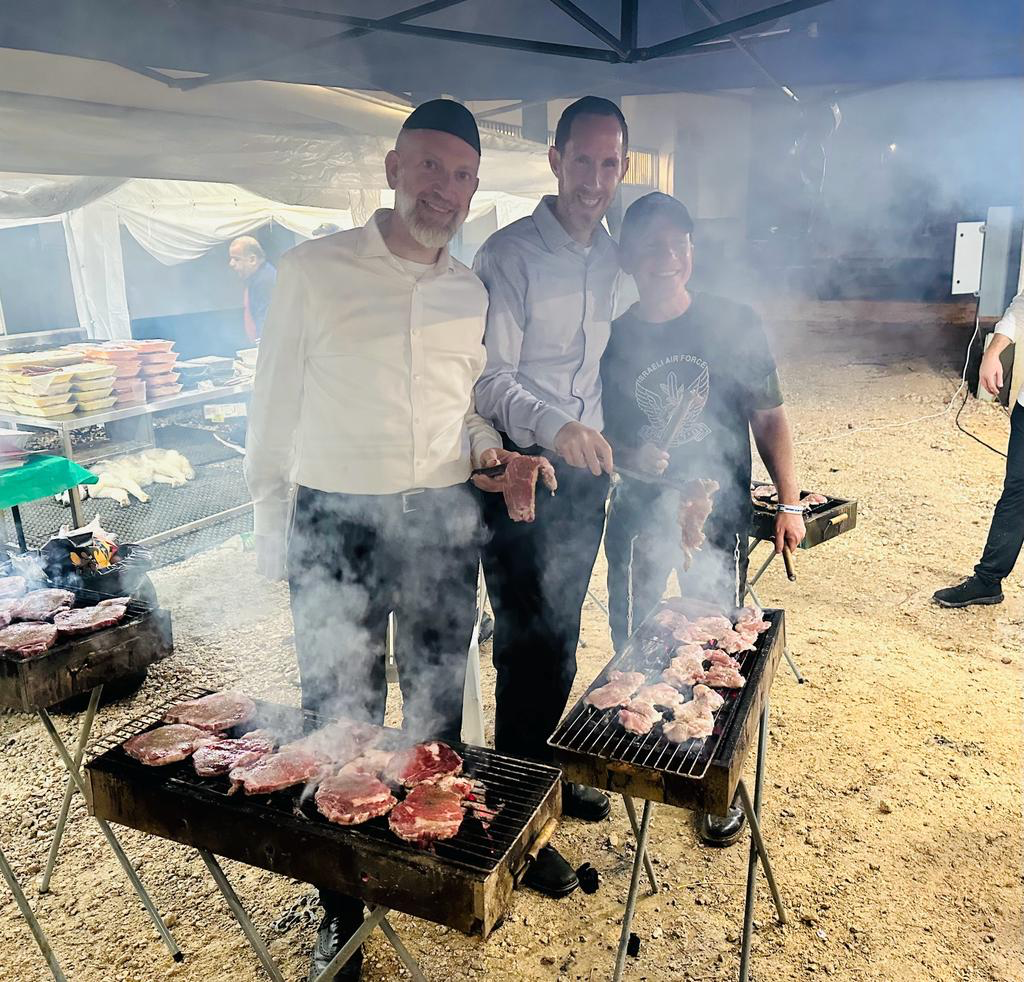
On the border of Gaza, at a barbecue we made for 700 soldiers, we met a 51-year-old sleeping on the floor, eating army food, going in to fight.  We asked him, how are you still in the active army? He told us he was released 11 years ago but refused to be finished. He negotiated with the army until they agreed that if he passes a physical each year he can continue to serve.  We said, “what do you do, make the food, clean the guns?” He said, “No I drive a hummer into Gaza to our missions.” 


We met soldiers everywhere, on several bases, in Chevron, at new pop-up locations to feed and care for them.  There is no such thing as a secular soldier. We found angels of Hashem putting on tzitzis, securing a pair of Tefillin, and going to fight for a cause they believe in with every fiber of their soul.  Shem Shamayim Shagur Bfi the IDF, all of them telling us “Elokim Yishmor,” “Hashem Yaazor.” We met injured soldiers at Tel HaShomer hospital who are fighting to heal so they can return to battle. They are positive, upbeat, determined.  We spent time with a father of a fallen soldier. He and his family are Olim and he told us he has no regrets bringing his family to Israel despite paying the highest price because it is what it means to be a Jew, it is why we live and sometimes what we need to die for. 


We toured Be’eri for three hours, walking the site of a pogrom, like visiting Poland the day after the Holocaust. We will never get that smell out of our nose or unsee what we saw. We saw burnt homes, bloody sheets, bullets on the ground, smashed windows.  We heard stories of how two parents and a big brother leaned over three younger siblings to save their lives by paying with theirs, homes people were kidnapped from.  A man named Yarden told us the story of his heroic brother, a medic who tried to save the injured and ultimately, Hamas terrorist shot him at blank range first saying out loud, a witness later shared, רק בשביל הכיף, “just for the fun,” before pulling the trigger. 


Naor, whose father-in-law was murdered, shared with us: “A strong message I remind myself, is when the same thing happened in Europe, we didn’t go back to Poland and Germany, but this is our house, our land, our country our people.  We are going to come back.  It doesn’t matter what you did to us, you cannot stop us.  Buildings you can burn, but you can’t break our spirit.  We will rebuild.”


I think this is our part of the war from America.  Yes, donate, support, visit, check in. But ultimately, the enemy around Israel is the same enemy sitting in the administration at Harvard, MIT and Penn, the same enemy in the offices of the New York Times, in some Congressional offices, and on streets of major cities.  They all want the same thing – להשכיחם תורתך ולהעבירם מחוקי רצונך, for us to abandon our values, our mission, our way of life, our way of thinking.  They are trying to extinguish our Menorah, our source of wisdom and truth, our Toras Chaim. 


We may be 6,000 miles away from the physical front lines, but make no mistake, if you saw the hearings in Congress in which the leaders of three prestigious schools of so-called higher learning couldn’t say calling for genocide against Jews is hate, we are very much on the battlefront.  They want us to stop learning and living Torah? The response must be to learn and live it more.  They want us to abandon our values? Lean into them, hold on to them stronger, tighter.  They want to dim our candle? Add more fuel, make it burn brighter.  They want you to hide your yarmulka, tuck in your tzizis? Get a bigger yarmulka, longer tzitzis.  Someone asked me, if I had $100 million to fight antisemitism what would I do? I said I wouldn’t buy ads on television or hire lobbyists in Congress.  I would put every penny into reaching out to our Jewish brothers and sisters to stand taller, prouder, to live more Jewishly.  I would send a mezuzah for every Jew and every Jewish student on a college campus to hang on their door. I would send candles for every Jew to light Friday night or for Chanukah.  We cannot win a war if we don’t know what we are fighting for.  We can’t have victory if we are in the dark without the light of the Menorah. 


Don’t just take something upon yourself, become a better, bigger, and more practicing Jew as a merit for the soldiers on their front lines.  Do it because it is how we fight on our battle front in this very same war.  150% of reservists showed up for this war, we have to show up at the same rate, give a 150% effort.  They aren’t afraid, we can’t be afraid, they have courage of their convictions, we must have the courage of ours.  This war has multiple fronts. They are doing their job on theirs, will you show up, will you serve, will you be counted and will you be part of victory in our battle?


We daven for the miracles today that we had yesterday, biggest among them not supernatural oil, but the miracle of believing in ourselves and believing in our cause and therefore having the determination to fight against all odds. 


Is it Better to be Loved or Feared? A Reflection on the Washington Rally

According to a new Reuters poll, a majority of Americans now back a ceasefire in the war Israel is fighting again Hamas.  Disturbingly, nearly 70 percent of Americans said the Israeli government should pursue a ceasefire, including three quarters of Democrats and half of Republicans.  Predictably, as time passes and Palestinian propaganda continues to be promoted, support for Israel has begun to wane.


While the calls for a ceasefire ring, rockets continue to rain down on innocent Israelis, and not in areas that are “in dispute,” but in central Israel and “undisputed” cities like Tel Aviv.  This is not the first time and sadly sure not the last that the world will hold Israel to a double standard and deny Israel the most basic right, the right to take the necessary steps to defend its citizens. 


While modern Israel’s founding fathers, David Ben-Gurion and Menachem Begin disagreed on much, they both understood that Israel cannot afford to bend itself to conform to the will of the nations of the world.  Ben-Gurion once said, “What matters is not what the goyim say, but what the Jews do.” Describing the lessons of the Holocaust, Begin said, “When a Jew anywhere in the world is threatened or under attack, do all in your power to come to his aid. Never pause to wonder what the world will think or say. The world will never pity slaughtered Jews. The world may not necessarily like the fighting Jew, but the world will have to take account of him.”


Last week, former Prime Minister Naftali Bennett was in New York when he offered a similar sentiment: “A huge wave of antisemitism is sweeping the United States and the world. It’s incomprehensible: Hamas massacres, murders, rapes, loots, and who is blamed? Jews. A combination of radical Islam flooded with hatred and a progressive left flooded with stupidity. Especially on campuses. My interim conclusion: More than all the words, arguments, pictures and interviews, one thing is needed: defeat Hamas. We will not convince antisemites, but our victory is clear and clear, and the elimination of our enemy will put fear in the hearts of our enemies. We don’t need to be loved. Just let them be afraid of us. Forever. At all costs. There is no choice.”


Ben-Gurion, Begin, and Bennett were not the first to weigh in on whether it is better to be loved or feared. Five hundred years ago, philosopher and historian Niccolo Machiavelli concluded, “Whether it be better to be loved than feared or feared than loved? One should wish to be both, but, because it is difficult to unite them in one person, it is much safer to be feared than loved.”


The question – is it better to be loved or feared – is indeed an age-old question, one contemplated and debated by leaders, philosophers, and mob bosses alike.  As Israel relentlessly decimates Hamas and fearlessly pushes back at Hezbollah, it is instilling fear in the hearts of enemies and planting it in the mind of friends.  Jews around the world are pushing back at antisemites, not with violence or physical weapons but by shining a light and holding accountable those that tear down posters of hostages or tolerate hate on their campuses. Publicizing the faces of antisemites and withdrawing financial support of universities are powerful weapons and will instill fear in those who don’t want to suffer those consequences.  Legislation must be passed and prosecutions must be pursued against those who spread hate and incite violence against the Jewish community.  We can and should continue to make the case for Israel, spread the truth of the beauty the one and only Jewish state and its positive impact on the world.  The likelihood is that we will never be loved; if we want to secure our own future, let us be feared. 


The Torah (Devarim 28:10) tells us,וְרָאוּ֙ כל־עַמֵּ֣י הָאָ֔רֶץ כִּ֛י שֵׁ֥ם ה׳ נִקְרָ֣א עָלֶ֑יךָ וְיָֽרְא֖וּ מִמֶּֽךָּ  , “And all the peoples of the earth shall see that Hashem’s name is proclaimed over you, and they shall stand in fear of you.”  Commenting on these words, the Talmud (Berachos 6a) explains that this pasuk is referring to Tefillin Sheberosh, the Tefillin on the head.  Inspired by this comment, before the Six Day War in June 1967, the Lubavitcher Rebbe announced “Mivtza Tefillin” — the “Tefillin Campaign” — and that every effort should be made to put on Tefillin with as many Jews as possible. Once again today, during Israel’s current war we are seeing an enormous spiritual awakening including “secular” soldiers seeking to wear Tefillin. 


If you look more closely you will notice that the Talmud doesn’t say “Tefillin al harosh,” Tefillin worn “on the head,” but Tefillin sheberosh, in the head.  I wear Tefillin on my head, what are Tefillin “in” the head?  The story is told that the Vilna Gaon was once staying at an inn when a stranger came in and attacked the Jewish owner who was wearing Tefillin and praying.  The Gaon heard and opened the door to his room where he was davening in Tefillin.  When the attacker saw the Vilna Gaon, he was overwhelmed with fear and fled.  When the owner asked what happened, the Gaon explained that our rabbis taught when someone sees the head Tefillin that they will fear you.  The owner responded, “But I was also wearing Tefillin on my head and that didn’t stop him from attacking me?”  The Gaon explained, “You are wearing your Tefillin on your head, I am wearing my Tefillin in my head.  I don’t just place the leather box on top of my head, I place its messages, values and ideas inside my head.”  Said the Gaon, when we believe, live and practice what Hashem wants from us, the nations of the world will fear us. 


Fear or love?  Let our enemies fear how much we love, how much we love Hashem and how much we love each other. 


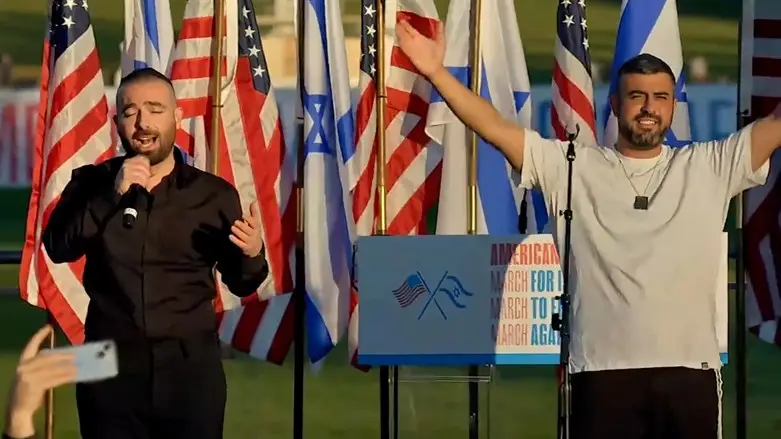
This week, BRS proudly brought a large delegation to Washington, D.C. to stand with at the largest rally for Israel in history.  For the overwhelming majority of attendees, taking a day off of work and traveling to the nation’s capital was inconvenient, time-consuming, and expensive.  And yet, almost 300,000 did it.  We stood together to rally, demand the hostages be brought home, and support elected leaders who support Israel.  But we also did so to sing, daven, dance and stand with an enormous array of our brothers and sisters, incredibly diverse but united by a shared concern about our people and committed to our homeland. Participating with the spectrum of the Jewish people from great Roshei Yeshiva like Rav Schachter, Rav Willig, Rav Lopiansky, and others, and with Rabbonim from Yeshivas Chafetz Chaim and Chabad, to Jews of all backgrounds, beliefs, and practices was a demonstration of unity to Hashem and to ourselves and of steadfast resolve to our enemies local and abroad. 


While most of the attendees were eager to post, stream, and stay connected, Hashem had other plans.  The dense gathering overwhelmed the local towers leaving almost all with no service or connection.  While frustrating and challenging, it quickly became clear it was a beracha from Above.  It felt like Hashem was looking down and saying, “My sweet kinderlach, you have never stood together in these numbers before.  Look around at your brothers and sisters, some like you and many very different.  Savor this moment, be fully present, disconnect from the world and connect with those you are standing right next to.” 


The highlight of the rally for me was when Ishay Ribo took the stage.  While I enjoy his singing and am regularly moved by his songs, it was what he said, not sang, that transformed the gathering into a religious experience for me.  Ribo led more than a quarter of a million Jews in a perek of Tehillim and turned to the mass gathering imploring everyone to be mekabeil ol malchus shamayim with him by reciting Shema together. 


People were excited when Ribo sold out Madison Square Garden earlier this year. This week, he touched the hearts, prayed, sang and led ten times that number in making a Kiddush Hashem.


While many American Jews didn’t attend for various reasons, the nearly 300,000 Jews gathered in D.C. this week were filled with love – Love for each other, love for our brothers and sisters in Israel, love for the hostages, love for the IDF and love for Hashem. 


Hamas, Hezbollah and antisemites should be very afraid.  Fear the power of our love, for it will always defeat them and whatever they plan.  

An Open Letter to My Fellow Jews in the Diaspora


Dear fellow Jews who don’t yet live in Israel,


We are living in extraordinary times, days in which atrocities about which we pledged “Never Again” have happened, with dozens of pogroms, over 1,400 brutally and barbarically murdered, and unthinkably, 200 Jews taken hostage, among them babies, infants, women, and elderly, even Holocaust survivors. Hundreds of thousands of young, beautiful souls – our children, brothers, sisters, cousins, nephews, nieces, and friends – have been called up, asked to risk their lives to protect our people, in Israel and around the world.


These are indeed extraordinary times, and we cannot and must not be leading ordinary lives.  It isn’t only the media and elected leaders that need to be careful about their language, their attitudes, and their focus.  All of us need to be more sensitive, aware, and thoughtful in not only what we are doing, but what and how we are messaging.  I don’t believe people generally have malicious or bad intentions, but our words online and offline matter, they can lift and support and boost morale or they can deflate, cause pain, make our brothers and sisters in Israel feel very alone. 


Don’t Move On: Nobody in Israel, not a single person in the country regardless of age, location, or religious denomination, has been able to return to “normal” or move on.  Hundreds of thousands have been called up to fight.  Their spouses, children, parents and family have had to pick up the slack, all while worrying non-stop about their loved one’s fate.  Cities in Israel have no men to run businesses, pick up the garbage, or serve the roles we take for granted.  Restaurants and food establishments have take-out only.  The government is already planning for, and citizens are starting to think about, food conservation.  This war has barely begun with a ground operation imminent and 200 hostages still not home.  There may have been events or tragedies in Israel in the past that caught our attention – we davened, we said Tehillim, we attended a rally, maybe called a Congressman, but then we more or less got back to normal fairly quickly. This cannot be our attitude right now. Our brothers and sisters in Israel have not returned to any semblance of normal and neither can we.  It is up to each individual and family to decide how to continue to live life, do what needs to be done, and yet remain acutely sensitive to what is happening in Israel.  We must be careful not to judge one another and how we strike that balance.  But one thing we can do universally is not move on. 


Think Carefully About The Words You Use: Making those in Israel, on the actual front lines, feel alone is compounding their pain, and is downright cruel.  If you were in Israel over Yom Tov and needed to get back to work, if your family and kids’ schools and life generally are outside of Israel, it is reasonable and understandable that you had to leave.  If your child was experiencing anxiety or trauma being in a country at war, you did the right thing bringing them back.  But you and they aren’t “evacuees” or “refugees,” you didn’t “flee” for your life, and you weren’t “rescued.” Your situation was no doubt stressful, traumatic, and difficult.  You deserve to and should work through those feelings and get support for them as needed but choose your language carefully.  An American who made Aliyah 20 years ago, who voluntarily put her family’s future and destiny in Israel and has three children now fighting in the IDF, described what it is like to read and hear American Jews, including those who daven daily to return to Yerushalayim, run from Israel, post about their stress and anxiety about their return, and describe themselves as evacuees.  If you needed to leave Israel or your child needed to come home, nobody should judge you, but talk about your experience sensitively, thoughtfully, and intelligently.  Leave Israel the way you walk away from the Kotel: backwards and wistful.  Don’t turn your back and run; walk away hesitantly, slowly, regretfully, and facing Israel the whole time.


Prioritize The Captives: There is so much pain and horror to absorb, so much fear and concern on our minds. We grieve and try to comprehend 1,300 funerals and shivas, we worry about half a million soldiers in uniform, but we must keep at the top of our minds the terrifying fact that there are 200 innocent people, including small children, being held by Hamas right now.  When three boys were taken nine years ago, Klal Yisroel held our collective breath and didn’t stop davening. There are TWO HUNDRED hostages being held in ways we don’t want to imagine. Like Yaakov was inconsolable until Yosef was returned to him, we must be inconsolable until the fate of those 200 is secured.


We Are All Part of this War:  Israel is battling on the front lines, but this is not only their war.  The horrific massacre and atrocities in Israel have revealed the ugly reality of Hamas sympathizers who live in major cities around America and Europe.  We have watched supposedly educated, respectable people not only fail to condemn brutal murder, rape, and kidnapping, but defend it, identify with it, and reveal that they would be perfectly fine with it being perpetrated against us, their neighbors, not in Israel but around the world. Hamas has in its charters not only to drive Jews from Israel but to kill Jews around the world.  This is not something that happened or is happening “over there.” You are not a spectator to this war, you are not on the sidelines.  We all have skin in this, and we should be acting like it. 


Use Your Influence: Every one of us can and should be having an impact on other people. We are responsible for influencing neighbors, co-workers, friends, and family by educating them on this war and advocating for Israel, or recruiting others to daven, learn and earn merits for our soldiers and for all Israel.  But let’s be clear, when soldiers are risking their lives, you are not defeating the enemy by insisting on going about business as usual in America, by shopping or going to fancy restaurants, setting a beautiful table, or focusing on fashion or planning your next vacation.  On social media, this isn’t a time to mark birthdays or anniversaries, display desserts or décor, get vacation advice or post anything that is tone-deaf and callous to the crisis facing the Jewish people everywhere. (Of course, we should continue to celebrate milestones, particularly our children’s. We should take vacation if we need to. We should set a beautiful Shabbos table. But we need to take extreme care with what we are posting publicly right now.)


This is our Family: If you don’t have a close family member in Israel, it is time to start acting like you do. If a member of your immediate family—a parent, sibling, spouse or child—were God forbid in crisis, in the ICU, or missing, or fighting for his or her life, could you be distracted?  Would you look for or welcome distraction?  Would you not be drawn to any news, any update on their well-being?  As one person online posted, when asked by a co-worker, “Do you have any family in Israel,” he responded, “Only a few million.” Our genuine pain, anguish, grief, and worry should not just be expressions of imo anochi b’tzaaa, sympathy and empathy for what another is going through. This is OUR pain, OUR anguish, OUR fear, and our lives, our priorities, our focus and our time must reflect it.  


Be Aware of And Sensitive To Those Around You: In your shul, among your neighbors and friends, are people who have children and grandchildren serving in the IDF. Their lives are on hold, they are tortured by the concern. In some cases, they have literally no idea where their children are or what their assignment is. There are parents and grandparents of children in Israel in yeshiva and seminary or who have made Aliyah.  This is personal to them.  Be thoughtful, sensitive, and kind how you speak, what you post, how you refer to what is happening there. For example, the shul lobby might not be the best place for you to weigh in on how many soldier casualties would be acceptable to you in a ground invasion, when you don’t know if the person behind you might be sitting shiva for one of those casualties.


Focus On Practical Things You Can Do: In America we might feel helpless at times but there is so much we can be doing. Check in on people in Israel or who have loved ones there:  text, email, call, show you care.  It takes a moment and it means the world.  Also: daven, daven, daven.  Each and every one of our heartfelt tefillos and perakim of Tehillim matter, they mean something to Hashem and also to those who know we are pouring out our hearts.  Learn, do mitzvos, perform chesed in the merit of those we who cannot be doing those things right now.  Advocate, write letters, reach out to elected officials, protest those who are telling the story inaccurately and thank those who are supporting Israel the way it deserves.  Pass up on a luxury you were going to afford yourself and send support for equipment, supplies, and an economy hurting badly. (Also, be mindful of where and to whom you are giving. Give generously, but make sure you’re giving to someone you trust (who themselves are making sure the funds are being used appropriately) or a known organization. There are many well-meaning people and campaigns, but sending supplies to soldiers or civilians is not always simple. Giving to a website or cause going around Whatsapp that has not been vetted may not be the best use of your support.)


Good Day? I was checking out of a store and the cashier asked me, “Are you having a great day?”  She did nothing wrong and it could be her employee handbook mandates she say that, but I had to hold back from screaming, “Great day?  Do you know the crisis my family is in?” Again, she did nothing wrong, but we should be careful about the language we use. On Motzei Shabbos instead of “gut voch” and “Shavua tov,” I wished others, “May it be a gut voch and shavua tov.” Instead of saying “Have a great day,” when I see others, I say, “May klal Yisroel have a great and successful day.” Think about how the words you use and the way you communicate indicates that you are acutely feeling being in an eis tzara.


Pace Yourself: It is understandable that you can’t make it to every rally and can’t and shouldn’t be (nor is it healthy to be) tied to the news 24/6.  All indications are that this crisis for Klal Yisroel won’t be over quickly.  We need to pace ourselves. Be aware of what is happening but let yourself take a break from your phone and don’t let it interfere with other responsibilities. Advocate, fight, cry, daven, learn, check in, give… and take a moment to catch your breath if the alternative is burning out. The challenge of keeping up with the intensity of the efforts and opportunities to help right now must not be an excuse to abandon all of them altogether and return to “normal.” 


My dear friends who live in the Diaspora – this is a gut check moment.  We will forever be defined and remembered for how connected we feel and act to Klal Yisroel and to those in Eretz Yisroel at this time.


When Bnei Gad and Bnei Reuven ask Moshe if they can live east of the Yarden and not settle in Eretz Yisroel proper, something the Midrash tells us they were the first to exiled later because of,  Moshe responds: וַיֹּ֣אמֶר מֹשֶׁ֔ה לִבְנֵי־גָ֖ד וְלִבְנֵ֣י רְאוּבֵ֑ן הַאַֽחֵיכֶ֗ם יָבֹ֙אוּ֙ לַמִּלְחָמָ֔ה וְאַתֶּ֖ם תֵּ֥שְׁבוּ פֹֽה׃ , “Are your brothers to go to war while you stay here?” 


Jews of the Diaspora are not being asked to come fight.  (Though some are heroically volunteering to do so.) We are not even being asked to come right now.  But our hearts, souls, and every fiber of our being must be in and with Israel, wherever we may physically be right now. 


In a previous war of the Jewish people against Amalek, Moshe stood and raised his hands heavenward. The Torah tells us: וִידֵ֤י מֹשֶׁה֙ כְּבֵדִ֔ים וַיִּקְחוּ־אֶ֛בֶן וַיָּשִׂ֥ימוּ תַחְתָּ֖יו וַיֵּ֣שֶׁב עָלֶ֑יהָ וְאַהֲרֹ֨ן וְח֜וּר תָּֽמְכ֣וּ בְיָדָ֗יו מִזֶּ֤ה אֶחָד֙ וּמִזֶּ֣ה אֶחָ֔ד וַיְהִ֥י יָדָ֛יו אֱמוּנָ֖ה עַד־בֹּ֥א הַשָּֽׁמֶשׁ׃ ,     But Moshe’s hands grew heavy; so they took a stone and put it under him and he sat on it, while Aharon and Chur, one on each side, supported his hands so his hands remained steady until the sun set.”


Moshe held both his hands up, directing the people’s prayer and faith to Hashem.  When it got uncomfortable and tiring for him, Yehoshua and Chur stepped in and helped him hold his hands up.  The Gemara explains that when it was too much for Moshe and he needed to sit, he sat down, but on a rock so that he would still feel the people’s pain and not feel comfortable during the war his brothers were fighting. 


We need to lift the hands of our brothers and sisters.  We need to refuse to be too comfortable, refuse to be distracted, refuse to move on or go back to normal until this war is won with the help of Hashem. 


With great love, respect, worry and concern,


 Rabbi Efrem Goldberg


Rabbi Efrem Goldberg

Join Our Community

Subscribe to our newsletter or connect with us on WhatsApp.