The Greatest Threat Facing the Jewish People Isn’t Antisemitism

Based on a talk I delivered at the Aish Legacy Summit in Bal Harbour on February 11, 2026


I want to begin by acknowledging something very important: The people who are here are not professionals. You are not obligated. You took time out of your busy schedules, set aside resources, and made it a priority to be here, to care, and to engage in a serious conversation because you care about Klal Yisrael, the future of the Jewish people.


In my lifetime, this is the most critical juncture to be having this conversation. With so many enemies from without, with so many threats that we face, and with so many concerns about our future, there has never been a more important time for all of us to shift our focus to the Jewish people. That is what I want to talk about in my limited time with you. What it means and looks like to care about Klal Yisrael.


One of the modules and incredible tools created by Aish and shared today focuses on antisemitism. That makes sense, because antisemitism has become the catchword of our age and tragically perhaps the word of our generation. Antisemitism is on the rise and everyone is exploring and suggesting ways to confront it.


I have only gratitude for Bob Kraft for putting his money toward confronting Jew hatred, and I don’t want to be critical of him or the commercial he commissioned that was shown during the Super Bowl. But I want to challenge us to think about this differently. Not focused on what may be wrong with the commercial but what you would have done with that money instead. If you had the resources to buy thirty seconds to be shown during the Super Bowl, if you could put a message in front of a hundred million people, what would it be? What message would best advocate for the Jewish people and our future? Would you focus on being a minority, on bullying, on hate, or the Holocaust? What would you choose?


If I had those thirty seconds, if I could put a billboard on every highway and broadcast one message everywhere, it would be rooted in this principle: There is a danger and a threat far more pernicious, far more penetrative, and far more destructive to our people than antisemitism, and it is called assimilation. If all the antisemites on the planet gathered together at a magnificent conference with top-tier branding and coordination, they could not do the damage to us that we are doing to ourselves. They could not cause our disappearance at the pace we are causing it on our own. Until the middle of the twentieth century, intermarriage never rose above three percent. In 1964 it rose to seven percent. Today, among secular Jews in the United States, the intermarriage rate is seventy percent. In Europe it is fifty percent.


Antisemitism is dangerous and of course we must confront it. We need leaders who will stand with our people and with Israel. We need legislation to protect Jewish students on campus and security funding for our institutions. I am not minimizing it in any way. But if antisemitism becomes the focus of everything we talk about, if it dominates every gathering and every conversation, we allow ourselves to be distracted.


The truth is that the only people who really want to talk about antisemitism all the time are antisemites. It fuels them, elevates them, and amplifies their voices. It distracts us from the conversation we should be having, which is not about them, but about us.


The real conversation the Jewish people must be having is who we are, why we are here, and what difference we are meant to make. Our enemies want us to slow down, to pull over, and to complain about the obstacles they put in our way. But we need to step on the gas, because there is too much work to do to repair and improve this world. Assimilation and antisemitism are different threats, but our response to both is the same. It is not endless discussion of either one. It is the promotion and empowerment of Jewish pride, Jewish practice, and Jewish passion. It is helping Jews of all ages reach into the Jewish soul inside them and ask why the world is obsessed with us and threatened by us. If they want to hate us for being Jews, then we need to find out and shout out what it means to be a Jew.


The Midrash (Bamidbar Rabbah 17:6) gives a metaphor of a person drowning at sea, flailing as the waves threaten to sweep them away. A rope is thrown to them, and they are told that if they hold on, they will survive, but if they let go, they will disappear. The Midrash teaches that tzitzis are that rope, and not only tzitzis, but all mitzvos. For thirty-three hundred years we have held the Tree of Life. עץ חיים היא למחזיקים בה.


We are living in the most prosperous and comfortable era in human history and yet people are more anxious, depressed, and unhappy than ever. Consumerism promised happiness and delivered emptiness. We have the answer. We have been living it for millennia.


The winds and waves are sweeping our people away.  Let’s throw the life preservers of Torah, Mitzvos, and uniquely Jewish meaning.  Let’s extend the branch of eitz chaim hi for others to hold on to. And so many are desperate to, even if they can’t put it into words.


A recent Harvard study found that over half of young adults (58%) said they had experienced little or no purpose or meaning in their lives in the previous month. In addition, half of young people said that their mental health was negatively influenced by “not knowing what to do with my life.” Those belonging to a religion were more likely to report meaning or purpose.  Young adults who said they had little or no purpose or meaning reported more than twice the rates of anxiety or depression than young adults who did feel purpose and meaning (54% vs. 25%, respectively).


At Har Sinai, Hashem told us that we are a mamleches kohanim v’goy kadosh. We are meant to live lives of responsibility, not entitlement. We are meant to wake up each morning asking what our mission is, what our responsibility is, and how we can make the world better today. That question, the one the Ramchal begins Mesillas Yesharim with, mah chovas ha’adam b’olamo, what is your duty in your world, is the foundation of a meaningful life and it is our gift to the world. We are meant to bring light instead of darkness, kindness instead of cruelty, justice instead of corruption, discipline instead of impulse.  Judaism is a platform to be a giver, not a taker, to feel a sense of duty, responsibility, not rights and entitlements, and we are meant to teach that to the world. 


Haman described the Jewish people as “yeshnu,” asleep, and he was right. We were fragmented and distracted. Mordechai refused to bow, not because he lacked a Halachic justification, but because he understood the moment demanded strength, not accommodation. He stood tall, proud, and unapologetic. And that is why the Megillah describes him as Ish Yehudi haya b’Shushan habirah. One Jew. Not because there were no others, but because he embodied what it meant to be a Jew. That is our calling in this moment.


What happens when Jews stand up for ourselves, when we stand tall and proud and practicing and refuse to bow down physically or spiritually? By the end of the story, the Megillah tells “fear of the Jew had fallen on them and so no man could stand up against them.” Why? Because Mordechai, the proud, unashamed, unapologetic and fearless Jew, “earned the respect of his multitude of brothers, he sought the good of his people and spoke for the welfare of the next generation.”


If I had thirty seconds to broadcast a message to the world, I wouldn’t address the one hundred million non-Jews watching, I would direct my commercial to the Jewish people and tell them – learn about where you come from, who you are part of, know our history, the difference we have made and the destiny we are yet to make.  Know the meaning it will bring to your life and with it the happiness and purpose. 


I would tell Jews everywhere to know where they come from, to be proud of who they are, and I would tell young people in particular to remember that they are not eighteen or nineteen years old. They are three-thousand, three-hundred years old. Carry that DNA. Embrace that destiny. Stand tall. Practice proudly. Partner with Hashem in repairing His world. And then I would give Jews the tools to do it.  I would advertise publicly that any Jew willing to put up a mezuzah, we will send them one.  Any Jew willing to wear a kippah, put on tefillin, light Shabbos candles, we will send it to you with a guide on how to do it and an invitation to learn more.   Yes, we need to ensure young people on their campuses are safe but we also, as importantly, need to empower them spiritually with anything else that helps them step out of hiding and into the light.


This happens one Jew at a time. One conversation. One invitation. One moment when someone casually asks about Passover or matzah and is really asking to be remembered, to be included, to feel connected. You are not alone in this mission. You have partners like Aish, equipping every Jew with the tools to succeed.


May the Ribbono Shel Olam give us the strength, courage, clarity, and conviction to take responsibility for our people, to be the ish Yehudi of our generation, and to step on the gas toward our destiny together.



The Cost of Being First

While returning to school from a class trip, a third-grade student from Yeshivat Noam in Paramus was severely injured when a rock was thrown at her school bus on the New Jersey Turnpike. As the buses traveled near the Teaneck Road exit, a large rock shattered a window and struck the young girl in the head. What initially appeared to be a minor injury quickly turned into a nightmare. A CAT scan revealed bleeding on the brain and the child now required surgery. Baruch Hashem the surgery was successful and she is recovering.


It was frightening. It was horrifying. And it understandably shook our community to its core.


Almost immediately, social media erupted. Though the school and law enforcement explicitly stated that they did not yet know the nature or motive of the incident (and there were no external markings on the bus that identified it as a bus with Jewish students), many online rushed to label it a horrific antisemitic attack. Predictably, the declarations followed. This is the end of Jewish life in America. Jews are no longer safe. History is repeating itself before our eyes.


Two days later, an arrest was made.


Authorities announced that the suspect, already charged in a series of rock-throwing incidents across Bergen County, was not motivated by antisemitism. He was mentally unstable. State police revealed that he had been awaiting trial for similar acts, including an aggravated assault in Bogota that had already landed him in jail. Court records showed multiple additional charges after his release, including alleged assaults on law enforcement officers, criminal mischief, and trespassing.


This was not a hate crime. It was a tragic act of violence committed by someone deeply unwell.


Just a few months earlier, a remarkably similar story unfolded. In October, a rabbi in New Jersey was attacked outside his home. Surveillance footage showed bystanders rushing to help as the rabbi and a good Samaritan suffered minor injuries. Within minutes, the internet declared with certainty that a rabbi putting up his sukkah was attacked in broad daylight by an antisemite.


Strong statements followed. Dire warnings were issued. Fear spread.


But once again, the facts told a different story. Police stated clearly, “This was a random act of violence. No words were exchanged prior to the assault, and there is no indication that this attack was motivated by race, religion, or ethnicity.” The suspect had a criminal record. There was no evidence of a hate crime. The rabbi was not putting up his sukkah. And yet the online verdict had already been rendered.


I do not share these stories to minimize or dismiss the very real and deeply disturbing rise in antisemitism. The statistics are undeniable. The threats are real. The actual, horrific acts of violence that have occurred are too painful and numerous to count. We must remain vigilant, courageous, and vocal. We must call out hatred, confront it, and fight it legally, morally, and spiritually.


The rush to assume motive is understandable. After October 7th (and the response to it), comedian Jim Gaffigan captured a feeling many Jews recognized when he quipped, “Does anyone else feel the need to call all their Jewish friends and say, ‘Okay, you weren’t being paranoid’?”


And yet, Torah does not ask us only to feel. It asks us to think. To pause. To reflect.

Our rabbis begin Pirkei Avos with the teaching: hevei mesunim b’din, be slow to judgment. Rabbeinu Yonah explains that one who is quick to judge is called a sinner. Even if he believes he is speaking truth, his error is not considered accidental. It is closer to willful wrongdoing, because he failed to reflect. A hasty mind, Rabbeinu Yonah teaches, lacks the depth required to truly know.


Technology has reshaped how we process reality. Information travels instantly. Opinions spread faster than facts. There is a cultural race to be first, to alert, to alarm, to analyze, to advise, often without the patience to gather, to listen, to learn. This is dangerous for the content creator and the content consumer alike. And despite repeated examples, we seem unwilling to slow down.


We are watching this same phenomenon play out now as the public rushes to conclusions about the incident involving the death of Renee Nicole Good at the hands of an ICE agent in Minneapolis. Before full video evidence emerged, before facts were established, before investigations concluded (or were even conducted!), each side hurried to condemn or defend, to accuse or absolve, filtered entirely through preconceived narratives. We saw not events, but reflections of our own assumptions.


Hevei mesunim b’din.


This teaching is not about passivity. It is about discipline. It is not a call to ignore injustice, but a demand to pursue truth responsibly. A Torah-guided life insists that moral clarity must be built on factual clarity. Outrage untethered from truth does not heal the world. It fractures it further.


The Torah’s insistence on deliberation is not antiquated wisdom. It is desperately needed guidance for a hyperconnected, emotionally charged age. Being slow to judgment does not make us naive. It makes us trustworthy. It makes our voices credible when real hatred appears, when genuine threats emerge, when antisemitism unmistakably reveals itself.


If we cry wolf every time, if we speak with certainty before we know, then when the wolf truly comes, our warnings lose their force.


We owe it to the victims of real hate. We owe it to our community. And we owe it to the Torah that demands integrity not only in what we believe, but in how we arrive there.


Hevei mesunim b’din. In a world rushing to conclusions, have the courage to pause.


To Go Is to Know

I have a confession to make. For most of my life, I bought into a stereotype. Supported by headlines and history, reinforced by wars, terror, and the chilling rhetoric that echoes from too many corners of the Middle East, I assumed that all Muslims and Arabs hate Jews, that deep down they want to destroy us and to eliminate the State of Israel. Then, on a recent trip to Dubai and Abu Dhabi, I discovered how incomplete that belief was. What I thought I knew could not hold up to the reality, the faces, the stories, the friendships, and the genuine feelings that we encountered.


A close friend, Eli Epstein, who has done business in the United Arab Emirates for more than thirty years, had long been urging me to see the reality with my own eyes.  The goal would be to meet Emirate leaders to express gratitude for the Abraham Accords and encourage its expansion.  Together, in partnership with his non-profit organization, Visions of Abraham, we arranged a small leadership mission of members of our shul, BRS, joined by our dear friends Eli and Shalva Paley from Israel. Eli Epstein’s mantra became our guideline: “To go is to know and to know is to grow.” He could not have been more correct. What we saw and whom we met changed what we know, and what we now know is already changing who we are.


The United Arab Emirates is a young nation, founded in 1971 by its benevolent ruler, Sheikh Zayed bin Sultan Al Nahyan on an intentional and courageous vision. From its inception, it committed itself to mutual respect, safety for different religions, valuing peace, and embedding into law a zero tolerance for hate. Today roughly 1.5 million Emirati citizens live alongside more than 10 million residents from around the world. More than 200 nationalities live together there in peace and harmony. This is not coexistence by accident. It is harmony by design.


The modern beauty is breathtaking. The cities are clean, orderly, and meticulously maintained. Crime is extraordinarily low. But the most striking feature is not steel or glass, it is spirit and culture. We are now seeing the third generation raised entirely within this vision, and the values have trickled down from the top. The tone set by leadership is echoed by regular Emiratis. Respect is not performative. It is practiced, expected, and felt.


We understandably generalize that the Arab world is a monolith of hatred. We point to Hamas, Hezbollah, and Iran and conclude that the rest must be the same. Yet our own history reminds us otherwise. There are chapters of Jews and Muslims living side by side, golden ages of Jewish life in Muslim lands, including from the 8th to the 12th centuries in Al-Andalus, Muslim Spain, and in parts of the Middle East and North Africa. During that period, Jews thrived as scholars, poets, physicians, and administrators, contributing profoundly to philosophy, science, and literature. In the UAE, we discovered a modern echo of that golden age, made possible by a people who do not merely tolerate us, but who admire and respect us. They share many of our values, ethics, priorities, and even practices. They are deeply committed to their faith, yet they do not seek to impose it on others.


The proof is in their actions. The UAE was the first Arab country to condemn Hamas after October 7. While airlines around the world stopped flying to Israel, Emirates Airlines never stopped once and, during that time, even increased their service.


What moved me most were the stories we heard so often. Despite the message from the leaders, prior to the Abraham Accords and a meaningful Jewish presence in the UAE, many of those we met grew up with stereotypes about Jews, just as too many of us grew up with stereotypes about them. They were taught to feel hate until real encounters rewrote their hearts.


We met with Loay Alshareef, a Saudi-born Egyptian activist who now lives in the UAE. He told us, without flinching, that he hated Jews as a child because that is what he was taught. Then he went to France to study and boarded with a Jewish family. The hospitality he received and the decency he experienced shattered what he thought he knew. Today he is a proud and fearless online advocate for better relations between the Arab world and Israel, with a massive following among young Muslims.

We met a senior leader in the Abu Dhabi Investment Office who said he, too, grew up thinking he was supposed to hate Jews. At the age of six, he traveled with his family to New York. In JFK Airport, he saw a chassid praying and asked his father who it was. His father told him it was a Jewish person.


The boy said, “But he is praying just like us.” His father replied, “Yes, we have much in common.”


That boy grew up to be a diplomat who worked on the Abraham Accords and today is building economic and human bridges between the UAE and Israel. He is eager for Jewish partnership and investment, not as a slogan but as a sincere invitation.


We met a successful Emirati businessman. He went to Cambridge without knowing English and was paired with an Israeli student who also did not know English. He called his father, anxious about studying with an “enemy.” His father answered gently, Jews are our cousins and our friends. That simple truth began a lifelong connection with the Jewish community.


We saw the fruits of those connections. There are approximately 500 Jews living in Abu Dhabi and about 2,000 in Dubai. There are daily minyanim, shuls, kosher restaurants, a mikvah, and a Jewish school which we visited. Even our guide, Houda, who wore her hijab proudly throughout the trip, spoke about the kinship she feels with the Jewish community and the many Jewish clients she has guided. She delights in comparing customs, traditions, and practices, in discovering the familiar within the foreign. It is easy to demonize and vilify the other when they remain a stranger. It is much harder when the other becomes a neighbor, a colleague, a friend.


The Hebrew word for “cruel” is achzar, a combination of ach and zar — “but a stranger.” We become cruel when we decide someone is a stranger, when we allow distance to define them, when we insist we have nothing in common. The UAE taught us how quickly cruelty can soften when strangers become familiar.


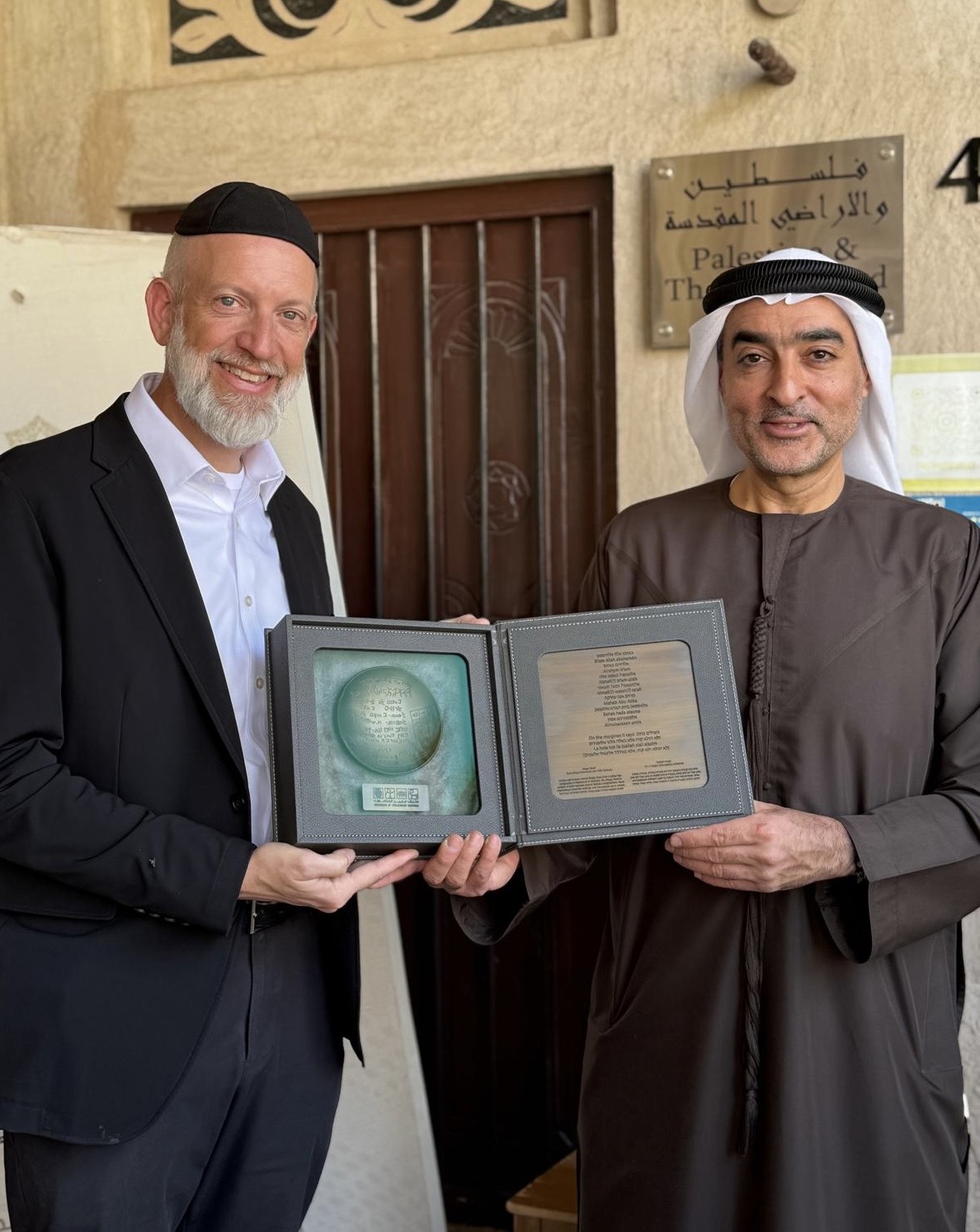
One of the most moving experiences was our visit to the Crossroads of Civilization Museum for a private tour with its founder, His Excellency Ahmed Al Mansoori, former member of the UAE Parliament. The museum celebrates the contributions of many faiths and cultures, and at its heart stands a powerful Holocaust exhibit. In an era of denial and distortion, standing before a Holocaust exhibit in the heart of a Muslim country was deeply meaningful and appreciated. It was a testament to the UAE’s commitment to truth and to the museum’s founder’s commitment to fight hate against all, including and especially against the Jewish People.


The highlight of the trip was an extended glatt kosher dinner hosted by His Excellency Dr. Ali Al Nuaimi, Chairman of the Defense Affairs, Interior and Foreign Affairs Committee of UAE. He described the UAE dream, an open and inclusive country for everyone, pointing to its multinational population. He reminded us that the UAE was the first country to combat Al-Qaeda and sent troops after September 11 to fight alongside the United States because terrorism is a threat to all humanity.


He spoke with conviction about how peace requires investment in people, not just signatures on paper. In the UAE hate speech is a crime. Hateful comments based on religion, nationality, or ethnicity carry legal consequences. He believes this model of coexistence must become the standard throughout the Middle East. He drew a distinction that has stayed with me. The goal should not simply be normalization, which is cold and transactional. The goal should be genuine human connection, friendships between peoples. The UAE does not want others to follow the old model of peace between governments; it wants to model and promote peace between people.


He also shared a concern born of friendship. Before October 7, he warned counterparts in Israel about the dangers of internal division. If you want to get along with those from without, he said, you must get along with those from within.


That lesson pierced. The same phenomenon of demonizing and vilifying those we disagree with exists within the Jewish community itself. We, too, can be quick to judge Jews who are not like us. The Torah tells us that when Yosef approached his brothers, vayir’u oso mei’rachok, they saw him from a distance and began to conspire against him. Distance breeds distortion. Tensions between brothers, and between fellow Jews, arise when we see each other from afar, when we refuse to come closer. Had they seen Yosef up close, had they spoken and listened, their hearts would have softened. Within our own people, we need to listen, to learn, and to find common ground.


This trip was not about tourist sites or luxury hotels. It was a mission to open hearts and minds and to bear witness to a model of coexistence that is not theoretical but real.  There is no doubt it needs work in both directions, as each side is still overcoming stereotypes, deepening connections, reinforcing built bridges and building new ones.


Those bridges should connect us in matters of technology, innovation, economics and more, but as one Emirati pointed out to us, they should also create connection over something even more real, something eternal.  He said that when he has visited Israel and when Israeli leaders have come to the UAE, they talk about Israel as the Start-Up Nation and focus on Israeli innovation, while omitting what makes Israel and the Jewish people uniquely special.  He yearns to hear about the Israel that is the land of Abraham and the Jewish People that gave the world ethical monotheism and Biblical values.


Listening to him, it became clear that while there is a significant role for government, political leaders and titans of industry to play in deepening connections with the UAE and moderates in the Muslim world, there is a critical role for Torah Jews to play as the ambassadors of the Abrahamic legacy and the representatives of living those Biblical values.


We are not so naive as to assume that what we saw in the UAE reflects the majority or even many in the broader Muslim world. We remain acutely aware of the venomous hate that is preached and practiced and of the dangers posed by enemies of our people. But our conclusion from this mission is clear: The same passion we pour into confronting our enemies in the Muslim and Arab world must be matched by the passion to celebrate and elevate our genuine friends from all worlds.


To go is to know and to know is to grow. The mission of our trip was accomplished. But, the larger mission, building bridges of understanding, trust, and genuine human connection, within the Jewish People and beyond, has only just begun. We all must have the courage to keep going, the humility to keep knowing, and the hearts to keep growing.


(Originally featured in Mishpacha, Issue 1091)

Massacre in Australia: Chanukah in the Shadow of Terror

The light of Chanukah this year is dimmed and diminished even before it is lit. The news of a horrific terror attack at a Chanukah event at Bondi Beach in Australia has shaken us to the core. Ten innocent people were murdered, among them the Chabad Rabbi, Rabbi Eli Schlanger Hy”d. Australia has become a hotbed of antisemitism, met far too often with a grossly insufficient response by government and authorities. Chanukah begins with a painful reminder that when our enemies march to the chant of “globalize the intifada,” they mean it. And they must be confronted.

It is far too soon to truly process or respond to such a heinous crime. But anyone with a sensitive soul cannot avoid the question that rises unbidden in the heart. How do we light candles, gather with family, sing songs of gratitude, spin the dreidel, and eat latkes in the shadow of such devastating loss and tragedy?

Two years ago, six holy hostages held captive by the evil Hamas terrorists gathered around a makeshift menorah fashioned from paper cups to light Chanukah candles. In an act of cruelty meant to compound the suffering of the hostage families, their wicked captors recorded the moment on video. That footage was later discovered by the IDF in Gaza, shared privately with the families, and only recently released in time for Chanukah this year. The video shows each of the hostages thin, weakened, but still alive. Some even smile at the camera. Among them is Hersh Goldberg Polin, missing the lower half of his left arm, blown off by a grenade on October 7.

In the video, almost impossible to comprehend, the hostages can be heard singing the beracha of Shehechiyanu, thanking Hashem for enabling them to reach that moment. Ultimately, all six, Hersh Goldberg Polin, Eden Yerushalmi, Ori Danino, Alex Lobanov, Carmel Gat, and Almog Sarusi, were brutally murdered by their captors in a tunnel in Rafah on August 29, 2024. Their bodies were discovered by Israeli troops two days later.

Released hostages later shared that when they encountered Hersh in captivity, he strengthened them with words of encouragement. He would quote the teaching made famous by Viktor Frankl, that those who have a why to live can bear almost any how. That belief empowered Frankl to survive the Holocaust. Though Hersh was ultimately murdered, it gave him the courage to live each day in captivity, and through it, he helped others survive and return home.

On that recently released video, as Hersh and the others light the menorah, he can be heard likening their circumstance to the Holocaust, saying, “There’s that picture of the Chanukkiah with a Nazi flag above it.”

If six hostages held captive by the evil enemies of our time, tortured and starved, could nevertheless push back the darkness with the light of the menorah, then we too can find the will and the way to respond to darkness with light. If they could smile and sing Shehechiyanu in that moment, then we can not only say Shehechiyanu, but sing it and mean it, more grateful than ever to be alive and present in this moment.

The Jews of Australia, and Jews around the world, are not the first to confront the challenge of lighting Chanukah candles against a backdrop of darkness. Two years ago, six hostages found a way to light in the darkest of places. Over eighty years before them, in the depths of Bergen Belsen, Jews also found a way to light and to sing Shehechiyanu.

In her Hasidic Tales of the Holocaust, Professor Yaffa Eliach shared the extraordinary story of Chanukah in Bergen Belsen:

Chanukah came to Bergen Belsen. It was time to kindle the Chanukah lights. A jug of oil was not to be found. No candle was in sight. A menorah belonged to the distant past. Instead, a wooden clog, the shoe of one of the inmates, became a menorah. Strings pulled from a concentration camp uniform became wicks, and black camp shoe polish became oil.

Not far from heaps of bodies, living skeletons assembled to participate in the kindling of the Chanukah lights. The Rabbi of Bluzhov lit the first light and chanted the first two blessings in his pleasant voice, the melody filled with sorrow and pain. When he was about to recite the third blessing, he stopped. He turned his head and looked around as if searching for something.

Then he turned back to the quivering lights and, in a strong, reassuring, comforting voice, recited the third blessing. “Blessed are You, Hashem our God, King of the Universe, who has kept us alive, preserved us, and enabled us to reach this season.”

Among those present was Mr. Zamietchkowski, one of the leaders of the Warsaw Bund, a sincere and thoughtful man with a passion for discussing faith and truth. When the ceremony concluded, he pushed his way to the Rabbi and said, “Spira, I understand your need to light Chanukah candles in these wretched times. I can even understand the second blessing, ‘Who performed miracles for our fathers in days of old at this season.’ But the third blessing I cannot understand. How could you thank God for keeping us alive when hundreds of Jewish bodies lie in the shadows of the Chanukah lights, when thousands of living skeletons walk this camp, and millions more are being massacred? For this you are thankful? This you call keeping us alive?”

“Zamietchkowski, you are one hundred percent right,” the Rabbi answered. “When I reached the third blessing, I too hesitated. I asked myself what to do. I turned my head to ask the Rabbi of Zaner and other distinguished rabbis standing near me whether I could recite it. But as I turned, I saw behind me a large throng of living Jews. Their faces were filled with faith, devotion, and focus as they listened to the kindling of the Chanukah lights.

“I said to myself that if God has such a nation, a people who at a time like this, when they see before them the bodies of their beloved fathers, brothers, and sons, when death lurks in every corner, still stand together listening with devotion to the blessing ‘Who performed miracles for our fathers in days of old at this season,’ then I am obligated to recite the third blessing.”

That night in Bergen Belsen, Mr. Zamietchkowski saw only what lay before him, death and unbearable suffering. The Rebbe saw that as well. But he also saw another layer of truth that was just as real. He saw a people who clung to faith and refused to surrender their spiritual dignity even in the most horrific circumstances.

Sadly, we have a long history of Chanukah overlapping with tragedy and loss. But we also have a sacred tradition of finding faith despite circumstance, and of stubbornly insisting on bringing light even when surrounded by darkness.

Our hearts and thoughts are with the Jewish community and all decent people of Australia. We pray for the families of those murdered, for the complete recovery of those injured, and for the healing of all who have been traumatized. As we light candles this year, we are not ignoring the darkness. We are following in the footsteps of those who came before us, responding to it with deeper faith, stronger resolve, and an even greater commitment to spread light.


An Invocation in an America First Moment: Standing for Faith and Principle

When I was invited to deliver an invocation at the America First Policy Institute (AFPI) Summit, I was honored, but I also hesitated. The timing, early Friday morning, was particularly challenging, and there were other considerations as well. After consulting with people I respect and trust, I came to see it as an important opportunity at a critical moment.


AFPI is a relatively new but rapidly growing conservative think tank that promotes a Trump-aligned “America First” agenda. It has limited Jewish involvement and, until now, had never hosted a rabbi to speak or offer an invocation. With several high-ranking members of the administration and prominent conservative leaders present, the invitation created a rare platform: to both express gratitude for those standing firmly with Israel and the Jewish people, and to candidly address the troubling trends and dangerous elements emerging in parts of the conservative world.


In this broader landscape, some institutions have taken divergent paths. Most notably, the Heritage Foundation has not, in recent times, been sufficiently clear or consistent in condemning antisemitism or its purveyors. By contrast, the Hudson Institute has been a steadfast ally of the Jewish community through its long-standing, principled pro-Israel positions. AFPI is currently on the pro-Israel side of that divide, but it is crucial to reinforce and encourage institutions like AFPI to follow the Hudson model rather than drifting toward the ambiguity we have seen from Heritage.


I am grateful to share that the remarks were warmly received. There were several spontaneous rounds of applause, particularly when speaking about unwavering support for Israel. Afterward, many attendees came over specifically to express their strong solidarity with Israel and the Jewish people, and to affirm how deeply the message resonated with them.


I am sharing the text of my remarks below not only for your interest, but also as a resource, a set of talking points and themes you can draw upon and adapt for your own settings, whether addressing a crowd or having one-on-one conversations where these issues arise.


Invocation at the America First Policy Institute

Mar-a-Lago | November 21, 2025


Ladies and gentlemen, honored leaders and dear friends,


We gather today to thank God for the gift of this great nation and to offer our prayers for America: for safety, unity, and for moral clarity and courage.


I stand before you this morning as an Orthodox rabbi, as an unapologetic Jew, and as a grateful and proud American.


If we speak of “America First,” we must also speak of how America first came to be. This country was born from an extraordinary faith, deeply informed by the language and ideas of the Jewish Bible.


When our Founders wrote in the Declaration of Independence that all men are “endowed by their Creator with certain unalienable Rights,” they were echoing the first chapter of Genesis, that every human being is created b’tzelem Elokim, in the image of God.


When they appealed to “the Laws of Nature and of Nature’s God,” they were affirming that there is a moral law higher than any king, any parliament, or any polling data.


When they concluded, “with a firm reliance on the protection of Divine Providence,” they spoke in the language of our prophets, a people placing its destiny in the hands of Heaven.


So if we say “America First,” it must mean America first in fidelity to these founding biblical principles: First in honoring the Creator who endows our rights. First in defending the dignity of every person and their right to practice their faith. First in preserving the moral order that makes liberty possible.


“America First” must not only mean prioritizing American interests; it must mean America first in standing true to the principles, values, and ideals that made her exceptional in the first place.


We now approach 250 years of American history. For nearly a quarter of a millennium, this nation has been a beacon of light and hope to the world. It has understood that being the world’s superpower means wielding not only might, but also moral influence.


This morning, we offer our deepest gratitude and our prayers for the next 250 years.  That America remains strong, free, and secure. That her children grow up in homes of stability, in communities of faith and responsibility. That her leaders be guided by wisdom, humility, and courage.


As Jews, we are profoundly conscious of the blessing this country has been. In all of Jewish history, no diaspora land has given us more freedom, more safety, and more opportunity than the United States of America, and for that we are deeply grateful.


I stand here as a rabbi but also as an ordinary Jew to say, “I love America,” not as a slogan or a platitude, but as a heartfelt expression of religious obligation, a fulfillment of hakaras hatov, of gratitude: recognizing the goodness we have received and feeling the responsibility to respond with loyalty and service.


Yet I must also take this moment to speak personally and honestly. We are living in a time when, from the extremes of both the left and the right, a climate is being created in which many Jews feel less safe.


There are moments, even in this blessed country, when I step onto certain streets wearing this yarmulka on my head, and for the first time in my life, I hesitate. I feel the stares. I hear the rhetoric. I read the threats. And I find myself unimaginably asking: Are they questioning my loyalty? Do they see me as fully American?


There are voices on the left who demonize Israel and then look suspiciously at anyone who loves and supports it, as if that love somehow disqualifies us from full belonging in American life. There are voices on the right who speak of “real Americans” and “patriots” in a way that can leave Jews and other minorities wondering whether we are truly included in that vision.


To all those voices, I say this, respectfully but firmly: my loyalty to this country is not conditional, not partial, not divided. It is expressed in prayer for its leaders, in gratitude for its freedoms, in service to its communities, and in the raising of children who sing its anthem and uphold its ideals.


And at the very same time and in no way a contradiction, I am a proud, unapologetic Jew and a steadfast supporter of Israel. To love Israel is not to betray America. To stand with Jerusalem is not to stand against Washington.


In truth, to love Israel is to be deeply faithful to America’s own values, because America is founded on values that come from Jerusalem: On belief in one God. On the sanctity of human life. On the rule of just law over mere power. On the conviction that nations are accountable to a higher moral standard.


The Bible that inspired the Declaration of Independence is the same Bible that first gave birth to the people and land of Israel. So when America stands with Israel, America is standing with the very wellspring of its own moral vocabulary.


Let me be clear: to platform purveyors of hate, to provide a podium to promote antisemitism, may be one’s first amendment legal right, but it is not “America First.” In fact, it is not American at all. It is an offense against the very values that America ought to be first in defending.  Those spreading vile lies against Israel and the Jewish people on college campuses, outside of Synagogues and even in the halls of Congress do so not only because they hate the Jew.  In truth, they hate America, they are not proud Americans, and they are not loyal to how America first came to be or how it must remain first in upholding its values.


We must speak with moral clarity. We must act with courage. And we must continue to express gratitude. We thank God Almighty that on July 13, as a bullet was fired at him, President Trump suddenly turned his head. Turning his head saved his life, and the president has continued to turn his head since then: turning to listen, turning to hear the call of the moment, turning to act.  President Trump and his Administration have shown unprecedented loyalty and friendship to Israel and the Jewish people, a steadfast support that we don’t take for granted and for which we will never stop saying thank you. 


I close with a brief prayer.


“The Lord is my Shepherd; I shall not lack.”  Let us never lack in knowing the Lord is our Sheperd.


Master of the Universe, Bless the United States of America as she approaches her 250th year. May she return again and again to the truths written in the Bible and echoed in its founding Declaration—that our rights come from You, and that our greatness lies in fidelity to Your moral law.  Bless our leaders, that they may have wisdom to discern right from wrong, courage to choose what is sometimes the harder path. Bless the alliance between America and Israel, two nations that look to Jerusalem not only as a city on a map, but as a source of enduring values. Bless this land so all may continue to walk proudly including those with our yarmulkas visible, our faith intact, and our love for America unwavering


Our Father in Heaven: Give strength, wisdom and courage to President Trump and his distinguished administration to guide our country towards unity, security, and success.  Guard the courageous members of the United States military and the Israeli Defense Forces as they guard us and protect freedom and democracy around the world.


Dear God – We ask that you grant peace and prosperity to the United States, to the State of Israel and to the entire world, and let us respond, Amen.


Friends Don’t Let Friends Embrace Antisemites

I still remember a slogan from a well-known public service announcement from my youth: “Friends don’t let friends drive drunk.” Simple yet profound, it captured the essence of true friendship: stepping in when someone else’s choices could cause harm.


That slogan came to mind this week in a different context when “friendship” became the excuse and defense for standing by those who platform antisemites and disseminate hate.


Tucker Carlson was one of highest-rated hosts in network news.  His shift to independent media has only expanded his global reach and influence, with views for his individual episodes on X often in the tens or hundreds of millions.  During that same shift, he has faced repeated accusations of spreading antisemitism, amplifying conspiracy theories, and promoting extremist views.


The controversy reached its peak when Carlson hosted Nick Fuentes, a far-right figure known mostly for extreme antisemitic rhetoric and Holocaust denial. While Carlson framed the interview as an attempt to understand Fuentes’ perspective, it was hard to see it as anything other than giving legitimacy to hate speech and normalizing extremist ideology, particularly as Tucker failed to ask difficult questions, condemn deplorable comments, or challenge Fuentes or hold him accountable for his views. 


While for the last couple of years, Carlson flirted with the line of anti-Israel bias and antisemitic beliefs, several recent comments, coupled with the Fuentes episode, have firmly and undeniably put him over the line and raised real questions. Was he always filled with this latent hate, or did his views and opinions change over time?  Can he still be brought back, or is he hopeless and irredeemable?  


Whatever the answers to those questions, it has become clear that it is time for those who align with him politically to call out and confront Carlson, and that is exactly what Ben Shapiro did last week on a special episode of his podcast.  Using clips from Carlson and Fuentes themselves, Ben called Tucker an “intellectual coward” and an “ideological launderer,” someone who softens “hideous ideas” and gives them wider audiences. He did not call for cancellation but instead issued a call for moral clarity and accountability, a line drawn that others had been hesitant to draw.


The episode drew over 36 million views on X, quickly becoming a flashpoint within the conservative world. With moral lines now unmistakably drawn, many praised Ben for his clarity and conviction, while others, especially those aligned with Tucker, Fuentes, and their ideological circle, reacted with hostility. His decision to speak out may appear straightforward and a low bar, but it demanded genuine courage. Speaking out against someone from his own side of the aisle comes with risks that are not theoretical, and challenging powerful figures and entrenched audiences comes at a cost: to one’s safety, reputation, and professional influence alike. In an era when moral equivocation has become the easier path, we should be both proud and profoundly grateful that one of the most visible Jews in public life, a man whose yarmulke is as recognizable as his voice, is using his platform to articulate moral truth when so many others remain silent.


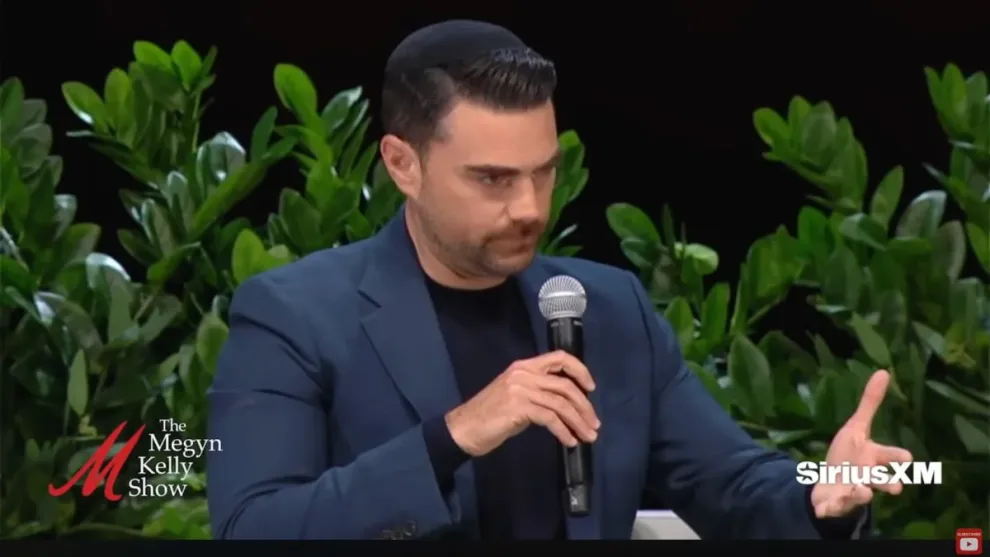
Ben didn’t stop there.  In the last few days, he has risked relationships by confronting conservative colleagues and challenging them on their silence surrounding the Carlson-Fuentes episode.  Megyn Kelly had Ben on her show to discuss these developments and when he confronted her on failing to speak out against people like Candace Owens, she defended herself by saying, “My position is it’s really none of my business,” and “I’m not mother of the internet.”  When pushed on Carlson, Kelly defended her friendship and spoke about loyalty. 


I don’t envy Megyn Kelly and others in the conservative world who have been caught between prominent, popular, and highly influential friends.  They express that this isn’t their fight, they aren’t responsible to police everything that everyone says or monitor who they host.  They argue that when it comes to friends, criticism and reproach should be shared privately, never in the public sphere. 


This tension between loyalty and moral responsibility is not unique to public figures, though for them it is a different calculation and conclusion. The truth is we all face these issues in our private lives: friends who make ethical missteps or betray trust, loved ones who engage in harmful or criminal behavior. How far should friendship go? Does standing by someone implicitly condone their actions or associate us with their behaviors? Is silence a sign of loyalty, or a betrayal of our own values?


Certainly, there are differences between public figures and private friends.  There are support roles for rabbis and professionals to play and that often differs from how individuals should navigate these complicated decisions. 


The Mishna in Pirkei Avos teaches: “Rav Yehoshua ben Perachia taught, make for yourself a rabbi, acquire for yourself a friend and judge every person favorably.”  The Rambam notes that it doesn’t say make for yourself a friend or befriend other people.  It specifically says “acquire” because when it comes to friendship, one cannot be casual or complacent.  We have to bring the same attention, critical thinking and seriousness in searching for a friend who will bring out our best and hold us accountable, that we bring to major acquisitions.


Perhaps with the choice of that word, our rabbis also intended another subtle message about friendship.  K’nei, acquire also has the same root as l’sakein, to repair.  Real friends reproach and seek to repair one another.  Real friendship is not loving someone so much that you let anything they do slide.  It is caring so much that you are willing to confront and call out when you are concerned your friend has lost his way.  


Perhaps it is time for a modern update to my childhood PSA: “Friends don’t let friends embrace antisemites.” Antisemitism, like any form of hate, clouds judgment, endangers others, and corrodes the soul. Standing by those who embrace it is not friendship, it is enabling. Moral courage, even at the cost of discomfort or confrontation, is the highest expression of care.


Friendship, loyalty, and ethics intersect in complex ways, but one thing is clear: love and loyalty do not absolve hate. True friends hold each other accountable and protect the moral health of their community and of their movement.


The Pulpit Must Not be a Political Podium… Most of the Time

The IRS announced it will break with a long-standing rule and now allow houses of worship to endorse candidates for political office without losing their tax-exempt status.  Since 1954, a provision in the tax code called the Johnson Amendment mandates that nonprofit organizations could lose their tax-exempt status if they participate in or intervene in “any political campaign on behalf of or in opposition to any candidate for public office.”


The rule was violated regularly in some houses of worship, but the IRS rarely enforced it. In explaining the change, the agency advised that when a house of worship, “in good faith speaks to its congregation, through its customary channels of communication on matters of faith in connection with religious services, concerning electoral politics viewed through the lens of religious faith,” it neither participates nor intervenes in a political campaign.


This means rabbis can now legally endorse candidate from the pulpit.


But should they? 


I don’t believe so.  In many or even most elections, reasonable people can come to a reasonable conclusion in either direction.  Sure, it is fair, maybe even constructive at times, to try to persuade others to see things as you do, but if you can’t, the best practice is to acknowledge that not only is the other person entitled to his or her perspective, but their opinion is reasonable, legitimate, and fair. The fact that they arrived at a different conclusion, even one you are convinced is wrong, doesn’t mean they have corrupt character, less patriotism, compromised commitment to Israel, or less devotion to Torah.


Rabbis and shuls should be spaces where people with diverse opinions can congregate, connect, learn together, daven together and work together on the issues that unite us.  If rabbis begin to offer public endorsements, especially from the pulpit, will those who disagree with his conclusion still feel comfortable being part of that shul?  What will the impact be on public discourse and debate within the community if the rabbi publicly weighs in endorsing one side, particularly invoking his Torah authority in doing so? 


Will those who disagree with the rabbi’s endorsement and choice continue to turn to him for direction, guidance, and support?  Will they ask him their halachic questions, want him to officiate at their simchas and lifecycle events, trust him to advise on sensitive matters?  


If the answers to these questions is no, even if it is a small percentage of the shul/community who will feel alienated, is the endorsement worth it?  Rabbonim are shepherds, charged with loving and caring for their flock.  If some will be driven from the herd or who walk away feeling unwanted, the shepherd has failed in his mission. 


Ultimately, as Shlomo HaMelech taught (Misheli 21:1) “פַּלְגֵי־מַ֣יִם לֶב־מֶ֭לֶךְ בְּיַד־ה’ עַֽל־כּל־אֲשֶׁ֖ר יַחְפֹּ֣ץ יַטֶּֽנּוּ – The heart of a king is like a stream of water in the hand of God, wherever He wishes, He will direct it.”  We say every single day in our prayers, “Al tivtechu b’nedivim, don’t place your faith and trust in princes and diplomats.”


As God-fearing Jews, we recognize that it is the Master of the Universe who orchestrates domestic, foreign, and of course all policies and their consequences. To be a student of Torah and of Jewish history is to recognize the Almighty’s guiding hand. His hand guided our history and ultimately, it is His hand that is guiding our destiny.


I said above that in most elections reasonable people can come to a reasonable conclusion in either direction, but like almost every rule, there are exceptions and we are living through one.


One group of clergy didn’t wait for the IRS to change its rule before making a public endorsement.  In an article titled, “We are NYC rabbis who support Zohran Mamdani – Here’s why,” they write:

My co-authors (listed below) and I are among many New York City rabbis who voted for and proudly support Zohran Mamdani in the race for New York City mayor. Our religious tradition calls us to pursue justice and invokes our responsibility to bring it into the world. For many of us, the campaigns of Mamdani and mensch co-endorser Brad Lander marked the first time in a long while that we witnessed the Jewish call for justice clearly reflected in the platforms and character of mayoral candidates. We are confident that Zohran will carry those values forward – we hope, all the way to Gracie Mansion.


Supporting Zohran and Brad was, for us, an explicitly Jewish act, and we’re kvelling over our contribution as Jewish New Yorkers to Mamdani’s historic victory…


We believe that rent is too high, buses are too slow, and New York should be a welcoming, safe home for everyone – no matter where we came from or how long we’ve been here. Like Mamdani, we believe…that the Israeli government’s treatment of Palestinians in Gaza and the West Bank is horrific and cannot be ignored. These convictions reflect a shared political ethic – not identical political beliefs – and they are strong enough to support both real coalition and real community.


The blatant smear tactics we see used against Mamdani are frequently deployed against Muslim elected officials and leaders of color who dare to criticize Israel. These accusations are not about protecting Jews. They are about shutting down necessary reckoning with our city and country’s complicity in Israel’s occupation…


We believe that Jewish safety will not be secured by demanding unconditional support for Israel or imposing litmus tests on public officials around language. It will be secured through effective policy, education, solidarity, and shared struggle. That is what Mamdani offers…


Absurd, dangerous, and deeply disturbing articles like this one make this New York mayoral election an exception in which reasonable people should not be able come to certain conclusions and rabbis should be vocally opposing this article and this candidate.  But let’s be clear about the parameters. Mamdani’s socialist views, calls to defund the police and dishonesty on his college application don’t, in my opinion, justify rabbis issuing an endorsement for his opponents. We should, however, call out and voice opposition to a candidate who is openly against Israel in the clearest possible terms and who proudly stands with antisemites.


I recognize that people will disagree about where to draw the line and when to make the exception, but I hope that reasonable people can agree that stopping the election of a candidate who is undeniably and objectively anti-Israel and by extension antisemitic is not a violation of a rabbi’s responsibilities but the fulfillment of it. 


Mamdani has refused multiple times to recognize Israel’s right to exist as a Jewish state, and he has supported the BDS movement against Israel. While he hasn’t himself used the phrase, “Globalize the Intifada,” he has refused to condemn those who do and defends their right to use the expression.  As the intifada is actually being globalized with Jews suffering attacks around the world in growing numbers, in no place more than New York City, defending the expression is egregious and incites violence against Jews. The founder of the Students for Justice in Palestine (SJP) at his alma mater, Mamdani has accused Israel of “genocide” and “apartheid,” and has vowed that as mayor he would arrest Benjamin Netanyahu.  


Despite the IRS’s rule change, don’t expect to see political endorsements from the BRS pulpit. But stopping Mamdani isn’t a question of politics, it is about self-preservation and the safety and security of the Jewish community. 

What They’ll Never Understand About the Jews

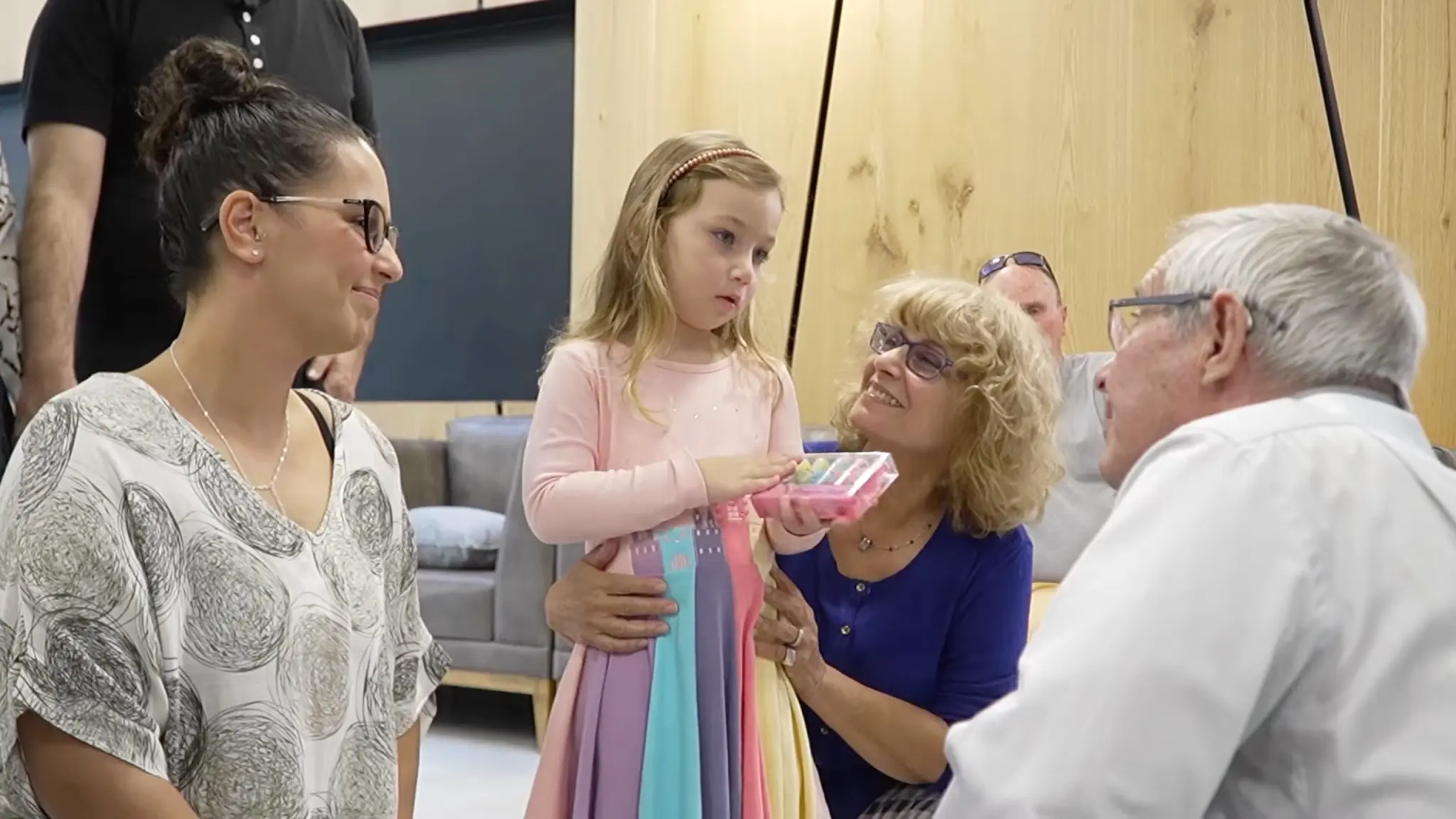
Chaim Lindenbaum, a 77-year-old man from Haifa, was diagnosed with aggressive leukemia in 2022. Doctors said the grandfather could only survive with a life-saving bone marrow transplant. Dr. Daniel Levi had signed up to be a bone marrow donor after moving to Israel from Peru and he came up as a match for Lindenbaum, even though they were not related. After finding out he could be a donor, Levi had about one week to prepare for the urgent stem cell transplant, which was arranged through Ezer Mizion, the world’s largest Jewish bone marrow registry. The transplant was a success, and the older man wanted to thank his benefactor. But donor rules forced the men to wait a year before the donor’s identity could be revealed.


A year later, Chaim Lindenbaum and Daniel Levi were anxious to finally meet each other.  They scheduled to meet after the Jewish holiday season that ended with Simchas Torah on October 7. But that meeting never happened. Daniel Levi and his young family lived in Kibbutz Be’eri and on October 7, when terrorists infiltrated the kibbutz, he answered the frantic calls from the medical clinic. He ran into the trouble, racing to treat the severely injured.  As his wife Lihi, 34, daughter Emma, 5, and son Liam, 2, were hiding in a safe room for seven hours, Levi calmly texted her, “I love you” while Hamas terrorists opened fire.  After treating many people and saving lives, Dr. Daniel Levi was killed on October 7.


Lindenbaum never did get to meet the man who saved his life, but he did get to meet his family.  A few weeks after the horror at Be’eri, someone from Ezer Mizion was trying to arrange the meeting and kept called Levi but didn’t hear back. She looked at his file and saw he was from Be’eri.  She did more research and learned he had been killed.  She decided to call Lihi nonetheless to see if a meeting could be arranged. During an “exciting and emotional” meeting  for the two families, Daniel Levi’s widow got a chance to do what her husband dreamed of doing for more than a year, hug his bone marrow recipient.


Bending down to little Emma, Lindenbaum explained, “I was very sick – my blood was sick. And today I’m healthy, thanks to your daddy’s blood.” He continued: “I was very sad, I wanted to thank him. His blood system is in my body. In compatibility we were like brothers.” He added that a part of Levi still lives on in him: “He left, aside from his two beautiful kids, his blood, which is my blood.”


The truth is this principle is not limited to Chaim Lindenbaum and Daniel Levi, but all Jews are brothers and sisters, we must work to be perfectly compatible. 


In describing the most seminal moment in history, the revelation at Sinai, the Torah tells us: Va’yachanu ba’midbar, vayichan sham Yisrael neged ha’har, they encamped in the desert and the Jewish people camped opposite the mountain. Rashi famously comments on the change in tense—from the plural “Vayachanu” to the singular “Vayichan”—that we stood “k’ish echad b’lev echad, like one person with one heart.”  The Ohr HaChaim writes that this mindset was from “ikarei ha’hachana l’kabbalas ha’Torah” a critical part of preparing to receive the Torah. It was then, and it is again now, as each year we accept the Torah together anew


The simple understanding of this concept is that we were united, cooperative, caring and loving of one another.  We were a family, a community, a people instead of just a gathering of disparate individuals.  But the idea is deeper.  Indeed, we can’t fully observe and keep the totality of Torah unless we are united and as one.  We are all obligated in Taryag mitzvos but yet can’t observe every one of them because we can’t simultaneously be a man, woman, Kohen, levi, Live in Israel and outside of it, during the Beis HaMikdash and without it, etc.   The Kiryas Sefer explains that only through the principle of Kol Yisroel areivim zah la’zeh can we fulfill the entire 613 commandments.  By being guarantors one for the others, we can be motzei each other and thereby all fulfill it all.  It is not a coincidence that areivim is the same word as ta’aroves, a mixture.  When we guarantee one another and have each other in mind, we become a mixture together. 


The Baal Shem Tov understands this idea in an even deeper way.  The only way to fulfill Taryag Mitzvos, he says, is to not only exist independently, but also to see ourselves as part of one organic, integrated whole, one unit.  קיום תרי״ג מצוות אינו אפשרי אלא ע״י שכל אחד כולל עצמו בתוך כלל ישראל באהבה ואחוה ע״י זה יש לכל אחד חלק בתרי״ג מצוות.  This is why Chassidim say before each mitzvah they perform, “בשם כל ישראל”. 


But perhaps there is yet another explanation. We all know the name of the mountain the Torah was given on is Har Sinai.  The Gemara (Shabbos 89a) tells us the etymology of the name Sinai.

דְּרַב חִסְדָּא וְרַבָּה בְּרֵיהּ דְּרַב הוּנָא דְּאָמְרִי תַּרְוַויְיהוּ: מַאי ״הַר סִינַי״? הַר שֶׁיָּרְדָה שִׂנְאָה לְאֻמּוֹת הָעוֹלָם עָלָיו.

It is called Har Sinai because it is the mountain from which sinah, hatred descended against the Jews.  While countless explanations have been offered for antisemitism, the world’s oldest hatred, there is no unifying explanation because it has reared its ugly head in times of prosperity and poverty, in times of assimilation and strong Jewish identity, throughout history and across the globe, when we have been in our homeland and when we were dispersed in galus. 


Ultimately, our rabbis taught, we are hated because we stood at Sinai and accepted a great role and responsibility, a mission to be models and examples, to improve and repair the world. Subjective cultures and systems of morality challenge the objective moral timeless truths of our Torah, but they don’t endure.  We are meant to be the moral conscience of the world, an example of creating an ethical and holy society and community, and the people of the world don’t like that.


The sinah, the hatred of the Jew, goes all the way back to Har Sinai when we stood at the mountain, three thousand, three hundred and thirty-seven years ago and accepted to live lives informed, inspired, and guided by the Torah.  We have faced discrimination, bias, double standards, tropes and hate since the very moment we began.  We have been forced to live with and navigate sinah since we first stood at Sinai. 


How? How has our people not only survived this sinah but thrived despite it throughout the millennia?  What is the explanation for our endurance, resilience, strength and capacity to still be here standing, to be back at that same mountain that brought this hatred?


The answer, the secret to our surviving the sinah, also goes all the way back to that mountain and the way we gathered there.  כאיש אחד בלב אחד, we stood together as one: undivided, invincible, ready to confront and overcome whatever sinah would come our way. 


A study released on friendship in 2008 by professors from four universities in the Journal of Experimental Social Psychology found something remarkable about companionship and community.  Participants in their studies were asked to estimate the incline of a hill in front of them. Over and over again, those who were accompanied by a friend estimated the hill to be less steep than participants who were alone. The researchers concluded that the more one is connected with others, the more we are part of a community, the more we feel we can climb whatever mountain is in our way.


Long before researchers, our Torah understood this.  The Navi Yeshayahu (41:6) said:אִ֥ישׁ אֶת־רֵעֵ֖הוּ יַעְזֹ֑רוּ וּלְאָחִ֖יו יֹאמַ֥ר חֲזָֽק׃ , Each one helps the other, saying to his fellow, “Take courage!”    We have overcome the sinah since Sinai because we stood and we stand together k’ish echad b’lev echad, as one, turning to each other over and over and saying, “Chazak! Be strong.”  We have not just stood united, we have become united, like one, laughing together, crying together, davening together and feeling together with our lev echad, one heart.


As we prepare to stand at the mountain again to reaccept the Torah, the sinah from Sinai continues to rage in Israel, on college campuses, in some offices of Congress, and in too many countries around the world.  Our response now must be as it was then, to turn to one another with a sense of unity, love and oneness and to wish each other chazak.  If we are going to not only survive but thrive, we must be in compatibility like brothers and sisters, like one. 

From Non-Jewish Nanny to Now-Jewish Nanny: A Lesson For Each of Us

Adriana Fernandez had a unique path to social media fame. For years, her almost-90,0000 followers online have enjoyed her posts, pictures, and videos reflecting her insights and experiences as a non-Jewish nanny working in observant Jewish homes. She even adopted and leaned into her moniker, “Non-Jewish Nanny.”


It all began when she was a student studying opera in college when she took a job on the side babysitting.  The first family that found her on the babysitting website was Jewish.  Adriana didn’t have Jewish friends growing up and knew little about the Jewish people’s practices and lifestyle.  As she began babysitting in observant Jewish homes, it quickly became much more than just a job or source of earning money.  She came to not only love the children she interacted with but the lifestyle they and their families were leading.


She began to share her “non-Jewish” perspective and thoughts on Orthodox Jewish laws, traditions, and rituals, and it went viral.  From insights and observations on tznius and shaitels to kosher recipes and Jewish holidays, people were enamored by her energy, positivity, and capacity to pronounce the “ch” sound.  As her following grew, kosher and Jewish businesses took notice, sending her clothing and other products to feature and promote.  All the while, she continued to serve as a nanny in Orthodox Jewish homes, developing meaningful relationships with the families she cared for, particularly the children.


Online, people saw her following and influence grow.  What they didn’t see was that offline, the influence of the families she was working for was growing on her.  Adriana wasn’t just curious and intrigued by the Torah way of life, she began to want it for herself.  Adriana approached a rabbi and rebbetzin in the neighborhood where she was working and they agreed to sponsor her in the geirus (conversion) process.  She took it seriously from the start, learning, reading, reviewing, studying the curriculum, attending davening and classes, and integrating among observant Jewish friends. (Every detail here is published with her permission.) When the Beis Din became involved, being an “influencer” didn’t accelerate her process; if anything, it made it go slowly, methodically and in a way that would build confidence this interest was genuine and not a way to grow her following or any other motivation.


While the change in her dress and her life was noticeable, Adriana never discussed her journey and process with her followers. She never announced the program she was in or what she was working towards.  And finally, after a lot of work and patience, the day came.  She immersed as Adriana and emerged as Adina Shoshana. A few days after the birth of her new identity came the transformation of her online profile. The “Non-Jewish Nanny” became the “Now Jewish Nanny.”


The Gemara (Yevamos 62a) teaches that ger she’nisgayeir k’kattan shenolad dami, one who converts is like a child that is born anew. But the language of the Gemara is puzzling. Shouldn’t it be a goy she’nisgayeir, a non-Jew who converts? Why do our rabbis phrase it as, “a convert who converts”?  The Chida (Midbar Kedemos) explains that Chazal were teaching that the conversion reveals that it wasn’t a non-Jew who converted, it was someone who was always destined to be Jewish, whose soul was also at Sinai.  Ger she’nisgayeir, the would-be convert, converts. 


Adina Shoshana is the real deal: genuine, authentic, knowledgeable, spiritual, and Torah-observant. She should be admired and appreciated for her journey and encouraged and supported as she continues her next steps as a full-fledged, proud, and practicing Jew.  Her Rabbi and Rebbetzin deserve enormous credit for their guidance, care, and time teaching her how to live as a Jew.  The Beis Din who enabled her to fulfill her dream will forever now be tied to Adina like everyone they convert, getting credit for her mitzvos and also carrying a responsibility for any shortcomings.


I share this story with you because it is fascinating and inspiring but also because I think there are other, unseen people in this story who deserve great credit and who obligate each of us. 


The families that Adina worked for live a Judaism, and interact with people around them, in a way that that someone who was working for them and living with them wanted be a Torah-observant Jew.  That is extraordinary and a tremendous credit to them.  Adina shared that it was the children in particular—their sweetness, their patience in sharing their learning and lives with her, their joy in being and living Jewish—that most inspired her.


An important lesson of the Now Jewish Nanny’s journey and the families that inspired her is to ask ourselves, if someone worked in our home, lived with our family, was involved in our lives and lifestyle, would that draw them closer to Judaism or push them away? Would it inspire them or turn them off? Would it make them want to be more like us or to have nothing to do with us? 


We find ourselves in the weeks leading up to Pesach, a time of tremendous work, planning, expenses, and often stress and pressure.  What is the atmosphere in our homes? Are they places of joy or misery, excitement and positivity or resentment and negativity?  Will those in our homes, whether our children or outsiders, be inspired in the future to look forward to Pesach or to dread it? 


The Talmud (Bava Metzia 59b) stresses that the Torah obligates us to love the convert and to refrain from causing anguish or pain no less than thirty-six times.  But it isn’t only the convert we should treat well.  All who work in our homes, and in whose places of work we frequent, Jew and non-Jew alike, will be impacted by how we behave in general and by our attitude towards our Judaism in particular. 


When he was older, Rav Yisroel Salanter no longer baked his own matzah before Pesach, but rather he asked his students to bake his matzos for him. The students, knowing that baking matza is not always a simple process, asked him, “What are the Chumros (stringencies) the Rebbe makes sure to adhere to when he bakes matzah?” He replied, “I am very careful not to yell at the woman who cleans up between every batch of matzah baking. She is a widow. Please speak kindly with her.”


We may not have asked to be role models or to be responsible for others’ impressions of Judaism, but we have been entrusted with this sacred mission, one we should embrace with pride rather than resentment. Not everyone we meet will go from Non-Jewish to Now Jewish, but if we live with positivity and joy, with honor and respect, they can go from “Never Liked Jews” to “Now Love Jews,” simply because of us. 

Don’t Just be Jew-ish: Be a Proud and Practicing Jew

Image by Benyamin Cohen

In the latest demonstration of antisemitism, protests directed at Jewish students broke out at Barnard College last week including the taking over of a hall and a fake bomb threat during a sit-in staged by pro-Palestinian protesters wearing keffiyas and masks.  In response to how wide spread and pernicious the problem has become, the US Department of Justice announced it has appointed a task force charged with investigating 10 U.S. college campuses including USC and UCLA over reports of antisemitism.  


Recognizing how great the problem has become, this week, Jewish actor, David Schwimmer  called on his fellow Jewish members of Hollywood to stand up against antisemitism. “Plenty of people I respect, even some of my heroes in entertainment, music and sports, have chosen to keep a low profile and sit this one out,” he told the audience at the Anti-Defamation League’s conference in New York. “So many have chosen not to say anything publicly at all. And if I can say something directly to them: I really wish you would…I wish you would stand up. I wish you would speak out, because your voice would be so meaningful to your fans who love you, to your community members who need you, to folks who can use just a little solidarity right now.” 


Unfortunately, antisemitism and the silence of too many is nothing new. When Haman approached Achashveirosh with his diabolical, genocidal plan to exterminate the Jews, he said, “there is a nation scattered abroad and dispersed among the nations.” The Talmud (Megillah 13b) expands on this conversation.


When Haman targeted the Jews for annihilation, he said to Achashveirosh, “Let’s destroy the Jews.” Achashveirosh replied, “Not so fast. I am afraid of their God, lest He do to me what He did to my predecessors.”


Haman relieved the King of that fear when he said, “Yeshno am echad,” which translates literally as “there is a certain nation.” The Talmud quotes Rava, who explains that Haman was telling the King something much more strategic and insightful. Not yeshno am echad, there is a certain nation, but rather yoshnu am echad, there is a sleeping nation. Said Haman, “They have been negligent of mitzvos, they are divided, fighting with one another. They are arguing amongst themselves but at the same time they are fast asleep as to what we want to do and how we threaten them.”


We were on the brink of extinction as a people because we were asleep.


We were vulnerable and literally on the brink of elimination and extinction as a people because we were asleep. Our eyes were closed to what was happening around us. We didn’t take the threats seriously and we didn’t stand up for our right to simply exist.


Haman recognized and took advantage that there is a nation that is sleeping. All he had to do was continue to lull the Jewish people into a false sense of security, to breed complacency and apathy, and at that moment he could accomplish his goal of ridding the world of our people.


Indeed, Rabbi Soloveitchik suggested that the true miracle of Purim is that an anti-Semite rose, threatened us, and we believed him. We didn’t excuse him, accept his bogus apologies or say he didn’t really understand what he was saying. We didn’t just reject his tropes, we confronted him, we took him at face value, and we were determined not to let him threaten our people.


Identifying an anti-Semite, taking him or her seriously and doing something about it is nothing short of a miracle.  So how did we survive? What spoiled Haman’s plan? Why did we ultimately triumph over Haman such that we are here today and he is a distant memory? The answer is simple: Mordechai and Esther.


We understand Esther’s heroism. She risked everything: her life, her family, her people, to go out on a limb and confront the king without permission. But what made Mordechai a hero? If you think about it, Mordechai may actually be a villain, a perpetrator in the story, responsible for initiating the decree to exterminate the Jews of Shushan and beyond.


Would it have been so terrible for him to just bow down? Just once? Not only does Mordechai refuse to bow down to Haman, he insists on antagonizing him by camping out on Haman’s route so that Haman would see him every day and be bothered by the one Jew who refuses to show him honor. Mordechai’s behavior provokes Haman and he responds by declaring his intention to destroy not only Mordechai, but all of Mordechai’s people, the Jews. Even after Haman’s plan has been pronounced, Mordechai continues to snub him.


When Achashveirosh remembers what Mordechai had done to save his life and sends Haman to reward him by parading around publicly, Mordechai could have declined the honor. Instead, he accepts, humiliates Haman and infuriates him further!


And this is the person we consider a hero of Purim? Why? A closer look seems to indicate that Mordechai’s ego put the Jewish people at risk. What was the source of Mordechai’s intransigence?


You might think it’s simple – bowing down was idolatry, one of the three cardinal sins for which we must give up our lives rather than violate. Indeed, the Ibn Ezra suggests that Haman was wearing idolatrous symbols. Rashi comments that Haman had declared himself a deity. Either way, it would seem Mordechai was right not to bow down, he was simply following Jewish law and it was his peers who were wrong for bowing, even if not doing so would mean risking their lives.


But that’s not the whole story. The Talmud (Sanhedrin 61b) says that the law of sacrificing your life rather than engaging in idolatry applies if in fact one is buying into the divine nature of the idol. If one is bowing simply out of fear, one is not liable.


So why didn’t Mordechai simply bow down in an effort to save the Jewish people?

Yes, Mordechai would have been entitled to bow down. To save his life, he could have been apologetic for his Jewishness and submitted to a virulent anti-Semite, bowing down to Haman and his worldview that wants a world without Jews. But Mordechai understood what was at stake.


Mordechai understood the antidote: To stand firm, to stand strong, and to stand as a proud Jew, a Torah Jew.


Mordechai, a humble scholar and righteous sage witnessed the growing antisemitism of Haman and his desire to see Jews and Judaism erased and he understood the antidote. If Jews were fast asleep, excusing away even the anti-Semitic “tropes” of their time, the answer was not to bow down, even if it was technically allowed. The answer was exactly the opposite. To stand firm, to stand strong, and to stand as a proud Jew, a Torah Jew.


The answer was to not apologize for being a Jew, but rather to be the proudest and most tenacious Jew, and that is exactly what he did. And this is how is Mordechai is known in the Megillah: “Ish Yehudi haya b’Shushan ha’bira – There was a Jewish man in Shushan the capital.” What do you mean a Jewish man; there was only one? There was a large Jewish population in Shushan!


The Megillah is telling us that true, there were many Jews, but some were abandoning their Judaism and others were failing to stand up for it. The Jewish community was asleep; there was only one Ish Yehudi, an unashamed, unembarrassed, unapologetic Jew.


What happens when Jews stand up for ourselves, when we call out and confront anti-Semitic song lyrics, tropes and yes, call out antisemites themselves? By the end of the story, the Megillah tells “fear of the Jew had fallen on them and so no man could stand up against them.” Why? “Because Mordechai, the proud, unashamed, unapologetic and fearless Jew earned the respect of his multitude of brothers, he sought the good of his people and spoke for the welfare of the next generation.”


One of the critical, but too often neglected, lessons of Purim is that the answer to our enemies is not to hide, apologize, or erase our Jewishness. To the contrary, it is to swell with and share our Jewish pride. When we act with confidence and pride, we gain respect. It is no coincidence that Mordechai emerges as a leader not only of the Jewish people, but a dignitary in the Persian government.


The mitzvah of Purim is to get to a point that we can’t tell between cursed is Haman and blessed is Mordechai. We are very good at the blessed is Mordechai. We look to explain, excuse, justify and see everyone as a blessing. But we need to get to a point of remembering that identifying a Haman and cursing him is as important as blessing a Mordechai. We have to call out an anti-Semite, hold them accountable, hold those whose silence makes them accomplices accountable.


This Purim, don’t just dress up like Mordechai; act like Mordechai.


If you share concern about growing antisemitism, the question is: what will you do about it? Certainly we have to write letters, make phone calls, attend rallies and hold antisemites and those who fail to condemn them accountable. But there is something else we must do.  I can’t help but notice that assimilation and intermarriage are at record highs, even as antisemitism is as well. Clearly blending in entirely and erasing our differences altogether is not only dangerously wrong theologically, it has no correlation to being safer and more secure.  It is as if just when Jews try to downplay their Jewishness, our enemies will not let us forget.


We must appeal directly to the American people, to carry ourselves with pride, but also with dignity, honesty, integrity and righteousness. If like Mordechai our neighbors come to know and respect us, they will be intolerant of leaders who dare promote anti-Semitic rhetoric or tropes. If we carry ourselves properly, those we work with, work out with, shop with, or live near will speak out and stand up to demand resolutions of condemnation and removal of voices of hate from critical committees.


Don’t sit this one out.  This Purim, don’t just dress up like Mordechai; act like Mordechai.


Be an Ish Yehudi.


Rabbi Efrem Goldberg

Join Our Community

Subscribe to our newsletter or connect with us on WhatsApp.