
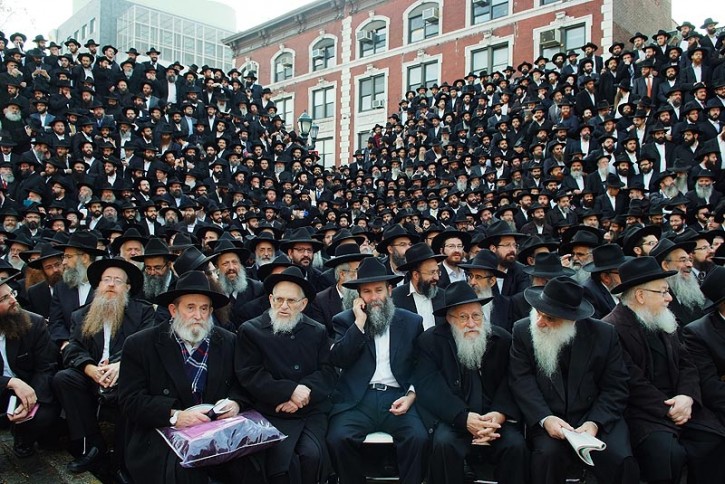
Has Chabad Quietly Revolutionized the Role of Rebbetzin?

Image result for chabad
Photo by Baruch Ezagui

With 5,600 rabbis serving in over 90 countries one would have thought that Chabad had the entire United States covered, yet they only placed a rabbi in the 50th state last week. South Dakota may only be home to about 400 Jews, but that isn’t stopping Rabbi Mendel and Mussie Alperowitz from buying one-way tickets, opening a Chabad House in the wild west, and seeking to build a relationship with each and every one of their Jewish brothers and sisters in the entire state.


This past June marked 75 years since the Lubavitcher Rebbe zt”l, Rav Menachem M. Schneerson and his wife, Rebbetzin Chaya Mushka, came to America from war-torn Europe.  The Rebbe didn’t accept the mantle of leadership until 1950, but his vision and influence were felt immediately upon his arrival to these shores and they continue to be felt 22 years after his passing.


Avraham Avinu was arguably the most influential person who ever lived. Today he is claimed as the spiritual ancestor of two and a half billion Christians, one and a half billion Muslims and thirteen million Jews around the world, representing more than half the people alive today.  Lord Rabbi Jonathan Sacks points out that Avraham, in partnership with Sarah, achieved that influence and impact without ruling an empire, commanding a great army, performing any miracles, or proclaiming to have prophecy.  All they did was heed the call of Lech lecha to begin a Jewish journey, and to define for all time what it is to be a Jew.


Avraham and Sarah revolutionized the world without political power or force.  They did it by preaching faith and showing lovingkindness.  They are the supreme example in all of history of influence without power.  It is hard to think of many Jewish leaders since Avraham who have left more fingerprints across the globe than the Rebbe.  By assembling a spiritual army and opening up Chabad houses and centers around the world, there is practically no destination left where Jews travel or which they won’t find a Shul, kosher food, a mikvah, and, importantly, a warm smile and an open heart.


When traveling recently, I found myself at a dinner marking the opening of a magnificent new Chabad building in an exotic location outside of the contiguous United States.  The event was attended by both financial supporters as well as those supported by that Chabad.  The participation and warm words from dignitaries and government representatives in attendance testified to the genuine relationships the Chabad rabbi and rebbetzin have established beyond the Jewish community.


As I sat there marveling at the accomplishments on display, it occurred to me that perhaps by preaching and inspiring a message of unapologetic faith in and dependence on the Almighty, unconditional love for all Jews, and unparalleled warmth and lovingkindness, the Rebbe was able to create a movement that transcends many of the controversies currently dividing the Jewish community.  The Rebbe certainly had his share of detractors when he was introducing some of his campaigns and placing great emphasis on Moshiach, but today Chabad has earned the admiration and respect of diverse segments of the Jewish people.


Consider the following two examples, which while based on my experiences and not statistically conclusive, I believe often go underappreciated.  The orthodox world has been rigorously debating women’s roles in Jewish communal leadership and whether women can formally serve as rabbis.  Meanwhile, though it has no stated progressive agenda or goals, Chabad has quietly revolutionized the role of women in leadership.  Chabad rebbetzins may not have the title of rabbi, but in most cases they are involved in, and empowered with, setting the vision of their community and executing the leadership necessary to make it a reality as much as their husbands are.  They design programming, lead meetings, teach, give support at lifecycle events, play very public roles and are often listed as co-directors, equal with their husbands.


At the opening I attended, it was the rebbetzin, not the rabbi, who served as the master of ceremonies.  The rabbi gave a wonderful dvar Torah and speech, but it was the rebbetzin who welcomed hundreds of people, offered expressions of gratitude to the list of dignitaries, gave her own dvar Torah, and charged the community with a vision of where they are going next.


The contemporary Chabad rebbetzin is functioning in a significantly different way than her predecessors and many of her peers in the orthodox world.  And yet, one doesn’t find people questioning her motives, her commitment to halachik norms, or her respect for rabbinic authority.  Her selflessness, mesirus nefesh and boundless love and devotion, with no other agenda regarding women’s roles, seem to insulate her from the usual suspicions and criticisms.


A second example: In world of tragic antagonism between the “right” and the “left,” both groups claim Chabad as a being more similar to them.  The “left” has an affinity for Chabad’s emphasis on loving all Jews, being non-judgmental, warm, and opening.  The “right” identifies with Chabad’s strict standards of modesty, stringent positions in halacha like cholov yisroel and pas yisroel and general Chassidic orientation.


I was once talking to someone who was complaining to me about how his rabbi is too far to the right and why can’t he be more like the Chabad rabbi who is so centrist.  I asked him: in what way is your rabbi more to the right of the Chabad rabbi?  Do you realize that your rabbi has a college degree and the Chabad rabbi never studied secular subjects?  Do you realize your rabbi is more comfortable with less strict standards of modesty and halacha than the Chabad Rabbi?  Do you appreciate that the Chabad rabbi always goes out in public with his black hat and wears a gartel while he davens while your rabbi doesn’t wear more than a kippa?  How is your rabbi more “right wing”?


The individual argued that his rabbi was more to the right because he wasn’t as open, tolerant, welcoming, friendly or warm as the Chabad rabbi.  I realized after that conversation that for many people, “right” and “left” are not a function of actual hashkafic differences or variances in halachik practice, but a function of how open or closed they feel someone is to others, particularly those that are different from themselves.


With its culture of lovingkindness, acceptance and warmth, Chabad successfully transcends the typical labels and divisions that divide us and instead, the movement and its rabbis and rebbetzins find resonance and embrace in the diverse segments of the Jewish community.


There is so much to admire and appreciate about Chabad.  Minimally, every one of us should be incredibly grateful for the ability to go almost anywhere in the world on business, vacation, or to live and to have a Chabad house welcoming us and providing for our Jewish needs.  We should be in awe of the selflessness of people like Rabbi Mendel and Mussie Alperowitz who move to places with no Kosher food, no school for their children, often no mikvah, no eruv, and only a handful of other shomer Shabbos people.  It doesn’t deter them that there is no endowment, or consistent membership dues, and that if they are going to keep the lights on it is up to them to raise the funds to do so.


Most of all, I think we can learn from Chabad how to continue the journey that Avraham and Sarah began.  The combination of faith in the Almighty with lovingkindness to His children can radically influence and improve the world and can help us transcend the differences that too often get in the way of our greater mission.  Like Chabad, let’s not have agendas that alienate, divide and create controversy, but be focused exclusively on the agenda of helping Hashem find expression in this world and showering love and kindness on others.


You May Think it is Not Your Problem – Here is Why You are Wrong

Image result for tuition crisis

For some time, the cost of Jewish education has been labeled a crisis.  While it feels like this issue has been addressed ad nauseam, believe it or, it is still being debated.  Our own Rabbi Adam Englander penned an article describing how KHDS was able to freeze tuition and even lower it.  Gershon Distenfeld, Chairman of Yeshivat He’Atid in NJ wrote an article in response entitled, “Is There Still a Tuition Crisis?”  He writes, “Today, what I (and others) are hearing is totally different. Many (day school administrators and board members chief among them) are expressing skepticism that we have any sort of “tuition crisis” for a very simple reason. Parents, and especially the younger generation, are demonstrating time and again that price just doesn’t factor much (if at all) into their decision-making process.”


It is true, that for those who can easily afford Jewish education there is no crisis, and frankly, for many of those receiving the largest scholarships it can be argued, there is no crisis in the sense that their children can remain in a Jewish school without question.  My experience has shown me, however, that there remains a crisis for a significant number of families who fall in between.  There is a population that is receiving a generous tuition reduction and yet they simply cannot afford to meet that reduced tuition contract.


None of us should know the crisis of having to consider the question of removing a child or children from a warm, nurturing, positive Jewish educational environment and put them in Public School for financial reasons alone. There are legitimate reasons to leave Jewish day schools, but money cannot and should not be one of them. I strongly believe that a Jewish education is a necessity, not a luxury, and every Jewish child deserves a chance at one.


To put it simply, these families, these children, need our help.  Our local Boca day schools are extraordinarily generous. Combined, they provide more than 6 million dollars of tuition assistance a year. They, and those paying full tuition that helps subsidize others are doing your part.  But to relieve the crisis for the children on the brink of leaving Jewish Day School, the rest of the community needs to step up and do their part.


In 2009, we created the BRS Jewish Education Scholarship Fund to provide modest support to struggling families and help close the small gap and keep their kids in Jewish schools. Since then, the generous donors to this fund have helped literally dozens of Jewish children stay in Jewish schools. The fund does not support the operating budget of schools or make donations to their fundraisers. The fund exclusively provides money on behalf of specific children in specific circumstances to ensure that they can remain in a Jewish school.  The fund has zero overhead or administrative costs.  Every penny that is donated goes directly towards the tuition of a particular child and helps them remain in Jewish school.


Helping the youth of our community is not the job of schools alone or of other parents who happen to have their children in the same school. It is the job, responsibility, and halachic obligation of each and every one of us alike, whether we have young children at home or are empty nesters.


You may be thinking, this fund is a fantastic idea and my neighbors should most definitely give, but I am exempt.  Here is why you are wrong:


MYTH #1 – “This is important, but it is someone else’s responsibility, not mine. I have been there and done that. I have built my children and grandchildren’s schools and now it is time for the next generation.” This is a myth and a fallacy.  In the year 64 C.E., R. Yehoshua ben Gamla introduced an idea that would revolutionize the educational world. He identified a crisis in which Jewish children, particularly orphans, were not being educated by their parents at home as they had been traditionally until that time. He left his prominent position and started the first Jewish public school.  He mandated each community to provide the funds to enable a Jewish education to all.  The Talmud (Bava Basra 21a) credits his vision and initiative with saving our people.


Indeed, his approach is quoted in Shulchan Aruch and remaining an obligation on Jewish communities until today.  The Rama, Rav Moshe Isserles writes, “In a place in which the residents of a city establish among them a teacher, and the fathers of the children cannot afford tuition, and the community will have to pay, the tax is levied based on financial means.” Living in a community means contributing to a fund that ensures every Jewish child can get the Jewish education they deserve.  One never graduates from this obligation, even if their children and grandchildren have graduated the schools they once supported.


MYTH #2 is “My children or grandchildren are struggling and I am helping them with their tuition.” That is fantastic, meritorious, and noble. However, it does not exempt you from giving locally as well.  Poskim are clear that local schools have the status of aniyei ircha, local indigent, and there is a halachic imperative and priority to give to them before giving to every envelope that comes in the mail and every knock that comes to the door. If for years we send at least something to every yeshiva, kollel and charity that contacts us, how could we not participate in our local communal obligation?


We need the community, especially those who are not otherwise giving to our schools right now, to participate in this fund. Whether you are single, married, young, old, an octogenarian or newlyweds, these are OUR children and OUR collective responsibility. This fund is not helping anonymous, unfamiliar children in faraway places. It is enabling your neighbor’s children, the children who sit next to you in shul or riding their bicycles down your street, to remain in Jewish schools.


Supporting the fund is an investment opportunity that is guaranteed to pay a return.  The dividends are informed, inspired, passionate Jewish children who are committed to Torah, the Jewish people, and the State of Israel. With all of the challenges we are having inspiring our youth, the research and statistics don’t lie.  One cannot compare the Jewish identity of a child that attended a Jewish day school with one who didn’t.  We need your help, please answer the call.


Go to http://www.brsonline.org/donate and generously enter an amount or drop off a check at Shul


Please consider one of the following levels:


$1-$1000 – Friend of Jewish Education


$1000 – $1800 – Supporter of Jewish Education (includes entry into the annual Poker tournament on November 29th)


$1800 – $3600 – Sponsor of Jewish Education


$3600 – $5000 – Pillar of Jewish Education


$5000 and up – Patron of Jewish Education


Special Needs & Special Opportunities: Lessons I Learned From Camp HASC


nor·mal


adjective: conforming to a standard; usual, typical, or expected.


The people in Camp HASC are not “normal” in that they are anything but typical or usual. HASC campers include those in their 50’s and 60’s, wheelchair-bound, individuals with feeding tubes, and with every imaginable special need including intellectual and physical disabilities. The needs are so great that it takes over 500 staff members to care for 350 campers.


In HASC, “normal” is redefined. It is “normal” during meals for campers to start screaming spontaneously or pacing frantically. It is “normal” during davening for campers to be laying on the floor, hitting themselves or thinking they are the Chazzan. It is “normal” in Camp HASC for adults to require being changed, showered, and diapered.


My family and I had the great privilege of spending this past Shabbos at camp and after seeing firsthand this magical place, I can report that they are not just special needs children, they are just truly special children. They may have disabilities, but in their purity, innocence, and sweetness they are more functional than many fully-abled people. The holy neshamos of the campers of HASC lack inhibition and hang-ups, and they don’t sit in judgment of those around them. Many can’t communicate traditionally, but with a smile, a nod, a brush of the cheek or just a meaningful look, their inner goodness shines through.


HASC officially stands for The Hebrew Academy for Special Children, but unofficially, the acronym clearly stands for something else as well. HASC is The Hebrew Academy for Special Counselors.


The campers are not the only ones at HASC that are not “normal” and that are “special.” One cannot witness the love, attention and affection of the extraordinary staff and not be moved to tears by their selflessness.


In his book, The Road to Character, David Brooks describes ours as “The Age of the Selfie.” He writes:


People have become less empathetic – or at least they display less empathy in how they describe themselves. A University of Michigan study found that today’s college students score 40 percent lower than their predecessors in the 1970s in their ability to understand what another person is feeling. The biggest drop came in the years after 2000.


Public language has also become demoralized. Google algorithms measure word usage across media. Google scans the contents of books and publications going back decades. You can type in a word and see, over the years, which words have been used more frequently and which less frequently. Over the past few decades there has been a sharp rise in the usage of individualist words and phrases like “self” and “personalized,” “I come first” and “I can do it myself,” and a sharp decline in community words like “community,” “share,” “united,” and “common good.” The use of words having to do with economics and business has increased, while the language of morality and character building is in decline. Usage of words like “character,” “conscience,” and “virtue” all declined over the course of the twentieth century. Usage of the word “bravery” has declined by 66 percent over the course of the twentieth century. “Gratitude” is down 49 percent. “Humbleness” is down 52 percent and “kindness” is down 56 percent.


Numerous articles discuss the narcissism and self-centeredness of the millennial generation (commonly referring to adults born between 1980 and 1994). How will leaders capable of mesirus nefesh, self-sacrifice, emerge from a mostly privileged generation of individuals consumed with posting selfies and personal status updates?


Observing what is happening around us and reading the results of studies and analysis, it is easy to be judgmental about the next generation and pessimistic about our collective future.


But that would be a terrible mistake. Our future is very bright and if you doubt it, spend five minutes at Camp HASC or one of the numerous other programs and camps that serve our children and adults with special needs.


p2099521971-o912307356-3The amazing staff who work there are by all measures “normal.” They also take selfies and update their statuses. But in between they are engaged in truly “abnormal” acts of selflessness and giving. From feeding, administering medications, and pushing people in wheelchairs to changing adult diapers, showering, and shadowing, the staff shows incredible attention and care for each and every camper.

One would think this exhausted group of young people would look tired, depleted, or even sad and depressed by their work. Instead, their selflessness yields the greatest satisfaction, deepest fulfillment, and most genuine happiness. Not only does the staff care physically for the campers, but all of their giving and nurturing results in a true love for them.


Visit camp HASC and you see young men and women spontaneously displaying hugs, kisses and affection to campers they only met a short time ago but have come to love as their children. For seven weeks, because of the generosity and kindness of these staffers, parents of 350 extremely challenging children get a reprieve and relief and can only do so knowing that in their place are 500 special, not “normal” people who will love and care for their children as if they were their own.


As much as the staff gives, they get more in return. One young man described to me that he was concerned about his ability to work with this population and their needs. In the first few days of camp he hesitated and was repulsed by some things he needed to do. But it didn’t take long for him to develop a love and concern for another person and the same tasks that once made him gag are second nature because they are for someone he cares deeply about.


Another amazing counselor told me that before working at HASC he was very impatient. He would always walk briskly wherever he was going. His camper is someone who shuffles along incredibly slowly. It takes him fifteen minutes to walk to a destination that should take two. At first, the counselor would get antsy and anxious each time they had to go somewhere, but after a few weeks, he learned to be patient and forbearing. He has become a more easygoing person and for that and so much more, he is so grateful to his camper.


Not everyone is cut out for working in a place like HASC. Those fortunate enough to spend a summer there are blessed to come close with some holy neshamos and develop relationships with some truly special people. HASC alumni are among the most selfless community leaders everywhere and undoubtedly, the experiences they gain there contribute to learning the skills necessary to be a devoted and giving spouse, parent and friend.


While we can’t all work there, like many of their staff, we can and should leave our comfort zones and dig deep. We will find a capacity for kindness and love beyond what we ever imagined.


There are families with special needs in all of our communities who need support, relief, and love. We can provide it ourselves, and we should teach our children to do what they can. In our community, I know of several teenagers who go each Shabbos morning to watch children with special needs so their parents can go to Shul or get some rest.


In Parshas Mishpatim the Torah says: “Kol almanah v’yasom lo s’anun, you shall not cause pain to any widow or orphan.” The Chizkuni points out that all of the other mitzvos in that parsha are written in the singular. The obligation to show kindness and sensitivity to the widow and orphan are an exception. Explains the Chizkuni, this mitzvah is written in the plural, for the rabim. The community is measured by the standard it sets and the environment it tolerates when it comes to being sensitive to those who aren’t typical.


Rav Yaakov Zvi Mecklenburg, author of the Ksav V’Kabbalah, points out that the Torah doesn’t limit this mitzvah to the orphan and/or widow. The almanah and yasom are simply symbolic of those that are missing something, those that don’t quite fit the mold and therefore may feel isolated, alone or unnoticed. He explains that the world almanah comes from al manah, lacking a portion. In every community there are people that don’t fit the mold; they are al-mana, missing something. As a community, we are judged and measured by our sensitivity, kindness, awareness and inclusiveness of such people and their families.


Last year, Lincoln Square Synagogue, led by my friend Rabbi Shaul Robinson, introduced a fabulous new component to their Purim Carnival. It featured an early start time for children with sensory needs and other disabilities that may prevent full participation in the stimulating carnival atmosphere. A quiet sensory room was made available throughout the carnival for those children who could be overstimulated and needed some quiet regrouping time.


We all need to look at our programming, events, and membership services with an eye on how we can be the most inclusive and sensitive to the populations that often feel the most neglected and left out. Inspired by Lincoln Square, this year we hope to introduce youth programming especially designed for those with special needs and to make our regular programming more accessible and inclusive. For example, this Simchas Torah we will host a special Kol HaNe’arim for the children who cannot participate in the regular one. If you have other ideas and suggestions, please don’t hesitate to share them with us.


In HASC normal and not normal are relative terms. Our communities cannot provide year-round what HASC does for seven weeks. But, we can be more special in the way we relate to and provide for our special children. Doing so won’t just help those with special needs, it will help us and the next generation have a bright future ahead.


Do You Know, Let Alone Celebrate, Your Hebrew Birthday?

Jews of diverse backgrounds, denominations and levels of observance seem to all observe yahrzeits of their loved ones based on the Hebrew calendar, not the Gregorian one. And yet, when it comes to birthdays and anniversaries, it seems few Jews—even observant ones—know, let alone commemorate, the Hebrew date of these significant milestones in their lives. One explanation is that a yahrzeit comes with observances and rituals like lighting a candle and saying Kaddish. However, the principle is the same. It is the Jewish calendar that should inform our time consciousness and awareness and on which our major milestones and observances should be kept.


Jewish time is not linear with the past behind us, the present happening now, and the future off ahead. Rather, Jewish time is cyclical. We believe that points in time have energy and character and while time is not a loop in which we meet ourselves from last year, it is a spiral in which we advance but along the same recurring cycle. Rosh Hashana contains the energy of new beginnings, Pesach carries the possibility of liberty and freedom, and Chanukah is the time of miracles. When we observe these holidays, we aren’t simply commemorating an event of the past, but rather the historical event revealed for us the special quality of those days that we seek to tap into now, bayamim ha’heim, u’bizman ha’zeh, in those days and at this time.


What is true for our national holidays is equally important for our personal and individual milestones. Our birthday is a time to reconnect with our having been created and what we uniquely can contribute to the world. Our anniversary is a day to reflect on our rebirth in union with another and what we as a couple can achieve together. While the Gregorian days corresponding with those events are lovely to acknowledge, it is only the Hebrew date that inherently has meaning for us as we revisit those energies year after year.


Sadly, many if not most observant Jews are unfamiliar with these significant dates. Indeed, many can’t even name all of the months of the Hebrew calendar. I am not suggesting that this is the greatest challenge facing the Jewish people and our most urgent problem at this time. However, conceding our time consciousness to the Gregorian calendar and abandoning our own is an expression of how assimilation even effects the committed, observant Jewish community and it is something relatively easy to repair.


When we study the exodus, we are reminded that the Jewish people merited redemption because they never gave up their identity. The Midrash tells us that they maintained Hebrew names, language (they only spoke Hebrew among themselves), and distinctive clothing.  In a time of great assimilation and in a society and world that welcomes us to integrate fully with open arms, we would do well to reinforce our distinct identities within a foreign culture by promoting use of the Hebrew calendar and staying mindful each day of the Hebrew date.


The very first mitzvah we received was HaChodesh hazeh lachem, the gift of controlling time by sanctifying the new moon. The Ramban understands that the commandment is not simply to observe Rosh Chodesh, but to count according to the Jewish calendar. Indeed, the Chasam Sofer wrote, “Those who begin their letters with the year of the birth of the Christian messiah, are writing and signing away their portion in the world to come.” According to the Chasam Sofer, there is a prohibition against using secular dates, including days of the week, the months of the year, and the year itself.


We follow the opinion that there is no prohibition to use the secular date, but nevertheless, there certainly is a great preference to date our documents using the Jewish date. Rabbi Ovadia Yosef summed it up well when he wrote, “It is therefore clear that there is no prohibition whatsoever in using the secular date. Nonetheless, there remains a virtue of using the Jewish date, and whenever there is no great need, the months and years should be written according to the dating of Israel—and particularly in our holy land. When there is a need to write the secular date, it is good to also make mention of the count of years from Creation.”


As Jews, it is the Hebrew calendar that best captures our most auspicious moments. Marking these events on a uniquely Jewish calendar will undoubtedly strengthen the Jewish people and help us maintain an identity and lifestyle that will please God merit the redemption yet again.


To find your Hebrew birthday or anniversary, go here.


Seeing the Rainbow in Grey Rather Than Black and White: LGBT & the Orthodox Community

I often find myself envious of people who live in a world of black and white and for whom everything seems so simple and clear. It would much easier not to struggle, feel torn or grapple with complexity and uncertainty. And yet, being truthful to Torah and to ourselves often demands not taking the easy way out, but finding the courage, strength, conviction and sensitivity to live in the grey and bear the tension inherent in a sophisticated and nuanced approach to complicated issues.


One example that is increasingly confronting us in Jewish communal life is our approach to LGBT individuals and the LGBT community. Recently, I spoke to a group of observant teenagers about this issue and began by asking them: If a close friend were to invite you to a same gender marriage, would you attend? I was startled when every single hand in the group went up, with a few saying that they don’t necessarily approve of the lifestyle, but their dedication and loyalty to their friend and desire for their happiness dictate that they participate.


To illustrate to the students just how rapidly the world has evolved on this issue, I informed them that although President Obama currently describes opposition to same gender marriage as a form of discrimination, he was on record as opposing same gender marriage when he first ran for President. At the time, he said, “I believe that marriage is the union between a man and a woman. Now, for me as a Christian, it is also a sacred union. God’s in the mix.”


While for some advocates of same gender marriage change has not been fast enough, society has actually evolved at light speed on this issue. Until 1974, the American Psychiatric Association listed homosexuality as a mental illness in its Diagnostic and Statistical Manual. Today, people are publicly celebrated, applauded and admired for “coming out” and for proudly embracing their identity and orientation.


The Jewish community in general, and the observant community in particular, are not insulated from this ongoing process. While statistics vary, somewhere between 1.6% (NHIS study) – 3.4% (Gallup poll) of Americans identify as LGBT. Make no mistake: that means that many Orthodox synagogues and schools likely have members and students who are struggling with their identities and with finding their place in a Torah community. In the coming weeks, months and years, our community will surely grapple with questions of shul membership, mazel tov announcements and receiving honors. Our schools will need to formulate policies on acceptances, shabbatons arrangements, and more.


Rather than continue to grapple, some in the community have taken radically opposite but equally confident approaches to these issues. On one side, one rabbi wrote, “It is a Mitzvah to come out!” Another declared, “Gay and Orthodox: An oxymoron no more.” And, most recently, yet another is quoted as saying that “LGBT must be welcomed in Orthodox communities and that one of the ‘great moments’ in his synagogue was when same-sex couples with children were accepted as full members.”


On the other side, there are websites and newspapers that refer to LGBT related events, including murder at a parade in Israel and a massacre in Orlando, with the label “to’eiva,” abomination, in the headline. Individuals flippantly and cruelly talk about those who identify as LGBT as disgusting, calling on them to undergo conversion therapy and “become normal,” and describe them as abominations.


Calling for categorical inclusion, acceptance and accommodation or, conversely, for absolute rejection, alienation and expulsion is convenient and expedient, but seems to me to be an unjust and unfair copout. Our Torah values demand that we approach this issue, like others, with nuance, sensitivity and conviction, even if it means living with the ongoing discomfort of tension and complexity.


The Torah’s prohibitions in these areas are incontrovertible and non-negotiable. All the sympathy and sensitivity in the world cannot move us to be matir issurim, to permit that which our sacred Torah forbids. Undeniably, our rabbis have been tremendously critical of those who unabashedly flaunt a lifestyle inconsistent with halacha.


Yet, it is also unquestionable that there are no perfect people and that everyone struggles with some aspect of the rigors and demands of halacha. We have 613 mitzvos that translate into thousands of Jewish laws, and we generally don’t define, accept or reject people based on their transgression of one or more of them. Granted, as this issue is not merely one of behavior or private action, but for many individuals, lies at the core of their self-identity, formulating our community’s approach is inevitably more complicated. But, nonetheless, it is critically important to remember that the Torah forbids action—the verb—and doesn’t even recognize LGBT identity as a noun.


The stakes for how we evolve—not with regard, of course, to core halachic standards and principles, but in how we apply them in our changing world—are tremendously high. To its credit, the Rabbinical Council of America, the largest umbrella organization of Orthodox rabbis in the world, dedicated a day of its conference this week to this very topic. The conversation instantly became very real and personal when we heard from a panel of men and women who were raised Orthodox and are learned, sincere and committed to a halachic life, but who no longer deny or hide their gay orientation.


They each had their own stories, backgrounds and experiences, but the common themes among them were the depression they suffered and the bullying and the abuse they experienced. One of them referenced that they struggled to fight off suicidal thoughts. All of them spoke lovingly and respectfully of the Torah community they long to find a place in and even went so far as to acknowledge the limitations to their full integration. A mental health professional spoke, as did several rabbis, who have dealt extensively with these issues and who offered a Torah perspective.


While the conversation did not end with conclusive answers, one thing is abundantly clear to me. We have a responsibility to Hashem and His Torah, to those who identify as LGBT, and to ourselves, to not take an inauthentic, pandering or cruel way out. Triumphant statements of breakthroughs or headlines with rhetoric and hate will not positively contribute to carrying out our awesome responsibility to deal with this issue sensibly, with sensitivity and with steadfast commitment to Torah and halacha.


The stakes are extremely high because it is not only the LGBT community that is carefully watching the policies we set and the statements we issue. Only approximately 2% of the population is LGBT, but many of the other 98% are almost equally interested in how we handle this issue that they care deeply about, even if they are not directly affected by it. Living with the tension and seeking to strike this balance will be critical to remain relevant and compelling to the next generation.


We may wish this issue had not evolved in this way and that we never had to confront this new reality, but it is here. Ignoring it or mishandling it won’t make it go away, but will likely make many Jews go away from our community and from an observant way of life.


As this conversation continues and policies need to be set, we must find ways to stay unwaveringly and unapologetically true to halacha and Torah while also being sensitive, caring, loving and welcoming, to the extent we can, for everyone. If we are inclusive, it is not because society dictates it as an absolute value, but because seeing tzelem Elokim in all and finding a space for them, no matter their particular struggles, is a Torah value. And if we must set limits, it is not because we are homophobic or reject basic civil rights, but because Torah, with its infinite wisdom and timeless sagacity, demands these principles and boundaries. Striking this balance, living with these tensions and being in a state of discomfort is not easy.   Being in the grey often feels increasingly lonely. Nonetheless, I believe it is our sacred duty and obligation now, perhaps more than ever.


Getting our communal policies right will take time, and we need not feel pressured by the frantic pace of societal transitions around us that want to see changes yesterday. We must move slowly, exceedingly cautiously and extremely delicately.


In the meantime, while the conversation continues, there are two contrasting sensitivities that I think we need to maintain. First, while it goes without saying that we should always choose our words carefully, be respectful and never communicate in a derogatory or disparaging manner, it is especially important to be careful how we talk about this issue. Remember, you never know what someone you are talking to or their family member, friend or neighbor is going through. Second, especially given the Torah’s position and halacha’s demands, remain respectful of those with traditional attitudes or who want to insulate their children from conversations on this topic.


As a community, we need to deliberate carefully and consult with our greatest poskim (halachik decisors), leaders, mental health professionals and stakeholders on all sides. Taking shortcuts, on the other hand, may imperil our quest to strike a faithful balance between allowing the entirety of our community to be true to themselves and maintaining our unequivocal dedication to the authenticity of Torah.


To Achieve Unity, You Don’t Have to Like Everyone, But You Must Love Them


On June 6, over 2,000 people attended the Boca Raton Jewish community Unity Day Event.


These remarks were delivered there.


“Can he unite the party?” “Can she unite the party?” Everyone is talking about unity these days. But it is a unity with an agenda, to win in November. Tonight, we gather with no agenda other than to experience Jewish unity and, in so doing, to be winners each and every day.


I want to share with you what I believe is the secret to achieving unity. The key to achieve harmony in our greater families and to realize unity in our community and our people is that we must learn to love everyone, even those that we don’t like.


We all have people we don’t like. Their personality grates on us, their lifestyle may offend us, maybe their political orientation or sense of style or their decisions disappoint us and we cannot relate to them whatsoever. We don’t like them. And that is ok. Nowhere does it say we have to like everyone.


However, “v’ahavta l’rei’acha kamocha,” it does say we have to love our neighbor as ourselves. What is the difference between liking and loving? How can I be commanded to love? After all, love is an emotion, not something you can simply legislate or regulate.


Like is an emotion. I like people I admire, I like those that I share similarities with, or whom I relate to or connect with. Love, however, is not an emotion; it is a decision. Love is a verb. It doesn’t describe how I feel about you; it describes how I treat you. To love someone is to be loyal, devoted, courteous, kind, thoughtful, giving, and caring. The Hebrew word for love is ahava, which comes from the root hav, which means to give. Love is the result of giving to another, investing ourselves in another, and building bridges that connect us to one another.


Almost everyone has at least one member of his or her family, sometimes immediate and sometimes distant, who we don’t like. We may not approve of their lifestyle or their choices or we can’t stand their ego or personality. But nevertheless, despite not liking them, we know that we must love them. After all, that is what it means to be a family. A family practices loyalty and can expect commitment and kindness even among the members who don’t like one another.


We, the Jewish people, all 13 million of us in the world, are one big family. We likely don’t approve of, or admire, or enjoy, or like, every member of our great big family, and that is alright. We don’t have to like them everyone, but we must love them all. That’s what ahavas yisroel, loving all Jews, is all about.


We often hear of a call for greater tolerance, but tolerance is not what we need. We tolerate a bad rash or we tolerate the side effects of medicine or we tolerate a poor Wi-Fi connection. We must never tolerate people. We must love them and we must love them even when—especially when—we don’t like them.


We as a people were never at a higher level spiritually than when we came out of Egypt. We merited witnessing the open hand of the Almighty as He executed the ten plagues and split the sea and yet He didn’t give us his precious Torah at that time. There was something missing from our collective character and practice. It was only when we stood as a nation at the base of the Mount Sinai k’ish echad b’lev echad, as one person with one heart, that God was ready to give us His sacred Torah.


This coming weekend we will celebrate that seminal event that changed the world when we re-accept the Torah. The prerequisite now, as it was then, was the capacity to show God, our father, that we get along with and love all of His children, whether we like them or not. There can be no holiday of Shavuos without the commitment to unity first.


Rav Aryeh Levin was known as the tzadik of Yerushalayim, the righteous man of Jerusalem. He was incredibly pious, kind, and a great scholar. He lived in the quaint area of Nachlaot, right behind the shuk, Machaneh Yehudah. There was a young man who grew up in the neighborhood whom R’ Aryeh knew well but he felt that the boy was avoiding him. One day, they bumped into each other in the narrow alleys of Nachlaot and Rav Aryeh confronted him and said, I can’t help but feel you are avoiding me, tell me how are you. The young man sheepishly replied that it was true, he was avoiding the great rabbi as he had grown up observant but had chosen to walk away from observant life altogether.


He said, “Rebbe, I was so embarrassed to meet you since I have taken off my kippa and am no longer observant.” Rav Aryeh took the young man’s hand into his own and said the following. “My dear Moshe. Don’t worry. I am a very short man. I can only see what is in your heart, I cannot see what is on your head.”


As we count down to receive the Torah anew, let’s pledge to be a little shorter like R’ Aryeh Levin. Let’s only look at what is in our brothers’ and sisters’ hearts and not what is on their heads or anything else that is external. Let us strive not just to tolerate one another, but to practice love even with those we don’t like and in that way get back to that lofty level of one people with one heart.


History or Memory: Honoring our Survivors by Attending a Yom Ha’Shoah Program

How many people do you know who fast on the 20th of Sivan?  The likely answer is zero.  It is not one of the minor fast days, and obviously not Tisha B’av or Yom Kippur, so why would anyone fast?


Twice in our history, the 20th of Sivan was designated as a permanent fast day to commemorate massacres against our people.  The first time was by Rabbeinu Tam, Rashi’s grandson in 1171, after 31 Torah scholars were executed as a result of a blood libel in France.  Rabbeinu Tam declared the 20th of Sivan as a day of fasting “greater than Tzom Gedalya, like Yom Kippur,” and instituted special selichos to be recited.  Shortly after, the Crusades expanded and for the next 150 years would bring great devastation of Jewish communities.  It overshadowed the incident of the blood libel and the fast ceased being observed.


Almost 500 years later, from 1648-1649, Polish Anti-Semite Chmielnicki launched a series of pogroms that led do the deaths of tens of thousands of Jews and the loss of hundreds of Jewish communities.  The Shach, Rav Shabbsai Ha’Kohen, instituted the 20th of Sivan as a private fast day for his family to commemorate their great loss.  Soon after, the Council of the Four Lands, the rabbinic authority of Eastern Europe, adopted the fast for all Polish Jewry in commemoration of the tragedies of what became known as Tach V’Tat.


Twice the 20th of Sivan was designated as a day commemorating Jewish tragedies, and twice the observance faded until it is now entirely obsolete.


Learning about the 20th of Sivan, one can’t help but wonder – what will become of Yom Ha’Shoah?  Will it continue to be observed 20 years from now?  Will gatherings, commemorations, ceremonies, and school assemblies be held, or as time passes will Holocaust Remembrance Day fade into oblivion?


Sadly, the likelihood is that Yom Ha’Shoah will go the way of the 20th of Sivan.   While the Holocaust was a defining event and experience for the last two generations, evidence shows that young people today want to “move on,” put it “behind us,” and come “out from under its shadow.”   The younger generation is rapidly seeing the Holocaust in the context of the Crusades, the Inquisition, and the Expulsion from Spain: events that are part of our past, rather than as something that happened to our parents and grandparents, a very real piece of our personal lives.


I don’t know what will happen with Yom Ha’Shoah in the future.  What I do know, is that as long as we are blessed to have our precious and holy survivors, Yom Ha’Shoah is not just about commemorating an event of Jewish history and memorializing the kedoshim, the 6 million who were murdered in our past.  For who knows how much longer, Yom Ha’Shoah is about the present and the opportunity to honor and express our awe at the extraordinary survivors in our midst.


Our survivors have lived through the greatest atrocities and most horrific circumstances in the history of the world.  They endured unimaginable suffering, inconceivable loss, and profound pain.  They rebuilt their lives with deep faith, amazing and inspiring optimism, and in most cases little to no expectation that the world owes them anything in return for what they have been through.


With the Holocaust survivors whom I have been privileged to know, I have found that there is one request they have of us, one wish and hope: they are desperate for us not to forget what they went through.  They reawaken their darkest memories and become traumatized each time they share their horrendous stories.  More than one survivor has told me that for days after telling their story, they cannot sleep, eat, or find a peaceful moment.    Nevertheless, they open themselves up to great pain continue to tell their story with the hope and expectation that we are listening, that we will remember, and that we will continue to tell it long after they are gone.


In his Hagaddah, Rabbi Lord Jonathan Sacks writes:


There is a profound difference between history and memory. History is his story – an event that happened sometime else to someone else. Memory is my story – something that happened to me and is part of who I am. History is information. Memory, by contrast, is part of identity. I can study the history of other peoples, cultures and civilizations. They deepen my knowledge and broaden my horizons. But they do not make a claim on me. They are the past as part. Memory is the past as present, as it lives on in me. Without memory there can be no identity.


Our survivors tell their story and give personal testimony because more than anything they don’t want the Holocaust to be relegated to history; they desperately want it to remain part of our collective memory.


In his article, “Holocaust Commemoration and Tish’a Be-Av: The Debate Over “Yom Ha-Sho’a” published in Tradition 41:2, Rabbi Jacob J. Schacter traces the origins of Yom Ha’Shoah and examines the great debate surrounding its observance.   Whether you feel Yom Ha’Shoah should have been established or you believe Holocaust remembrance should be incorporated into our day of national mourning, Tisha B’av, is academic at this point.  The reality is that the Jewish calendar marks Yom Ha’Shoah and failure to participate in remembering is essentially a slap in the face of our beloved survivors who yearn to know that we have not forgotten their loss and suffering.


Our Yom Ha’Shoah program this year will take place on Wednesday evening beginning with a live presentation via phone from Rabbi Broide and our students participating on March of the Living.  The formal  program begins at 7:00pm and features remarks by Mrs. Tova Friedman and the powerful film, “Treblinka’s Last Witness.”


If you have children of a suitable age, I implore you to bring them.  Older people and adults have lived with and met Holocaust survivors.  It is specifically children who are running out of time and opportunities to meet these extraordinary people whom they will look back at later in life and only wish they could have known better.  Babysitting is available at no charge by registering with Rabbi Gershon Eisenberger at rge@brsonline.org


With all the pressures on our time and the endless list of things that we must get done, I simply can’t imagine a more important place to be on Wednesday evening than with your children at your side honoring the survivors of our community.  What could possibly be more important?


(Reposted with modifications)


Give Proportionally to What You Spend on Your Pesach

Since the very creation of the luxury Pesach program, rabbis have been railing against them for their excessiveness, extravagance, and the forfeiting of many of the traditions involved in preparing and experiencing Pesach. Ironically, many of those same rabbis have later “eaten their words” and accepted invitations to serve as scholars in residence, bringing their families to the very type of five-star experience they had long condemned.


But there is a more fundamental reason not to rail against such programs: there is nothing fundamentally wrong with them. True, kashrus can be complicated at these programs, and yes, not all of the environments and activities at every program are appropriate for yom tov, or ever. But these are not intrinsic or inherent deficiencies and just mean that one must choose the program carefully.


Thank God, there are many large Jewish families that, for practical reasons, simply cannot experience a yom tov together if they are not at a program. In addition, there are those who are unable to make Pesach for themselves, don’t have family to go to, and rely on a program in order to experience a proper Pesach. And then there are those that can simply afford to experience the luxury of a Pesach program and, given that they are often equally generous with their support of charitable and communal institutions, why shouldn’t they?


But there is a caveat. There is no Jewish holiday and no Jewish experience that more divides the “haves” from the “have-nots” than Pesach. The contrast between those experiencing Pesach with endless menu options, midnight BBQ’s, quinoa sushi stations, and round-the-clock tea rooms and those who literally don’t know how they will buy matzah or wine, let alone meat, is startling and staggering.


As a community Rabbi, I am exposed to both extremes.  When arranging for the sale of chametz, I like to ask what people’s Pesach plans are.  Often I find myself meeting with someone who, with joy and excitement on his face and great anticipation in his voice, will describe the latest exotic location of the program he is attending this year or the newest amenity or entertainment being offered.  Literally moments later, someone will answer the same question with a tear in his eye and worry on his face and say I have no idea how I am going to afford matzah and wine this year because I am barely covering my bills day-to-day without these added expenses.


The Rambam writes (Hilchos Yom Tov 6:18):


When a person eats and drinks [in celebration of a holiday], he is obligated to feed converts, orphans, widows, and others who are destitute and poor. In contrast, a person who locks the gates of his courtyard and eats and drinks with his children and his wife, without feeding the poor and the embittered, is [not indulging in] rejoicing associated with a mitzvah, but rather in simchas kreiso, the rejoicing of his gut.


Though the Rambam is speaking of every holiday, there is a special practice of providing for others specifically before Pesach. The Rama (O.C. 429:1) quotes from the Talmud Yerushalmi, (Bava Basra 1:4) which states that residents of a city should give wheat or flour for matzah to those in their city in need. This is known as kimcha d’pischa, flour for Pesach, or maos chittim, money for wheat.


And yet, even with the widespread practice of giving to maos chittim, there remain far too many who struggle to keep up with the exorbitant cost of making even a basic, no-frills Pesach (a topic for another time) and are left having to cut back and sacrifice in other areas just to get through what should be a joyous holiday season.


And herein lies the caveat. There is nothing wrong with enjoying and indulging in the luxuries a Pesach program provides, or with making a beautiful, elegant Pesach at home, for that matter, so long as everyone from your community can afford to have the basic necessities. There is no set amount mandated for maos chittim, but I humbly submit the following proposal:


Just as with tzedaka, where we are instructed to give a percentage of our income, so too our maos chittim should be calculated based on how much we spend on ourselves for Pesach. If all of those who attend Pesach programs gave proportionally to maos chittim, we could ensure that all members of our communities have what they need for Pesach without having to compromise or make trade-offs with other basic necessities. And in the spirit of Pesach, v’chol hamarbeh, harei zeh m’shubach – anyone who can and does give more is certainly worthy of praise.


True, many Pesach programs run fundraisers over Yom Tov for all kinds of worthwhile causes, but only a fraction of people participate, and it is too late to help serve this particular need. It is instructive that the practice of giving to maos chittim is quoted in the context of the law that mandates that we begin preparations thirty days before Pesach. Not knowing how one will afford to make Pesach for their family brings incredible anxiety, stress, and worry that compound an already difficult situation. The sooner they can be provided for and have the security that their family will indeed enjoy the amenities of Pesach, the less they will worry and fear.


A woman once approached the Beis HaLevi, Rav Yosef Dov Soloveitchik of Brisk, a few days before Pesach with a strange question. She wanted to know whether one could use milk instead of wine for the four cups of the Seder. The Rav asked her if she was ill, to which she replied that she was perfectly healthy. He then responded by giving her a large sum of money. After she left, the Rebbetzin asked her husband why he had given the woman so much money, when wine costs much less. He responded, “If she is asking about drinking milk at the Seder, it is obvious that she has no meat for Pesach, so I gave her enough to buy both wine and meat for the entire holiday.”


When we sit down for our beautiful, bountiful seder with our loved ones, our simchas yom tov should be enhanced by the knowledge that we have done what we can to ensure that none of our brothers and sisters is sitting down to a bare table where real tears substitute for salt water.


We are already within thirty days of Pesach. Whether you are going to a Pesach program or making Pesach at home, please don’t wait to make sure that everyone can enjoy Pesach. When you are deciding how much to give, please consider what you are spending on your own Pesach for fine wines, delicious meats, and pounds of handmade shmurah matzah, and give commensurately to ensure a beautiful Pesach for all.


What is the Measure of a Great Community?

What is the measure of a great community? What are the metrics and tools we use to evaluate the success of a society?


In this week’s parsha, Mishpatim, the Torah tell us that we must not cause pain or suffering to a widow or orphan. So strict is this law, that God promises that one who aggrieves the widow or orphan will evoke His anger, and in turn, God will strike down the insensitive person, causing his wife to be a widow and his children to be orphans.


While Parshas Mishpatim is replete with mitzvos and laws, this one stands out. The Chizkuni, a 13th century French Rabbi, points out that all of the other commandments in our parsha, from civil law, jurisprudence, laws of loans, damages, shabbos, holidays and more, are all written in the singular. The commandments and obligations of Mishpatim are directed at individuals who must each feel the mandate and imperative to live inspired, ethical and moral lives with a loyalty and fidelity to Jewish law. The obligation to show kindness and sensitivity to the widow and orphan, however, are an exception as they are written b’lashon rabim, in the plural. Why, wonders the Chizkuni, should this mitzvah specifically stand out?


On April 12, 1999, Holocaust survivor and Nobel Laureate Elie Wiesel gave an impassioned speech in the East Room of the White House as part of the Millennium Lecture series:


What is indifference? Etymologically, the word means “no difference.” A strange and unnatural state in which the lines blur between light and darkness, dusk and dawn, crime and punishment, cruelty and compassion, good and evil.


Of course, indifference can be tempting — more than that, seductive. It is so much easier to look away from victims. It is so much easier to avoid such rude interruptions to our work, our dreams, our hopes. It is, after all, awkward, troublesome, to be involved in another person’s pain and despair. Yet, for the person who is indifferent, his or her neighbor are of no consequence. And, therefore, their lives are meaningless. Their hidden or even visible anguish is of no interest. Indifference reduces the other to an abstraction.


In a way, to be indifferent to that suffering is what makes the human being inhuman. Indifference, after all, is more dangerous than anger and hatred. Anger can at times be creative. One writes a great poem, a great symphony, one does something special for the sake of humanity because one is angry at the injustice that one witnesses. But indifference is never creative. Even hatred at times may elicit a response. You fight it. You denounce it. You disarm it. Indifference elicits no response. Indifference is not a response.


The Chizkuni explains that evil is not necessarily perpetrated actively. There is such a thing as passive, non-aggressive malevolence. This commandment to be sensitive and kind to the orphan and widow is written in the plural because while there is a directive to the individual, the entire community is measured by this mitzvah. This mitzvah is written in the plural because the community is measured by the standard it sets and the environment it tolerates. Even those individuals not directly, actively guilty of oppressing the less fortunate are culpable because of their indifference and apathy.


Rav Yaakov Zvi Mecklenburg, author of the Ksav V’Kabbalah, explains that the Torah doesn’t limit this mitzvah to the orphan and widow. The almanah and yasom are simply symbolic of those that are missing something, those that don’t quite fit the mold and therefore may feel isolated, alone, and unnoticed. The word almanah comes from al-manah, missing a portion. In every community there are people that don’t fit the mold, they are al-mana, missing something.


Ultimately, as a community and as a society we are judged and measured by our sensitivity, kindness, awareness and inclusiveness of people who feel invisible. “Indifference is not a response.” We must never be indifferent or apathetic, but as a community, we must always seek ways to make everyone feel included and cared for. That is the mark of a truly great community.


Wear Your Yarmulke – Because You Can & Because it is Good for You

The former CEO of Timberland, Jeffrey Swartz, has made numerous contributions to both his industry in particular and the corporate world generally. In addition to focusing on profits, revenue, and the financial bottom line, Swartz was among the first to emphasize a corporation’s social responsibility and duty. In his first “Corporate Social Responsibility Report,” issued in 2000, he wrote, “It is not enough for Timberland to make the absolute best boots, or shoes, or clothing in the world. We recognize we must also serve. Everything we do, everything we sell has an impact on the communities in which we live and work.”


In a recent article about him, Asher Schechter describes, “Jeffrey Swartz’s appearance is misleading. The former president and CEO of the footwear company Timberland is an affable Jew with a yarmulke, and as far as you can get from the rugged look of the shoes he sold until recently, a brand beloved by rappers and world travelers. Swartz dresses modestly and walks around without an entourage in tow – not what one may have expected from the CEO of a big company who made a $2 billion exit when he sold it less than a year ago.”


“An affable Jew with a yarmulke.” Most of us don’t have the platform or capacity of Jeffrey Swartz and yet we, too, have an opportunity to make a Kiddush Hashem each and every time that we publicly identify as an observant Jew. In the not so distant past, observant Jews in America could not wear their yarmulke to a job or school interview for fear it would handicap them. Many couldn’t wear their yarmulke to work for fear they would be discriminated against or even lose their jobs.


Recently, the head of the Jewish community in Marseille, France, called on Jews in the area to hide their yarmulkes. French President Francois Hollande called such a situation “intolerable.” A couple of French lawmakers even wore yarmulkes to Parliament in a show of solidarity.


In America, for the most part we are blessed to be able to wear our yarmulkes anywhere without giving it a second thought. My understanding is that today, wearing a yarmulke to interviews or to work in most parts of the country is no longer risky nor does it draw negative attention.


So, given the opportunity to wear a yarmulke so freely, why wouldn’t we want to proudly and confidently identify as Torah Jews and welcome the chance to make a Kiddush Hashem through our ordinary day? All around us, people are choosing to wear pins and ribbons that communicate their commitment to, and advocacy on behalf of, the causes that they care deeply about, including different forms of cancer and autism. Members of Congress wear pins and donors to the women’s division of Jewish Federation wear a Lion of Judah.


We also have an accessory that enables us to show our devotion to, and advocacy on behalf of, our cause, namely to fulfill our mandate of nekadeish es simcha ba’olam, to sanctify God’s name in His world.


Wearing a yarmulke or openly identifying as an observant woman doesn’t just serve the mission of sanctifying Hashem’s name, but it helps us be mindful of how we are behaving and the impression that we leave.


In an article entitled “The Trick to Being More Virtuous,” Arthur Brooks tells the story of how a briefcase changed his behavior:


Several years ago, I visited Provo, Utah — in the heart of what its residents call “Happy Valley” — to deliver a lecture at Brigham Young University. My gracious hosts sent me home with a prodigious amount of branded souvenirs: T-shirts, mugs — you name it. The Mormons are serious about product placement.


One particularly nice gift was a briefcase, with the university’s name emblazoned across the front. I needed a new briefcase, but the logo gave me pause because it felt a little like false advertising for a non-Mormon to carry it. Reassured by my wife that this was ridiculous, I loaded it up, and took it out on the road. In airports, I quickly noticed that people would look at my briefcase, and then look up at me. I could only assume that they were thinking, “I’ve never seen an aging hipster Mormon before.”


That gave me minor amusement; but it soon had a major effect on my behavior. I found that I was acting more cheerfully and courteously than I ordinarily would — helping people more with luggage, giving up my place in line, that sort of thing. I was unconsciously trying to live up to the high standards of Mormon kindness, or at least not besmirch that well-earned reputation. I even found myself reluctant to carry my customary venti dark roast, given the well-known Mormon prohibition against coffee.


Almost like magic, the briefcase made me a happier, more helpful person — at least temporarily.


But it wasn’t magic. Psychologists study a phenomenon called “moral elevation,” an emotional state that leads us to act virtuously when exposed to the virtue of others.


Long before psychology identified this phenomenon, a brilliant woman in the Talmud intuited it. “The astrologers once told R’ Nachman bar Yitzchak’s mother, ‘your son will be a thief.’ She therefore never allowed him to uncover his head. She told him, ‘cover your head so that the fear of Heaven should be upon you and pray for God’s mercies that the evil inclination will not dominate you.’” (Shabbos 156b)


Similarly, the Talmud (Kiddushin 31) teaches, “Rav Huna son of Rav Yehoshua did not go four amos with his head uncovered. He said, the Divine Presence is above my head.”


Dressing the part encourages us to live the part. Wearing the uniform makes us mindful to embody the uniform. The Jews were redeemed from Egypt in the merit of maintaining their names, their language, and their dress. Our Jewish dress redeems us and safeguards us from the temptations that surround us.


Jews in parts of the world cannot safely wear a yarmulke in public. We who can, should be especially eager to embrace our Jewish accessories and mode of dress and wear them proudly and with conviction.


Rabbi Efrem Goldberg

Join Our Community

Subscribe to our newsletter or connect with us on WhatsApp.
