Where Everybody Knows Your Name: Growing Larger and Smaller at the Same Time

Earlier this week, the employee helping me in a store used my name.  I was taken aback and asked how he knew my name.  He smiled and told me he remembered it from the last time I was there.  I don’t go to that store very often and hadn’t been there for a while. I was impressed that he remembered my name, but what made an even stronger impression on me was the power of the feeling that was generated just by his using my name.  It created an instant connection and made me feel like a person, not just a generic customer.  He doesn’t even know it, but his smile and use of my name brightened my day and energized me more than the cup of coffee he handed me.

Rav Elimelech Biderman relates that someone once asked Rav Avigdor Miller how he should prepare for the judgment of Rosh Hashanah and Yom Kippur. Rav Miller replied, “Smile.” He then explained: “How does smiling grant someone a good judgment? I will explain with a mashal: Someone owns a chain of stores. At the end of each year he takes inventory, and decides what changes have to be made for the upcoming year. Some stores will need more advertising, some employees will be laid off, and so on. The proprietor’s advisor said, ‘Even if you let go of some employees, don’t fire this one. He always has a smile on his face, which gives the consumers a good feeling. There are people who come to the store just to see him and be greeted by his smile.  We need him around.’


Similarly, at the end of the year Hashem takes inventory of His world to make determinations for the year ahead.  If someone always has a smile on his or her face, bringing joy to others, he or she has positioned themselves as an indispensable asset to the world, and Hashem will take that into consideration when making a determination for the year ahead.”


We are blessed to live in a large, vibrant community.  Our greater BRS family is comprised of more than 830 families, which translates into thousands of people.  On the one hand, that affords us countless opportunities like diverse friendships, multiple minyanim, extensive programming, and more.  At the same time, however, the larger our community gets, the harder it is to know others and to feel you matter.


In advising large religious institutions Rick Warren, describes our mission as growing larger and smaller at the same time.  We grow larger by attracting more people and families who share our vision, our values and our mission, but we must simultaneously grow smaller by providing programs, opportunities and experiences in which people know each other, feel they belong, and connect with others.


Towards that end, we are very excited to present two brand new initiatives this Shabbos.  First, based on an idea by Rabbi Moskowitz, our Young Leadership Committee is coordinating our first annual Name Tag Shabbaton.  As people attending any of our eight minyanim enter BRS this Shabbos morning, they will be given a name tag to wear around their neck, making it easy for all of us to learn and use one another’s names.


Additionally, on Shabbos afternoon, instead of coming to a class at BRS before Mincha, each development on Montoya Circle will host a dessert reception for their neighborhood, which will include a dvar Torah delivered by one of their neighbors.  (Those living off the circle are invited and encouraged to attend any of the receptions.)


In the Kelm yeshiva, a sign would hang during the month of Elul:


In theory, we should have to recite Birchas HaGomel, the blessing on surviving a life-threatening situation, after the Yamim Noraim, since traversing this time of the year is no less dangerous than crossing the desert.  However, we cannot know with certainty that in fact we have made it through and so we cannot recite the bracha.  What is the strategy to come out on the other side healthy, safe and secure?  The strategy is the same as necessary to survive a trek across the desert.  People who cross a dangerous area need to travel in groups, rely on one another, and support one another.  Similarly, to triumph in these days of awe, we need to recommit to togetherness, unity and mutual support and love.


A parent is especially flexible and forgiving towards a child when they see that child show devotion to his or her siblings.  The same is true with Avinu Shebashomayim, our Father in Heaven. We will soon stand before Him, imperfect with shortcomings, failures and disappointments.  We will ask forgiveness and pledge to do better to be attentive to His needs and more compliant with what He wants from us.  Like a father, He will be quicker to forgive and more generous with His love and affection if we show our dedication and devotion to His other children, namely, our neighbors and friends.


You can’t spell community without unity and you can’t have a thriving community without the people who comprise it committed to unity with one another. Please make an effort every Shabbos, but especially this week, to greet everyone on your way to and from shul, to say good Shabbos, offer a smile and even use someone’s name when talking to them. If you see a new face or you are sitting next to someone you don’t know, introduce yourself.  Your warmth and effort will have an enormous impact, not just on the other person, but on you and Hashem’s determination for you for the coming year.


Moreover, we should take the lessons we develop and practice this Shabbos and incorporate them into our interactions with the world. When you say thank you to the person bagging your groceries at Publix, look at name tag and thank him by name. Learn and use the name of your office building’s custodian or security guard.


Smile at your co-workers and your family members. Dr. Nicholas Christakis, a physician at Harvard Medical School, authored a study that concludes that happiness is contagious.  The same way when one person yawns it affects others, when one person smiles or is happy it leads to others’ happiness and smiling as well. Be the person who sets off the chain reaction of smiles and make yourself indispensable to Hashem this Yamim Noraim season.


As we grow larger, we cannot also grow smaller without everyone’s help.


Sorry We’re Not Sorry: We Need to Stop Apologizing for Jewish Values

Related imageIn the climactic scene of Erich Segal’s classic 1970 novel “Love Story,” the protagonist Oliver says what have become iconic words: “Love means never having to say you are sorry.” Though Segal was the son and grandson of rabbis and went to yeshiva himself, this approach to love is in fact very far from our tradition.

The Mishna (Yoma 8:9) teaches that if one hurts another person, he or she can’t achieve atonement, even if compensation is made, without requesting forgiveness from the injured party.  Caring about others, showing love, means that you are willing to say you are sorry.


Too many people are unwilling to say they are sorry.  They lack the humility, self-awareness and remorse to take responsibility and to make amends.  But lately, on the opposite end, it feels as if it is becoming popular to say sorry and ask for forgiveness for things that one has nothing to apologize for.


The New York Times had a question posed to their advice columnists last week that I genuinely am struggling to determine if it is real or just satire:


I’m riddled with shame. White shame. This isn’t helpful to me or to anyone, especially people of color. I feel like there is no “me” outside of my white/upper middle class/cisgender identity. I feel like my literal existence hurts people, like I’m always taking up space that should belong to someone else…I donated to Black Lives Matter. Yet I fear that nothing is enough. Part of my fear comes from the fact that privilege is invisible to itself. What if I’m doing or saying insensitive things without realizing it?


Does one now have to apologize for being white, or simply for being and taking up space? I cite this as an extreme example, but the trend calling for apologies has infiltrated our own heritage. In a recent column in the Forward, a mother writes:


As parents of young Jewish children, we’re taught to pray on Shabbat that our daughters be like Sarah, Rebecca, Rachel and Leah. It’s never occurred to me to question how literal we’re meant to be. I can’t say I’d wish the fate of any of our Matriarchs on the young women in my life, much less on my own little girl… I give the blessing as a tribute to the Matriarchs’ faith and forbearance, not to the lives they led or the choices they made, which feature plenty we find morally repugnant today.


The author is embarrassed by our tradition and uncomfortable with the idea that we bless our daughters to emulate our sacred Matriarchs.  Maybe we should offer a collective apology to our daughters throughout the millennia for holding out the wrong role models for them, ones who made “morally repugnant” choices?


Yet in other news, the Israeli Reform movement has decided to expunge Aleinu, a central prayer of our Siddur that has been recited by Jews for thousands of years, over concerns that it is offensive.  Throughout history, our adversaries censored the siddur from language they found disparaging, including editing parts of Aleinu.  For maybe the first time in history, we Jews are censoring ourselves, ironically in a siddur being produced to be used in the Jewish homeland.


According to a Reform leader who teaches at their Hebrew Union College’s Jerusalem campus, “This is a historic procedure for the movement, we tend to replace the prayer that is formulated with negative language to a prayer that is formulated with positive language.”


And lastly, some reactions to Israel’s recent Nation State Bill, which reflect a certain sense of shame and embarrassment that Israel would be defined as the “national home of the Jewish people,” are quite troubling to me.  It is perfectly understandable to be concerned with the impact of some of the language and the law on minority populations in Israel. One can respectfully debate the timing and value of the bill as well.


However, I shudder imagining what God thinks when, after 2,000 years of exile and our longing to come home, He sees many of our own people apologetic and defensive about calling Israel a Jewish state. A mere seventy years after miraculously transitioning from living with absolutely no place in the world to find safe haven, to having a land and state of our own, could there be a greater act of ingratitude to God than proclaiming that His gift to us, His people, isn’t really ours?


The very first Rashi on Chumash tells us that Hashem begins the Torah with the story of creation so that if anyone challenges the Jewish right to Israel, they will be reminded that God Who created the world also designated that special land to the Jews.  Would those who deny the Jewish right to the land really care how the Torah begins?  Sadly, we see that Rashi’s insight is not directed necessarily at our external adversaries.  Rather, the Jewish people from within need to be reminded that this is our land.  We need never apologize or be defensive for proudly proclaiming and even legislating that Israel is the “national home of the Jewish people.”


It seems to me, in this season of forgiveness, the one deserving some of these apologies is the Almighty, for how, in the interest of political correctness, we sometimes put His agenda second and our eagerness to be loved and to integrate first.  If He created us a certain race or ethnicity, we aren’t taking up anyone else’s space, and while we must always carry ourselves with sensitivity and concern for others, we must not apologize for our existence or for being ourselves.


Aleinu was composed by Yehoshua thousands of years ago upon our entry to the Land that God promised us.  When he encountered pagan religions and idolatrous practices, he reacted with a sense of gratitude of being “chosen” to model an authentic, mission-driven religious life.  To edit the siddur to conform to our contemporary sense of comfort is an affront to our ancestors who said those words throughout the millennia and to God who transmitted its themes to us in the first place.


Neither you nor I would let anyone dishonor our grandmothers by describing them as people who made morally repugnant decisions, and we shouldn’t tolerate someone disparaging our great Matriarchs that way.  They, like our Patriarchs, were not perfect.  But even with the ideologies and “isms” of our time redefining gender roles and opportunities, we can still only dream that our daughters have the righteousness, kindness, faith and tenacity of our holy Matriarchs, whom we continue to draw from for inspiration and hold up as role models.


Indeed, there are plenty of apologies we should be offering this time of year.  There are affronts, hurts and injuries for which we must make recompense.  But perhaps among them we need to apologize for being so apologetic about our Jewish values, practices, and beliefs.


The very first law in the Shulchan Aruch, our code of Jewish practice states: “One should strengthen himself like a lion to get up in the morning to serve his Creator…And one should not be ashamed because of people who mock him in his service of God.”


Our measure and metric for whether or not to hold a belief, pursue an action, recite certain words or have specific role models is not contemporary culture, the latest fashion or fad, or the ideology of our day.  It is what does Hashem want from us, what has He dictated to us and what does He expect from us.  Instead of the passing notions and beliefs, we would serve ourselves and our existential purpose best by being proud and unashamed of our Jewish values, beliefs and practices.


The Talmud (Shabbos 31a) states: “Rava said: When a soul appears before the Heavenly tribunal to be judged, he will be asked: ‘kavata itim la’Torah,’” literally translated as, “Did you set aside time for the study of Torah?”  Rav Soloveitchik encouraged us to read it differently: kavata itim l’Torah or kavata Torah l’itim?  Did you interpret the times through the prism of Torah or did you try to make Torah conform with the interests of the times?


We are positively informed and inspired by the world in which we live, but we must measure its value and influence by its compatibility with Torah, not the other way around.  We have not survived and thrived against all odds through an ever-changing world by adapting to, and adopting from, values and visions that are in conflict with our own.


In this season of apologies, let’s be careful not only for what we apologize for, but what we need not be apologetic about.  Jewish continuity will be served by pride in who we are and what we represent.


When it comes to our loyalty to Hashem, love means never having to say we are sorry for our Jewish values.


Friendship Before Philosophy: The Formula For Winning the Unity Prize

This week marked the fourth yahrzeit of Eyal, Gilad and Naftali, the three boys tragically kidnapped and murdered in the summer of 2014.  Their disappearance and subsequent deaths united our people, not only in Israel, but around the world.  Jews in communities across the globe felt connected, bound by a shared history and destiny.

For eighteen days, our differences and disagreements didn’t matter, our diverse opinions and interests didn’t divide us.  For a short time, Jews of various backgrounds, philosophies and denominations felt as one, all pained by the episode and all invested in what this meant for our people, our country, and our future.  None of us will ever forget the experience of being glued to the news, desperate for an update in the search for the boys and holding out hope for good news.  When the news arrived and it was the worst possible outcome, we remained united in grieving, mourning and in our outpouring of support for the people of Israel and members of the IDF defending them.


In an effort to capture the feelings from that summer, and to perpetuate them going forward, the three families collaborated with Jerusalem Mayor Nir Barkat and the organization Gesher, instituting the Jerusalem Unity Prize and inaugurating the observance of Unity Day.


While unfortunately most of the Jewish world has since returned to the disunity that characterized the days before the summer of 2014, the Unity Prize seeks to recognize those that maintain a commitment to Jewish unity and work to spread the values and practice of Jewish peoplehood.


This year, we are immeasurably proud and honored that the Boca Raton Jewish community has been awarded the 2018 Jerusalem Unity Prize. An interdenominational delegation of rabbis and community leaders will travel to Israel this week to receive the award at the home of Israel’s President, Ruvi Rivlin.  While I truly wish I could travel among them, the ceremony conflicts with my daughter’s high school graduation and the father prize comes first.


Why has our community of South Palm Beach County been singled out for this distinction?  Matt Levin and his team at our Jewish Federation and Rabbi Broide and his amazing work at the Deborah and Larry D. Silver Center for Jewish Engagement have played a critical role in bringing our diverse communities together to collaborate on projects, participate in dialogue, and work together.


There is no question there are critically important, foundational, and fundamental issues we disagree about.  Torah, halacha and mesorah are immutable; they are non-negotiable.  A fidelity to our tradition demands that we reject the legitimacy of distortions or misrepresentations of it.


So how do we maintain our beliefs and stay true to our principles and at the same time practice unity and peoplehood?  The answer is rather simple and straightforward.


In 2003, as a young Assistant Rabbi at BRS, I served as one of the rabbis on the March of the Living, a teen trip to Poland and Israel.  At the time, I didn’t have relationships with rabbis of the other denominations in Boca and hadn’t worked with them on any projects.  The foundation and formation of my connection with them came from a shared experience, a profound journey through the darkest period of our people’s history.  Following the emotional march from Auschwitz to Birkenau with thousands of teenagers, we took a three-hour train ride to Warsaw.  I found myself sitting with Rabbi David Steinhardt of Bnai Torah, Rabbi Bob Silvers of Bnai Israel, and Rabbi Broide.  Though exhausted, we spent the entire time in deep conversation.  We reflected on the experience we had just shared, we spoke about our families and backgrounds, we compared our interests and hobbies and we formed a friendship that has only grown in the years since .


When I became Senior Rabbi at BRS, working with them did not come from my seeking an intentional exercise of unity with other denominations, and it didn’t take work or effort, it was just natural to want to connect with friends on common causes that didn’t compromise any of our core values.  Over the years, I have formed similar friendships with many other colleagues with whom I have gone out for coffee, met for lunch, or played a round of golf.  The common denominator of all these interactions was that the agenda was not debating the origin of the Torah or the nature of halacha.  The sole agenda was to develop a relationship, to form a friendship.


This past year at AIPAC policy conference, I participated on a panel with Rabbi David-Seth Kirshner and Rabbi Denise Eger, conservative and reform rabbis with whom I traveled to Israel on the Leffel Fellowship trip.  When we finished the panel and went behind the stage, a very high-ranking Member of Knesset remarked, I wish the rabbis in Israel could get along like the three of you.  I told him we get along because our relationship didn’t start with having to work together or trying to solve intractable issues together, it began with a shared experience and a good time.


I believe the key to Jewish unity is to focus on friendship, not philosophy, especially while forming a relationship. Love fellow Jews as members of the same family, not as counterparts or colleagues.  When you have someone in your family with whom you disagree about politics or sports or religion, in an effort to remain unified and loving, you avoid those topics and instead connect through things you have in common and that you both care about.  There is no greater concern you share then your family’s well-being, safety and security.  The same is true for our Jewish family.  Unity begins not with debating or seeking to resolve differences, but with a shared experience, a cup of coffee, or a round of golf.  Unity blossoms when we work together on protecting our shared family, our homeland and the values we have in common that are near and dear to our hearts.


If the foundation of the relationship is strong, then when issues of conflict arise, which inevitably they do, the person who sees things differently or advocates for different policy is not just “the other,” a faceless adversary whom you speak about vociferously and insensitively, but they are a friend, a member of the family whose feelings you care about, even while you differ with their opinion or behavior and advocate for an alternative to their position.


This formula for unity—first friendship and only then philosophy—is not only true for the rabbinate, it is critical to many arenas of our increasingly polarized world.  Imagine if members of Congress from opposite sides of the aisle got together more often for drinks, a meal, a softball game, or a Bible study. How much more productive would they be and how much more could be accomplished if they knew each other’s families and cared about one another as people.  Not only would they find more ways to work together, but even when they couldn’t they wouldn’t demonize one another, call each other names or model the very behavior we tell our toddlers is reprehensible.


Our Parsha includes the command to Aharon to light the Menorah, the candelabra in the Mishkan, the Tabernacle.  The many branches of the Menorah and its base were fashioned out of one single piece of gold.  The commentators point out that the vehicle for light, the instrument of illuminating the world, had to be unified, united and made from one.  It isn’t a coincidence that it was Aharon who kindled that light.  The Mishna in Avos instructs us to be students of Aharon – to love all people and bring them close to Torah.  Aharon, the person of ahavas Yisroel, loving all Jews, lit the Menorah, the utensil that lit the world and dispelled the darkness.


I don’t know if we can ever recapture the feelings Jews around the globe had for those 18 days.  Even while a hundred rockets rained down on our brothers and sisters this week, Jewish disunity continued.  I hope and pray we can develop the friendships and feeling of family that can form the foundation of a relationship that can transcend our differences and enable us to navigate our important divides.


Applaud your Rabbi for his relationships across denominations and encourage him to have more.  I promise you the trickle-down impact on the total community will be felt and celebrated.  Ask your elected officials to connect with those on the other side of the aisle and to care about them.  Our entire nation will benefit as a result.


On the one hand, our South Palm Beach community can be and should be proud of being awarded the unity prize.  We have worked hard to overcome differences, to develop friendships and to focus on peoplehood and we have more work to do.  On the other hand, we have done nothing special, practiced nothing extraordinary.  We have simply acted like a family, sometimes with disagreements or debates, but ultimately, always with loyalty and love.  We long for the ultimately prize for Jewish unity, the arrival of Moshiach, speedily in our days!


Mazel tov!


We Have Been Called Out by a Teenager: Will We Get Defensive or Get Serious?

A few years ago, I went to see Rav Eli Sadan, the Rosh Yeshiva of Bnei David, a Mechina in Eli.  Maj. Roi Klein z”l, the hero who threw his body over a hand grenade in the 2006 Lebanon war to save his fellow soldiers, was a graduate of Bnei David.  So was Lt. Hadar Goldin, z”l, as was Col. Ofer Winter, who led the massive effort to get Goldin back after he was kidnaped and killed in the last Gaza war.  A growing number of officers in the IDF are products of Eli.  It seemed to me that something very special is happening in the yeshiva and I wanted to meet its founder and visionary to better understand what it might be.

Rav Sadan explained to me that in his yeshiva they teach the classic curriculum of Gemara, halacha and mussar; however, underlying all that they study is a common set of values and motifs they want to inculcate into the young men: living with emunah, faith in Hashem, and being devoted to a life of mesirus nefesh, selfless service to Him and to His people.  Every text they encounter, every law they analyze, is looked at from the perspective of how it can reinforce, grow and help them be more inspired in their emunah and in their devotion to a life of avodah (service).  In addition to classic texts, the yeshiva spends much time studying the writings of the Maharal, Rav Kook and other who focus on these themes.


On the first day each year, Rav Sadan hands each boy a piece of paper and a pen and asks them to write their goals in five years and ten years from that point. Where do they see themselves?  What do they want to accomplish?  He then collects the papers, submitted without their names, and looks through them. Rav Sadan explained to me that every year, almost everyone writes a version of the same thing: “I want to marry a great girl, I want to have a family and I want to have a great job where I can make enough money to live comfortably.”


Rav Sadan then turns to the boys and asks a piercing a question.  What did you write in your goals and ambitions for your future that reflects that you are a Torah Jew?  Is what you wrote any different than what someone without Torah and who isn’t observant would write?  Where are your aspirations spiritually?  What are your goals in avodas Hashem and in yiras Shomayim?


Rav Sadan’s goal for his students is that by the time they leave his yeshiva, each one thinks, feels, and acts like a Torah Jew with spiritual ambitions, aspirations, and goals.  He wants them to see themselves as having a personal mission in this world, a unique calling to serve Hashem in some capacity or form.  It is said that Rav Sadan calls every graduate of Eli in the month of Elul and asks, what did you do to serve Hashem and the Jewish people this past year?  How have you made the world a better place?


Rav Sadan’s extraordinary success has revolutionized the IDF with the number of religious officers having grown tenfold since he began.  Last year, he was awarded the prestigious Israel Prize in recognition of his great contributions to Israeli society.  I walked away from the meeting very inspired, and the following year we were proud to host Rav Sadan for a Shabbos in Boca where, among other things, he met with our educators and leaders to share his approach.


I was reminded of Rav Sadan and his wonderful Mechina in Eli when I read a very provocative blog post this week.  Eitan Gross, a high school student who describes himself as a modern orthodox teenager, writes:


As kids, we are proactively exposed to media and entertainment that is anti-religious and contrary to Halacha. Is it realistic to assume that a teenager’s value system will not be corroded by the endless subtle and not so subtle attacks on Torah true values?


Aside from the challenge of not letting the modern world negatively affect our inner world, the supposed balance between religious values and secular values seems to be much more weighted towards the secular than the religious.


Modern Orthodox teenagers can tell you who Kobe, Jay Z, or even Shakespeare is, but very few will know R’ Chaim Kanievsky or R’ Herschel Shachter. We’ll know the history of America in depth, but won’t know how the State of Israel was established. We’ll know how to solve complex math equations, but wouldn’t be able to read a simple mishnah. We are infested with American culture, and forget our past. We care about world values, and neglect our own. We care more about Western morals than the true morals of the Torah. We are high school students before talmidim. We are aspiring sports players before yearning Talmud scholars. We are college graduates before yeshiva bachurim. We are Modern before Orthodox.


Many in our communities take up the attitude that G-d’s laws are a burden (or even immoral in certain cases) so they simply write off areas of Halacha as if they don’t apply. Of course, their kids get the message and proceed to pick and choose whatever is comfortable for them as well. And for the laws that are being kept, we treat them as if they are a checklist — Say Modeh Ani, check. Wash hands, check. Then go to davening, look on my phone and wrap my Tefillin before Aleinu because I’m so eager to get on with my day, but it still counts because I said Shema and Shemonah Esrei, right? Check.


We are so addicted to the secular world that Hashem is never given a chance.


You may disagree with his analysis or formulation, but I believe Eitan is on to something and we cannot dismiss his heartfelt and sincere plea to provide him and his peers with an education, community, and hashkafa that gives a relationship with Hashem a chance.


If Rav Sadan gave us a blank paper and pen, and asked us to record our dreams, goals and aspirations for the next month, year, or decade, would they include being a better eved Hashem, davening with more kavanna, improving our emunah and bitachon, living with more yiras Shomayim, or would they just list losing weight or getting in shape, earning more money, buying a bigger house, getting a nice car, and taking better vacations. To be sure, all of these are reasonable and in some cases admirable goals, but none of them reflect our core identity as Torah Jews.


There continues to be a great deal of discussion regarding the tuition crisis, and it deserves to continue to be addressed.  But, Eitan brings our attention to a parallel crisis, one more urgent and much less comfortable to deal with meaningfully.


In our parsha, Avraham is described as “Ha’ivri.”  Rashi explains that this title derives from the fact that he comes from “mei’eiver ha’nahar,” from the other side of the river.  Avraham is an immigrant to Cana’an.  Nevertheless, the midrash tells us he was called an “ivri,” and we continue to be labeled “ivrim,” not as a geographical description but an existential one. Avraham loved people, he was a selfless and devoted giver and he was dedicated to all of humanity, not just his family.  However, when push came to shove and everyone stood on one side of an issue that ran contrary to what Hashem wanted, Avraham had the courage, fortitude and faith to stand mei’eiver, on the other side.


When there is a conflict between our Western values and our Torah ones, which side do we stand on?  When there is tension between being modern and being orthodox, which side are we on?  As the progeny of Avraham we carry within our DNA the capacity and strength to be mei’eiver, to stand on the unpopular side; the question, though, is will we?  Eitan and his peers are counting on us to.


A New Study Shows That American Jewry is Disappearing. Patrilineal Descent and Intermarriage are the Problem, Not the Solution

Image result for american jewry

The startling findings of a recent Jewish People Policy Institute study drew an Ha’aretz headline of “Low Marriage Rates and Intermarriage Threaten Future of U.S. Jewry” and an Arutz Sheva’s headline asking, “Is there a future for non-Orthodox American Jewry?” The study found that outside of Orthodoxy, fewer Jews are getting married, those marrying are marrying later and having fewer children and intermarriage rates are increasing.  The combination of these three factors raises the daunting question of the future of American non-Orthodox Jews.


Shockingly, the study shows that among all non-Orthodox Jews in the 25-54 age group, just 15% are married to a Jewish spouse and have Jewish children.  An additional 8% have a Jewish spouse, but no children, 4% are single parents, 36% are single and have no children, 13% are intermarried and have Jewish children, 8% are intermarried and have non-Jewish children, and 17% are intermarried and have no children.


Intermarriage rates increase the younger the generation.  Among those aged 40-44, 60% are intermarried.  Among those aged 35-39, it is 73%, and 75% of those aged 30-34 have a non-Jewish spouse.


In contrast to the other denominations, studies show that the Orthodox community is on the rise and exhibit high levels of demographic stability.  While that conclusion is gratifying and validating, it is absolutely no cause for celebration or triumphalism.  Realize that the hemorrhaging of other denominations is not the result of Jews flocking to the Ocommunity.


Rav Aharon Lichtenstein zt”l wrote (Tradition, Spring 1982):


Nor do I share the glee some feel over the prospective demise of the competition. Surely, we have many sharp differences with the Conservative and Reform movements, and these should not be sloughed over or blurred. However, we also share many values with them – and this, too, should not be obscured. Their disappearance might strengthen us in some respects, but would unquestionably weaken us in others. And of course, if we transcend our own interests and think of the people currently served by these movements – many of them, both presently and potentially, well beyond our reach or ken – how would they, or klal Yisrael as a whole, be affected by such a change? Can anyone responsibly state that it is better for a marginal Jew in Dallas or Dubuque to lose his religious identity altogether rather than drive to his temple?


If the muscles of the left arm atrophy or the arm needs to be amputated, it is hardly a comfort that the right arm is strong and has larger muscles than ever.  Sadly, rather than an honest review and return to tradition, ritual and halacha, there has been a doubling down of the policies and ideology that have brought these results to begin with.


Some have suggested an embrace of patrilineal descent as a solution.  Others argue it is time for rabbis to officiate at intermarriages. Aside from representing gross distortions of halacha, mesorah and the will of the Almighty, these suggestions don’t actual address the core issues. They simply attempt to put a Band-Aid over a deeply infected wound that is gushing blood.  Indeed, they are the equivalent of cooking the books or manipulating earnings so that they appear to report profit instead of loss.  Recognizing patrilineal descent or accepting intermarriage just gives the illusion of addressing the problem; it doesn’t actually do anything to address the very real threat facing the future of American non-orthodox Jewry.


If one thinks the Orthodox community is unaffected by these suggested monumental shifts in policy, they are grossly mistaken. Individuals and families who will have grown up thinking they are Jewish will meet our children through NCSY or at their college Hillel and their Jewish status will come into question.  Children who apply to attend day schools or families that will seek membership in our shuls may have questionable statuses.  This potential shifts in policy and practice will not only fail to stem assimilation, but it will further divide our people.  This is not a hypothetical issue that may arise in the future.  This is happening now in our own institutions and among families in our own community.  I see these issues arise frequently – and tragically.


The antidote to these devastating demographic findings is not less adherence to halacha, but more.  When talking about the mitzvah of tzitizis, our rabbis (Bamidbar Rabbah 17:6 and see Nesivos Shalom) provide the following metaphor.  A person was once cast into the sea and was drowning.  The Coast Guard threw the person a rope and said grab on. If you hold onto it, you will survive but if you let go, you will be swept away and disappear.  Wearing tzitzis reminds us of our commitment and responsibility to a life of Torah and mitzvos.  Grabbing on to those ropes and what they stand for gives us life.  Tzitizs themselves are not the solution, but they are symbol of a lifestyle of mitzvos.   Eitz chaim hi la’machazikim bah, the Torah is the tree of life for those who grab onto it.  Let it go and you will be swept away.


The storms of change are raging around us.  The current is getting stronger and stronger and sweeping more and more people away.  The only way to stay safe, and remain true to our values, our traditions and our obligations, is to make a commitment to not only hold on to Torah, but to demonstrate a willingness to swim upstream at times, to go against the tide, to dare to be different and to be willing to stand out.  This is no easy task and takes great courage, but we have it within our very DNA because our great patriarch Avraham planted it there.  Avraham was called Avraham Ha’Ivri meaning mei’eiver, on the other side.  When the whole world took one position and stood on one side, he had the courage to stand out, remain true to the vision and will of the Almighty and to stand on the other side, even when it meant standing by himself.


The great Piacetzner Rebbe, R’ Kalonymous Kalman Shapira writes in his spiritual diary, Tzav V’Ziruz:


You cannot remain static in this torrent river just by standing firm in your place – you must actively swim against the flow.  You may not be successful in swimming upstream, but at least you will not be swept down by the flow.  So it is with spiritual life and the purity of spirit that you have attained.  You cannot retain them against the flow unless you continue to struggle for spiritual growth.  You must swim upstream without respite – upward, onward against the flow.  There may be a limit to how far you can go, but at least you will not be drawn down with the flow.


W.C. Fields once said, “Remember, a dead fish can float downstream, but it takes a live one to swim upstream.”  Those who are spiritually dead, cut off from our timeless and time tested traditions, are floating away.  We, the community who are willing to swim upstream, must not only swim harder, but we must be willing to grab on to those around us and share our life preserver (the Torah).


The potential demise of other denominations is no cause for celebration.  It is an opportunity —  and an obligation  —  to reach out and share the beauty, majesty, meaning and joy of a Torah lifestyle.  These findings demand a mass movement of outreach.  The needle won’t move and the problem won’t be solved by kiruv professionals and rabbis alone.  A difference will only be made when every Torah shul, institution and individual sees as part of their core identity and personal mission to not only hold on to the sturdy tree of Torah (eitz chaim hi la’machazikim bah) to prevent being swept down the river, but to reach out and extend a hand to those floating by.  We are proud that BRS has a dedicated outreach rabbi on our staff whose mission is not to service our members per se, but to run outreach programs, make contacts in the greater Jewish community and minister to those who are integrating into the community.


Milton Friedman, the great Nobel Prize-winning economist and professor at the University of Chicago, had a very simple suggestion for how to identify a person or institution’s priorities.  Many people eloquently describe their beliefs, values, and principles and talk about what is most important to them.  Friedman advised to ignore what they say.  If you want to truly know what someone’s priorities are, it is simple – Look at someone’s budget and you know what is important to him/her.  See how someone prioritizes their money and you will know their priorities.


We claim to care about outreach but do our institutions, shul and schools have an outreach budget?  Do we have dedicated people working on this cause?  Do we put our money where our mouth is?


This is our generation’s test; it is our challenge.  Many summers ago, I worked at Aish Ha’Torah in Jerusalem as an advisor in their Discovery program.  My friend and I were fresh out of yeshiva and when asked to recruit at a particular location that we didn’t feel was appropriate for “bnei Torah” to spend time, we resisted.  A meeting was scheduled with Rav Noach Weinberg zt”l, founder of Aish.  After some small talk, he asked us what the problem was.  We explained that we were yeshiva guys trying to work on ourselves and we didn’t feel that it would be good for our neshamos to hang out at an immodest location.  I will never forget what he answered.


He looked us in the eye and with the greatest sincerity said, “Let me ask you.  If you were in Eastern Europe and the train was leaving to Auschwitz and a woman extended her hand for you to pull her off, would you hesitate to take it because you are a yeshiva guy?!”  “Well,” he said, “the train is leaving and it is taking millions not to Auschwitz, but to assimilation and oblivion.  You need to go recruit and figuratively extend your hand to pull people off the train and redirect them from assimilation and into Discovery.”


It has been said that in Europe they killed us with hate and in America they are killing us with love.  These statistics bear out that truth and challenge us to ask ourselves, will we rise to our generations test and care enough to not only be willing to swim upstream ourselves when necessary, but to extend our hand to those around us who are being swept away.  If the answer is not a resounding “yes,” the consequences will be devastating.


What Could Be More Important Than Showing Honor to our Survivors?

How many people do you know who fast on the 20th of Sivan?  The likely answer is zero.  It is not one of the minor fast days, and obviously not Tisha B’av or Yom Kippur, so why would anyone fast?


Twice in our history, the 20th of Sivan was designated as a permanent fast day to commemorate massacres against our people.  The first time was by Rabbeinu Tam, Rashi’s grandson in 1171, after 31 Torah scholars were executed as a result of a blood libel in France.  Rabbeinu Tam declared the 20th of Sivan as a day of fasting “greater than Tzom Gedalya, like Yom Kippur,” and instituted special selichos to be recited.  Shortly after, the Crusades expanded and for the next 150 years would bring great devastation of Jewish communities.  It overshadowed the incident of the blood libel and the fast ceased being observed.


Almost 500 years later, from 1648-1649, Polish Anti-Semite Chmielnicki launched a series of pogroms that led do the deaths of tens of thousands of Jews and the loss of hundreds of Jewish communities.  The Shach, Rav Shabbsai Ha’Kohen, instituted the 20th of Sivan as a private fast day for his family to commemorate their great loss.  Soon after, the Council of the Four Lands, the rabbinic authority of Eastern Europe, adopted the fast for all Polish Jewry in commemoration of the tragedies of what became known as Tach V’Tat.


Twice the 20th of Sivan was designated as a day commemorating Jewish tragedies, and twice the observance faded until it is now entirely obsolete.


Learning about the 20th of Sivan, one can’t help but wonder – what will become of Yom Ha’Shoah?  Will it continue to be observed 20 years from now?  Will gatherings, commemorations, ceremonies, and school assemblies be held, or as time passes will Holocaust Remembrance Day fade into oblivion?


Sadly, the likelihood is that Yom Ha’Shoah will go the way of the 20th of Sivan.   While the Holocaust was a defining event and experience for the last two generations, evidence shows that young people today want to “move on,” put it “behind us,” and come “out from under its shadow.”   The younger generation is rapidly seeing the Holocaust in the context of the Crusades, the Inquisition, and the Expulsion from Spain: events that are part of our past, rather than as something that happened to our parents and grandparents, a very real piece of our personal lives.


I don’t know what will happen with Yom Ha’Shoah in the future.  What I do know, is that as long as we are blessed to have our precious and holy survivors, Yom Ha’Shoah is not just about commemorating an event of Jewish history and memorializing the kedoshim, the 6 million who were murdered in our past.  For who knows how much longer, Yom Ha’Shoah is about the present and the opportunity to honor and express our awe at the extraordinary survivors in our midst.


Our survivors have lived through the greatest atrocities and most horrific circumstances in the history of the world.  They endured unimaginable suffering, inconceivable loss, and profound pain.  They rebuilt their lives with deep faith, amazing and inspiring optimism, and in most cases little to no expectation that the world owes them anything in return for what they have been through.


With the Holocaust survivors whom I have been privileged to know, I have found that there is one request they have of us, one wish and hope: they are desperate for us not to forget what they went through.  They reawaken their darkest memories and become traumatized each time they share their horrendous stories.  More than one survivor has told me that for days after telling their story, they cannot sleep, eat, or find a peaceful moment.    Nevertheless, they open themselves up to great pain continue to tell their story with the hope and expectation that we are listening, that we will remember, and that we will continue to tell it long after they are gone.


In his Hagaddah, Rabbi Lord Jonathan Sacks writes:


There is a profound difference between history and memory. History is his story – an event that happened sometime else to someone else. Memory is my story – something that happened to me and is part of who I am. History is information. Memory, by contrast, is part of identity. I can study the history of other peoples, cultures and civilizations. They deepen my knowledge and broaden my horizons. But they do not make a claim on me. They are the past as part. Memory is the past as present, as it lives on in me. Without memory, there can be no identity.


Our survivors tell their story and give personal testimony because more than anything they don’t want the Holocaust to be relegated to history; they desperately want it to remain part of our collective memory.


In his article, “Holocaust Commemoration and Tish’a Be-Av: The Debate Over “Yom Ha-Sho’a” published in Tradition 41:2, Rabbi Jacob J. Schacter traces the origins of Yom Ha’Shoah and examines the great debate surrounding its observance.   Whether you feel Yom Ha’Shoah should have been established or you believe Holocaust remembrance should be incorporated into our day of national mourning, Tisha B’av, is academic at this point.  The reality is that the Jewish calendar marks Yom Ha’Shoah and failure to participate in remembering is essentially a slap in the face of our beloved survivors who yearn to know that we have not forgotten their loss and suffering.


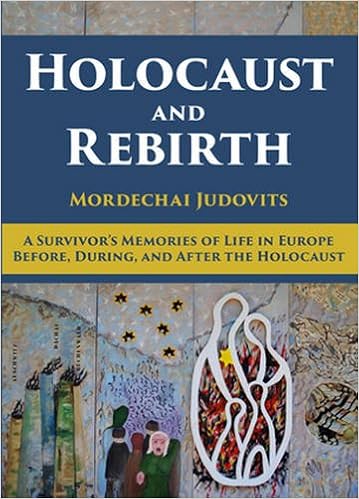
Our Yom Ha’Shoah program this year will take place on Sunday evening beginning with a live presentation via phone from Rabbi Broide and our students participating on March of the Living at 6:00 pm.  The formal program begins at 7:00 pm and features a conversation with our very own Martin Judovits who will share his story of survival and renewal.  Martin’s new memoir, Holocaust and Rebirth, will be available for purchase following the program.


If you have children of a suitable age, I implore you to bring them.  Older people and adults have lived with and met Holocaust survivors.  It is specifically children who are running out of time and opportunities to meet these extraordinary people whom they will look back at later in life and only wish they could have known better.  Babysitting is available at no charge by registering with Rabbi Gershon Eisenberger at rge@brsonline.org


With all the pressures on our time and the endless list of things that we must get done, I simply can’t imagine a more important place to be on Sunday evening than with your children at your side honoring the survivors of our community.


When You Dip the Karpas, Think of AIPAC and What We Could Accomplish With Our Many Voices if We Had One Mission

Last March, I tore my Achilles tendon and needed surgery.  The tear, surgery, and rehab were uncomfortable, but having to miss the annual AIPAC Policy Conference in Washington was painful.  I lay in bed on painkillers, security pass and credentials around my neck, watching the conference live on my laptop.  Not only did I miss the exhilarating two and a half days of the conference itself, but something felt missing from my entire year, though I couldn’t put my finger on it until this week when I once again was able to attend Policy Conference in person.

With its hundreds of breakout sessions, one can learn an incredible amount about a diverse range of topics.  But that is not why I go.  Sitting in the conference center and the Verizon arena with over 18,000 pro-Israel advocates is nothing short of a religious experience.  The diversity in that room crosses religion, ethnicity, race, political affiliation, Jewish denomination, age, and more.


And yet, this large group of people who agree on little and in many cases have little in common, choose to put all of their differences aside and focus exclusively on what they have in common, a love and devotion to the Jewish State of Israel.  I spend the conference swelling with Jewish pride and pride for what our people have accomplished in the short time we have returned to our homeland.  The conference each year features Israeli innovation and technology that are changing the world.  It highlights Israel’s leadership in humanitarian efforts around the world.  It celebrates Israel’s values that are so closely aligned with America’s, including democracy and human rights.


I measure the conference by how many “goose bump moments” occur.  Who could not be moved by Hatikvah being played by virtuoso Hagai Shaham on a repaired violin that the Nazis had forced Jews to play as they witnessed their fellow Jews march to their deaths in gas chambers. Who could not rise to their feet for the endless applause for UN Ambassador Nikki Haley as she pledged “The days of Israel-bashing are over,” adding, “We don’t have a greater friend than Israel.”


The theme for this year’s conference captured the secret to AIPAC’s effectiveness: “Many voices, one mission.”  The idea of “many voices” is nothing new, but having one mission, being singularly focused on one goal, is something we don’t see often and is what makes AIPAC both special and successful.  For two and a half days, nobody discusses what divides us, what makes us different, or what we can’t begin to understand about one another.  AIPAC has one goal, bi-partisan support for the US-Israel relationship and for Israel’s security and military advantage, and it will not be distracted, deterred, or sidetracked from it.  By focusing exclusively on one goal and creating a culture and atmosphere that won’t tolerate anyone hijacking the agenda or changing the conversation, over 18,000 very different people can feel united not only for the two and a half days, but throughout the year.


Imagine what we could accomplish if we follow this model in other areas.  What if the whole Orthodox community found its common ground and we dedicated ourselves towards seeing it through, despite our differences.  Imagine what could be possible if the many denominations within Judaism worked together on matters that we all agree on, without allowing our differences to deter us. Think what we could achieve.


Soon, we will all sit down at our sedarim and dip the karpas in salt water, an odd opening to a night of freedom.  In his commentary on the Rambam, Rabbeinu Manoach suggests that the word karpas is closely related to pasim, the coat of many colors given to Yosef by his father Yaakov.  When the enmity between Yosef and his brothers grew and they sold him into slavery, the dipped his coat in animal’s blood and presented it their father as if Yosef had been killed.


Yosef’s brothers didn’t just hate him. “V’lo yachlu dabro l’shalom,” they couldn’t even speak to him.  R’ Avraham Ibn Ezra explains, “afilu l’shalom.” It isn’t just that they couldn’t talk about the issues they disagreed about. It isn’t that they didn’t want to be close, loving brothers. And it’s not that they couldn’t debate respectfully. “Afilu l’shalom” — The issue with Yosef and his brothers was they couldn’t even give each other a Shalom Aleichem. The hatred and intolerance had grown so deep that they couldn’t stand to even extend greetings to one another or to be in a room together.  This expression describes a disgraceful and shameful state of affairs. They couldn’t even say “good morning,” “how are you,” or “good Shabbos” to one another, let alone attend a conference and work for a common cause together.


Rav Yehonasan Eibschitz in his Tiferes Yonasan has an additional insight on the verse in question. Translated literally, “lo yachlu dabro l’shalom” means “they could not speak to him to peace.” What could that mean? Rav Eibshitz suggests that when we disagree with people, we withdraw from them and stop speaking to them. We see them as “the other,” different from us and apart from us. As our communication breaks down, the dividers rise and grow stronger and stronger.


We can never resolve conflict, find common ground, or maintain a relationship despite our differences, if we can’t even have conversation between us. Had Yosef and his brothers been talking, he might have communicated how he felt isolated and alone, and they might have explained how his tattle-telling and the favoritism their father displayed toward him were very painful to them. However, “lo yachlu dabro l’shalom.” They weren’t talking at all, so they couldn’t use speech to achieve peace, or even just civility, between them.


We begin our seder, our night of freedom and liberation from bondage, by remembering what started it all, how we found ourselves in Egypt to begin with and the source of our slavery and suffering.  Sinas chinam, baseless hatred, intolerance, and animosity landed us in Egypt and, if we don’t want to find ourselves metaphorically back there again, we best learn the lesson of the dipping of the karpas and kesones pasim.


To be clear, there are important things we disagree about and there are times, places, and platforms to explore those differences and debate them.  However, if we spew venom and rhetoric at one another, look to find fault, pursue our agenda in a militant fashion without respect for other views, if we try to marginalize those we don’t like or agree with, we can never come together on the things we do have in common.  AIPAC proves that when we want to, we can maintain our many voices, but still pursue one mission, but everything begins with being able to communicate b’shalom, peacefully and civilly.


When the Bullies Go Low, BRS Goes High: A Sad Update on Matthew Kelly and Boca Raton Synagogue

At so many points during this past month, I have not known whether to laugh or cry.  As I was assaulted with emails, texts, voicemails, social media campaigns, and numerous videos spewing outrageous and hateful lies, I laughed out loud because of the ridiculousness, preposterousness, and absurdity of what was being said.  When I read and heard about the “special place in hell reserved for me,” how I “dishonor the memory of those killed in the Holocaust,” how nobody should marry my children or come within four feet of me, how I should “be fired and thrown to the garbage” by my community “yesterday,” how I am the biggest rasha, wicked person since Korach,  among many more charming comments, I mostly laughed.

When my wife was harassed, chastised, and instructed to be more like the wife of Ohn ben Peles and stop her wicked husband, I laughed a little less.  When a video posted to Facebook challenged, how could Rabbi Moskowitz repay God in this way after his prayers were answered and he was cured from cancer, I stopped laughing.


And then I got a letter from Matthew Kelly, the speaker around whom this invented scandal erupted, and not only did I no longer laugh, I cried. I literally shed tears.  He writes (see the complete letter at the end of the article):


Dear Rabbi Efrem Goldberg,


It is with a profound sadness that I write to you today to inform you that I have decided not to present to your community this coming Sunday.


Over the past month, at an ever increasing rate, I have been receiving phone calls, emails, social media messages, and You Tube video messages warning me not to come. To summarize, I have been accused of being an “anti-Semitic idol worshipping missionary bozo.”


This harassment at first felt like a simple disagreement between people who love God. As this hate campaign continued it has grown in quantity, disrespect, and intensity: disagreements became harassment, harassment became bullying, bullying turned into threats lightly veiled as warnings, and finally, the warnings became all out threats. But woven into every message I have received is fear not courage, and hate not love. What we do out of fear should always be questioned and discerned. What we do without love always has a lesson to teach us.


At first, my concern was for your safety due the hateful words that were directed towards you, but it is now very clear that there is a dark cloud over my own safety. As a result, I no longer feel that it is safe to appear and speak at the Boca Raton Synagogue this weekend.


These critics have lied, taken extreme positions, refused to be distracted by the facts, and promoted the defamation of one good man, and another who is striving to be a good man. You are the former, Rabbi…


It is perplexing that such criticisms were leveled at you and me, given that my presentation was to be in the area of professional development. For more than two decades I have been speaking to people of all faiths and people with no faith. I have spoken to groups of politicians, school children and college students, and the Fortune 500 business community has welcomed my presentations with open arms. In every instance, I have been respectful of the audience and tried to exercise the emotional intelligence necessary to avoid alienating or offending anyone.


But the critics in this situation seem to have focus exclusively on my spiritual convictions, and have attacked me in a way that I would never dream of attacking someone else.


We have so much in common and it pains me that I would be falsely accused of seeking to dissuade the people you lead from the beauties of Judaism. Nothing could be further from the truth…


The individual and his followers who launched and relentlessly promoted this campaign predicated on lies will undoubtedly feel victorious and that they triumphed in what they have explicitly called their “holy war.”  They will surely say they prevented a chillul Hashem by stopping a missionary from speaking “in front of the holy Torahs.”


But here is the thing – Matthew Kelly is a motivational speaker and business consultant and while a proud practicing Catholic, he is not a missionary to the non-Catholic community.  The truth is they have not prevented a chillul Hashem, they have perpetrated one.  They have not “won.” God’s honor has lost.


Through their absurd campaign, the critics who have spread lies, slander, hate, and threats have also ironically spread more of Christianity’s teachings, tenets, and texts to the Jewish community than Matthew Kelly ever has or would.  Through their campaign they have achieved exactly what they illegitimately declared Kelly was going to do – they have driven Jews further away from Judaism.


Civility, derech eretz, disagreeing agreeably, and speaking with dignity are hallmarks of Boca Raton Synagogue and core values of our community.  That is why my BRS colleagues and I have taken the high road.  We have not responded to one nasty or threatening post, comment, email, or message.  We refuse to get down in the mud and lower ourselves to the level of those behind this campaign of lies and distortions and that will not change.


Our BRS community slogan, proudly embedded in our logo and displayed on every single piece of literature the shul produces, is “Valuing diversity, celebrating unity.” Our derech eretz statement, which sets forth our expectation that people in our community communicate their diverse views respectfully and appropriately, is prominently displayed in our bulletin every single week and referenced regularly in sermons, classes, and writings.


This entire “scandal” was manufactured by people outside of our community who have an axe to grind.  While a few have inquired what this is all about, literally not one member of Boca Raton Synagogue has objected to Matthew Kelly speaking or has questioned our judgment or the judgment of our rebbeim to whom we turned to for guidance on this and other matters.


That is why rather than engage these individuals, our response is to affirm our BRS values and dedicate ourselves even harder to promote them in our community and beyond.  In response to this massive chillul Hashem, we will be holding an event centered around civility and derech eretz that I know will prove to be unforgettable.  We look forward to a phenomenal turnout, a clear rejection of the methods and language that has been directed at our community, and a strong commitment to create a community and culture that allows for principled disagreement and debate but insists on respect, dignity and honor.


The people who sought to make my life miserable employed an age-old tactic – bullying.  They tried to bully not only me, my wife, and fellow BRS rabbis, they bullied my rebbeim with harassing phone calls, they bullied the Chief Rabbinate of Israel to reject my conversions, and even tried to bully an Israeli newspaper to run a story on us.  They called on thousands to “disrupt the program and the synagogue” and have attempted to bully our members to fire us or demand we resign.  They must be held accountable for their bullying and their tactics and I hope the broader Jewish community will condemn them and marginalize them.  (For starters, please contact the website that hosts these vile videos and demand all of Yosef Mizrachi’s videos be removed – https://www.torahanytime.com/#/contact-us)


Before the seminal moment of revelation at Sinai, before God gifts us His precious Torah, He says, “If you will obey Me faithfully and keep My covenant, you will be My treasured possession among all the peoples. Indeed, all the earth is Mine, but you shall be to Me a mamleches Kohanim, a kingdom of priests, and a goy kaddosh, a holy nation” (Shemos 19:5-6).  Our national mission is to be a people that sanctifies God’s name.  Each time we recite Kedusha, we reaffirm that pledge – “nekadeish es shimcha ba’olam, I am committed to sanctify your name in the world.”


It is not a coincidence that when the Torah warns us “V’lo sechalelu es sheim kadshi, we must not ever perpetrate a chillul Hashem, it immediately enjoins us, “v’nikdashti b’soch b’nei yisroel,” instead we must be dedicated to sanctifying Hashem’s name.  Rabbeinu Yona writes, the only antidote to chillul Hashem, the only repair to the devastating damage it leaves in its wake, is to fill the void with Kiddush Hashem, sanctification of Hashem’s name.


Eliminating bullying and the chillul Hashem that ensues begins with ourselves, our interactions, our digital footprint, and our way of interacting.  Sadly, due in part to social media and in part to other contributing factors, bullying and boycotting are becoming the new normal.  Otherwise kind, good and thoughtful people are unintentionally engaging in bullying and likely don’t even realize it.  When you have a bad meal at a restaurant and you rant about it online and call on your friends not to go there, you are bullying.  When you spread unsubstantiated rumors about local businesses and contribute to conflict, you are bullying.  When you look down on, are cynical about, or condescending towards, those who are not exactly like you religiously, politically, demographically, or in any other way, you are a bully.  When you are insensitive or cruel in your interactions with your spouse or children, you are a bully.


We are each responsible not only for how we speak but for the type of speech we tolerate within our space. Space can mean our Shabbos table, it can mean at the water cooler, and in this moment in time it most definitely means on our social media platforms. When we remain “friends” with toxic people, when we allow hateful and vitriolic comments, we are guilty by association. While there is much we should tolerate, bullying, hate and disrespect are not among them. Our Torah websites must not be platforms for chillul Hashem, our Facebook walls must not be podia for negativity, and our Shabbos tables must not be spaces for lashon hara, gossip, slander and hurtful talk.


Not stooping to the horrifying level of those who have sought to contaminate our community with their venom is not enough.  We must negate their bullying with kindness.  We must offset their grand chillul Hashem with marvelous displays of kiddush Hashem.  We must drown out their negativity with positivity.  We must silence their incivility with a viral campaign of derech eretz and respect.


If we each take responsibility to improve ourselves, to be more pleasant, and to sweeten one another’s lives, the light will dispel the darkness of this unfortunate episode, we can realize our mandate to be a goy kaddosh, a holy people, and we can, in fact, be Hashem’s treasured people.


[pdf-embedder url=”http://rabbisblog.brsonline.org/wp-content/uploads/2017/02/mathew-kelly-letter.pdf” title=”mathew kelly letter”]


Victimized by Fake News: Setting the Record Straight on Matthew Kelly Speaking at BRS

Fake news warning signFake news doesn’t distinguish between parties or victims.  At the end of his term, former President Obama bemoaned the explosion of fake news and current President Trump has referenced the phrase often since entering office.  This month, lawmakers introduced two bills that would legislate schools to teach students how to distinguish fake news from the real thing.
Wikipedia describes “fake news” as websites that “deliberately publish hoaxes, propaganda, and disinformation purporting to be real news — often using social media to drive web traffic and amplify their effect. Unlike news satire, fake news websites seek to mislead, rather than entertain, readers for financial, political, or other gain.”


Thousands of years ago, the Torah warned us of fake news, only it called it a different name – lashon hara, wicked gossip and slander.  The Torah warns, “Lo seilech rachil b’amecha, do not go about as a talebearer among your people.” (Vayikra 19:16) Why is talebearing called rechilus?  A rachil is a peddler, one who goes door to door, but instead of selling encyclopedias or Girl Scout cookies, the rachil is peddling fake news and slander.  Rechilus is a particularly insidious form of gossip, as the perpetrator seeks to make slander go viral.  The Gemara (Erchin 15b) cautions us about the grave danger of rechilus and warns that it destroys three people – the peddler, the recipient, and the subject.


Sunday morning, I woke up to fake news about myself in my emails, texts, Whatsapp messages, social media feeds, and every other form of communication.   When my phone lit up with people calling me, I quickly learned it had been sent around the world.


HELP!!!!!!!!!! Chilul HaShem being made!!!!  Am Israel we have a kehila of over 1000 Modern Orthodox Jewish families in danger and they don’t even know it.  The leadership at Boca Raton Synagogue in Florida is bringing The #1 Catholic MISSIONARY in the World to speak about the purpose of life…Reasoning with Rabbi Efrem Goldberg at the leadership has failed. They think that this guy is not coming to recruit PURE JEWISH SOULS and will just motivate them, putting his missionary work aside for the day…Am Israel, We NEED YOUR HELP. Call the Gdoley HaDor, your local Beit Din, local Rabbi’s, Jewish KIRUV Organizations, and anyone else that cares and get these naive leaders to stop this before it’s too late.


Don’t be surprised about Heavenly punishment from the Creator when His Name, His Torah and His people are being desecrated.  If you care about saving jewish souls from Christian/Catholic Missionaries then please share this.


This message was soon followed by a barrage of emails such as:


Mr.Amalek, why would you invite such a rasha to speak? You’re not afraid of your judgement day when you’ll leave this world? acting like you’ll be here forever. Full of ga’ava. Zero yirat shamayim. Busha vecherpah. Erev Rav amalek you are!


Posts and comments, including “How dare you call yourself “orthodox,” “May Hashem have mercy on you for making his children go off the derech,” and “we should call you Father Efrem” soon followed.


Like fake news, this was and is a propaganda campaign instigated by an individual whose intent is to mislead and goal is to cause havoc.  To set the record straight, here is the rest of the story:


Last year, after a discussion regarding marriage counseling, a well-respected therapist in New York, whose Torah observance is unimpeachable, sent me a book about relationships titled “The Seven Levels of Intimacy.”  The book included no references to religion and was excellent, worthy of its status as a New York Times bestseller. I looked into the author, Matthew Kelly, and found other brilliant, secular material he authored, as well as his professional web site referencing the forty companies on the Fortune 500 list who are his clients.  He is an internationally renowned motivational speaker and consultant who is sought after around the world.  We invited him to give a seminar at Boca Raton Synagogue and he graciously agreed.


If you Google Matthew Kelly you will find that he is also a devout Catholic who is proud of his religion and dedicated to teaching its principles and values.  He is not a pastor or a priest, has never engaged in missionary work to convert Jews, and has clearly delineated separate intellectual disciplines, including different web sites that distinguish his professional profile and career from his personal religious pursuits. Study his business website (http://floydconsulting.com/) and you won’t find any reference to religion.


The agitators of the campaign against me would have you believe that a missionary has been invited to share his religious beliefs and convert our members to his faith.  They give the impression he is speaking on Shabbos morning, in front of the holy ark and is being provided a platform to “make people go off the derech.”


Here is the truth – Boca Raton Synagogue invited Matthew Kelly to give a talk on a Sunday evening in our social hall.  Part of the arrangement was that there would be no reference to religion and that his talk would be consistent with the secular motivational speeches he regularly delivers in business forums.  Not surprisingly, Mr. Kelly had no issue with this at all, and was on the same page as the shul regarding the subject matter of his presentation.


To be clear, I recognize that not all communities are as open as ours in inviting diverse speakers.  I respect those communities who would not invite Matthew Kelly or any other non-Jew or even a non-observant Jew to address their members.  That is their standard and their choice and we would never challenge them or judge them for it.


However, I feel it is perfectly within halacha and Jewish values for us to have extended this invitation.  Recognizing my personal bias, when the fake news campaign struck, I sought the counsel of two of our generation’s greatest poskim, one in Israel and one in America.  After providing the exact facts I’ve presented here, both felt there was absolutely no reason to cancel Mr. Kelly’s appearance provided that he was not speaking about religion which, again, he isn’t.


While I would never provide a platform for another theology in our Shul or invite our members to possibly be convinced by it, it is interesting to note that the biggest critic of our hosting Matthew Kelly held a three-hour debate with a professor of Christianity who freely shared his views, religious beliefs and theological arguments inside a holy synagogue and repeatedly recited the name of a foreign deity.  (https://www.youtube.com/watch?v=UQ6ZIMPm-KE&app=desktop)  Our rabbis teach (Kiddushin 70a) kol ha’poseil b’mumo poseil, whoever invalidates another, does so with his own flaw.


Lest you think Boca Raton Synagogue has engaged in a radical departure from the rest of the Orthodox community by having a non-Jewish presenter who holds beliefs different from our own, consider that Agudas Yisroel of America has hosted the following speakers at its dinners: Zalmay M. Khalilzad, a religious Muslim-American, the late Justice Antonin Scalia, a proud Catholic whose son is a priest, Senator Cory Booker, an outspoken proponent of same-gender marriage, and then-Rep. (now Director of National Intelligence nominee) Dan Coates, a devout Presbyterian who drew parallels between his religion and ours, among others.  Of course, the obvious explanation for their presence is they were invited to speak about something other than their beliefs that contradict our own. They had vast resources of wisdom and inspiration to offer beyond their faith. The same is true with Matthew Kelly.


Perhaps a closer analogy is the great Stephen Covey.  Search the words Stephen Covey and Torah and you will find countless pages of Jewish web sites quoting Covey’s famous “Seven Habits of Highly Effective People” in the context of Divrei Torah.  Examples include chabad.org, klalperspectives.org, aish.com, torahlinks.org, torah.org, ou.org, and jewishpress.com, to name a few.


Undoubtedly, if orthodox synagogues could have afforded Covey, they would have eagerly hosted him to deliver his famous, revolutionary motivational and productivity lectures.  And guess what: Covey was a practicing member and leader of the Church of Latter Day Saints.  He authored several devotional works including: “Spiritual Roots of Human Relations,” “The Divine Center” and “6 Events: The Restoration Model for Solving Life’s Problems.”


It is legitimate to have a different opinion from mine about the choice of inviting Matthew Kelly to address our community.  It is not legitimate to spread fake news, share only part of a story, distort the facts, and slander a community.  I am proud of the sizable amount of shiurim and Torah learning our shul offers, and of the many visiting scholars and world famous Roshei Yeshiva who inspire our BRS community regularly.  We care deeply and unconditionally about the spiritual growth and well-being of our community and would never compromise or risk them.  We would never proceed with this program without the support of our poskim, true gedolei Yisroel.


The Torah has a specific prohibition regarding listening to gossip and slander, and in fact, our Rabbis teach that one who accepts such speech and communication is worse than the one speaking it.  The burden is on us not to accept everything that enters our inbox or our ears as truth, accurate or the whole story.  We must be discerning in distinguishing fake news from the real thing and should be especially careful and cautious when we know the subject being spoken about and he or she deserves the benefit of the doubt.


Make no mistake, like fake news stories, a systematic campaign has been organized by a person with an agenda.  He has employed grossly unethical, deceptive, and nefarious tactics that are unbecoming of any decent and honest human being, let alone a true yirei shomayim.


I can’t pass legislation that educates how to distinguish fake news from the real thing.  However, I can ask for your help to share the truth, stand up to boorish bullies and not let the peddler instigating this episode to successfully peddle his slanderous wares.


We Cannot Control Enemies from Without But We Can Stop Being Our Own Worst Enemies From Within: A Call for a Kiddush Hashem Campaign

Image result for un vote

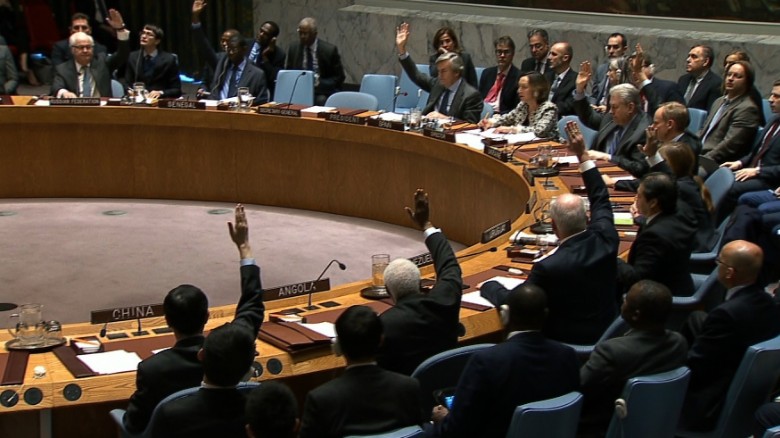
What was supposed to be a Chanukah week of joy and happiness has in fact been challenging and difficult.  On the very holiday celebrating our liberation from the Syrian Greeks occupying our most sacred space, Har HaBayis, the Temple Mount, the UN Security Council passed a resolution declaring that we are in fact illegally occupying the very location of our miracle.  Acutely painful was the abstention from the vote by Israel’s closest ally in the world, who participated in—if not outright orchestrated—the ambush and betrayal.  That pain was compounded by the lopsided, unfair, historically inaccurate rebuke of Israel by the Secretary of State before the entire world.


I think these events have been particularly agonizing because they represent a harsh wake-up call to the reality that as much as things have changed over time, they have by and large stayed the same.  Israel may contribute to global medical and technological advances, may be the first to arrive at humanitarian disasters, may be a beacon of democracy and human rights in a region devoid of either, but at the end of the day, the prophecy of, “hein am levadad yishkon, they are a nation that will dwell alone,” remains true.  The vote was 14-0, with our greatest ally abstaining.  That is the epitome of levadad yishkon, isolation and solitude.


As excruciating as these developments have been, they were predicted and prophesized.  While we should never stop fighting anti-Israel activism, standing up for truth, justice, and our beloved Israel, we should stop allowing ourselves to be lulled into the fantasy that Israel or the Jewish people will be treated more fairly now that we have a modern state, than we have as a people throughout our long and mostly lonely history.


The Torah predicted our adversaries and opponents from without.  What has made this Chanukah particularly challenging has been our adversaries and antagonists from within.  The last few weeks have seen prominent scandals and arrests involving observant Jews, including the second largest hedge fund fraud in history.  In the week in which we light our Menorahs to dispel the darkness and illuminate the world, our light and our sacred mission have been dimmed by these heinous alleged crimes and the great desecration of God’s name that has resulted.


We cannot control the enemies that rise from without, but we can and must stop being our own worst enemies from within.  We have a mission and mandate to model for the world a life of values, guided by ethical principles and lived with kindness, dignity, integrity, and sanctity.  Following each headline featuring a scandal, we must redouble our efforts to offset the damage by making positive impressions and conducting ourselves in ways that will bring all with whom we interact to appreciate the Ribono Shel Olam, the Master of the Universe, and to jump on board to perfect His world.


Opportunities for Kiddush Hashem, sanctifying God’s name, are all around us.  Just this week, Mr. Hershel Waldner, a Chassidic employee of B&H in Manhattan added great light to the world and helped offset the darkness with a generous act of lovingkindness.  He was walking in Manhattan when he found a wallet with a driver’s license, credit cards, and cash, but no contact information other than a business card with a handwritten phone number on the back.  Mr. Waldner called it and the man who answered was the boss of the wallet’s owner, who was in New York for a few days of vacation.  The boss put them in touch and the stranger came to B&H Photo to retrieve his wallet with great gratitude and appreciation.


We don’t all discover wallets and aren’t presented with prospects for acts of Kiddush Hashem that will make it to the newspapers, but we do have daily opportunities to advance the mission.  Here are a few to consider, particularly during this season of the year:


  • I have not formally studied the subject, but it stands to reason that, on average, there is more garbage picked up after the weekend outside Observant Jewish homes than from our neighbors. We have all seen the multiple garbage cans plus overflow bags following each Yom Tov, let alone a three-day holiday.  Wouldn’t it be amazing if every observant Jewish family tipped their sanitation workers once a year and communicated gratitude for literally handling our garbage?  The same goes for the people who deliver our mail.  True, they are paid, but so are many of us who still appreciate gestures of appreciation.
  •  


  • When we go out to eat, we are served and waited on by people who work hard and are not retiring on the salary the job provides. At the end of the meal, we have an option.  We can be stingy, exacting, and look to reduce the tip because of flaws in the service.  Or, we can be generous, magnanimous, appreciative and overlook what might not have been perfect.  If we choose the latter, coupled with common courtesy like please and thank you, we can advance the mission more than we think.  The few extra dollars between a generous or miserly tip will unlikely affect our lifestyle or savings but they are a great investment in making a Kiddush Hashem.
  •  


  • Some people have part-time or full-time help at home. Often, these individuals clean our messes, scrub our toilets, do our laundry, and much more.  They add great value and service to our family and while they are paid for their work, they are too often mistreated, dealt with disrespectfully, or taken advantage of.  Be fair and transparent about whether they will be partially paid when you are on vacation.  Consider giving a gift or tip this time of year to say thank you.  Treat them as you would want your family members treated in the same position.
  •  


  • Next time you are standing on line in a store or supermarket, watch as people approach the cashier and notice how many are talking on their cell phone and never look at or engage the person helping them. Cashiers stand on their feet all day providing a service.  They deserve not to feel invisible or insignificant.  When you get to the front of the line, hang up the phone, look your cashier in the eye, ask him or her about their day and say thank you.  Consider using their name when addressing them.  You wouldn’t believe the positive impression you can make just by using someone’s name.
  •  


Rabbi Yosef Shalom Elyashiv zt”l once commented that every generation possesses a mitzvah that is especially significant for its time. Previous generations were challenged with the mitzvah of dying al Kiddush Hashem.  Rav Elyashiv said the mitzvah for our day is to “let the Name of Heaven become beloved through you.” Our mitzvah is living al Kiddush Hashem.


We cannot easily impact the way the UN votes on Israel or how fair or friendly the administration will be.   However, it is entirely in our hands to not God forbid hurt our people by setting back the mission, and instead always act like a mensch and thereby bring greater light into the world.


Rabbi Efrem Goldberg

Join Our Community

Subscribe to our newsletter or connect with us on WhatsApp.