Are They Humoring Us or Do Our Solidarity Visits Matter? Reflections on 2 Days in Israel this Week

I have been longing to go to Israel all summer. Each day while following the news and connecting closely with the unfolding of events I have felt drawn to walk the land of our forefathers, to be one with our brothers and sisters and to experience the destiny of our people not as a spectator on the sideline, but on the big stage itself. While some have experienced Israel fatigue, growing tired of the rallies, sermons and articles focused almost exclusively on Israel, I have felt the opposite  –  an increasing appetite and craving for more.


All summer long we have watched and read about the incredible displays of unity, the remarkable acts of chesed, the courage and bravery of a people forced to endure the kidnapping and murder of three of their children, the incessant fall of rockets, the danger of sending their boys into battle and the challenge of living normal lives in utterly abnormal circumstances. The people of Israel have more than risen to the challenges; they have been brave, filled with faith, and resolute in their unwavering commitment to our land, our people and our values. Like an uncomfortable itch that is gnawing to be scratched, each and every day of this summer I have been uncomfortably itching to show solidarity and to be part of our people’s experience in Israel directly, not simply watching from the side.


And so, when the opportunity presented itself to join nine of my rabbinic colleagues on a very brief solidarity visit to Israel organized by the Orthodox Union, I jumped at and I remain deeply grateful to my wife and our BRS President for giving their consent, support and encouragement.


What could one really accomplish in two days? How much could one see, do, and experience? The answer, I learned, is an enormous amount.


Our group made a shiva visit to the Turgemans, whose four-year-old son was murdered by a mortar. We visited an iron dome installation and a tank unit still gathered on the Gaza border. We met the people of Sderot, shopped in their stores, visited their Hesder Yeshiva and met with its Rosh Yeshiva. We met with an incredible youth program in Sderot and participated in a siyum by one of their madrichim (youth leaders) who studied most of the mesechta (tractate) during his time fighting in Gaza. We toured a Kibbutz two miles from Gaza that was hit 19 times by rockets in the last three months alone. We spent significant time with the Shaer family whose son Gil-ad was kidnapped and murdered. We met with the Chief Rabbi of the IDF as well as with Col. Bentzi Gruber, an expert on war ethics who is responsible for directing 20,000 soldiers. We visited Soroka hospital and spent time with injured soldiers and their families.


The real question is did our visit matter, not only to us who got to scratch our itch to be in Israel, but to the people of Israel itself? I must share with you that as I read our itinerary on the plane over, I was somewhat skeptical and even cynical. All summer we have seen pictures and read testimony of American rabbis and lay people who went to Israel to show solidarity. But while the trips made those who took them feel connected, inspired and motivated, what impact did they truly have on those whom they came to support?


Were the soldiers on the army base, the injured ones in the hospital and even the Sha’er family just going to humor us? Were the people in the south and dignitaries we met going to be courteous and kind on the surface, but in their hearts feel like props in a photo op? Our visit would certainly make us feel good, but would it really matter to the people we came to see?


Among the powerful messages of this short trip is not only did our visits matter, but we were blown away by how much they seemed to matter. I want to share with you a few of the reactions to our visit, not as an expression of self-congratulations, but to communicate and hopefully inspire you to coordinate a visit of your own as soon as possible with the recognition that it truly matters.


  • A few of us took a cab to daven at the Kotel early our first morning. The driver described that in the last 50 days he has barely had any business. He averaged 70 shekels of income a day while his fuel costs exceeded 100 shekel a day. He asked us to encourage visits to Israel as soon as possible to help the damaged tour industry recover and thanked us for being in Israel and supporting the economy.
  •  

  • We stopped in Sderot on our way to an army base in order to buy cold drinks, food and treats. The owners of the stores we entered described how challenging it has been to make a living this summer with so few people leaving their homes as the sirens sounded regularly and rockets fell incessantly. While of course we thanked them for the resilience and courage in not allowing our enemies to drive them from their homes, remarkably they overflowed with gratitude to our group for visiting and showing support. The woman who owns the Judaica store described how she was born in Sderot, got married in Sderot and will not be driven from Sderot.   We hit a remarkable impasse when we tried to support her by shopping broadly while she insisted on giving us discounts in appreciation for our visit.
  •  

  • When we arrived at the army base on a steaming hot day, I knew the soldiers would appreciate the goodies, but I didn’t realize how much they would welcome our warm sentiments and love. Rabbis Topp and Posey bought cards written by the children of their community in LA. I watched as they handed out the cards to the soldiers and wondered if they would even read them after we left or just toss them aside. As we were gathering to get on the bus, I was amazed as a soldier rushed up to R’ Topp and asked him, “can I please have one too.” Our well wishes and messages of support clearly matter.
  •  

  • Our visit with Ofir and Bata Galim Shaer was transformative. They are beyond exceptional people who have emerged role models and teachers to us all. Their response to the kidnapping and murder of their son Gil-ad is nothing short of heroic. As we pulled into their home in Talmon, I wondered if they really wanted to meet with us. After all, shiva and sheloshim were completed and I imagined that they must be trying their hardest to return to some sense of normalcy. Not only did they greet us warmly and host us graciously, they were tremendously expressive of their gratitude for our visit and for demonstrating that we have not forgotten their ordeal. We went around and all shared the rallies, tehillim gatherings and sheloshim ceremonies held in our communities. We told them about how you, my beloved friends, felt their pain personally without even knowing them. They told us how our visit closed a circle for them as they heard about the support from American Jewry, but meeting us in person and by extension feeling the love of the communities we represent, gives them great comfort. Ofir hugged each one of us and gave us his email and cell phone number asking us to keep in touch.
  •  

  • There are, thank God, only three soldiers remaining in Seroka hospital ailing from their injuries due to the war. The first, Dan, who has undergone 12 surgeries in the last month, was not feeling well enough to receive us, but we spent time with his family. The second, Yehudah, sustained a direct injury to his head and has been in a coma for the last few weeks. He will please God wake up to find out that his wife has given birth to their son. The bris took place outside of his hospital room shortly before our visit and we were invited by the family to eat from the seudas mitzvah and share in the simcha, as bittersweet as it was. The third soldier, Roi, has undergone three surgeries in the last month and still needs more. We visited with him and his parents and frankly they all seemed tired from the attention and eager to just go home. They were lukewarm in our conversation until we shared with them how in all of our Shuls, every single day following davening we say tehillim on his behalf and for all of his comrades injured in battle. Roi and his parent’s eyes literally opened wide as they had no idea and couldn’t believe that people in our communities from the East Coast to the West Coast of America think about and care deeply about them literally every day. Their shyness to our visit turned to expressive appreciation as we invited Roi to visit our communities and enjoy a vacation to America on us.
  •  


Not everybody can go to Israel on short notice for a very brief trip. However, we can all continue to do more to show our appreciation, support and love to those who are sacrificing so much, some economically, some through trauma, some sustaining injuries and some paying the highest price for our people and our land.


If you can plan a trip to Israel in the short future, don’t hesitate, do it now. If you can’t, you can continue to contribute to causes that provide for our soldiers, you can send cards and messages to those who have experienced loss from this war and you can continue to daven for the recovery of the injured and the well-being of the IDF.


We learned so much from this trip, but most of all we learned that our expressions of support and love truly matter, so please don’t stop sharing them.


Sometimes Confusion Breeds Clarity

**NASA astronauts have a special word to describe how re-entry feels, and it isn’t heaven. I wrote this during the 72 hour ceasefire this week in which Israel and those who care deeply about her experienced a re-entry into a small semblance of quiet and normal.  Though Hamas has resumed launching rockets and Israel has been forced to respond, my concerns below remain deeply relevant for when this will please God finally be over in a lasting sustainable way and are worthy of consideration and thought now, even before this is over.


__________________________________________________


What will we do when this is over?


For nearly two months, we have been drawn to the news 24/6 to follow what was happening in Israel, even reaching for the phone in the middle of the night to be updated in real time. For nearly two months, we have showed up at rallies, vigils, and gatherings, and put our differences aside to join together in ways that made us feel more united than ever. For nearly two months we have mourned and grieved for people we never met as if they were our family or closest friends. For nearly two months we have limited our posts on social media to links about Israel: we didn’t care how our sports teams fared, we weren’t obsessed with how our portfolio performed, we weren’t in the mood to show off our children or pet or gloat about the delicious new recipe we prepared.


For nearly two months we have minimized our own personal challenges and we have refused to feel hurt or injured by the small things that might normally debilitate us. For nearly two months we have been more forgiving, more compassionate, kinder and more generous. For nearly two months we have watched countless videos and clips and alternated between crying from sadness to crying from being uplifted. For nearly two months our davening has been more sincere, more personal, and more real. For nearly two months we have been magnetically drawn to the land of Israel and the people of Israel like never before.


To put it simply, for nearly two months our souls have been alive as we felt meaning, purpose, transcendence, and peoplehood, as participants and witnesses to the very unfolding of Jewish destiny.


What will happen when thing go back to “normal?” Will our souls go back to sleep, back into hibernation, back to a place where we struggle to touch it, to nourish it, and to feel it pulsate within us? I am fearful of the vacuum that will be created and the void we will feel in returning to mundane conversations, reading meaningless posts, and longing with desperation to have up-to-the-minute updates about events in Israel.


Don’t get me wrong. I am neither happy that Israel had two months of agony, nor am I sad at the prospect of it ending. I am, however, devastated and distressed at the thought of moving on and returning to our state of affairs before this all began.


How long will it take before Jewish factions begin fighting, bickering, and dismissing one another? How long will it be before our davening becomes rote, the utterly insignificant feels critically important, and the feeling that we have nothing in common with those that are different than us returns? How long before, for too many, Israel returns to the place they go for Sukkos, send their children for summer programs or a gap year, or make a bar/bat mitzvah, rather than feel be the physical and spiritual center of the universe?


One of the most popular questions I am asked, and one of the most elusive goals for many, is how can we be more spiritual? “Spirituality” is a buzzword not only in general society, but among observant Jews as well. We have conferences, conventions, programs, speakers, and journals all dedicated to how Judaism can yield greater spirituality.


As we approach Shabbos Nachamu, the Shabbos of comfort and consolation, perhaps we can find solace in the past two months by looking back and realizing that in fact we gained the secret to what makes our souls feel alive and the keys to feeling spiritual. Our soul is nourished with a healthy diet of peoplehood, unity, sincere prayer, kindness, generosity, connection with our homeland, meaning, and focus on that which truly matters. We knew it intellectually beforehand, but we hadn’t experienced it at this level and we couldn’t necessarily describe what it felt like.


Now we can, and though it is only natural that these feelings will dissipate, it is up to us to make sure they don’t disappear altogether. Now we know that when we crave spirituality, we should seek to truly empathize with someone else’s pain, to dig deep and graciously give, to connect with the condition of the greater Jewish people, to daven like our words truly matter, and to focus on pursuing meaning and purpose, rather than just happiness and pleasure. Now we know that we don’t have a soul; we are a soul, and nothing in the world feels better.


The last two months have brought great confusion. Why can’t Israel live in peace and harmony? Why do so many insist on hating us, targeting us, judging us unfairly, and seeking to annihilate us? How could so many sophisticated, intelligent, informed people be so backwards when it comes to evaluating this conflict between Israel and Hamas?


Sometimes, it takes utter confusion to gain clarity. In the last two months among all of the confusion, we have felt a clarity of purpose, of belonging and of mission.


Nachamu, nachamu ami, Yeshayahu Ha’Navi speaks to us today, after the last two months, as we so desperately need his message. He says be comforted, be comforted my people. Explains the Slonimer Rebbe, when will you find nechama, comfort? When you function like ami, my people.


Though we long for rockets, conflict, and war to come to a truly peaceful and lasting end, let’s not let the feelings we experienced and the levels we reached during this period end anytime soon. We now know what spirituality feels like. We have no excuse not to do what is necessary to achieve it more regularly.


It’s Time for Jewish Organizations to Stop Placing Obituaries in The New York Times

With Israel’s military superiority, there is little doubt that despite its already great cost, Israel will physically defeat Hamas. While the IDF needs our prayers and certainly benefits from our care packages and donations, there is little more we can do to assist our incredibly brave and resolute soldiers in their fight on the ground.


It is this war’s second front that needs our help, and in which each one of us must be a soldier. Much of the mainstream media, too many in the international community, and even our own elected officials here in America have cast Israel and the IDF as the immoral aggressor firing indiscriminately on civilians, rather than more accurately as the victim of heinous terror simply trying to defend her people while taking extraordinary measures to protect Palestinian civilians.


The pain of the loss of fifty-six precious soldiers, combined with our collective concern and worry for the people of Israel as rockets continue to rain down on them, is compounded by the literally unbelievable statements and comments coming from people who absolutely should know better.


This week we heard people in the highest levels of American leadership say such things as, “We have to confer with the Qataris who have told me over and over again that Hamas is a humanitarian organization,” while another said, “I’m not a military planner but Hamas puts its missiles, its rockets in civilian areas, part of it is Gaza is pretty small and is densely populated.” Despite having found rockets in three UN schools and a booby-trapped UN clinic taking the lives of three IDF soldiers, the White House didn’t hesitate from saying an Israeli strike on a UN school was “indefensible,” even without knowing the details.


While we are winning the war on the ground, by all estimates it seems we are losing the war of words. On that front, Israel and all who support her are facing many adversaries on TV, the internet, and in print. The most prestigious and authoritative media outlet, that with perhaps the largest readership and overall impact, is the New York Times.


For years, many have called out the New York Times for their bias when reporting about Israel, while even pro-Israel advocates defended their coverage.   However, in this latest conflict, from the headlines, to the pictures, to the moral equivalency between Hamas and Israel assumed in almost every article, the bias and slant in the New Times are undeniable.   Certainly, the paper and its staff are entitled to take positions on what is unfolding. What they are not entitled to do, though, is present their opinions as objective and unbiased coverage.


Yes, The Times has included opinion pieces that favor Israel, and no, not every single article can be accused of being unfair. However, the clearly documented overall slant of the coverage is so disturbing and offensive that in the last few weeks, many lifetime subscribers have canceled their subscription, for some something almost as painful as the amputation of a limb without anesthesia. In fact, last week, Rabbi Haskel Lookstein, the Rabbi of Kehilath Jeshurun and Ramaz in Manhattan sent an email to his community calling on them to cancel their subscription and “to deliver a clear message to its editor.”


Calls to boycott The Times have come before and either because the numbers were simply not effective or for other reasons, the message was clearly not delivered loudly enough to the editor. I would like to suggest that there are other addresses for us to voice our dissatisfaction with The Times’s coverage of Israel in a way that will hopefully have an impact on the fairness of their reporting, but minimally will allow us to say we participated as soldiers in the war of words being waged against Israel.


In the past month, while the conflict in Israel escalated and in the very same newspaper that included biased, negative articles, the following Jewish organizations paid to place obituaries in the paper, some of them multiple times:


  • The Yeshiva University family (x4) (212-960-5400)
  •  

  • Congregation Emanu-El Of the City of New York (x6) (212-744-1400)
  •  

  • Congregation Shearith Israel (The Spanish and Portuguese Synagogue) (x3) (212-873-0300)
  •  

  • UJA-Federation of New York (x7) (212-980-1000)
  •  

  • Board of Directors and management and staff of Bank Leumi USA (917-542-2343)
  •  

  • Board of Trustees of the Simon Wiesenthal Center (310-553-9036)
  •  

  • Queens College Hillel (718-793-2222)
  •  

  • Officers and Clergy of Temple Israel of the City of New York (212-249-5000)
  •  

  • The Community of the Benjamin N. Cardozo School of Law (212-790-0200)
  •  

  • Jewish Board of Family and Children’s Services (x3) (212-582-9100)
  •  

  • The Jewish Museum (x2) (212-423-3200)
  •  

  • Board of Trustees and staff of The Jewish Foundation for the Righteous (212-727-9955)
  •  

  • The Jerusalem Foundation (212-697-4188)
  •  

  • Raoul Wallenberg Committee of the United States (646-678-3711)
  •  

  • American Jewish Committee (AJC) (212-751-4000)
  •  

  • Jewish Community Center of Harrison (914-835-2850)
  •  

  • Board of Directors and staff of Plaza Jewish Community Chapel (212-769-4400)
  •  

  • Congregation Or Zarua (212-452-2310)
  •  

  • The Dorot Foundation (401-351-8866)
  •  


Most or even all of these organizations (I am not familiar with them all) are Zionist, pro-Israel, and are worthy of our support and appreciation. The collective amount of money they paid The Times to post obituaries, while significant, is undoubtedly not enough to impact the paper’s bottom line. And I understand that many of these organizations’ supporters and their families expect to see an obituary in The New York Times and find comfort and solace in the recognition it provides.


Yet I believe Jewish organizations using the New York Times as a vehicle to publicly memorialize and honor their donors is a tacit, while perhaps unintended endorsement of the paper, at the very time we should be protesting, not supporting it. If Jewish organizations announced that they are taking a moratorium on posting obituaries in The Times as a protest to its coverage on Israel, it would send a loud and important statement to many, including our brothers and sisters in Israel, even if it didn’t ultimately deliver a financial statement to the editor worthy of the paper changing its ways. If we agree with the premise that cancelling our subscriptions to The New York Times right now is worthwhile in an effort to communicate our dissatisfaction, shouldn’t Jewish organizations do their part by ceasing to essentially advertise within their pages?


I actually made this suggestion privately to one major organization listed above, but was dismissed. I am one person, but if many contact these organizations and respectfully encourage them to take such a leadership position, perhaps the message will get through to them.


To be clear, I am not questioning these organizations’ loyalty to Israel or their Zionist credentials. I am simply calling on them to follow exactly what so many individuals are doing, in some cases at great personal sacrifice to years of habitual reading. How can we justify the idea that at the same time that so many of us as individuals, in protesting the objectionable coverage, have cancelled our subscriptions, while these organizations continue to financially support The Times, using money we ourselves donated to them? We should encourage our Jewish organizations to contact the New York Times and protest their reporting the same way we as individuals are.


This Shabbos we begin the 5th and final book of the Torah which remarkably starts with the words “Eleh ha’devarim asher dibeir Moshe, these are the words that Moshe spoke.” The Midrash notes that the man who, when recruited by God, described himself as “lo ish devarim anochi, a person of few words,” produced a monologue that continues to resound and inspire until today.


To be a leader, Moshe found his voice and he found his words. At this critical time for Israel, so must we. If you have not yet cancelled your subscription to the New York Times, please do so immediately and be sure to register on the phone or online exactly why you are doing so. Additionally, please consider taking a moment to contact our Jewish organizations to ask them to announce that they will not place obituaries in the New York Times while its reporting on Israel is biased. Tell them that as a supporter of Israel, you are boycotting the New York Times and asking them to do the same.


You may ask: Why am I highlighting these groups or this issue and, of all of the efforts we expend for Israel, is fighting the New York Times really worth it? Yes! It is not all that we can be doing, but it is among the things we should be doing in addition to davening, lobbying elected officials, raising money for Israel, etc. We may not be able to produce enough noise to get The New York Times to change their reporting. However, it is the least we can do to find our words and show some leadership during this critical time for Israel.


Chaveirim Kol Yisroel – Maintaning the Incredible Unity in this Difficult Time

*Adapted from sermon given in Boca Raton Synagogue this  Parshas Masei 2014/5774


Sgt. Eviyatar Moshe Torjamin was only twenty years old. He was a student at Yeshivat Ha’Kotel, a hesder yeshiva in the Old City of Yerushalayim that combines army service with Torah study. He had only two weeks left until the end of his service and was therefore given the option of not entering the fighting in Gaza. Nevertheless, he insisted on taking part in the war. Worried that he would be delayed in getting back to the yeshiva for the beginning of the new zman (semester), he sent a message asking to have his personal seforim (books) set up in the Beis Midrash so that he could jump right in. His place in the Beis Midrash was set, but he will never again sit in it, for rather than sit in his makom (seat), this week his parents and siblings have been receiving the greeting of Ha’makom as they sat shiva for the loss of their beloved son and brother, Eviyatar.


Eviyatar’s is only one of many tragic stories that could be told over this past month. It has been a horribly painful time for the Jewish people. Three yeshiva students were kidnapped. Jews everywhere were shaken by their disappearance and longed together for their return. Then we learned the devastating news of the discovery of the boys’ bodies. Soon after sirens began to sound and rockets began to rain down not only in communities in the south but in Tel Aviv, Yerushalayim and as far north as Zichron Yaakov. Israel decided to strike back against Hamas terrorists in Gaza and, after long deliberation, ultimately began a ground operation that has already cost forty-three Israeli soldiers their lives.


This month has been one filled with sadness, fear, uncertainty, suffering and sorrow. It has been particularly difficult Yocheved and me to absorb all of the news and events while away on vacation and apart from you, our beloved BRS family and community. We longed to daven with you, hope with you, cry with you and stand with you in support of Israel in every way possible.


There are many reasons to look at what is happening with Israel and with Jews around the world and to feel pessimistic, anxious and concerned. We are all drawn to the news 24/6 and follow everything that is happening in real time. We are obsessed and consumed by alerts, updates, articles, pictures and videos. We are gripped by the stories as if we are following a reality show, but it is not a show. It is our reality. It is our story. It is what is happening to our people and to our family.


So much of the mainstream media, as you know, have been intellectually dishonest, unfair and slanted in how they have presented this conflict and the events that surround it. Sometimes it feels as if Israel is not only fighting Hamas, but fighting the NY Times, CNN, and perhaps even the FAA who are not analyzing the situation from an objective, logical, moral perspective, but from a sensationalistic, distorted, and agenda driven one.


We have been inundated with news coverage, but there is so much that is not being covered, not reported on, or even spoken about outside of Jewish media:


  • They do stories on family members of Hamas fighters, but what about the wives, children and parents of the young men who are going into Gaza risking their lives in order to restore peace and quiet to their people? What about the impact on parents and spouses whose lives are literally put on hold for weeks, while they are consumed by wondering, fearing, imagining the worst and dreading the phone call no parent ever wants to receive? There are parents in our BRS community whose sons are serving in Gaza right now, and they describe that they cannot sleep at night, they cannot eat, and they cannot function. Who is caring for their stories, who is writing about them and the lasting impact of living with this stress and worry?
  •  

  • They do stories on the impact of rockets on children in Gaza, but where are the stories describing the trauma and impact on over a million children in Israel who have been introduced to sirens and bomb shelters and who have a new appreciation of just how short 15 seconds truly are? My nephew could not sleep at night because he was afraid he wouldn’t wake up if there was a siren. Another nephew began wetting his bed every night, clearly out of fear. Who is telling the story or concerned with how all of this will affect their lives going forward after the rockets stop falling? How will they cope with the sound of every fire truck that passes by, or a firecracker set off in their vicinity?
  •  

  • They do stories about the economic impact of the war on Gaza, but what about Israel’s economy and how it has been impacted by the drastic drop in tourism, the practical closure of its airport, the disappearance of tens of thousands of businessman and employees from their business and place of work while they have been called up as reserves to defend their country? Who is sending Israel aid? Who will provide millions of dollars to compensate for the impact of this war on Israel’s economy and businesses?
  •  

  • They do stories about Gaza families forced to leave their homes, but where are the stories about the 8,500 people evacuated from Gush Katif and other Jewish areas in Gaza nine years ago? They were told their tremendous sacrifices were necessary for peace. We can’t imagine how their pain has resurfaced or become compounded by watching how their sacrifices were for naught, and their former homes have become sites where rockets are now being launched at them. Who is telling their story or concerning themselves with their plight?
  •  

  • They do stories about the fear in Gaza, but where are the stories in the mainstream media about Jews in France being chased and attacked in their synagogue? Where is the expose on how Jews in London are afraid to go out with their yarmulkas visible.
  •  


    Yes, there is in fact so much to be sad about, so many reasons to be down, mournful, anxious and afraid.


    We find ourselves in the period of bein ha’metzarim, the three weeks between the 17th of Tammuz and the 9th of Av, an inauspicious time designated for mourning, loss and destruction. Close to two thousand years ago, a group of rabbis looked up at Har Ha’Bayis, the Temple Mount. In the place that had held our holy Mikdash, a place where Jews gathered 3 times a year, a place where sacrifices were offered and where our Sanhedrin sat, there was now a pile of rubble and the smell of ash.


    The image and the realization of the new reality, the vulnerability and fragility of the Jewish people and the uncertainty of what the future would hold, brought feelings of grief and sorrow. In fact, the Talmud at the end of Makkos, in a very famous passage, tells us that the small group of rabbis saw a fox running where the Kodesh Ha’Kadoshim, the Holy of Holies, once stood and they began to weep. However, rather than cry, one of them began to laugh. The colleagues turned to Rabbi Akiva and wondered how could he be so callous, how could he be so cold, so distant?   How could he possibly laugh in the face of so much loss, suffering and uncertainty?


    R’ Akiva explained: We have two prophecies, that of Uriah and that of Zechariah. Uriah described, ‘Tziyon will be plowed like a field’ (Micha 3:12). Zechariah foretold, ‘Od yeishvu z’keinim u’zekeinos…yeladim v’yelados mesachakos, old men and old women will sit in the streets of Jerusalem… and the streets of the city shall be filled with boys and girls playing’ (Zechariah 8:4-5). I also was fearful about the future and what it would bring, but now that I see the prophecy of Uriah come true as a fox runs across the plowed Har Ha’Bayis, now I know that the prophecy of Zechariah will also come true and it gives me so much reason to hope. His friends turned to him and said, Akiva nichamtanu, Akiva nichamtanu, Akiva you have comforted us. Why do they say it twice; why not just once? He had clearly found the right words to lift their spirits so say once, nichamtanu, you comforted us. Why twice? Why the repetition?


    Suggests Rabbi Dr. Abaham J. Twerski, what in fact they were telling him was this: Akiva, you have comforted us with your words, but Akiva, you have also comforted us with your actions, with who you are, with how you choose to live your life. Akiva nichamtanu, by being Akiva you have brought us comfort.


    You see, R’ Akiva had endured incredible hardship and loss in his life. He experienced tremendous poverty, he buried thousands of students, he lived through the destruction of the Temple. However, R’ Akiva made the choice to be optimistic, to live with faith, to look with hope and to see the light, even when overwhelmed by darkness. Akiva nichamtanu, Akiva nichamtanu, Akiva you have comforted us with your words, but even more you have comforted us by being you, by showing us that when given the choice, choose to see the light, to be hopeful and optimistic, no matter how many reasons you have to feel otherwise.


    R’ Akiva has taught us, particularly during these three mournful weeks, mournful on the calendar and mournful in reality, not to see the sadness on the surface, but to see the hope and optimism and light that lie just beneath it.


    When we think about the unfair way the media and the international community are treating Israel, there is reason to despair. When we consider, the 3 boys and 43 precious soldiers whose candles have been extinguished, worlds unto themselves that are no longer, there is certainly reason to be sad and mourn.


    However, my dear friends, if we put on our R’ Akiva glasses, if we look back on the past month through his lens, there is so much to be hopeful for, so much light, so much to be optimistic about and so much to look forward to. We have learned such incredible things about ourselves and we have come to appreciate so much that we took for granted until now. Consider the following incredible blessings and miracles:


    • For the first time in two millennia, our safety, security and well-being is not outsourced to the world and we are not entirely dependent on the beneficence. We don’t have to be victims, passively accepting our destiny. Unlike during the crusades, inquisition, countless pogroms or the Holocaust, we don’t have to hide or run or beg others for mercy.   We are blessed to have our own country, to be in our homeland, to have the most resilient, tenacious, focused, brave, spiritual army in the world. Who has not watched the video of IDF soldiers coming back from an all night mission singing, dancing and proudly waving Israeli flags to the words mi she’maamin lo m’facheid, whoever has faith in Hashem has nothing to fear?! Mi k’amcha yisroel, what an incredibly special people.
    •  

    • We learned this week that though Nefesh B’Nefesh and the FIDF have an incredible program to take care of chayalim bodedim, Lone Soldiers, the truth is that there is no such thing as a lone soldier. Twenty one year old Sgt. Sean Carmeli, a heroic young man from Texas, volunteered to serve in the IDF 6,000 miles from his home. He was tragically killed defending Israel last week. His favorite Israeli soccer team learned of his death and worried that given his few connections in Israel, his funeral would be empty. They placed one post on Facebook and sent a message on What’s App asking people to come to the funeral so it would be dignified. They even provided busses to and from Haifa so people would have no excuse not to come. Imagine how the Carmeli family felt when they arrived at their son’s funeral and expected a handful of people only to discover over 20,000 who had never met Sean but attended his funeral, simply because we are all brothers and sisters. There is no such thing as a lone soldier; we are all one family. Mi k’amcha yisroel, what a remarkable people.
    •  

    • Consider the miracles that we have merited to see before our very eyes. Imagine what devastation there would have been if not for the miraculous invention of Iron Dome — against all odds and with the gracious support from the United States necessary to provide it. Think about what we now know is the miracle of discovering these tunnels. Maariv and others have reported that through interrogations of those arrested, around Rosh Hashana time, “thousands of terrorists were meant to cross over to Israel from Gaza through the tunnels and kill and kidnap as many Israelis as they could.” Thank God, though illogical, Hamas rejected multiple cease-fire offers that would have avoided the Israeli ground forces entering Gaza and discovering the tunnels before what might have been the largest terrorist event in history.
    •  

    • Remember the divisiveness and infighting in the Jewish world just a month ago. Could you have ever dreamed that the Jewish people could experience the level of achdus, unity, interconnectedness and peoplehood that we have felt in the last month? Jews around the world have united in prayer, in hope, in giving, and in a shared sense of destiny. I read an email from someone who got off a plane when the boys were missing and before he even left the gate area he rushed to turn on his phone. He describes that there was a Chassid on his flight who also stood there right at the gate and quickly turned on his phone. The two saw the news at the same time, that the boys were gone, their bodies had been discovered. Their eyes locked and then filled with tears. Two strangers who had little in common, at that moment felt the strongest bond and the closest connection.
    •  

    • A grass roots effort began in Israel for chareidi women to cook dinner and bring it to families whose husband/father has been called up for reserves. It has been growing in popularity and is appreciated by the beneficiaries.
    •  

    • Think about the incredible unity and unanimity in the Israeli government and security cabinet right now. Despite the incredibly diverse opinions represented, they have been unanimous in their decision to go into Gaza, to start a ground operation and even to withstand extraordinary pressure and reject a ceasefire until Hamas is defeated. The Israeli government, Tzahal, the country and Jews around the world are together. We are one people with one destiny.
    •  

    • My brother attended a rally in Tel Aviv when the boys were missing that had tens of thousands of people. He wrote to me on his way home about the indescribable feeling of realizing that night that he belongs to a country, a nation and a people who truly care about him and that if anything ever happened to him, millions of people would do all that it takes to bring him home. What an incredible feeling to live with. Mi k’amcha yisroel!
    •  

    • I was on a conference call with Rachel Frankel who described that if Hamas knew the unity it would bring, they never would have taken the boys. Gil-ad Shaar’s mother said thank God the boys’ bodies weren’t found earlier even though they had been killed immediately because it enabled the army to do all it needed to do in Chevron. What mothers are capable of putting the nation ahead of themselves? Such amazing strength and faith – Mi k’amcha yisroel!
    •  

    • Consider the outpouring of chesed, generosity and donations. The IDF has more underwear and socks than they could possibly know what to do with. There has been a steady stream of care packages, toiletries, cold drinks, equipment and more. I urge you to continue to give at this time.
    •  

    • Do you know that the biggest challenge facing the security at hospitals in Israel right now is the influx of visitors who are neither friends nor family with the injured soldiers but have come to visit in droves.
    •  

    • I received an email from a friend who went to visit soldiers in the hospital. He described a visit to a soldier from Rosh Ha’ayin who lost an eye from a shrapnel wound.  His family was with him but he was very depressed, and it was hard to lift his spirits. As they were on their way out of the room, a ten-year-old boy came in which was unusual because children are not allowed in that ward of the hospital. They listened as he turned to the soldier and said he had lost his eye to cancer and had come to tell the soldier to be strong; you can live a wonderful life with one eye and everything is going to be okay.
    •  


      And so each moment of each day of the past month has been filled with these conflicting emotions. On the one hand, we cry from the horror we have seen. But at the same time, we cry from the beauty of what we have witnessed. We feel overwhelmed by sadness, but at the same time, we are overwhelmed by the strength of our people. We are depressed and uplifted simultaneously. This has been the worst three weeks, soon to be nine days, in many years, but at the same time, in other ways, it is the most hopeful as we palpably feel the unity necessary to bring Moshiach.


      To be a Jew is to live with this tension, to embrace these contradictory feelings. R’ Akiva has taught us that our job, our task, is to channel one into the other, to experience the bad, but seek to find the good.


      The Ohr Ha’Chaim Ha’Kadosh wonders why does it say eileh masei, these are the travels? It should say eileh ha’chaniyos, these are the encampments, since after all the parsha describes the forty two times we stopped. Perhaps the answer is that though we have stops in life, we have moments of being still, we must remain focused on the journey. We must, like R’ Akiva, put one foot in front of the other and carry forward with strength, hope and faith.


      When we completed the fourth book of the Torah this morning, Sefer Bamidbar, we all said, chazak chazak v’nischazeik. When the Rama quotes this practice, he simply says we say chazak. We, however, expand the statement by turning towards one another and saying chazak – you be strong, and chazak – you be strong and nischazeik, together we will strengthen one another. Do you know where those words, chazak v’nischazeik come from? They are from a pasuk in Shmuel that is so appropriate not only to end Sefer Bamidbar, but because we need to hear them right now – Chazak v’nischazeik b’ad ameinu uv’ad arei Elokeinu, be strong on behalf of our people and our holy land.  Israel and the Jewish people are arguably as strong as we have ever been and together we will only grow stronger and stronger.


      Let’s be honest. We have not solved our differences. When the dust settles the debates about yeshiva students serving in the army and all the division among the denominations of Judaism will undoubtedly return. However, what this month has taught us is, if we want to experience unity, if we want to focus on what we have in common, if we want to remember we have a shared destiny, if we want to never take for granted having our own country and army and the sacrifices it takes to have them, we now know that we have the capacity to live this way.


      Before this month, I think many of us didn’t realize how connected we feel, how drawn to Israel and her well-being we are, how sincere our davening can be, how deep our faith extends or how much we are willing to donate to help others. We have learned a lot about the world, much of it disappointing. But we have learned even more about ourselves. We said in Rosh Chodesh benching a moment ago, mi she’asa nissim la’avoseinu, may the One who did miracles for our forefathers and brought them redemption, bring it for us. We end that sentence with the words that are the catalyst for salvation – chaveirim kol Yisroel.


      Like R’ Akiva, we must choose what to focus on and to see all the hope and good that has emerged. Today, Jews everywhere are chaveirim kol yisroel. We need to embrace our unity, nourish it, reinforce it and promote it so that it grows only stronger and stronger until we bring the final redemption that we so desperately long for.


      My friends, do not despair – chazak, chazak v’nischazeik. Remain strong, and together we will strengthen one another.



      Don’t be Apathetic

      While the response to our proposed mission was positive, unfortunately, due to a number of factors, the mission sadly did not come together in the end. I sincerely hope our community will find the ability to successfully organize a large mission of support and solidarity to Israel in the future.


      While we may not be able to show support for Israel by traveling there right now, there remain many things for us to do, even from afar. We cannot be apathetic or indifferent to the plight of our brothers and sisters at this time. In addition to remaining informed about what is happening in Israel, sharing email and posting to social media, I encourage you to dedicate time each day to take additional meaningful action on behalf of Israel. Here are some things we can do:


      1. Pray Like You Mean It – In addition to adding the consistent recitation of Tehillim, we can all make an effort to improve our prayers. Consider attending minyan more regularly, making a greater effort to come on time, pledging not to talk at all during davening, trying to truly concentrate on each of the berachos of the amidah, and speaking to Hashem in your own words. Don’t underestimate the power of sincere prayer, a power our Rabbis at least partially attribute past redemption of our people to.


      • I strongly encourage you to visit www.shmiraproject.com and sign up to spiritually adopt a specific soldier to daven on behalf of and keep in your thoughts.
      •  

      • For a list of injured soldiers in the IDF in need of our prayers, please see page 5.
      •  


      2. Give Generously Now – We have all been bombarded with emails requesting funds for various needs of the IDF and it is hard to know where to direct our giving. I highly suggest that you consider the following organizations and efforts, whom I know personally and trust implicitly:


      • Yashar L’Chayal – Thanks in part to Glen Golish’s introduction and his great efforts on behalf of IDF soldiers, our community is blessed to have a close relationship with Yashar L’Chayal and its director, Leon Blankrot. Based on direct experience, I have great confidence in their ability to identify and fill the needs of the IDF in real time with no overhead. I highly recommend contributing generously by visiting www.yasharlachayal.org/immediately.
      •  

      • Friends of the IDF – The FIDF Palm Beach Region, to which BRS belongs, has adopted the Golani Brigade as our Adopt-A-Brigade Program. Their restricted emergency campaign supports the FIDF dignity program with food & clothing vouchers as well as FIDF spirit weeks for the brave soldiers of the Golani brigade to recover emotionally and physically after incredibly stressful service. 100% of the funds donated to the emergency campaign goes directly to the soldiers. www.fidf.org
      •  

      • Nefesh B’Nefesh – Under the leadership of our beloved Rabbi Fass and Tony Gelbart, Nefesh B’Nefesh in coordination with FIDF provides the only official Lone Soldier Program recognized by the IDF. http://www.nbn.org.il/support
      •  

      • One Israel Fund – In coordination with Security Chiefs and the IDF, the One Israel Fund brings basic life saving kits and security equipment to border communities who are vulnerable to tunnel infiltrations and rocket attacks. www.oneisraelfund.org/donations
      •  


      If you prefer to contribute to our local Israel emergency campaign for us to distribute as a collective community, please contribute to the BRS Israel Emergency Fund or through our South Palm Beach Jewish Federation at www.bocafed.org


      I want to express tremendous gratitude to those who have enabled us to donate 6 generators to the IDF as well as enabled us to help the father of a severely injured lone soldier travel immediately to be with his son. Thank you!


      3. Use Your Voice –


      • Our Representative Ted Deutch and Florida Representative Ileana Ros-Lehtinen have introduced House Resolution 107 denouncing Hamas’ criminal use of civilians as human shields. Please contact them and thank them for their leadership and support of Israel – Rep. Ileana Ros-Lehtinen (202) 225-3931, www.ros-lehtinen.house.gov; Rep. Ted Deutch 202-225-3001 www.teddeutch.house.gov
      •  

      • Additionally, it has come to my attention that members of Congress are being contacted by anti-Israel voices at a much higher rate than by those who support Israel. Please contact as many members of the House and Senate as possible to thank those who support Israel and encourage those who haven’t. Please visit www.AIPAC.org to contact elected officials. It literally takes a moment but can make a big difference. Don’t underestimate the power of your voice. For example, AIPAC’s lobbying efforts are largely responsible for the incredibly generous funding Congress and the Administration approved for the Iron Dome that has saved countless lives each day of this war.
      •  

      • As Israeli government officials as well as AIPAC made clear, the FAA ban on flights to Ben Gurion handed Hamas terrorists a victory and served to isolate Israel from the world causing great loss and damage. I suggest calling the FAA (1-866-TELL-FAA) or email them (www.faa.gov/contact) to register your dissatisfaction with their decision.
      •  


      May Hashem protect our precious soldiers and enable them to succeed in their critical missions. May He protect our brothers and sisters in Israel and around the world. May we merit seeing these days of mourning and sadness culminating in Tisha B’av, transformed into a time of redemption and joy.


      Good Shabbos


      Be Israel’s Iron Dome

      Watching the short clip you cannot help but feel you are seeing a fictional scene produced by Hollywood. A rocket is fired at civilians and a missile immediately launches swirling through the sky until it calculates the trajectory of the incoming missile, changing course to meet it high in the sky where it explodes without damaging or threatening anyone below. But this scene isn’t computer generated or the result of special effects. It is a reality playing itself out every few minutes throughout almost the entire width and breadth of our beloved Israel, thanks to the miracle of Iron Dome.


      When the researchers at Rafael Advanced Defense Systems, an Israeli defense company suggested that they could create a system that would launch missiles to meet rockets in the sky and explode them they were laughed at by their colleagues in America and around the world. Yet their resolve didn’t diminish, for as they say- necessity is the mother of invention.


      Early versions of Iron Dome required great improvisation. One of the creators described, “As scientists we dream to sit in our offices without limitations of time and budget and to develop perfect products. But the reality is different, and these constraints forced us to think hard. There are parts in the system forty times cheaper than the parts we buy normally. I can give you even a scoop – it contains the world’s only missile components from Toys R Us…One day I brought to work my son’s toy car. We passed it among us, and we saw that there were actually components suitable for us. More than that I can not tell.”


      Manufacturing and operating Iron Dome installations is not inexpensive. The original funding came from Israel, but since then, the United States has provided over one billion dollars of funding to provide more installations and support the cost of operating the system. A tremendous debt of gratitude is owed to Congress and the Administration who have been overwhelmingly supportive in providing the funding necessary to allow Iron Dome to be the protective shield in the sky that Israel sadly needs.


      In the last few days alone, hundreds and hundreds of rockets have been launched at Israel, some reaching far distances and cities that have not yet been vulnerable to rocket attacks from Gaza. Remarkably, in this latest escalation, the Iron Dome system has over a 90% success rate of taking out rockets on trajectories towards populated areas. Indeed, it has been reported that Hamas is growingly frustrated with Iron Dome’s success rendering their rocket attacks futile.


      Bli ayin ha’rah, despite the enormous amount of rockets fired over the last week there have been no casualties. This extraordinary fact is nothing short of miraculous. We must not take the kindness of the Almighty for granted, nor the ingenuity of Israel or the generosity of the American government and people.


      While Iron Dome is doing an incredible job defending the State of Israel from the rocket offensive, there is a second front to Israel’s war even before a ground attack is potentially launched. It is easy to dismiss the lies, distortions and bias against Israel prevalent today in some of the media and among much of the world. One is tempted to remember the prophecy from last week’s parsha (Balak 23:9), “Hein am levadad yishkon, they are a nation destined to be isolated and alone,” and to not even bother to demand accurate, fair and just reporting.


      But, Shlomo HaMelech, the wisest of all men teaches (Mishlei 18:21) “Maves v’chaim b’yad halashon, death and life are in the power of the tongue.” It goes without saying that we need to use our power of speech to daven from the depths of our hearts and beseech the Ribono Shel Olam, Master of the Universe to guard and protect our brothers and sisters in Israel and the members of the IDF.  But the pasuk means something more.  Words, articles, op-eds, interviews, blogs and posts matter. They shape popular opinion, which in turn shapes policy, policies like funding for Iron Dome, military cooperation and international lawsuits.


      Verbal rockets are being launched at Israel hourly in the form of moral equivalencies, doctored images, misinformation, criticism, and unfair calls for restraint. Some flinging these dangerous and at times lethal missiles do so intentionally and strategically while others are simply poorly informed and ignorant.


      Ron Dermer, Israel’s Ambassador to the United States, was interviewed by CNN’s Jake Tapper who asked him about the civilian deaths in the current operation. Dermer asks him, “What do you think America would do if over 200 million Americans were in bomb shelters? What do you think the American people would demand that their government do? Do you think that America would use less force than Israel is using now?” Tapper responds, “The hypothetical is essentially meaningless because is America building housing in Mexico at the time?” Dermer, who somehow remains calm, explains that Israel removed 10,000 of its citizens from Gaza and don’t occupy one inch of it. Yet, since we left, there have been over 8,000 rockets. One can’t help but wonder, in offering the absurd parallel to Mexico, is Tapper just ignorant or is he slanted?


      The New York Times bias towards Israel has already been demonstrated before, but this week they hit a new low. Their coverage has been egregiously misleading to the point that they had to issue a correction after misrepresenting Prime Minister Netanyahu’s reaction to the murder of a Palestinian teenager.


      While there is nothing we can do to shoot down rockets flying into Israel, there is much we can and must do to be the Iron Dome protecting Israel from verbal rockets from around the world. Part of the genius of Iron Dome is that it calculates the anticipated target of the rocket and only shoots it down if it is headed towards a populated area.   We too need to be judicious and thoughtful in our effort to defend from verbal attacks.


      We should not waste time, energy or resources pursuing futile avenues like debating people in the comments sections of online articles or being drawn into endless Facebook and Twitter discussions that serve either as echo chambers of like-minded individuals, or escalations of counterproductive vitriol and rhetoric.


      Instead, like Iron Dome, we need to respond in efficient and meaningful ways. Write letters to the editor of local, national and international newspapers and submit op-eds and editorials.   Engage your co-workers, neighbors, people at the gym or fellow shoppers at the supermarket and share the truth about Israel’s just operation to protect her citizens from terrorist attacks. Let them know that Israel has one of the most moral armies in the world and takes exemplary measures to protect civilians in Gaza.  Encourage them to take the time to learn the facts, not just rely on headlines as a source of information. If you need help articulating Israel’s position or learning more about the facts, not just the headlines, AIPAC has wonderful talking points on their website AIPAC.org


      Reach out to government officials from the administration, your senators and representatives, down to your local elected officials like your city’s mayor and others. Challenge them to publicly support Israel’s right to take all measures necessary to protect her citizens against Hamas, a terror organization that is violating human rights by firing rockets at civilians while at the same time using their own civilians as shields. Ask them to be clear and unequivocal in their message and to issue a press release, post on Twitter and Facebook and make a speech from the floor if appropriate.


      The creators of Iron Dome were told it could not be done, but they persevered because the safety of Israel needed them. Don’t believe that nothing can be done to fight back against the distortions, bias and verbal attacks against Israel.  Your phone call, letter, conversation or post could influence policy and public opinion in real and meaningful ways. Persevere, because the safety of Israel needs all of us.


      “Ema, Was it Very Meaningful?” (Guest Post)

      My sister in law, Shayna Goldberg, who lives in Alon Shvut near where the boys were kidnapped, shared her reflections upon attending the tragic funeral for Eyal, Naftali and Gil-ad z’l this week.  I found her words incredibly powerful, inspirational and worth sharing:


      “Are they dead?” Asked my 8 year old Tuesday morning after we gathered our children in our bed and told them that we have “something very sad to tell you.”  “Who? Naftali?” asked my 4 year old with big open eyes because of course he knows the names of all three boys. He has been davening for them every day in gan. (My 6 year old can tell you their mothers’ names as well.)  Meanwhile our 10 year old who had been to the rally on Sunday night buried his face in the pillow bracing himself to hear the horrible news that he knew was about to be shared. When his worst fears were confirmed he asked us if Hashem has a plan that somehow this is for the good.  He himself returned from the rally with new found feelings of closeness to his chiloni counterparts.  “They really are a big part of our Am” he told us that night.


      My 4 year old wants to know if it was the Romans who killed them.  “No”, I tell him “other very very bad people.”  But as if he somehow understands the inherent message of Maoz Tzur and V’hi Sheamda he often confuses the “Romans”, the “Mitzrim” and the “Naatzim.”  I quietly thank G-d that he has no name for or sense of  our current enemies because I don’t want him to develop a fear or a hatred for those he often sees around him.  My children have a lot of questions.  The same questions we all have.  Why? How could this happen? Why would Hashem want this?  What should I daven for now in my tefilah ishit because this is what I have been thinking about for the last couple of weeks? We tried to answer what we could and explain to them that we don’t always understand but that our tefilot were not a waste…and then we hugged them and cried…and got them dressed for their first day of camp and sent them on their way.  They absorbed the news, processed it each in their own way and then continued on with what they were scheduled to do. Late that night when I returned home from the funeral and went to kiss my kids in their sleep my 10 year old stirred and asked me with his eyes closed “Ema, was it very meaningful?” Yes, I answered.


      Yes, it is meaningful to be part of a nation where thousands upon thousands of people came from across the country, walked miles from where their buses unloaded them and then stood hours in the hot sun to be there to comfort and to honor strangers that they had never met.


      Yes, it is meaningful that in the heat, squished together, no one pushed, shoved, even raised their voice.  People fainted and others rushed to help.  Water bottles were shared, snacks were given away from those who brought extra to those in need.  Cell phones were passed around when batteries died.


      Yes, it is meaningful to sing words of Tehillim and tefila that have been said in every generation by Jews all over the world and feel like somehow we continue to find the strength to have emuna in terrible times.


      Yes, it is meaningful to see and hear three bereft fathers recite kaddish together and still be able to praise Hashem’s name after everything they have gone through.


      And yes, it is meaningful to be here, to live here, to raise children even right here in Alon Shvut, right now.  Where else would I want to be but here? In a country where you feel cared for and loved by and connected to complete strangers because they are your people and together you share a crazy history and a common destiny.  Together you cry and daven and sing. Together you hope for a happier time, a better day.  And together you know it will come because our morality, our humanity, our decency, our care and kindness and deeply held beliefs and commitments are intact. Our children know it, they feel it, they couldn’t be prouder to be in Israel and to feel a part of this very special people in a very special land.


      The Temple Mount is in Your Hands

      In his incredible book “The Prime Ministers,” Yehudah Avner describes the remarkable circumstances surrounding the capture of the Old City of Jerusalem and the reunification of the eternal capital of the Jewish people.


      Menachem Begin’s brain was so crammed with thoughts that he could not sleep. Tossing and turning, he was gripped by Jewish memories as old as time. His all-encompassing grasp of Jewish history stirred his deepest convictions, causing him to ponder how much longer Israel could wait before restoring to the bosom of its people Jewry’s most sanctified treasures locked behind the Old City’s walls. Who among his cabinet colleagues, besides Allon, would be brave enough to fight for a motion calling for the immediate storming of the Old City’s walls? At four in the morning he switched on the radio and heard the BBC announcer say that a UN Security Council ceasefire resolution was about to be voted upon with a clear majority. This was the last straw! Instantly, he phoned Eshkol. “What is it?” the prime minister yawned. “Forgive me for disturbing your sleep,” said Begin, “but I’ve just heard the BBC. The Security Council is about to pass a ceasefire resolution. We have no time left. I propose the army be ordered to enter the Old City forthwith, before it is too late.”


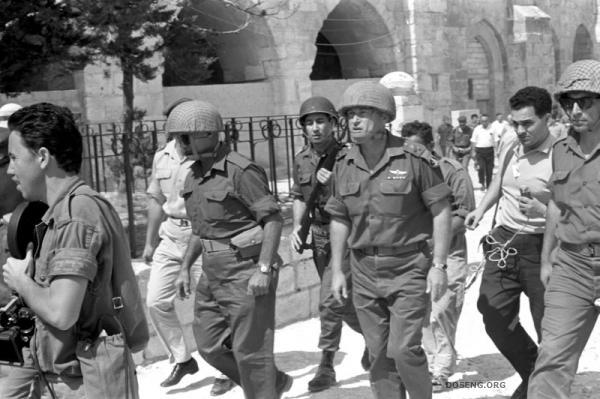
      “Speak to Dayan,” said Eshkol, his voice suddenly wide awake. “See what he thinks and get back to me.” Begin got hold of Dayan and urged him to agree to a quick cabinet meeting to decide on the storming of the Old City. He did. Again Begin spoke to Eshkol and it was decided the cabinet would convene at seven that morning. It was a quick meeting. By unanimous decision the order was given to immediately penetrate the Old City’s walls, the troops to be spearheaded by a parachute brigade. Some three hours later, after intense combat, the brigade crashed through the Lion Gate, and shortly thereafter came the commander’s message over the wire: “The Temple Mount is in our hands! The Temple Mount is in our hands!”


      Just imagine, that now famous statement, “Har Ha’bayit b’yadeinu,” “the Temple Mount is in our hands,” uttered by Motta Gur, commander of the division that captured the Old City of Yerushalayim, might not have been said had Begin slept well that night and a cease fire been called, eliminating the possibility of retaking the Old City and the Temple Mount.


      In his book “Like Dreamers,” Yossi Klein Ha’Levi explains what happened next:


      “Motta’s communications officer, Orni, produced an Israeli flag from his pouch. “Should we hang it on top of the Dome? Arik asked Motta. “Yallah,” Motta replied – Go on. Ari and Orni approached the copper doors, intending to hoist the flag onto the crescent moon atop the tome. The entrance was bolted; Arik shot it open with his Uzi.


      The men entered the domed silence, boots on thick patterned carpets…Orni and Arik ascended a staircase to the balcony overlooking the sanctuary…Standing on Arik’s shoulders, Orni reached up and fastened the Israeli flag to the Islamic crescent…


      Captain Yoram Zamosh reached the Mount. Zamosh was the Mercaz student who had been given an Israeli flag by an elderly woman just before the battle and who had promised to hang it on the Wall.


      Motta’s deputy, Moisheleh Stempel-Peles, along with several other paratroopers, was searching for a way down to the Wall and Zamosh joined them. They came upon an old Arab man in a white robe, an official of the Waqf, the Islamic trust in charge of the Mount. He pointed them towards a fenced-off ledge.


      The paratroopers stepped onto the ledge. Below them – the Wall. From his ammunition belt, Zamosh extracted the flag and fastened it onto the fence. Then the men sang “Hatikvah,” the national anthem. Zamosh recalled a legend he’d learned as a child: when the Roman legion commanded by Titus burned the Temple, priests threw its keys toward heaven, and a hand reached out and retrieved them for safekeeping. Now, Zamosh thought, the keys had been returned…


      Defense Minister Moshe Dayan stood on Mount Scopus and, raising binoculars to his single eye, watched the Temple Mount across the valley… Now, seeing an Israeli flag flying over the Dome of the Rock, Dayan was appalled. He radioed Motta: You’re going to set the whole Middle East on fire. Remove the flag immediately. Motta relayed the order to Arik, who dispatched one of his men: he couldn’t bear to do it himself.


      Now, forty-seven years later, as we look back on these miraculous events and reflect on those historic words, Har Ha’bayit b’yadeinu, the Temple Mount is in our hands, we can’t help but wonder, is it really? When Israel gained possession of the Temple Mount, Prime Minister Levi Eshkol wanted to fulfill his dream for this holiest spot. He envisioned a multi-faith council of Jews, Christians and Muslims to control the location and allow all who wished to come and pray to do so. However, his plan never came to fruition.


      If, in fact, as the young soldier Zamosh thought, the keys to the Temple Mount had been returned, Moshe Dayan gave them back rather quickly. Just a few days after the Six Day War, Dayan, an Israeli war hero, visited the Muslim Waqf on the Temple Mount. In his autobiography, “Moshe Dayan: Story of My Life” he describes the conversation:


      I said that Israeli troops would be removed from the site and stationed outside the compound. The Israeli authorities were responsible for overall security, but we would not interfere in the private affairs of the Moslems responsible for their own sanctuaries.  These were two Moslem places of worship, and they had the right to operate them themselves. My hosts no doubt knew that on the day we had captured this site, I had given orders that the Israeli flag be removed from the Mosque of the Dome, where it had been hoisted. We had no intention of controlling Moslem holy places or of interfering in their religious life.


      Forty-seven years ago, Moshe Dayan gave the Waqf control of the Temple Mount and they continue to control it today. Just a few weeks ago, I visited Har Ha’Bayis for the third time. When Rabbi Levine, Daniel Katz, David Kay, and I approached the entrance we were told we must submit identification and wait for approval to ascend. As we waited for a good half an hour, we watched as non-Jews and non-observant Jews marched right up without being stopped at all. When we were finally approved, we were cautioned emphatically not to bow, pray or even move our lips in a way that looked like prayer. We were not allowed to bring a Siddur, Tehillim, Tefillin or any religious objects. As we walked the perimeter of the enormous Mount, in addition to an Israeli police officer who seemed more concerned with our not upsetting anyone than with protecting our right to be there, a representative of the Waqf followed us closely looking and listening to all that we did.


      har ha'bayishar ha'bayis2

      Our experience on Har Ha’Bayis was paradoxical, spiritually exhilarating on the one hand, and yet so sad and mournful on the other. Standing on stones from the time of the second Temple, seeing where the Holy of Holies stood, understanding the enormity and magnificence of our Beis Ha’Mikdash, visualizing how the Mount looked on Erev Pesach when the entire Jewish people were bringing their Pesach sacrifices, was simply incredible. Yet, observing the irresponsible excavations that are destroying our ancient artifacts, seeing our holiest site being desecrated, and being deprived of the ability to pray was depressing, tragic, and mournful.


      As we walked, we passed groups of women, each of whom stared in our direction and screamed Allah Akbar.   As our group paused to look and learn about where we were standing, a man near us took a large metal pipe and continuously dropped it against the stone floor in an effort to disturb and intimidate us, both of which he accomplished successfully.  In a small gesture of defiance, we continuously prayed in our hearts and when we paused opposite the Kodesh Ha’Kadashim, the Holy of Holies, we even had Daniel Katz, a Kohen, give us the Priestly Blessing.


      As we descended the Mount, I kept thinking to myself, it sure doesn’t feel like Har Ha’Bayit b’yadeinu. Did Moshe Dayan make a historic mistake or were we simply not ready? Are we ready now? Do we really care about Har Ha’Bayis and do we truly yearn to have the right to pray there?


      Less than a year ago, a survey was done in Israel to measure public opinion on the importance of the Temple Mount. Only 29% of the people asked thought that Har Ha’Bayis is the holiest place for the Jewish people, with 66% believing it is the Kotel.   Forty percent said that it is not important to them that Jews visit the Temple Mount. Forty-one percent have no interest in a tour of Har Ha’Bayis. The survey was conducted randomly, but I imagine that if these same questions were asked of observant Jews, the responses wouldn’t be that different.


      Despite being pervasive in our prayers and occupying so much of our tradition, the average Torah Jew, unfortunately, does not think often about Har Ha’Bayis or what we can do to gain the right to pray there. Granted, ascending the Mount is not for everyone. There are legitimate halachik concerns and not all authorities allow it. Those that do ascend need to first go to the mikvah with full preparations, not wear leather shoes, not carry any bag and maintain the seriousness and sobriety that our holiest place demands.


      There are legitimate reasons not to go on Har Ha’Bayis but there is no excuse not to think about, care about, and advocate for the right for Jews to pray on Har Ha’Bayis. No matter what has happened in our history, we have not forgotten the Temple Mount. R’ Menachem Meiri in the 13th century references those that ascend Har Ha’Bayis. Rabbeinu Nissim, the great 14th century Spanish halachist, explicitly acknowledges the custom yet in his time of aliyah l’regel, visiting Har Ha’Bayis.   In the 15th century, the Radbaz wrote that his peers regularly visited the Temple Mount to pray there and, “we have not heard or seen anyone object to this.”


      Maybe we are finally ready to take back the keys. This week, Labor Party Knesset member Yehiel Bar joined Likud Knesset member Miri Regev in sponsoring a bill that would grant freedom of movement, religion, and worship on the Temple Mount to all religions. However, immediately, the Jordanians, Arab Knesset members, and even the Shin Bet who fear it could spark riots, placed significant pressure to withdraw the bill.


      Importantly, nobody is suggesting doing anything to the Dome of the Rock or the Mosque on Har Ha’Bayit. No one is advocating preventing Muslims from practicing and praying. The bill only seeks equal access and rights for all religions, just as Prime Minister Eshkol originally wanted.


      Will it pass? Will we get the keys back to our people’s holiest place taking us one step closer to the final redemption? I don’t know. What I do know is meriting Har Ha’Bayis begins with caring about it. As we celebrate Yom Yerushalayim this week and the forty-seventh anniversary of the reunification of our holy city, the eternal capital of the Jewish people, please keep Har Ha’Bayis close to your hearts and prayers.


      May we merit the day to ascend together as we visit the third Beis Ha’Mikdash speedily in our day.


      Words Matter – Just Ask Donald Sterling, John Kerry & Avigdor Kahalani


      When I studied in Yeshiva University there was a young man named Yossi z”l who suffered from a degenerative disease that left him in a wheelchair, immobile and unable to speak. All Yossi could do was move his finger and that is how he communicated. He had a board on his wheelchair with a chart of the alphabet on it. He would painstakingly move his finger to point to a letter, and then another letter until he spelled out a word and patiently continued until his words formed sentences.


      After getting married, Yocheved and I went to Israel for two years where I studied in YU’s Gruss Kollel in Yerushalayim. I was pleasantly surprised to learn that Yossi had made Aliyah with his family and was studying there as well. By this time, he was unable to control any muscle in his entire body other than moving his eyes. In order to communicate, instead of Yossi, you had to move your finger over the board and Yossi would look to the side to indicate which letter he wanted to use to form the word that would make the sentence that would communicate his thought. Yossi’s Rebbeim in YU described him as having a brilliant mind. He had so much to offer the world, insight, wisdom, humor and yet we were so limited in our ability to gain from Yossi, simply because he lacked the ability to communicate with ease.


      Today, we have technology that would allow Yossi to share his thoughts with others. However, from my relationship with him I learned that without the gift of communication, verbal or otherwise, we are left paralyzed, with so much to share, but an extremely limited ability to influence or impact the world around us. Communication allows mankind to advance and grow, to create and destroy, to build and demolish. Words matter and can even have lethal consequences. Shlomo Ha’Melech, the wisest of all men taught, “Maves v’chaim b’yad lashon, death and life are in fact found in the power of speech.”


      I am not telling you anything that we haven’t all been taught since our earliest age. However, somehow despite our knowledge about the power and impact of words, we struggle to be discerning, careful and judicious in our employment of them. This week was a stark reminder of how the choice of words can have dramatic and lasting effects.


      Few of us knew the name Donald Sterling before this week, but now he is a household name. He has become the poster child of racism, the symbol of bigotry and image of discrimination. Sterling’s attitude towards black people is actually nothing new. In 2009 he was sued by the coach of the Clippers, the NBA team he owns, for wrongful termination saying that the team’s owner underpaid him and treated him “as a token because of his race,” though the suit was later dropped.   In 2006 the Justice Department filed a lawsuit accusing Sterling’s rental company of refusing to lease Beverly Hills apartments to African-Americans. In 2003, the nonprofit Housing Rights Center and a group of tenants filed a lawsuit accusing Sterling of “numerous discriminatory statements and housing practices,”


      Sterling’s record towards African Americans didn’t impede him from public recognition and awards. In January 2006, Sterling was inducted into the Southern California Jewish Sports Hall of Fame during a gala dinner at the Milken Jewish Community Center in West Hills. Even more shockingly, he was slated to receive his second NAACP Lifetime Achievement Award at the group’s 100th anniversary celebration next month.


      But today, Sterling is considered a villain, reviled and loathed by decent people everywhere.   The NBA is fining him $2.5 million and is forcing him to sell his team. What did he do wrong? Was he caught practicing discrimination, bias or racism? No. Amazingly, it wasn’t anything he did, it was entirely what he was caught saying. A tape emerged capturing a racist rant from Sterling.   The consequences have been swift and drastic. Amazingly, those consequences were not imposed when he was accused of actually practicing racism, but they came with furor when he used his words and spoke in a vile, intolerable, reprehensible way. Words matter and the wrong choice of them can have grave consequences.


      A poor choice of words can be revealing or inflammatory and provocative in dangerous ways.   Secretary of State, John Kerry’s use of the word Apartheid in the context of Israel’s future brought on a bipartisan firestorm of criticism this week. His defenders will point out that two former Israeli Prime Ministers have used that word in describing what may result in a failure to make peace. Kerry defended himself aggressively and vehemently citing his record as a Senator on Israel. Many, myself included, were unconvinced.   His record on Israel was not under question; it was his choice of one particular word, a word that is viewed as dangerously inflammatory in any context and under any condition, but especially when used in connection to Israel.


      My point here is not to make the claim that it is absurd to suggest that Israel is an Apartheid state or heading towards being one, something relatively easy to do.   I am simply pointing out a second incident from just this week where someone did not take an action or enact a policy, but was riddled in controversy simply because of the words they chose to use.


      Words matter. Words can be lethal, but they can also save lives and even save a country. This week I had the privilege of visiting Emek Ha’Bacha, the Valley of Tears in the North of Israel, together with the incredible Hillel Day School 8th Grade mission to Israel. A little over 40 years ago, Israel was caught by surprise when they were attacked on Yom Kippur day.   The IDF was unprepared and some suggest even arrogant after the miraculous sweeping victory in the Six Day War, just a few years earlier.


      On the fourth day of the war, Syria began a new attack from a valley in the Golan Heights. The Syrians had 1,500 tanks and the Israelis had 177. The Syrians had 460 artillery and cannons and the Israelis had 44. The Syrians had 36 anti aircraft missile batteries and the Israelis had none. In this particular battle, the Syrians had 500 tanks and the Israelis had 40.   The Syrians charged forward seeking access to the plateau that would have allowed them to spread out their forces, take control of the Golan Heights and charge deep into Israel.


      At one point, 29-year-old Lt. Col. Avigdor Kahalan, who commanded the IDF’s 77th Armored Battalion, told one of his tanks to take a certain position that would intimidate the Syrians. The driver radioed back that he had no ammunition. Kahalani’s response was, “but they don’t know that.” He instructed the tank to take the position and move around raising dust in a way that would give the impression it was fierce and dangerous.


      The battle raged for days and the Syrians were advancing. Kahalani’s men hadn’t eaten or slept in days. They were physically exhausted and their spirits were broken.   The Syrians made an aggressive push forward. There was one last opportunity to enter the valley and stem the Syrian advance before it was too late. Kahalani radioed the remaining tanks to join him in a rush towards the enemy, but the men were tired, they were scared and they had all but given up hope not only of protecting the Golan but of Israel’s very future.

      Kahalani realized that he was going forward alone and he radioed his weary men the following words: “Just look at the Syrians’ courage as they come up to the positions facing us. I don’t understand what’s happening to us. After all, we are stronger than they. Now, start to move forward…Move!” The courageous men of his battalion described how those words, Kahalani’s short but dramatic charge, literally transformed their spirit and gave them the strength, fearlessnes, and will to join him in his aggressive advance. The battled raged and ultimately Kahalani’s battalion miraculously succeeding in achieving the Syrian retreat.


      Following the war, General Rafael Eitan said to the 77th Battalion: “If we had not stopped the Syrians on the Golan Heights, then the State of Israel would have been destroyed…This division saved Israel from defeat, from catastrophe…I want to stress and make it clear to you; you saved the people of Israel. First and foremost, you!”


      We went from the movie that told the story and included the actual radio conversations to a lookout over the valley where the battle was fought. As we stood there, just a few days before Yom HaZikaron and Yom Ha’Atzmaut we were in awe of the courageous men and women who founded and defend our beloved and precious State of Israel. We were overwhelmed with gratitude to God for the blessing of returning to our homeland after all of these years.


      And we walked away realizing that words truly matter, and finding the right ones at the right moment can make the difference for an entire nation. Words matter, so let’s remember to always choose ours carefully.


      Israel – A Major Part of Judaism

      Once again, this year’s AIPAC policy conference proved to be nothing short of extraordinary.  Being together with 14,000 like-minded pro-Israel advocates, people of all religions, ethnicities and backgrounds, united by our shared passion and commitment towards a strong U.S.–Israel relationship, was exhilarating and electrifying.


      This year’s goose bump moments for me included observing a showcase of some of Israel’s latest innovations, hearing about Israel’s humanitarian efforts around the world, listening to an African American Pastor who recently accompanied a plane bringing the last Ethiopian Jews to Israel, welcoming Israel’s first female Ethiopian member of Knesset who walked from Ethiopia barefoot at three years old, hearing from a Latina Union Leader who, on an AIPAC-sponsored trip, learned about Israel’s incredible immigration accomplishments and fell in love with Israel, among many other moments.


      A wide range of opinions and diverse perspectives on what is best for Israel was represented inside the Washington Convention Center.  We heard from leading Republicans and Democrats, from hardline Minister Naftali Bennett and from the head of the Labor party and opposition leader Yitzchak “Buzi” Herzog.  We were addressed by Prime Minister Bibi Netanyahu and, though unfortunately she was ill and couldn’t attend, Minister Tzipi Livni was scheduled to speak.  I am extremely proud that our local delegation to Policy Conference included almost every Rabbi from Boca Raton, including Reform, Conservative, and Orthodox, all of whom have significantly differing views, but share friendship, mutual respect and a common love of Israel.


      Transcending the diverse opinions of the attendees was a unified commitment and devotion to Israel, the eternal homeland of the Jewish people.  Tragically, like every year, across from the convention center there were also diverse groups including Neturei Karta, anti-Israel activists, and even people waving Hezbollah flags, united, not in their love for Israel, but by their hatred of her.  Thank God the snow and bitter cold drove them away after the first day.


      On the two sides of the street the line was clear between Israel’s friends and her enemies.  Sadly, in the world at large that line is getting blurrier and blurrier.


      In an article entitled “With Sadness, I’m Getting Off the Hillel Bandwagon,” a South Florida retired Rabbi, wrote:


      Hillel is no longer the Hillel of yesteryears. In 2010 the national Hillel issued guidelines as to what is permissible dialogue at Hillel — speakers who “delegitimize, demonize or apply a double standard to Israel,” support boycotts, divestments or sanctions against Israel or “foster an atmosphere of incivility” are banned from Hillel. This has essentially banned all liberal Jews who love Israel but disagree with the current Netanyahu government from Hillel involvement…


      I’m a Zionist. I love Israel — that’s the reason I’m critical of the current Israeli government and support a reasonable peace agreement with Palestinians. But I refuse to let my Zionism dominate my Judaism. The love of Israel is only a part of Judaism. The Zionist movement is only 150 years old; Israel is only 65 years old. Judaism has existed for thousands of years without both. Unfortunately, for too many years American Jewry has made Israel the major part of its Judaism. It’s a part, but not the major part...I’m not calling for a boycott of Hillel. The only thing I’m boycotting are settlements in the West Bank. (Emphasis mine)


      First of all, it is tragically sad that an actress, Scarlett Johansson, displayed greater understanding of the issues and love of all Israel than a Rabbi who should know better. Boycotting the West Bank means boycotting products like SodaStream, which employs a thousand Palestinians who are deeply appreciative for their jobs.  Is the Rabbi calling for a boycott of any other country?  Is he boycotting countries that regularly violate human rights and slaughter their citizens, including children?  Calling only for a boycott of parts of Israel while ignoring corrupt, tyrannical regimes elsewhere, is hypocritical at best and outright anti-Semitic at worst.


      But even more significantly, the Rabbi displays incredible ignorance in designating Israel a minor part of Judaism (even if it is minor in reality for too many Jews).  Countless Torah sources indicate Israel’s centrality to our history and destiny, our identity and our practices, our dreams and our longings.  Our prophets describe God’s vision for a united Am Yisroel (Jewish people), living in Eretz Yisroel (Israel), while observing Toras Yisroel (Jewish law).


      The Talmud (Taanis 10a) tells us: The Land of Israel was created first and the rest of the world was created afterwards, as the passage states (Proverbs 8:26): “Before He made Eretz (land) and Chutzos (outlying areas).”  This is the source of our practice of referring to the land of Israel as Eretz Yisroel and the rest of the world as “Chutz La’aretz,” outside “The” (singular) land.


      Almost all of our Prophets lived in Israel or prophesized about it.  Almost the entire Tanach was written in Israel.  The Ramban (Vayikra 18:25) goes so far as to suggest mitzvos are authentically fulfilled only when observed in Israel.  Outside of Israel, our religious lives are essentially practice for when we eventually return home.  Israel is the only place in the world in which mitzvos (commandments) depend on the land, the earth itself.  Of the 613 commandments, 343 (56%) depend directly on the Land of Israel, such as tithing and the sabbatical year.


      Wherever a Jew is in the world, he or she faces Israel during prayer.  Synagogues across the globe are built facing Israel.  Our prayers are replete with references to Israel and Jerusalem.  Both the holiday of Yom Kippur and our Pesach seder conclude with the declaration “Next Year in Yerushalayim.”  Jewish weddings end with the breaking of a glass in fulfillment of the verse (Tehillim 137:5) – “If I forget Jeruslaem, let my right hand be forgotten.”  At Jewish burials anywhere in the world, we sprinkle earth from the Mount of Olives, binding the deceased with the eternal resting place of the Jewish people – Jerusalem and Israel.


      From these few sources alone it is clear that the Rabbi could not be more wrong.  It is not American Jewry who has made Israel a major part of Judaism; it is Judaism itself that places Israel at the center of our national identity, religious practices, prayers, lifecycle events and more.


      Even if he or others deny the authority of the sources I reference or reject the practices I cite, shouldn’t Israel be central to Jewish life simply because it is the one and only Jewish homeland, a place of refuge, immigration and a source of protection for Jews all over the world?  The rise of anti-Semitism in Europe, coupled with the devastating results of the recent Pew study on the American Jewish community, make it clear that the future of vibrant, strong Judaism is in Israel.  Israel now has more Jews than the rest of the world combined.  That alone makes it worthy of being a “major part” of Judaism.


      And if you believe the few sources I quote acknowledge our affection for the land of Israel but not necessarily the State of Israel, I would ask you to consider the following.  What would have happened to the tens of thousand of Ethiopian Jews had the State of Israel not courageously rescued them and transported them to Israel?  What would have happened to the more than one million Jews from the former Soviet Union had they not been welcomed and absorbed into Israel?  Would Torah, Yeshivos and Kollelim have proliferated and thrived in the land of Israel in an unprecedented way without the support and protection of the State of Israel?


      It is not just that retired Rabbi challenging the centrality of Israel to Judaism.  An active Rabbi, quoting Prime Minister Netanyahu from AIPAC, posted the following this week:


      ‘It’s about time the Palestinians recognize Israel as a Jewish state – we have only been there for 4,000 years.’ – Benjamin Netanyahu


      The second half of this line is one of the worst arguments for Israel. Please stop making it.


      Please don’t stop making it Mr. Prime Minister, because it cuts to the heart of the matter.  We don’t need to remind people we have been there for 4,000 years in an effort to restore the world to the way it looked thousands of years ago.  We need to pronounce our lengthy ties to the land because it challenges a narrative that Israel is a modern invention, a prize to the Jew for surviving genocide and introduced only recently as a major part of Judaism.  In fact, just this week, in comments published by his official WAFA news agency Mahmoud Abbas said there’s “no way” he’ll recognize Israel as a Jewish state.


      Thank God, while these two Rabbis don’t “get it,” Senator Robert Menendez, a Democrat from New Jersey who chairs the Senate Foreign Relations Committee, does and stated it articulately at AIPAC, broadcast over C-Span for the world to hear:


      I have said many times before and will repeat again today, the Holocaust was the most sinister possible reminder that the Jewish population in exile was in constant jeopardy. It was a definitive argument that anti-Semitism could appear anywhere, and its horrors galvanized international support for the State of Israel. But, while the Shoah may have a central role in Israel’s identity, it is not the reason behind its founding, and it is not the main reason for its existence.


      The modern reestablishment of the state of Israel has long and deep roots going back to the time of Abraham and Sarah. There is no denying the Jewish people’s legitimate right to live in peace and security on a homeland to which they have had a connection for thousands of years and that has not changed through the centuries.


      Too often the past is, truly, prologue, and next week — March 15th — is the start of Purim, a holiday that marks the deliverance of the Jewish people in the ancient empire of Persia – now Iran. As the story goes, a plot had been hatched to destroy all Jews in the Persian empire, but Mordecai and his adopted daughter, Esther, foiled the plot and the day of deliverance became a day of celebration and feasting – Purim.


      The parallel is all too obvious when it comes to the situation today in the Middle East, and the protection of the Israeli people from the threat posed by a nuclear Iran. Let us pray that – if the time should come – together we will be like Mordecai and Esther, we shall foil Iran’s nuclear plot, and deliver the Jewish people again as well as protect the world from a nuclear threat.


      Minister Naftali Bennett said it well in a recent interview with the BBC: “We’ve been in this land way longer than America has been in American land, and for that matter longer than the British have in the British land. I do recognize that in our land there are two million Palestinians. They’ve got aspirations—they’re not going anywhere, but we’re not going anywhere. So we’ve got to figure out how to live together, how to work it out.”


      If the Rabbi I reference is “getting off the Hillel bandwagon,” let’s fill his seat tenfold with knowledgeable, well-informed, pro-Israel, proud Zionists who will unapologetically play the role of Mordechai and Esther and confront our enemies by standing up for a major part of Judaism, the one and only Jewish homeland – our beloved State of Israel.


      Rabbi Efrem Goldberg

      Join Our Community

      Subscribe to our newsletter or connect with us on WhatsApp.