
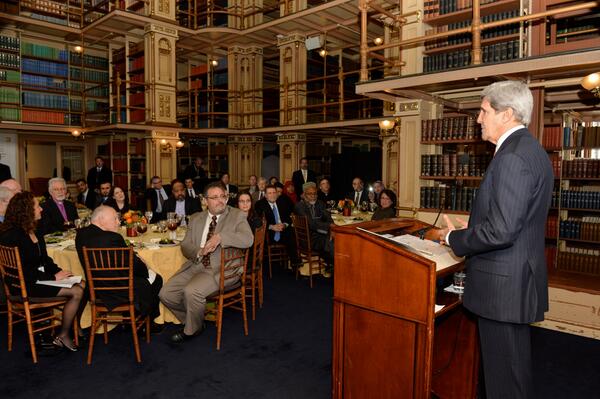
Disagreeing with Dignity – Interfaith Lunch with Secretary Kerry


Embedded image permalink

In October, Boca Raton Synagogue adopted a Civility Policy (since renamed Derech Eretz Policy) as an affirmation of our community’s commitment to debate, dialogue and disagree with respect and dignity, always focusing on issues and policies, rather than on people.  Last week, I was reminded of the importance of this commitment when I traveled to Washington D.C. to participate in an interfaith lunch meeting with clergy from Judaism, Christianity, and Islam.  Dr. John J. DeGioia, President of Georgetown University, invited us to meet with Secretary of State John Kerry to discuss the Israeli-Palestinian peace process and to dialogue among ourselves in an effort to build bridges and strengthen relationships.


Following three moving invocations, one from each faith, Secretary Kerry addressed us and shared his perspective on the peace process.  He spoke passionately and enthusiastically as he articulated his argument for why success in the peace process is more important right now than ever and shared why he is so optimistic that the factors are in place to reach a final agreement that will secure a real and lasting peace.  He referenced the concessions on both sides in the form of the Palestinians having held off from pursuing action at the United Nations and Israel having released over 100 prisoners.


In an op-ed in Ha’aretz following our meeting titled, “How John Kerry Won Me Over,” Rabbi Eric Yoffie, past president of the Union for Reform Judaism, expressed why he found the Secretary of State’s words so compelling that day and how, in his words, he “left the meeting convinced that chances for peace are better now than they have been in a very long time.”


Secretary Kerry laid out for us why he believes the status quo is not sustainable, and that what lies ahead for Israel if they cannot arrive at a peace deal is a “boycott campaign on steroids,” arguments he continued to advance in other venues in the days that followed.  Abe Foxman of the ADL, who wasn’t present at the meeting, but was responding to similar sentiments expressed by Secretary Kerry elsewhere, was highly critical of Secretary Kerry’s invoking the threat of a growing boycott movement.  In an open letter to Secretary Kerry, he wrote: “Describing the potential for expanded boycotts of Israel makes it more, not less, likely that the talks will not succeed; makes it more, not less, likely that Israel will be blamed if the talks fail; and more, not less, likely that boycotts will ensue.”


In Israel, rabbis identifying themselves as “The Committee to Save the Land and People of Israel,” in an open letter to Secretary Kerry, wrote this week: “Your incessant efforts to expropriate integral parts of our Holy Land and hand them over to Abbas’s terrorist gang amount to a declaration of war against the Creator and Ruler of the universe.” They compared Secretary Kerry to Haman, Nevuchadnetzar, and Titus and promised Heavenly retribution if he continues his efforts.


The RCA and OU were quick to disassociate themselves from these rabbis who claim to represent “hundreds of other Rabbis in Israel and around the world” by saying: “We, the leadership of the RCA and the OU, repudiate this letter and the rhetoric they have deployed. While the people of Israel and Jews around the world may properly possess serious concerns about proposals Secretary Kerry is putting forth, such concerns must only be expressed with civility and on the substance of the issues, not degenerating into personal venom and threats.”


Listening to Secretary Kerry last week, I heard a genuine and sincere man who sees the implications of his efforts extending far beyond the political and diplomatic spheres alone.  He seemed to be speaking from his heart when he described a vision for bringing a peace that would position Israel as the center of the Middle East for commerce, innovation, trade, travel, and culture.  I personally saw no reason to doubt his sincerity, question his motivation, or be skeptical of his ultimate goal.


That said, unlike Rabbi Yoffie, I was not won over by his argument about the prospects for peace right now, and I continue to have grave concerns for our beloved Israel and her citizens.  Fortunately, I had the chance to voice them in the form of a question I posed to Secretary Kerry.


After thanking him for the opportunity to meet and for his efforts on behalf of peace, I asked, “Mr. Secretary, you say that the status quo is unsustainable and there is no choice but to come to a final status agreement.  But before Oslo, we also heard that the status quo was unsustainable, while in retrospect, the status quo was far better than the thousands of Israeli lives lost post-Oslo.  Before the Gaza withdrawal, we were told the status quo was unsustainable, but in retrospect, it would have been far better than the 40,000 rockets that subsequently rained down on Israel.  Why will this time be different, and how can we be so optimistic and confident that we won’t,once again, end up longing for the status quo even if it was just the lesser of two evils?


“I wish I shared your optimism,” I continued, “but Israel has twice offered 95% of the territory asked for and twice their offer was rejected.  Why, Mr. Secretary, are you so optimistic that this time will be different?  And lastly, you equated not going to the UN with releasing over 100 prisoners, but they are not parallel concessions.  Israel seems to consistently be asked to make concessions for peace that are irreversible and contain extraordinary risks and dangers.  The Palestinians can always decide to go to the UN tomorrow, but land cannot simply be taken back.  Prisoners, many of whom are in fact murderers, cannot just be called to report back to prison.  Wounds, scars, and trauma suffered by those uprooted from their homes and by those tasked with uprooting them, don’t simply heal and disappear.  Please, Mr. Secretary,” I concluded, “I truly want to be more optimistic; help me understand how or why.”


Remarking that he was so happy to be asked that question, Secretary Kerry proceeded to give a very thoughtful answer, one that made some very good arguments that I had not heard or considered before.  Nevertheless, they didn’t fully satisfy or convince me.


But in truth, I am not the one who needs to be convinced or persuaded.  It is Israel’s government and its people who will be forced to live with the consequences of this process and its conclusions.  Their opinion and vote are what counts and what will ultimately shape the future for Israel.  If we truly want our voice to matter on what concessions are made or how far this process goes, we should move to Israel and participate in the public referendum that has been promised before any final agreement is implemented.


Secretary Kerry had to leave the meeting soon after this exchange, but the experience was far from over.  The interfaith dialogue was, in fact, just beginning as members of the clergy – Jewish, Muslim and Christian – stood up one by one and shared their thoughts, impressions, concerns, hopes, and aspirations.  Everyone who spoke did so respectfully, with moderation, and with an apparent commitment to attaining peace and harmony, even if we disagreed on what “peace” means or how it is achieved.


I was struck and uplifted by the level of discourse shared by the diverse religious leadership gathered.  We are all equally passionate about our positions and secure and confident in our analysis and understanding of the situation.  We all entered the conversation unlikely to be persuaded or swayed to change our understanding of history, our people’s narratives or our prescription for what is necessary to bring peace for Israel and her neighbors.  And yet, those differences did not have to create animosity, tension or personal attacks.


Though it likely wasn’t the primary goal, the interfaith lunch meeting accomplished something very significant.  It set an example and model of our capacity to be honest, forthright and direct about our differences, in conversations at the highest level with the Secretary of State and with clergy of other faiths, all with civility, mutual respect and graciousness.  Last week reminded me that we need not be defensive or apologetic for our positions.  We must confidently speak truth to power when given the opportunity.  But we must remain vigilant in maintaining dignity, even as we express our differences.


If every participating clergy member went home and preached about our experience as an example of civil discourse for our communities to emulate, the gathering was valuable and productive indeed.



Sharing the Burden

The emotionally charged expression “Sharing the Burden” has been bandied about of late, but has a variety of meanings depending on the setting in which it is used. In the context of the Jewish Day School tuition crisis conversation, sharing the burden means helping families find relief from the debilitating levels of tuition. During the last presidential election season, sharing the burden was code for raising taxes. Coming back from my recent visit to Israel I can confidently tell you that there is no place on earth and perhaps no time in history in which the attitudes towards “sharing the burden” have created such a massive divide and monumental challenge as in Israel today.


An exemption from serving in Israel’s army, intended for a modest number of full-time Yeshiva students, is today being utilized by over 60,000 men who are eligible but not serving. As the number of exemptions grows, the broader Israeli society has reached their limit and is vociferously calling on their Chareidi brothers to start sharing the burden.


During my short stay in Israel, I saw first-hand the seemingly insoluble divide and vast chasm between the secular and national religious on the one hand, and the Chareidim who don’t serve on the other. The secular and national religious simply cannot fathom how a population could feel entitled to benefit from the protection of those who risk their lives for them and not participate in providing that protection for others in any tangible manner. The Chareidim, however, cannot fathom how they can be asked to abandon the Beis Midrash and neglect the Torah that needs to be studied. Moreover, they cannot comprehend how they can be forced to serve in an army that they believe is designed to purge them of their religious identity, convictions, observances, and lifestyle.


My personal feeling is that the default must be participation in Israel’s army. Appropriate concessions should be made to honor opportunities for full-time Torah study before serving, but service should be a given. Additionally, units should be developed that will meet the sensitivities and requirements of the Charedi population. However,, I believe the burden is on the Charedi community to provide a long-term, sustainable proposal that will include Yeshiva students participating in at least some form of national service.


While in Israel, as I read the newspaper, listened to the radio, and had conversations with people on both sides of this issue, it dawned on me that there is another population that is not fairly sharing the burden, yet they are not being addressed. A fundamental principle of religious Zionism is that Israel is not simply a secular state for Jews, but it is a Jewish state. We believe that the return of Jewish sovereignty to Israel represents a seismic step in the process of redemption and major progress towards the Messianic era.


Israel is not the Israeli homeland; it is the Jewish homeland. The law of return states that all Jews have the right to return to, to live in, and to be a citizen of Israel. Most remarkably, Israel feels a responsibility not only to its citizens and residents, but has exhibited extraordinary steps to help protect and rescue Jews everywhere including Ethiopia, the former Soviet Union, and Argentina. Do we doubt for a moment that if, God forbid, a Jewish community were in danger or at risk anywhere in the world, Israel would step up and do whatever necessary to protect them or us?


Israel belongs to all Jews, not only all Israelis, and all Jews, not only all Israelis, must share the burden of protecting her. The question, then, is what are diaspora Jews doing to share the burden? I am not naïve or foolish. I understand that there are different rights and different obligations for those who live in the land and are legal citizens of it than for those who live outside. Our share in the rights is not as great: we cannot vote, for example. And our share in the burden is obviously not as great, as we in the diaspora are not conscripted into the IDF. However, what is not debatable or deniable, it seems to me, is that we have at least some share of the burden.


The obligation of Jews outside of Israel to share the burden of protecting her is not only a philosophical or ideological statement, it is a halachic one. The Talmud tells us that in the circumstances of milchemes mitzvah, a mandated war, all must participate, even a bride and groom who were standing under their chupa. The Rambam defines a milchemes mitzvah as “war against the Seven Nations, war against Amalek, and assisting Israel in defending herself from the enemy who descends upon them.” (Hilchos Melachim 5:1) His last definition certainly seems like an apt description of Israel’s condition today. The halacha doesn’t differentiate between those that live in Israel or outside her boundaries. Rather, in the circumstance of defending Israel from her enemies, halacha demands that all Jews, wherever they may live, must share the burden and participate in protecting the people. Technically, we should all be drafted into service, no matter where we may live.


And so, while in Israel they debate the question of Yeshiva students exemptions from army service, I propose that we in the diaspora ask ourselves how can we do more towards fulfilling our share of the burden?


The first and foremost suggestion is to consider aliyah. There are legitimate and valid reasons not to make aliyah right now. But, there are no excuses not to consider, struggle with, and plan for a time that we can move to Israel, the Jewish homeland and be part of the Jewish destiny.


Secondly, though we lack a legal obligation to serve in the IDF, we don’t lack a moral obligation to support the members of the IDF in every possible way that we can. I am regularly contacted by young people serving in the IDF whose units have needs that cannot be met by the Army itself. Partaking in a small share of the burden means generously supporting organizations like Friends of the IDF (www.fidf.org) and Sgt. Benjamin Anthony’s Our Soldiers Speak (www.oursoldiersspeak.org). Additionally, while we don’t protect soldiers in the field, we can seek to protect them with our heartfelt prayers by always thinking of them, each and every time we pray.


Thirdly, sharing the burden means advocating for Israel and seeking to influence America’s policy towards Israel on a regular basis and in meaningful ways. Minimally, being a member of AIPAC, (www.aipac.org) and hopefully being active and involved, positions AIPAC to successfully lobby on behalf of Israel’s interests and to be the strongest voice influencing the policies of the US-Israel relationship in the world.


There are countless other ways we can share the burden even from the diaspora, such as by investing in Israel through Israel Bonds (www.Israelbonds.org), supporting organizations that care for IDF veterans (www.zdvo.org), and much more.


Israel has some very difficult and undoubtedly painful work to do to heal the divide and find a solution that will bring the country together on the issue of mandatory army service. While they struggle to figure it out, let us neither forget nor neglect our obligation to share the burden and let us pledge to do more for Israel this year than ever before.


Say Little, Do Much

News of President Carter receiving an award from Yeshiva University’s Cardozo School of Law broke last week and the Internet lit up immediately.  Graduates of the law school, graduates of Yeshiva University, and concerned pro-Israel advocates were outraged, incensed, and bewildered.  How could the subsidiary of a Jewish University, the sister school of a Yeshiva, bestow an honor on a man who is blatantly and consistently anti-Israel?  Alan Dershowitz, upon hearing about the award, put it best. “Carter has prevented peace, encouraged terrorism, and done more than anyone else to isolate and demonize the Middle East’s only democracy, Israel.”


After Cardozo made the official announcement, an uproar ensued.  Some graduates reacted immediately to form the Coalition of Concerned Cardozo Alumni and even set up a Web site, shameoncardozo.com, declaring their outrage to the law school’s board of overseers.  The controversy grabbed headlines in every Jewish newspaper, on blogs, in Israel, and even in the New York Times.  The pro-Israel community expressed indignation, some going so far as to challenge YU’s commitment to Israel.


President Richard Joel soon after released a statement clarifying: “President Carter’s invitation to Cardozo represents solely the initiative of this student journal, not of Yeshiva University or the Benjamin N. Cardozo Law School.”  He continued, “While he [Carter] has been properly lauded for his role in the Camp David Accords of 1978, I strongly disagree with many of President Carter’s statements and actions in recent years which have mischaracterized the Middle East conflict and have served to alienate those of us who care about Israel.  President Carter’s presence at Cardozo in no way represents a university position on his views, nor does it indicate the slightest change in our steadfastly pro-Israel stance.”  He concluded by saying that Yeshiva “both celebrates and takes seriously its obligation as a university to thrive as a free marketplace of ideas, while remaining committed to its unique mission as a proud Jewish university.”


The Anti-Defamation League and The Simon Wiesenthal Center blasted the students’ decision and described it as the result of gross ignorance.  When it became clear that the event would take place despite the opposition, the rhetoric escalated.  The Forward quoted one alumnus as saying that a dozen or so alumni would attempt to block Carter physically from receiving the award.  Dershowitz said it should be turned into “an educational experience” by students handing out leaflets challenging Carter’s record or by having the University invite “someone like myself” to debate Carter.  “He should be made to regret that he ever agreed to accept the award,” Dershowitz said.  In the days before the award was to be given, tensions ran high as calls were issued for protests and rallies in opposition to Carter.


Well, the award ceremony took place this past Wednesday.  About 250 Cardozo students gathered as the Journal of Conflict Resolution bestowed its International Advocate for Peace prize on Carter.  Did President Joel, Yeshiva University and Cardozo Law School do the right thing in allowing the award to go forward?  To be honest, it’s debatable.  There is merit to both sides of the argument.  On the one hand, as a University, it must honor academic freedom.  On the other, every University will draw a line around the freedom they provide students before they run interference or even veto their decisions.


While those things are debatable, there is one thing that is not.  The greatest indictment and biggest source of shame for our Jewish community this week came, in my opinion, not from YU, but from the deafening silence from of all those who made blustering promises to make sure Carter knows how we feel about him and then failed to show up at all.


Members of the media arrived at the event expecting to be greeted by hundreds or thousands of protesters carrying placards calling out Carter for his anti-Israel positions or handing out leaflets.  How many so called pro-Israel activists did they find?  Not one.  With hundreds of thousands of pro-Israel Jews living in the tri-state area, absolutely no one showed up to protest Carter.


Haaretz journalist Chemi Shalev was on the scene and tweeted, “Anti-Carter protestors are a no-show at Cardozo award scene. Not even one.” He followed up, “Other than a few pro-Carterites and one foul-mouthed anti-Semite, all quiet as students fill into Cardozo hall for Carter ceremony.” In a story following the event, Aryeh Younger quotes Ben Winter, a senior at Yeshiva College, who claims that YU’s students are ultimately unwilling to physically volunteer themselves for pro-Israel causes. “While many students at YU feel strongly about their Zionism, few have the courage to publicly express their opinions,” he said.


I am shocked, stunned, and profoundly disappointed by the conclusion of this story.  Sadly, it seems the postscript to the Carter event is that the Jewish community is much better at expressing criticism, condemnation, outrage, and castigation, than actually doing something about that which they bemoan.


Apparently, that wasn’t always the case.  Yishai Fleisher recalled his time in Cardozo as a student when the very same journal awarded Archbishop Desmond Tutu, a Holocaust denier, the same exact prize.  “We had an amazing protest in the lobby of the law school, with placards detailing Tutu’s opinions. As Tutu walked by he was booed by many students who had joined CHAI’s loud and proud protest. Tutu had egg on his face, and I am not certain that the prize he received from the Journal of Conflict Resolution was worth the embarrassment for him. He certainly did not look happy.”


Perhaps Cardozo was wrong not to rescind the invitation.  But once that decision was made, a tremendous opportunity presented itself.  Imagine the impact on Carter and his legacy if indeed he had to walk past thousands of protesters vocally challenging his anti-Israel positions.  Imagine the debate that could have resulted in the secular media evaluating Carter’s true legacy on Israel.  Imagine how Carter might have been forced to think twice next time he was going to meet with the leadership of Hamas or describe Israel as an apartheid state.


Instead, because of our people’s complacency, laziness, indifference, or busy-ness, Carter left the event with his head held high and the clear impression that his positions are not reprehensible enough to elicit even one protestor.


Woody Allen once famously said, “80 percent of success is showing up.” Unfortunately, 100 percent of the people failed to show up this past Wednesday outside of Cardozo Law School.  Whether in NY, Florida or anywhere in the world, the likelihood is we will be called upon to show up in support of Israel, rather than simply criticize from the comfort of our couch.


Our Rabbis teach us, “emor m’at, v’asei harbeh, say little and do much.”  This sad, small chapter unfortunately displayed the opposite.   Sefiras Ha’Omer is a time to not only count days, but also to make sure our days count.  Let’s not just talk a big game; let’s make a big difference.


Holy Candles and Holy Guns

When a convert stands in the Mikvah about to immerse and undergo an existential transformation, we ask him or her a series of questions. One of the most poignant and yet seemingly irrelevant is the following: “You know that Jews have been subject to persecution, anti Semitism, and attempted extermination throughout the millennia. If you become a Jew, you will join this hated, targeted people. Are you prepared to share in the destiny of the Jewish people for good and for bad?” At every single conversion with which I have been involved, the candidates all responded in the affirmative. Invariably, I think to myself – of course they answered yes. We live in a free, tolerant and pluralistic society that allows us to practice religion freely. What are the chances that they will suffer for becoming a Jew?


My entire perspective changed this week when I read an incredible article (http://blogs.timesofisrael.com/building-in-a-state-of-hope/) by a righteous convert who subsequently made aliyah and indeed has linked his safety, security and destiny with that of the Jewish people. In reflecting on the experience of living through his first siren and the sound of the explosion that followed just as he was welcoming Shabbos in Gush Etzion, he referenced the conversation at the Shabbos table that night, and the question of his host’s young son.


“Why do they want to hurt us?” It was the kind of question only a young child could ask, simultaneously piercing and innocent. As we sat talking later in the evening, trying to make sense of what felt like a new, heavier reality, my friend Judah explained that he could have answered any other question that his son had asked. Just not that one. He felt helpless looking into his own son’s eyes.”


Throughout our people’s history Jewish parents have struggled to answer that most difficult and painful question. While many reasons and explanations for anti Semitism have been offered, none remove the ache or dispel the agony of feeling hated, loathed and despised. While there is no completely satisfying answer to the question that young boy asked his father, there is a response that Jewish parents can provide today, that they could not in good faith articulate for the last two thousands years.


Rav Shlomo Aviner, Rosh Yeshiva of Ateret Cohanim and Rav of the community of Beit El was asked a question that I have not received in Boca Raton and I doubt my colleagues in North America have been asked either. In his responsa, She’eilat Shlomo 4:87, he address the question – Is it proper to recite the beracha of shehechiyanu on purchasing a new gun? Rav Aviner provides a long halachic explanation and defense of why he feels a shehechiyanu is warranted, even though the need to own a gun is sad and unfortunate. His closing argument touched me deeply and I share them with you:


“That which we have guns shouldn’t elicit sadness that we still have wars and conflicts. Indeed, the opposite is true, it should elicit happiness that we have merited to be an am chofshi b’artzeinu (free nation in our homeland), that we have an established Jewish government, we have an army and a police force, that we are no longer the punching bag of the wicked nations, but rather we have the capacity to protect ourselves. Would it even occur to you that when the War of Independence began and we had weapons in our hands to defend ourselves after 2,000 years of Jewish blood being spilled freely, that one shouldn’t recite shehechiyanu with joy and gladness?! That joy continues to carry us and protect us from then until now. And for that reason, a shehechiyanu should be recited when an Israeli soldier puts on his or her IDF uniform for the first time.”


We cannot explain to our children why they want to hurt us, but finally, after 2,000 years we can reassure them that we won’t allow our enemies to hurt our people without doing everything that we can to provide protection and security. No longer will Jews go like sheep to the slaughter as they have been accused of throughout the centuries. No, today we have the technology, the resources and the autonomy to shape our own destiny and to defend our own people. But there is something else that we have which truly distinguishes our soldiers and gives them, and us, an edge over our enemies.


A few weeks ago, BRS partnered with Temple Beth El in showing the Yoni Netanyahu story. When he was in high school, Yoni’s father received an academic appointment in Philadelphia and so the family moved there for a few years. Yoni grew restless to return to Israel. He wrote in a letter, “I yearn for a place that is narrow, hot, rotten, filthy — a place that’s more than 60 percent desert…The only things people talk about are cars and girls. Freud would have found very fertile soil here.” Yoni was a prolific writer who sent letters to family and friends regularly. Upon his death the letters were collected into a book. A theme that pervades throughout was his nationalism and willingness to die for his homeland.


Yoni Netanyahu was an exceptional soldier and leader in many ways, but his courage, selflessness and willingness to sacrifice for his people and homeland are the norm of most soldiers in the IDF. This past Shabbos, Sergeant Benjamin Anthony spoke at BRS and moved most of the room to tears with his passionate commitment to serve in the IDF with all that it entails. He described the disappointment of many of the reserve soldiers who were poised to enter Gaza to eliminate Hamas terrorists in being sent home. They are not violent or in search of war, he said, they are simply committed and ready to defend their people and their land, even if it means paying the ultimate personal cost. Yes, the Iron Dome had an 85% success rate, noted Sgt. Anthony, but the reservists of the IDF showed up at a higher rate of 100%.


Chanukah is the celebration of our military victory in the land of Israel against enemies that sought our destruction and elimination. Then, like now, we were the few against the many. Ha’neiros ha’lalu kodesh heim, we say after lighting the candles each night. These candles are holy and sacred as they commemorate the miracle of re-consecrating our holy Temple and the military triumph against all odds.


Rav Aviner ends his responsa by quoting his Rebbe, Rav Tzvi Yehudah Kook zt”l who wrote:


“Fighting to protect our homeland is a mitzvah, the mitzvah of all Klal Yisroel. Therefore, everything connected with it, every gun and every weapon that is our response to our enemies, everything associated with establishing and protecting malchus Yisroel (Jewish sovereignty), it is all kodesh (holy).”


Rav Aharon Lichtenstein related that once when he returned to America and was visiting with his father in law, Rav Soloveitchik, he posed a series of questions from students who were serving in the IDF. One student worked in the tanks division and his job was cleaning out and maintaining the tanks. Often his uniform got covered in oil and grime and he wanted to know if he needed to change before davening Mincha, something that would be terribly inconvenient and difficult. The Rav looked at Rav Lichtenstein and wondered out loud, “why would he need to change, he is wearing bigdei Kodesh (holy clothing)?”


The candles of Chanukah are holy for what they represent, and our precious soldiers who risk their lives to protect our people are instruments of holiness for what they represent. No, we cannot fully answer the question my nephew asked my brother at the Shabbos table that Friday night. But we are incredibly blessed to be able to tell our children that the Jewish people have the greatest, most passionate, loyal, courageous and HOLY army in the world.


The Fame and Infamy of November 29th


There is only one street that I know of named for a date on the calendar.  Rechov Chaf Tet B’November, November 29th Street, runs through the Katamon neighborhood of Yerushalayim.   Why would a street in our Holy City be named for a date on the Gregorian calendar?


Just a short time after the darkest period in Jewish History and the annihilation of 6 million Jews, on that fateful date, the first light of redemption broke through.  On November 29, 1947 the United Nations General Assembly voted in favor of a resolution, which adopted the plan for the partition of Palestine and restored Jewish sovereignty to at least a portion of the Land of Israel.   Thirty-three states voted in favor of the resolution, thirteen voted against it and ten states abstained.


If you wonder for even a moment if we live in miraculous times and if we are experiencing the flowering of redemption, I challenge you to consider the following:  If the United Nations were to take that vote today, just 65 years later, is there even a possibility that it would pass?   In our wildest dreams could we picture today’s UN awarding the Jewish people a state in the Middle East?


Yes indeed, November 29, 1947 is a miraculous day on the Jewish calendar in which the international community went against their ordinary behavior and attitude of hatred, anti Semitism, persecution and passed an extraordinary resolution that would usher in a new era for our people.


To understand just how extraordinary the vote that day was, contrast it with a vote that took place on the very same date, November 29th of this year.  This week, the United Nations passed a resolution declaring Palestine a non-member observer state.  Prior to the vote, Israel and the United States publicly condemned the initiative and placed immense pressure on President Mahmoud Abbas not to pursue that path.   Members of Congress suggested that if the Palestinians violate the will of the US on this issue, they and the UN should lose US funding.


Pursuing recognition of statehood at the United Nations while circumventing direct negotiations is a direct violation of international agreements including the Oslo Accords.   The move constitutes a direct rebuff to President Obama’s personal request to return to direct negotiations and abandon the pursuit of this vote.  Moreover, Abbas asked for recognition of a state, half of which he doesn’t control or influence.  Hamas has ruled Gaza since 2006 and Abbas hasn’t even visited once since then.  Declaring Gaza a state gives credibility and authority to a terrorist group who just a few days ago shot over 1,000 rockets at Israel.


The arguments against voting for this resolution are obvious, compelling and overwhelming.  Yet, it shouldn’t come as a surprise that 138 states voted in favor of the measure, only nine against and 41 abstained.   Once again the United Nations proved that their interest is not to bring peace to the region as much as it is to see the State of Israel in pieces.


The Secretary of State, US Ambassador to the UN and members of Congress were quick to point out that this vote represents a step away from peace and hurts the ability to make progress towards that goal.   I would go even further and suggest that pursuing this path resurrects ideology and strategy of the past that proved utterly unsuccessful and caused great damage, destruction and loss of life.


Indeed, the founder of Fatah, former leader of the PLO and orchestrator of terrorism against Israel, Yasser Arafat, was himself literally dug up, just this week.  Arafat’s body was exhumed to examine the cause of his death.  His wife, Suha Arafat had this to say:   “It was as if his soul was resurrecting.  It’s as if he was saying, `I am still alive and with you,’” she told the Associated Press before the UN vote.


Perhaps the most painful part of this week’s vote was the recognition of just how alone and isolated Israel is in the international community.  It is as if 65 years ago, the world felt bad for the Jews in the aftermath of the Holocaust and awarded us our homeland as a global apology for standing by while we were slaughtered.  In 65 short years, sympathy has turned to enmity and the Jewish people are right back were we have been for a large part of our history.


Bilam already described us so many years ago – “Hein am levadad yishkon, u’vagoyim lo yischashav, they are a people that will dwell alone, and they will not be considered among the nations.”   The realization of his prophecy and feelings of loneliness and isolation are painful and hurtful, but we will persevere.


We read this week of how Yaakov wrestled with the Angel of Esav.  Though he ultimately triumphed, he didn’t walk away unscathed.  Yaakov received a blow to his hip that injured his sciatic nerve.  As a result we refrain from eating the Gid Ha’Nasheh, the sciatic nerve until today.  The Sefer Ha’Chinuch describes Yaakov’s experience as being forbearing of the Jewish journey.  Like Yaakov, the Jewish People have confronted many enemies.  Like Yaakov, we too sustain injuries, blows, and wounds.  But the pasuk describes, “vayizrach lo ha’shemesh, the next morning the sun rose for him.”  Like Yaakov, we have limped through our history, but our sun will rise as well and we will experience a redemptive era.


The UN vote of November 29, 2012 can now be added to the long list of blows our people have sustained.  We have been triumphant and proudly walked away from the others albeit sometimes with a limp, and we will walk forward triumphantly from this one as well.


Is the Glass of Redemption Half Full or Half Empty?

Last week, an Israeli Rabbi wrote an article in a weekend magazine wondering out loud why we still observe the fast of the 17th of Tammuz. After all, we have recovered Jewish sovereignty over the land of Israel, we have a thriving State of Israel, and more people are learning Torah in Israel than ever before. So why are we fasting, why are we mourning, what are we commemorating? This Rabbi found his questions so compelling that he concluded that indeed, we should no longer be fasting as the redemption is upon us. We intuitively know he is wrong, but why?


As I spent the 17th of Tammuz in Israel, I too was bothered by similar questions. The Prophets description of Yerushalayim as desolate, barren and in ruins, is no longer accurate. We are meriting seeing with our own eyes Yerushalayim and the Land of Israel blossoming, blooming, developing and growing in ways that were unimaginable just a short time ago. Why then are we fasting, mourning, not shaving, listening to music or rejoicing? Why are the practices of the 3 weeks and the fasts of the 17th of Tammuz and the 9th of Av still relevant and how do we find meaning in them given the contemporary circumstances in Israel?


I suggest to you that to feel the pain of this period and the agony of an incomplete redemption, one need do nothing more than open the newspaper or follow Israel in the news. Just a few examples from the past few weeks alone to help give meaning to our mourning:


  • Fifty Metro-North subway stations in NY have just received new ads including an accusation that Israel has been systematically taking Palestinian territory. The ad refers to 4.7 million Palestinians as refugees. The Anti-Defamation League has called the ads “Deliberately misleading, biased and fundamentally anti-Israel.”
  •  


  • A global counter terrorism forum initiated by the US was held this week in Spain. Twenty-nine countries that have suffered from terrorism and are committed to fight against it participated. Noticeably absent, due to a lack of invitation, was a country that has suffered more terrorism than any other and that knows how to fight it better than any other – Israel. Most analysts have concluded that this snub was intentional and was necessary to get other Arab countries to participate.
  •  


  • Iran defiantly tested ballistic missiles including of the long-range variety that can travel 2,000 kilometers and easily hit Israel and parts of Europe. Senior Iranian leaders accompanied those tests with the most threatening remarks directed against Israel to date.
  •  


  • Israel continues to be the victim of a campaign to isolate and delegitimize her. One of the most heinous and hurtful accusations often hurled against Israel is that she is guilty of apartheid and no different than the former South Africa that discriminated against blacks. Rabbi Dr. Danny Gordis has already pointed out that this claim is absurd, ridiculous and offensive. “In apartheid South Africa, were there blacks on the Supreme Court? (Justice Salim Joubran, an Arab, serves on Israel’s highest bench; nor is he the first to do so.) In apartheid South Africa, were there recognized black parties in the parliament, legally pressing for their rights? The list could go on, almostendlessly.”
  •  


  • This week I was shopping with my brother in a supermarket near his home in Alon Shvut, which is located over the “Green Line” in the “West Bank.” Throughout the store, one could easily notice the many Arabs shopping. My brother pointed out to me that these are not Israeli Arabs, but they are Palestinians who are openly welcome to shop freely in this store and the others in the Gush Etzion neighborhood. Perhaps the only apartheid being practiced is the lack of ability of a Jew to equally shop freely in a Palestinian store in the same area without risking his or her life.
  •  


  • My daughter and I were at the Kotel this week when suddenly we heard several loud pops that sounded like gunfire. Silence overcame the Kotel plaza for a few moments while everyone looked up to see what was happening. It turns out that someone in the Arab quarter lit a few firecrackers and no danger was posed at all. Despite the benign nature of the noise, my daughter was scared and wanted to leave. I wonder if we heard the same sound while walking on Montoya Circle if we would have felt the same anxiousness or if my daughter would have wanted to leave. The constant state of worry and unease we have been forced to live with, even at our holiest and most sacred locations, where we should be consumed exclusively with spiritual pursuits, is itself a tragedy and worthy of our mourning.
  •  


Yes, if you walk around Israel with your eyes even partially opened you cannot help but feel the beginning of the redemption is upon us. And yet, if you read the news with your eyes even partially open you cannot help but recognize how incomplete and partial that redemption is, and how far we still must go to experience it fully.


The destruction we mourn until this date is the result of Hashem withdrawing his intense countenance from our midst. He did so because we misbehaved in our attitude towards one another. But, he did so also because we failed to appreciate the divine gifts He bestowed upon us and we took for granted what it means to be protected by His presence.


The Prophet Yirmiyahu bemoans, “Tziyon hi, doreish ein lah, no one searches out Zion, she is forgotten.” Taking an interest in Israel, identifying with her people, her problems and her destiny is not only part of what it means to be a Jew, it is part of what it will take to bring the Geulah and rebuild the Beis Ha’Mikdash.


Two Remarkable Graduations


Greetings from the Holy Land.


When it comes to the State of Israel, there is never a shortage of things to worry about.  It seems that since its birth just a few years ago, Israel remains in a state of perpetual crisis due to enemies from the outside, and tragically sometimes from the inside.    In America, we tend to focus on the existential threat posed by Iran and its maniacal leaders.   We raise awareness, lobby our elected officials to take a firm stand, and most significantly, daven that Iran not be allowed to realize its stated goal of wiping Israel off the map.


Remarkably, in Israel, one hardly hears about, reads about, or talks about Iran.  Instead, conversations everywhere from taxis, Shabbos tables, and op-eds in newspapers all focus on the Tal Law revisions and the question of Chareidim and Israeli Arabs serving in the IDF.   As one can imagine, the emotions run high when discussing this issue.   If a significant and satisfactory compromise is not found, a further rupture and widened divide will likely result between the religious and irreligious in Israel.   The chasm and hatred that will result may be as real and dangerous a threat as Iran.


Yet, with all the challenges, crisis and threats, the overwhelming truth is that Israel is thriving in extraordinary ways.  Every visit back to our blessed homeland, I see incredible building, progress and innovation.  Perhaps this thriving can best be measured by one particular piece of data.   I recently learned that amazingly, Israel has the highest fertility rate among Western countries (those included in the OECD) with an average of 2.96 children per household, significantly higher than the average of 1.74.  You may think that this number is skewed by the large Chareidi families, but further analysis of the data shows that Chilonim, non-religious Jews in Israel, also have considerably larger families than the average.


Throughout history, the fertility rate is a good measure of how much happiness, meaning and faith people have.  We only bring children into a world that we think will be good for them and to them.  The high fertility rate in Israel is a true testimony to the faith, tenacity, resolve and resiliency of our people and represents their collective affirmation that Israel is here to stay and the best is yet to come for our people.


Last week I attended the Kindergarten graduation of my nephew Shlomo in Modiin where my sister and her family live.   Thirty five children and their families packed into a small room that due to a poorly timed power failure lacked air conditioning and lights. Under normal circumstances I wouldn’t have been able to tolerate the intense heat and claustrophobic feeling of being in a dark space with lots of people.   But as I watched these beautiful children with their Israeli accents sing their songs, dance their dances and wave their flags, I didn’t feel the sweat running down my back.  Instead, I felt the goose bumps of excitement at watching the future of the State of Israel and the fulfillment of thousands of years of dreams and prophecies coming true.


A week before I arrived, another nephew of mine, Shmuel, had his third grade graduation ceremony, an Israeli tradition.  My brother and his family live in Alon Shvut which is part of Gush Etzion.  Gush is filled with great biblical and historical significance.  Avraham and Yitzchak walked through on their way to the Akeidah.  Ruth gathered crops from the fields of Beit Lechem.  Dovid Ha’Melech watched his father’s sheep on her hills and went on to proclaim his kingdom there.


After thousands of years, in 1927 Jews tried to settle the area once more, but the conditions were too harsh. A second attempt to settle Gush was made by Shmuel Holtzman in 1935. Arabs drove the pioneers out and the settlement was unsuccessful.  In 1943, a third attempt was made, this time successfully with a group of four communities being founded.  However, in the War of Independence in 1948, all four settlements were totally destroyed.  240 men and women were murdered, with another 260 taken into captivity.


After 1948, the children of those parents who tragically fell and those who survived longed to return to Gush Etzion.  After 19 years banished from their homes, the miracle of the Six Day War brought about a fourth opportunity to settle Gush Etzion and for these families to return, this time permanently, please God.


With this history in mind, my nephew’s third grade graduation was remarkable not only because of where it was being held, but because of how many third graders graduated.  Shmuel was one of 220 third graders from 10 third grade classes from the small area of Gush Etzion alone.


We must be cautious, wary and concerned about our enemies both from without and within.  But, with all the fear and unease, let’s never forget to feel gratitude for the incredible blessing and redemption we are living through.  How fortunate we are to merit living at this time and how great is our obligation to not take the land of Israel or the State of Israel for granted for even one second.


But Is It Anti-Semitism?

The organized effort to delegitimize and demonize Israel recently arrived right here in our local Boca Raton backyard. Two weeks ago, students at FAU opened their dormitory doors to find a mock eviction notice posted, complete with an illegally placed seal from the Palm Beach County Commission. An insidious group called Students for Justice in Palestine was responsible for the flyers, which accuses Israel of evicting Palestinians from their homes, violating human rights and essentially, of practicing apartheid. Most offensive was the perpetuation of the blatantly false claim that Israel brutally murdered an American peace activist working in Gaza and indeed ran her over multiple times to make sure she was dead.


Remarkably, these notices were hung with the approval of FAU’s housing department and a University employee accompanied the anti-Israel activists as they hung their libelous and hate filled message around the dorm. FAU has since acknowledged the mistake, but has fallen pathetically short of both condemning the activity and creating consequences for the group and their employee who coordinated it.


ADL, AJC, JCRC, ZOA and a number of our local community Rabbis have been unified in our vow to confront Students for Justice in Palestine and our commitment to continue to place pressure on the administration of FAU. We all agree that efforts to delegitimize and demonize Israel are unacceptable, reprehensible and intolerable, but there is one aspect that we are not all in agreement on. Some feel that while the methodology and behavior of Students for Justice in Palestine is wrong and immoral, it is not anti-Semitic. I disagree strongly, and here is why.


In May of 1960, Israeli agents in Argentina captured SS Lieutenant Colonel Adolf Eichmann and brought him back to Israel to stand trial and be brought to justice by the State of Israel. Not surprisingly, much of the world condemned Israel’s violation of international law and extra judicial practice and objected to Eichmann’s trial taking place in Israel.


What is shocking though, at least to me, was the protest and disapproval by members of the Jewish community and prominent Jewish organizations. Joseph Proskauer, a former AJC president, contacted Ben-Gurion urging him to turn Eichmann over to Germany or an international tribunal. When Ben-Gurion wasn’t moved, AJC leaders met with Golda Meir telling her that an Israeli trial would obscure the fact that Nazism was the enemy of mankind, and that Eichmann had committed “unspeakable crimes against humanity, not only against the Jews.”


You see, AJC took exception to Israel’s right to speak for the Jewish people and therefore rejected the claim that Israel would be trying Eichmann on behalf of Jews everywhere. Indeed, earlier in 1948, when AJC leaders saw a proposed draft of the Israeli declaration of independence, they urged that references to “the Jewish State” be replaced by “the State of Israel.”


Ben-Gurion stood his ground and it was concluded that Eichmann’s trial would take place in Jerusalem, but AJC leaders didn’t relent. They told Government leaders that public comments about the trial should stress not only Jews, but also Germans who suffered. They intentionally described bombed Synagogues in broader terms such as houses of worship and told Israel bluntly to stop “harping constantly on the identity of deceased Jews.” The Jewish establishment’s reaction at that time is almost unbelievable to me and I encourage you to read Deborah Lipstadt’s excellent book, “The Eichmann Trial,” to learn more about it.


In my opinion, those who tried to obscure the Holocaust from being portrayed as a uniquely Jewish atrocity were profoundly misguided and thank God, Ben-Gurion was not influenced by them. Throughout history, anti-Semitism has taken different forms and hidden behind varied guises and costumes, but it nevertheless at its core is always the same – a hatred, disdain and intolerance of Jews and the desire to exterminate and eliminate us.


Let me be clear – in my opinion, it is absolutely legitimate and valid to appropriately criticize Israel. Moreover, America is about free speech and the right to express diverse and divergent opinions. Those with different point of view about the Palestinians or what should happen in the Middle East should not be silenced.


However, the flyers distributed at FAU and the greater agenda of Students for Justice in Palestine is something altogether different, and needs to be called out for what it is – unadulterated anti-Semitism, plain and simple. Malicious distortions, hateful campaigns, calls for an intifada all delivered using threatening and intimidating tactics directed at Jewish students on campus, is pure anti-Semitism under the disguise of anti-Israel and human rights efforts.


If we hesitate to expose our enemies and their nefarious goals for what they are, we have little chance of winning allies in the academic world or of defeating them altogether. Students for Justice in Palestine wants to see an end to the Jewish State, our people’s homeland, by driving the Jews into the sea. If that is not anti-Semitism, I don’t know what is.


Once again, I am grateful and proud that the local Jewish community is unified in recognizing that we must respond to the events at FAU and that we cannot be apathetic or complacent at this time. However, I believe that our willingness to call this anti-Semitism will be the defining factor determining our success. If we refrain from labeling it anti-Semitism, the FAU Administration will likely remain bystanders to this conflict, dismissing it as a political difference and defending the right to free speech. But, if we have the courage to identify it as anti-Semitism, as I believe it is, we stand a greater likelihood of eliciting a vigorous and forceful response from the University who will not tolerate or accept anti-Semitism on their campus.


I implore you to join us this Monday evening at 8:00 pm to learn more about what happened locally on the FAU campus, how the community is responding, and the broader anti-Israel and anti-Semitic campaign taking place on campuses across the country.


If our recent observance of Yom Ha’Shoah is to have meaning, “Never Again” cannot just be a slogan, but must be a call to action and to respond to the anti-Semitism of every generation.


Stand Up and Fight Back


Many of us saw our parents fight for soviet Jewry.  Others saw their parents fight for the birth of the state of Israel or on her behalf after the 6 day war and Yom Kippur war.  Some saw their parents fight to pioneer Jewish communities and found day schools, Shuls and Mikvahs.  What do our children see us fight for?  What do they see us get excited about?  Where do they see our passion directed?


Last week, Houston’s Beren Academy boys’ basketball team made a great kiddush Hashem when they showed their willingness to sacrifice their basketball ambitions, rather than sacrifice Shabbos.  They reached the semifinals only to learn that the game would be played on Friday night.  Despite their Christian opponent’s willingness to adjust the schedule, the league said no and insisted the game had to be played on Shabbos.  The school sued, won, and the boys defeated their opponents in the semifinal only to lose in the final.  But the truth is, at that point it no longer mattered if they won or lost.  The statement had been made to the world, through Jewish media and more significantly, secular national and international media including CNN, Foxnews, ESPN and other.  These boys had demonstrated their willingness to forfeit the dream of any adolescent, to win a championship, in order to honor Shabbos.


While most of the world focuses on the positive message this team sent the world about the value of Shabbos, I believe that the greatest impact of their decision was on themselves.  These boys will grow up and forever remember the experience of standing up for something, protesting on principal and fighting for a core value.  The fierce loyalty to Shabbos and the satisfaction of Jewish pride are indelibly impressed on them forever.


Last Shabbos morning, I gave a sermon that included referring to the relative silence of Jewish groups on Harvard’s campus in light of the anti-Israel conference being held there, as appalling.  The response to my sermon was for the most part very positive, but surprisingly, this one point touched a nerve and drew some heavy push back.   One man from outside our community, who had read the sermon on a blog, called my home late one evening to heavily criticize my message saying that his son attends Harvard and given the challenging nature of the Ivy League school, there is no time to protest or object even to inappropriate conferences.  He also argued that there is less than a minyan of Orthodox students and therefore, no organized protest is possible.


While this man’s arguments in response to my sermon didn’t exactly convince me to retract my remarks, other comments did cause me to think about this issue further.  I have learned that Chabad on campus did, in fact, organize a protest and I believe they deserve our encouragement and appreciation.  I also heard from a leader of another Jewish campus group who was offended by my words and took great exception to the way I related the situation.  He communicated that outrage and protest are not the only response and that a strategic decision was made not to react in this way.  Instead, students shared their opinion through op-eds in the campus newspaper, the Harvard Crimson.


I feel terrible for having offended him or his students and told him so.  As a person on the ground, his assessment of the situation and the impact of this conference directly affect him.  The argument that we should not shine a light on our enemies and provide the attention they seek certainly has merit.  Nevertheless, I still feel strongly that a more public response should have taken place for many reasons.


Firstly, the strategy of remaining mostly silent, not giving our enemies attention, not reacting with outrage and protest, is simply not working.  We are losing the battle on campuses and we are losing badly.  The pro-Palestinian students have dominated the conversation with their narrative of modern Israeli history and there is growing sympathy for the Palestinian plight, with increasing hostility towards Israel on campuses across this country.  It seems to me that remaining shy, quiet and working behind the scenes, all arguments I have heard locally and now from Harvard, are simply not working to silence our enemies or slow the growth of their movement.


But, there is a second consideration that to me is as important as winning the public relations battle on campus and that is winning the hearts and identities of our Jewish students.  Most of them, including Day School graduates are tremendously under equipped to handle confrontations with anti-Israel groups.  While our local Jewish Day Schools do a good job, ask the average child who has been in Jewish school their whole life, simple questions like – What is an armistice line?  What is the green line and when was it established?  Are Arabs citizens in Israel and do they have a vote?  What are the Biblical borders of Israel and how have the modern borders changed from 1948 to the present?  Who started each of Israel’s wars and who did we fight?  Has there ever been a country called Palestine and who were its citizens?  You may be shocked by their ignorance, and to a certain degree lack of interest or passion.


I submit to you that our Jewish students on campus lack the knowledge, passion, spirit and courage to properly fight for Israel and it is largely our fault.  We have failed them by not providing rigorous modern Israel history curriculum in their education.  And, moreover, we fail them when we encourage a shy, behind the scenes, approach when pro Palestinians activists aggressively promote anti-Israel sentiment on campus.  The strategy employed recently at Harvard and frankly, only a year ago in our own backyard, does a disservice to our Jewish students, in my opinion, who could use an experience fighting for something.


Mordechai told Esther 2,500 years ago, salvation and redemption will come from God through someone else, but if you don’t rise to the occasion by lobbying and protesting, you and your family will be lost.   The same can be said of us.  I am confident that Hashem has a plan for Israel and that security and prosperity will come despite what is happening on campuses and elsewhere.  But, what will be with us and with our precious children if they go through life never having stood up for something, never having fought for a value or ideal, never protesting an injustice and never advocating for our beloved State of Israel?


The famous South African author Alan Paton once said, “When I go up there, the Big Judge will say to me, ‘Where are your wounds?’ and if I say ‘I haven’t any,’ He will say, ‘Was there nothing to fight for?’ I couldn’t face that question.”


We are correctly concerned about Jewish continuity, Jewish pride, and Jewish living.  Let’s solidify our children’s Jewish identities and values by teaching them that there are some things worth fighting for, whether it is not playing a semifinal game on Shabbos, or confronting anti-Israel and anti-Semitic activists on campus.


Confounded and Conflicted

Zman simchaseinu, Sukkos as a time of great joy, took on a whole new meaning this year with the announcement that Gilad Shalit will be released in the next few days.  After 5 years languishing in a Hamas dungeon in an undisclosed location with absolutely no visits or contact from family, the people of Israel or even the Red Cross, Sergeant Shalit is finally coming home.


I must admit, I am confounded and conflicted in my emotions.  On the one hand, I feel unbridled joy, jubilation and euphoria.  As Prime Minister Netanyahu has said on a number of occasions, “Gilad Shalit is the son of every Israeli family,” and I would add of every Jewish family.  Who could imagine the conditions he has faced, the treatment he has received, and the torture he has been forced to undergo by the brutal terrorists, Hamas.  The mere thought of his release and return to his family and all of Israel elicits a feeling of boundless happiness.


And yet, on the other hand, I feel unbridled sadness and grief when contemplating the price that Israel must pay to secure Shalit’s return.  The release of 1,000 terrorists who are sworn to the destruction of Israel and to the murder of innocent men, women and trouble is a source of sadness, anger, resentment and fear.  Undoubtedly, there will be a hero’s welcome and a national celebration when Shalit is reunited with his family.  But how will we all feel if God forbid just one of these vicious terrorists being released succeeds in striking Israel again, resulting in casualties?


On the one hand, Israel is showing incredible and remarkable commitment to her soldiers by displaying a willingness to go to extraordinary lengths to bring Gilad Shalit home.   Morale in the IDF will surely be lifted by the knowledge that no matter what happens to them, their country will do everything in their power to protect their soldiers and secure their freedom.


However, on the other hand, how do the soldiers who risked their lives to capture these 1,000 terrorists feel, knowing that their efforts are being reversed when the prisoners they arrested will be back on the street and back to planning heinous attacks?


On the one hand, parents and family members of every Israeli soldier must be comforted to know how much the country values each and every soldier.  On the other hand, how does the family of those murdered or injured by one of the 1,000 terrorists being released feel about this news?


Sukkos is a time of great simcha, joy, but it is specifically on this holiday that we read Kohelles which reminds us of our own vulnerability, fragility and the futility of many of our efforts.  Even under the Chuppa, a moment of incredible happiness, we break a glass to remember the threats, challenges and problems we face.


As we celebrate Sukkos anticipating the return of our beloved soldier, Gilad Shalit, it seems to me to be appropriate to feel unbridled happiness and joy as well as unbridled sadness and sorrow at the same time, after all that seems to always be the Jewish way.


Rabbi Efrem Goldberg

Join Our Community

Subscribe to our newsletter or connect with us on WhatsApp.