The Freedom of Simplicity

Tariffs and free trade. AI and the proliferation of technology. There are many issues of our day that remain complicated.  But for each issue that is truly complex, there are issues, policies and perspectives that are presented as complicated when in truth they should be simple and straightforward. 


Matzah, the most important food at our seder, seems straightforward, but if you think about it, it is actually complicated and confusing.  On the one hand, it symbolizes and celebrates freedom, it is the bread over which we recline like aristocrats and tell the story of our liberation.  Yet, on the other hand, it is called “lechem oni,” the bread of affliction.  Moreover, for the bread meant to be a sign of royalty, it is rather bland.  The recipe is flour and water, period.  Not only does it not call for other ingredients, any additional item would invalidate it.  When you hear someone talk about their sourdough starter, they might use more affectionate and protective words than they talk about their spouse and children.  With matzah, however, if the dough ferments or processes in any way, if you add ingredients, sweetener, spices, you disqualify it and that cannot be used to fulfill the mitzvah.  In food competitions, the taste is only part of the story, the presentation, texture, even appearance are all also important.  Matzah is asymmetrical, imperfect, basically a bland cracker, dull and simple even in its presentation and appearance. This is the food of royalty and wealth?


The Maharal is bothered by this question and in several places in his writings, he uses it to explain the fundamental theme of Matzah and how in fact it symbolizes freedom, wealth, and royalty.  In Gevuros Hashem (36) he explains that we tend to think the more things we have, the more complex and complicated our portfolio, the more intricate and sophisticated our possessions, the more elaborate and extravagant, the more it reflects wealth, freedom, and affluence.  But says the Maharal, in fact it is the opposite.  The more we are dependent on fancy things, fancy experiences, and even fancy ideas, the more we are enslaved to them, beholden to them, and reliant on them.  To truly be free, to actually be wealthy, is to embrace simplicity, pashtus.  The less we are dependent on externals, on what an object or experience can provide, the freer we are from them. 


Explains the Maharal, lechem oni doesn’t mean bread of affliction, that those who eat it are suffering.  He translates it as bread of oni, of living without, which doesn’t lead to affliction and suffering, it leads to freedom and liberation.  When you are dependent on something, dependent on worldly, material things, dependent on superficial experiences, dependent on exciting stimulation you are not at all free.  Freedom is a return to pashtus, to simplicity, to uncomplicated, to plain. Only the one who can live with oni, can live without, is free and wealthy because they have no dependency.


Now to be clear, we don’t eat Matzah the whole year.  There is nothing wrong with enjoying some yeast, some leaven, from feeding that sourdough. But, for one week we demonstrate our freedom from those things so that even when we return to them, we do so by seeing them as luxuries, as external to who we are, not necessities, part of us, something we can’t live without. 


Warren Buffet is an incredibly wealthy man.  Most would assume I say that because he is worth $139 billion, but that isn’t why.  The 93-year-old has lived in the same modest house in Omaha, Nebraska for 66 years.  When asked why he never upgraded, he said, “I’m happy there. I’d move if I thought I’d be happier someplace else. This house does just fine. I’m warm in the winter, I’m cool in the summer, it’s convenient for me. I couldn’t imagine having a better house.”  The founder of Berkshire Hathaway, one of the richest men in the entire world, only swapped his flip phone for a smartphone in 2020.  Buffett is free not because of his tremendous material wealth but because he doesn’t depend on it for happiness.

Others, too, are craving this wealth.  There is a big movement towards getting rid of smartphones and turning them in for dumbphones.  The movement isn’t in Monsey, Lakewood or Yerushalayim, it is all over America.  Sales of flip phones and dumbphones are up with people craving simplicity, plain, simple, bland, back to basics.  People are bloated on chametz and looking for more matzah in their lives.

Matzah is freedom because it is a return to simplicity, a break from that which we have grown dependent on and it is the discovery that we can be happier with less than with more.  Isn’t that exactly what we feel for the week of Pesach?  We have fewer ingredients to cook with but eat more than ever.  We put most of the toys away and the children and grandchildren are even happier playing with the simple toys that are left out, sometimes finding more joy in the box they came in than the toy itself. 


The Brisker Rav would keep his matzos for the seder under lock and key. When asked if he was concerned with someone stealing them, he would reply, “u’shemartem es hamatzos, safeguard the matzah – do you not put your valuable jewels in a safe?” The poshut, simple matzos are our most valuable treasure.


All year long we make things more complicated than they need to be by pursuing complex things and experiences.  Pesach and the Matzah remind us that the things that are most pashut, most simple and straightforward are most true and most valuable, they set us free and make us wealthy.  Like Warren Buffett, we shouldn’t be attached and dependent on complex things, even if we can afford them.  Being happy with the simple and plain will set us free.  And lastly, let’s let the Matzah inspire us to simplify our relationships.


I once attended a funeral of a woman who was clearly complicated.  There was a palpable tension among her children and grandchildren and during their eulogies they subtly (and sometimes not so subtly), while offering praise, still communicated that she introduced lots of conflict into the family.  The last speaker was her son.  He got up, paused, and said, “Mom was complicated, let’s keep things simple. Let’s simply love one another, simply be loyal to one another and simply get along with one another,” and with that he sat down.

If we want geulah, we need to introduce more Matzah into our relationships, instead of making them complicated, keep them simple.  Let’s simply love one another, be loyal to one another and get along with one another.   


From Non-Jewish Nanny to Now-Jewish Nanny: A Lesson For Each of Us

Adriana Fernandez had a unique path to social media fame. For years, her almost-90,0000 followers online have enjoyed her posts, pictures, and videos reflecting her insights and experiences as a non-Jewish nanny working in observant Jewish homes. She even adopted and leaned into her moniker, “Non-Jewish Nanny.”


It all began when she was a student studying opera in college when she took a job on the side babysitting.  The first family that found her on the babysitting website was Jewish.  Adriana didn’t have Jewish friends growing up and knew little about the Jewish people’s practices and lifestyle.  As she began babysitting in observant Jewish homes, it quickly became much more than just a job or source of earning money.  She came to not only love the children she interacted with but the lifestyle they and their families were leading.


She began to share her “non-Jewish” perspective and thoughts on Orthodox Jewish laws, traditions, and rituals, and it went viral.  From insights and observations on tznius and shaitels to kosher recipes and Jewish holidays, people were enamored by her energy, positivity, and capacity to pronounce the “ch” sound.  As her following grew, kosher and Jewish businesses took notice, sending her clothing and other products to feature and promote.  All the while, she continued to serve as a nanny in Orthodox Jewish homes, developing meaningful relationships with the families she cared for, particularly the children.


Online, people saw her following and influence grow.  What they didn’t see was that offline, the influence of the families she was working for was growing on her.  Adriana wasn’t just curious and intrigued by the Torah way of life, she began to want it for herself.  Adriana approached a rabbi and rebbetzin in the neighborhood where she was working and they agreed to sponsor her in the geirus (conversion) process.  She took it seriously from the start, learning, reading, reviewing, studying the curriculum, attending davening and classes, and integrating among observant Jewish friends. (Every detail here is published with her permission.) When the Beis Din became involved, being an “influencer” didn’t accelerate her process; if anything, it made it go slowly, methodically and in a way that would build confidence this interest was genuine and not a way to grow her following or any other motivation.


While the change in her dress and her life was noticeable, Adriana never discussed her journey and process with her followers. She never announced the program she was in or what she was working towards.  And finally, after a lot of work and patience, the day came.  She immersed as Adriana and emerged as Adina Shoshana. A few days after the birth of her new identity came the transformation of her online profile. The “Non-Jewish Nanny” became the “Now Jewish Nanny.”


The Gemara (Yevamos 62a) teaches that ger she’nisgayeir k’kattan shenolad dami, one who converts is like a child that is born anew. But the language of the Gemara is puzzling. Shouldn’t it be a goy she’nisgayeir, a non-Jew who converts? Why do our rabbis phrase it as, “a convert who converts”?  The Chida (Midbar Kedemos) explains that Chazal were teaching that the conversion reveals that it wasn’t a non-Jew who converted, it was someone who was always destined to be Jewish, whose soul was also at Sinai.  Ger she’nisgayeir, the would-be convert, converts. 


Adina Shoshana is the real deal: genuine, authentic, knowledgeable, spiritual, and Torah-observant. She should be admired and appreciated for her journey and encouraged and supported as she continues her next steps as a full-fledged, proud, and practicing Jew.  Her Rabbi and Rebbetzin deserve enormous credit for their guidance, care, and time teaching her how to live as a Jew.  The Beis Din who enabled her to fulfill her dream will forever now be tied to Adina like everyone they convert, getting credit for her mitzvos and also carrying a responsibility for any shortcomings.


I share this story with you because it is fascinating and inspiring but also because I think there are other, unseen people in this story who deserve great credit and who obligate each of us. 


The families that Adina worked for live a Judaism, and interact with people around them, in a way that that someone who was working for them and living with them wanted be a Torah-observant Jew.  That is extraordinary and a tremendous credit to them.  Adina shared that it was the children in particular—their sweetness, their patience in sharing their learning and lives with her, their joy in being and living Jewish—that most inspired her.


An important lesson of the Now Jewish Nanny’s journey and the families that inspired her is to ask ourselves, if someone worked in our home, lived with our family, was involved in our lives and lifestyle, would that draw them closer to Judaism or push them away? Would it inspire them or turn them off? Would it make them want to be more like us or to have nothing to do with us? 


We find ourselves in the weeks leading up to Pesach, a time of tremendous work, planning, expenses, and often stress and pressure.  What is the atmosphere in our homes? Are they places of joy or misery, excitement and positivity or resentment and negativity?  Will those in our homes, whether our children or outsiders, be inspired in the future to look forward to Pesach or to dread it? 


The Talmud (Bava Metzia 59b) stresses that the Torah obligates us to love the convert and to refrain from causing anguish or pain no less than thirty-six times.  But it isn’t only the convert we should treat well.  All who work in our homes, and in whose places of work we frequent, Jew and non-Jew alike, will be impacted by how we behave in general and by our attitude towards our Judaism in particular. 


When he was older, Rav Yisroel Salanter no longer baked his own matzah before Pesach, but rather he asked his students to bake his matzos for him. The students, knowing that baking matza is not always a simple process, asked him, “What are the Chumros (stringencies) the Rebbe makes sure to adhere to when he bakes matzah?” He replied, “I am very careful not to yell at the woman who cleans up between every batch of matzah baking. She is a widow. Please speak kindly with her.”


We may not have asked to be role models or to be responsible for others’ impressions of Judaism, but we have been entrusted with this sacred mission, one we should embrace with pride rather than resentment. Not everyone we meet will go from Non-Jewish to Now Jewish, but if we live with positivity and joy, with honor and respect, they can go from “Never Liked Jews” to “Now Love Jews,” simply because of us. 

Making Courtesy in Shul Common

The observance of the annual National Common Courtesy Day on March 21 is not so common, but then again, neither is common courtesy itself these days.  Some behaviors and conduct that used to be considered rude and uncouth have become commonplace.  This is true in life in general, such as holding doors, saying please and thank you, looking up from a phone when talking to someone, among many more examples.  And it is also sadly true in shul, a place in which we are expected to be even more mindful and aware of our conduct, both towards Hashem and towards others. 


We must not allow courtesy to become uncommon.  We must not accept rudeness or discourtesy as a new normal.  On the whole, we are blessed to live in beautiful communities filled with sensitivity and kindness, but there are areas in derech eretz, kindness and courtesy, which we as a community can work on. I want to call attention to several shul-specific behaviors that, while not malicious or poorly intended or necessarily reflective of a rude attitude, nevertheless lack the consistent derech eretz we aspire to.  Some feel almost silly to list but all are real issues that arise all too often. These are not particular to our community; indeed, I can confidently say most are ubiquitous in shul life. 


Parking:  Parking lot boundaries are not suggestions or recommendations.  Please don’t park on the line or over it.  Park evenly spaced between the lines so others can comfortably and safely park alongside you and get in and out of their cars. If you accidentally parked over the line, go back into your car and park properly. Don’t park in handicapped-accessible parking or reserved spots if they aren’t meant for you no matter how late you are for davening or how important it is for you to get there.


Talking: “If you come here to talk, where do you go to daven?” This somewhat famous sign discouraging talking during davening hangs in many shuls and appeals to our spiritual conscience and ambition not to talk.  But there is an even more basic, Bein-Adom-L’chaveiro reason to refrain from conversation during shul:  It is rude.  Even if we struggle to connect with prayer and are willing to exchange a conversation with the Almighty for a conversation with our neighbor, it is unkind to someone within earshot who isn’t undergoing that struggle.  People who talk aren’t bad people.  They are often outgoing, social, warm, and gregarious.  But without even being aware, they are acting unkind.  There are people all around shul davening who are utilizing a safe space to experience an intimate conversation with Hashem.  We have been socially conditioned not to talk while someone is trying to watch a show, we wouldn’t talk while someone is swinging on the golf course or tennis court, and we shouldn’t talk and cause a distraction l’havdil, when people are trying to daven.  Even if it is hard to rise to the standard of not speaking at all, there are critical times where it is particularly rude to talk (even if you think you are whispering), such as during Kaddish, which people are saying in memory of loved ones, while waiting for chazaras Hashatz to begin while others are still davening, or when those around us are trying to follow the Torah or Haftorah reading.  We can and we must do better.


Phones, candies, throat clearing:  It can be and should be simple – turn your phone to silent or off when in shul.  Period. Make a habit or ritual of putting it on airplane mode when walking in to our situation room that needs our full attention.  It goes without saying not to answer a phone during davening, even—or especially—to say, “I can’t talk now, I’m in shul.”  Don’t open or unwrap candies that make a lot of noise during davening or a shiur.  Do it before you walk in or step outside.  It is disturbing and distracting to the people around you.  If you need to clear your throat excessively or consistently, step outside, get a drink of water, take your time, but be aware of how it impacts others.


Coughing, Nose Blowing, Illness: If you don’t feel well, have signs of a contagious illness, or symptoms that disturb others like coughing, sneezing or nose blowing, stay home.  It is more than unkind; it is downright cruel to expose others to illness, including and especially vulnerable populations among us. Your righteousness or desire to socialize doesn’t supersede other people’s safety, health, and wellbeing. 


Kiddush:  Kiddush is meant to be a social event, not a contact sport.  No matter how appetizing the cholent or kugel looks, please remain vigilantly aware of your surroundings.  Be patient and careful not to elbow, knock over, or spill on others.  With diverse age groups in our communities and attending our kiddushes, it is critical to supervise children and to ensure they are careful.


Children Interrupting a Derasha or Guest Speaker: When I was young, if a child walked across a room while someone was speaking, the child’s parent would be mortified, grab the child to come sit until the talk was over, and would strongly instruct the child never to walk into a room while someone is speaking again. If not the parent, another adult would stop the child and direct them not to walk through the room at that time. Our sweet, precious children rely on us to place boundaries and condition proper behavior. Children who come into shul during a sermon or lecture to speak with a parent, or to collect candies, or deliver a message, should gently be instructed that this is not an appropriate time to do so. If we don’t teach them derech eretz, who will?


Standing When it Distracts Others: It is understandable that it isn’t always possible for everyone to be in shul on time, particularly women. While catching up with davening, it is important to be thoughtful and considerate when saying Shmoneh Esrei.  If you are davening at your seat during the derasha, standing and swaying may block others from seeing the speaker and distracts the person speaking. It is better to move to the side or back, or even step into the hall, to recite the Amida and catch up.


Late to a Shiur or Early for Mincha:  We have a wonderful community of learners who come each Shabbos for the class before Mincha. Even many people coming for Mincha arrive early to catch the end of the class.  If we aren’t there in time, the proper thing is to find the first available seat. If we are early for Mincha, we should wait quietly in the back.  Arriving towards the end of class and walking through the room is discourteous to both the speaker and those attending the shiur.


Picking Up Garbage: We are blessed to celebrate many simchas in our community. They are often marked with the throwing of or distribution of candy, which in turn generates lots of garbage. Often, wrappers can be found on the floor of the shul.  Children drop them or walk right past them without anyone saying anything.  We wouldn’t allow a child to leave garbage on the floor of our home and we shouldn’t let them walk past garbage on the floor of our sanctuary.  Stop a child and (kindheartedly) teach them to pick it up or pick it up yourself so they see it isn’t beneath adults to keep Hashem’s home as clean or cleaner than our own.


Putting Siddurim and Chumashim Back: Each week, when shul is over, our wonderful custodians spend considerable time collecting Siddurim and Chumashim and returning them to the shelves with great care and respect. But why should they have to? Isn’t it basic derech eretz to put something back on the shelf when we finish using it?  Being “people of the book” means not only learning what is in them, but modeling what we literally do with them and how we treat them.


Turning Your Back on a Speaker: It is one thing to not go to a shiur, but it is an altogether different thing to get up and choose to walk out of one.  Over Yom Tov, and daily between Mincha and Maariv, someone gives a short Dvar Torah. Sometimes, a person may have an obligation or responsibility at home or elsewhere that necessitates their leaving shul. On the other hand, some people leave to stand in the lobby and shoot the breeze, share the latest gossip, or simply pass the time.  Others make an exit for what they consider a noble reason—to go to the Beis Midrash for “real” learning.  Some remain in shul and brazenly open a sefer to study, oblivious to the impression it leaves and the message it sends.  Whoever is speaking in the front of the room worked hard to prepare, is putting in effort, and is making themselves vulnerable by speaking.  Walking out, opening a sefer, or staring at or texting on a phone, isn’t menschlich and is unintentionally hurtful.


The famous Midrash (Vayikra Rabba 9) tells us, “Derech eretz kadma laTorah,” derech eretz preceded Torah by 26 generations and it must be the prerequisite or precursor to our Torah.  Derech eretz, basic courtesy, must be common in shul and everywhere we go.  One has to be a mensch in order to be a vessel to receive Torah, as the Mishna in Avos (3:17) teaches: im ein Torah, ein derech eretz v’im ein derech eretz, ein Torah, If there is no Torah, there is no derech eretz and if there is no derech eretz, there is no Torah.  On this Mishna, Rabbeinu Yonah writes, “One must first improve one’s own character traits and with that, the Torah can endure with him because it cannot endure with a person that doesn’t have good character traits. One cannot learn Torah first and then acquire good character traits because this is impossible.”


Shul is perhaps the most powerful classroom our children attend.  They are watching and learning what we do to see if it matches what they hear us say.  With a little more thoughtfulness and effort to be mindful of the unintended consequences of our behavior, we can make courtesy common again each and every day, not only one day a year. 


The Man with the Golden Arm Who Saved Millions

Tara Delia/Australian Red Cross Blood Service

“Thank you for donating almost $7 million to our Boca Raton Synagogue community.”  Chaim didn’t know what I was talking about when I called him to thank him.  $7 million?  He had made a generous contribution but only a fraction of that enormous amount.  Why was I thanking him for something he didn’t give?

Two months earlier, Chaim was visiting Boca Raton and made an appointment to meet with me.  Before we began discussing the topic he had come to meet about, he casually asked me about the BRS campus expansion. “Why is there no energy or excitement, where is the publicity and active campaign?”  I shared that we had been successful raising a significant amount but had hit a wall and encountered some challenges that were holding us back.  “Why not do a matching campaign?  Raise new money from matchers who give on condition that the local and global community respond generously and match it.”  I reflexively shot him down and told him we don’t do those kinds of things, that will never work, it isn’t for us.  He made one more push, explaining why he thought it was a good idea, and we quickly pivoted to his topic.


For the rest of that day, I couldn’t stop thinking about what he said.  Maybe we could do a matching campaign.  Maybe it would create an energy, buzz, community buy-in, and excitement.  Surely it was worth a try.  Fast forward less than two months and not only did we meet our goal of $6 million, we Baruch Hashem blew past it and are so grateful that people continue to give, as our work is not yet done.


Chaim had “randomly” come to Boca and “coincidentally” chose to meet when he spontaneously, “happened” to raise the idea of a matching campaign and the result was an influx of almost $7 million towards helping us build a center of Jewish life and learning from which to share Torah light and inspiration to the world.  Had I not alerted Chaim, he would come upstairs after 120 and Hashem would say, yasher koach on raising almost $7 million for a community in Florida you don’t even live in.


One person can make an enormous difference with the right word in the right moment and we never know which word and which moment. 


Esther didn’t want to go to Achashveirosh without being invited, she hesitated to reveal her true identity and wanted to continue to keep it a secret.  Esther preferred the passive route, the spectator position.  But thanks to Mordechai’s encouragement and power of persuasion, she mustered the courage and conviction to enter without invitation, to speak despite the risk. The result was one woman saved an entire nation.  The story of Megillas Esther and the power of Purim is the story and directive to go from passive to active, from bystander to bringing about redemption.  Never underestimate your power to positively impact the world when you simply care enough to step up instead of sitting back. 

In 1951, a 14-year-old Australian boy named James Harrison had major surgery to save his life, the removal of one of his lungs.  He was alive, thanks in large part to a vast quantity of transfused blood he had received.  He was hospitalized for three months but when he came out, he was determined to pay it forward by donating blood himself.  The problem was Australia’s laws required blood donors to be at least 18 years old. After turning 18, Harrison made good on his promise, and despite a fear of needles, he began to donate blood regularly.


At the time, doctors in Australia were struggling to figure out why thousands of births in the country were resulting in miscarriages, stillbirths or brain defects for the babies.  In 1967, they discovered the babies were suffering from Haemolytic Disease of the Newborn, or HDN. The condition arises when a woman with an Rh negative blood type becomes pregnant with a baby who has Rh positive blood, and the incompatibility causes the mother’s body to reject the fetus’s red blood cells.


Doctors in Australia discovered that a very rare antibody in blood called Anti-D could be used to make a lifesaving medication that when given to mothers whose blood is at risk of developing HDN would keep the baby safe.  Researchers scoured blood banks to see whose blood might contain this antibody and found a donor in New South Wales named James Harrison.  Scientists asked him to participate in an experimental Anti-D program that turned out to be effective in saving these babies.

For more than 60 years, Harrison donated blood every single week and his plasma was used to make millions of Anti-D injections.  Every ampoule of Anti-d ever made in Australia has a piece of James in it. Because about 17% of pregnant women in Australia require the Anti-D injections, the Australian blood service estimates that Harrison has helped 2.4 million babies in the country. 


After donating 1,100 times, at 81 years old, despite wanting to continue, James Harrison was forced to retire from donating blood.  James Harrison, appropriately nicknamed “The man with the golden arm,” passed away last month at the age of 88, one person who without exaggeration saved millions of lives.


Don’t underestimate your ability to impact others.  Chaim contributed millions of dollars to our community without even knowing it.  James Harrison saved millions of babies in Australia.  Queen Esther, with one act of sacrifice and courage, saved the Jewish people. 


To the world, you may be one person, but to one person, you may be what saves their world. 

Don’t Just be Jew-ish: Be a Proud and Practicing Jew

Image by Benyamin Cohen

In the latest demonstration of antisemitism, protests directed at Jewish students broke out at Barnard College last week including the taking over of a hall and a fake bomb threat during a sit-in staged by pro-Palestinian protesters wearing keffiyas and masks.  In response to how wide spread and pernicious the problem has become, the US Department of Justice announced it has appointed a task force charged with investigating 10 U.S. college campuses including USC and UCLA over reports of antisemitism.  


Recognizing how great the problem has become, this week, Jewish actor, David Schwimmer  called on his fellow Jewish members of Hollywood to stand up against antisemitism. “Plenty of people I respect, even some of my heroes in entertainment, music and sports, have chosen to keep a low profile and sit this one out,” he told the audience at the Anti-Defamation League’s conference in New York. “So many have chosen not to say anything publicly at all. And if I can say something directly to them: I really wish you would…I wish you would stand up. I wish you would speak out, because your voice would be so meaningful to your fans who love you, to your community members who need you, to folks who can use just a little solidarity right now.” 


Unfortunately, antisemitism and the silence of too many is nothing new. When Haman approached Achashveirosh with his diabolical, genocidal plan to exterminate the Jews, he said, “there is a nation scattered abroad and dispersed among the nations.” The Talmud (Megillah 13b) expands on this conversation.


When Haman targeted the Jews for annihilation, he said to Achashveirosh, “Let’s destroy the Jews.” Achashveirosh replied, “Not so fast. I am afraid of their God, lest He do to me what He did to my predecessors.”


Haman relieved the King of that fear when he said, “Yeshno am echad,” which translates literally as “there is a certain nation.” The Talmud quotes Rava, who explains that Haman was telling the King something much more strategic and insightful. Not yeshno am echad, there is a certain nation, but rather yoshnu am echad, there is a sleeping nation. Said Haman, “They have been negligent of mitzvos, they are divided, fighting with one another. They are arguing amongst themselves but at the same time they are fast asleep as to what we want to do and how we threaten them.”


We were on the brink of extinction as a people because we were asleep.


We were vulnerable and literally on the brink of elimination and extinction as a people because we were asleep. Our eyes were closed to what was happening around us. We didn’t take the threats seriously and we didn’t stand up for our right to simply exist.


Haman recognized and took advantage that there is a nation that is sleeping. All he had to do was continue to lull the Jewish people into a false sense of security, to breed complacency and apathy, and at that moment he could accomplish his goal of ridding the world of our people.


Indeed, Rabbi Soloveitchik suggested that the true miracle of Purim is that an anti-Semite rose, threatened us, and we believed him. We didn’t excuse him, accept his bogus apologies or say he didn’t really understand what he was saying. We didn’t just reject his tropes, we confronted him, we took him at face value, and we were determined not to let him threaten our people.


Identifying an anti-Semite, taking him or her seriously and doing something about it is nothing short of a miracle.  So how did we survive? What spoiled Haman’s plan? Why did we ultimately triumph over Haman such that we are here today and he is a distant memory? The answer is simple: Mordechai and Esther.


We understand Esther’s heroism. She risked everything: her life, her family, her people, to go out on a limb and confront the king without permission. But what made Mordechai a hero? If you think about it, Mordechai may actually be a villain, a perpetrator in the story, responsible for initiating the decree to exterminate the Jews of Shushan and beyond.


Would it have been so terrible for him to just bow down? Just once? Not only does Mordechai refuse to bow down to Haman, he insists on antagonizing him by camping out on Haman’s route so that Haman would see him every day and be bothered by the one Jew who refuses to show him honor. Mordechai’s behavior provokes Haman and he responds by declaring his intention to destroy not only Mordechai, but all of Mordechai’s people, the Jews. Even after Haman’s plan has been pronounced, Mordechai continues to snub him.


When Achashveirosh remembers what Mordechai had done to save his life and sends Haman to reward him by parading around publicly, Mordechai could have declined the honor. Instead, he accepts, humiliates Haman and infuriates him further!


And this is the person we consider a hero of Purim? Why? A closer look seems to indicate that Mordechai’s ego put the Jewish people at risk. What was the source of Mordechai’s intransigence?


You might think it’s simple – bowing down was idolatry, one of the three cardinal sins for which we must give up our lives rather than violate. Indeed, the Ibn Ezra suggests that Haman was wearing idolatrous symbols. Rashi comments that Haman had declared himself a deity. Either way, it would seem Mordechai was right not to bow down, he was simply following Jewish law and it was his peers who were wrong for bowing, even if not doing so would mean risking their lives.


But that’s not the whole story. The Talmud (Sanhedrin 61b) says that the law of sacrificing your life rather than engaging in idolatry applies if in fact one is buying into the divine nature of the idol. If one is bowing simply out of fear, one is not liable.


So why didn’t Mordechai simply bow down in an effort to save the Jewish people?

Yes, Mordechai would have been entitled to bow down. To save his life, he could have been apologetic for his Jewishness and submitted to a virulent anti-Semite, bowing down to Haman and his worldview that wants a world without Jews. But Mordechai understood what was at stake.


Mordechai understood the antidote: To stand firm, to stand strong, and to stand as a proud Jew, a Torah Jew.


Mordechai, a humble scholar and righteous sage witnessed the growing antisemitism of Haman and his desire to see Jews and Judaism erased and he understood the antidote. If Jews were fast asleep, excusing away even the anti-Semitic “tropes” of their time, the answer was not to bow down, even if it was technically allowed. The answer was exactly the opposite. To stand firm, to stand strong, and to stand as a proud Jew, a Torah Jew.


The answer was to not apologize for being a Jew, but rather to be the proudest and most tenacious Jew, and that is exactly what he did. And this is how is Mordechai is known in the Megillah: “Ish Yehudi haya b’Shushan ha’bira – There was a Jewish man in Shushan the capital.” What do you mean a Jewish man; there was only one? There was a large Jewish population in Shushan!


The Megillah is telling us that true, there were many Jews, but some were abandoning their Judaism and others were failing to stand up for it. The Jewish community was asleep; there was only one Ish Yehudi, an unashamed, unembarrassed, unapologetic Jew.


What happens when Jews stand up for ourselves, when we call out and confront anti-Semitic song lyrics, tropes and yes, call out antisemites themselves? By the end of the story, the Megillah tells “fear of the Jew had fallen on them and so no man could stand up against them.” Why? “Because Mordechai, the proud, unashamed, unapologetic and fearless Jew earned the respect of his multitude of brothers, he sought the good of his people and spoke for the welfare of the next generation.”


One of the critical, but too often neglected, lessons of Purim is that the answer to our enemies is not to hide, apologize, or erase our Jewishness. To the contrary, it is to swell with and share our Jewish pride. When we act with confidence and pride, we gain respect. It is no coincidence that Mordechai emerges as a leader not only of the Jewish people, but a dignitary in the Persian government.


The mitzvah of Purim is to get to a point that we can’t tell between cursed is Haman and blessed is Mordechai. We are very good at the blessed is Mordechai. We look to explain, excuse, justify and see everyone as a blessing. But we need to get to a point of remembering that identifying a Haman and cursing him is as important as blessing a Mordechai. We have to call out an anti-Semite, hold them accountable, hold those whose silence makes them accomplices accountable.


This Purim, don’t just dress up like Mordechai; act like Mordechai.


If you share concern about growing antisemitism, the question is: what will you do about it? Certainly we have to write letters, make phone calls, attend rallies and hold antisemites and those who fail to condemn them accountable. But there is something else we must do.  I can’t help but notice that assimilation and intermarriage are at record highs, even as antisemitism is as well. Clearly blending in entirely and erasing our differences altogether is not only dangerously wrong theologically, it has no correlation to being safer and more secure.  It is as if just when Jews try to downplay their Jewishness, our enemies will not let us forget.


We must appeal directly to the American people, to carry ourselves with pride, but also with dignity, honesty, integrity and righteousness. If like Mordechai our neighbors come to know and respect us, they will be intolerant of leaders who dare promote anti-Semitic rhetoric or tropes. If we carry ourselves properly, those we work with, work out with, shop with, or live near will speak out and stand up to demand resolutions of condemnation and removal of voices of hate from critical committees.


Don’t sit this one out.  This Purim, don’t just dress up like Mordechai; act like Mordechai.


Be an Ish Yehudi.


A Personal Message and Request

BRS is more than a Shul, it is a community.  What is the difference?  A Shul is a place you come to daven, to learn, to say Kaddish, celebrate milestones, and mark lifecycle events. It is purely functional, pragmatic, transactional. Membership provides privileges, rights and entitlements.  “Members” are clients or customers.


A community, on the other hand, is a place of belonging, connection, shared mission, shared values, shared aspiration, shared history, and shared destiny.  Members of a community don’t only have rights, they have duties. They don’t just have privileges, they have responsibilities.  They aren’t customers or clients, they are stakeholders. 


When you have a membership at Costco, for example, you simply want to take advantage of the benefits and utility of the store but have no connection with the other members, no sense of real community among the shoppers.  There is no commonality other than a desire to buy things in bulk and at a discount. 


Some belong to a shul like a Costco.  It is a place to conveniently catch a minyan or Daf Yomi, to place one’s children in groups or to enjoy a kiddush, but there is nothing more that is binding the people there together.  There is no community that transcends the individuals. 


Sociologists define community as “a group of people who share a story that is so important to them that it defines an aspect of who they are.”  No matter how much you may like the people you meet at Costco or check books out next to at the library, you likely don’t define an aspect of who you are as a person by your membership in either place. 


Our goal has always been that people do not simply say or feel they are a member of BRS but rather, “I am a member of the BRS community who connects with the values and priorities of the community.  I share the love of all Jews. I am committed to the centrality of Torah learning and Torah living.  I feel profoundly connected to Israel and to my brothers and sisters who live there, serve there, and protect our home.  I am devoted to outreach and to making our sacred, timeless, and timely Torah accessible to all Jews.  I celebrate with my community, mourn with my community, and feel my identity intertwined with my community.”


To be part of a community is to ask not only what can I get, but what can I give.  Not only what are my rights and entitlements, but what our my duties and obligations. 


Nothing creates or bring a community closer than building together.  Indeed, Rabbi Lord Sacks z”l explains that this is the reason for the lengthy description of the campaign for and building of the Mishkan:


During the whole time the Tabernacle was being constructed, there were no complaints, no rebellions, no dissension. What all the signs and wonders failed to do, the construction of the Tabernacle succeeded in doing. It transformed the people. It turned them into a cohesive group. It gave them a sense of responsibility and identity.


Seen in this context, the story of the Tabernacle was the essential element in the birth of a nation. No wonder it is told at length; no surprise that it belongs to the book of Exodus. And there is nothing ephemeral about it. The Tabernacle did not last forever, but the lesson it taught did.


It is not what God does for us that transforms us, but rather what we do for God. A free society is best symbolized by the Tabernacle. It is the home we build together. It is only by becoming builders that we turn from subjects to citizens. We have to earn our freedom by what we give. It cannot be given to us as an unearned gift. It is what we do, not what is done to us, that makes us free. That is a lesson as true today as it was then.


As you may know or have seen, we are currently building, we are expanding, and will be almost doubling the size of our campus.  We are not building bricks and mortar or square footage. This is not about a physical footprint. We are expanding so that we can build the Jewish people, build Torah, build our connection to Israel, build our teens and youth and our future.   Our expanded campus will be even more of a destination for people from all over South Florida to catch a minyan at any hour, pull up a seat to sit and learn, use the women’s mikvah, men’s mikvah, meet with the Beis Din, learn in our Dr. Yitzchak Belizon Beis Medrash or Dannie Grajower Women’s Midrasha, invite an unaffiliated Jew to come daven or learn or have coffee, attend a concert, hear a speaker, come to a shiur, participate in an event, enjoy a simcha, and much more. 


While our primary community is our local, offline family, our BRS community is much broader and spans the globe.  All who listen, watch, read, follow, and feel connected to our values, our vision, our mission and our movement are part of our community, our family. 


If you love and believe in all Jews, if you value and draw from the wide spectrum of authentic Torah sources and personalities, if you have a growth mindset no matter what age and stage of life, if you see Israel as central to our people, Boca Raton Synagogue is YOUR community, whether you live in Florida or anywhere else in the world. 


Your community needs your help, wherever you are.  On Tuesday and Wednesday March 4 and 5 we will be launching our BuildeRS Charidy Campaign. Thanks to the incredible generosity of several significant donors, we have secured $3 million in matching donations—but we need to raise another $3 million to fully realize our dream for the campus and our community’s growth both locally, and the impact we can have well beyond. 


THIS IS WHERE YOU COME IN!


Here’s how you can help:


Financial Partnership: Your generous contribution will directly support the creation of new shiurim, additional minyanim spaces and options, and resources that will inspire greater learning and enrich our local and global community. To learn more about dedication opportunities or find out more details about our expanded campus and how you can help us, please contact Talia at tb@brsonline.org or donate directly here.


In addition to the dedications of spaces and larger gifts from local members, we are looking for 250 members from our Global community to give or raise $1,800. It can be paid one time or in installments.  You can give directly here. If you can commit to this, we have a special gift for you:


Members of our BRS Global Community who give or help raise $1,800 are invited to join me and the BRS Rabbis in New York, Israel or Florida for an exclusive celebratory dinner with an exclusive BRS giveaway.


Become an Ambassador: If you are able to directly give to the campaign, we are incredibly grateful. If you can’t directly give as much financial support as you wish you could, you can still play a critical role in the success of this campaign. By sharing our campaign with your network and taking on a personal fundraising goal, you will help build your shul and ensure it will have the proper facilities for everyone to learn and daven together and celebrate each other’s simchas. We need your help so we can expand our reach and ensure this project impacts even more lives.  Set up your page here.


If you can’t be one of the 250 helping us with $1,800, please consider giving or raising $1,000 to be acknowledged as a global pillar in our newsletter or $360 to be entered into a raffle for two domestic flights to Florida to join our BRS community for a special Shabbos of Unity.  Contribute here.


Even if you don’t live in Florida, make no mistake, you are part of OUR community, a community that loves and values every Jew, that is informed and inspired by Torah, that feels connected to Israel and that is devoted to growing throughout life.


Together, we’ll make this dream a reality and continue building a community of learning and growing in meaningful and lasting ways.


Airplane Mode While on the Ground

When I meet with people in my office, I leave my phone on my desk, behind us and out of reach.  This week during a meeting, my phone rang.  As I was apologizing and reaching to turn it to silent, one of the people I was meeting with shared that he left his phone at home for this meeting.  Just those words, “I left my phone at home,” startled me.  Turning it to airplane mode, leaving it in the car, I can understand, but the discipline, self-control, and courage to leave it at home truly impressed me. He did it so he could be fully present, invested in our conversation, and that meant something to me.


In May 2023, best-selling author Simon Sinek was giving a presentation at the Banca Mediolanum National Convention in front of an audience of thousands.  In the middle, he had someone come to the stage and hand him his cell phone which he simply held in his hand.  A moment later he shared:


I just want to show you something. This is the psychological power of the device. What if I was sitting here talking to you holding my phone? It’s not buzzing it’s not beeping, no one’s calling me, I’m just holding it. Do you feel like you are the most important thing to me right now?


No, you don’t.  That’s the association.  So when we show up for a meeting or we sit down for dinner with our families and we put the phone on the table, it sends a psychological message to everyone sitting there that you are not the most important thing to me right now.  And putting the phone upside down is not more polite.  Put into the airplane mode to take away the temptation that something’s coming in.  And put it in a bag or on a shelf out of sight.


This is how we should be interacting with people, giving them our full attention, because the idea is not that we hear the words they say but that they feel heard and this is one of the tricks. 


If you wake up in the morning and you check your phone before you say good morning to the person sitting next to you, you probably have a problem.  If you have to take your phone from room to room, no matter where you go, you probably have a problem.  And just like any recreational drug, the more you practice leaving it away, for example if you go out for dinner, you don’t need four telephones.  Leave one at home leave one in the car, you have one with your spouse, it’s fine.  if you have a client meeting leave it in the car, leave it in the bag, never take it out and it becomes easier and easier and you find it easier not to be sucked in by the by the fear mongering as well. So like any addiction, it just takes a little work. 


It is hard to compete with a ringing phone or a person scrolling while we are talking to them but it turns out that someone simply holding their phone signals to us that we are competing for attention and focus. 


While the proliferation of technology and the distraction that comes with it is fairly recent, the struggle with being fully present is not a new phenomenon. 


In our parsha, Hashem invites Moshe to come up on Har Sinai and says: “Alei eili ha’harah veheyei sham, Ascend to Me to the mountain and be there.”  Commentators are bothered by the seemingly superfluous phrase in Hashem’s invitation to Moshe. After Moshe is directed to ascend the mountain, it surely was unnecessary for Moshe to also be directed “veheyei sham,” and “be there.” Obviously, once Moshe ascends the mountain he will necessarily be there.


Rashi, in his usual style, answers very succinctly.  Why remain there – two words says Rashi, “mem yom.”  Hashem wanted Moshe to know that it wouldn’t be a quick visit, up the mountain and down the mountain.  Rather, veheyei sham, Hashem told Moshe pack for a forty-day stay.


But perhaps the pesukim are messaging the following contemporary lesson: Hashem, as it were, summons Moshe up the mountain. “Come Moshe,” says Hashem. “I am the infinite, omnipotent and eternal Being. I seek to share with you the truth and mysteries of the universe.” Moshe climbs the mountain as directed, and Hashem then says “Moshe, I recognize how many congregants, disciples and followers are emailing and texting you. I know how many responsibilities are demanding your immediate attention. However, when you are with Me, I expect you to disconnect entirely and actually be with Me.”


Veheyei sham, “be there,” means “be in the present.” Don’t be distracted, interrupted or unfocused. Hashem is telling Moshe that He does not want to compete for attention, even for the most noble of distractions, such as caring for the Jewish people. “Put them aside when you are with Me, and be with Me.” Kenneth J. Gergen, a psychologist and professor at Swarthmore College, has coined the phrase “absent presence,” the experience of being totally absent in spirit, even when physically present in body. The Torah is teaching that absent presence is unacceptable; it is antithetical to healthy relationships.


Technology introduces a constant and consistent diversion from living a life of veheyei sham, from being fully, spiritually present in whatever conversation, activity, event, davening, or learning we are supposedly engaged in. Unfortunately, people experiencing absent presence can be observed everywhere: in our homes, in the workplace, on public transportation, at doctors’ offices or when simply walking down the street. Nevertheless, we must consider absent presence to be intolerable. Being in a state of absent presence is essentially a form of cheating on one’s spouse, neglecting one’s children or simply being unfair to one’s co-workers or chavrusa. Most of all, however, one who is absent present is suffering a life devoid of mindfulness, consciousness, and presence.


We cannot resign ourselves to viewing absent presence as an unavoidable consequence of 21st-century living. It is critical that we always retain the capacity to disconnect from technology at will. Only those who can disconnect at will really own their technology, rather than being owned by it.


I once took a tour of the West Wing of the White House. I noticed a container outside of the Situation Room with numerous slots. I asked what the container was for and was told that everyone, regardless of rank or office, must deposit their devices into the container before entering the Situation Room. What is being addressed in that room is simply too important to risk distractions.


The Mikdash Me’at, the Sanctuary of our Shuls, is our spiritual Situation Room. There continue to be too many incidents of phones ringing or beeping in the middle of davening.  A personal pledge not to bring our cell phone into Shul, let alone ever take it out of our pocket, would yield immediate benefits to our concentration in prayer, to the atmosphere of our minyanim, and, most of all, to our creating sacred space in which we truly disconnect from our mundane life and focus on developing our relationships with Hashem. 


Our family relationships are also invaluable, and also require effort and focus. Often, couples try to spend quality time together, but in fact are only physically in close proximity while their minds are on whomever or whatever they are addressing on their devices. Families would do well to introduce an inviolate rule that electronic devices cannot be brought to the family dinner table. In so doing, both parents and children would be much more present. Similarly, relationships would surely benefit from a practice of leaving devices in the car, or placing devices in the middle of the table, when a couple is on a shidduch date, or on a married couple’s night out or even talking at day’s end.


If we can develop a ritual of taking out our phone and putting it on airplane mode before minyan begins or as we sit down with someone who deserves our attention, it will not only eliminate distraction and interruption, but also reflect and signal a deep devotion to the relationship.  We can only climb the mountains of our lives to enjoy and appreciate the high moments within each day if we are prepared to veheyei sham, to truly be present. 

Don’t Withdraw, Draw Closer

In 2023, the U.S. Surgeon General warned the country that we collectively are suffering from an “epidemic of loneliness.”  He claimed that the negative health effects of loneliness are on par with those of tobacco use and obesity.  According to one recent survey, 20% of American adults report feeling loneliness “a lot of the day.” A growing number of public-health officials see loneliness as the world’s next critical public-health issue.


There are many factors contributing to the rise in loneliness.  Technology brings people together online, yet paradoxically, it increasingly makes people feel lonely offline.  Many feel overworked and too tired or busy to find time with others.  Mental health challenges have driven people to isolate and be alone.  


Some are alone by choice, but many are struggling with a loneliness brought on because of others.  I was recently speaking to someone who is the caregiver for their spouse who has been experiencing a decline with her health and faculties.  He described the pain and anguish of living with and watching his loved one struggle while attempting to navigating her care and support. That pain, he said, is truly compounded by the feelings of loneliness and abandonment from friends, neighbors, and even some family. 


People are generally wonderful.  At the moment of a diagnosis, crisis, or loss, we know how to rally, show up, offer meals, support and love.  But then we tend to settle in, and too often move on.  Nobody forgets about or neglects people they know or love on purpose or intentionally.  Nobody thinks about something they could say that would be hurtful or insensitive. These situations are complicated, uncomfortable, and sometimes awkward. Sometimes people disappear because a situation hits too close to home.  Sometimes it is because they subconsciously think the situation is contagious and could affect them next.  Most often, because it is hard to know what to do or say, people simply withdraw.


In speaking to a few people who are caregivers to their loved ones, and with input from a therapist specializing in support, here are a few recommendations and directions emerged that can guide us all to be better:


REACH OUT – If isolation hurts, then contact and connection comfort and soothe.  Don’t just ask how the person struggling is doing, ask the caregiver how they themselves are holding up. 

LISTEN & VALIDATE – One of the simplest and most profound ways to help a caregiver is not by doing anything active at all, just by simply listening.  Be a friend, a compassionate listener, someone who will give full attention, someone who will provide comfort and not be judgmental.

DON’T  – Our friends and family are not looking for us to have the answers or solutions.  Don’t offer platitudes or unsolicited advice.  Avoid sharing stories about other caregivers or asking why they don’t make certain decisions or place a loved one in a facility or choose another path of care. 

CONSISTENCY – Don’t reach out just once.  Don’t pledge or promise how you will always be there, and definitely don’t say, “Don’t hesitate to reach out if there is anything I can do to help.”  Consistency is key. Check in, follow up, show up, be available.

INVITE & INCLUDE – Don’t assume someone’s condition means they and their caregiver can’t participate in a Shabbos meal or social event.  Invite and include when possible and practical.  If the caregiver has coverage or help, invite him or her to go out, to get together. Give them social contact that is “normal” and ordinary.  Invite them to join at a shiur, shul program, community event, or anything else that lets the caregiver know you are thinking of them and want to spend time with them.

PRACTICAL HELP – The family caregiver has essentially begun taking on the responsibilities of two.  Don’t ask if you can help—just help.  When you are heading to the supermarket, call or text and say, “I’m going out for groceries, what can I get you.”  Offer to take in or pick up their dry cleaners while taking care of your own.  Drop off fruits and vegetables for no reason, just because you care.  Whichever errand you choose, set expectations before you start.  If you are planning to visit that is helpful and meaningful, but make sure to let the caregiver know when to expect you and how long you may stay. 


The Torah describes that originally, man was created alone. However, Hashem quickly amends creation: “Lo tov heyos ha’Adom l’vado – It is not good for man to be alone.” (Bereishis 2:18) Aloneness leads to loneliness, and that, says Hashem, is not good.    


Pirkei Avos (6:6) teaches that one of the 48 ways that Torah is acquired and lived is with dibuk chaveirim, friends who cling to one another.  To be a friend is to not bail, or disappear, to not abandon or desert.  True friendship includes dibuk, to cling which is the same word as devek, glue.  Friends stick together and are glued to one another.  Camaraderie is caring.


We can’t necessarily resolve the health challenges and conditions of people we know and love.  But we can inoculate our friends against the epidemic of loneliness.  Show you care, stay connected, offer help when you can with specific tasks, and be consistent.


Eating Garbage

Earlier this week, I was standing right next to a large trash can in a public area when something startling happened.  A seemingly put-together man walked up, removed the lid, and began to rummage.  He found a half-eaten sandwich, pulled it out, and gobbled it down.  He then reached back in, examined the soda bottles and cans that had been disposed of, and found one that still had soda left. He pulled it out and guzzled down the little ginger ale that was left in the bottle. 

I am embarrassed to admit that my first reaction as I witnessed him literally eat garbage right next to me was to recoil with a sense of disgust and revulsion.  Something was incongruous about the way he was dressed, the fact that we were in a public, visible place, and what he was doing.  But not a moment later I caught myself and realized – how hungry must this man be to be willing to reach into a trash bin in front of many other people, pull out a half-eaten sandwich that was contaminated with garbage, and put it in his mouth.  How thirsty must he be that he would grab a stranger’s unfinished bottle of ginger ale covered in someone else’s germs and gulp it down.


The world produces enough food to feed all of its 8 billion people, yet 822 million people, over ten percent, are malnourished and go hungry every day.  Around 9 million people die every year of hunger and hunger-related diseases, yet over 1 billion meals are wasted every day.  I am hardly the first to recognize and point out that we must do a better job of rescuing food and getting it into the hands of those who are hungry. (There are amazing organizations attacking this issue, like Leket in Israel or Shearit HaPlate in some cities in America, but not every community yet has such programs in place.)


It should hurt to observe a simcha and look out at the shmorg and Chosson’s tisch in which so much food is leftover, untouched, and will eventually be wasted, then find ourselves at the main meal in which many of the guests won’t remain even though food was prepared for them and to consider how many could benefit from food that will go right into the trash.  How much food is disposed of even after eating the Shabbos and Yom Tov leftovers a few more days?  What happens to the food from Kiddush and Shalosh Seudos at shuls everywhere? 


I wanted to help the man who had gone through the garbage but he was gone before I knew it.  In that moment, I felt not only tremendous compassion for him, but enormous gratitude for myself and my family.  If you have fresh and clean food to eat, if each time you are hungry you are able to satiate yourself, if you don’t know what it means to have to rummage through garbage to put something in your belly, you are fortunate and blessed.  If you were in a room with nine other random people from the greater world, the chances are one of them would be hungry and malnourished enough to eat food out of the trash and if it isn’t you, be grateful, say thank you each and every day. 


We are fortunate to have Torah and Halacha that is designed to make us mindful.  A Beracha before and after we eat reminds us to be grateful to have access to fresh and clean food and to further express gratitude when our belly is full and our body is hydrated.  Our rabbis teach that benefiting from this world such as by eating without first making a beracha is considered me’ilah, taking sacred and holy property for oneself.  The Tosefta (Berachos 4:1) references a verse in Tehillim (24:1), “The earth is Hashem’s and its fullness.”  If you take and benefit from the world without first paying with a “thank you,” you have taken something holy and made it profane, you have desecrated something consecrated. 


We don’t need to wait for something extraordinary to say thank you.  Each and every day, with each and every morsel of food, there is so much to appreciate, not take for granted, and be grateful for. 


Last Shabbos, we hosted Michoel Gottesman of Shlomit, Israel, a community on the border of Israel, Gaza, and Egypt.  On October 7, as a member of the community’s volunteer security team, Michoel grabbed his weapon, put on his vest and helmet, and went to defend his family and his community.  Shlomit wasn’t infiltrated but the neighboring community of Prigan was and they desperately needed reinforcements.  Michoel and others answered the call, the only volunteer security team that defended a neighboring community, not only their own.  They encountered a large group of terrorists that far outnumbered them and were much better armed. 


Tragically, four of those heroic volunteers fell in that battle.  Michoel himself was shot.  The bullet entered from his side, in the small area not protected by the ceramic vest.  It pierced his lung, went through his kidney and spleen, exited his left side and shredded his upper arm.  He fell to the ground bleeding profusely and understood there was significant damage to his internal organs.  He calculated that he didn’t have long to live and used what he thought was his last breath to say Shema and to declare the unity of Hashem’s existence. 


After finishing Shema, he found that he was still conscious, still alive but thought that for sure, now he only had moments to live, enough time to think or say one more thing.  What should it be?  In a conversation at our Shul he shared that after saying Shema, he looked up to the Heavens and said, “Thank you Hashem.  Thank you for a beautiful life.  Thank you for my amazing wife, my beautiful children, my friends and neighbors.  Thank you for all that you gave me.  If I go now, Hashem, I just want to say thank you for everything.”


As he described what happened, I thought to myself, what a perspective and what an attitude.  Instead of saying, “Why me, Hashem, how could you do this,” while lying on the floor in a pool of his own blood, Michoel chose to look at his life and to say thank you. 


It took two hours to evacuate Michoel and two more hours for him to be picked up by the helicopter and taken to the hospital.  Miraculously, he survived, though he spent many months in the hospital healing and many surgeries to reconstruct his arm.  He continues to need rehab three times a week.  While his body will please-God heal, he will forever carry the emotional and spiritual injuries and trauma of that day. He lost close friends, almost lost his life, but never lost his sense of gratitude. 


If he could express gratitude in that moment, can’t we and shouldn’t we express gratitude when everything is going well, when we have food to eat, a roof over our head, and air in our lungs?  We don’t need to wait until we think it is the last moment of our life to say thank you for our lives, the big and small, the ordinary and extraordinary. 


When we wake up in the morning, the very first words we say are Modeh Ani, which literally means, “Grateful am I.”  Grammatically, it would be more correct to say “Ani modeh, I am grateful,” but our rabbis understood that the first word on our lips cannot be “I.”  Instead, despite it sounding clumsy, we wake up saying “Grateful,” and with that we set the tone for our day, an attitude of gratitude.


With each beracha you say, be mindful to feel grateful for the food you will eat and committed to enable all to never go hungry.  Wake up with an attitude of gratitude and fill each day with a sense of “Grateful am I.”

What Books Are On Your Shelves?

While print book sales were up less than 1% last year, sales of the Bible rose 22% in the U.S. through the end of October, compared with the same period last year.  Many ascribe this phenomenon to anxiety over uncertainty with the economy, security, and the world in general.  It seems people are turning to the Bible for hope, strength and faith. 


The Wall Street Journal reports: “Publishers say the books are selling well at religious bookstores, but also on Amazon.com and at more mainstream retailers. People buy print copies to make notes in and highlight but often supplement them with audiobooks as well.” 


As people who place a tremendous value on the centrality of the Bible and on its study, we see this trend is most welcome.  A woman once shared with me a story from her childhood.  She attended public school and one day, when school let out it was raining hard.  Her mother came to pick her up so she wouldn’t have to get soaked walking home.  As she entered the car, her mother pointed to the public-school entrance and said, “I can tell you which kids are Jewish and which aren’t.”  Surprised and curious, she asked her mother, how do you know?  Her mother answered, “The children who put their books under their shirt or jacket to protect it and keep it dry are Jewish.  Those who hold the book over their head to keep their head dry but sacrifice the book are not Jewish.” 


Since our inception, the Jewish people have placed a premium on literacy and on study.  As a result, we have been dubbed the People of the Book.  For us, study is not relegated to scholars and the elite.  There is a mitzvah on every man to engage the book, to learn Torah every morning and every evening.  Women, too, are obligated to study the laws that pertain to them. 


Indeed, the 613th and final mitzvah in the Torah is the obligation to write a Sefer Torah.  Rabbeinu Asher, the Rosh, argues that today when we don’t study directly from a Torah scroll, this mitzvah is fulfilled when we buy seforim, when we collect and learn Torah books.  Seforim, Torah books, should adorn every Jewish home and be its essential décor. There is a prominent teacher of Torah in the greater Jewish community whose father grew up with no Jewish background and had never learned or open a sefer in his life. When this teacher was a young boy and his father was becoming observant, someone in his community instructed the father to buy a set of Shas to keep in his home. The father resisted, explaining there would be no point since he did not understand the words and would be unable to study it. The person said, “That’s not why I’m telling you to get a Shas. Get a Shas and display it in your house so your children see and understand that their parents value Torah and its study.” The father bought the Shas, his children are now grown up and teach Torah all over the world, and the father himself grew into regular Torah study as well.


We don’t just learn seforim or collect them, we celebrate them.  Indeed, Chabad this week celebrated a holiday, the 5th of Shevat designated to the celebration of seforim. 


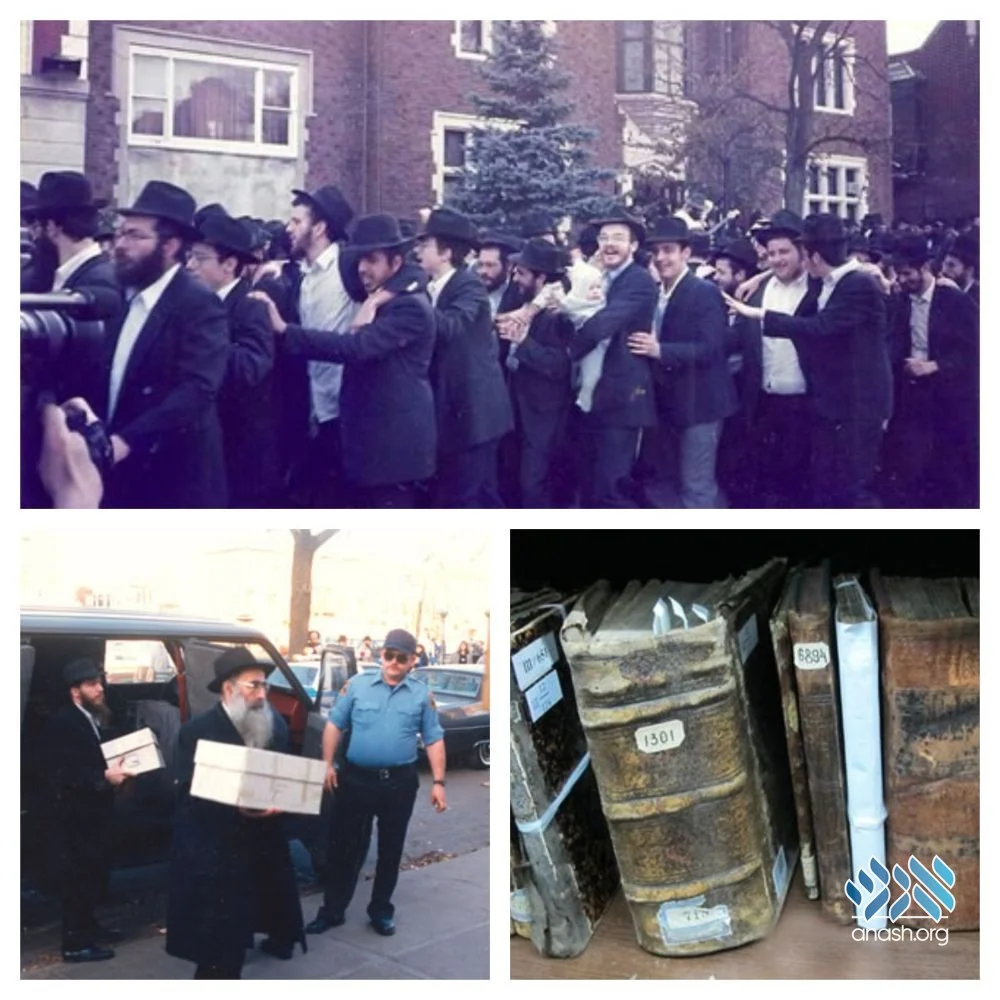
In 1985, the librarians of the Agudas Chassidei Chabad Library began to notice that rare books and manuscripts were missing from the library. Simultaneously, collectors and sellers of rare books began reporting suspicious items entering the market.  After an investigation, it came to light that a nephew of the Rebbe was stealing books from the Chabad library and putting them up for sale.  When confronted with his actions, he argued that as a grandson of the Frierdiker Rebbe, the previous Lubavitcher Rebbe, the seforim were his rightful inheritance.  After several failed attempts to resolve the issue through Beis Din, Chabad filed a restraining order against the sale of any more books from its library. They also filed a lawsuit, and the case was brought before federal judge Charles Sifton.


The nephew’s lawyers argued that the books were privately owned and were bequeathed to members of the family, essentially his rightful inheritance.  Rebbetzin Chaya Mushka, the Rebbe’s wife was deposed by the nephew’s legal team. In her testimony, she famously declared, “I think they [the seforim] belonged to the Chassidim because my father belonged to the Chassidim.” Her words and sincerity were compelling and ultimately pursuasive to the judge. 


The trial lasted for twenty-three days. During that time, the Rebbe spoke about it at farbrengens, urging his chassidim to demonstrate how active, vibrant and alive Chabad is by increasing their efforts to spread chassidus.


On the 5th of Teves, 5747, corresponding with January 6, 1987, almost a full year after the trial ended, the judge issued his ruling that the books belong to Chabad.  As the news spread among chassidim, they employed a rabbinic phrase from the Talmud: “victory is ours.”  The intense celebration that followed lasted for days. The chassidim understood that this was about more than just the seforim. The ruling made a statement to the world that Lubavitch was alive and vibrant and that indeed, the seforim and the movement belong to the chassidim, to the people. From that day, the 5th of Teves was designated as a holiday, “Didan Notzach,” marked by the purchase of seforim, the printing of sefarim, and the rededication to learning seforim. 


I had the privilege of visiting the Rebbe’s Ohel this week on the 5th of Teves.  An enormous crowd was gathered, people were dressed for Shabbos and wishing one another a Gut Yom Tov.  Though not a Torah or rabbinic holiday, not a day that appears on any other Jewish calendar other than Chabad’s, I was moved by the simcha, the sheer and authentic joy, enthusiasm and love those who weren’t even alive when the trial happened still felt towards not only the judicial victory, but to the significance and centrality of seforim.


If sale and study of the Bible is surging in the U.S. in general, all the more so should it be surging among our people, the people of the book.  We are living in an age in which there is a proliferation of Jewish and Torah literature in countless languages, in hard copy, online, audio and reading devices and on a diverse range of topics, themes, and ideas. There is so much noise and nonsense in the world today.  Engaging Torah is our blueprint, our manual for navigating this complicated world. 


Don’t just buy seforim, learn them and celebrate them, not only on the 5th of Teves, but each and every day.   

Rabbi Efrem Goldberg

Join Our Community

Subscribe to our newsletter or connect with us on WhatsApp.