The Art of Saying Hello

A couple of weeks ago, the 20th of Adar, marked the twentieth yahrzeit of Rav Shlomo Zalman Auerbach zt”l. In a tribute written shortly after his passing, Rav Aharon Lichtenstein, who shared a very close relationship with Rav Shlomo Zalman, described him as a “Gentle giant.” He wrote:


Reb Shlomo Zalman was endowed, as a lamdan, with a set of qualities which served him, ideally, as a posek. He had encyclopedic knowledge — and he had it, as mechudaddim beficha, at his fingertips. His temperament was remarkably judicious, invariably level-headed, and never pedestrian. He was deferential to the views of others, and yet genuinely self-confident. He could be innovative and even daring.


Rav Shlomo Zalman’s brilliance was undeniable, and yet it was perhaps surpassed only by his humility and sensitivity to all. R’ Chanoch Teller recounts the following anecdote: “When Rav Shlomo Zalman passed away, a beggar in Sha’arei Chesed sobbed in her anguish: “Now who will say ‘good morning’ to me every day?” (Mi yagid li boker tov?)”


While a testament to his unpretentiousness and accessibility, the anecdote has the potential to leave the reader believing that one must be the gadol ha’dor, the greatest of the generation, to be friendly, caring and gracious to all. Indeed, Rav Shlomo Zalman’s greatness was seeing his warmth and friendliness as nothing extraordinary at all, but something that should come naturally and be instinctive.


This week, I had the privilege of attending a retirement party of an executive who was stepping down after twenty years of dedicated service to his company. In his typical humility, when he invited me, he portrayed the gathering as being something like a small cake in the conference room for a few minutes to mark his retirement. In reality, however, over six hundred people packed into the company cafeteria, most of them standing for what turned into two and a half hours of tributes offered by those who reported to him and with whom he worked closely.


One by one the presenters noted the individual’s business acumen, talents, skills and gifts. They talked about his attention to detail on documents, his negotiating prowess and his invaluable contributions to the growth and success of the company. Every single one of them, however, also noted that what made him truly special and beloved was not his mind, but his generous heart and soul that he brought to work each day.   They described him as a man of high moral character.  Exasperated when he couldn’t find a better word (he wasn’t familiar with the word mensch), one person described him as amazingly decent.  Speakers were literally chocked up as they recounted his warmth, wise counsel, sagacious guidance, and most of all, his genuine care and concern for their personal lives.


When the event concluded, I asked him, “You only thought a handful of people were going to attend, those you worked closest with for the last two decades.   Why do you think over six hundred people decided to attend?” He answered, “When I began my career many decades ago I made a conscious decision that I would smile and greet every single person I would encounter throughout my day at work, whether in the lobby, elevator, hallway, in line at the cafeteria or outside in the parking lot. I made it a goal to learn everyone’s name and made it a point to use his or her name whenever I said hello. I guess people appreciated it and maybe that’s why they showed up today.”


The Talmud testifies (Berachos 17a) about Rabban Yochanan ben Zakai that no one ever preceded him in a greeting [of Shalom], even a stranger in the marketplace.” The Mishna in Pirkei Avos (4:20) encourages us all, “Hevei makdim b’shalom kol Adam, be the first to greet each person.” The Maharal explains that when you walk by someone without offering a greeting you make him or her feel invisible and insignificant. By making a point of greeting someone you demonstrate that you don’t see yourself as superior or better than another. Rather, by instigating the greeting, you show that you respect that person as an individual and thereby you give them dignity and worth.


In his book, “Reflections of the Maggid, Rabbi Paysach Krohn tells the following story:


In Argentina there was a ritual slaughter complex, comprised of several buildings. There was a building where the animals were fed, a building where they were slaughtered and the meat packed and loaded onto trucks, and an office building with dressing rooms for the shochtim (ritual slaughterers). The entire area was surrounded by a tall chain link fence and everyone entered through a wrought iron gate in the front, near the parking lot.


The owner, Yisrael (Izzy) Nachmal, was a workaholic. He was the first one in every morning and the last one out every evening. He oversaw every aspect of his company, Ultimate Meats, and made it a point to know every worker. The guard at the front gate, Domingo, knew that when Izzy left in the evening, he could lock the gate and go home.


One evening as Izzy was leaving, he called out to the guard, “Good night, Domingo, you can lock up and go.” “No,” Domingo called back, “not everyone has left yet.” “What are you talking about,” Izzy said, “everyone left two hours ago!” “It is not so,” Domingo said, “One of the shochtim, Rabbi Berkowitz, hasn’t left yet.” “But he goes home every day with the other shochtim, maybe you just didn’t see him,” Izzy said. “Believe me, I am positive he didn’t leave yet,” the guard insisted. “We better go look for him.”


Izzy knew that Domingo was reliable and conscientious. He decided not to argue, but instead got out of his car and rushed back to the office building with Domingo. They searched the dressing room thinking that perhaps Rabbi Berkowitz had fainted and was debilitated. He wasn’t there.


They ran to where the animals were slaughtered, but he wasn’t there either. They searched the truck dock, the packing house, going from room to room. Finally they came to the huge walk-in refrigeration room where the large slabs of meat were kept frozen.


They opened the door and to their shock and horror they saw Rabbi Berkowitz rolling on the floor, trying desperately to keep himself warm. They ran over to him, lifted him off the floor and helped him out of the refrigerated room, past the thick heavy wooden door that had locked behind him. They wrapped blankets around him and made sure he was warm and comfortable.


Izzy Nachmal was incredulous. “Domingo,” he asked, “how did you know Rabbi Berkowitz hadn’t left? There are over two hundred workers here every day. Don’t tell me you know the comings and goings of every one of them?”


The guard’s answer is worth remembering. “Every morning when that rabbi comes in, he greets me and says hello. He makes me feel like a person. And every single night when he leaves he tells me, ‘Have a pleasant evening.’ He never misses a night – and to tell you the truth, I wait for his kind words. Dozens and dozens of workers pass me every day – morning and night, and they don’t say a word to me. To them I am a nothing. To him, I am a somebody. “I knew he came in this morning and I was sure he hadn’t left yet, because I was waiting for his friendly good-bye for the evening!”


We may not have encyclopedic Torah knowledge or a brilliant business mind, but every one of us can be extraordinary just by making a point of greeting everyone with a smile. Whether at work, the gym, the supermarket or walking to Shul, we should never retire from being friendly, courteous and attempting to provide dignity and worth to all.



Confronting Mortality

It is remarkable how precious and cherished personal items can become “stuff” for someone else to get rid of literally overnight. After a BRS member recently passed away, I was visiting with a member of her family in her home when he shared that he had set aside items that are meaningful to him and proceeded to kindly offer me to take whatever I like for myself or for the Shul.


I looked around the room at the china cabinet, the bookcase and the paintings on the wall and was overwhelmed with the realization that just a week before, these were the precious possessions of this wonderful person and only a week later, they are now stuff, junk, things that need to be donated, given away, or even trashed.


It is said, you never see a U-Haul attached to the back of a hearse.   Our Rabbis teach that while you cannot take any of your possessions with you, you can take your acts of kindness and good deeds. Contact with the finality of death naturally elicits a sense of our own mortality and provokes thinking about what is truly important in life and how we should take advantage of every single day.


“Re’eh anochi nosein lifnechem hayom beracha u’kelalah.” Our parsha begins by telling us, “behold I have placed before you today blessing and curse.” This verse is traditionally viewed as expressing the concept of free will, of our ability to recognize that set before us are options of good or evil, right and wrong and that the choice is ours to make. However, I would like to suggest an alternative punctuation and meaning.


Re’eh anochi nosein lifnechem…hayom. Behold, I have placed before you…today, the concept of mortality. I have set before you a feeling of transience and impermanence. That feeling can be channeled in a number of ways, the pasuk continues. It can result in beracha, blessing, or it can result in kelala, in curse.


If we allow our feeling of vulnerability, of hayom, to bring us to a state of despair and of depression then it is kelala. If the recognition of our mortality makes us complacent, stagnant or content, it is a curse.


However, if our sense of being fragile and unstable, of hayom, causes us to take advantage of the moment for it may be fleeting, than we have turned it into beracha, for it has been the catalyst for change.


Indeed, Chazal, our Rabbis, have contrasted these two perspectives of hayom. On the one hand, they discourage us from approaching life with the attitude of echol, v’shaso, ki machar namus, eat, drink and be merry for tomorrow we may die. This attitude and interpretation of hayom leads to a hedonistic lifestyle. Recognition of our own mortality has for some become a license to be self-serving and pleasure seekers.  With this outlook, hayom, our vulnerability, is a curse.


But Chazal encourage us to say rather im lo achshav aimasai, if not now, when? Judaism teaches us to take our feelings of fragility and vulnerability and use them as springboards to grow, change and make a difference. A sense of mortality should encourage us to take advantage of every moment and to cherish every opportunity. Indeed, the Torah subscribes to an attitude of carpe diem, seize the day to contribute to society, positively affect other people and become a better spouse, parent or grandparent.


An awareness of just how unpredictable and volatile our lives can be must motivate us to stop procrastinating and take advantage of hayom, of right now. As we prepare to welcome in the month of Elul, let’s make a commitment to stop saying I will get to it later. This can truly be our best year ever, if we only say ha’yom, I am going to make it happen today.


Pesach Sheni – Give God, Others and Yourself a Second Chance

The prisoners of Buchenwald never dreamt they would be given a second chance. They didn’t know if they would survive that day let alone what life they would ultimately lead. Of course when imprisoned they could not observe any Jewish holidays including Pesach. They couldn’t partake of the matzah, marror, seder or hagadah and never imagined celebrating a transition from slavery to freedom again.


“Vayehi ha’anashim asher hayu t’mei’m l’nefesh adom v’lo yochlu la’asos ha’pesach ba’yom ha’hu va’yikrevu lifnei Moshe v’lifnei Aharon.”   It was one year after the Exodus and the Jewish people have settled in to their new routine of freedom and emancipation. They are commanded to once again sacrifice a lamb, eat matzah and celebrate liberty, but this time not in anticipation of leaving. Instead, pesach is to be the annual commemoration of the transition from slavery to freedom.


Pesach was a national celebration, a remembrance of the birth of our people and the large family we all are. But, there was one group that felt on the outs. They did not participate in Pesach and therefore felt very disenfranchised and excluded from the community. Vayomru ha’anashim ha’heimah elav anachnu t’mei’im l’nefesh adom, lamah nigara l’vilti hakriv es korban Hashem b’moado b’soch Bnai Yisroel.   This group came forward and said at the time of Pesach we could not participate in the sacrifice because we were impure having had contact with a corpse. Lamah nigara, why should we be denied this experience?


Moshe advances their legitimate grievance to Hashem and Hashem responds positively by introducing the laws of Pesach sheni. On the 14th of Iyar, exactly one month after the Pesach sacrifice was offered, the group unable to participate was given a second chance, a pesach sheni.


Why specifically does this mitzvah have a second chance? What if you miss Chanuka due to illness or travel and could not light the candles – there is no second Chanuka. What if there is a hurricane, God forbid, and you can’t sit in a Sukkah – there is no second Sukkos. Why specifically here is there a Pesach sheni, a second chance?


Rabbi Ari Kahn of Bar Ilan University suggests that perhaps the answer lies in why these individuals were impure and from whom they contracted that impurity. The gemara sukkah 25a quotes a few opinions. One says they were occupied with burying an anonymous corpse not being tended to by anyone else. In the merit of their commitment to the highest chesed, the ultimate kindness, they were given a second chance. Another opinion says they were impure from contact with the coffins of Nadav and Avihu, Aharon’s two sons who died tragically and seemingly prematurely. The final suggestion is that it was the individuals who had carried the coffin of Yosef from Egypt in fulfillment of the promise to bury him in the Holy Land.


The Midrash in Shemos Rabbah sees the final opinion as the most correct and authoritative and seeks to prove the connection between Pesach Sheni and Yosef Ha’Tzadik. These individuals stepped forward and said we have been fulfilling the promise to Yosef Ha’Tzadik and have carried his remains on our shoulders through our travels in the desert. For making good on a promise to our Patriarch we are excluded from a national celebration? Says the midrash, the gift of Pesach Sheni and the second chance it provides are in direct merit of Yosef. What is the connection?


Think about Yosef and his life. This handsome, charismatic young man had alienated his brothers to the extent that they contemplated killing him, threw him in a pit with snakes and scorpions and ultimately sold him into slavery. Yosef was isolated from his family, on his own and far from the greatest influence in his life, his father. Despite the challenges he faced, Yosef rose to greatness in Egypt and became the second most powerful man in the strongest empire in the world.


When his brothers found themselves in Egypt appealing to Yosef for food, Yosef could have let them have it. When he finally revealed himself, he could have told them off, put them in their places, denied them assistance and in fact, have them killed in retribution. What does he do instead – he gives them a second chance. He revisits the relationship and allows them back in to his life.


Pesach Sheni is given in the merit of Yosef because courageously, bravely and with tremendous humility, Yosef introduced us to the idea of second chances in interpersonal relationships. Perhaps it is for this reason that when the group came to Moshe to register their complaint they phrase it as lamah nigara l’vilti hikriv es korban Hashem b’moado b’soch Bnai Yisroel, among the Jewish people. They wanted to feel connected, together, unified with the nation and community. After all, how did the slavery in Egypt begin – it was because Yosef was sold into slavery, violated by his brothers, dismissed, discarded, marginalized and condemned by his own brothers.


Despite being scorned, Yosef gave the brothers a second chance because he wants the family to be whole. Now, those who carried Yosef’s coffin, also carried on his mission and vision and came to Moshe saying, we want to be b’soch bnai yisroel, we want to be included in the nation so our people are whole and complete. Hashem’s response – Yosef gave a second chance, and therefore so will I. Here is Pesach Sheni.


Last March, a very special Rabbi left this world at 95 years old. Rabbi Herschel Schacter z’l, father of Rabbi JJ Schacter, led a remarkable life. He graduated Yeshiva University in 1938 after studying under Rabbi Moshe Soloveitchik and in 1941 he became the first musmach of the Rav.   He was a former chairman of the Conference of Presidents of Major American Jewish Organizations and served as the Rabbi of the Mosholu Jewish Center in the Bronx for more than 5 decades.


Most notably, Rabbi Schacter served as a chaplain in the Third Army’s VIII Corps. during WW II and was the first US Army Chaplain to enter and participate in the liberation of Buchenwald in 1945.


I share this with you firstly because Rabbi Schacter deserves to be spoken about. I share it today because Memorial Day weekend, a time we think about those who served in the American military is the perfect time. And I share it with you now to tell you about what Rabbi Shacter did on April 27th, 1945.


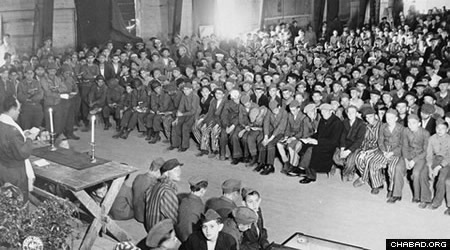
In Buchenwald on that day which was after the liberation, Rabbi Schacter led a Pesach Sheini Seder. Hundreds of individuals who were t’meiim l’nefesh adom, who had direct contact with death and who were denied the opportunity to celebrate pesach, gathered to experience Pesach Sheni. That incredible seder was likely the first Pesach Sheini Seder since the time of the Beis HaMikdash.   Just imagine for a moment a barrack filled with survivors, standing room only, in Buchenwald making a Pesach Sheni seder. We actually have a picture of that event and it is simply incredible.


Shiku Smilovic, in his autobiographical memoir tells the following about that day:


“All Jews were invited by Rabbi Schacter to attend services and to eat Matza, since it was Pesach Sheini that day. The second Pesach, for Jews that couldn’t observe the holiday of Pesach at the proper date. Rabbi Schacter brought Matzos and distributed them to everyone. Rabbi Schacter started to deliver his sermon, when suddenly he was interrupted by a fellow prisoner. When he heard the Rabbi say, “We know what you have gone through” The man screamed and said: “No one, but no one, can dare say that he knows what we went through unless, he or she was there! Only they can say, I know what you went through!” He continued at the top of his voice with quotes from the Torah and other scriptures. He was no plain ordinary every day Jew. He spoke with authority. “Why did G-d forget about his children? And we were devastated, just because we are Jews?” he continued. “Before we make a blessing and eat this Matza. We want a Din Torah with the Ribono shel olam: Why? Why the little children? They didn’t have a chance to sin yet? Why so many thousands of true dedicated Talmidei chachomim (Jewish learned men), that were sitting and learning yomam v’lyla day and night? You can take your matzos back to America. I don’t want them, as far as I am concerned. The rest of you: you are free! You can do what your heart desires!” Rabbi Schacter did not interrupt the man and he let him finish. He moved his fists towards his heart and said, “Chotosi Uvisi Pushati Lefonecha: Please, may I have your forgiveness?” The man raced up to the Rabbi and embraced him for a while. The rest of us just stood there in silence, and our tears did the talking. After that scene we all decided to have some Matzo anyway. We made the blessing of al achilas matzah in unison. I am sure that this blessing was heard in heaven, and all the Angels answered Amen.”


Yosef gave his brothers a second chance despite what they had done to him.   Years later, Hashem gave Pesach Sheni to those who requested it, in his merit. And on April 27th, 1945 the survivors of Buchenwald observed Pesach Sheni and through it gave Hashem a second chance.


It is simply never too late. Many of us, like Yosef, have been hurt by our brothers. They have caused us pain, damage, or loss. A family member, co-worker, friend, neighbor or even a spouse or child has hurt us terribly and we are tempted to write them out of our lives forever. I would argue that it is unlikely anyone here has been hurt more than Yosef and yet, he gave his brothers a second chance. We can too. Don’t think a relationship is ever damaged beyond repair. Don’t severe a connection forever. If the circumstances are right, give others a Pesach Sheni, give them a second chance.


And, like the incredible heroes of Buchenwald, even be willing to give Hashem a second chance. I would argue nobody has experienced greater suffering and nobody is entitled to write off God more than Holocaust survivors. And yet, that fateful day in 1945, hundreds of liberated prisoners observed a Pesach Sheni and were willing to give Hashem a second chance. You were disappointed by God, felt abandoned, hurt, ignored – that is legitimate and those are valid feelings. But, if they could be open to giving God a second chance, so could you. Work on the relationship, rebuild, invest, talk to Him, let Hashem back in to your life and you will benefit the most.


And lastly, while Pesach is formally the only mitzvah for which we are giving a second chance, in truth we always have second chances. If you never properly learned to read Hebrew or follow the siddur, you can still have a second chance. If you want to learn your haftorah, celebrate a milestone that passed you by you can still have a second chance. If you got married without kosher witnesses or a kosher wedding, it isn’t too late. You can have a second chance and we can arrange a private ceremony. If you have always wanted to learn gemara or complete the daf yomi, it is not too late, you have a second chance.


Whatever happens in life – between us and others or between us and Hashem – never stop believing in second chances.


Don’t Just Pursue Happiness, Experience It


When the Founding Fathers included the pursuit of happiness as an American right and entitlement, it is almost as if they conceded that happiness can be pursued, but it is unlikely to ever be attained.  If you look around, you can’t help but notice that for many, the pursuit has grown tiring and indeed, many have given up.  In the last twenty years, there has been an astounding increase in antidepressant use by Americans. One might even suggest that the growing effort to legalize marijuana nationally is driven by a community eager to find pleasure and happiness, even if it is by escaping reality.


In 2006, Harvard psychologist Daniel Gilbert wrote a book called “Stumbling on Happiness.”  In it, he argues that the things and experiences we typically predict and imagine will bring us happiness, rarely do.  Rather, he says, happiness is elusive and we should learn from how others have stumbled upon it.  The first part of his thesis is undeniable.  Study after study has concluded that money, fame, and power not only don’t contribute to happiness, but often are obstacles to and detractors from experiencing it.


As we find ourselves in the first of two months characterized by happiness and in which we are charged to be marbeh b’simcha, increase and expand our joy, it is worth asking ourselves: what are the true keys to happiness?  This Sunday evening, BRS is privileged to host world-renowned happiness expert Dr. Tal Ben-Shahar, who has written best selling books on the topic as well as having taught a course on happiness at Harvard, the most popular class in the university’s illustrious history.  I strongly encourage you to join the over-325 people who have already preregistered for this incredible seminar.


Obviously, Dr. Ben-Shahar does not need my endorsement, nor am I so presumptuous to suggest I can add to his teachings.  However, I would like to share with you three suggestions from Torah sources for finding happiness as a complement to his upcoming seminar.


1)   Happiness is not an emotion; it is a decision.  Stop waiting passively to feel it and start actively choosing to be it.


In Parshas Ki Savo, the Torah says, u’vau kol ha’berachos ha’eleh, v’hisigucha, which literally translates as “All these blessings will come upon you and overtake you.”  What does it mean v’hisigucha, to be overtaken by blessing?  Rav Shlomo Yosef Zevin explains that Hashem gives each of us beracha, blessing in our lives.  That blessing can manifest itself in all types of form – material possessions, meaningful relationships, special skills, wonderful opportunities, family, and the list could go on and on.   The first blessing is the particular gift.  But even more important and an even greater blessing is v’hisigucha…to recognize, appreciate and acknowledge the blessing.


Simcha, happiness, occurs when we make the decision to focus on the blessings in our lives, no matter how challenging or formidable the struggles we face simultaneously.  If our happiness results from the blessings we already have, we can always find happiness because we always have at least something.  But if our happiness is determined by what we don’t have, “If only I had more money, a nicer house, a better job, a more loving spouse, more loyal children, etc.” we will never be happy because we can always have more.  Therefore, by definition, there will always be something we don’t have.


The decision to be b’simcha, happy, doesn’t only affect us but it can positively influence our environment and family. Dr. Nicholas Christakis, a physician at Harvard Medical School, authored a study that concludes that happiness, scientifically speaking, is literally contagious.  The same way a person yawning causes , others to also begin to yawn, when one person smiles or is happy, it is infectious and draws smiles and happiness from others.


It has been suggested homiletically that the etymology of the word simcha comes from sam-mo’ach, focus your thoughts.  Make the decision to be happy and the feeling will follow.


2)   Happiness comes from giving not from getting.  It comes from being a giver, not a taker.


After many years concentrating on what makes people depressed, social scientists are now beginning to study what makes people happy.  Their answer is counter-intuitive.  Paradoxically, it turns out the biggest obstacle to achieving happiness is our own pursuit of it.  When happiness is defined by our needs, our wants, and our desires, it will remain elusive and unattainable for we will never have everything.  Instead, studies show that people report better health and greater happiness when they volunteer for a worthwhile cause or spend time helping others.  Moreover, studies have shown the efficacy of volunteering and helping in combating depression.


Happiness does not result from a focus inward, but it results from the deep satisfaction and profound gratification of imitating God and helping others.  At the end of Hilchos Megillah (2:17), the Rambam makes an incredible comment.  He asks, if a person has limited funds and has to choose between having a more lavish and luxurious Purim meal, more extravagant and impressive mishloach manos, or giving more matanos l’evyonim, money to the poor, what should he do and why?


The Rambam codifies that the resources should be dedicated to helping the indigent and poor because Purim is about simcha and there is no greater happiness than bringing joy to others, especially the underprivileged.


Someone once wrote to the Lubavitcher Rebbe z’l in a state of deep depression and hopelessness.  The letter essentially said, “I would like the Rebbe’s help. I wake up each day sad and apprehensive. I can’t concentrate. I find it hard to pray. I keep the commandments, but I find no spiritual satisfaction. I go to the synagogue but I feel alone. I begin to wonder what life is about. I need help.”


The Rebbe sent a brilliant reply back that did not use even a single word. He simply circled the first word of every sentence in the letter and sent it back. The author of the letter understood, and he was on the path to greater happiness and hope.  The circled word at the beginning of each sentence was ‘I’.


A self-centered person, a taker, can never be happy in life because they could never take enough.  Givers find joy in doing for others and therefore have great access to happiness because there are always ample opportunities to give.


3)   Surrender control and to borrow an expression – let go, let God.


A few summers ago, on a visit to Israel, I decided to go skydiving and to appreciate our homeland from a new perspective.  After a comprehensive five minutes of instruction, I was taken up in a tiny plane that if I wasn’t crazy enough to jump out of, I was crazy to get into.  With a soft helmet on, and goggles on my face, they placed me with my feet dangling off the side of the airplane.  We were 12,000 feet in the air and the beautiful land of Israel was a fuzzy blur.  I vividly remember leaning over and looking down and feeling like I couldn’t breathe.


Before I could have second thoughts, I felt a nudge and out the plane I went.  I was heading towards mother Earth travelling over 130 miles an hour.  The wind was rushing all around me, my arms and legs were extended, and I think I tasted my spleen.  For a brief moment, I felt panicked.  “This is absolutely nuts, what kind of crazy, insane person does this?” I thought to myself.  I started to get scared, worried and anxious and then I remembered.


Immediately behind me, attached by numerous metal latches and clips, was a big Israeli man who trains paratroopers in the Israeli army and who does these jumps around 8–10 times a day.  We jumped in tandem and the moment I remembered that he literally had my back, I felt the biggest relief and was able to enjoy the rest of this remarkable experience.


The difference between a miserable, painful, anxious experience and the experience of my life, was remembering there was someone who had my back and who knew what he was doing.  Six thousand feet and forty five seconds into the jump, he pulled the cord, the chute released, we sat up in the harness and for the next 10 minutes had the most extraordinary ride over Israel, checking out our magnificent homeland from the sky and giving Israel a huge virtual hug.


We need to take initiative, put forth our best efforts, and do everything we can to bring positive outcomes in our lives.  However, believing that we can control and manipulate every outcome and result places impossible stress and pressure that preclude our ability to experience happiness.  There is nothing more liberating, cathartic and joyful than doing our best, and then letting go of our need to control and allowing God do the rest.


No matter how hard we try and what kind of effort we produce, our lives are going to inevitably and invariably throw curveballs our way.  The difference between panicking anxiously or enjoying the ride is our ability to let go.  Perhaps this is what the pasuk means when it tells us, “Ivdu es Hashem b’simcha, serve Hashem with joy.”  The greatest service of Hashem is feeling the simcha that can only come by recognizing that He has our back so we can enjoy the ride.


Happiness is within our grasp if we simply reach for it.  Join us for the brand new BRS Happy Minyan this Friday night and continue to reach for it by not missing a truly special opportunity in our Happiness Seminar with Dr. Tal Ben-Shahar on Sunday night.  Don’t just pursue happiness.   Learn to experience it.


Not All Dreams Are Created Equal

On August 28, 1963, from the steps of the Lincoln Memorial in Washington, Martin Luther King, Jr., whose contributions and influence we will mark this coming Monday, delivered what ultimately became his signature speech.   Many identify that address, delivered to over 250,000 civil rights supporters that had gathered for the March on Washington, as the defining moment in the American civil rights movement.


What many don’t know is that the now-famous “I have a dream” speech was not intended to be given that day.  Dr. King had actually delivered a different speech and was moving to close when a woman called out from the crowd, “Tell them about the dream, Martin!” He then deviated from his original ending, partiallly improvised on the spot, and launched into a vivid and compelling description of his dream of freedom and equality for all.


Due to hard work, resolve and perseverance, MLK’s vision went from a dream to at least a partial reality.  His dream was not about himself, his advancement, or his glory.  He dreamt of a better, more just and fair world in which all are respected, appreciated and treated equally and fairly.


As we mark MLK’s life this coming week it seems appropriate to ask ourselves – what do we dream of?  What do we wish for?  Do our dreams include others or just ourselves?  Do our dreams include a vision for a better world for all or just for ourselves?  How do our dreams integrate with those of our families, our spouses, or our children?  Are our dreams compatible with our realities, our commitments, and our obligations, or do our dreams necessarily require us to abandon them?


Starting in 2024, a new initiative called Mars One will begin sending people to Mars in the hopes of creating a permanent human settlement there.  Missions will leave every two years to bring people.  The decision to go is irreversible, as those that move will have a one-way ticket with no mechanism to come home.  Furthermore, under Martian gravity, a person’s bone density would decrease significantly and he or she would be unable to return to withstand Earth’s gravity, which is far stronger.


The organization publicly invited all those interested to apply for a spot and remarkably, since just April of last year, more than 200,000 individuals have applied.  Last month, 1,058 applicants were contacted and told that they had made it through to the second round.  Among them, is 38-year-old Ken Sullivan, a medevac pilot from Utah who has always dreamt of exploring and inhabiting another planet.  According to the Salt Lake Tribune, there is only one minor problem.  Ken applied without ever consulting his wife Becky, and now the two are struggling with what his dream means for their marriage and family.


“The question is do we get divorced now or get divorced later,” she said. “If I stand in the way of his dreams and passions, then we get divorced now, so I have to be supportive.”  Ken’s dream is not only affecting his wife, but it has unalterable consequences for his four children, ranging in age from 6 months to 13 years old who, if he is selected, stand to never see their father again. The permanent effect on his family is not lost on Ken, who said, “I just hope the family will be able to forgive me down the road.  Hopefully there isn’t too much hatred of my being selfish in pursuing a dream that isn’t theirs.”


If I was one of Ken’s children, I don’t think I could forgive my father for putting his self-centered dream ahead of his loyalty to his family.  You see, there is nothing wrong with having dreams.  Indeed, dreams are wonderful, significant, and important.  They cause us to aspire, to be ambitious and to seek out goals.  Dreams motivate, stimulate and inspire.


But it seems to me that dreams should bring us closer to the people we love, not drive us apart from them.  Dreams should include those that we care about, not marginalize them.  Dreams should be compatible with and reinforce our values, our commitments, and our obligations, not cause us to abrogate, distort, or compromise them.  Dreams should be mature, selfless and meaningful, not childish, selfish or superficial.


I cannot relate at all to the over-200,000 people who are ready to voluntarily leave our planet and all that inhabit it, never to come back here or see those people again.  We likely read the story of Ken Sullivan and think we have absolutely nothing in common with him or his priorities at all.


But the truth is, many of us, like Ken, are putting our dreams ahead of our families.  We may not abandon our spouse and children to go to Mars, but many neglect time with their spouse and children to pursue personal dreams and interests that don’t benefit or advance our family or even help us become better spouses or parents to them.


There is nothing wrong with dreaming of a low golf handicap or competing in a triathlon.  It is wonderful to dream of professional or financial success beyond imagination.  It may even be noble to dream of performing extraordinary amounts of chessed or being the fixture in the Beis Medrash, learning many hours a day.   But these dreams must be pursued in moderation, with the consent and cooperation, hopefully followed by support, of our families, as well as in conjunction with our other responsibilities, not in place of them.   Our dreams must never make us judgmental or intolerant of those who don’t share them. Even the dream of taking on more observance must be pursued carefully, with great sensitivity, moderation and with respect for those around us.


In a 2011 Wall Street Journal article entitled, “A Workout Ate My Marriage: Exercise Can Set Off Conflict About Family and Free Time,” the author writes:


“Commitment to a demanding training schedule cuts to the heart of the issues couples often find themselves fighting about—who does chores, who gets time for themselves and who decides where and how the family has fun.  The threat can go beyond time issues. If one partner gets a new, buff appearance and a new circle of buff acquaintances, romantic possibilities can open up—and give the other spouse good reason to feel insecure about his or her own physique.”


The article coins the phrase, “exercise widow,” and describes the stress on marriages when one partner suddenly decides to pursue a dream of endurance competitions and marathons with rigorous and time consuming training schedules.   Just as there are exercise widows and widowers, there are career widows and football orphans produced when someone prioritizes their dream and desire over their responsibilities, commitments, and obligations.


Not all dreams are responsible or appropriate to pursue.  Someone might dream of owning a yacht, but it would be financially reckless and irresponsible to do so.  Some might dream of fancy luxury vacations, but it would mean taking children out of Jewish day school.   Some might dream of spending Saturdays on the beach or dream of tasting lobster, but it would mean compromising on our heritage and its expectations of us.


Like Martin Luther King, Jr. we should all have dreams and work hard to make them into reality.  But like Dr. King, our dreams should be inclusive, noble, balanced, sophisticated, serve to better the world and bring people closer together.  Most importantly, our dreams should be coordinated with our families and pursued only with their support.


The Talmud in Berachos describes what happened when the sages approached R’ Elazar Ben Azarya to accept the position of Nasi, the head of the Sanhedrin.  He must have been stunned by the invitation and incredibly excited and enthusiastic.  After all, Nasi was the most prestigious and prominent position of the Jewish people and he was only 18 years old at the time.  Nevertheless, R’ Elazar’s response to them is so instructive.  “I have to consult with my wife before I can give you an answer,” he said.  Our commentators explain that while the invitation to become Nasi was an incredible honor and privilege, it would be incredibly demanding and leave R’ Elazar ben Azarya with little time for his family.   Though it would have been a dream come true, he refused to accept the position without the buy-in and support of his wife first.


Ken Sullivan’s application is unconscionable.   Dreams should never hurt, cause pain or create division.   They should heal, unify, and create a better circumstance for ourselves, our families and the world.


Practicing Savlanut Makes for Perfect Patience

Given the frigid weather and snowfall elsewhere in the country, it is hard to complain in December about life in South Florida.  And yet, if there is a complaint it is this: with the influx of snowbirds who come south for the winter, it becomes exceedingly difficult to find parking or get a decent reservation at a restaurant.   In fact, if I ever ran for public office in Boca, my platform would be legislating reserved parking and reserved tables for full-year residents.  Sometimes, patience is more than just a virtue; it is a key to survival.


People who are quick to anger, lose their cool, get bent out of shape, grow impatient, and blow their top cannot hope to find happiness or joy in life.  Indeed, the Alter of Kelm, Rav Simcha Zissel Ziv writes that we must make great efforts to become patient, for it is the root of all positive character traits and ultimately of experiencing serenity.


Patience is an absolutely necessary ingredient in life and one cannot live without it.  Invariably and inevitably we encounter situations, people, and circumstances that will test our patience.  Whether or not we have patience in those situations can have the greatest consequences for the remainder of our lives.  As a Chinese proverb astutely notes, “One moment of patience may ward off great disaster. One moment of impatience can ruin a whole life.”


Why is patience so critical and how do we improve ours?   Rav Shlomo Wolbe explains that the root of the word savlanut is sovel which means to carry a heavy load or to bear a burden. For example, towards the beginning of this week’s parsha, Hashem promises to redeem us: “V’hotzeisi eschem mi’tachas sivlos mitzrayim, I will take you out from under the burdens of Egypt.”  Sivlos, the burdens of Egypt, is the same word as savlanut, patience.  A patient person bears the burden or endures the suffering, but never reacts with impulsiveness or impetuousness.  A more literal translation of savlanut is actually sufferance as one who is patient can live with suffering, a little discomfort or inconvenience.


Every single one of us in life will confront difficulties and challenges.  We cannot control what happens to us, but we absolutely can control how we react and in fact, it is how we react that says everything about us.  We inevitably will be soveil, burdened, with different forms of hardships, but will we react and respond with savlanut?


The ability to cultivate a sense of forbearance and to live with great patience, particularly in the face of relatively small challenges, is actually the source of great spiritual growth and development.  After all, why do people get impatient?  When stuck sitting in traffic, waiting in the doctor’s waiting room, waiting for your spouse to get ready, or for the webpage to finish loading, doing homework with our kids or explaining something for the millionth time to someone, our physiology actually begins to change.  Our heartbeat quickens, we begin to sweat, the blood rushes to our faces and our impatience grows and with it our lack of control and sound judgment.


If you think about it, impatience is never a solution and never actually improves any situation.  In fact, when we become impatient, time doesn’t speed up, it slows down, actually causing us to suffer more.  So what is the source of impatience which is so self-destructive that it often leads to us yelling at the people we claim to love most or to embarrassing ourselves by overreacting or making a scene?


Impatience comes from being egocentric.  I want it this way, at this time, in this place, at this pace.  We absolutely eliminate other people or even God as having roles in our lives and fully expect life to unfold the way we drew it up.  When it doesn’t and we are forced to wait for someone or to be in an uncomfortable position, our egos force us to grow impatient and ultimately to become angry.


Patience is actually an expression of humility and of our recognizing that we cannot control and manipulate every circumstance.  When we display impatience we are implicitly saying that the world revolves around us, but when we cultivate a strong sense of patience, we are making room for other people and most especially for the Master of the Universe and His divine plan, even when it doesn’t match up with ours.


On a very real and everyday level, patience with others means accepting and tolerating other people in our lives.  Having savlanut, patience, means a willingness to be soveil, to bear the burden of things not going exactly as we planned or wanted and being okay with that.


Patience will make our lives so much more pleasant and allow for the peace, serenity, and calm we all crave and desire.  Adjust your expectations.  If you know you are traveling in rush hour, leave early so when you run into traffic you won’t grow impatient.  When you go to the doctor, have the expectation that you are going to wait.  As one comedian points out, that is the name of the room, after all.  When you are getting together with someone whom you know tries your patience, prepare yourself in advance and remember, that while you cannot control him or her you can control how they make you feel.  Learn to expect and plan for things not always going smoothly or your way so you are prepared when it happens.


So next time you are circling around the parking lot or waiting for a table endlessly, remember what’s truly important.  Keep life in perspective and focus on what truly matters.  When you start to feel anxious and impatient, your blood boiling, and your muscles tensing, take a few deep breaths and try to relax.  Recognize that ‘gam zeh ya’avor,’ this too shall pass.  As annoying and frustrating as it is at the moment, life will move on, unless we react in a way that won’t let it.


Celebrity or Somebody? Be a Person Who Matters

I was sitting at the gate recently, waiting to board a plane, when a man walked right past me.  Something about his look and walk made him seem like he was a “somebody.”  I didn’t think anything of it until a few minutes later when I noticed that people were beginning to approach him for autographs and then stood in line to take a picture with him.


I asked a fellow passenger sitting near me if he knew who the person was.  He said somewhat incredulously, “You don’t know who that is?!  That is Jeremy Wade, the extreme fisherman and host of Discovery Channel’s show ‘River Monsters.’”  He jumped up to get in line to take a picture he could put on his Facebook page with a celebrity and thereby prove that he too was a “somebody” by association.


I have a confession to make.  For a brief second—and I mean really just a millisecond—I contemplated going over to say hello and get a picture as well.  Thankfully, my sanity was immediately restored and I realized, “Why in the world would I take a picture with someone who may be a very nice man, but moments ago I had no idea who he was?”


The experience humored me until I boarded the plane.  Here I have a second confession to make.  I actually read the airline’s American Way magazine and I was glad that I did.  It contained an article that substantiated the experience I had just had.   Celeb 4 A Day (celeb4aday.com) is a service that offers non-famous people a chance to experience life as a celebrity for a few hours.  For a fee, the company arranges to have mock paparazzi follow you around snapping pictures and calling your name as you come out of a restaurant or store.


You probably don’t recognize the name Larry Dobrow and it is even less likely that you would recognize his face.  He is a writer for American Way who decided to test this company and see if, in fact, having photographers follow him would fool anyone into thinking he is a celebrity.  He describes himself as having, “ a face best suited for AM radio in rural areas, with skin tone that falls somewhere between pale and translucent…The notion that anyone would buy me as a celebrity seemed comically far-fetched.”


He arranged with the company his approximate schedule that morning, but to keep the element of surprise, didn’t know exactly where or when they would descend upon him.  He was crossing 44th Street in Manhattan when it happened.  “It came in the form of four photographers.  They darted out from behind an illegally parked truck and, before my brain registered their presence, positioned their cameras inches from my face.  As if this alone wouldn’t command my complete attention they affirmed it with a persistent chirp: ‘Larry! Hey, Larry” Here, Larry!’”


Larry goes on to describe that moments later, people started to ask him for a picture together.  In total, he estimates more than 30 people approached him for autographs or pictures simply because they had seen the fake paparazzi snapping away.  They had no idea who he was and frankly he wasn’t anyone they would likely care about and certainly would never take a picture with.  But that didn’t matter.


Why are so many people infatuated with the lives of celebrities?  Why is our first instinct when seeing someone famous to take a picture with him or her or to interact at all given that in reality we are complete strangers to one another?  Larry Dobrow suggests, “Being in the presence of ‘Someone Who Matters’ is emotionally validating” and “a memento of that encounter posted on Facebook is the social currency of our time.”


Someone Who Matters. It all comes down to how we define that expression.  Does appearing on TV or in movies automatically mean that you matter?  Does having great athletic ability translate into being someone who matters?  Does having lots of Facebook friends or millions of followers on Twitter mean that you matter?  What does it mean to matter and doesn’t Judaism answer that question differently than pop culture?


The original location prescribed for the Chanukiah to be lit on Chanuka is outside of the home, al pesach beiso mi’bachutz.  Halacha allows for it to be lit inside during what it calls sha’as sakanah, times of danger.  The Chassam Sofer, Rav Moshe Sofer of Pressburg, who lived 200 years ago asks, why do we still light inside the home when it is often completely safe to light outside?  What exemption are we relying on today?


He explains that the light of the Chanukiah, like that of the Menorah in the Temple, symbolizes Torah, and its values, lessons, and teachings.  Torah dispels the darkness and illuminates the world with its timeless messages and enduring ideals.  Says the Chassam Sofer, in the past, the Jewish home was a pure, pristine, insulated place whose identity and practices were informed by Torah alone.  The Chanukiah was placed on the outside in order to illuminate the darkness out in the world and to dispel the unwelcomed foreign influences from penetrating into our houses.


Today, foreign influences, pop culture and alien values have made their way into our Jewish homes.  We subscribe to magazines and newspapers, have smartphones and tablets, TVs, DVD players and DVRs, and web access everywhere.  These bring with them powerful and destructive images, ideas and temptations.  Now that the darkness has come into our homes, says the Chassam Sofer, it is a sha’as sakana, not of anti-Semitism, but of assimilation, and therefore, we light the candles inside.


Infatuation with pop culture, obsession with celebrities, and mistaking people who make headlines for people who matter are symptoms of darkness.  Our celebrities who truly matter should be great Torah scholars and righteous men and women of impeccable character.  We should be obsessed with real heroes like members of the IDF, coordinators of Chesed, and simple ehrlich (honest) people who work tirelessly for their families so their children can receive a Jewish education.  They may not make headlines and aren’t followed around by the paparazzi, but they are leading lives that truly matter and being able to say we know them or having a picture with them should be the social currency of members of a Torah community.


Our children have all heard of Lebron James and they are likely familiar with Oprah, but have we made sure they know the name Rabbi Noah Muroff?  A few weeks ago, Rabbi Muroff purchased a desk on Craigslist for $150.  It wouldn’t fit in the spot he had designated for it so he took it apart in order to try to make it smaller.  When he lifted off the top, he discovered $98,000 in cash.  With his wife’s encouragement, it took less than 20 minutes to call the previous owner of the desk, a woman named Patty, to tell her they had found her money.  She was speechless and later wrote in a thank you note, “I do not think there are too many people in this world that would have done what you did by calling me.”  The Muroffs specifically brought their four children with them to return the money the next day, with the goal of teaching them in his words, “the message of honesty and integrity.”


Let’s teach our children to celebrate people like the Muroffs.  Let’s inspire them to become tomorrow’s celebrities, not by hiring paparazzi or even by becoming famous, but by becoming people who truly matter.


Are You Essential or Non-Essential?

postit

The dictionary definition of “non-essential” is “not completely necessary.” Synonyms include “dispensable, gratuitous, inessential, needless, and unnecessary.” So imagine the impact on your self-esteem and self-worth when your employer tells you that you should stay home from work without pay for the foreseeable future because you are considered to be “non-essential.” That is exactly what over a million federal workers were told when the government shut down over a week ago. In fact, because the label made so many feel uncomfortable, they have changed the official descriptions to “exempt” and “non-exempt.”


Essential and non-essential. Perhaps when it comes to work these labels can be measured and defined, but when it comes to life is anyone actually non-essential? The Mishna (Sanhedrin 4:5) teaches us, “kol echad chayav lomar bishvili nivra ha’olam, every one of us is obligated to say ‘the world was created for me.’” How do we balance this statement with the declaration of Avraham Avinu, “anochi afar v’eifer” (Bereishis 18:27) “I am but dust and ash?”


Rav Noach Weinberg z”l, the founder and Rosh Yeshiva of Aish HaTorah, used to explain: We are not supposed to say the world was created for me in a self-centered, self-absorbed, hedonistic way. Rather, “the world was created for me” means it falls to me to take care of the world. He would continue to challenge: if you knew you personally could solve the world’s problems, would you not feel the incredible privilege and responsibility to act? Would you not immediately take the necessary action to transform the world for the better? Why don’t we? Because most of us don’t believe we can and we don’t want to exert the energy and expend the resources necessary to try, so we give up before we even start.


The truth is, every single one of us is a unique expression of God in this world and each of us is uniquely positioned to contribute positively to the world in a way that nobody before us or after us possibly can. Being created b’tzelem Elokim, in the image of God, means that we are all essential personnel and each has a mission to accomplish. We simply need to believe that we are worthy and capable and we must be willing to try.


I am reading a fascinating new book by the great historian Martin Gilbert entitled “In Ishmael’s House: A History of Jews in Muslim Lands.” Early in the book, Gilbert describes the origins of Islam. In the year 610, Muhammad came to the conclusion that Arabs were the descendants of Yishmael, Avraham’s older son born in this week’s parsha, and he began preaching new beliefs and visions.


I was very surprised to learn that initially, Muhammad had very few followers. In fact, after three full years he had only 40 disciples. But he didn’t give up and tenaciously continued to spread his teaching and attract converts. By the year 630 he had amassed an army of 10,000 soldiers and conquered Mecca, turning it into a center of Islam. When he died just two years later at the age of 62, only 22 years after he had begun, almost all of the Arabian Peninsula had been conquered for Islam.


Today, Islam boasts 1.6 billion adherents, comprising 23% of the world population. One man, who three years into his endeavor could only convince 40 people he was right, didn’t give up and I don’t need to tell you his religion’s impact on the world today.


There are many examples of individuals who single-handedly transformed the world sometimes for the better, and too often, for the worse. Christopher Columbus led Europe to the Western Hemisphere, Adolf Hitler orchestrated the world’s worst genocide, Eddie Jacobson convinced Truman to support the birth of the modern State of Israel, and the list could go on and on.


In this week’s parsha, Lech Lecha, we read about the man who spiritually revolutionized the world and his teachings transformed half of our planet from pagans to monotheists. Avraham Avinu didn’t have a Facebook account or a pulpit; he didn’t publish any books or upload Youtube videos, and he didn’t have his own radio show. Yet he taught the world to believe in one God and to stand for justice, charity, selflessness and righteousness.


Every single one of us is essential and can make the biggest difference in the world if we just believe in ourselves. In last week’s parsha, the Torah describes how Noach didn’t enter the ark until it began to rain. Rashi comments, Noach mi’katnei emunah haya, normally translated as Noach lacked faith in the Almighty, and therefore only entered the ark when he felt the rain actually begin to fall. The great chassidishe Rebbe, Rav Levi Yitzchak of Berdichev,, explains that indeed Noach lacked faith, but not in the Almighty. Mi’katnei emunah haya means he lacked faith in himself. He didn’t grasp that he could save the world if he would only inspire those around him and, as Avraham would later, advocate on the world’s behalf. Noach failed to be a transformational leader and therefore witnessed the destruction of the world, all because he simply didn’t believe in himself or his ability to make a difference.


As we continue to analyze the results of the Pew survey, it is clear that we may be witnessing the demise of the world of American Jewry, as over 70% are intermarrying and fully assimilating. While none of us may be a contemporary Avraham Avinu, each of us is obligated to follow his model and to consider how we can contribute to the essential mission of working to positively shape the world. Like some of the individuals I mentioned before, even one person with tenacity, resolve and belief in himself or herself can stem the tide of assimilation and transform American Jewry into a strong, vibrant and deeply committed community. Will it be you?


When it comes to the continuity of our people and our Torah values, nobody is exempt. Every single one of us is essential, so let’s get to work.


The Addict in All of Us

AAThis past week, someone with whom I am close celebrated a major milestone event in his life and invited me to attend. Like you, I have been to countless birthday parties, anniversary parties, weddings, and graduations, but this was a meeting unlike anything I had ever previously seen. My friend is an alcoholic and a member of Alcoholics Anonymous. Each year, to celebrate the anniversary of sobriety, members are presented with a medallion at the beginning of an AA meeting that is open to the public, including those who are not alcoholics themselves.

This meeting may have been typical for the dozens of people in attendance, but it was a life-transforming hour for me. There are so many aspects to the meeting that were incredibly inspiring and frankly, our Shul—and Judaism as a whole—could learn a great deal from AA’s success. I am anxious to elaborate on my observations with you in the future, but for now I just want to share one thought.


Attending the meeting were men and women, young and old, people covered in tattoos and piercings, and others in expensive suits. It is hard to imagine a more eclectic and diverse group assembled in one room, and yet, for all their differences, I don’t know that I have ever been in the presence of people who felt so united, so together, and so much like family with one another.


The members of AA are part of a special fraternity, a group united by a common battle and therefore they can relate to one another in ways nobody else in their lives can. The loyalty, kinship and extraordinary displays of support are something truly special.


I listened attentively as the meeting opened with a reading of the 12 steps followed by the 12 promises the program makes to those who steadfastly follow them. Before the powerful sharing portion began, the medallions were awarded to the evening’s celebrants. The first celebrant was a woman who was marking her two-year anniversary of being clean from alcohol. In her remarks she said something that gave me great pause. She noted that being an alcoholic makes her feel like “damaged goods” and in some ways “inferior.” As painful as those feelings are, she described that overcoming her struggles with alcohol and being clean is such a source of blessing that it far overshadows those other negative feelings.


“Damaged goods.” “Inferior.” I was struck by those words and couldn’t help but think that both she and all the others in that room were anything but. If we were honest with ourselves we would recognize that in truth, everyone in the world has a vice, a poor habit, or an addiction. Some are workaholics who never see their families. Others are shopaholics who spend beyond what they have or buy things beyond what they could possibly need. Some struggle with gossip, others are challenged not to gaze at lewd images. Some lead sedentary lives in which they never exercise and others have eating habits that leave much to be desired. Some are quick to anger and others seem to never have learned how to speak nicely. Some drive too quickly and others text while driving. Some procrastinate while others are perfectionists to a fault. Some can’t disconnect from their technology and others can’t live without their reality TV.


While society may label all of these “bad habits,” for some reason we put them in a different category than other addictions like alcohol or drugs, even though they share similar patterns, cravings, and compulsions, and can also have devastating consequences. While alcoholics and drug addicts have programs and support groups, most of the other practices are not only not addressed, we often excuse their behavior at best and encourage it at worst. The workaholic impresses us and we may even be jealous of the shopaholic. We dismiss, or sometimes even glorify the tech junkie as “quirky” or “hip” and actually identify with junk food addict. The procrastinator says they can’t find inspiration unless it is the last minute and the person obsessed with reality TV is just a pop culture enthusiast.


The members of Alcoholics Anonymous have an incredible amount to teach the rest of us, their fellow addicts who can’t live without our vices, what it means to confront a bad habit, to stare down a relentless temptation, and to persevere. Indeed, not only are they not damaged or inferior, those successfully overcoming alcoholism are heroic warriors worthy of both our admiration and emulation. After all, the famous mishna in Avos (Ethics of our Fathers) teaches: Eizehu gibor – Ha’koveish es yitzro. Who is a mighty warrior? One who conquers his or her inclination.


In a few days we will encounter the Day of Judgment and be evaluated for our lifestyles, our habits, and our behaviors. We are running out of time to perform an intervention on ourselves and to finally admit that we have a problem or in some cases, multiple problems. Everyone who shares at an AA meeting begins by saying his or her name following by the courageous admission: “and I am an alcoholic.” What participants say only has credibility and meaning if it begins with an admission and acknowledgement that there is a problem. Similarly, our teshuva process begins with confession, the verbalized, articulated statement: I made a mistake, I have a problem, and I want to correct my ways.


“B’makom she’baalei teshuva omdim, tzadikim gemurim einam yecholim la’amod. In the place that someone who has conquered his or her flaws stands, a purely righteous person is not worthy to stand.” The recovering addict, no matter the addiction, is in fact superior, say our rabbis.


The Gerrer Rebbe once met a young man learning at Ohr Somayach, a yeshiva mostly for Ba’alei Teshuva in Yerushalayim, and asked him where he learned. The young man replied that he learned at Ohr Somayach, but hastened to add, “But I am not a Ba’al Teshuva.” The Rebbe did not hesitate before asking him, “Far vost nisht – and why not?”


Let’s not wait to hit rock bottom to be motivated to change our ways. Let’s take advantage of this special time of year to take honest accountings of our lives and to confront our vices and imperfections the way alcoholics do every single day that they are in recovery. May we indeed be worthy to stand with them and to proudly bear the title of ba’alei teshuva.


What Does God Want From You?

Most people think of themselves as “good” people. In fact, I have often heard from those that are less than scrupulous or meticulous with halacha (Jewish law), “I am not be so careful about observing Shabbos and I may eat dairy out, but to me Judaism is about being a good person and that is what I focus on.” Recently I have been thinking about what we mean by “good” and what exactly it is to be a good person. Who is a good Jew and what is the goodness we strive for?


It is instructive to consider – what does it mean to be a “good American”? Ask the average person and he will tell you being a good American means not cheating on taxes, not disobeying the law and not being generally unpatriotic. The truth is paying taxes and following the law doesn’t make you “good,” it just means you aren’t “bad.”


Let me give you another example: If there is a security guard at the building you work in and every day when you pass him by you say good morning, have you done something good? It seems to me you haven’t done anything particularly righteous or noble, you have simply avoided being rude. Saying good morning doesn’t make you good; it just means you aren’t bad.


The distinction may seem inconsequential and perhaps even just a case of semantics. But I believe it is highly significant. I think we have dumbed down what it means to be good. We have lowered the bar so much that our expectation of being good is actually to just avoid being bad. Don’t cheat, don’t steal, don’t be dishonest, don’t murder, don’t rape, don’t pillage, and you are good. Perhaps it is because not being rude, discourteous, or dishonest has become so unusual in our time that we fail to recognize that being polite and honest doesn’t de facto make one good, it just means you aren’t bad. While such neutral behavior may in fact meet the secular definition of good, the Torah demands so much more of us to be called good.


The entire system and framework of our sacred tradition is designed to mold, shape, and form us into truly good people. In the secular law if you see a lost object you have done nothing wrong if you keep walking. According to Jewish law, however, you are mandated to stop and to seek to find its rightful owner. According to secular law if you see someone struggling for his or her life you are free to close your eyes and pretend you didn’t see anything. According to Jewish law, lo sa’amod al dam rei’eicha, you must intercede to save a life. Secular law is silent on interpersonal relationships while Jewish law legislates visiting the sick, comforting the mourner, and hosting guests as binding obligations, not merely suggestions.


So according to Jewish law, then, saying hello to the security guard instead of walking right by him doesn’t make you a good person. Remembering his name, inquiring about his family, getting him a cup of coffee on your break to Starbucks – that would make you a good person.


Defining goodness accurately is important so that we can set an appropriate bar and expectation and strive to achieve what being good really means. Rotating Shabbos meals with my friends doesn’t necessarily make me good. Hosting someone I don’t know well but who needs a meal, or inviting a stranger I met in Shul or calling the Chesed committee and asking who could use an invite? That would make me truly good.


We should not and must not be satisfied with not being bad. A life of true Torah observance is supposed to yield a life of goodness, kindness, sensitivity, empathy, charity, generosity, honesty, integrity and most of all Godliness. As I have shared before, the question that plagues me is with all the Torah learning, all the observance and at times even all of the stringencies, are we achieving the goodness which is the purpose of it all?


If we could develop an experiment made up of five or ten tests for goodness such as leaving a wallet and seeing if it is returned, how would our communities score? How would we compare to other denominations of Judaism that don’t embrace the same adherence to Torah and halacha, or to those that follow halacha rigorously and super-stringently? If the proverbial plate were passed around our Shuls, would we have the same percentage participation as the Church down the road?


Don’t get me wrong. I am well aware of the incredible, substantive “good” going on in the Orthodox community today. Networks of chesed, tzedaka, bikur cholim, Tomchei Shabbos, Shomrim, Misaskim and Hatzalah are just a few examples of coordinated, elaborate efforts of goodness. However, with all of that, I am not entirely confident how we would score on the hypothetical experiment I mentioned before. Nor am I confident in how we would compare to other religious groups and demographics on such a test. That lack of confidence in itself is deeply troubling and disturbing.


So what is it to be good? Our prophet Micha (6:8) asked just that a few weeks ago in the Haftorah of Parshas Balak: “He has told you, O man,what is good, and what Hashem seeks from you? Only the performance of justice, the love of kindness and walking humbly and modestly with your God.”


It is time for the Torah community to evaluate – are we fulfilling what Hashem seeks from us? Are we meeting the standard of goodness that He has set for us? Are we pursuing justice, performing kindness and living humbly? If we are not, if we are coming up short, shouldn’t we consider why?


Kashrus is supposed to give us greater self-control and discipline. Are we more disciplined as a result of observing it? Shabbos is designed to help us disconnect from technology and work and connect to our family and Hashem. Are we more connected in meaningful ways after we keep Shabbos? Davening to Hashem for our daily needs should make us humble. Are we humble each time we leave davening? Watching our words and being selective in what we look at are supposed to make us holy. Are we in fact leading holy lives?


Perhaps we need to reevaluate our educational emphasis or maybe Rabbis need to rethink the focus of our sermons, classes, programs, scholars in residence and seminars. Perhaps we need to make volunteering in some capacity a mandatory requirement of membership in a Torah community. Maybe pursuing justice should be a standard part of the agenda of Shul Board meetings.


I don’t have all the answers and this is most certainly not the space to try to develop the thoughts that I do have. What I know is that if we want greater Shabbos observance, Kashrus adherence and halachic commitment from our children, demonstrating how an observant life leads to a life of goodness will likely be much more productive than enforcing stricter rules and more biting punishments.


My friends, as we gave begun the month of Elul, let’s not be satisfied with simply not being bad. Let’s spend this month trying to truly be good by pursuing justice, performing acts of kindness, and improving our modesty and humility.


Rabbi Efrem Goldberg

Join Our Community

Subscribe to our newsletter or connect with us on WhatsApp.