Transforming “Jewish Time” into Being Punctual

The Powerball lottery and its record $1.5 billion jackpot has engendered great conversation about what we would do with the money if we won. Indeed, money is a tremendous commodity, a critical resource. And yet, there is an even more precious commodity that we waste all too often.


When it comes to money, if we run low, there are ways in which we can try to replenish. If we work harder maybe we can always earn more and, therefore, have more money to spend. But when it comes to time there is nothing we can do to earn more. No matter who we are, how smart or foolish, young or old, rich or poor, we all are bound by the same 24 hours in a day and 168 hours in a week. There is nothing we can do to expand or accumulate or grow more time. Once it has passed, it cannot be recovered. If it is wasted, it cannot be made up. There is a limited amount of it allocated to each one of us and with every passing second we come closer to emptying our account. As badly as we would like to slow it down sometimes, or speed it up at others, we cannot control time; it moves along at a steady pace entirely beyond our control or manipulation.


And yet, despite its preciousness and irreplaceability, we tend to bring a casual attitude towards it, wasting it, and some even choosing to kill it.


Urban Dictionary, a web site dedicated to cataloging modern phrases and idioms, defines Jewish time as follows:


Not perfectly on time; possibly somewhat late, but no harm is done as a result. The implication is that there is no need to be exactly on time, and starting a little late is acceptable.


The term comes from Jewish culture, which is often relaxed about punctuality.


When an event is schedule to take place at 2:00 Jewish time, it could be at 2:05, 2:12, 2:15, or even 2:35, and everyone is satisfied.


“The wedding will start at 6:00 PM Jewish time.” “We will meet in the lobby at 4:30 Jewish time.”


One can debate why historically or sociologically the phenomenon of “Jewish time” being synonymous with being late developed, but whatever the reason, it is sad and unfortunate. Of all people, we are to have an acute time awareness, time consciousness, and profound appreciation for the value of time. Our Jewish lives are informed and directed by mitzvos, many of which depend on time; by prayers, which must be completed by a certain time; and by holidays that are determined by date and time.


Indeed, the very first mitzvah of the Torah, the first commandment that we received as a people, is to value time. “Ha’chodesh ha’zeh lachem rosh chodoshim, rishon hu lachem l’chadshei ha’shanah. Hashem said to Moshe and Aharon – This month shall be for you the beginning of the months; it shall be for you the first of the months of the year.” With this commandment comes the privilege and responsibility to control the Jewish calendar through testimony of the new moon and the determination of the human court of when the month begins and consequently when our holidays fall.


For two hundred and ten years, as slaves in Egypt, our people had no control over their own time or their own destiny. Our taskmasters and oppressors determined how we spent every single moment. It is specifically at that point, when the Jewish people are on the cusp of attaining freedom, explains the Sforno, that we are given the commandment about time. At the core of freedom is the ability to be the arbiters and determiners of our own time. Freedom and time are intertwined. Rabbi Soloveitchik saw the freedom to control time as the very definition of a human being and the very essence of consciousness. The only creature that can experience time, that feels its passage and senses its movement, is man.


Time awareness is at the core of our humanity and is the responsibility of freedom. Being relaxed about punctuality, running late, and having a casual attitude towards start times, is not Jewish time, it is the antithesis of the Jewish notion of time. Wasting time, bitul z’man, is tantamount to burning money, and killing time murders possibility and potential.


In a fantastic article in Forbes, “5 Minutes Early Is On Time; On Time Is Late; Late Is Unacceptable,” Brent Beshore shows how disrespectful, inefficient, and self-centered it is to run late. He writes:


  • Disrespectful: Being on time is about respect. It signals that you value and appreciate the other person. If you don’t respect the meeting’s participants, why are you meeting with them in the first place?
  •  

  • Inconsiderate: Unintentionally being late demonstrates an overall lack of consideration for the lives of others. You just don’t care.
  •  

  • Big-Timing: Intentionally being late is about power. It’s showing the other person, or people that you’re a “big deal” and have the upper-hand in the relationship.
  •  

  • Incredible: No, not in the good way. When you miss meeting times or deadlines, your credibility takes the trajectory of a lead balloon. If you can’t be counted on to be on time, how could you possibly have credibility around far tougher tasks?
  •  

  • Unprofitable: Let’s consider a scenario where five people are holding a meeting at 2 p.m. Your sauntering in ten minutes late just wasted 40 minutes of other peoples’ time. Let’s say the organization bills $200/hour. Are you paying the $133 bill? Someone certainly is.
  •  

  • Disorganized: If you can’t keep your calendar, what other parts of your life are teetering on the edge of complete disaster? Being late signals at best that you’re barely hanging on and probably not someone I want to associate with.
  •  

  • Overly-Busy: Everyone likes to equate busyness with importance, but the truly successful know that’s not true. Having a perpetually hectic schedule just signals that you can’t prioritize, or say “no,” neither of which is an endearing trait.
  •  

  • Flaky: Apparently some people just “flake out,” which seems to mean that they arbitrarily decided not to do the thing they committed to at the very last minute. Seriously? That’s ridiculous.
  •  

  • Megalomaniacal: While most grow out of this by the age of eight, some genuinely believe they are the center of the universe. It’s not attractive.
  •  


Beshore concludes: “Paying attention to punctuality is not about being “judgy,” or stressed. In fact, it’s quite the opposite. It makes room for the caring, considerate, thoughtful people I want in my life, whether that’s friends or colleagues. Think of how relaxing your life would be if everyone just did what they said they’d do, when they said they’d do it? A good place to start is with yourself and a great motto is something I was taught as a child: ‘5 minutes early is on time. On time is late. Late is unacceptable.’” 


Of course being late will happen. We run into emergencies and unexpected, uncontrollable circumstances. The decision we have to make is, for us, is being late an exception or the rule? Are we chronically late, or does it happen on occasion? Do we anticipate we will be late or do we make every effort to be on time? Are we ashamed when we are late and do we apologize and take responsibility, or have we become so habituated to not being on time that we no longer even notice?


Imagine how much time would be saved and how much good could be done if our simchas started and ran on time, if our classes and programs were punctual, and if we were always true to our word when meeting a friend or attending a meeting.


While we can’t expand or slow down time, we can make the most of it and value each moment. By learning to manage this most precious commodity, we will in fact have won much more than the lottery.


How to Behave When Someone You Know is Struggling

Over the last couple of years, a few YouTube videos were made mocking the sometimes stupid and foolish things that people say when visiting the sick or comforting the mourner. Things like, “I know someone who had the same sickness as you. They suffered terribly and died after a short time. I hope that doesn’t happen to you.” Or, “sorry for the loss of your child; at least you have other healthy children that you should be grateful for.”


Clearly, the people who uttered those imprudent and thoughtless expressions meant no harm and indeed would be horrified to learn that they had compounded pain rather than relieved it. Rather than stemming from malice, I suspect that these comments are the result of an earnest desire to be comforting and yet feeling at a loss for the right thing to say.


Susan Silk, a clinical psychologist, wrote an op-ed for the LA Times in which she shared her fantastic “Ring Theory” for helping people in crisis:


Draw a circle. This is the center ring. In it, put the name of the person at the center of the current trauma. Now draw a larger circle around the first one. In that ring put the name of the person next closest to the trauma. Repeat the process as many times as you need to. In each larger ring put the next closest people. Parents and children before more distant relatives. Intimate friends in smaller rings, less intimate friends in larger ones. When you are done you have a Kvetching Order. One of [my] patients found it useful to tape it to her refrigerator.


Here are the rules. The person in the center ring can say anything she wants to anyone, anywhere. She can kvetch and complain and whine and moan and curse the heavens and say, “Life is unfair” and “Why me?” That’s the one payoff for being in the center ring.


Everyone else can say those things too, but only to people in larger rings. When you are talking to a person in a ring smaller than yours, someone closer to the center of the crisis, the goal is to help. Listening is often more helpful than talking. But if you’re going to open your mouth, ask yourself if what you are about to say is likely to provide comfort and support. If it isn’t, don’t say it. Don’t, for example, give advice. People who are suffering from trauma don’t need advice. They need comfort and support. So say, “I’m sorry” or “This must really be hard for you” or “Can I bring you a pot roast?” Don’t say, “You should hear what happened to me” or “Here’s what I would do if I were you.” And don’t say, “This is really bringing me down.”


If you want to scream or cry or complain, if you want to tell someone how shocked you are or how icky you feel, or whine about how it reminds you of all the terrible things that have happened to you lately, that’s fine. It’s a perfectly normal response. Just do it to someone in a bigger ring.


Comfort IN, dump OUT.


The Ring Theory is a brilliant prescription for how best to interact with someone going through a crisis. It captures something we intuitively know yet too often fail to practice. In fact, it probably should be posted on hospital room doors and entrances to shiva homes.


However, for all of its brilliance, the Ring Theory takes something for granted that, unfortunately, is not a given at all. The theory provides guidance for those choosing to engage. But ask anyone who has gone through a crisis and he will tell you, the majority of people in his life didn’t comfort or dump, neither in nor out. They simply disappeared.


Yes, at the moment of crisis, family, friends and community often rise to the occasion. True, funerals and shivas are often well-attended, hospital rooms and ICU’s get lots of visitors, and parties to divorce get invitations the first few weeks following the separation. But what happens when the acute crises passes? How present are we in the lives of those we claim to care deeply about when the urgency subsides and the catastrophe dissipates?


As time goes on, without consciously intending to, many take an “out of sight, out of mind” approach, leaving the afflicted person feeling forgotten, neglected, insignificant and alone. What the “Ring Theory” doesn’t account for is that doing nothing and staying silent towards someone struggling with illness, loss, divorce or unemployment can be more painful than saying or doing the wrong thing. An insensitive comment is hurtful, but at least it communicates an attempt to connect and comfort. Silence and neglect, however, leave a person feeling invisible, that she doesn’t matter, and that friends think that her problems are contagious and transmittable.


Nobody suffered more than Iyov (Job). The response of his friends is very instructive and in fact is codified in Jewish law. The book of Iyov describes that as he suffered profoundly, his friends silently comforted him. Isn’t that an oxymoron? If they remained silent, where was the comfort? The answer is simple: their mere presence communicated much more at a louder decibel level than anything they could have possibly said. In fact, Iyov’s suffering was so inexplicable and incomprehensible that there was nothing meaningful to offer at all. Had they opened their mouths, they likely would have provided great material for a YouTube video. It is for this reason that Jewish law requires us to remain silent until the mourner speaks first. Moreover, even once we speak, the Rambam cautions us not to be talkative or loquacious lest we say the wrong thing or set the wrong tone with our words.


Sadly, there are many in our community suffering from illness, loss and other sources of pain. Simply put – they rely on us, their friends and community to care enough to enter the Ring. Perhaps we will be towards the center of the circle, or maybe we will be in one of the outside concentric rings. But the worst thing we could do is to disappear from the picture all together.


Reach out, visit, send a text, spontaneously drop off flowers or a Challah, invite for a meal, or just let them know that you pray for them, think about them, and empathize with them. Find the important balance between showing up and providing them necessary space. Obviously, we can’t all follow up with everyone we know who has ever been sick or suffered a loss.  However, we can all follow up with some.


Let’s do all we can to make sure that these videos have no sequel because we have learned how to comfort IN, dump OUT and that sometimes our silent presence is the greatest comfort of all.


Make Real Resolutions, Not Just Wishes

Leo Tolstoy, the famous Russian writer, once said, “Everybody wants to change this world; nobody wants to change themselves.” I disagree. I think we do want to change. We want to become the people we were meant to be, the people we are capable of being. Many of us just don’t know how.


Every year, data shows that the biggest spike in gym memberships occurs in the second week of January. With the (Gregorian) New Year comes resolutions and by far the most popular is to get in shape. However, statistics show that by the second week of February, almost 80% of new gym members stop coming.


It isn’t just weight loss or exercise. While 45% of Americans make New Year’s resolutions, only 10% are successful at keeping them and meeting their goals.


Rabbi Yehudah Halevi writes in one of his poems: “The world at large is a prison and every man is a prisoner.” We often feel trapped, confined by the self-imposed limitations we set on ourselves or by the habits, practices and behaviors that we think we cannot break out of or change. According to the Society for Personality and Social Psychology, as many as 40% of our daily activities are driven by habit.


Will we be late or on time, will we get angry or keep our cool, will we eat healthy or let ourselves go, will we be distracted by technology or disconnect, will we make it to minyan or daven at home or not daven at all, will we say a beracha with kavana before we eat or when we come out of the bathroom, say it in a meaningless way, or not say it at all – all of these and many more have been programmed into our daily lives such that we are practically on autopilot. We feel imprisoned and trapped by the habits we have formed and the momentum that carries our lives forward.


Rav Kalonymus Kalman Shapira, hy”d, also known as the Piaseczno Rebbe, was a Chassidic Rebbe in Poland who served as the Rabbi of the Warsaw Ghetto and, after surviving the uprising, was later shot dead by the Nazis in the Trawniki labor camp. He had such incredible human insight and advice, you may have thought he was trained as a psychologist or motivational speaker.


In his spiritual diary called Tzav V’Ziruz he has the following entry:


If you want to know if you you’ve progressed on your spiritual path over the years, the way to judge is to look at your resolution – at your inner drive – and not at your wishes. Only the inner drive with which you work to attain your desired goal is called resolution. But if you don’t work but rather just want, this is not called resolution. It is just some wish that you wish for yourself to be blessed with that desired objective. For example, the pauper who works to sustain himself, this is a drive, because he is doing something constructive toward it. But the wish that he’ll find a million dollars is just a wish to be rich and not a resolution. Every Jew would like to be a tzadik, but this is no more than a wish; he’d like to wake up in the morning and suddenly find himself a tzadik. Only the level and state of being that you seriously work toward can truly be called a resolution.


The secret to real change, says the Rebbe, is to be honest with ourselves and to distinguish between our wishes and actually making resolutions. There are countless things we claim to want to change about ourselves. We want to eat more healthy, be more patient, spend more time with our children, find time to volunteer, attend daf yomi, go to minyan more often, learn what the words of the siddur really mean, do chesed, stop speaking lashon hara, and so on.


We claim to want to do them, but the truth is they are just wishes. We wish to wake up one morning, as the Rebbe said, and find ourselves suddenly doing those things or living that way. The real secret to change is to stop wishing and to start making real resolutions. Personal growth is the result of making a plan, spelling it out and holding ourselves accountable to keeping to it.


When you make a resolution, when you formulate a plan, you need to know where the pitfalls lie and what is likely to try to knock you off your course. The pasuk says in Tehillim (119:98) mei’oyvai sechakmeini, from my enemies I became wise. Rav Yankele Galinsky explains mei’oyvai means I need to gain wisdom and strategy from studying my yetzer ha’rah. Only when I identify the obstacles and hazards can I plan to avoid them and circumvent them.


A plan, a resolution, has to be articulated to be serious. We can put it down on paper, set it as a reminder in our phone, or simply repeat it out loud to ourselves over and over but it isn’t real, it is just a wish, not a resolution, unless it is formally verbalized, articulated, or recorded in a way that will make us more likely to follow through.


I recommend an app called Strides that allows you to track your goals and habits in areas from reading, budget, sleep, exercise, or even flossing. You set your goal and the app sends regular alerts and reminders and tracks your progress, holding you accountable by having to confront real data and facts.


Leadership expert Robin Sharma once said, “Don’t live the same year 75 times and call it a life.” Don’t articulate the same wishes year after year and call them resolutions. Make this your year, by articulating and implementing a plan.


Israel Advocacy and Orthodoxy’s Boundaries: Being Right Versus Being Effective

The second of Stephen Covey’s highly acclaimed “7 Habits of Highly Effective People” is to “begin with the end in mind.”   In explaining this habit, Dr. Covey invites us to visualize our own funerals and carefully consider how we would like to be remembered and described by our family, friends, and community. When we have formulated an answer to that question and begin with the end, we will have a vision for how to conduct ourselves, make the choices, and live the life that will indeed earn and elicit the eulogy we aspired to.


Covey’s advice about how to live our lives on the whole strikes me as critically important. Without referencing Covey, my father taught me an invaluable lesson early on in my career that I think about almost every day. Most people walk into a meeting or enter a conversation with a general idea of the subject or agenda, but give very little thought as to what they hope to accomplish or the most effective strategy to achieve that goal.


To be effective and successful, my father taught me, before every meeting you walk into and every professional (and even personal) conversation you enter, take a moment to determine what you are trying to achieve, what is your desired outcome, and what is the best way to achieve that result. For example, he said, when you are out on a date and discussing some subject, telling your date that her position is wrong and relentlessly arguing why your position is right, may allow you to win the argument, but is unlikely to allow you to win the girl. What is the more important outcome for you?


Clearly, knowing what is really important allows you to keep your eye on the ball, execute the strategy effectively, and remain focused throughout, no matter any distractions or diversions. Achieving the goal will sometimes mean swallowing pride, overlooking slights and poor conduct, or reluctantly making a concession or compromise. However, if, in Covey’s language, you always begin with the end in mind, you will be mindful to do everything to achieve the desired end.


While Covey’s and my father’s advice may seem obvious for achieving success, occasionally people seem to put a greater premium on “being right” than on “being effective.” They seem more focused on taking a stand, making a statement, lodging a protest, or articulating an objection than they are on using the power of persuasion to change minds and behavior, or influence policy and practice.


The difference between “being right” and “being effective” has been glaringly evident of late in some of the debates raging in the Jewish community. For example, regarding Israel advocacy, some believe in the importance of issuing strong public statements and condemnations without regard for the continued need for the future support and votes of the very elected officials being targeted. In contrast, others, while equally disappointed in the votes of certain elected officials, recognize that Israel continues to require the support of these same individuals who will almost certainly remain in office and whose future votes matter. Remaining focused on the ends of achieving that long-term support for Israel, they take a much more nuanced and moderate approach to reacting and interacting with those in elected office.


Similarly, when it comes to the question of the boundaries of Orthodoxy and the limits of religious innovation, much effort has been made of late to “be right” using rhetoric, statements, and resolutions. Those advancing such efforts may feel they have won the argument, but have they won the hearts and minds of the silent majority who are still formulating their feelings towards these issues and see  non – nuanced declarations as unconvincing and often offensive?


I sympathize with those who feel compelled to take a stand or make a statement objecting to what they perceive as non-halachic and corrosive behavior and practices. After all, we have a biblical obligation of tochecha (Vayikra 19:19), a mandate to rebuke and constructively criticize others when they have gone astray or are misbehaving. The Rambam (Hilchos Deios 6:7) says, “If someone sees his friend sinning or following an undesirable path, it is a mitzvah to return him to the proper path.” The Talmud (Shabbos 54b) tells us, “Whoever could have protested and prevented a violation and made no protest will be punished for that violation.”


These halachic injunctions would seem to encourage making a mecha’ah, lodging a protest when necessary. And yet, our rabbis did not encourage unconditional tochecha, rebuke. They added the following important caveat (Yevamos 65b): “Just as it is a mitzvah for a person to say something that will be listened to, so to is it a mitzvah for a person to refrain from saying that which will not be listened to.” In essence, our rabbis felt that it was not enough to be right; one also has to be effective.


It seems to me that if you look around, just “being right” is not compelling enough to necessarily be listened to. Not only is much of the rhetoric not swaying opinions, moving the needle, or persuading anyone to change their mind, it seems it is being counterproductive. Our rabbis insist that divrei chachamim b’nachas nishma’in. The words of the wise are most likely to be heard when communicated pleasantly.


Wherever we stand on any particular issue, whether in marriage, at work, on behalf of Israel, or in communal life, we need to begin with the end in mind. We must fashion a strategy that includes an effort to persuade, rather than to just protest; to educate, rather than to indoctrinate; and to always remain civil, not just to be correct.


Granted, “being effective” is much more difficult and challenging than just “being right.” However, if one is truly confident that they are right, they should be willing and able to develop a strategy to also be effective.


Finish What You Start

The Torah tells us that there was a special person who uprooted his family, took his wife, took Lot, and left his homeland, his familial territory, his place of residence – Ur Kasdim – and began a journey to the land of Canaan, known today as Eretz Yisroel. This special man’s name – Terach. Yes, Terach. If you look at the very end of last week’s parsha, Noach, the Torah describes the journey of Terach which sounds awfully familiar to us as the story of Avraham.


Avraham and Terach seem to take the same path, embark on the same journey, and display the same courage and resolve. Both abandon what they know to leave on a journey to the promised land. Why does Avraham emerge a hero of epic proportions, THE Patriarch not only of our people but of all monotheistic society, a person of unique faith who surpasses his trial of lech lecha…and Terach is remembered as a historical villain??


The answer is as simple as the question but captures an important insight for us all. Yes, Terach and Avraham both walked away from their familiar surroundings, they set their sights on the same goal, they both begin a journey with the same destination in mind. The difference is Terach never got there; Avraham did. When it comes to Terach the Torah says va’yeitzu mei’Ur Kasdim laleches artza Canaan, Terach left Ur Kasdim heading to Canaan, va’yavou ad Charan va’yeishvu sham, but he only arrived to Charan and settled there. With Avraham, the pasuk teaches, va’yeitzu laleches artza Canaan va’yavou artza Canaan, he set out to arrive in Canaan and he succeeded in arriving in Canaan.


Terach and Avraham both took initiative, both had enthusiasm and zeal, excitement and fervor. Both had the same goal. Avraham had the tenacity and resolve to complete what he started and so he is the patriarch of our people. Terach started with a bang, but ultimately failed to finish what he started.


So many of us begin projects, goals, and ideas with tremendous ambition and aspiration. It is not a physical, geographic destination we journey towards but rather the journeys of life. We want to reach a target weight, build or paint a project, work on a character trait, train to participate in a marathon, save a specific amount of money or some other goal. Are we like Terach or Avraham? Do we arrive at our destination or do we find ourselves lost and sidetracked along the way.


What happened to Terach; why did he fail to complete his journey? Perhaps the answer can be found in the pasuk itself. Va’yavo’u ad charan, va’yeishvu sham. Terach and his traveling party take a detour and pass the city of Charan. Charan is not just an ancient Sumerian city. It is a metropolis, a hub of activity, commerce, culture, activity and licentiousness. Charan was a serious distraction and disruption from the journey to the promised land. When we set goals and objectives, we all encounter distractions and disruptions along the way that threaten our success. Avraham, too, lived in Charan and undoubtedly was taken by all it had to offer. Terach, the pasuk tells us, vayeshvu sham, he settled there. He found it comfortable and he literally settled in. He abandoned and aborted his mission because he found a comfort zone along the way that became more appealing.


Avraham’s resolve was so strong he couldn’t be held back. He would not allow himself va’yeshvu sham, to settle in when an obstacle confronted him or a temptation enticed him. Rather, with great perseverance and determination, Avraham arrives in Canaan, reaches his destination.


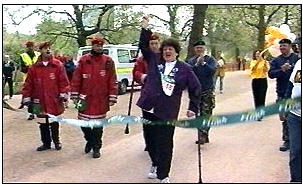
Zoe Koplowitz is an enormous winner despite always losing. When everyone else passes her by, Zoe Koplowitz keeps walking. Koplowitz has completed a total of 25 New York City Marathons, every single one of them in last place. In 2000, she set a world record for the longest marathon time in the history of women’s running at 33 hours, 9 minutes.


Zoe has multiple sclerosis and diabetes and walks all 26.2 miles with crutches. She has written a book called “The Winning Spirit: Life Lessons Learned in Last Place.” After one of the marathons, which she finished a day later than everyone else, Zoe said,–“The marathon is really only a metaphor for life. I am sending a message to everyone that you don’t need to win the race to be a winner in life. Everybody faces marathons each day whether it be looking after kids, parents or at work – it is about finishing what you have started.”


We are blessed that Avraham left us a legacy not only of the promised land but the strength and courage to do what it takes to get there. The promised land is literal and in other ways metaphorical in our lives. Whether it is completing a mesechta of learning, losing a certain amount of weight, or ridding ourselves of a bad habit or routine, we have the capacity like our forefather Avraham to reach the destination.


Make Resolutions, Not Wishes

(Adapted from a drasha delivered at Boca Raton Synagogue on Rosh Hashana 5776/2015)


It was an ordinary day in Judge Mindy Glazer’s Miami-Dade courtroom when forty-nine-year-old Arthur Booth appeared before her for his bond hearing. He had been arrested the previous day for breaking into a home, stealing a car, and running from police. He caused two accidents before crashing the stolen car and being arrested.


What happened next was incredible. My description cannot even do it justice; I encourage you after Yom Tov to see it for yourself. As she shuffled papers on her desk, Judge Glazer turned to Booth and said, “I have a question for you — did you go to Nautilus (middle school)?” Booth looked up at her, recognized her, then covered his face with both hands and, overwhelmed with emotion, cried “Oh my goodness! Oh my goodness!” seven times.


The judge then said to him, “I’m sorry to see you here. I always wondered what happened to you.“ She turned to the court and continued, “This was the nicest kid in middle school. He was the best kid. I used to play football with him, all the kids, and look what has happened.” Glazer set his bond at $43,000 and closed the hearing by saying, “Good luck to you sir,” she said. “I hope you are able to come out of this okay and just lead a lawful life.”


Booth’s cousin was interviewed by the news right after the hearing and was asked why she thought he was so emotional. She answered, “He probably was thinking, ‘Wow, I had those opportunities and those abilities. That should have been me up there… He was overwhelmed with emotion because he was filled with remorse and the thoughts of what could have been.”


“Ha’yom haras olam, ha’yom ya’amid ba’mishpat kol yetzurei olamim… Today is the birthday of the world. Today all creatures of the world stand in judgment.” This morning, like Booth, we appear before the Judge who recognizes us, who knows us since our childhood and beyond. Like Booth, as we appear before the Judge of Judges, we are overwhelmed with a sense of what could have been. This morning, as we confront the reality of the many mistakes we have made, the poor judgment we have shown, the self-destructive behavior we have engaged in, the opportunities we have wasted and the potential we have not realized, we are filled with a profound sense of remorse, an intense regret, and an acute awareness of who we could be.


Leo Tolstoy, the famous Russian writer, once said, “Everybody wants to change this world; nobody wants to change themselves.” I disagree. I think we do want to change. We want to become the people we were meant to be, the people we are capable of being. Many of just don’t know how.


Rabbi Yehudah Ha’Levi writes in one of his poems: “The world at large is a prison and every man is a prisoner.” We often feel trapped, confined by the self-imposed limitations we set on ourselves or by the habits, practices and behaviors that we think we cannot break out of or change. According to the Society for Personality and Social Psychology, as many as 40% of our daily activities are driven by habit.


Will we be late or on time, will we get angry or keep our cool, will we eat healthy or let ourselves go, will we be distracted by technology or disconnect, will we make it to minyan or daven at home or not daven at all, will we say a beracha with kavana before we eat or when we come out of the bathroom, say it in a meaningless way, or not say it at all – all of these and many more have been programmed into our daily lives such that we are practically on autopilot. We feel imprisoned and trapped by the habits we have formed and the momentum that carries our lives forward.


We are familiar with the first part of the pasuk in Tehillim (81) that is part of our prayers and our Kiddush today: “tiku b’chodesh shofar, b’keseh l’yom chageinu, ki chok k’yisroel hu, mishpat lei’lokei Yaakov.” But it continues, eidus bi’hoseif samo, b’tzeiso al eretz mitzrayim, it is a testimony for Yosef when he went out over the land of Egypt.


Our rabbis teach us (Rosh Hashana 10b) that today, Rosh Hashana, is the anniversary of the day Yosef was released from prison in Egypt. According to Chazal, Yosef’s release from prison specifically on this day is not a mere coincidence, but it is a reflection of the power and potential for becoming free on this day. Chazal understood that when we blow the shofar on Rosh Hashana it is “a testimony for Yosef,” as it commemorates his leaving prison on that very day.


As we listen to the sound of the shofar this morning, as we celebrate Yosef’s release from prison, it is time to recognize that today, Rosh Hashana, it is time for us to break out of our prisons, today is the day to finally attain freedom from that which restricts and restrains us.


In one of his letters, the Rambam draws an analogy between teshuva, the exodus from our previous selves, and the exodus from Egypt. On Pesach, we tell the story of our national exodus from Egypt. On Rosh Hashana, we write the story of our personal exodus from that which holds us back and enslaves us.


A fundamental analysis often offered in Brisker lomdus is the distinction between the cheftza and gavra, the object and the person. In an incredible teshuva derasha from 1974 the Rav applied cheftza and gavra to describe two components of the mitzvah of tekias shofar. We don’t have time to review his entire thesis now but I want to share the Rav’s application to the impact shofar is designed to have on us.


Rabbi Soloveitchik explains that human beings have the potential to be objects or subjects. When our lives are on autopilot, when we become creatures of habit, we have allowed ourselves to essentially become objects. When we are mindful and spiritually conscious, when we are driving our lives instead of being driven by them, we are subjects.


It is not a coincidence that when the Jewish people fail, make mistakes and come up short, such as with the cheit of chava, the cheit ha’egel, Shimshon and others, the Torah describes them with the word “falling.” An object is affected by gravity. It descends and falls. Similarly, when we allow our lives to be objects, we fall. In contrast, when the Torah wants to describe someone who is growing, changing, or doing teshuva, as the Torah uses the language of ascending, going up. When we choose to be subjects rather than objects, when we are disciplined and in control of our lives, we can overcome the force of gravity and lift ourselves up.


The Rambam famously writes, “Although the shofar blowing of Rosh Hashana is a Torah law, there is an allusion in it, as if the shofar were saying ‘Awake, sleepers from your sleep! Arise, slumberers from your slumber! Scrutinize your deeds…Remember your Creator.”


When we are sleeping, we are objects. We are just unconscious bodies. When we wake up, we become subjects again, animated, thoughtful people making choices. Many of us are sleeping even while awake. We are living life as objects. The shofar is the alarm that screams wake up! Be a subject not an object, ascend don’t descend; set yourself free from the prison of your life.


The Rama, Rav Moshe Isserles, in his gloss on Shulchan Aruch quotes the Yerushalmi:“nohagin she’lo lishon b’yom Rosh Hashana u’minhag nachon hu. We have the practice not to nap or sleep on Rosh Hashana day and this is a worthy custom.”


Rosh Hashana is not a time to be an object; it is the day to be subjects, to wake up and finally make the lasting changes to become the people we know and the Judge knows we were meant to be. But how?


Rav Kalonymus Kalman Shapira, hy”d, also known as the Piaseczno Rebbe, was a Chassidic Rebbe in Poland who served as the Rabbi of the Warsaw Ghetto and, after surviving the uprising, was later shot dead by the Nazis in the Trawniki labor camp. He had such incredible human insight and advice, you may have thought he was trained as a psychologist or motivational speaker.


In his spiritual diary called Tzav V’Ziruz he has the following entry:


If you want to know if you you’ve progressed on your spiritual path over the years, the way to judge is to look at your resolution – at your inner drive – and not at your wishes. Only the inner drive with which you work to attain your desired goal is called resolution. But if you don’t work but rather just want, this is not called resolution. It is just some wish that you wish for yourself to be blessed with that desired objective. For example, the pauper who works to sustain himself, this is a drive, because he is doing something constructive toward it. But the wish that he’ll find a million dollars is just a wish to be rich and not a resolution. Every Jew would like to be a tzadik, but this is no more than a wish; he’d like to wake up in the morning and suddenly find himself a tzadik. Only the level and state of being that you seriously work toward can truly be called a resolution.


The secret to real change, says the Rebbe, is to be honest with ourselves and to distinguish between our wishes and actually making resolutions. There are countless things we claim to want to change about ourselves. We want to eat more healthy, be more patient, spend more time with our children, find time to volunteer, attend daf yomi, go to minyan more often, learn what the words of the siddur really mean, do chesed, stop speaking lashon ha’rah, and so on.


We claim to want to do them, but the truth is they are just wishes. We wish to wake up one morning, as the Rebbe said, and find ourselves suddenly doing those things or living that way. The real secret to change is to stop wishing and to start making real resolutions. Personal growth is the result of making a plan, spelling it out and holding ourselves accountable to keeping to it.


I was recently talking to Daniel Gibber, Rabbi Gibber’s brother, who lives in Teaneck. He is spiritually on fire and sounds more like a young man who just got back from his second year of studying in Israel than a middle-aged father far removed from yeshiva. Just talking to him and hearing his energy, passion, and excitement for Torah and learning is contagious. He told me about how he is waking up early every morning, going to daf yomi shiur, and staying for minyan. He listens to inspiring classes on the way to and from work and has arranged a weekly shiur in his neighborhood on emunah. Naturally, I asked him how it happened.


He shared the following: He had been a disaffected, typical day school graduate living life, working hard, paying the bills, and though he was doing his best to be a good husband, father, and person, he was totally disconnected from anything spiritual. His life was the grind of family life, coaching basketball, and professional ambition; he had drifted so far he wasn’t davening at all let alone attending minyan.


On August 1, 2012, everything changed. He attended the 12th Siyum HaShas at MetLife Stadium in New Jersey along with 90,000 other people. He hadn’t learned daf yomi and was mostly there out of pride for his grandfathers who had learned the daf numerous times. There were many speakers that evening in Yiddish, Hebrew, and English.


Deep into the night, Rabbi Yissocher Frand took the podium and delivered an impassioned 22-minute speech that electrified the stadium. He spoke about the Bas Kol, the heavenly voice that asks each one of us why we aren’t doing more to learn and to strengthen our relationships with Hashem. Rabbi Frand was adamant in suggesting that in response to the proverbial Bas Kol, “every one of us must leave here with a plan.” He challenged the attendees to “learn a Daf a day. If you can’t learn a Daf a day then make it an Amud a day, or a Daf of Mishna Berurah a day or a Mishna a day.”


He then yelled out – “But SOMETHING a day!” For some reason, at that moment, those words pierced Daniel Gibber’s soul and touched him in a way nothing else ever had. “Something a day.” Why not do something a day. Surely he is capable of doing something a day.


The next day he started learning daf yomi, but soon after he missed a day here and there. He realized that he needed a plan, it couldn’t just be a good intention, and so he joined a daf yomi shiur every morning at 5:30 a.m. Once he was going to shul that early, he realized he might as well stay for Shacharis. A few months later he realized that it is silly that he goes to shul for Shacharis every day but doesn’t even daven Mincha so he started davening Mincha and Ma’ariv and a few months later, thought to himself, why not go back to shul for Mincha and Ma’ariv each evening.


It all started with a plan. He made it a priority to go to the early daf, which turned into staying for minyan, which turned into a love of Torah learning, which resulted in a deepening of emunah and a life on fire. It all began with a plan, it all began with a resolution to do something each day.


When you make a resolution, when you formulate a plan, you need to know where the pitfalls lie and what is likely to try to knock you off your course. The pasuk says in Tehillim (119:98) mei’oyvai sechakmeini, from my enemies I became wise. Rav Yankele Galinsky explains mei’oyvai means I need to gain wisdom and strategy from studying my yetzer ha’rah. Only when I identify the obstacles and hazards can I plan to avoid them and circumvent them.


An indispensible part of the Rambam’s formulation of teshuva is kaballah al ha’asid. A personal kabbalah is not a wish, it is a resolution, it is a pledge to keep to a plan.


Last summer, Yocheved and I were both very inspired from some of the people we met and conversations we had. When we returned to Boca we decided to each make a list of kabalos, things we were taking upon ourselves to do differently. We each made our list and then met for lunch one day to exchange lists and talk about how we can in a loving way hold one another accountable so that the kabalos last and stick. I am proud to say that they are still going well and I credit it to the fact that on our way back to Boca, we didn’t talk about wishes – I wish I was more like him, or I wish our home were more like that. We made real resolutions, not just a wish list.


A plan, a resolution, has to be articulated to be serious. We can put it down on paper, set it as a reminder in our phone or simply repeat it out loud to ourselves over and over but it isn’t real, it is just a wish, not a resolution unless it is formally verbalized, articulated or recorded in a way that will make us more likely to follow through.


Share your kabbalah, your resolution, and plan with your spouse, a family member, or a trusted friend. Ask them to help you formulate a plan and hold you accountable to your commitment.


Leadership expert Robin Sharma once said, “Don’t live the same year 75 times and call it a life.” Let’s not sit Rosh Hashana after Rosh Hashana and fill our hearts and minds with wishes that will dissipate as quickly as the sound of shofar. Let’s not sit before the Judge who knew us since we are born and knows what we are capable of, crying because of the missed opportunities and what we could have been. Today, right now, like Yosef, let’s walk out of prison and set ourselves free to become the people we know we can be.


This year, when people ask you how was your Rosh Hashana – tell them, I am not sure yet, I will let you know in six months after I implement my plan.


_________________________


To get started on making real and lasting changes in your life, use the Resolution Worksheet

 

Torn on the Apology – Is Everything Forgivable?

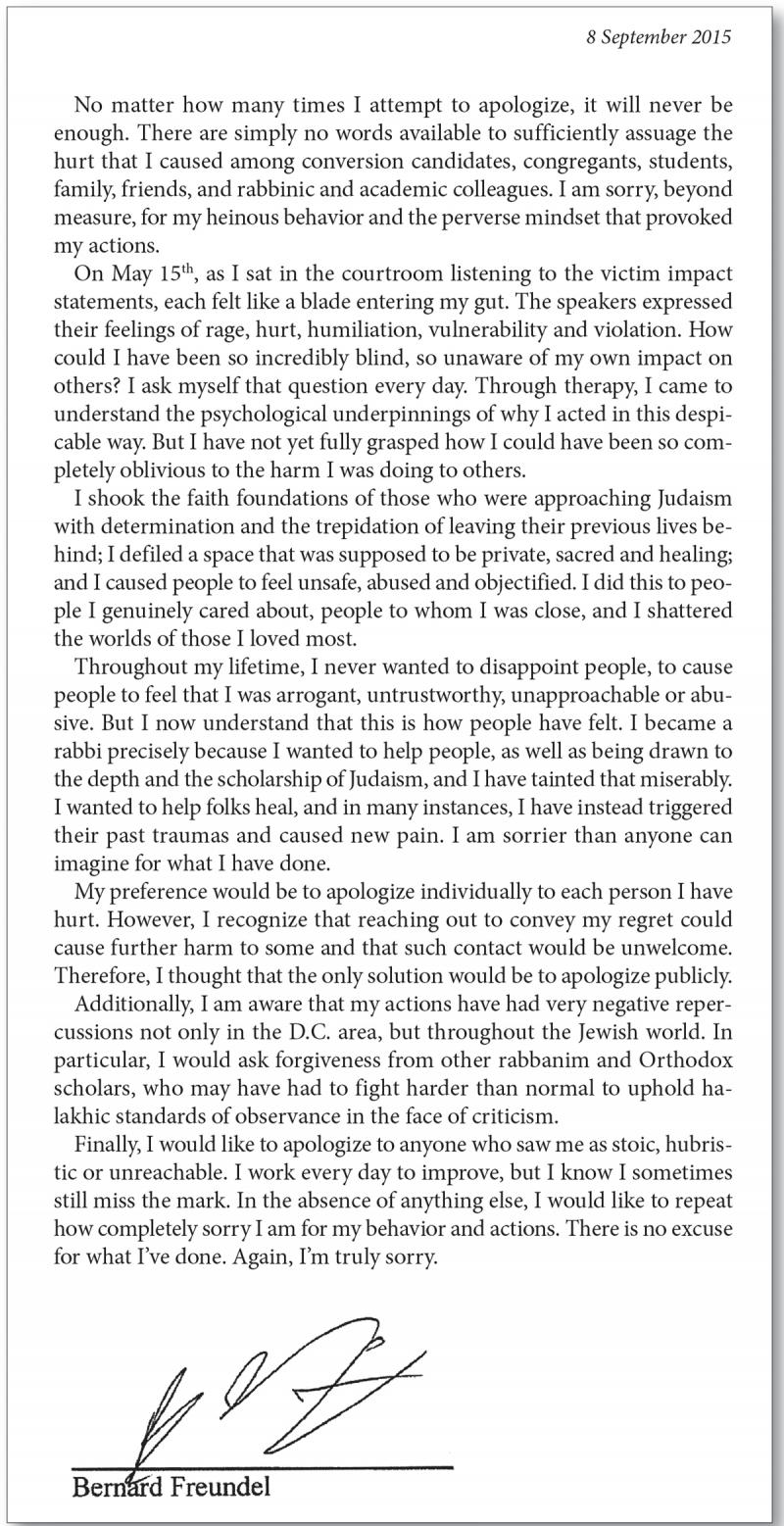
“No matter how many times I attempt to apologize, it will never be enough. There are simply no words available to sufficiently assuage the hurt that I caused among conversion candidates, congregants, students, family, friends, and rabbinic and academic colleagues. I am sorry, beyond measure, for my heinous behavior and perverse mindset that provoked my actions.”


These words were penned this week in a public letter of apology by a disgraced rabbi who pleaded guilty to secretly videotaping fifty-two women and was sentenced to six and a half years in prison. One of his victims said she is “torn on the apology… I don’t think we would be seeing this had he not been caught. It’s hard to take it seriously when he’s making the apology after the fact.”


Who could blame or judge this victim or any other for struggling with granting forgiveness to a perpetrator who caused them immeasurable and unimaginable pain? It takes time to heal from the trauma of being violated and similarly it takes time to find the capacity for forgiveness, if it can be found at all.


In his bestselling book “The Sunflower,” Simon Wiesenthal recounts his work camp experience of being brought to a dying Nazi soldier’s bedside. The man turned to Wiesenthal and confessed his crimes and horrific wrongdoings against the Jewish people. He then asked Wiesenthal to serve as a representative of all his victims and begged forgiveness. Wiesenthal describes that he could not grant the soldier his wish because some things are simply too heinous and atrocious to forgive. Wiesenthal describes that the rest of his life, he remained tortured by that request and by his reaction to it.


Are there indeed things that are unforgivable? Or, does every sincere, genuine, remorseful appeal for forgiveness deserve to be granted? Victims of unthinkable heinous acts undoubtedly struggle with this question for the rest of their lives.   Those that have never walked in their shoes cannot and should not judge the conclusion they reach.


For survivors of the Holocaust or victims of enormous abuse like being physically violated as a child or adult, or videotaped in a Mikvah, granting forgiveness is tremendously complicated. However, when it comes to the everyday slights, snubs, insults and offenses, granting forgiveness is even more valuable and important for us than it is for the one requesting it.


Our rabbis teach: “Kol ha’maavir al midosav, ma’avirin lo kol p’shaav – who is forgiving, God is forgiving of them.” (Rosh Hashana 17a) Too many of us are accountants, not by training or trade, but in practice. We are constantly balancing the books of our relationships with others. “We invited them 3 times and they only invited us once,” or “they didn’t give my son a bar mitzvah gift even though they attended, so I am not giving their child a gift either.” “I am always calling him or asking to go to lunch, he never initiates so I am done with this friendship.” “Would you believe he walked right by me in Shul and shook hands with someone else without even acknowledging my presence. Forget him, our friendship is over.”


With family, the accounting is often more detailed – “I always call her on her birthday, she didn’t call me this year so I am not talking to her.” “I can’t believe they sat me at the table with those cousins and not with the people I wanted to sit with.” “Three years ago, we didn’t get a card for our anniversary so we are no longer sending them cards.”


“Kol ha’maavir al midosav, ma’avirin lo kol p’shaav.” With this statement the Talmud provides the formula for receiving forgiveness from the Heavenly court.   God, say our rabbis, approaches us with the same attitude and philosophy we approach the people in our lives. He judges us with a mirror. If we are exacting, accounting and unforgiving to those around us, He is exacting, accounting and unforgiving of us. If we instead choose to dismiss, minimize and ignore the slights, snubs and slurs that people have perpetrated against us, then Hashem chooses to dismiss and ignore our slights and snubs of Him.


I don’t believe that the Talmud is referring to Wiesenthal’s conundrum, which is of a different magnitude and order. Perhaps there are violations that the Ribonno Shel Olam Himself cannot expect the victims to forgive and certainly not forget. However, when it comes to the petty affronts and offensives that are committed against us sometimes as often as daily or weekly, it is in our own self-interest to find a way to grant forgiveness when it is sincerely sought and sometimes, even when it isn’t.


When we walk around with the accounting books and keep track of everything everyone around us has done that is hurtful both intentionally and unintentionally, the one who suffers the most is ourselves. Authentic forgiveness is not only about the perpetrator of the act and absolving him or her of their misdeed.   Forgiveness is for the victim, the one who has been hurt or harmed.   It is exhausting, burdensome, even paralyzing to carry and harbor negative feelings and negative memories.


This is the season to let go. A professor once held up a beaker filled with water before a class and asked how much they think it weighs. One student said two ounces, another though six ounces, another two pounds. The professor looked at the class and said they are all right. How could they all be right, asked the students, aren’t they saying different things? The professor answered, they are all right, it just depends how long I hold onto it.


When our grudge is formed, it seems somewhat light, small, and insignificant so it is easy enough to carry around with us. The longer we hold onto it, however, the heavier it becomes and the greater the energy, effort, and focus necessary to carry it forward. It is time to let go, to be willing to forgive and forego, even that which is due to us.


Indeed, it is only when we have the capacity to let go, to move on, to not absorb the negativity and toxicity of a strained relationship, to be a forgiving person, that we have the capacity for greatness. The Rambam identifies as one of the defining characteristics of a Talmid Chacham that one must be a mevateir, a forgoer, one who is forgiving and does not hold a grudge.


As we enter Rosh Hashana and Yom Kippur, now is the time to decide to be a mevaitair, to transform ourselves into the kind of people who let things go. I can tell you with certainty the Almighty loves a mevateir. Don’t be concerned with rights, honors, privileges, and entitlements. Don’t focus on what we are due and what the people who hurt us deserve. Put down the heavy baggage, let go and forgive, and you will live life so much lighter.


Learning to Love Even Those We Dislike

Rosh Hashana is approaching in a few days and I am truly frightened. My fear stems not just from God’s impending annual judgment, but from the current status of our people and how we will appear before Him.


Next week we will gather in synagogues around the world and beseech the Almighty – “v’yeiasu kulam aguda achas, bring us together with unity and togetherness in Your service.” At this moment, for too many, that prayer will be utterly disingenuous, as they have no interest or even tolerance to be together or unified with many of their fellow Jews.


Recently, my Facebook page played host to a heated exchange in the comments section. An individual was respectfully but rigorously defending his support of the Iran deal. Someone who saw his position contacted me and actually suggested that I unfriend or block him for espousing such vile and dangerous positions.


My fear is that we have reached a point that friends who have opposite opinions on the Iran deal and other contentious issues are unfriending each other online and in real life, incapable and unwilling to maintain a relationship with those that have come to different conclusions than they have on any range of issues.


I have been an outspoken opponent of the Iran deal. I have written about and spoken about why I feel this deal is devastatingly dangerous and an enormous mistake with the gravest consequences. I have attended rallies, I have met with members of Congress, I have been to Washington to lobby and I am going back again this week. Nobody can doubt where I stand on, or how strongly I feel about, this issue.


And yet, I am fully aware and I recognize that not everybody, including many of my fellow Jews, feels as I do. They don’t love Israel less than I and they are not less concerned about our national security here in America than I am. They simply come at this issue from a different vantage point, trust different experts, defer to the opinion of different leaders in America and Israel, and have come to a different conclusion. I am not happy with their conclusion. Frankly, I find it difficult to even comprehend their conclusion. But nevertheless, I accept their right to have arrived at a different conclusion and I am committed to love them as fellow Jews despite their different conclusion.


The Jerusalem Talmud (Berachos 9:1) tells us “Just as no two physical appearances are the same, similarly, no two opinions are the same.” Nobody has ever stopped talking to his or her friend because his eyes are a different color or her hair is a different style. Nobody has ever looked at a friend who is a different height or build or has different features and expressed hostility and anger for those differences. Why? Because we all intuitively know and implicitly accept that we are born with DNA that predisposes us towards our appearance. Our Rabbis were teaching us to recognize that similarly, our genetic makeups, our socio-economic statuses, our backgrounds, our experiences, and our lives predispose us to different opinions, perspectives, and conclusions. We recognize the right of others to look differently and we must acknowledge their right to think differently as well.


After all, what choice do we really have? We are one people, one nation, and one covenantal community. Essentially, we are one family. Sometimes there are members of your family whose actions or behavior you disapprove of. There are times that you will disagree passionately with a member of your family and not even be able to comprehend their perspective. We don’t always like every member of our family. But nevertheless, the Torah tells us we need to love them.


V’ahavta l’reiacha kamocha, love your neighbor as yourself, is not a commandment to feel a romantic love or even an emotional connection necessarily. It is a mandate to exhibit love and relate with love, even when dealing with someone you don’t like. We don’t have to always approve nor must we always agree, but we must conduct ourselves as a loyal and cohesive family. We are all in this together. We are responsible for one another. We have a shared history and like it or not, we will share one destiny.


Congress’s vote on the Iran deal is going to be taken soon and there will come a day after. As we approach Rosh Hashana, it is time to worry about what our family will look like on that day after if we can’t talk to one another, live with one another, or love one another again. What would our lives look like and how would our people function if we were no longer talking to all of those with whom we disagreed on Oslo and the Gaza withdrawal, or with whom we still disagree on abortion, gun control, same sex marriage, or the Iran deal? The command to love your neighbor doesn’t apply only to your neighbor with whom you agree and who votes like you and practices Judaism like you. It is most challenging and most meaningful when practiced with those with whom we disagree and even of whom we disapprove.


Loving someone doesn’t mean we can’t disagree or debate passionately. It means we must remain respectful throughout our dialogue and that when the dust settles and the debate ends, the things that we disagree about don’t define our relationship. It means when we disagree, even on something as critical and consequential as the Iran deal, we don’t write off or break off from those that have come to a different conclusion on how to best care for America and Israel. Loving fellow Jews means having their backs, being loyal and functioning as a family, regardless of our differences. It means not being dismissive, derogatory or denying others the right to be different and still be part of our family.


Granted, Jewish law acknowledges that there are those who have forfeited the right to be loved by us. The wicked, our rabbis teach, have removed themselves from our family and are deserving of our animosity and dislike. While perhaps members of Neturei Karta who wave the Iranian flag and conspire with Israel’s enemies belong in this category, clearly those who love Israel and seek her security but disagree with us on how to achieve it, are full members of our family, deserving of our love and our loyalty.


When we stand before the Almighty on Rosh Hashana, He will not have an interest in hearing from us if at the same moment we seek to talk to Him, we are not talking to groups of His children. When we recite kedusha in the repetition of the Amidah each day, we bow to our left and to our right. Rav Shlomo Wolbe writes (Alei Shor 2:431) that before we can affirm our love of God and acknowledge His holiness, we first need to look at those on the left of us and those on the right of us and affirm our love and acceptance of them.


On seder night, we perform yachatz and break the middle matzah, and then recite magid, the story of our exodus. Our story can only be told, explains the Bobover Rebbe, if we bring both halves to the table.  Our story is still being written and this is a crucial chapter. We can and should continue a rigorous debate and, given the stakes, respectfully lobby as hard as we can for our side. However, we need both halves at our family table. Rosh Hashana is coming and if we want Hashem to find favor with us, we need to find favor with one another.


It is time to heal our family and find a way to love one another even when we vehemently disagree with one another. Only then can we sincerely come before God as one nation, one people, one family, turning to our Father in Heaven for a year of peace and prosperity.


Extraordinary People Posing as Ordinary, All Around Us

A few years ago, I was leaving Shul after davening Shacharis one morning when an older gentleman in our community stopped me and asked if I had a minute to talk. The truth was, I was running late and barely had time to say hello let alone entertain an entire conversation.  But, he seemed so happy to run into me in the parking lot that morning and so I couldn’t say no. He shared with me a most remarkable story that changed not only the way I see him as an individual, but also the way I relate to people in general.


A few days before this chance encounter, we had sat on the floor together with many others reading Kinnos, commemorating the tragic suffering of our people throughout the ages.  In my introduction to the Kinah composed by Yirmiyahu Ha’Navi for Yoshiyahu, I shared an insight of Rav Soloveitchik.  Why, asked the Rav, do we pause in our mourning for millions of Jewish martyrs throughout the millennia, to focus on the story of a particular individual?   He explained that when we reflect on the magnitude of the loss of Jewish lives throughout our history, the sheer number is overwhelming and staggering.  Indeed, paradoxically, the greater the quantity of individuals lost, the more challenging the quality of our sense of grief for them. The Rav felt that we dedicate an entire Kinnah to Yoshiyahu, a single individual, to remember that the loss of millions is really the loss of one plus one plus one plus one.  Each person is unique and irreplaceable.  Each loss equals the loss of an entire world.


I continued by relaying a personal experience from leading March of the Living, a tour for teenagers of Poland and Israel.   One of the most powerful points of the trip is the visit to the death camp, Majdanek.  From the intact barracks to the enormous pit of human ash, touring Majdanek is simply devastating.  One of the most stirring images of the entire trip is a barrack in Majdanek filled with shoes that were confiscated from Jewish prisoners.


Before entering the barrack filled with shoes everywhere, we encouraged the students not look at the overwhelming scene of countless shoes that lay before them.  Instead, we told them, pick out one shoe to focus on.  Look at it and consider, who was its owner?  How did they feel when they bought those shoes and when they slipped them on for the first time?   Where did these shoes lead them?  Recognize that each shoe was worn by a person who had a mother and father and perhaps a spouse and children.  They had a personality, dreams, ambitions, and goals.  All of it was tragically cut down and all that is left to commemorate them is the shoe that is before you.


Standing in the parking lot a few mornings later, the elderly man reminded me of my remarks Tisha B’av morning and told me that he must share a story.  He proceeded to say that when he was a young child he was taken, together with his family, to Auschwitz.   His brothers and father were taken one direction and he was ordered to go a different one. He found himself in a room with other children and elderly people.  The Nazi’s instructed them to take off their shoes and undress.  There was one older man who was wearing the most magnificent, fancy, expensive shoes.  He went up to the guard and said, “I won’t leave my shoes here; they are my prize possession.” The guards laughed and said, “do you think where you are going you are going to need shoes” and commanded him to undress.


Our community member continued by telling me that even as a young child, when he heard the guard’s laugh and his unforgettable words, he thought to himself, dos iz nisht gut, this is not good, and instinctively ran, avoiding all of the guards, until he rejoined his brothers and father.   Looking back all these years later, he confessed, he doesn’t know how he made it from one barrack to another without being caught or seen or how he was able to blend in with the grown up men as a young boy.  But, he said, the only reason he survived is because of that man’s fancy pair of shoes and the fact that he wouldn’t part with them.


I walked away from the conversation that morning feeling so small, utterly insignificant, and frankly somewhat embarrassed.  Until that morning, this man, whom I have always tried to be friendly towards, was nothing more than ordinary to me.  True he had an accent and likely had a “story.”  But, he modestly blends in and quietly goes about his business as if he has led the most mundane, uneventful life when in truth his life, was anything but.


If you look around you on a regular basis, there are seemingly ordinary people who in fact have led the most extraordinary lives.  This shy, humble, quiet man had displayed unfathomable courage, tenacity and strength in his life.  His attendance at davening every day of the week is in truth an enormous expression of faith and devotion to the Almighty, despite the hardships, tragedy and loss that he has confronted.


All too often, we only learn the background of a person when it is too late to ask them questions.  We walk away from their funeral inspired, impressed, but also curious to learn more.   With their loss goes their story as only they could tell it, the answers to our questions and the solutions to that which piques our curiosity.


The Torah (Devorim 32:7) tells us, “Sh’al avicha v’yagedcha z’keinecha v’yomru lach, Ask your fathers and they will tell you, your elders and they will explain to you.” Our fathers and mothers and our elders have so much wisdom, incredible life stories and extraordinary experiences to share with us. We stand to gain enormously by learning from them. However, “sh’al,” we need to first ask and show interest.


That day I learned that a man I had considered an “average Joe,” was indeed a mighty hero.   Let’s not wait until it is too late to learn other people’s stories.  Be inquisitive, ask questions, and most importantly recognize that behind most ordinary people are extraordinary experiences that we can all learn from, if only we take a moment to ask.


Start a Gratitude Journal Today


gratitude

Years ago, someone gave me a Tony Robbins CD to listen to. I was excited to hear what one of the most inspirational people of modern times would have to say and how it could change my life for the better. He started his talk by saying that he has the secret to both happiness and success. If you follow his advice and begin each and every day of your life exactly as he prescribes, he can all but guarantee you will find yourself both happier, and achieving your goals and dreams.


I was very eager to hear what his secret is.


What Tony Robbins said is correct, but for me, and for you, and for Jewish 3-year-olds around the world, it was nothing new. The secret to happiness and to achieving success, he said, is to start every day of your life by expressing gratitude. As soon as you wake up, before doing anything else, say thank you. Be grateful and appreciative for being alive, having a roof over your head, having your health if you are lucky, your family, etc.


He continued that it isn’t enough to think appreciatively, but you need to start your day by verbalizing and actually saying thank you out loud. If you do, the rest of your day is guaranteed to be successful and happy.


What Tony Robbins is teaching in the 21st century, Judaism has taught since its inception thousands of years ago. From an early age, we teach our children to wake up saying Modeh ani lefanecha, I am grateful to you God for the fact that I woke up, that I am alive to see another day, for the wonderful blessings in my life and for my relationship with You. It has been inculcated within us from our youth that we don’t wake up feeling entitled, deserving and demanding. Rather, we wake up with a deep and profound sense of gratitude, appreciation and thanks.


In my experience, Tony Robbins is right. How we start our day has an incredible impact on how the rest of it will go. This coming week we will celebrate Lag B’Omer, the 33rd day of the Omer. Each day of the Omer is characterized by another kabbalistic attribute. Lag B’Omer is Hod sh’b’hod, the glory of glory, reflecting our appreciation of God’s greatness and glory. The Hebrew word hod can be understood as coming from the same word as hodu, or modeh, meaning thanks. Lag B’Omer is a day characterized as “thankfulness within thankfulness,” or a day to celebrate gratitude.


The Chassam Sofer, Rav Moshe Sofer says that the miraculous manna that fell from Heaven began to descend on Lag B’Omer. On the first day, the manna was undoubtedly greeted with great enthusiasm and appreciation, but as time went on and there was an increasing expectation the heavenly bread would descend, it became much easier to take it for granted and to forget to be appreciative for it at all. Therefore Lag B’Omer is a time that we identify and say thank you for all of the blessings that regularly descend into our lives, but unfortunately, like the manna, that we take for granted.


It is so easy to fall into a sense of entitlement and to forget to be grateful. Why should I thank my children’s teachers? They’re just doing their job. Why should I be so appreciative to the waiter, or the custodian, or the stewardess? Isn’t that what they are supposed to do? When was the last time we said thank you to whomever cleans our dirty laundry? Do we express gratitude regularly to our spouse who shops, cooks dinner, or who worked all day to pay for dinner, or in some cases did both? Are we appreciative of the small things like finding a parking spot, recovering from a cold, having a beautiful day, or tasting the sweetness of an apple?


Dr. Robert A. Emmons of the University of California is pioneer in research on gratitude.  In one study he and his colleagues divided participants into three groups, each of which made weekly entries in a journal. The first group identified and wrote five things they were grateful for.  The second group made a daily list of five irritations and a third control group listed five events that had affected them in some way.  The study concluded that those who kept a daily gratitude list  felt better about their lives overall, were more optimistic and reported fewer health problems or doctor visits than the other participants.


There are numerous apps for keeping a gratitude journal that will remind you to spend time identifying things for which to be grateful.   We may be almost 33 days into the omer, but it is not too late to make it day #1 of keeping a gratitude journal.


As we celebrate Lag B’Omer, let’s not just say modeh ani in the morning and then quickly transition to feelings of entitlement. Let’s remember to say thank you to the people who do extraordinary things in our lives. But even more importantly, let’s especially express gratitude to the people who do the ordinary things that make our lives so filled with blessing.


Rabbi Efrem Goldberg

Join Our Community

Subscribe to our newsletter or connect with us on WhatsApp.