Suggestions for a More Meaningful Seder This Year

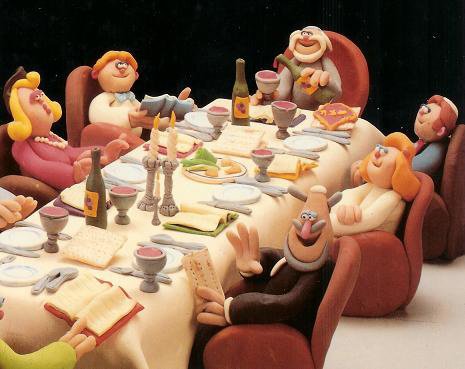
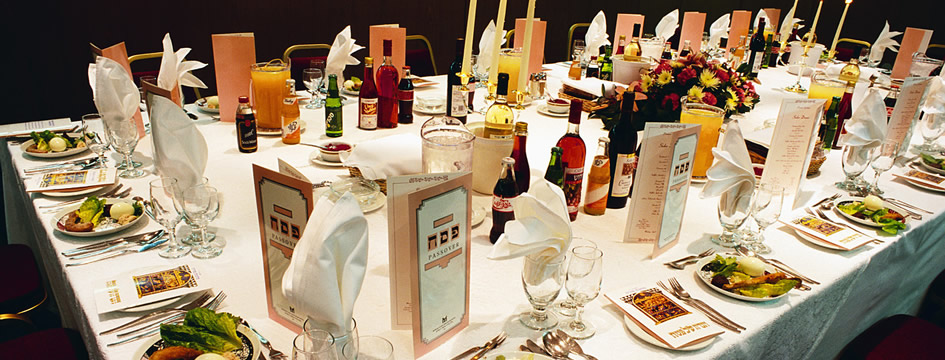
Image result for seder table

If your Seder looks anything like the typical one, you likely have young kids fighting over giving every single Dvar Torah they prepared in school, adults offering technical and complicated vortelach (Torah thoughts), someone napping on the couch due to drinking the four cups too zealously, and more than one person complaining that they spent most of the Seder in the kitchen and missed the whole thing.


Is this an authentic picture of what the Rabbis really had in mind when they instituted an evening with family and friends designed to nostalgically recall the miracle of leaving Egypt and our journey to freedom? I think not!


It is abundantly clear from countless sources that the purpose of the evening is not simply to ramble through the text of the Haggadah, or to compete for who has the most to say. The entire format of the Seder supports the goal of the evening, which is, at its core, to simply have a conversation.


Indeed, Rav Chaim Soloveitchik suggests that this format is what differentiates the mitzvah to speak about Yetzias Mitzrayim (the exodus) on Seder night, from the mitzvah to remember it every single day. The rest of the year we lecture, teach, and tell Divrei Torah about leaving Egypt. Seder night, we have a conversation about the experience in the form of questions and answers, give and take, dialogue and discussion. Indeed, so many of the peculiar practices of the evening are done just so that the children will be curious, ask and ignite a conversation.


I would like to offer a bold suggestion – consider asking your children to put away their Haggadahs for part of the Seder. The teachers of our community do an extraordinary job in preparing our students. The creativity, ingenuity and hard work that goes into designing the beautiful, personalized Haggadahs, and filling them with Torah thoughts is a testament to the dedication of our outstanding Rebbeim, Morahs, and teachers. We should welcome their incredible Haggadahs at our Seder table, but in moderation. If not, these Haggadahs can become a source of distraction and even worse, a source of friction when each of our children feel an obligation to read every single thought on every single page of their Haggadah at the Seder.


Of course, we should spend time sitting with each child, looking through their Haggadah, listening to their Divrei Torah, and appreciating their enthusiasm. Perhaps we can dedicate time on Erev Pesach or on Yom Tov afternoon to look at their Haggadahs more in depth and to hear the thoughts that didn’t make it into the Seder itself. But, if we want our children to get the most out of our Seder experience, it can’t just be a presentation of what they learned in school.


The Seder must be a time to have conversations that matter and discussions that can be transformative and provide inspiration that lasts the entire year. These conversations can happen with children and adults of all ages. Young kids should be engaged in storytelling in a real and personal way.


We must turn to our children and grandchildren and tell them the riveting story of how we used to be slaves, do backbreaking labor, and then we were freed through miracles. With older children and adults, the conversations should be more sophisticated. I would like to suggest a few examples of how the Seder can be a platform for great conversations.


Here are some thought-provoking questions that you can share Seder night to generate the kind of rigorous and robust discussions that our Rabbis imagined us having:


  1. Ha Lachma Anya: Why do we begin the Seder specifically by inviting the underprivileged to join us? Is there a connection between freedom and sharing with others?
  2.  

  3. Avadim Hayinu: What is slavery and what is freedom? Though we are physically free, are there things and behaviors we are enslaved to? Does technology give us greater freedom or enslave us?
  4.  

  5. Four sons: Which child do you identify with? Is the Rasha really so wicked if at least he comes to the Seder? What about the hypothetical 5th son who doesn’t even show? Are the eino yodei’ah lish’ol (don’t know how to ask) the unaffiliated of our generation, and how do we engage them?
  6.  

  7. V’hi she’amdah: Who are the enemies of our generation that seek to destroy us, and can we identify miracles Hashem does to protect us? What is the root of Anti-Semitism and why have we always had enemies that seek our destruction?
  8.  

  9. Arami Oveid Ami: We became a nation when living among the Egyptians. Is living in a land of freedom good or bad for Judaism? Has the freedom of this great country, America, contributed positively or negatively to the continuity of Torah Judaism?
  10.  

  11. Ten Plagues: Can you think of a situation where you felt stuck and Hashem bailed you out? Are there miracles in your life in which you saw the guiding hand of Hashem?
  12.  

  13. Dayenu: What does it mean to have the capacity to say enough? Are we ever satisfied or do we always crave more?
  14.  

  15. Hallel: What are you thankful for and why? Tell stories of personal freedom and liberation.
  16.  


These are just a few examples, but there are countless more conversations to be had on Seder night. Even if you disregard my earlier suggestion and insist on listening to every single Dvar Torah your child brings home, I urge you to be sure to make time to tell stories, ask questions and have critical conversations.


When all is said and done, the Seder is intended to be an exercise in emunah (faith). If we walk away from the Seder and we have not grown in seeing Hashem in our lives and feeling a connection and closeness to Him, we have failed in our mission. Make sure to have the kind of Seder that will leave friends and family wanting to come back for more of your good food and great company, but most of all for your incredible and inspiring conversations.


 

If it Takes You More Than a Day to Clean for Pesach, You are Doing Spring Cleaning, Not Pesach Preparations

Image result for purim pesach cinderella

Now that Purim is behind us, the countdown to Pesach has officially begun, complete with its angst, anxiety, stress, and exhaustion. Sadly, many people associate Pesach with backbreaking work, exorbitant expenses, endless preparation, and bread deprivation. It is not unusual to hear moans, groans, and krechts coming from both men and women when mentioning the upcoming holiday. Many describe themselves as rolling into Pesach ‘like a shmatta,’ unable to enjoy the festive atmosphere, meaningful Sedarim, or even quality time with friends and family.  The consequences of this attitude, don’t just impact us, they negatively influence our children and those around us.


The Haggadah quotes the rasha, the wicked son who challenges – what is all of this work to you?   Why does he specifically choose the seder as the time to question and challenge?  The seder is filled with good wine, good food and good conversation.  Wouldn’t it make more sense for the rasha to issue his challenge on Yom Kippur, when we are fasting and abstaining from pleasure?  In his new Hagaddah, Rav Avraham Elimelech Biderman answers (thank you R’ Naftali Lavenda for pointing it out to me) that the work the turned off child is referring to, is not the seder, it is all of the preparation and lead up to Pesach.  After hearing his parents complain about the cleaning and hard work, after being yelled at neurotically not to bring chametz anywhere in the house, after overhearing the moaning about the cost of making Pesach, he comes to the table and challenges, why would I want all of this avodah, this work that YOU do and don’t stop complaining about?


This is not the way the Torah or our Rabbis intended it. I believe that the bulk of the stress, aches, and pains that result from Pesach preparation is self-induced and utterly unnecessary. True, there is a high cost of matzah, wine, and Kosher-for-Pesach groceries that cannot be avoided and are challenging particularly during these difficult economic times. However, the overly labor-intensive house preparations and extensive,arguably overly complicated menus and recipes can all be avoided.


For some reason, Pesach has gotten away from us with the purely voluntary now becoming mandated standards and what should be the primary goals becoming almost entirely neglected and dismissed. Undoubtedly, halacha demands that we seek and destroy all chametz in our possession. Definitions of “chametz,” “seek,” and “in our possession” are all very clear and require a preparation of a home that should take only a few hours total. Areas and places where chametz is never brought don’t need to be cleaned or checked (Shulchan Aruch o.c. 433:3). Appliances that will not be accessed or used need not be cleaned or checked; they simply need to be put away and sealed. Any food that is not categorized as edible (a dog would not eat it) is not considered chametz (Shulchan Aruch 442:2). There is no need to check for crumbs that are less than a k’zias if they are dirty or soiled and wouldn’t be edible by a human (Mishna Berura 442:33).


Practically speaking, any cabinet, closet or room that will not be entered on Pesach, can simply be closed with a piece of tape across the door and any chametz contents in it sold. Any kitchen cabinet, drawer, or cupboard that will not be used on Pesach need not be cleaned at all; it just needs to be taped shut. Any appliance, food processor, sandwich maker, mixer, bread machine, etc. that will not be used, need not be cleaned whatsoever. They just need to be put away for Pesach in a sealed space.


Nevertheless, at some point in recent Jewish history, Pesach preparation was substituted with spring-cleaning. If one is moving a refrigerator, oven, or any other heavy appliance, he is spring cleaning, not preparing for Pesach. If one is climbing on a ladder to clean a ceiling fan, taking a toothpick to a toaster or food processor, scrubbing grout with a toothbrush, emptying and wiping all dressers, closets, linen pantries, crawl spaces, or shaking out books that haven’t been opened in years, she is spring cleaning, not preparing for Pesach.


Halacha demands that we go room to room confirming there is no chametz that is larger than 30 grams and edible. That can realistically be accomplished in a few hours at most in almost all of our homes. If you are spending days, weeks, or over a month cleaning, if you are worn down, exhausted and your back aches, blame your proclivity for spring cleaning, don’t dare blame God or His wonderful holiday of Pesach.


Make no mistake, this substitution of spring-cleaning instead of Pesach preparation comes at a great cost and it will likely hurt our community’s attitude towards Pesach in the future. Rather than enter Pesach excited, enthusiastic, and energized to spend time with family and share divrei Torah at our Sedarim, we are increasingly becoming resentful and negative about being observant and burdened by Pesach. Rather than happy people eating bitter herbs to celebrate freedom, we are becoming bitter people exchanging our freedom for unnecessary burdens in anticipation of Pesach.


Pesach, more than any other holiday or time of year, is designed to communicate our values, priorities and lifestyles to the next generation. Pesach, and the days leading up to it, should leave our children with sights, smells, flavors, traditions, and experiences they will draw from and seek to emulate in their own homes for the rest of their lives. It should provide memories and recollections that will inspire and charge the next generation in their Judaism and commitment to the beauty of a Torah lifestyle.


Bedikas chametz, complete with its hide-and-seek nature, should be fun, exciting, and adventurous. Instead, for many it has become a chore that we unburden ourselves from as quickly as possible. Burning chametz, rolling matzah balls by hand, chopping charoses, grinding marror, setting the regal seder table, reenacting the Pesach story at our seders, welcoming visiting family, are among the activities that can be carried out with joy, enthusiasm, nostalgia, and meaning.


Depleting ourselves of energy and joy by engaging in spring cleaning rather than Pesach preparation is not only depriving us of the simcha, joy, we are capable of feeling, but it is indelibly impressing on our children negative memories and associations that will likely haunt them and shape their own attitude toward Pesach preparation and observance.


By exerting all of our energy into that which is unnecessary, we have little left to do the things that make Pesach preparation fun and create the memories that our children and grandchildren will draw from throughout their lives. Today, you can buy bedikas chametz kits complete with numbered pieces of bread, packaged finely chopped charoses and even a jar of kosher for Pesach salt water.


With all respect to the companies that have commercialized those mitzvos, I implore you, don’t cave. I vividly remember how we prepared and hid the bread for bedikas chametz and that is how I taught my children to do it. I can easily picture my siblings and me competing over who got to chop the charoses and how my mother and grandmother lovingly added all the ingredients in their special recipe and it is that experience we try to create for our children today. Is adding salt to water so laborious that we can’t put in even that effort to prepare for our seder table?


As we enter the final countdown to Pesach this year, I beg you to ask yourself the question – which sounds will ring in your children’s ears in the future when they think back to Pesach in their home? Will it be moans, groans, bitterness and complaints or will they remember the joyous sounds of an energized family eagerly preparing for a meaningful Yom Tov?


The Shulchan Aruch (529:2) tells us, “Chayav adom liheyos sameach v’tov leiv b’moed. A person is obligated to be joyous and happy on the holiday.” The Mishna Berura is quick to add that being happy on the holiday is a Biblical mandate and applies equally to men and women.


Let’s not allow spring cleaning or unnecessary stringencies to get in the way of fulfilling our duty to God, our children and ourselves of being happy, joyous, energetic, and enthusiastic.


Over the next few weeks as we prepare for Pesach, let’s remember what is essential and what is unnecessary, what is an obligation and what isn’t even a mitzvah and most importantly, what will make our children love Pesach and what will cause them to resent it.


Scientists Have Proven That Doing This Improves Health and Brings Greater Happiness, But Our Rabbis Knew it Long Ago…

Image result for happiness

Milton Friedman, the great Nobel Prize-winning economist and professor at the University of Chicago, had a very simple suggestion for how to identify a person or institution’s priorities.  Many people eloquently describe their beliefs, values, and principles and talk about what is most important to them.  Friedman advised to ignore what they say.  If you want to truly know what someone’s priorities are it is simple – Look at someone’s budget and you know what is important to him.  See how someone prioritizes their money and you will know her priorities.


Our Parsha that begins with the capital campaign for the Mishkan follows Parshas Mishpatim, which ends with the famous words “na’aseh v’nishma.”  Isn’t it a bit anticlimactic to go from the high of na’aseh v’nishma immediately to an appeal?


The Ba’al Shem Tov explains that not only is it not strange, it is absolutely critical.  Whenever a person is spiritually awakened, whenever we have a moment that our neshama is alive and aroused, we must concretize the inspiration in a practical action or deed.  We must help that fleeting feeling find tangible expression and physical manifestation.


Being moved and inspired by Matan Torah to say na’aseh v’nishma is nice, it is impressive, and it is commendable, but it is only meaningful and lasting when it is immediately followed by a yikchu li terumah.  As Milton Friedman taught, Hashem heard about our priorities and values with our lips, but immediately put to the test whether our actions and our budget would match. V’yikchu li terumah.  Are you ready to put your money where your mouth is?


The Beis HaLevi like so many others asks the famous question:  Why does it say v’yikchu, they should take, when it should say v’yitnu, they should give?  He explains that when you buy something material, when you make a purchase, you may appreciate what you bought or it may have been a complete waste. Sometimes the money we expend adds value to our lives and sometimes we don’t truly get anything for it in return and it is gone forever.


What applies to money we spend on ourselves is completely inapplicable to money we spend for others or on others.  When we give for others, or to others, we not only don’t lose, but we gain much more in return.  The pasuk in Tehillim 49 that we say in a shiva home says, ki lo b’moso yikach ha’kol, for in death you cannot take it all.”  The Malbim asks, cannot take it all?! Implying you can take some of it with you?  Isn’t the reason that a kittel doesn’t have pockets is to emphasize that you can’t take any with you?


The Malbim explains that in fact, there is something you can take with you. The money that you give to tzedaka and the money you use to help others remains with you and you take it and its impact with you forever.


This insight is familiar to most of us.  We have been taught that by giving, we are truly getting.  But, science has now shown that not only do we receive spiritually when we give, but we receive physical benefits as well.


In their book “Happy Money,” researchers Elizabeth Dunn and Michael Norton summarize the research on the science of spending, explaining how spending money on others enhances one’s own happiness.  Happiness does not result from a focus inward, but it results from the deep satisfaction and profound gratification of helping others.


At the end of Hilchos Megillah (2:17), the Rambam makes an incredible comment.  He asks, if a person has limited funds and has to choose between having a more lavish and luxurious Purim meal, or more extravagant and impressive mishloach manos, or giving more matanos l’evyonim, money to the poor, what should he do and why?


The Rambam codifies that the resources should be dedicated to helping the indigent and poor because Purim is about simcha and there is no greater happiness than bringing joy to others, especially the underprivileged. If your meal is smaller, or your mishloach manos less elaborate, because you’ve appropriated some of that money for helping poor people, you have fulfilled the mitzvah of simchas Purim to the fullest.


The words of the Rambam remain profoundly appropriate for us this year. How can we spend significant funds to create a theme for each mishloach manos package or make dozens of packages with expensive items when there are people around us who literally don’t have food to eat?


It is in the context of the above stated halacha that I appeal to you and to all of the members of our community to scale back both on the type of mishloach manos we make, and on the amount of people to whom we give.  I strongly encourage you to do the following three things:


  1. Fulfill the basic mitzvah by giving to one person.
  2.  


  1. Participate in the Sisterhood’s project and help every family in our community receive at least one package.
  2.  


  1. In lieu of mishloach manos, contribute to the Tomchei Shabbos program. There are dozens of people who are fed weekly by this discreet, confidential program. Our monthly budget to give food items and Kosher Market gift cards is over $10,000 a month and unfortunately only growing. We desperately need your help. Please contact Linda at 561-394-0394 to purchase cards that can be distributed instead of mishloach manos. The cards can be individualized and state that in lieu of mishloach manos, a gift has been made in your honor to FOR Tomchei Shabbos.
  2.  


Not only does being generous with others with your time and money bring you happiness, it brings you greater health.  A team at the University of British Columbia recruited adults ages 65 to 85 who had high blood pressure, the leading risk factor for death worldwide. They gave each person a total of 120 Canadian dollars to spend over the course of three weeks, and measured their blood pressure before and after.


Every week, the participants got a pill bottle fitted with a special cap that recorded the date and time it was opened. Inside each bottle were two $20 bills. The bottles came labeled with instructions about how to spend the money. Some participants always got bottles telling them to spend the money on themselves, while the remaining participants were required to spend the money on others.


Those who spent the cash on themselves purchased anything from wool sweaters and massages to tickets.  Meanwhile, people in the spending group bought muffins for firefighters, cookies for neighbors, and toys and clothing for their grandchildren.


When participants reported back to the lab, nearly all of them said they liked getting bottles of money. Using a device that automatically measured their blood pressure, researchers saw a clear difference between the spending groups. People who spent money on themselves showed no change whatsoever, whereas people assigned to use the money in generous ways showed a significant reduction in blood pressure.


The researchers found to their astonishment that this change was similar in magnitude to what is typically observed when people start engaging in regular aerobic exercise.


But it is even easier than that.  Recent findings by the psychologists Tristen Inagaki and Naomi Eisenberger show that simply writing a supportive note to a friend can lower blood pressure.


The Vilna Gaon famously comments that the word venasnu, and they shall give, is a palindrome, it is spelled the same way forwards and backwards. The act of giving is intrinsically linked with receiving benefits.


We are now into the month of Adar and rapidly approaching Purim.  If we want to attain simcha, happiness, lower our blood pressure and receive great spiritual fulfillment, it is time to put our actions where are words are.  The more we give of our time, energy and resources, the more we will in fact receive in return.


Managing Expectations is the Key to a Beautiful Holiday

According to the 2013 Pew study, while only 23% of American Jews said they attend religious services at least monthly, 70% reported that they participate in a Seder on Passover. More than any other holiday, Pesach brings family together. These reunions are often filled with promise and hope of quality time that will yield only the most positive memories. In reality, however, it can be difficult to be with lots of people in cramped quarters for numerous meals that go on for hours without some conflict, competition, or quarrels arising.  After all, they say the definition of a dysfunctional family, is any family with more than one member.


An unusual custom regarding matzah is very instructive as to how to prepare for a family Pesach together:


The holiday of Pesach, and the Seder in particular, are brought to us by the number four: four questions, four sons, four cups of wine. And yet, when it comes to matzah, we have three. Why?


Many explanations have been offered:


  • The halachik explanation is that we need to have lechem mishna, two full matzahs, just as we have two challahs every week. Since we plan on breaking one at yachatz, rendering it ineligible for lechem mishna, we need to begin with three.
  •  

  • The matzahs commemorate the three measures of fine flour that Avraham told Sarah to bake into matzah when the three angels were visiting. Rashi points out in his Torah commentary that the angels’ visit occurred on Pesach.
  •  

  • The Magen Avraham, Rav Avraham Gombiner, suggests that the three matzahs represent Moshe, Aharon, and the Jewish people.
  •  

  • One suggestion is that the three are for Chachma, Bina and Da’as, known commonly by its acronym, Chabad.
  •  

  • More popular explanations include – Kohein, Levi and Yisroel, or Avraham, Yitzchak, and Yaakov
  •  


We have come to take it for granted that there are three matzahs, but Sefer Minhagei Yisroel by Professor Daniel Sperber of Bar Ilan references a fascinating custom. In the 17th century, the practice was to have four matzahs at the seder, not three. Rav Yaakov Reischer was a dayan in Prague before being called to the Rabbinate, first in Galicia and ultimately in Worms. In his work, Chok Yaakov, he mentions that the custom in his community is to bake four matzos, in order to have a spare. His commentary, published in 1696, indicates that this was the prevalent custom already at that time in Eastern Europe. In addition, there are mentions of the custom to bake four matzahs in the eighteenth century in England.


This custom was opposed by great halachik authorities, not because they didn’t like the idea, but for a technical reason. They felt the more matzah baked, the more dough necessary and the more dough necessary, the greater the chance of chametz. So, in the end, we only have three matzahs. But I believe the symbolism of the fourth is very meaningful for us as well.


Why have the fourth matzah? It was called the matzas safek. Its purpose was to be a reserve matzah in case one of the other ones breaks. But that explanation raises questions as well. Sure the matzah is delicate, but so is the pittom of an esrog and we don’t say to have an extra esrog handy. We don’t have a spare shofar, or a backup menorah. Why specifically do we have a backup, reserve matzah?


Studies show that depression and anxiety spike during holiday time. “A lot of times it’s the disconnect for many people between what is supposed to be a really warm family gathering and what it’s really like for some families,” says Dr. John Oldham, chief of staff and senior vice president of The Menninger Clinic in Houston.


Shofar, esrog, the menorah, etc. can all be accomplished and fulfilled on one’s own. There is no dialogue, no relationship, and no interaction involved with those mitzvos. The seder, in stark contrast, is characterized by haggadah – a dialogue and conversation. Pesach above all other holidays brings people together. “How many are you having for yom tov” or “How many are you having for the seder” are common questions this time of year.


We bring high expectations to our holiday reunion. This year will be great. Everyone will get along. I won’t have to compete for attention. The kids will be enraptured by the seder and not distracted. Nothing will spill. Perhaps the custom of a fourth matzah originated because we must understand going into the seder that matzah is going to break.  The Torah does not describe a utopian life. The Torah is designed to inspire and enrich our imperfect lives.


The message of the matzas safek, though we may no longer practice it, is to adjust your expectations and set yourself free. Maintaining hope in a perfect experience, relationship or holiday is exhausting and burdensome. Understanding at the outset that things will go wrong and bumps will be encountered along the way is liberating and cathartic.


Part of the seder, the order of life, is preparing for the broken pieces. A chassan and kallah, groom and bride, stand underneath the chuppah and ceremony concludes with breaking glass. It is critical before they even take leave of this most auspicious and special moment that the young man and woman realize that things will break, obstacles will be encountered, and that this is ok. We can’t control other people and we can’t control all events and circumstances. We can control our expectations and, more importantly, how we respond in turn. That ability to control and adjust our expectations is freedom.


May our lives and our matzahs remain whole, but let us be prepared for something to break and know that we have the ability to put it back together again.


This Chanuka See What is Right Under Your Nose

A husband and wife are getting ready to go to sleep. The wife is ready to close her eyes and her husband stands staring at himself in the full-length mirror. “What’s the matter with you?” she says. Come to sleep already.” He turns to her and says, “Look at this, I am so depressed. All I see is a receding hairline, a growing gut, and wrinkles under my eyes and what hair I have left is grey. Tell me something positive, something uplifting so I can go to sleep.” She thinks for a moment and says, “Well the good news is your vision is still 20/20.”


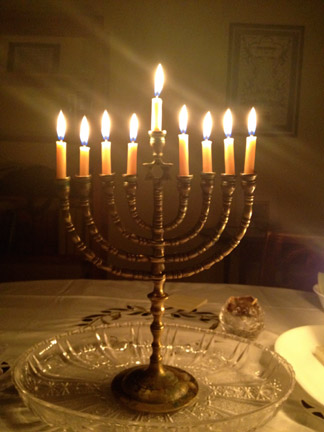
There is a very high association between Chanuka and the sense of sight. “HaNeiros halalu kodesh heim, v’ein lanu reshus l’hishtameish bahem elah lirosam bilvad.” As we will begin to sing next week on each night of Chanuka, the candles are sacred, we don’t have permission to benefit from their light, but their purpose is simply to be looked at. Moreover, we have a unique halacha on Chanuka. The Talmud tells us and the Shulchan Aruch records – ha’roeh mevareich, one who can’t light for himself or herself and sees the candles of someone else – nevertheless makes the second beracha, she’asah nissim la’avosainu. When I see someone put on tefillin, take a lulav, or blow shofar, I don’t make a beracha. Only on Chanuka do I make a beracha on seeing someone else do the mitzvah.


The Kedushas Levi, Rav Levi Yitzchak of Berdichev, tells us that Chanuka is the holiday of seeing. The different moadim correspond with our different senses. On Purim our hearing is heightened as we listen to the megilla. On Pesach our sense of taste is sharpened when we eat matzah and marror and on Chanuka, he says, we evaluate our sense of sight, how well do we see.


What kind of seeing are we honing? It is not our physical sense of sight. Indeed, in a sort of paradoxical way, our eyes are a liability. You see, we often feel that “seeing is believing.” If I can perceive and observe it, it is true. If I can’t, it is not real. Following this rule, we have dismissed and disregarded many of the most precious truths and realities in our lives. There are ideas, feelings, thoughts and dreams that are authentic and genuine, despite the fact that they can’t be seen or observed.


Our Rabbis describe the Greek empire and Hellenist influence as choshech, darkness. In expounding on the opening verses of the creation story, the Midrash Rabbah says choshech al p’nei sehom – zu galus yavan, darkness on the vastness, that is the exile of Greece. Moreover, our Rabbis taught that darkening our eyes was the goal of our Greek oppressors – shehechshichu einehem shel yisroel.


What is the difference between a room that is filled with darkness or with light? Is there any actual change to the room itself? Whether the light is on or off in the room, the furniture remains the same, the layout of the room, the placement of the door and the height of the ceiling are a constant. What, then, is the difference whether the light in my room is on or off? The answer is just my perception. The only difference is my ability to identify and see the reality, the truth and that which was right before me all along. Chanuka is about seeing things, people, ideas, and miracles that are really right in front of me, even though I may not be able to visibly see them.


George Orwell once wrote: “To see what is in front of one’s nose needs a constant struggle.” One can live with his eyes open, perfect vision, and the light on and still be cloaked in darkness. On the other hand it can be pitch black all around and yet a person can see absolutely clearly. The Chashmonaim didn’t see their few numbers, weak army, and impossible task. They saw the mighty hand of Hashem, they saw the obligation to fight, and they saw Divine protection that would accompany them.


Chanuka is about lighting the candles and using them to harness our sight, not opthalmologically speaking, but our deep vision of what is true, precious, and dear. When we look at our spouses and children, do we see the amazing blessing of their presence in our lives or do we hear lots of noise, see rooms that need to be cleaned up, and a messy house? When we face a challenge do we see no way out or an opportunity to further lean on our Creator? There are truths all around us; it is up to us to decide what to look at and how to see.


In her “Hasidic Tales of the Holocaust,” Professor Yaffa Eliach shared the incredible story of Chanuka in Bergen Belsen:


It was time to kindle the Chanuka lights. A jug of oil was not to be found, no candle was in sight, and a Chanukia belonged to the distant past. Instead, a wooden clog, the shoe of one of the inmates, became a Chanukia, strings pulled from a concentration camp uniform, a wick, and the black camp shoe polish, pure oil.


Not far from the heaps of bodies, the living skeletons assembled to participate in the kindling of the Chanuka lights. The Rabbi of Bluzhov lit the first light and chanted the first two blessings in his pleasant voice, and the festive melody was filled with sorrow and pain. When he was about to recite the third blessing, he stopped, turned his head, and looked around as if he were searching for something.


But immediately, he turned his face back to the quivering small lights and in a strong, reassuring, comforting voice, chanted the third blessing: “Blessed are Thou, O Lord, our God, King of the Universe, who has kept us alive, and has preserved us, and enabled us to reach this season.”


Among the people present at the kindling of the light was a Mr. Zamietchkowski, one of the leaders of the Warsaw Bund. He was a clever, sincere person with a passion for discussing matters of religion, faith and truth. As soon as the Rabbi of Bluzhov had finished the ceremony of kindling the lights, Zamiechkowski elbowed his way to the Rabbi and said, “Spira, you are a clever and honest person. I can understand your need to light Chanuka candles in these wretched times. I can even understand the historical note of the second blessing, “Who wrought miracles for our Fathers in days of old, at this season.” But the fact that you recited the third blessing is beyond me. How could you thank God and say “Blessed art Thou, O Lord, our G-d, King of the Universe, who has kept us alive, and hast preserved us, and enabled us to reach this season”? How could you say it when hundreds of dead Jewish bodies are literally lying within the shadows of the Chanuka lights, when thousands of living Jewish skeletons are walking around in camp, and millions more are being massacred? For this you are thankful to God? For this you praise the Lord? This you call “keeping us alive?”


“Zamietchkowski, you are a hundred percent right,” answered the Rabbi. “When I reached the third blessing, I also hesitated and asked myself, what should I do with this blessing? I turned my head in order to ask the Rabbi of Zaner and other distinguished Rabbis who were standing near me if indeed I might recite the blessing. But just as I was turning my head, I noticed that behind me a throng was standing, a large crowd of living Jews, their faces expressing faith, devotion, and deliberation as they were listening to the rite of the kindling of the Chanuka lights.


I said to myself, if G-d has such a nation that at times like these, when during the lighting of the Chanuka lights they see in front of them the heaps of bodies of their beloved fathers, brothers, and sons, and death is looking from every corner, if despite all that, they stand in throngs and with devotion listening to the Chanuka blessing “Who performed miracles for our Fathers in days of old, at this season”; indeed I was blessed to see such a people with so much faith and fervor, then I am under a special obligation to recite the third blessing.”


You see, that night in Bergen Belson, Mr. Zamietchkowski only saw what lay before him, dead bodies and terrible suffering. The Rebbe also looked, but he saw another layer of truth that was equally accurate – that there was a gathering of people who maintained incredible faith despite the most horrific circumstances.


As we celebrate Chanuka next week, let us remember that there are truths all around us not visible to the naked eye. Let us use the light of the Chanuka candles to inspire us to see with vision.


Six Lessons From Being Called to Appear in Court


“Do you solemnly swear or affirm that you will tell the truth, the whole truth, and nothing but the truth, so help you God?”


“I do.”


Though there wasn’t formal training for this in Rabbinical school, over my career I have appeared in court on behalf of others at least a few dozen times.  Often it is to testify on a divorce matter, but I have also served as a character witness on drug issues, financial disputes and even a horrible false accusation.


Remarkably, more often than not, the occasions that I have been asked to come to court have fallen during this time of the year, in the month of Elul.   As I think back on those court appearances, it strikes me that there are many comparisons we can draw to the great court dates we will all face just a short time from now on Rosh Hashana and Yom Kippur, and the lessons we can learn: 


Fate – The tension, anxiety and uncertainty in a courtroom are palpable.   All parties, including highly skilled legal counsel, know that they can advance the most persuasive arguments and provide the most compelling evidence, but ultimately the judge – and the judge alone – will rule in their case as he sees fit.   Despite all of their efforts and pleadings, the fate of the litigants is solely in the hands of the judge who will determine their future.  There is much we can learn from observing the temperament, behavior and disposition of those appearing before a human judge.   As we stand before the Almighty, how can we truly feel and acknowledge that our fate is in His hands? 


Decorum – The decorum in a courtroom is impeccable.  Given the seriousness of appearing before a Magistrate, the parties all dress formally and show concern for the message their appearance sends.   There is an absolute and total intolerance for talking, eating, ringing cell phones, noisy children, or anything else that will either distract from the proceedings or compromise the prestige of the courtroom.  How is the decorum in God’s courtroom?  Do we create an atmosphere that is equally intolerant of distractions and frivolous conversation?   Do our dress and behavior reflect the seriousness and majesty of the forum in which we stand and the reason we are there? 


Preparation – No lawyer or client walks into a courtroom without having prepared.  The strategy is devised, the witnesses are prepped, and opening and closing arguments are scripted and rehearsed.  Many hours are spent in preparation before appearing before the judge in an effort to achieve a favorable result.  The gemara in Berachos tells us that the early pious Jews would spend an hour in meditation, preparing to pray.  How much preparation do we do?  Do we dedicate a few moments to clear our minds and focus our thoughts before making our presentation before the Judge of Judges? 


Swearing In – I find it noteworthy that before a witness testifies, the court asks him or her to swear or affirm in God’s name that he or she will tell the truth.  Implicitly, the statement acknowledges God’s existence and the consequences of dishonoring His name by lacking fidelity to the truth.  The court assumes that the fear of God will prevent any witness from violating his oath to tell only the truth.  Jewish law also mandates taking an oath in certain circumstances.  The gemara explains that invoking God’s name will automatically elevate the seriousness with which the witness approaches his words.  Our words matter, particularly in a courtroom, and using them accurately, appropriately and with integrity speaks to our very credibility as people.  Do we always say what we mean and mean what we say?  Are we honest, truthful and precise when reporting experiences to others?  Does the fear of God lead us to be honest with God -– and ourselves? 


Record – Every courtroom has either a stenographer sitting and typing each word that is uttered, or a recording device that captures everything that is said.  Lawyers, witnesses and litigants must choose their words carefully, for once they are expressed they enter the record for posterity.  The mishna in Avos encourages us to always remember Who is above us and therefore to recognize that an eye is always watching, an ear is always listening, v’chol ma’asecha b’sefer nichtavimv – and all of our deeds are recorded forever.  Do we live with a cognizance and consciousness that what we say and do matters and that they enter the record of our lives, even when nobody is around to see it? 


Contempt of Court – Part of the proceedings I recently observed included an accusation that one party had been in contempt of court for not following a court order.  The judge turned to the accused party and said, “Do you understand that when I issue a ruling, if the other party can supply evidence that you knowingly and willingly disobeyed me, I will find you in contempt of my court and there will be great consequences?  I can throw you in jail, and you will remain there until you obey my judgment.”   Do we honor and obey the rulings of the Judge of Judges?  Do we recognize that our choices have consequences and we are accountable for what we do? Are we in contempt of God’s court?


The comparisons could go on, but it is evident what I am trying to communicate at this solemn season of the Jewish year. Sitting in a courtroom in the month of Elul is, I have found, among the best sources of inspiration and motivation to prepare for the Days of Awe so that they are, indeed, awesome days of prayer, introspection, reflection and growth.


I hope and pray that none of us has to appear in a courtroom as a litigant.  But should you find yourself there as a witness or juror or prospective juror, take advantage of the opportunity to observe and learn and find inspiration for your appearance in God’s courtroom in the hope that you will find favor in His eyes and secure a favorable outcome from the Supreme Judge.


Have you Told Your Children Your Family Narrative?

On July 4, 1776, the Continental Congress of the newly formed United States of America convened a committee to design what would become our Great seal, our emblem and the symbol of our sovereignty.


The committee was comprised of three of the five men who had drafted the Declaration of Independence: Thomas Jefferson, Benjamin Franklin and John Adams.  Adams chose a painting known as the “Judgment of Hercules,” to adorn the seal.  Jefferson suggested a depiction of the Children of Israel in the wilderness, led by a cloud by day and a pillar of fire by night for seal.


Benjamin Franklin also chose a design based on the Jewish story that he would describe as, “Moses standing on the Shore, and extending his Hand over the Sea, thereby causing the same to overwhelm Pharaoh who is sitting in an open Chariot, a Crown on his Head and a Sword in his Hand.”  Franklin in fact suggested the motto for this new country: “Rebellion to Tyrants is Obedience to God.”


As in most cases of committees, it took six years, three committees, and the contributions of 14 men before the Congress finally accepted a design in 1782 and it wasn’t any of the original three suggestions.  However, Thomas Jefferson liked the motto “Rebellion to Tyrants is Obedience to God” so much, he used it on his personal seal.


Why Matzah before Marror?


The story of our Exodus has universal appeal; it has been embraced by countless groups to inspire their own journey towards freedom including the founding fathers and later the civil rights movement.  But the truth is that while the story can inspire others, it is uniquely ours and describes a history that belongs to us alone, it is our family’s narrative.


While others have written about it, drawn emblems based on it and composed songs and poems around it, we alone relive it, and we alone invoke the memory of having experienced it directly with sensory experiences.  Others tell the story, but we are the only ones who taste the story.


We retell the story of our journey from bondage to freedom specifically with matzah and marror before us.  In the Haggadah we read, “Rabban Gamliel said that one who has not said Pesach, matzah and marror has not fulfilled his obligation.”   After reminding ourselves of the centrality of matzah and marror, we soon proceed with fulfilling these mitzvos, first eating matzah and only then consuming the requisite measure of marror.


Every time we invoke the themes of matzah and marror, we seem to do so in the wrong order.  Matzah represents our freedom and liberty, the culmination and climax of the story.  Marror is because the Egyptians made the lives of our forefathers in Egypt bitter.


The marror, the memory of bitterness, servitude, suffering, oppression should come first and only then should we taste the matzah and remember our journey towards freedom and prosperity? Why do we consistently address matzah and marror in the wrong order?


Many illustrious rabbis have addressed this question, however I would like to humbly offer you my own understanding.


Stories that Bind Us


For years researchers have sought to understand, what holds families together? What are the ingredients that make some families united, strong, resilient, and happy, while others are in disarray, fractured, broken, and fragile? Why are some families functional and others utterly dysfunctional?


As it turns out, the single most important thing you can do for your family is to develop a strong family narrative. Two years ago, the New York Times had a fascinating article entitled, “The Stories That Bind Us.” It provides the background for how this conclusion was reached.


In the mid-1990s Dr. Marshall Duke, a psychologist at Emory University was doing research into the dissipation of the family. His wife, Sara, a psychologist who works with children with learning disabilities noticed something about her students.  She told her husband, “The ones who know a lot about their families tend to do better when they face challenges.”


Duke decided to test the hypothesis by developing a measure called “Do You Know,” a test for children with questions about their family. Examples of questions were: Do you know where you grandparents grew up? Do you know where your Mom and Dad went to high school? Do you know an illness or something terrible that happened in your family


Duke took the answers he received and compared them to a battery of psychological tests that the same children had taken and he reached an overwhelming conclusion. The more children knew about their family’s history, the stronger their sense of control over their lives, the higher their self-esteem and the more successfully they believed their families functioned.


Three Narratives


Psychologists have found that every family has a unifying narrative and they take one of three shapes. The ascending family narrative is exclusively positive: Son, when we came to this country, we had nothing.  We worked hard, opened a store, your grandfather went to high school, your father went to college and now you…”


The second is the descending narrative: “Sweetheart, we used to have it all, then, we lost everything.”  Dr. Duke explains that the third narrative, the oscillating family narrative is the most healthful one.  “Let me tell you we’ve had ups and downs in our family. We built a strong business, your grandfather was charitable, but we also had setbacks. You had an uncle who was once arrested. Your father lost a job. No matter what happened, we always stuck together as a family.”


Duke and his colleagues concluded that the children who have the most self-confidence and resilience have a strong “intergenerational self.” They know they belong to something bigger than themselves. Dr. Duke recommends parents pursue opportunities to convey a sense of history to their children. Use holidays, vacations, family get-togethers, or even a ride to the mall to tell your family stories and personal anecdotes. He recommends adopting rituals and traditions that can get handed down from one generation to another.  The hokier the family’s tradition, he says, the more likely it is to be passed down.


Duke’s bottom line is this: if you want a happier family, create, refine and retell the story of your family’s positive moments and your collective ability to bounce back from difficult ones.


Passing Over Our Family’s Story


When I saw this article and read about Duke’s research, all I could think of is the Pesach Seder and the wisdom our sacred tradition. This new research simply affirms what we knew and have practiced for millennia. When we sit at the Seder and tell the story of our people, our children feel part of something larger than themselves. When they hear our personal stories of ups and downs, bitterness and sweetness, they feel part of something larger and greater than themselves. They don’t see their own circumstance in a vacuum or feel the need to face their challenges alone. When they see themselves as part of our collective history and our family’s personal narrative, they are encouraged, strengthened and uplifted.


Perhaps this research explains why we eat the matzah and marror out of order. You see, we don’t just eat the marror at the seder as a prop in order to tell the story chronologically. It isn’t just a function of reminding our children we were once slaves, but now we are free.


Rather, we eat the marror to remind our children that our narrative is an oscillating one with ups and down, sweetness and bitterness, successes and yes, even failures. We become stronger, more resilient, more effective, more functional and more united when we don’t hide the marror part of our past but instead, we embrace the marror as part of our oscillating narrative. We don’t have marror and then once we have matzah everything is smooth sailing from there.  No, we have matzah and then marror and then matzah and then marror and thus is life.


Knowing our narrative is an oscillating one gives us each courage and strength and empowers us to confront the marrors we may face today. The Pesach Seder teaches us to be honest, direct and truthful in our conversations with our family. The more we share about both the matzah and marror moments, the stronger we will be, the more united we will feel and the greater our capacity to overcome whatever may come our way.


Bitter Herbs, Not Bitter People: Preparing for Pesach

Now that Purim is behind us, the countdown to Pesach has officially begun, complete with its angst, anxiety, stress, and exhaustion. Sadly, many people associate Pesach with backbreaking work, exorbitant expenses, endless preparation, and bread deprivation. It is not unusual to hear moans, groans, and krechts coming from both men and women when mentioning the upcoming holiday. Many describe themselves as rolling into Pesach ‘like a shmatta,’ unable to enjoy the festive atmosphere, meaningful Sedarim, or even quality time with friends and family.


But this is not the way the Torah or our Rabbis intended it. I believe that the bulk of the stress, aches, and pains that result from Pesach preparation is self-induced and utterly unnecessary. True, there is a high cost of matzah, wine, and Kosher-for-Pesach groceries that cannot be avoided and are challenging particularly during these difficult economic times. However, the overly labor-intensive house preparations and extensive,arguably overly complicated menus and recipes can all be avoided.


For some reason, Pesach has gotten away from us with the purely voluntary now becoming mandated standards and what should be the primary goals becoming almost entirely neglected and dismissed. Undoubtedly, halacha demands that we seek and destroy all chametz in our possession. Definitions of “chametz,” “seek,” and “in our possession” are all very clear and require a preparation of a home that should take only a few hours total. Areas and places where chametz is never brought don’t need to be cleaned or checked (Shulchan Aruch o.c. 433:3). Appliances that will not be accessed or used need not be cleaned or checked; they simply need to be put away and sealed. Any food that is not categorized as edible (a dog would not eat it) is not considered chametz (Shulchan Aruch 442:2). There is no need to check for crumbs that are less than a k’zias if they are dirty or soiled and wouldn’t be edible by a human (Mishna Berura 442:33).


Practically speaking, any cabinet, closet or room that will not be entered on Pesach, can simply be closed with a piece of tape across the door and any chametz contents in it sold. Any kitchen cabinet, drawer, or cupboard that will not be used on Pesach need not be cleaned at all; it just needs to be taped shut. Any appliance, food processor, sandwich maker, mixer, bread machine, etc. that will not be used, need not be cleaned whatsoever. They just need to be put away for Pesach in a sealed space.


Nevertheless, at some point in recent Jewish history, Pesach preparation was substituted with spring-cleaning. If one is moving a refrigerator, oven, or any other heavy appliance, he is spring cleaning, not preparing for Pesach. If one is climbing on a ladder to clean a ceiling fan, taking a toothpick to a toaster or food processor, scrubbing grout with a toothbrush, emptying and wiping all dressers, closets, linen pantries, crawl spaces, or shaking out books that haven’t been opened in years, she is spring cleaning, not preparing for Pesach.


Halacha demands that we go room to room confirming there is no chametz that is larger than 30 grams and edible. That can realistically be accomplished in a few hours at most in almost all of our homes. If you are spending days, weeks, or over a month cleaning, if you are worn down, exhausted and your back aches, blame your proclivity for spring cleaning, don’t dare blame God or His wonderful holiday of Pesach.


Make no mistake, this substitution of spring-cleaning instead of Pesach preparation comes at a great cost and it will likely hurt our community’s attitude towards Pesach in the future. Rather than enter Pesach excited, enthusiastic, and energized to spend time with family and share divrei Torah at our Sedarim, we are increasingly becoming resentful and negative about being observant and burdened by Pesach. Rather than happy people eating bitter herbs to celebrate freedom, we are becoming bitter people exchanging our freedom for unnecessary burdens in anticipation of Pesach.


Pesach, more than any other holiday or time of year, is designed to communicate our values, priorities and lifestyles to the next generation. Pesach, and the days leading up to it, should leave our children with sights, smells, flavors, traditions, and experiences they will draw from and seek to emulate in their own homes for the rest of their lives. It should provide memories and recollections that will inspire and charge the next generation in their Judaism and commitment to the beauty of a Torah lifestyle.


Bedikas chametz, complete with its hide-and-seek nature, should be fun, exciting, and adventurous. Instead, for many it has become a chore that we unburden ourselves from as quickly as possible. Burning chametz, rolling matzah balls by hand, chopping charoses, grinding marror, setting the regal seder table, reenacting the Pesach story at our seders, welcoming visiting family, are among the activities that can be carried out with joy, enthusiasm, nostalgia, and meaning.


Depleting ourselves of energy and joy by engaging in spring cleaning rather than Pesach preparation is not only depriving us of the simcha, joy, we are capable of feeling, but it is indelibly impressing on our children negative memories and associations that will likely haunt them and shape their own attitude toward Pesach preparation and observance.


By exerting all of our energy into that which is unnecessary, we have little left to do the things that make Pesach preparation fun and create the memories that our children and grandchildren will draw from throughout their lives. Today, you can buy bedikas chametz kits complete with numbered pieces of bread, packaged finely chopped charoses and even a jar of kosher for Pesach salt water.


With all respect to the companies that have commercialized those mitzvos, I implore you, don’t cave. I vividly remember how we prepared and hid the bread for bedikas chametz and that is how I taught my children to do it. I can easily picture my siblings and me competing over who got to chop the charoses and how my mother and grandmother lovingly added all the ingredients in their special recipe and it is that experience we try to create for our children today. Is adding salt to water so laborious that we can’t put in even that effort to prepare for our seder table?


As we enter the final countdown to Pesach this year, I beg you to ask yourself the question – which sounds will ring in your children’s ears in the future when they think back to Pesach in their home? Will it be moans, groans, bitterness and complaints or will they remember the joyous sounds of an energized family eagerly preparing for a meaningful Yom Tov?


The Shulchan Aruch (529:2) tells us, “Chayav adom liheyos sameach v’tov leiv b’moed. A person is obligated to be joyous and happy on the holiday.” The Mishna Berura is quick to add that being happy on the holiday is a Biblical mandate and applies equally to men and women.


Let’s not allow spring cleaning or unnecessary stringencies to get in the way of fulfilling our duty to God, our children and ourselves of being happy, joyous, energetic, and enthusiastic.


Over the next month, as we prepare for Pesach, let’s remember what is essential and what is unnecessary, what is an obligation and what isn’t even a mitzvah and most importantly, what will make our children love Pesach and what will cause them to resent it.


Seeing with 20/20 Vision – the Essence of Chanuka

A husband and wife are getting ready to go to sleep. The wife is ready to close her eyes and her husband stands staring at himself in the full-length mirror. “What’s the matter with you?” she says. Come to sleep already.” He turns to her and says, “Look at this, I am so depressed. All I see is a receding hairline, a growing gut, and wrinkles under my eyes and what hair I have left is grey. Tell me something positive, something uplifting so I can go to sleep.” She thinks for a moment and says, “Well the good news is your vision is still 20/20.”


There is a very high association between Chanuka and the sense of sight. “HaNeiros halalu kodesh heim, v’ein lanu reshus l’hishtameish bahem elah lirosam bilvad.” As we will begin to sing next week on each night of Chanuka, the candles are sacred, we don’t have permission to benefit from their light but their purpose is simply to be looked at. Moreover, we have a unique halacha on Chanuka. The Talmud tells us and the Shulchan Aruch records – ha’roeh mevareich, one who can’t light for himself or herself and sees the candles of someone else – nevertheless makes the second beracha, she’asah nissim la’avosainu. When I see someone put on tefillin, take a lulav, or blow shofar, I don’t make a beracha. Only on Chanuka do I make a beracha on seeing someone else do the mitzvah.


The Kedushas Levi, Rav Levi Yitzchak of Berdichev, tells us that Chanuka is the holiday of seeing. The different moadim correspond with our different senses. On Purim our hearing is heightened as we listen to the megilla. On Pesach our sense of taste is sharpened when we eat matzah and marror and on Chanuka, he says, we evaluate our sense of sight, how well do we see.


What kind of seeing are we honing? It is not our physical sense of sight. Indeed, in a sort of paradoxical way, our eyes are a liability. You see, we often feel that “seeing is believing.” If I can perceive and observe it, it is true. If I can’t, it is not real. Following this rule, we have dismissed and disregarded many of the most precious truths and realities in our lives. There are ideas, feelings, thoughts and dreams that are authentic and genuine, despite the fact that they can’t be seen or observed.


Our Rabbis describe the Greek empire and Hellenist influence as choshech, darkness. In expounding on the opening verses of the creation story, the Midrash Rabbah says choshech al p’nei sehom – zu galus yavan, darkness on the vastness, that is the exile of Greece. Moreover, our Rabbis taught that darkening our eyes was the goal of our Greek oppressors – shehechshichu einehem shel yisroel.


What is the difference between a room that is filled with darkness or with light? Is there any actual change to the room itself? Whether the light is on or off in the room, the furniture remains the same, the layout of the room, the placement of the door and the height of the ceiling are a constant. What, then, is the difference whether the light in my room is on or off? The answer is just my perception. The only difference is my ability to identify and see the reality, the truth and that which was right before me all along. Chanuka is about seeing things, people, ideas, and miracles that are really right in front of me, even though I may not be able to visibly see them.


George Orwell once wrote: “To see what is in front of one’s nose needs a constant struggle.” One can live with his eyes open, perfect vision, and the light on and still be cloaked in darkness. On the other hand it can be pitch black all around and yet a person can see absolutely clearly. The Chashmonaim didn’t see their few numbers, weak army, and impossible task. They saw the mighty hand of Hashem, they saw the obligation to fight, and they saw Divine protection that would accompany them.


Chanuka is about lighting the candles and using them to harness our sight, not opthalmologically speaking, but our deep vision of what is true, precious, and dear. When we look at our spouses and children, do we see the amazing blessing of their presence in our lives or do we hear lots of noise, see rooms that need to be cleaned up, and a messy house? When we face a challenge do we see no way out or an opportunity to further lean on our Creator? There are truths all around us; it is up to us to decide what to look at and how to see.


In her “Hasidic Tales of the Holocaust,” Professor Yaffa Eliach shared the incredible story of Chanuka in Bergen Belsen:


It was time to kindle the Chanuka lights. A jug of oil was not to be found, no candle was in sight, and a Chanukia belonged to the distant past. Instead, a wooden clog, the shoe of one of the inmates, became a Chanukia, strings pulled from a concentration camp uniform, a wick, and the black camp shoe polish, pure oil.


Not far from the heaps of bodies, the living skeletons assembled to participate in the kindling of the Chanuka lights. The Rabbi of Bluzhov lit the first light and chanted the first two blessings in his pleasant voice, and the festive melody was filled with sorrow and pain. When he was about to recite the third blessing, he stopped, turned his head, and looked around as if he were searching for something.


But immediately, he turned his face back to the quivering small lights and in a strong, reassuring, comforting voice, chanted the third blessing: “Blessed are Thou, O Lord, our God, King of the Universe, who has kept us alive, and has preserved us, and enabled us to reach this season.”


Among the people present at the kindling of the light was a Mr. Zamietchkowski, one of the leaders of the Warsaw Bund. He was a clever, sincere person with a passion for discussing matters of religion, faith and truth. As soon as the Rabbi of Bluzhov had finished the ceremony of kindling the lights, Zamiechkowski elbowed his way to the Rabbi and said, “Spira, you are a clever and honest person. I can understand your need to light Chanuka candles in these wretched times. I can even understand the historical note of the second blessing, “Who wrought miracles for our Fathers in days of old, at this season.” But the fact that you recited the third blessing is beyond me. How could you thank God and say “Blessed art Thou, O Lord, our G-d, King of the Universe, who has kept us alive, and hast preserved us, and enabled us to reach this season”? How could you say it when hundreds of dead Jewish bodies are literally lying within the shadows of the Chanuka lights, when thousands of living Jewish skeletons are walking around in camp, and millions more are being massacred? For this you are thankful to God? For this you praise the Lord? This you call “keeping us alive?”


“Zamietchkowski, you are a hundred percent right,” answered the Rabbi. “When I reached the third blessing, I also hesitated and asked myself, what should I do with this blessing? I turned my head in order to ask the Rabbi of Zaner and other distinguished Rabbis who were standing near me if indeed I might recite the blessing. But just as I was turning my head, I noticed that behind me a throng was standing, a large crowd of living Jews, their faces expressing faith, devotion, and deliberation as they were listening to the rite of the kindling of the Chanuka lights.


I said to myself, if G-d has such a nation that at times like these, when during the lighting of the Chanuka lights they see in front of them the heaps of bodies of their beloved fathers, brothers, and sons, and death is looking from every corner, if despite all that, they stand in throngs and with devotion listening to the Chanuka blessing “Who performed miracles for our Fathers in days of old, at this season”; indeed I was blessed to see such a people with so much faith and fervor, then I am under a special obligation to recite the third blessing.”


You see, that night in Bergen Belson, Mr. Zamietchkowski only saw what lay before him, dead bodies and terrible suffering. The Rebbe also looked, but he saw another layer of truth that was equally accurate – that there was a gathering of people who maintained incredible faith despite the most horrific circumstances.


As we celebrate Chanuka next week, let us remember that there are truths all around us not visible to the naked eye. Let us use the light of the Chanuka candles to inspire us to see the truth with clarity and 20/20 vision.


Asking Mechila on Group Email, Mass Texts or Facebook is Inauthentic

Please forgive me if I don’t send a mass email or group text message or Facebook post asking everyone for mechila. Also forgive me if I see you in the next few days and don’t shoot a “I am mocheil you, I hope you are mocheil me” your way.   I will not be doing so, not because I don’t value my relationships, but rather because I value them greatly.


On Yom Kippur we read the story of the asarah harugei malchus, the ten heroic and courageous scholars who were murdered by the Romans. We read their story as part of selichos, the portion of davening in which we are seeking forgiveness and reflecting on what we have done wrong, suggesting that these great scholars died for something we need to think about and improve. Why did they meet their demise in such a horrific way? What did they do wrong?


The Midrash Eileh Ezkera tells us that a Roman emperor came across the story of how Yosef’s brothers sold him into slavery, a crime punishable by death. Noting that the brothers were never put to death as punishment, the emperor decided to execute the rabbis in their place.


Something about the story doesn’t add up. If you go back to the Torah you will remember that after their heartfelt reunion, Yosef reassures his brothers that he bears them no ill will and wishes them no harm. So how is it possible that generations later, ten great Torah scholars could be punished, seemingly with the consent of the Almighty, for something the victim himself seems to have forgiven?


The great 14th century Spanish commentator Rabbeinu Bachya makes an incredible comment and shares a critical insight about the Yosef story. He notes that though the text says that Yosef reassured his brothers, he never actually forgave them. They never achieved genuine mechila because their request for it was superficial and shallow.


The brothers didn’t seek forgiveness in a sincere effort to repair a relationship; they pursued forgiveness as a strategy to avoid consequences and move forward. Saying sorry as a strategy, rather than as a genuine, personal desire to heal and make amends, is counterfeit and falls short.


Sorry is not a policy or protocol. The purpose of an apology is not to achieve a pardon relieving us of accountability or retribution. The most genuine apology comes with an understanding that saying “I’m sorry” may bring with it consequences. Too many are only willing to express regret if you assure them that it won’t hurt and that nothing bad will happen as a result. But that isn’t a real sorry. True apologies come with remorse, regret, and acceptance of responsibility and accountability.


We live in a litigious society in which saying sorry and admitting guilt can be risky. Organizations, institutions, universities, doctors and even yeshivas and rabbis are counseled: ”When an allegation of wrongdoing or malpractice is made, don’t apologize. An apology can be viewed as an admission of guilt and potentially bring great liability.”


But isn’t accepting the liability exactly what saying sorry and apologizing are all about? Is sorry without liability really an expression of responsibility, remorse, or regret? Like it or not, saying sorry is an admission, and sometimes admissions require making meaningful amends and even providing restitution to right a wrong. In some cases, the restitution can be financial, but it can also include repairing a reputation or compensating the victim in other ways.


Saying “You were wronged and hurt, but my lawyers have counseled me that I can’t say more,” is not an apology and doesn’t repair the damage that was done.


A true apology is therapeutic and healing to the recipient specifically because it validates their feelings of hurt and tells him or her that you acknowledge their pain, accept accountability for what you have done and are fully prepared to make things right. The brothers’ apology to Yosef fell short because it was only a strategy and not genuine, and therefore Yosef never truly forgave them or granted real mechila, resulting in the asara harugei malchus.


In his Alei Shor, Rav Wolbe, the great Mashgiach of Yerushalayim, tells an incredible story: Rav Eliyahu Lopian was a great Rosh Yeshiva in Yerushalayim. A man once came up to him and asked mechila. Rav Lopian insisted on knowing what the mechila was for, what did the man say about him. The man repeated the lashon ha’rah he had told about Rav Lopian. Listen to what Rav Lopian told him: “That is a very harsh thing you said; I don’t know if I can forgive you. Come back to me in two weeks. I will study lots of mussar and work to accept your apology with a full heart.” The man came back in two weeks and Rav Lopian greeted him with a huge smile and said, “I have learned a lot and thought hard and I have been able to forgive you fully and with a whole heart.”


Rav Wolbe concludes that true mechila is an avodah; it is hard work and requires great effort. True forgiveness is not superficial, shallow or pretend. It is demanding, difficult, painful and, most importantly, genuine.


We live in a culture of superficial apologies. “So sorry, please forgive me.” “Are you mocheil me? I am mocheil you.” “Please forgive me if I said or did anything that bothered you.” “If I said or did anything?” If? Does that sound like acknowledgment, accountability, remorse and an attempt to repair?


Mass text messages or group emails or Facebook posts that say “I know I probably hurt some of you and I hope you are mocheil me because I am mocheil you” don’t acknowledge anything, don’t demonstrate accountability, don’t express remorse and don’t repair anything.   They may make us feel good or sometimes make us look good, but they don’t accomplish the goal of truly asking for forgiveness and don’t meet the requirements of teshuva on Yom Kippur. It’s not I expressing this view; it is the Chafetz Chaim. In his Mishna Berura (606:3), he writes “Whoever asks mechila from the masses does not fulfill anything if he knows he has hurt any specific individual.”


Flippant, mass requests for mechila are not just insincere; they can be hurtful and damaging. The Shelah Ha’Kadosh, Rav Yeshaya Horowitz, writes that one should not ask mechila generically or at all unless they know that they have done something specific to hurt someone and are ready to take responsibility. For if we just turn to one another and casually say “are you mocheil me,” he says, someone may go home and think, why did he or she ask if I am mocheil them. I wonder what they said about me, or did to me.


In other words, says the Shelah, casually and superficially throwing around “are you mocheil me, do you forgive me” is a selfish act that makes the person saying it feel better, but could easily have the unintended consequence of hurting another person. Hurting others is not what saying sorry is all about.


To be clear, when it comes to our pain and hurt, we are encouraged to be forgiving. Indeed, every night when we go to sleep, as part of the bedtime Shema we recite a formula that grants mechila to all those who have hurt us.  We should be eager and quick to forgive, for, if not, we are the ones weighed down and we suffer by carrying that grudge which only grows heavier with every passing moment.


However, when it comes to the hurt we have caused others, we shouldn’t be quick, generic or formulaic. We must be sincere, direct, specific and genuine.


The likelihood is, whether intentionally or unintentionally, in the last year we have hurt people with our words, in writing or in person, with our actions or even with our inactions. We owe them a real apology, not a Facebook post or a bcc in a mass email.  Make some time, seek them out and look to make sincere amends, regardless of the consequences such an admission may generate.


Not only will their heart be lighter heading into Yom Kippur, but yours will be as well.


Rabbi Efrem Goldberg

Join Our Community

Subscribe to our newsletter or connect with us on WhatsApp.