If You Don’t Know Where You’re Going, Any Road Will Get You There

I recently drove to a funeral at a cemetery deep in Miami.  One of the other attendees asked me which route I took to get there.  I thought for a moment and realized I couldn’t remember. I had entered the address into Waze before I left and was so preoccupied with phone calls the whole way down, I arrived at the destination with no memory of how I got there. 


When Hashem refers to the holiest place in the world, He doesn’t give us an address or coordinates.  He didn’t offer directions or what route to take.  He simply says:


כִּ֠י אִֽם־אֶל־הַמָּק֞וֹם אֲשֶׁר־יִבְחַ֨ר ה״ אֱלֹֽקיכֶם֙ מִכָּל־שִׁבְטֵיכֶ֔ם לָשׂ֥וּם אֶת־שְׁמ֖וֹ שָׁ֑ם לְשִׁכְנ֥וֹ תִדְרְשׁ֖וּ וּבָ֥אתָ שָֽׁמָּה׃

Look only to the site that Hashem your God will choose amidst all your tribes to set His name there, you shall inquire after His dwelling and come there.


What is this mysterious place that Hashem wants us to find?  Why doesn’t Hashem provide the coordinates for it?  Why not give an address for Moshe to plug into his GPS?


The Chizkuni says there was no set address as the precursor to the Beis HaMikdash, the Mishkan, moved around. The Ramban disagrees and says the adverb “there” is, in fact, referring to the Beis HaMikdash. The location isn’t revealed because Hashem wants us to seek it, to calibrate our compass towards holiness and to find it.  Rather than give a specific location, Hashem wants us to intuit the location of the holiest place on earth and then confirm it with a Navi, a prophet. 


The Ramban offers a second understanding, explaining that the word שמה, “there” is not referring to a geographical location, but is modifying the word “לשכנו”, to feeling Hashem’s presence and influence.  The Torah is saying תדרשו, if you want to feel Hashem in your life, seek Him, look for Him, reveal Him, connect with Him. 


Uncle Moishe famously sings that Hashem is here, Hashem is there, Hashem is everywhere, but the Kotzker Rebbe disagreed. When he was yet a little boy, he was once asked where can Hashem be found, and he answered, only where you let Him in.  It is up to us to have that relationship to make that connection, to see behind the curtain that Hashem is there all along. 


In Havdalah, we highlight the distinctions between several things: בין אור לחושך בין ישראל לעמים בין יום השביעי לששת ימי המעשה, between light and dark, Jews and gentiles, the seventh day and the first six.  Rav Soloveitchik points out that light and darkness are clear for all to perceive. Even animals respond to the difference in these stimuli. But the Havdalah between kodesh and chol, what is holy and what is profane, is much different.  It cannot be perceived or measured by the naked eye.  A person needs to have a special intuition, to see with his or her heart, as this separation can only be sensed, not seen. 


The Midrash (Tanchuma Vayera) says when Avraham went with his entourage to the Akeida, he saw Har HaMoriah from a distance and turned to Yitzchak and asked, what do you see? Yitzchak answered, I see a beautiful and praiseworthy mountain and a cloud envelops it.  He asked Eliezer and Yishmael, what do you see?  They said, we see a barren desert.  He said to them, שבו לכם פה עם החמור – stay here with the donkey – the donkey does not see and you do not see, and ואני והנער נלכה עד כה, Yitzchak and I will go until there.


The “there,” was Har HaMoriah, the future site of the Beis HaMikdash. Avraham intuited holiness, Yitzchak was drawn to holiness, the others saw barrenness, they saw a desolate desert. 


To be a Jew, is לְשִׁכְנ֥וֹ תִדְרְשׁ֖וּ וּבָ֥אתָ שָֽׁמָּה, to be able to make Havdalah, to distinguish between holy and profane, spiritual and mundane, and be drawn to holiness, to seek spirituality.  A donkey sees everything as superficial, only at its surface level.  A donkey wants to satisfy its appetite and to be happy. If we fail to understand certain images, ideas, media, language, behaviors are profane, they are the opposite of holiness, we are no better than a donkey.  We have to see beneath the surface, to distinguish between what is holy and profane, what brings out the best in us and what satisfies a craving that is only skin deep. 


We don’t strive for happiness; we strive for and are to be drawn to holiness.  To be the progeny of Avraham is to intuit holiness, to calibrate our compass of kedusha and ובאת שמה, go to it. To go to “there” is to see Hashem in everything.  In every bite of an apple, every sunrise, every meaningful experience and every contact with kindness, you can feel Hashem.  In the words of the Kotzker, let Him in, make room, invite Him into a relationship.


We are welcoming the month of Elul, which, as is well known, is an acronym for אני לדודי ודודי לי – I am to my beloved and my beloved is to me.  When we are in a period of courtship, of falling in love, we are tidreshu, we are drawn to the other.  We keep checking our phone to see if they have called or texted, we count down until the next time we will be together, and we struggle to hang up the phone, no matter what time of night. 


Dr. John Gottman, one of the greatest authorities on healthy marriage, explains what we were doing when we stayed up all night talking or finding it hard to get off the phone. He says we were drawing love maps, learning about one another, being inquisitive, we are engaging in discovery and that creates electricity, excitement and brings romance and love. 


But too often, we then get married, life, children, responsibilities get in the way and we stop drawing love maps.  We have no time or emotional energy to discover, to learn, to ask about the other’s inner world, hopes and dreams.  And that is why many marriages struggle. Gottman says continuing to draw love maps is critical to a healthy marriage.  (On his website, you can download great questions couples can use to ask one another and continue to learn about one another deep into marriage.)


Hashem doesn’t provide the coordinates or the address, He wants us to draw the map in our relationship, to use our spiritual intuition to find Him, and to let Him in.  How?  The same way we approach our other important relationships. By learning, inquiring, being curious about Hashem’s “inner world.” 


It is time to renew our relationship with Hashem, to bring ourselves back to a time when we struggled to hang up with Him and just wanted to talk all night, finding out more, experiencing more. Relationships, both human and with Hashem, need nurturing.  They are fed with a diet of time, communication and attention.  Our relationship with Hashem, like all other relationships, needs all three. 


When I met with the Skver Rebbe a few years ago, he asked me a lot of questions about the community – he was truly curious about what it is like here.  At the end of our conversation, he said he had one more question.  He turned to me and said, Rav Goldberg, are there mevakshim in Boca Raton?  Does your community have seekers, people who are looking for Hashem?  I was proud to give him a resounding yes, but I found it fascinating that this was his major question and it struck me, it should be the question of ourselves as well.


Are we mevakshim, are we dorshim, are we searching for Hashem by learning about Him, talking to Him, listening to Him.  Over Elul and beyond, set aside time to learn daily, talk to Hashem in davening in a way you haven’t in a long time.  Draw your new love maps, reignite the energy and don’t let your relationship remain stale. 

The Camera is Always On – You Could Go Viral

In 2007, an employee of a New Jersey Dunkin Donuts named Dustin Hoffmann (not that one) made news when the store was nearly robbed by a serial robber who jumped on the counter grabbing the cash out of the cashiers’ register. The twenty-something Hoffmann fought back. Grabbing the man’s arm with one hand and a large coffee mug with another, he quickly and repeatedly smashed the crook’s head with the mug and successfully thwarted the crime.


When later asked about the incident, Hoffmann said that what galvanized him into action was YouTube: “What was going through my mind at that point,” he said, “was that the security tape is either going to show me run away and hide in the office, or whack this guy in the head, so I just grabbed the cup and clocked the guy pretty hard!” He then said, “There are only a few videos like that on YouTube now, so mine’s going to be the best. That’ll teach this guy!”


We traditionally assume that we read Megillas Rus on Shavuos because the story of Rus describes the paradigmatic convert. Rus made the choice to join the Jewish people and to forge her destiny with ours. She is the model of “opting in” and on the holiday in which we commemorate the mass conversion of our nation at Har Sinai, her story inspires us to embrace our Torah, our tradition and our heritage with great enthusiasm, zeal, and fervor.


Without rejecting that reason, I would like to suggest another one. The Midrash (Rus Rabbah 5) says:

The Torah teaches us Derech Eretz, that when a person does a mitzva, he should do it with a happy heart, because if Reuven would have known that God would write about him, “And Reuven heard and saved him (Yosef) from their hands,” he would have brought Yosef back to his father carrying him on his shoulders. If Aharon would have known that God would write about him, “Behold he will come out towards you and be happy in his heart,” he would have come out with drums and musical instruments (to greet Moshe). If Boaz would have known that God would write about him, “And he picked for her roasted corn,” he would have served her fatted calves.)


Had he only known… the mic is on, the camera is rolling. Had he only realized that this clip of his life would be shown on YouTube… If they had only realized that the red light was flashing… they would have done so much more.


Asks Rav Yaakov Kamenetsky, does the Midrash mean to suggest that these great individuals would have acted differently if they knew the cameras were on them? Are we meant to understand that these most humble, righteous individuals were motivated and driven by their egos such that their conduct would have been altered by the knowledge that their actions would be publicized? How could this be?


Explains Rav Yaakov, the Midrash doesn’t mean to imply that that PR would have changed their behavior. It wasn’t ego that was the problem. It was the opposite, their extreme humility. These great men thought of themselves as small, insignificant personalities on the great world stage. They saw their behaviors as small acts of kindness, no big deal. They failed to recognize the cosmic impact and large influence our small deeds can have.


If Reuven had indeed brought Yosef back to his father, the entire servitude and exile could have been avoided altogether. When Aharon and Moshe met, the greatest redemption in history was beginning to unfold and Moshe was on perhaps the most important and significant mission any individual has ever undertaken in Jewish history.


Boaz thought he was giving a little tzedaka, sharing a small amount of food. Little did he know that his interaction with Rus was the beginning of a relationship that would yield the Davidic dynasty and ultimately that will bring Moshiach.


Indeed, Rus and Boaz were truly a match made in Heaven. Rus in her soft-spoken manner did what she thought was a small chesed. She refused to leave her mother-in-law alone and pledged to accompany her. Boaz, rather than looking the other way, embraced the chance at sharing the produce of his field. Together, these two individuals who saw themselves and their actions as pedestrian and inconsequential altered all of human destiny by planting the seeds for Moshiach. Indeed, the Midrash notes how God Himself took notice of their humility and declared, “Boaz did his, and Rus did hers, so too will I do Mine!


Our actions have cosmic implications. The small acts of kindness we engage in can make the biggest difference not only to ourselves, but to all of humanity. In 1963, meteorologist Edward Lorenz introduced what he called the “butterfly effect.” He showed that the flapping of a butterfly’s wing in Australia can cause a tornado in Kansas, a monsoon in Indonesia, or a hurricane in Boca Raton. Lorenz’s thesis is part of a greater theory called chaos theory that essentially believes that small acts can have large outcomes. Chaos theory is applied in mathematics, programming, microbiology, biology, computer science, economics, engineering, finance, philosophy, physics, politics, population dynamics, psychology, robotics, and meteorology.


Chief Rabbi Jonathan Sacks has applied chaos theory in one more realm. In his book “To Heal a Fractured World,” he coined the phrase “chaos theory of virtue,” demonstrating how small acts of kindness can have immeasurable consequences on the world.


Boaz and Rus each did one act that changed the world, and so can we. Who knows what opportunity we will be presented with or what chance we will encounter that can literally change the world. The Midrash has one last line and I believe it contains the reason we read Rus on Shavuos:

In earlier times when man would do a mitzva, the prophets would record it, now that there are no prophets, who records the mitzvot of man? Eliyahu and the Moshiach; and HaKadosh Baruch Hu stamps it. (Vayikra Rabbah Behar 34)


On the day that we celebrate the giving of the Torah, Rus reminds us that the Torah is not yet complete. It is a work in progress because we continue to write it through our actions. There is a Megillas Rus and a Megillas Esther and a Parshas Noach and a Sefer Shmuel, but there are new megillos and new parshios and new sefarim being written every day that record our small acts and the ways they have changed the world, even without our knowing.


We can become the heroes of tomorrow about whom the next book is written through our small acts of kindness.  The camera is always on.  You never know which small deed you do that can have cosmic implications. 

Be Grateful It Tastes Bitter

In too many homes, marror is not the most bitter thing at the seder table.  There are people who suffer from chronic negativity, who drag down those around them and make most interactions unpleasant, often confrontational, almost always negative.


There is lots of new research that has been coming out about how people who live marror lives can cultivate and foster more positive emotions and attitudes.  Barbara Fredrickson, a psychologist at the University of North Carolina, has developed a theory about accumulating what she calls, “micro-moments of positivity.” She demonstrated that more than a sudden burst of good fortune, it is repeated brief moments of positive feelings that can provide a buffer against stress and depression and foster both physical and mental health


To foster more positive thinking, she and her colleagues suggest:

• Recognize a positive event each day.

• Savor that event and log it in a journal or tell someone about it.

• List a personal strength and note how you used it.

• Set an attainable goal and note your progress.

• Recognize and practice small acts of kindness daily.

• Practice mindfulness, focusing on the here and now rather than the past or future.


All their suggestions revolve around amassing positive experiences, thoughts and feelings and having them overwhelm the negative.  In other words, have so much charoses that you can’t even taste the marror.  One almost didn’t need the research to know we benefit mentally and physically from focusing on positive thoughts.


However, the halacha comes to a different conclusion and with it, I believe a great insight into transforming ourselves from negative, to positive people.  Yes, we dip the marror in charoses, but we don’t overwhelm or overpower the taste of marror, we specifically eat it to invoke its bitterness.


Almost every Hagaddah is bothered by the presence of marror at the seder.  After all, it is a night of freedom, joy and celebration.  It is one thing to be maschil b’genus, to start from the beginning of the story despite it being degrading or humiliating, but why harp on the negative?  By the time we have completed maggid, the essential telling of the story, we have arrived at the miracle of our liberation from bondage to freedom.  Why not celebrate with sweet treats, why with bitter marror?


Rabbi Lord Sacks z”l explains that we eat marror because “within freedom, we are commanded each year never to forget the taste of slavery, so that we should not take liberty for granted, nor forget those who are still afflicted.”  The Sfas Emes says we eat the marror to remember that not only were the matzah and freedom from Hashem, but the suffering and bitterness too were part of His master plan and design.  Others say we eat marror to remember that even after matzah, even after being set free, there are bitter moments in life and they too are part of our continued journey and story.  Many more answers are offered, but they all have in common that the bitter taste serves to remind us about bitterness.  


Rav Kook explains that we don’t eat the marror to invoke bitterness, we eat it to affirm our freedom.  A slave whose entire life is bitter and only has access to bitter foods no longer tastes anything as bitter.  Bitter simply becomes their default taste, their new normal. When we bite into something and an alert goes off, we recoil by its bitterness, we are in fact so incredibly fortunate because it means we are not accustomed to that taste, we have not adapted to that as our reality.  Says Rav Kook, we eat the marror not to invoke bitter times or experiences, but the opposite.  The fact that we can taste something as bitter is an affirmation of how sweet our lives generally are.


Perhaps we can transform ourselves from negative to more positive people not by overwhelming the negative with positive, but by embracing the negative and recognizing that if that is our negative, we in fact have such positive lives. I am not referring to out of the ordinary negative, deeply painful and devastating situations of life that understandably justify pain, negativity and sadness.   


But just as we can be transformed with micro moments of ordinary positivity, I think most negative people suffer from the composite or compounding of micro moments of ordinary negativity. Instead of harping on the small negatives and frustration – someone said something hurtful, they ran out of the pesach product I needed, the traffic made me late, the service at the restaurant was poor — we should stop and remind ourselves that if these are my biggest problems, how much is going right and well in my life.  If this is my marror, my bitterness, how sweet my life is.  


This past year has been filled with frustration, challenges and for some people real pain.  Last Pesach, unimaginably, many had the Sedarim alone, isolated and apart from family or friends.  Everyone was locked down, separated and longing for the Pesach we have been accustomed to.  While our lives have been significantly altered and major adjustments were needed throughout this pandemic, they are a reminder of how blessed we normally are, how much we take for granted and just how sweet our lives are ordinarily.   


The great coach Lou Holtz once said, “Life is 10 percent what happens to you and 90 percent how you respond to it.” The moments of small pain and inconsequential frustration not only alert us that something is momentarily wrong, but they are a very healthy reminder about how much is right.


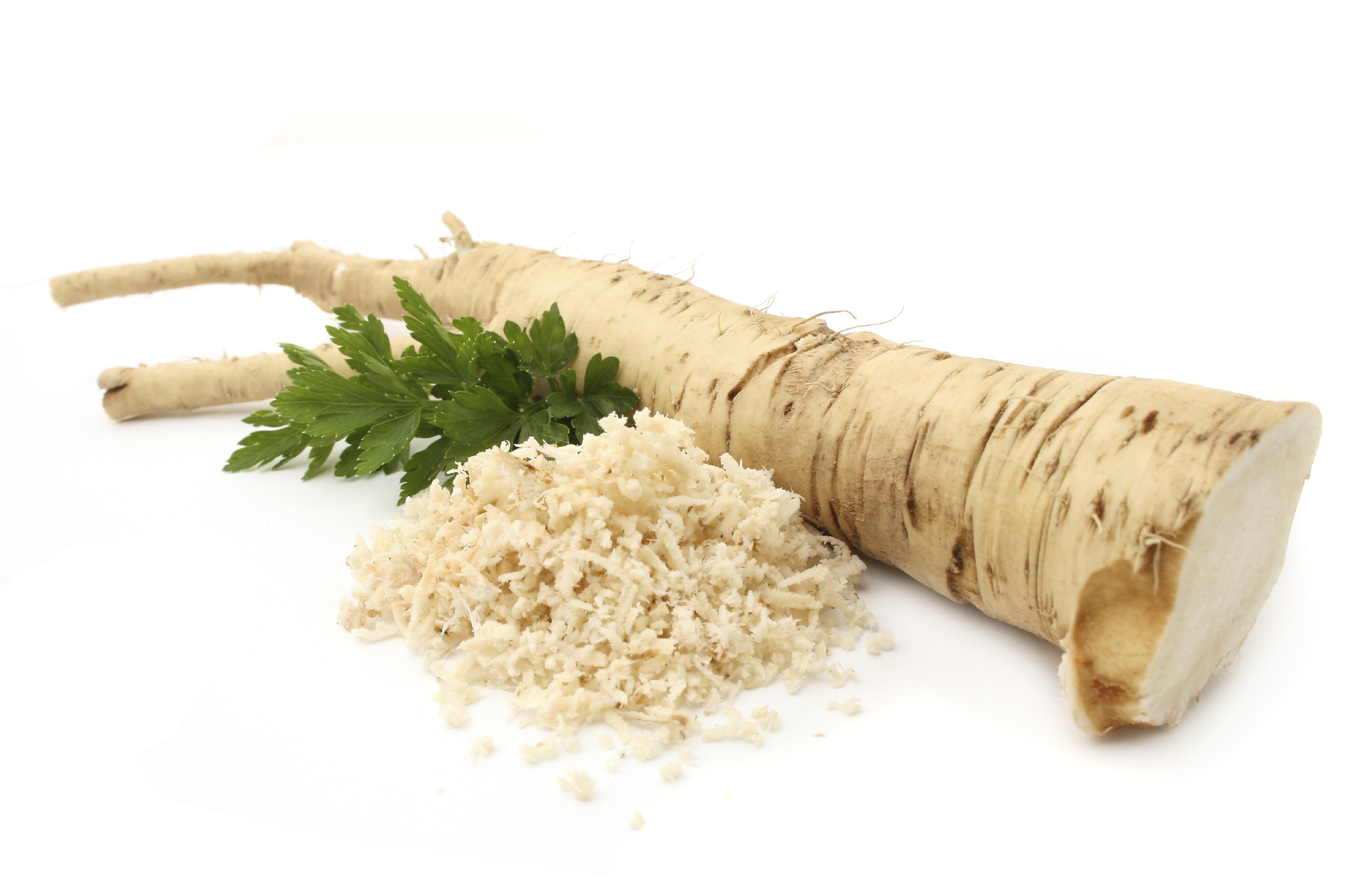
We are commanded to eat marror to remember that the romaine lettuce or grated horseradish should be the only bitter and negative thing at our table. If we can taste bitter, we in fact have sweet lives for which we should be not only profoundly grateful, but eternally positive people.  


A Year Ago We Put on Masks For Purim and Haven’t Taken Them Off Yet

While Purim is normally one of the happiest days on our calendar, this year it will mark a sobering milestone.  Purim will essentially mark a full year of living through a pandemic that has radically changed our lives. While we are beyond grateful for the progress with treatments and vaccinations, the return to some sense of normalcy doesn’t seem imminent.


In ordinary times, when we meet someone, we shake their hand.  Why not nod, bow, smile or just say hello?  The history of the handshake dates back to the 5th century BCE in Greece. Shaking someone’s hand showed you weren’t approaching with a weapon.  It was a gesture to communicate that you came in peace, that you posed no threat. 


But while handshaking began as an effort towards safety and peace, during this pandemic, it came to symbolize a simple threat.  And so, it is now a year since we last shook hands, a year since we hugged anyone outside of our immediate family, a year of distancing from people we want to feel close to. 


Who knew a year ago that when we put on a mask for Purim, we would still be wearing a mask a full year later?  How can we not be anxious for this to finally end, frustrated by how long it has gone on, and concerned with how uncertain the future is?


Towards the ends of the Megillah, we are told how the holiday that we will observe this week, all these years later, came to be.  The 14th and 15th were dedicated to observe and celebrate.  Why were these days chosen?  The Megillah tells us because that is when אֲשֶׁר־נָ֨חוּ בָהֶ֤ם הַיְּהוּדִים֙ מֵא֣וֹיְבֵיהֶ֔ם, the days the Jewish people “rested from their enemies.” 


Isn’t that a peculiar way of choosing a holiday?  Shouldn’t it be designated based on when they defeated their enemy, triumphed over their enemy, were victorious over their enemy?  Why because asher nachu, they found peace and rest from their enemy?


To answer, we look to a different reading from this time of year. Each year, the Torah mandates us to stop, pause and remember what Amalek wanted to do to us.  Amalek the people, but just as important, Amalek the philosophy, seeks our destruction, our utter elimination.  Amalek’s methodology is not limited to physically attacking, overpowering, and destroying.  Amalek is also satisfied with crushing our spirit, with breaking our faith. 


The Torah tells us that the attack from Amalek was unexpected.  The people weren’t prepared.  Amalek came suddenly, from behind, and startled them.  Amalek thrives by confusing their enemy, by evoking a sense of panic and hysteria in their opponent.  When they create a paranoia, instill a fear and worry, when they deprive the Jewish people of a sense of tranquility and serenity, they have essentially accomplished their goal; they have won. 


When the world was created, the Torah tells us:


וְהָאָ֗רֶץ הָיְתָ֥ה תֹ֙הוּ֙ וָבֹ֔הוּ וְחֹ֖שֶׁךְ עַל־פְּנֵ֣י תְה֑וֹם וְר֣וּחַ אֱלֹהִ֔ים מְרַחֶ֖פֶת עַל־פְּנֵ֥י הַמָּֽיִם׃

The earth being unformed and void, with darkness over the surface of the deep and a wind from God sweeping over the water—


The Midrash (Bereishis Rabbah 2:4) expounds:

רַבִּי שִׁמְעוֹן בֶּן לָקִישׁ פָּתַר קְרָיָא בַּגָּלֻיּוֹת, וְהָאָרֶץ הָיְתָה תֹהוּ, זֶה גָּלוּת בָּבֶל, שֶׁנֶּאֱמַר (ירמיה ד, כט): רָאִיתִי אֶת הָאָרֶץ וְהִנֵּה תֹהוּ. וָבֹהוּ, זֶה גָּלוּת מָדַי (אסתר ו, יד): וַיַּבְהִלוּ לְהָבִיא אֶת הָמָן.


The Torah’s choice of words in Bereishis explicitly evokes our Megillah. The exile of Persia in which the Purim story takes place is characterized by chaos, craziness, frenzy, and hysteria.  When they come to get Haman to bring him to Esther’s party, the Megillah says וַיַּבְהִלוּ לְהָבִיא, they scramble to bring him, they rush and come suddenly and hurriedly.  The galus of Persia is בהלה, the power of Amalek is to take away yishuv ha’daas, to be a disrupter.  This was Haman’s goal, his mission.


כִּי֩ הָמָ֨ן בֶּֽן־הַמְּדָ֜תָא הָֽאֲגָגִ֗י צֹרֵר֙ כָּל־הַיְּהוּדִ֔ים חָשַׁ֥ב עַל־הַיְּהוּדִ֖ים לְאַבְּדָ֑ם וְהִפִּ֥יל פּוּר֙ ה֣וּא הַגּוֹרָ֔ל לְהֻמָּ֖ם וּֽלְאַבְּדָֽם׃

“Haman had plotted to destroy the Jews, and had cast pur—that is, the lot—with intent to confuse, complicate, disrupt, destroy and exterminate them.”


There is an Amalek energy in us, a negative voice that says, “Panic! Be hysterical, have no peace of mind, be anxious, worried and deprived of happiness and calmness.” 


We defeat the Amalek around us and the Amalek within us when we find the capacity to show faith, to stay calm, and to carry on with confidence.  Says Rav Avraham Schorr in his HaLekach V’Halibuv, that is why our rabbis made the holiday of Purim not directly correspond with the physical defeat of Haman, but specifically with the asher nachu part of the story, when we restored our menuchas ha’nefesh, we found a way to be calm, to live with confidence, to have a peace of mind, to find faith, no matter what.


Panicking, becoming frantic, worrying about what is, what will be, stressing over things that we cannot control, is the influence of Amalek, it is the voice of our enemy who seeks to deprive us of happiness, to rob us of serenity.  It is not who we are and who we can be.  We are God-fearing Jews of deep faith.  We believe in taking our initiative, making our effort, and then relying on our Creator. 


As challenging as these times have been and remain, as much as we still, nearly one year in, don’t know about what will be, we cannot and must not forfeit our lives and our happiness in the very month in which we are told to be happier than ever, to have greater confidence and trust, to believe there is something so much bigger than ourselves and therefore to find the capacity to stay calm. 


In 1939, in preparation for World War II and in an effort to raise the morale of the British public, the British government printed 2.5 million copies of a poster to be hung in all the major cities in England.  It displayed a simple message that still resonates 70+ years later:  Keep Calm and Carry On.


There is still so much we cannot control, so many variables we cannot predict.  One of the few things we can regulate is our menuchas ha’nefesh, our sense of calm and of peace.


As we come up on a year of wearing a mask, let us make an extra effort to be mindful of the impact of Amalek-type thinking on our lives, and pledge no matter what, to Keep Calm and Carry On. 

Admitting “I Don’t Know” is a Sign of Strength, Not Weakness

Mark Twain once said: “It ain’t what you don’t know that gets you into trouble. It’s what you know for sure that just ain’t so.” Nobel prize winner Dr. Daniel Kahneman put it a little differently: “We’re blind to our blindness. We have very little idea of how little we know. We’re not designed to know how little we know.” Indeed, when asked what he would eliminate in the world if he had a magic wand, Kahneman answered with one word – overconfidence.


Overconfidence has been blamed for the sinking of the Titanic, the nuclear accident at Chernobyl, the loss of Space Shuttles Challenger and Columbia, the subprime mortgage crisis of 2008, the great recession that followed it, and the oil spill in the Gulf of Mexico, among other things. Overconfidence has brought personal financial disaster, imploded relationships and ruined lives.


One person who understood this was Shlomo HaMelech, the wisest of all men. In Koheles, which we read on Sukkos, he describes his efforts to explore and understand.  אמרתי אחכמה והיא רחוקה ממניI said I will be wise, but it remained elusive to me.” Shlomo confesses that he tried, analyzed, contemplated, but at the end of the day, he came up short; complete understanding was beyond his grasp.


What is Shlomo referring to and why do we specifically read his words on Sukkos, the holiday marking our greatest joy? What did he try to apply wisdom to but was unsuccessful? Most say he is talking about the quintessential chok, the parah adumah, whose law is paradoxical. The impure person is purified from its ashes, but the pure person becomes impure. Shlomo tried to understand its mechanics, how and why it worked, but in the end, he concedes, rechoka mimeni, it is too distant.


Rav Yosef Shaul Natanson, the Shoel U’Meishiv, has a different interpretation. He says the word v’hi in “v’hi rechoka mimeni” refers to the entire Torah. He understands Shlomo HaMelech as telling us: After I saw that I could not comprehend the reason for parah adumah, I realize that the reason for everything in the Torah was entirely beyond me.


Someone once challenged the Chazon Ish about the challenge of theodicy, how bad and painful things can exist in the world. He was driven to make sense and understand the suffering. The Chazon Ish showed him a Tosfos and asked him to explain it. The man tried but failed to interpret or understand the Tosfos. The Chazon Ish told him, “If you don’t understand a few line of Tosfos, how do you expect to understand the ways of Hashem, which are concealed from all mankind.”


We say in Tehilim, מה גדלו מעשיך ה׳ כולם בחכמה עשית…איש בער לא ידע וכסיל לא לבין את זאת, How great are your ways, Hashem.. A fool doesn’t understand them…” R’ Meilech Biderman wonders why Dovid singles out the fool as not understanding them, when even the wise can’t comprehend the ways of Hashem? He explains, what makes someone wise is that they know what they don’t know. The fool suffers from overconfidence, thinks they understand and know everything. The fool thinks he or she has all the answers.


We live in a world that makes us feel that if we say “I don’t know” or “I don’t have a strong opinion about that” we are uninformed, weak or unsophisticated. But we come from a tradition that says exactly the opposite. Humility, nuance and admitting that we don’t know are not signs of weakness, but strength. They don’t display ignorance; they show that we are informed enough to know that we can’t possibly know absolutely.


The Gemara (Berachos 4a) states, דאמר מר למד לשונך לומר איני יודע שמא תתבדה ותאחז “Teach your tongue to say ‘I do not know, lest you become entangled in a web of deceit.” Our greatest scholars didn’t hesitate to say “I don’t know,” causing us to think more, rather than less of them, and to place greater confidence in the things they did purport to know. Rashi, without whom the Talmud would be a closed book, is famous for the several places in which he writes, “eini yodei’ah, I don’t know” regarding the meaning, interpretation, or relevance of a particular verse or statement.


I had the privilege to sit in Mori V’Rabbi, Rav Hershel Schachter’s shiur for several years. I truly appreciated his greatness not when he quoted from the width and depth of all Torah by heart, but rather, when someone asked him a question and he humbly and simply said, I don’t know.


Perhaps this passuk is why we read Koheles on Sukkos, zman simchaseinu. Feeling entitled or capable of understanding everything only sets ourselves up for disappointment, brings about a failure of overconfidence, and leaves us feeling down, incomplete and unfulfilled.


This pandemic and Covid-19 specifically should humble us all.  The greatest experts and most brilliant minds have struggled to understand, predict and even guide us.  This shouldn’t make us lose confidence in others who are doing their best as much as it should make all of us more humble, modest and willing to admit the limits of our knowledge and understanding, not only regarding this, but regarding everything.


Of course, we should pursue understanding, try to gain wisdom, and obtain insight. But we must admit and concede that we can’t have the answers to everything and there are things we just can’t understand. Listen to the advice of the wisest of all men: If you want to be happier in your marriage, at work, in your relationship with your children and with Hashem, learn to say ״I don’t know״.

Be Grateful for the Essential & Make Yourself Essential

Originally delivered as a derasha in Boca Raton Synagogue, Rosh Hashana 5781

Recently, an undisclosed customer of Israeli jewelry company Yvel reached out to its owner, Isaac Levy, with an unusual request.  The clearly wealthy client ordered a special, custom-made Covid-19 mask but only if it met three criteria:  it had to incorporate N99 filters, be completed by the end of the year, and it had to be the most expensive mask in the world.  

Twenty-five of Yvel’s artisans went to work on a mask made of 18-karat white gold with 3,600 white and black diamonds. They produced a mask worth $1.5 million that weighs over half a pound. 


זכרנו לחיים מלך חפץ בחיים וכתבנו בספר החיים למענך אלוקים חיים

Remember us for life, King Who desires life, and inscribe us in the book of the living, for your sake, living Hashem.


In this simple yet deeply moving sentence, we beseech Hashem to inscribe us in the book of life.  Again, in the second addition to our Aseres Yemei Teshuva, מי כמוך אב הרחמים, we ask Hashem to remember us לחיים ברחמים, mercifully for life.  In the third insertion, though we add a word to chaimוכתב לחיים טובים כל בני בריותך, now we ask Hashem to inscribe us for a good life.  And then again in the last insertion we reference בספר חיים…לחיים טובים ולשלום.


Why is good life mentioned only in the last two insertions and not the first two? Why not ask for חיים טובים, a good life, from the start? 


The Vilna Gaon explains that the first three berachos of Shemoneh Esrei are about life in the World to Come.  In the future, in the עולם האמת, the world of truth, the world of complete revelation, there is no good or bad, there is no distinction between life and a good life.  By definition, life in the next world is good and so we don’t need to specify טובים it in our tefillah.  However, says the Gaon, the last two insertions refer to our request for life in this world, in the here and now.  In this world, which could go either way, we specifically want a good life so we ask for חיים טובים.


But I would like to offer a different suggestion, one that these past six months have taught us all.  Perhaps the reason we begin by simply asking for חיים, for life, is because we cannot and must not take life itself for granted.  Before we can ask for חיים טובים, for the wonderful and beautiful joys and pleasures of life, before we can dream, wish, fantasize, and hope for exactly what we want our life to include, it cannot and must not be lost on us how fragile, tenuous, and unpredictable life is altogether.  


If last Rosh Hashana I would have stood up here and said, “Chevra, we need to daven hard, we need to dig deep and pray from the bottom of our hearts because I have a premonition, I fear in this coming year the entire globe will be struck by a plague, we will have to shut down the economy, the country, our shul, we will all wear masks, distance from one another, many won’t be able to leave their homes and many, way too many will lose loved ones almost overnight from this horrific plague,” it might have been my last speech.  You would say, “Rabbi, talk about something real, something relevant, something that could actually happen.” 


And yet in the last half of the past year, חיים טובים, the indulgencies and luxuries of life, have not been the priority.  חיים, our very survival, our family’s safety, our community’s health and wellbeing, staying alive and keeping those we cherish healthy have consumed our thoughts and dictated all of our actions, policies, and practices.


The distinction between two categories – “essential” and “non-essential” – has always been part of living a Torah life.  Remarkably, these words have dominated the world’s conversations this past half a year.  Essential workers and businesses were allowed to operate even when non-essential ones were asked or ordered to lock down.  We went out for essential items and activities, even when we were asked to remain at home and forego that which was unessential.  People everywhere continue to struggle to determine what is essential and important to do or go to, and what is unessential and worth skipping in an effort to mitigate risk. 


For almost seven months now we have been preparing for today, for coming before our Creator knowing the difference between חיים and חיים טובים, between essential and non-essential.  Now don’t get me wrong, we miss the non-essential. The “normal” parts of our lives we took for granted—socializing, playdates, vacations, kiddushes, simcha dancing, travel, and so much more—were not only enjoyable and fun, these were important and significant parts of life.  Yet, as badly as we crave their return, we have learned to live without them, at least for the time being.  We have realigned our priorities, refocused our values, and we have come to appreciate the gift of חיים, even before we get to חיים טובים.


Before Corona most people were inclined to feel invincible, indomitable, that all would continue the way it was, that we could and should expect to wake up tomorrow, to experience next week, to fully live next year and to enjoy the next decade and beyond.  And yet, an invisible and pernicious virus has taught us that nothing could or should be taken for granted, nothing, not our lives or anything in them, is predictable or certain.  The default and expectation should not be forחיים טובים or even חיים at all.  Each day we wake up, each moment we live is a gift from above.


The Shulchan Aruch (OC 225:1) rules based on the Gemara (Berachos 58b) that one who sees a friend after a year of not seeing him or her recites the beracha of ברוך מחיה המתים, Blessed is He Who revives the dead. The Maharsha wonders, just because you have been locked down, quarantined, distancing and haven’t seen others doesn’t mean they were dead and have been revived, so why does the beracha upon seeing a long-lost friend invoke literal resurrection?  The Mishna Berura quotes the Maharsha’s answer.  He explains that every year on Rosh Hashana and Yom Kippur, our lives hang in the balance, our future is not certain, it is not secure. If we emerge successfully, it is as if we have been recreated and so when you see someone you haven’t seen in over a year, after a Rosh Hashana and Yom Kippur have passed, you make a beracha acknowledging that Hashem has revived them for another year, granted them חיים.


With this in mind, firstly, we must not take life for granted. We cannot skip to asking for חיים טובים without first thinking about the gift of חיים.  I was once talking to a mother in our community who has several significant challenges in her family.  I asked her how she was doing or how was her day and her response has stayed with me ever since.  She said, “Rabbi, any day which ends with the same head count in my home as it began is a good day, no matter what else is going on.”   Let us pour out our hearts this morning to ask Hashem for the same head count in our homes at the end of each day, each month and each year as we had at the beginning.


This morning, on the anniversary of the creation of man, of first receiving life, let’s pause and be grateful to be alive and to pray that we and those we love merit long lives.  Let’s take a moment to declare we know what is essential and it isn’t a $1.5 million mask, but it is our health, our family, a roof over our heads, food in our mouths, meaning, purpose and Torah and our lives.


Secondly, the Gemara (Rosh Hashana 32b) says that on Rosh Hashana Hashem sits on His throne and the books of life and death are open before Him.  Why does He need a book of life, isn’t it enough to not be inscribed in the book of death?  Perhaps we earn חיים, life, by simply not being inscribed in the book of death.  But what kind of life?  A life of loneliness and solitude, a life of lockdown and quarantine, a life of retreat, of fighting to survive?  Or, a life of vibrancy, dynamism, a life of company, companionship and community, a life of activity and activism?  Our Creator opens two books because we don’t just want to be inscribed not to die, we want to be given the chance to fully live, to live a good life, a life filled with joy, pleasure, nachas, companionship, and happiness.


We begin by asking for חיים, but we don’t hesitate to also ask for חיים טובים.  My dear friends, this morning, let’s not be satisfied with just not dying, let’s aspire to live again, to sit in shiur together again, to hug our friends again, to hold our grandchildren again, to dance together again, to enjoy Shabbos and Yom Tov meals together again.  These days are Yemei Ratzon, special days to pour out our hearts to daven, to plead. Let’s together, collectively storm the gates of Heaven and ask Hashem to not only spare us from being written in the book of death, but to inscribe us in the book of life, of good life.


And lastly, when we think about the difference between essential and non-essential, we can’t just think about how we define the things in our lives, but we must ask ourselves how others define us in their lives.  Are we essential or non-essential?  Do we matter to others, do we make a difference in their lives, do we prove ourselves essential to our family and friends, to our colleagues, to our community and most of all to Hashem? 


The Mishna (Sanhedrin 4:5) teaches us, “כל אחד ואחד חייב לומר בשבילי נברא העולם”, every one of us is obligated to say “The world was created for me”. How do we balance this with the famous declaration of Avraham Avinu, “אנכי עפר ואפר” (Bereishis 18:27) “I am but dust and ash”?


Rav Noach Weinberg z”l, the founder and Rosh Yeshiva of Aish HaTorah, used to explain: We are not supposed to say the world was created for me in a self-centered, self-absorbed, narcissistic way. Rather, “The world was created for me” means it falls to me to take care of the world.  I see myself as essential, I am prepared to step up, to serve and to be of service, to matter, to make a difference, to pursue my mission. 


You can be essential by sharing love with those who desperately need it, you can prove essential by helping others or volunteering. You are essential when you make choices not based on comfort or convenience, rather what you can do for the community. You are essential when you consistently add your unique voice to davening and learning.  You are essential not only if you donate your kidney, but also when you donate your time and your resources. 


I recently read the story of a Satmar Chassid from Williamsburg whose mother, who is in her early seventies, was having trouble breathing. Her oxygen levels were not good and she was rushed to one of New York City’s major hospitals.  She was subsequently put on a respirator as her condition worsened. For several weeks, she was in an induced coma and all her son could think was that please God she will awaken and what will she find, how startled will she be.  She will be totally disoriented after weeks of being unconscious and no family will be there to comfort and support her.  He asked if he could visit for just a half hour after she regained consciousness, but, as was the case with virtually everyone at the height of Covid in New York, his request was denied.  Only essential personnel were allowed in the hospital, absolutely no non-essential visitors could enter. 


He soon discovered that the hospital had a longstanding contract with a company that supplies personal nursing care.  The man hired a private nurse to care for his mother but then he had an idea.  He approached the owner of the company and asked to be admitted to his mother’s room under the auspices of the private nursing company.  The owner thought he was crazy and told him it simply wasn’t possible; if he sent someone who didn’t have credentials, he could lose his license and his business.  The son, this chassid, had another idea. He asked what would be necessary to acquire appropriate nursing credentials.  It turns out, as a consequence of the severe nursing shortage caused by the pandemic, New York state had enacted a law creating an expedited procedure for certifying licensed practical nurses (LPNs). One needed to only take a series of online courses and pass a written exam.


This chassid happened to be a long-time Hatzolah volunteer and an emergency medical technician (EMT). So for three straight days he locked himself in a room and listened to the online courses for LPN certification. He then took the exam and passed with flying colors.  Armed with certification, he persuaded the company to let him join their staff as a regular scheduled nurse for the night shift in his mother’s hospital room.  When she came out of the induced coma, he was there. And during her remaining weeks in the hospital, because he refused to accept that he was non-essential and went to great lengths to be deemed essential, he was there to offer support, care, and love. 

As we coronate Hashem today, let’s not take life for granted, let’s not be satisfied with not dying, but let’s truly live and let’s promise and prove that we are essential to the people around us and to our Father in Heaven. 

Geshmack or Shver: Are You Willing to Sacrifice Or Must it All Come Easy?

A few summers ago, Yocheved and I were in a remarkable supermarket.  The supermarket was larger than our local Publix.  It had all the same sections as any other supermarket – meat, poultry, fish, fresh produce, prepared foods, groceries, frozen items and much more.  What made this supermarket incredible is that it is entirely under kosher supervision. There was a complete aisle of kosher vitamins.  There was even a keilim mikvah in the supermarket so that if you buy any vessels that need immersion you could do it on the spot.  As I stood in the enormous store with an endless variety of kosher food, Jewish newspapers, kosher vitamins and even a board game called “Monseyopoly,” I thought to myself we are living in a time in which it is more comfortable than ever to be an observant Jew.  

Every aspect of Jewish living has been rendered easier, more comfortable and requiring less sacrifice.  We have pop-up Sukkahs and pre-packaged hadassim and aravos.  We purchase complete Chanukah sets already pre-assembled and ready to use.  Endless potato recipes for Pesach have been replaced by kosher l’pesach bagels, cereal and pancakes.  We buy ten pieces of bread labeled for bedikas chametz. 


Artscroll has revolutionized learning, making what were once closed texts accessible to the masses for study.   We have diverse kosher restaurants, an app to help us find minyanim within proximity to our exact location.  We have Shabbos clocks and Shabbos lamps and Shabbos alarm clocks.  In some ways, fidelity to Halacha requires less sacrifice, less compromise and less effort than ever.


And it is not just halachic conveniences, it is simply easier to function in the world today than it ever was.  Remember Disney’s “Carousel of Progress”?  It had a display showing inconceivable technology like programmable refrigerators and ovens, voice command, video conferencing, and inconceivable video games.  I remember seeing it as a child and thinking how creative this showcase was and how unlikely it would or could ever come true.  Well, somewhat sadly Disney has not updated that carousel, and when I saw it with my family a couple of years ago, my children wanted to know why things that exist in their past are being described and celebrated as the future. 


We now FaceTime with people around the world, program our smart houses, and some are already relying on our self-driving cars. The increasingly comfortable world, Jewishly and technologically, is making us progressively uncomfortable with discomfort.  Even now, when a global pandemic forced us to adapt, we got used to everything being conducted over Zoom, from shiurim to board meetings to parent-teacher conferences, in a way that makes us consider whether we want to return to those things in person. We expect everything to be easy, compatible, pleasant, and convenient. 


To be honest, I am worried about our generation, a truly privileged generation’s capacity for mesirus nefesh.  To be clear, there is nothing wrong with all of the wonderful progress.  We should enjoy and celebrate the abundance of options and the ease of being an observant Jew and a blessed member of the 21st century.


But, what happens when we encounter that which is inconvenient, uncomfortable or incompatible?  Do we have the interest let alone the strength to persevere, to overcome, to endure?


On Rosh Hashanah we use a horn of the ayil, a ram, for a shofar.  The Shulchan Aruch writes (586:1), “It is best when the shofar of Rosh Hashanah is from an ayil…although all shofros are kosher.”  The Gemara (Rosh Hashanah 16) wonders, “Why do we blow shofar specifically with a ram’s horn?”  It answers, “Hakadosh Baruch Hu says, ‘Blow for Me with a ram’s shofar so I will remember akeidas Yitzchak and I will consider it as though you were bound on the akeida before Me.’” 


When we want to persevere and triumph in judgment, when we want to be worthy of being written and ultimately sealed for a year of prosperity and blessing, we think about and invoke the story of the akeidah.  It is what we literally read for Kerias HaTorah on one of the days, and it is the reason we use the shofar of a ram on both days: “Vayehi achar ha’devarim ha’eileh v’ha’Elokim nisa es Avraham, va’yomer elav Avraham, va’yomer hineini.  And it happened that God tested Avraham and said to him, ‘Avraham,’ and he replied, ‘Here I am.’”


I would like to suggest to you that the akeida and Rosh Hashanah go together because it is the power of “hineini,” of being tested and answering the call, that should be on our minds as we prepare for judgement.  As we think about coronating God as our King, we are to consider – Have we answered the call like Avraham?  Have we been prepared to make sacrifices in our lives and lifestyles?  Have we passed the tests that we have confronted and persevered in the face of the adversity, temptation, and seduction that has come our way?


Some are tested with maintaining faith during a health crisis or a financial collapse or infertility or a failing marriage.  Some are tested with being loyal to the Torah’s view of the world when it conflicts with Western culture and values and others are tested observing Jewish laws that are inconvenient or even incomprehensible to them.  Some are tested with coming to shul while others are tested with paying attention while there.  Some are tested when submitting their income taxes and others are tested when surfing the web. And of course, while we all face a variety of tests every year, there is surely not a single person in the world who has not been tested in some way this past year by the coronavirus and all that has come with it.


When it is our turn and our time, when v’ha’Elokim nisa es…, when God tests us, do we care enough and are we strong enough to say “hineini,” I am here, I am prepared to sacrifice, to struggle, to compromise, to forfeit and to submit?  Or do we believe that life should be comfortable, easy and convenient, so when we encounter conflict we disappear, we check out, we drop whatever necessary to get our comfort level back up?


Rav Moshe Feinstein zt”l famously said that we must not tell our children “t’iz shver tsu zeyn a yid,” it is difficult to be a Jew, but instead, we must tell them “it’s geshmak to be a yid,” it is amazing to be a Jew.  He was right and remains right.  We need to show our children the beauty of our tradition, how it enriches and enhances our lives and brings deep meaning and great joy. 


But with that said, let’s admit for a moment that it isn’t always geshmak to be a yid.  It is sometimes shver.  When you have to wake up early for selichos and you are exhausted, when you lose a business opportunity because of Shabbos, when you are stuck somewhere with nothing kosher to eat, when the Torah law doesn’t fit neatly with the mores of the time, it is shver, it is difficult.  And yet, at those times, in those moments, are our “hineini” opportunities.  That is our chance like Avraham to say, I don’t only show up for a Judaism which I perceive as pleasant and pleasurable, but even when it is hard and challenging and makes me work – “hineini!” – I am here, I am in, I am ready.


Willingness to compromise, sacrifice and submit is a critical part of religious experience.  We like to show how compatible Judaism and Torah are with science, with our liberal values, with the world we live in.  But religion is not about compatibility with what is convenient for us to believe and with how we prefer to behave.  At its core it is about a willingness for submission.  Rosh Hashanah is about being mamlich Hashem, coronating God as our King and with it, kabalas ol malchus shamayim, accepting and surrendering to the will and dominion of our King, even when it takes sacrifice and submission.  On the Day of Judgment we coronate God with our words but we truly coronate God not in shul but in our homes, our work places, our gyms, and our recreational activities, by standing the tests we face.


In a famous footnote in Halakhic Man, Rabbi Soloveitchik wrote:


This popular ideology contends that the religious experience is tranquil and neatly ordered, tender and delicate; it is an enchanted stream for embittered souls and still waters for troubled spirits…This ideology is intrinsically false and deceptive.  That religious consciousness in man’s experience which is most profound and most elevated, which penetrates to the very depths and ascends to the very heights, is not that simple and comfortable.  On the contrary, it is exceptionally complex, rigorous and torturous.


If we use the ram to invoke Akeidas Yitzchak why do we specifically use the horn?  If our goal is to remind Hashem of Akeidas Yitzchak, couldn’t we have used any part of the ram that was ultimately brought instead of Yitzchak?  Why specifically the horn?


Perhaps we can answer with an insight from R’ Meir Shapiro in his Imrei Da’as.  The passuk says he set out on the first day and arrived on the third.  What happened in between?  The Midrash (Tanchuma, Vayeira #22) says that when Avraham set out to bring his son as a sacrifice, along the way the Satan, the dissuading voice tried numerous times to discourage Avraham from going through with his mission. Avraham persevered each time and ignored the voice seeking to dissuade him.


When he finally raised his hand to strike his son Yitzchak, an angel instructed him to stop.  Wonders Rav Meir Shapiro, how did Avraham know that the voice of the angel was authentic and legitimate?  How did he know it wasn’t the Satan one last time?  He answers that the text tells us that Avraham notices the ram ne’echaz basvach, struggling in the thicket.  Only upon noticing the ram struggling was Avraham convinced to in fact put down the knife.  Explains Rav Shapiro, falsehood and temptation come easy.  Truth and meaning are connected to struggle and effort.  Avraham noticed the struggle of the ram after hearing the angel’s voice.  When he saw struggle, he knew he was in the presence of truth.


Perhaps we specifically use the horn of the ram because it was the horn that was entangled and caught.  The ram struggled to escape but its horns were caught in the bush and it couldn’t get out.  The shofar represents challenges and struggles.  It was chosen because Hashem cherishes our struggles.  He values our efforts and cares deeply about each and every moment of perseverance.


A few years ago I got to know a family living on an island in the Caribbean that wanted to convert to Judaism.  They were mentored by their local rabbi and studied diligently with a rabbi in Israel.  I ultimately met them in person and visited their small local Jewish community.  A few weeks later I got an email from him:

We have made a lot of changes in our lives just to be a part of HaShem’s people. These changes have not been easy but have been worthy, and even more when we complete the process. You saw our commitment, as you expressed that you were impressed.


Our desire to finish the process is not just for the sake of getting to be called  Jews. Being a Jew is very hard, takes courage and dedication. We are willing to continue to make sacrifices and take this path all the way. For this we need your help. 


When we welcome someone to the Jewish people they stand in the mikvah about to undergo an enormous transformation and we ask them a series of questions.  One of them, the Gemara tells us, is do you know that it is really difficult to be a Jew?  Are you aware that keeping Jewish law is complicated, keeping kosher and Jewish schools are expensive, anti-Semites want to kill us?  Are you prepared to make the necessary sacrifices to be a Jew?  Only when a candidate says yes do we welcome them to our people.


The ram’s Shofar asks us those same questions.  Do we answer the call of the akeida like Avraham Avinu?  In the coming year, are we willing to remember that avodas Hashem is called “avodah” for a reason, because it takes work and effort. 


Robert Browning, the 19th century English poet, put it well when he said, “When the fight begins within himself, a man’s worth something.”  Let’s make our lives worth something. When inevitably called upon to struggle spiritually or theologically or in our lifestyle, let’s determine, as we approach this great day of judgment and awe that we will answer hineini, here we are. 

Becky Overcame Her Fear and it Saved Thousands of Lives – The “What Ifs” of Life


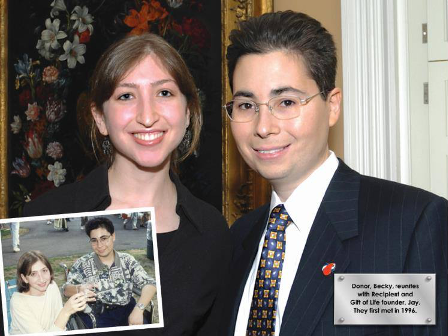
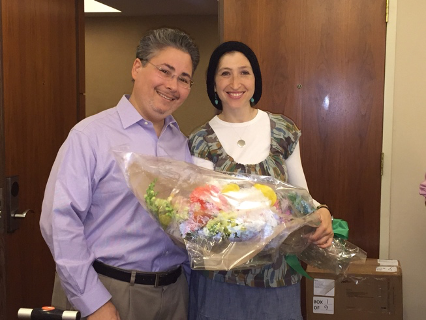
Jay Feinberg is one of the most soft-spoken and humble people I know.  Even at an event for Gift of Life, the organization he founded and serves as CEO of, he likes to blend in.  While he is modest and would never tell you directly, it is not an exaggeration to say that he is personally responsible for saving thousands of lives. 


Jay is the visionary behind Gift of Life, an organization that has conducted over 10,500 bone marrow drives in 49 countries, has 374,855 registered donors, has found 17,888 matches (including several amazing BRS members, Avi Amsalem, Perel Hande, Matthew Hocherman and Jonathan Struhl) and has facilitated 3,645 transplants. 


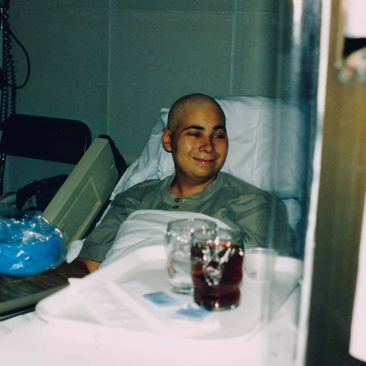
But all of that almost didn’t happen.  In 1991, during his first year of law school, Jay was diagnosed with leukemia.  His family was told he would need a bone marrow transplant to survive, but there were no matching donors in his family or in the entire national registry.  For four years, while they watched Jay’s health deteriorate, his tenacious family conducted drives around the globe.  They tested 60,000 donors and found matches for hundreds of patients along the way.  Finally, they found one for Jay. 

When he recovered, Jay was determined to ensure others wouldn’t have to wait as long for a transplant or risk not finding a match at all. Instead of returning to law school, he used his own experience to found an organization dedicated to educating and encouraging people to add themselves to the bone marrow registry and to improve the efficiency of finding matches and coordinating transplants within the Jewish community and beyond.


This week marks the 25th anniversary of Jay’s transplant, his new lease on life.  Not only is he personally celebrating and feeling grateful to be alive, we should all be appreciative of the gift of Jay to humanity and the Jewish people.


While Jay and his story are extraordinary, there are other remarkable people without whom this story wouldn’t have a happy ending.  Jay’s condition had worsened terribly, but friends of his in Milwaukee, Benjy Merzel and R’ Amir Gutman (now of Boca), refused to give up hope and organized one last drive. A young lady from Illinois, Becky (Faibisoff) Keller, volunteered at the drive, but due to her fear of needles decided not to get tested herself. 

The drive was packing up at the end of the day having tested 130 new people, hopeful one would be Jay’s lifesaving match.  In the last moment, Becky said to herself, it is silly to have come and helped out but not get tested myself.  She overcame her fear and was the last of 60,000 people tested, at the very last drive for Jay.


You guessed it – she turned out to be Jay’s perfect match and the transplant took place a short time later at the Fred Hutchinson Cancer Research Center in Seattle.

A determined family set out to find Jay a match. Two friends refused to give up hope.  And one young lady overcame a fear to do an act of kindness that not only saved Jay, but by extension has now saved the lives of thousands and given hope to leukemia patients around the world. 


We are currently observing the darkest period of the year, mourning the tragedies, atrocities, suffering and loss throughout the millennia. Our rabbis tell us that what precipitated it all was baseless hatred, a lack of kindness, a self-centeredness that corrupted our world to the extent Hashem essentially disbanded and destroyed it, dispersing us around the globe.


The antidote, the key to rebuilding that world, to hastening redemption is to do the opposite, acts of selflessness, baseless kindness.  Dovid HaMelech wrote (Tehillim 89:3): Olam chesed yi-baneh – the world is built on kindness. 


On Shabbos Nachamu we transition from mourning and destruction to comfort and consolation.  Yet our Beis HaMikdash remains unbuilt, our holy city still incomplete. Where is the comfort when nothing that we mourned has changed?  Perhaps our comfort stems from using the struggles of the past to inspire and motivate a future filled with kindness, goodness and selflessness. 


What if Jay’s family hadn’t tried? What if Jay’s friends didn’t run one more drive? What if Becky hadn’t overcome her fear?


Who knows the consequences, the “what if” created, by neglecting whatever act of kindness that we can do next?  Who may desperately need a phone call, a checking in, someone to shop for them or cook a meal, send flowers to for no reason or offer to learn on the phone.  There are no limits to the possible acts of kindness that can enrich or even save the lives of others, even when physical proximity is difficult or impossible.


Overcome a fear or inhibition, leave your comfort zone and reach outside yourself to do something kind for another.  Who knows what life you might not only touch, but save, and by extension how many thousands of other lives too. 


*Find out more about Gift of Life at www.giftoflife.org

Stand Up and Speak Out

On April 11, 1944, a young Anne Frank wrote in her diary:


Who has made us Jews different from all other people? Who has allowed us to suffer so terribly until now? It is God Who has made us as we are, but it will be God, too, who will raise us up again. Who knows – it might even be our religion from which the world and all peoples learn good, and for that reason and that reason alone do we now suffer. We can never become just Netherlanders, or just English, or representatives of any other country for that matter. We will always remain Jews.


Anne Frank was on to something. The Talmud asks, from where did Har Sinai derive its name? After offering a few alternatives, the Talmud suggests that Har Sinai comes from Hebrew word “sinah” which means hatred, because the non-Jews’ hatred of the Jews descended upon that mountain when the Jewish people received the Torah there. Torah demands a moral and ethical lifestyle, an attitude of giving rather than taking, a life of service rather than of privilege, that has revolutionized the world.


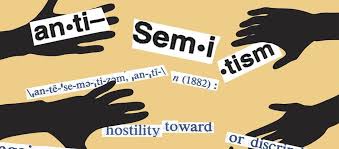
The Jewish people have been charged to be the moral conscience of the world, a mission they have not always succeeded at, but that nevertheless drew the ire, anger and hatred of so many. For two thousand years the Jews were bullied and persecuted simply because of their Jewishness and all that stands for. After the Holocaust, the world gave the Jews a reprieve from their hatred, becoming instead beneficiaries of their pity. But looking at events around the world, it is rapidly becoming clear that the last 75 years was an aberration. We have witnessed the rise of anti-Semitism around the world as the world reverts back to its ageless pattern and habit.


The Midrash (Eichah Rabbah 1) teaches that three prophets used the term “eichah” – o how! In Devarim, Moshe asks: “Eichah, how can I alone bear your troubles, your burden and your strife?” (Deut. 1:12) In the Haftorah for Shabbos Chazon, the Prophet Yeshayahu asks: “Eichah, how has the faithful city become like a prostitute?” Lastly, Yirmiyahu begins the Book of Eichah: “Eichah, how is it that Jerusalem is sitting in solitude! The city that was filled with people has become like a widow…” Eicha – How? How is it that anti-Semitism persists? Why must they rise up against us in every generation?


On Tisha B’Av we will sit on the floor and wonder aloud, eicha? How could it be Jews have to fear for their lives yet again? Eicha – how could it be that today, with all the progress humanity has made, more than a quarter of the world is still holding anti-Semitic views? 


Rabbi Soloveitchik tells us that though the Midrash identifies three times the word eicha is used, in truth there is a fourth. When Adam and Chava fail to take responsibility, God calls out to them and says ayeka, where are you? Ayeka is spelled with the same letters as eicha, leading Rabbi Soloveitchik to say that when we don’t answer the call of ayeka, when we don’t take personal responsibility for our problems and blame others, we will ultimately find ourselves asking eicha, how could it be?


We can ask eicha, how could all of these terrible things be, but we may never have a definitive answer. Our job is to make sure we can answer the call of ayeka, where are you? Are you taking responsibility? We may not be able to fully understand why anti-Semitism exists, but we can and must remain vigilant in calling it out, confronting it and fighting it. We must remain strong in standing up for Jews everywhere. We must confront evil and do all we can to defeat it.


And, we must do all that we can to take personal responsibility to fulfill the Jewish mission to bring Godliness into the world. If individual Jews were hated for being the conscious of the others, all the more so does a Jewish country generate hate for being the moral conscious of the whole world, held to higher moral standards than any other country or state.


Our job is not to be discouraged by asking eicha, but to ensure that we can answer the call of ayeka. Anti-Semitism will not come to an end by assimilating and retreating. It will come to an end when we can positively answer the question that the Talmud tells us each one of us will be asked when we meet our Maker: did you long for the redemption and did you personally take responsibility to do all that you can to bring the redemption? Did you truly feel the pain of exile and feel the anguish of the Jewish condition in the world? Do you truly and sincerely care? Did you anxiously await every day for Moshiach to herald in an era of peace and harmony, an end to anti-Semitism and suffering?


It is not enough to long for Moshiach, we must bring him. It is not enough to hope for redemption, we must be the catalyst for it. It is not enough to be tired of eicha, we must answer ayeka. If we want to get up off the floor and end the mourning, if we want to finally end anti-Semitism, it is up to us to do what is necessary to heal our people, to repair the world, to love one another, and to earn the redemption from the Almighty.


Resilience and Tenacity: Finding the Strength to Split our Sea

The phrase is practically a cliché at
this point, but it is inescapably true that we find ourselves in very difficult
times.  These are times that challenge
those who have lost a loved one in the most unimaginable ways and circumstances
that challenge us all to adjust to a new “normal,” one that leaves us confined,
concerned, and in some cases unemployed. 
Even those fortunate not to be grieving that which is irreplaceable are
all grieving so much that we took for granted that is unavailable to us now and
for an unknown and undetermined amount of time. 
This is a time we are all being challenged to dig deep, not only into
our wallets but into our faith, and into our character.  This is a time that demands tenacity,
resiliency, and forbearance, but it isn’t the first time.

The last days of Pesach are a celebration
of the culmination of the miracles of our exodus when we were stuck between the
Egyptians and the sea, the proverbial rock and hard place. The Midrash
describes that when Hashem told the sea to split, the sea protested and said, “What
do you mean split!  God, You created me
and designed me to flow to the lowest point and to be one sea.  Splitting would violate the nature with which
you created me.” 

The Midrash relates that Hashem responded,
“Do you see that coffin on the shoulders of Moshe standing on the shore?  It holds the remains of Yosef.  I created him, too, with a natural instinct, with
impulse and desire, and yet when the wife of Potiphar orchestrated things so
she could be alone with him, when she did everything in her power to seduce
him, though he was ready to give in, he transcended his nature, said no,
stopped himself and, as the pasuk says, Va’yanas ha’chutza, he fled
outside.”  The sea was thus convinced it,
too, could overcome its nature and as we now say in Hallel, hayam ra’ah va’yanas,
the sea saw and it fled.  It saw the coffin
of Yosef and then, like Yosef, va’yanas, it went against its nature and
split.

Though it was convinced it was ready
to split, the sea still needed something or someone to be the catalyst.  When everyone else was standing there dejected,
hopeless, or perhaps deliberating what to do, one Jew, Nachshon ben Aminadav,
didn’t feel down, he didn’t debate, he didn’t give up; he started walking.  As the water reached his nose, he shouted, “הושיעני כי באו מים עד נפש, save me because the
water is covering my soul,” but he kept walking.  He went against his instinct to freeze, to
wait for a miracle, or to give up altogether. 
The sea saw Yosef go against his nature, felt Nachshon go against his
nature, and the sea, too, agreed to go against its nature and split. 

The Tzemech Tzedek says the last
days of Pesach are the Rosh Hashanah for mesirus nefesh, the new year
and days of judgment with regard to our willingness to sacrifice and for our
courage to overcome, to rise to the occasion. 
These are the days that we remember the strength of Yosef Ha’Tzadik, the
courage of Nachshon ben Aminadav, the miracle of the sea transcending its
nature and we recall our capacity to be moseir nefesh, to overcome our
natural instinct and inclination and show the strength and character to do what
is right, to do what is expected of us, to bring out the best in us. 

Mesirus nefesh
doesn’t only mean the willingness to die or endure something devastating or
catastrophic.  It also means taking time during
our everyday decisions to consistently ask ourselves what does Hashem want me
to do right now, what is ethical, moral and correct, what does this situation
demand—and then staying committed to doing it, even if it takes compromise,
effort or sacrifice, even if it is inconvenient or uncomfortable. 

A few years ago, I read a story
that disturbed me deeply at the time, and reading it now highlights an absurd
contrast to what so many were asked to give up for their sedarim this year.  The author writes:

I love spending Passover with my family. I love the seder. I love the homemade seder guides that my family uses… I even love matzah.  So it was a total no-brainer when I booked tickets back in January to come home for Passover.  But this year, I learned, will be different from all other years. Why? Because this year, the first night of Passover  happens to fall on opening night at Wrigley Field — where, for the first time in 108 years, the Chicago Cubs will play on their home turf as World Series champions.

So instead of hard-boiling massive amounts of eggs and hiding the afikomen in the piano bench, my parents and I will be making the trek to the Friendly Confines for a different kind of spring festival — one that may not be religious in the traditional sense, but just as significant to my family’s spirituality and identity.

Last fall, as the Cubs made their historic run to the World Series, I became even more aware of just how integral Cubs fandom is to my family’s culture — and how much being a Cubs fan is a lot like being a Jew. From the superstitions we habitually follow to the rituals passed down from generation to generation, one tribe starts to look a lot like the other.  And so, when we realized the Cubs-Passover scheduling conflict this year, my parents and I didn’t think twice about “doing the right thing.” For us, the choice was clear.

My dad admitted to feeling just a smidge of guilt.  “I hope God understands as I dine on hot dogs at Wrigley Field with Theo Epstein,” he said.

I wonder if the author now
reconsiders or regrets her decision from just a few years ago.  Missing a Cubs game is not, and was never, mesirus
nefesh
.  Having children and
grandchildren, in some cases only a few towns or even a few blocks away, and
yet sitting alone, experiencing a seder by oneself, is sacrifice and
commitment. 

If we are honest with ourselves,
while we may not publish essays about our failure to be moseir nefesh, all
of us, too, sometimes put our own desires, wants, needs, or cravings ahead of
what is right, what is expected of us, or what we should be doing.  These last days of Pesach are the Rosh
Hashanah of mesirus nefesh.  It is
the time that we admit we can do better and we accept that we have the capacity
to do what is right, even when it demands that we go against our nature. 

Where did Yosef get the strength to
resist?  After all, he was alone,
abandoned by his family, working as a slave in a foreign, unfamiliar land.  Day after day, this beautiful woman literally
threw herself at him and circumstances were such that on this day, nobody was
around, nobody would ever know. He thought about it, he was tempted by the
opportunity, he was stirred to act, and suddenly, at the last minute, he found
the strength to be moseir nefesh, to resist and overcome.  How?

Chazal say demus deyukno shel
aviv
, at that moment Yosef saw the image of his father, he heard his voice
echoing in his ears teaching him right from wrong and reminding him of who he
could be.  The Izbitzer Rebbe adds that
while his father’s lessons indeed were powerful and stayed with Yosef all throughout
his time Egypt, Yosef’s real strength came from remembering his mother.  After all, it was Rachel Imeinu who performed
one of the greatest acts of mesirus nefesh of all time.  She was scheduled to be married to the love
of her life for whom she had waited seven years.  To avoid being tricked by her father, she had
devised a series of signs with Yaakov so he would know it was her. And yet,
when she learned how embarrassed her older sister would be, Rachel graciously
and generously gave her the signs and allowed her sister to take her place
under the chuppah, not knowing in that moment if she would ever be able to
marry her beloved. 

When Yosef faced his battle, when he
confronted his moment to do the right thing, it was his parents who gave him
strength.  Yosef heard his father’s
voice, but he also undoubtedly remembered his mother’s amazing mesirus
nefesh
and the combination of the two convinced him that he could overcome
whatever challenge lay in his path.

This past month, to preserve and
promote the health and wellbeing of the many, we have been asked to be moseir
nefesh
, to make sacrifices.  We have
gone without our beloved shuls, our school campuses have been closed, many have
shut their businesses.  Many have been
asked to serve in roles and capacities they didn’t train for and never felt
capable of, such as partnering with teachers to supervise children at home all
day.  We are living for extended periods
in close quarters that try our patience and test the limits of our
forbearance.  This is our moment to
shine, this is when we can and must discover strengths and capacities we didn’t
know we have. 

We have been able to succeed in
being moseir nefesh before this crisis. For example, until this pandemic
began, many struggled with sleeping in and getting to shul late, or missing
minyan altogether.  We thought it is just
who we are, but it doesn’t have to be. 
Yosef planted within each of us, his progeny, the ability to overcome
our instinct and to be in control.  He
passed onto us the tenacity, resolve and will to overcome, to endure, to rise
to the occasion and to be our best when the situation demands it. And now that
we are currently unable to be moseir nefesh to get to shul, or be on
time, or talk less during davening, we have the opportunity to apply our mesirus
nefesh
to these new, challenging circumstances.

We must be moseir nefesh to daven
more genuinely than ever before, despite not having the tools and instruments
that normally enable and promote it.  (Others
who may be tempted to organize a backyard or driveway minyan must overcome their
temptation, even if well-intentioned, and be moseir nefesh to daven
privately.) We must be moseir nefesh to continue to learn, grow and
achieve even while out of our normal routines and patterns.  This is when we must be the most patient
parents, most devoted spouses, most loyal friends, most faithful servants of
Hashem, even when for some it has never been harder.

We all have battles, challenges, temptations, conflicts and moments of truth that we face.  Doing what is right and doing what we must do is not always compatible with doing what we want.  The right choices are not always consistent with what are the most convenient choices.  Like Yosef, we can find the strength when we remember those who came before us. 

We won’t be saying Yizkor together,
but as you say it individually or even if you don’t say it at all, as you
remember the loved ones who came before, feel their fingertips on our back,
pushing us forward to persevere and do the right thing.  The fingertips of Mama Rochel and Yaakov
Avinu, but also those of our mothers and fathers, Bubbes and Zaydas who
confronted great obstacles and formidable challenges and exhibited tremendous mesirus
nefesh
in their lives and give us the courage to know we can in our lives
as well. 

As we enter Rosh Hashanah for mesirus nefesh, let us take to heart the lessons of Yosef and Nachshon, spend some time reflecting on what urges and natural inclinations we need to work to overcome in these circumstances, what changes we want to see in ourselves in the “new year,” and how we can use this period to emerge stronger and more resilient than ever.

Rabbi Efrem Goldberg

Join Our Community

Subscribe to our newsletter or connect with us on WhatsApp.