Sharing Your Blanket

Israeli war hero and statesman Moshe Dayan was once stopped for speeding by a military policeman. Dayan protested: “I only have one eye. What do you want me to watch—the speedometer or the road?”


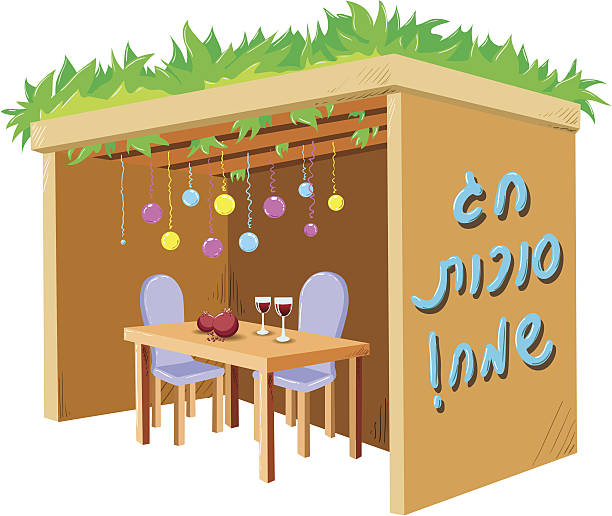
The Shulchan Aruch (634:1) teaches that the minimum size of a kosher sukkah is 7 tefachim by 7 tefachim, about 2.5 feet by 2.5 feet—less than half the size of my desk. The Mishnah Berurah explains that as long as a sukkah can fit your head, most of your body, and part of a table, it is valid.


Rav Yankele Galinsky highlights a striking contrast between Pesach and Sukkos. On Pesach we recline, stretch out, and dine like royalty. On Sukkos, however, we squeeze into fragile, temporary huts. And once we’re inside, pressed against each other, that’s when we invite the ushpizin—Avraham, Yitzchak, Yaakov, and more. Not only them, but v’imach kol ushpizei ila’ei—“come one, come all, there’s plenty of room.” But where exactly is there room?


So much of life depends not on what we see, but on how we see. The Mishnah in Avos (5:22) teaches that Avraham Avinu lived with an ayin tova—a generous eye—while Bilam embodied an ayin ra’ah—a critical, stingy eye.


The truth is, we all carry both. At times, we see loved ones with an ayin tova, overlooking flaws, excusing quirks, and feeling close. Psychologists call this the Halo Effect. Other times, when we feel distant, we look with an ayin ra’ah, where nothing the other person does can be right.


What makes the difference? Not the size of the bed or the blanket. Not even necessarily the other person’s behavior. It’s our own perspective. As the Talmud (Sanhedrin 7a) says: when love is strong, a couple can sleep on the edge of a sword and still have room. When love is weak, even a ninety-foot bed feels cramped.


This is the heart of Sukkos. After the High Holidays, when we’ve repaired relationships and renewed our bonds, we enter our sukkah and choose to see others with an ayin tova. We give the benefit of the doubt, forgive slights, and see the good in people.


That’s why on Pesach, the four sons each ask their own question and receive their own unique answer, and the four cups must be drunk separately. But on Sukkos, the four species must be taken b’agudah achas—bound together as one. Pesach highlights individuality; Sukkos highlights unity.


So will our sukkah feel cramped and claustrophobic, or spacious and welcoming? The answer doesn’t lie in its square footage, the menu, or even our guests’ behavior. It depends entirely on us. With an ayin tova, even a tiny sukkah feels endless. With an ayin ra’ah, even the largest sukkah feels suffocating.


The Mishnah in Avos (5:5) describes how in the Beis HaMikdash, people stood crowded, yet when bowing, there was space for all. The Chasam Sofer explains: it was objectively crowded, but no one felt restricted because of the joy and love that filled them.


Several years ago, researchers in England found that the average couple argues in their bedroom 167 times a year. What do they fight about? The survey revealed the most common disagreements: leaving a light on to read, adjusting the temperature, letting children sleep in the bed, and snoring. But the top cause of conflict? Hogging the blanket.


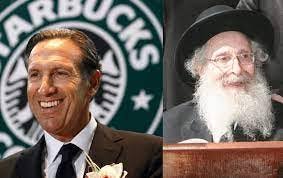
Howard Schultz, the Chairman and Chief Global Strategist for Starbucks, visited Israel in 2011 and wrote an article upon his return. He related an encounter that he and a number of high-powered executives had when they met with Rav Nosson Tzvi Finkel, zt”l, the former Rosh Yeshiva of the Mir.


Gentlemen, the elderly rabbi began, who can tell me the lesson of the Holocaust? The Rabbi called on one of the men who was surprised to be singled out and he began meekly, “We will never, ever forget …” The Rabbi indicated this was not the right answer… No one wanted to be called on next. Schultz avoided eye contact with the teacher so he wouldn’t be recognized. Another man spoke up saying “We should never be a victim or a bystander.” The elderly Rabbi dismissed this answer as well.


At this point, Schultz said the entire group felt reduced to a group of elementary school students. Then the Rabbi responded in gentle but firm voice, “Let me tell you the essence of the human spirit. As you know, during the Holocaust, people were transported in the worst possible inhumane way, by cattle cars, convinced they were going to prisoner of war camps but ultimately they ending up in death camps. After hours and hours in the stifling crowded cattle car with no light, no bathroom, nowhere to sit, they arrived in the camps freezing cold and hungry. The doors of the rail cars were swung wide open and the people inside were blinded by the light.


Men and women were separated, mothers were torn from their daughters and fathers from their sons, and they were herded off to bunks to sleep. Only 1 person out of 6 was given a blanket. And at that moment, that person, who was fortunate enough to be handed that blanket, had a choice: am I going to push the blanket to the other five people who didn’t get one or am I going to pull it toward myself to stay warm? Am I going to give or am I going to take? It was during this defining moment that we learn the power of the human spirit, when people pushed the blanket to five others.” With that, the Rabbi stood up and said “take your blanket, take it home and push it to five other people.”


This Sukkos, let’s see our sukkah, our blanket, and our love as big enough to share with other people.


Which [Book of] Life Will You Choose?

My wife’s grandfather, Isadore (Sruli) Bruckstein z”l, passed away just shy of his 99th birthday. When he was already well into his nineties I asked him, “Bameh he’erachta yamim? Why do you think you merited longevity?”

Without hesitating he responded:

“When I was in the concentration camp, I didn’t tip my cap properly to an SS guard who walked by, not out of rebellion but because I didn’t notice him. It didn’t matter; the guard beat me senseless. [In fact, he became blind in one eye as a result.]

“I returned to the barrack, broken, despondent, and in incredible physical and emotional pain. I was ready to give up; I decided that that night I would leave This World. But in the same barrack was the Chuster Rav. He saw how hopeless I was, and he stayed up the entire night giving me chizuk. He told me that if I make it through the night, he gives me a brachah that I will survive, and while Hitler and the Nazis will become a distant memory, I will live a long life and merit to see children, grandchildren, and great-grandchildren, all shomrei Torah u’mitzvos.

“That is why I have merited arichus yamim.”

The brachah of the Chuster Rav meant the world to him because he had been to Gehinnom and back and seen the Rav’s unconditional emunah and effort to do everything he could to live, not only physically, but spiritually. My wife’s grandfather related that one Yom Kippur in the concentration camp, the Chuster Rav found an empty barrack and invited anyone who wanted to join him for Kol Nidrei. They obviously didn’t have machzorim and kittels, and they didn’t hold sifrei Torah, but he knew the entire davening by heart and everyone else listened. Before he began Kol Nidrei, he told those in attendance that he wanted to say something.

The Gemara (Rosh Hashanah 32b) says that on Yom Kippur the books of life and the books of death are opened before the Almighty. Why, he asked, does it say books of life and books of death, in the plural? Isn’t there one book for those who will merit life and one book for those who won’t?

The Chuster Rav looked out at those skeletal Jews, the broken souls who had gathered with him to daven, and said, “I’ll tell you why: Because there is not one way to live and one way to die. You can live with freedom and prosperity, or you can live in a camp like this being tortured, beaten, and forced to work. You can die at an old age in your bed, or you can die in the gas chamber. You can be buried in a Jewish cemetery, or you can be burnt in the crematorium.

“Let us say Kol Nidrei,” he told them, “and daven that we not only merit life, but that we merit a real life, a life outside of this camp, and that if we must die, that we merit a dignified death and a proper Jewish burial.”

With that he began to sing Kol Nidrei, and all of those gathered were crying, sobbing.

The window of the barrack was open, my wife’s grandfather related, and an SS officer heard the cries. He came in and started screaming, “What are you crying about? You have no reason to cry. I will give you a reason to cry!” He shouted for the windows to be closed, but in the meantime my wife’s grandfather jumped out the window, anticipating what was to come. He later heard that the SS had beaten those inside, some of them to death.

The Chuster Rav’s question was actually asked earlier, by the Alshich Hakadosh (Parashas Emor) and others, but the answer was likely never as powerful as it was that night.

Unlike the Chuster Rav and millions of other Jewish martyrs and survivors throughout history, most of us have known only freedom, opportunity, and prosperity. We have the great luxury and brachah of not having to think of the books of life and books of death in that way. What, then, do the multiple books of life mean to us?

There are multiple books of life and death, for us as well, because there is more than one way we can choose to live. Will we see the blessings in our lives, or the hardships? Will we be grateful for what we have, or resentful and bitter for what is missing? Into which book of life will we inscribe ourselves?

Hashem decides if we live or die, but we decide how we will live, and even, to an extent, how we will die. Will you inscribe yourself in the book seeing the good in your life, even within the suffering? Or will you inscribe yourself in the book of negativity, of bitterness, of being dead while alive?

For ten days, from the bottom of our hearts we will plead zachreinu l’chayim, Melech chafetz bachayim, vechasveinu b’sefer hachayim, lemaancha Elokim chayim. The Maggid of Mezritch explains that we aren’t simply asking for a pulse and the ability to breathe. We are asking Hashem to make us truly alive, to help us know why we are here, and to imbue our lives with simchas hachayim, the joy of life that comes from understanding our mission, pursuing the opportunities we have, and recognizing the brachah that surrounds us.

We can’t change our circumstances; we can’t change the people in our lives and how they behave; we can’t change the natural events that impact us and our health. The only thing we can change is how we process and react to what happens to us. We can choose a life filled with living, or we can concede our happiness and our health to others and be as good as dead, even while alive.

Money is one form of wealth, but there so many other forms: good health, happiness, shalom bayis, nachas and more. “Some people are so poor,” the saying goes. “All they have is money.” Money can solve a lot of problems, but the ones that it can’t help are problems none of us would ever want. If our happiness is defined by what we don’t have, by what we crave, then we will never be happy because there is always something more to acquire. However, if our happiness is the result of being grateful for what we have, we can decide to be happy, because we always have something.

Throughout this time of the year, we repeat the words, “Al tashlicheinu l’eis ziknah, kichlos kocheinu al taazveinu,” which are normally translated as: Do not cast us away in old age; when our strength gives out, do not forsake us. But if that is the case, we should say b’eis ziknahin old age. Why do we say l’eis ziknahto old age?

Rav Eliezer Waldenburg, the Tzitz Eliezer, offers a magnificent explanation. Young people are filled with energy and vitality. They have their whole life ahead of them to grow, mature, develop, and change. Older people, however, are set in their ways, fixed in their behavior, and unlikely to change. We ask Hashem, Al tashlicheinu l’eis ziknah — don’t cast me away or give up on me as if I can’t change, as if I am old and set in my ways. Don’t forsake me when I don’t believe I have the strength to change. Help me recognize, Hashem, whether I am young or old, healthy or infirm, that I have the capacity to choose life, that I can yet change, that I am not stuck in my ways.

The possibilities, the potential, the opportunities are great. We don’t have one book, we have many. There is the book of our complacency, apathy, excuses, and regret, and there is the book of possibility, no matter what age or stage of life we are at. There is the book of misery and bitterness, or the book of feeling blessed and grateful, even when paralyzed in every muscle of your body but your eyes.

At this time of the year, the books of life and the books of death are opened. In which one will you inscribe yourself?

Taking the Plunge: Ice Baths, Neuroplasticity, and Rosh Hashana

A little over a year ago, I got an ice bath and I am proud to say I hardly miss a day of spending three minutes immersed in 45-degree water.  Many studies now show the health benefits of cold exposure, from cardiovascular to controlling inflammation, from muscle recovery to increasing metabolism. When you get into an ice bath your body goes into a fight or flight, knows it can’t stay there forever, and the cold exposure causes a significant release of epinephrine or adrenaline and dopamine in the brain and body. These neurochemicals make us feel alert, awake, and energized. Each day after my “plunge,” I feel like I drank three cups of coffee and can lift a truck.  All of that is nice, but it isn’t what inspired me to buy it or why I use it. 


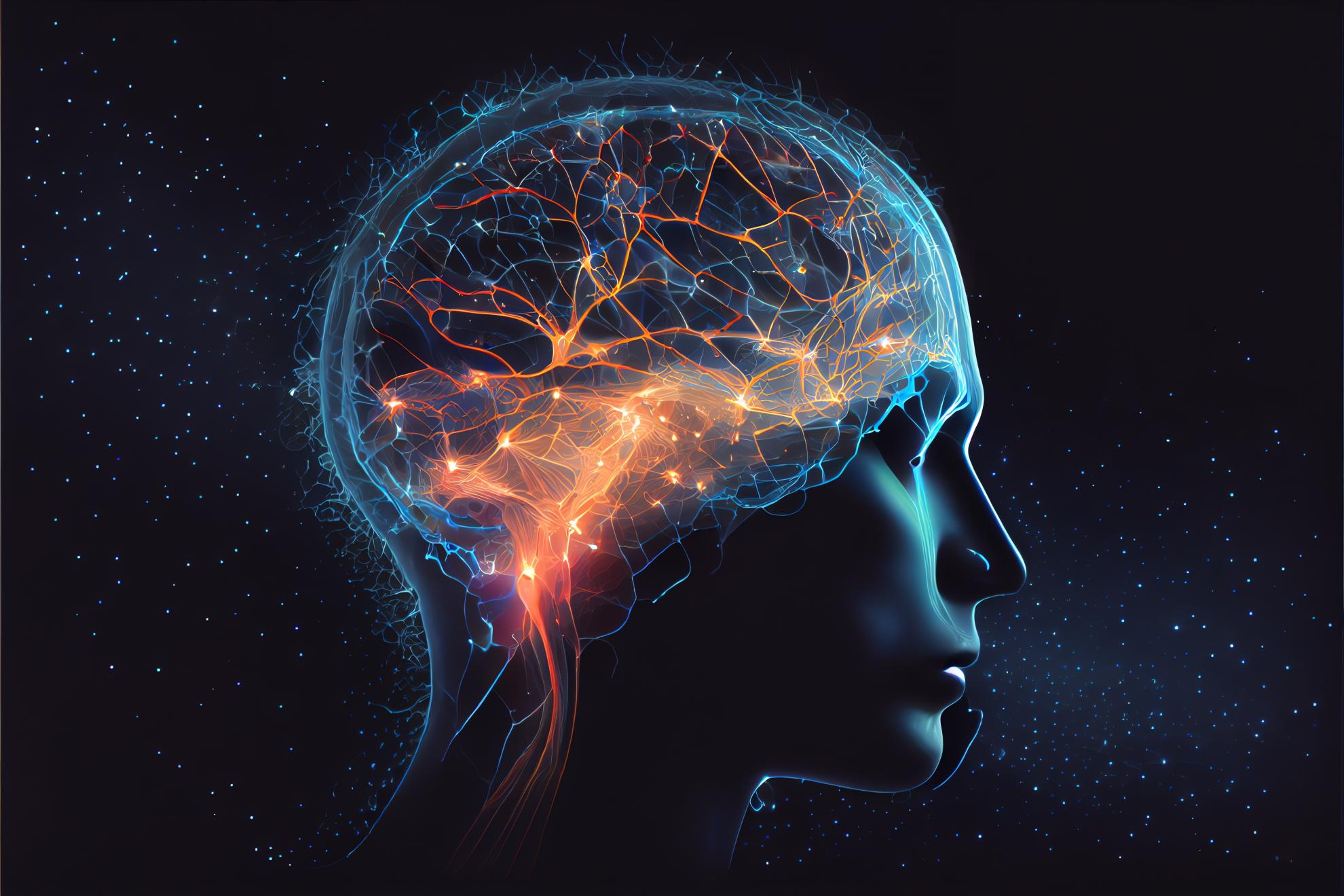
Science used to believe that our brains were hard-wired, rigid, fixed, finite. But more recently, neuroscience has discovered that the brain is “plastic,” which means that it can change, it can be molded, and we can rewire.  We aren’t born with specific personalities, feelings, thoughts, capabilities, skills, strength, focus, and that is it, we are fixed and stuck that way. Rather, we are blessed with the gift of neuroplasticity.


Neuroplasticity describes the brain’s ability to change throughout our lives.  According to Dr. Norman Doidge, a neuroscientist at Columbia University, in his book, The Brain that Changes Itself, the brain plasticity exists from the cradle to the grave.  New neural pathways can open, we can rewire our brain based on our habits, our behaviors, our choices, our efforts.  Scientifically, a 100-year-old person, like any 10-year-old or 1-year-old, can still mold their brain, it is never too late.  We can literally be reborn, we can recreate and rewire if we want to, if we choose to. 


Rosh Hashana corresponds not with the first day of creation but with the sixth day, not with when heaven and earth came to be, but when we, humanity, were introduced to the world. This is because only then did the world have meaning and purpose and could be considered complete.  On Rosh Hashana, we don’t say היום היה הרת עולם, today was the creation of the world. It isn’t just a birthday or an anniversary, we aren’t commemorating a historical event or something that happened in the past.  Indeed, we aren’t even being judged for what we have done with our time since our creation until now; judgement is not for our past. 


We say, הַיּוֹם הֲרַת עוֹלָם – today, YOUR new world is BEING conceived…and therefore, הַיּוֹם יַעֲמִיד בַּמִּשְׁפָּט, TODAY, you and I, we will be judged for what we do with the opportunity to be born again, to restart, to reset and to reboot.  We cannot change the past, we cannot go back in time and make different choices.  Of course we must take responsibility for the past, feel remorse and regret for it. But its real significance is what we learn from it, how we make changes to not repeat it, how we create a new future with our fresh start.


Chazal say (Rosh Hashana 16b) אין דנין את האדם אלא לפי מעשיו של אותה שעה, we aren’t judged for the past, we cannot change it.  We are only responsible for the present, who we are right now, at this moment. We are evaluated based on what we do not with our birthday, the anniversary of our birth, but our “birth-day,” the day we are reborn, we get to start again. 


Rosh Hashana as a gift of new beginnings, fresh starts, and clean slates is not only a metaphysical truth, it is evident in the physical world, too.  We are evaluated not for what we have done since creation, but if we are choosing to embrace creation, the power to create again and again, to remold, rewire, to shape our brains and ourselves. 


Rosh Hashana we are asked: Are you fixed or are you growing? Are you a finished product or a work in progress?  Are you stuck in the past or improving for the future?  Are you neuro-stuck or neuro-plastic?


Every single time I get into the ice bath I don’t want to.  But I do it anyway and when I do, I am rewiring and changing my brain, not metaphorically or symbolically, but literally.  There is a part of our brain in the cortex that controls willpower called the Anterior Mid-Cingulate, the AMC, and it turns out, when we perform an action or task even when we don’t want to, the AMC actually grows in size, it gets bigger and stronger and becomes more capable of completing tasks and actions out of our comfort zone. The challenge is that it only works one day at a time and needs to be renewed daily.  If you return to your comfort zone, if you don’t push your limit, the AMC shrinks and goes back to its original size.


We live in an age of life hacks, shortcuts to accomplish things.  But here is the thing:  there may be hacks in technology and home improvement, but not in life. The only hack in life is to do the hard thing and when you do the hard thing, you become more capable of doing more hard things.  We can sit in 45-degree water for three minutes.  We can rewire ourselves to be selfless instead of selfish, to be calm instead of angry, to be patient instead of rushed, to be a giver instead of a taker, to live the life we have dreamt of living.


There is someone from another community who is looked up to for his generosity and volunteering, but also his religious commitment and practice. He doesn’t miss minyan, learns daily and inspires others.  But it wasn’t always that way.  In 2014, on Erev Yom Kippur, he wrote to his children:


My Dear Children,


Yesterday was an important day for me. For the first time in 25 years, I started to wear Tzitzis again. That is my commitment for the New Year.  I just wanted you to know that the three of you were my inspiration to do it. Each of you in your own way and at different times made me think about how I can improve myself. 

He then went on to spell out how each of his children’s growth motivates him.
He concluded: “So, in summary you three are my inspiration.  Mom and I love you more than anything and wish you all an easy fast and the most unbelievable year. We are so proud of you. Words cannot describe.”


This grown man who hadn’t put on tzitzis in 25 years but he took the plunge and with it he rewired his brain. He grew his AMC stronger to add more and more to his life. 


This Rosh Hashana should be a neuroplasticity day. Take some time to reflect and decide how will you rewire, what will you reprogram, which challenge will you take on, which comfort zone will you breach, will you take a plunge, will you have a change of mind and allow your mind to change.


Who is Sitting Next to You?

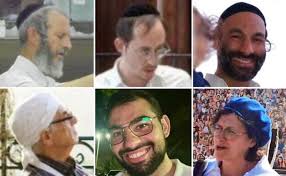
Our hearts were broken by the news that two evil terrorists indiscriminately opened fire on a crowd of innocent people waiting at a bus stop in Yerushalayim earlier this week. The lives of the family members of the six beautiful souls (in addition to 4 precious solders) who were murdered will forever be different, and the futures of the twelve people who were wounded—six of them seriously—are forever changed.

 
The scene was horrific, filled with panic, dread, sadness, and grief. The wicked terrorists who perpetrated the atrocity, and the organization and society that sent and applauded them, were successful in casting a shadow of darkness not only over that intersection, but in truth, over all Israel. The central victims of this event were of course the kedoshim who were murdered, those injured, and those directly in harm’s way that day. But in truth, all of Israel became victims of terror that day and beyond. The goal of terrorists and terrorism is to terrorize. Two of my daughters in Israel called me that day, worried about taking the bus. They, and nearly ten million people, are now (or, in some cases, once again) looking over their shoulders, increasingly mindful of their surroundings, braced for what to do if an attack occurs.
 
If you look at that scene, you see darkness, hate, and evil. But if you look closer, you can also find light, love, and goodness. Naturally, countless people ran away from the scene, fleeing for their lives. But, as is often the case in Israel, several ran toward the gunmen, risking their lives in an effort to protect total strangers. Indeed, many lives were saved because an IDF soldier from Chashmonaim and an armed civilian were successful in neutralizing the perpetrators before they could claim more lives. While understandably most people were focused on saving themselves, one particular taxi driver could be seen ignoring bullets being shot mere steps from him while helping an elderly woman exit his cab and get out of harm’s way.
 
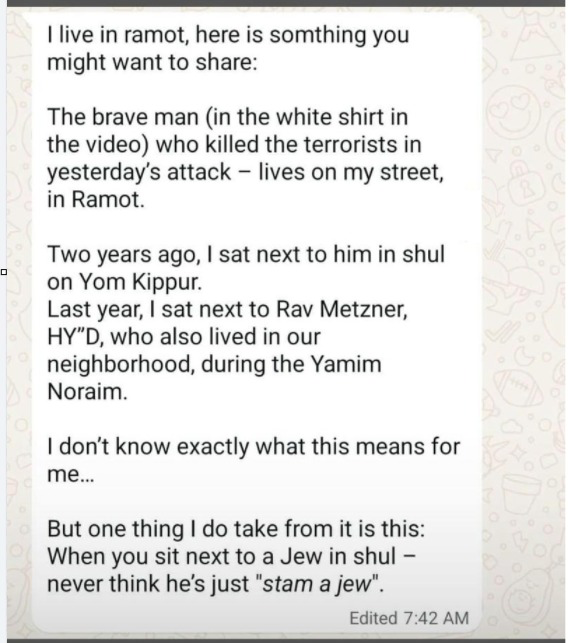
A day after the attack, I saw a message from someone who lives near where the attack occurred that left me deeply moved:


People will sometimes refer to themselves as “stam a Jew, just a simple Jew.” There is no such thing as “just a Jew.” Every person you encounter carries an entire world within them, a unique mission, an irreplaceable neshama, and a story, a history, and a destiny only Hashem fully knows. If you knew that in the coming year the person you were sitting next to would be murdered, would you not cherish him a bit more? If you knew that in the coming year the person you were sitting next to would display heroic courage and save countless lives, would you look at him the same way?
 
As we prepare for the Yamim Noraim, it’s natural to become absorbed in ourselves—our situation, our status, our tefillos, and our success. We open our selichos or machzor, look down at the words, and focus on our personal struggles, our hopes, our fears. These are important concerns that deserve our heartfelt prayers. But the Yamim Noraim are not meant to be experienced in a silo. They are not private retreats of the soul; they are communal pleadings of Am Yisrael standing together before our Father in Heaven.
 
The great Rosh Yeshiva of the Mir Yeshiva, R’ Nosson Tzvi Finkel zt”l, was once asked by a student on Rosh Hashana what he should prioritize in his davening. Success in Torah? Good health? A proper shidduch? What is the most important thing to daven for? The Rosh Yeshiva answered him with two words: “Someone else.”
 
When you sit in shul this Rosh Hashana and Yom Kippur, take a moment—not to interrupt your davening, but to expand it. Look around. Who is sitting next to you? Who is behind you? Who is in front of you? Don’t assume you know their story. That elderly man may have carried the weight of unimaginable suffering and still comes faithfully to minyan. That young father may have risked his life to protect others. That quiet neighbor may be enduring an invisible struggle you can’t see.
The person beside you is not “stam a Jew.” He or she is a precious child of the Ribbono Shel Olam, with infinite worth and unique greatness.
 
So as you pour out your heart in prayer, include them. Daven not only for yourself and your family, but for the family sitting two rows behind you, for the widower across the aisle, for the single struggling mother, for the child fidgeting beside you. And just as importantly, trust that they are davening for you, too.
 
This year, may we enter the Yamim Noraim with the awareness that there is no such thing as “stam a Jew.” Every Jew is extraordinary. Every Jew is worth knowing, worth caring about, and worth davening for. And when we recognize that—when we see the greatness and holiness in each other—then perhaps Hashem will see the greatness and holiness in us all, and inscribe us together for a year of blessing, health, and peace.
 

The Real You: Overcoming Imposter Syndrome This Elul

Have you ever felt like a fraud—as though you’re just making it up as you go, and one day the world will discover you aren’t as capable as they thought? This feeling can appear in professional life, family life, religious life—or in all three.


I’ll admit something personal. For several years after I graduated, I had a recurring nightmare: the registrar’s office called to demand my diploma back because I hadn’t really earned it. Even now, after more than twenty years serving as a rav, I catch myself thinking, “Who am I to give this derasha, officiate at this wedding, answer that halachic question, or give that shiur?”


If you’ve ever felt this way, you are not alone. Studies show that as many as 70% of people experience what psychologists Pauline Clance and Suzanne Imes in 1978 coined “imposter syndrome.” It’s the conviction that your accomplishments aren’t truly earned—that success comes from luck, timing, or having somehow fooled others into thinking you’re competent. A feeling of faking it on the outside while imprisoned by a gnawing feeling of unworthiness on the inside.  Doctors feel it. Lawyers feel it. Parents feel it. Rabbis feel it.


And our greatest leaders felt it too.


When Aharon was called to serve in the Mishkan on its opening day, the Torah describes him hesitating. Rashi explains that Aharon felt unworthy, like a fraud. Moshe, who once resisted his own calling by insisting he wasn’t a speaker or a leader, reassured him: “Why are you ashamed? You were chosen for this.” That moment reframes imposter syndrome. It is not weakness—it is part of the human experience, even for the greatest among us.


We have begun the month of Elul, the countdown to Rosh Hashanah and the start of a new year, a new beginning. The Talmud teaches that Rosh Hashanah not only marks the creation of humanity, but also the day Yosef HaTzadik was released from prison. Why highlight that event? Because Yosef’s liberation mirrors the opportunity given to each of us. New beginnings, a fresh start, begin with being freed like Yosef—freed from prisons of self-doubt, from the false narratives we tell ourselves, from the limitations we impose on who we can be.


That is why the Navi Amos calls us “she’eiris Yosef”—the remnant of Yosef. This time of year, we too are invited to walk out of our prisons, to prepare for our new beginning.


A couple of years ago, I met with a tzaddik in Beit Shemesh, Rav Avraham Zvi Kluger, who gave me a total paradigm shift in how to experience this time of year. He explained that Elul and Rosh Hashanah are not about our failures but our potential. Hashem sees not only where we fall short, but He knows the best version of ourselves—the moments when we rose above, when we were patient, loving, disciplined, and strong. He knows that is our true self, the real us. The slip-ups and shortcomings, the failures, are the aberrations, not the other way around.


We mistakenly think the real us is the one who loses our cool with our spouse or children, the one who looks at the wrong things when nobody is looking or indulges the urge to say the wrong thing to curry favor with the listener. We mistakenly think that when we show up despite our shortcomings, when we occasionally get it right, that makes us imposters.


But that is wrong! The truth is that when we are able to stay calm and be patient with those we love, when we have the discipline to do the right thing despite being tempted to follow our urge, that is who we really are, that is the true us, it is who we really are.


When the shofar sounds each morning of this month and on Rosh Hashanah, it doesn’t call us to wallow in guilt. The Rambam writes that it awakens us to look into our souls, to remember who we really are and what we are capable of. Rosh Hashanah’s teshuvah is not about confession—that comes on Yom Kippur. Rosh Hashanah’s teshuvah is about recognition: remembering our best selves and realigning with them.


As Rav Kook wrote in Oros HaTeshuvah, “The primary role of teshuvah is to return to one’s true self, to the root of one’s soul.”


We are defined by our strength, not our weaknesses; we are our best moments, not our worst. While we have to take ownership and responsibility for our failures, we deserve the success and achievements we have earned.


In 1977, Laura Schultz, 63, was in the kitchen of her home in Tallahassee, Florida, when she heard her 6-year-old grandson screaming from the driveway outside. Schultz ran to the door to find her grandson pinned beneath the rear tire of a full-size Buick. Giving no consideration to limitations or barriers, Schultz ran to the car, used one hand to lift the rear of the vehicle, and used the other hand to drag her grandson to safety.

For years, Schultz refused to speak about the incident. After finally agreeing to an interview with peak performance coach Dr. Charles Garfield, Schultz was asked why she had remained silent about her miracle. Schultz revealed that the incident had scared her and reminded her that she had wasted most of her life living far beneath her true potential. If she had that strength inside her all along, why hadn’t she realized it or utilized it more often or more fully?


With a little coaching from Garfield, Schultz returned to college, earned her degree, and went on, at nearly 70 years of age, to fulfill her long-held dream of becoming a college professor.


Like Schultz, we often dismiss our best moments as exceptions, flukes, or lucky breaks. But those moments are the real us. They reveal what Hashem already knows—that we carry extraordinary potential inside. Don’t ignore the strength that is inside you. Your best moment as a mother or father, as a husband or wife, as an eved Hashem—that is the real you. Believe it, embrace it, nurture it, repeat it, and grow it.


Spend Elul overcoming your imposter syndrome and seeing and believing in the real you. This year, instead of just limiting our challenges, let’s challenge our limits.


The Freedom of Simplicity

Tariffs and free trade. AI and the proliferation of technology. There are many issues of our day that remain complicated.  But for each issue that is truly complex, there are issues, policies and perspectives that are presented as complicated when in truth they should be simple and straightforward. 


Matzah, the most important food at our seder, seems straightforward, but if you think about it, it is actually complicated and confusing.  On the one hand, it symbolizes and celebrates freedom, it is the bread over which we recline like aristocrats and tell the story of our liberation.  Yet, on the other hand, it is called “lechem oni,” the bread of affliction.  Moreover, for the bread meant to be a sign of royalty, it is rather bland.  The recipe is flour and water, period.  Not only does it not call for other ingredients, any additional item would invalidate it.  When you hear someone talk about their sourdough starter, they might use more affectionate and protective words than they talk about their spouse and children.  With matzah, however, if the dough ferments or processes in any way, if you add ingredients, sweetener, spices, you disqualify it and that cannot be used to fulfill the mitzvah.  In food competitions, the taste is only part of the story, the presentation, texture, even appearance are all also important.  Matzah is asymmetrical, imperfect, basically a bland cracker, dull and simple even in its presentation and appearance. This is the food of royalty and wealth?


The Maharal is bothered by this question and in several places in his writings, he uses it to explain the fundamental theme of Matzah and how in fact it symbolizes freedom, wealth, and royalty.  In Gevuros Hashem (36) he explains that we tend to think the more things we have, the more complex and complicated our portfolio, the more intricate and sophisticated our possessions, the more elaborate and extravagant, the more it reflects wealth, freedom, and affluence.  But says the Maharal, in fact it is the opposite.  The more we are dependent on fancy things, fancy experiences, and even fancy ideas, the more we are enslaved to them, beholden to them, and reliant on them.  To truly be free, to actually be wealthy, is to embrace simplicity, pashtus.  The less we are dependent on externals, on what an object or experience can provide, the freer we are from them. 


Explains the Maharal, lechem oni doesn’t mean bread of affliction, that those who eat it are suffering.  He translates it as bread of oni, of living without, which doesn’t lead to affliction and suffering, it leads to freedom and liberation.  When you are dependent on something, dependent on worldly, material things, dependent on superficial experiences, dependent on exciting stimulation you are not at all free.  Freedom is a return to pashtus, to simplicity, to uncomplicated, to plain. Only the one who can live with oni, can live without, is free and wealthy because they have no dependency.


Now to be clear, we don’t eat Matzah the whole year.  There is nothing wrong with enjoying some yeast, some leaven, from feeding that sourdough. But, for one week we demonstrate our freedom from those things so that even when we return to them, we do so by seeing them as luxuries, as external to who we are, not necessities, part of us, something we can’t live without. 


Warren Buffet is an incredibly wealthy man.  Most would assume I say that because he is worth $139 billion, but that isn’t why.  The 93-year-old has lived in the same modest house in Omaha, Nebraska for 66 years.  When asked why he never upgraded, he said, “I’m happy there. I’d move if I thought I’d be happier someplace else. This house does just fine. I’m warm in the winter, I’m cool in the summer, it’s convenient for me. I couldn’t imagine having a better house.”  The founder of Berkshire Hathaway, one of the richest men in the entire world, only swapped his flip phone for a smartphone in 2020.  Buffett is free not because of his tremendous material wealth but because he doesn’t depend on it for happiness.

Others, too, are craving this wealth.  There is a big movement towards getting rid of smartphones and turning them in for dumbphones.  The movement isn’t in Monsey, Lakewood or Yerushalayim, it is all over America.  Sales of flip phones and dumbphones are up with people craving simplicity, plain, simple, bland, back to basics.  People are bloated on chametz and looking for more matzah in their lives.

Matzah is freedom because it is a return to simplicity, a break from that which we have grown dependent on and it is the discovery that we can be happier with less than with more.  Isn’t that exactly what we feel for the week of Pesach?  We have fewer ingredients to cook with but eat more than ever.  We put most of the toys away and the children and grandchildren are even happier playing with the simple toys that are left out, sometimes finding more joy in the box they came in than the toy itself. 


The Brisker Rav would keep his matzos for the seder under lock and key. When asked if he was concerned with someone stealing them, he would reply, “u’shemartem es hamatzos, safeguard the matzah – do you not put your valuable jewels in a safe?” The poshut, simple matzos are our most valuable treasure.


All year long we make things more complicated than they need to be by pursuing complex things and experiences.  Pesach and the Matzah remind us that the things that are most pashut, most simple and straightforward are most true and most valuable, they set us free and make us wealthy.  Like Warren Buffett, we shouldn’t be attached and dependent on complex things, even if we can afford them.  Being happy with the simple and plain will set us free.  And lastly, let’s let the Matzah inspire us to simplify our relationships.


I once attended a funeral of a woman who was clearly complicated.  There was a palpable tension among her children and grandchildren and during their eulogies they subtly (and sometimes not so subtly), while offering praise, still communicated that she introduced lots of conflict into the family.  The last speaker was her son.  He got up, paused, and said, “Mom was complicated, let’s keep things simple. Let’s simply love one another, simply be loyal to one another and simply get along with one another,” and with that he sat down.

If we want geulah, we need to introduce more Matzah into our relationships, instead of making them complicated, keep them simple.  Let’s simply love one another, be loyal to one another and get along with one another.   


The Greatest Threat Americans Face

Ask Americans what the greatest threat we face is and you will get a range of answers.  Some will say it is global warming and climate change.  Others think it is the issue of illegal immigration and unsecured borders.  Still others say it is the threat of terrorism or a nuclear war. The truth is it is none of the above.


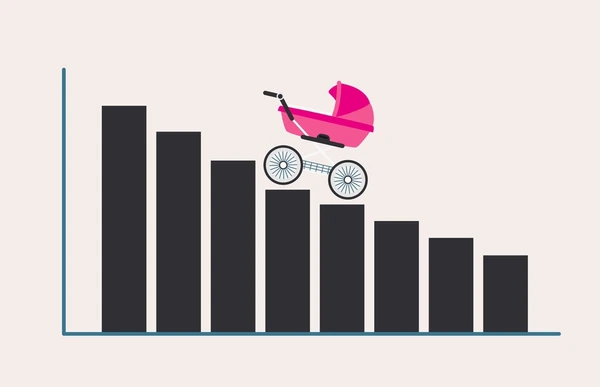
Our greatest threat is extinction. The National Center for Health Statistics reported the total fertility rate in the United States was 1.62 in 2023. That’s the lowest rate ever recorded in the United States and well below the rate needed to maintain a growing population.  Recently, the EU reported another declining birth rate, their lowest in 60 years.  Many developed countries’ birth rates are below the rate needed to maintain and grow the population. Projections suggest that by century’s end, a shocking 93% of countries, including the UK and the US, will confront underpopulation given the present trajectory.  The statistics seems clear – extreme birth rate collapse is the biggest danger to human civilization by far.


The Jewish people are doing our part with a birth rate of 1.7 overall, an average of 3.3 for Orthodox Jews, 1.4 for non-Orthodox Jews, and 6.6 for “Ultra-Orthodox” Jews.  Israel’s birth rate remains the highest among countries in the Organization for Economic Cooperation and Development and is the forum’s only member state reproducing above replacement rate.


The Talmud (Shabbos 31a) reports that each of us will be asked a series of questions by the heavenly court at the end of our lives.  One of them is Asakta b’pirya v’rivya, did you occupy yourself with populating the world?  The Maharsha points out that we will not be asked whether we fulfilled the mitzvah to have children, because that is beyond our control.  We will be asked, asakta, were you oseik, did you take responsibility for continuity, did you contribute to creating a better future, irrespective of whether you had children.  The Chochmas Shlomo, Rav Shlomo Kluger, rules that one can fulfill the mitzvah of pru u’rvu, to have children, by caring for children, even if not biologically their own.  (It goes without saying that we daven daily that all who want children and who are waiting should be blessed with healthy children who give them nachas.) 


One can have no biological children but still be the proud progenitor of generations by living for and being dedicated towards the future. And one can have a large biological family but be entirely consumed with themselves and their own pleasure, indifferent and apathetic to creating continuity and to the next generation.


The Lubavitcher Rebbe and Rebbetzin had no biological children, but they were the parents and grandparents of generations, of worlds of spiritual heirs.  Two weeks ago, over 6,500 rabbis who each see and feel the rebbe as a father gathered for the annual Kinus Hashluchim. 


As an American, the birth rate collapse is a genuine concern but as a Torah Jew, what it reflects about our society is even more concerning.  The world around us is increasingly more concerned with the here and now, with pleasure, comfort, and convenience rather than in the effort, sacrifice, faith, hope, and optimism it takes to bring and raise children in this world.  Is it any surprise that we are suffering from a population threat when many states have laws that require insurance companies to cover birth control while simultaneously refusing to cover fertility treatments such as IVF, leaving many couples with the burden of exorbitant expenses when trying to have a child privately?


Soon, in Sefer Shemos, we will read how Moshe Rabbeinu was commanded to make the boards of the Mishkan out of shittim wood. Rashi says that the wood used for the Mishkan came from special trees that Yaakov Avinu planted in Egypt.  Just prior to his death, he instructed his children to remove these trees and take the wood with them when they left Mitzrayim.  Where did Yaakov get the wood? The Midrash on Vayigash tells us that on his way down to Egypt, Yaakov stopped in Beer Sheva and he gathered cedar wood that his Zayda, Avraham, had planted there years earlier.  This wasn’t ordinary wood from ordinary trees. This was intergenerational.  It represented and reflected the effort, sacrifice, forethought, and investment of earlier generations.


Are you planting the trees that your great-grandchildren will be nourished by and will build their religious lives from?  Do you prioritize building the future over indulging in the pleasure of the present?  Is Jewish continuity a concern for you and what are you doing to educate, enrich, empower, and inspire future generations?


Chanukah begins this week and ironically, though it is not even a Biblical holiday, it is perhaps the most observed Jewish holiday, including by those who would not define themselves as observant.  Rav Samson Raphael Hirsch writes that the root of the word Chanukah is chinuch because at its core, the battle against the Hellenists was about the continuity of Jewish identity and who would define our future..


A couple of years ago, Yeshivas Rav Yitzchak Elchanon (RIETS/YU) celebrated the 50th anniversary of Rav Hershel Schachter Shlita serving as Rosh Yeshiva. In an interview, he was asked: “What are you most proud of accomplishing in these 50 years?”  Rav Schachter responded: “Over this 50-year period I am most proud of raising together with my eishes chayil a wonderful family. To me, that comes way before anything else I accomplished.”


What is your greatest source of pride? How do you define success?  Do your calendar and credit card statements reflect a commitment to the future or the present, to others or to yourself, to ensuring our continuity or to prioritizing the here and now?


This Chanukah, let’s touch our candle to others to pay the flame forward, to make our Menorah shine with the light that illuminates the world. 

Simchas Torah One Year Later: A Day of Death, an Opportunity for Rebirth

Simchas Torah, October 7, will forever be etched in our hearts and minds as the day of the greatest massacre of our people since the Holocaust.  The brutal, cold-blooded murder of innocent men, women and children, young and old, entire families, over 1,200 people, rocked our worlds, broke our hearts, and shattered our collective illusion of safety.  The events of that day launched a war in which our people have sustained even more casualties, more parents bereft of children, children orphaned from parents.  For over a year, we have been a nation in a perpetual state of grief, mourning, and sorrow.


Any look back at a year ago, and all the days since then, begins with honoring the memory of the fallen, learning each of their unique and individual stories, gaining an appreciation for who and what was taken from us. Simchas Torah, heretofore one of the happiest and most joyful days on our calendar, is now forever complicated by the competing feelings of sadness and loss.


Additionally, beyond the unimaginable loss of life, on Simchas Torah a year ago, many of our ideas and assumptions died as well.  We lost more than 1,200 irreplaceable lives, but we also lost our innocence, in some cases our confidence, our optimistic view of the Jewish condition in America and the world, and for some, communities of association or identification.  A year ago, so much died.


But a year later, as we reflect, we can look back and see that on Simchas Torah, October 7 of last year, so much was also born.  On the brink of a civil war over judicial reform and religious differences, overnight a sense of unity, togetherness, and shared destiny was reborn. 


From the resolve of the devastated communities on the Gaza border, driven by displaced families from the north and the south, powered by a record response to the IDF call up, the Am HaNetzach, the determined, tenacious nation of eternity was reborn.  From the ashes of the Gaza communities, an unprecedented chesed effort to provide for chayalim, support families of reservists, comfort mourners, visit displaced families and provide provisions was born, with leadership and participation from diverse communities literally around the world. 


A spiritual awakening, a Jewish pride burst forth in people who had never experienced their Jewish soul before or in whom it had been dormant for a long time.  Throughout this year, I have regularly been “bageled,” approached by Jews simply signaling their Jewishness to a fellow Jew (and signaling their desire to signal that Jewishness) in airports and on airplanes, in supermarkets and at stores, at a baseball game and even in a bathroom. Jews are returning to study, practice, proudly display their identity  The Jewish people are alive, reborn, proud, practicing, growing and united.


To be sure, things are far from perfect. There are important differences and disagreements and there are forces seeking to divide us again.  The war continues to rage, our heroic soldiers are still fighting on multiple fronts, and our precious hostages are still not home. 


But with all the problems and challenges, with all the lives that were prematurely and tragically snuffed out, so much has come alive.  Moshe Naaman, a soldier in the IDF, wrote the following inspiring story (Translated from Hebrew):


Two weeks ago, we were called up by Order 8 to the northern border. Today, we had the privilege of holding Yom Kippur prayers at Kibbutz Beit Zera. For 93 years, the kibbutz existed without agreeing to have a Yom Kippur minyan. But we, as soldiers, set one up in the company area at the kibbutz.


There were 12 religious soldiers among us. We sent a casual WhatsApp invitation to the kibbutz members. When the holiday started, we were shocked—dozens of members came for Kol Nidrei and Maariv. In the morning, elderly members came for Yizkor. The climax came with many dozens of people, including children, women, and toddlers, arriving for Neilah and shofar. People were moved to tears.


What can I say? I never imagined this would happen. The verse “Master of Wars, Sower of Righteousness” took on a new meaning for me today. Two weeks ago, I never imagined I wouldn’t be in the beit midrash for the High Holidays. I found myself as the shofar blower, gabbai, cantor, and speaker… The members kept thanking us after Yom Kippur and tearfully asked us to return next year…


Last year, I had tears of pain and sorrow at the end of Yom Kippur, but this year, those tears turned into excitement and joy.


“And seal all Your people for a good life.”

Moshe Naaman  –   גדוד הבוקע 5035


To mark the year since October 7, Danny Wise of Ami Magazine conducted 38 interviews focusing on the rebuilding efforts of the Israeli communities in the Gaza envelope.  Among his interviews, he met with a woman named Dafnah from Kibbuz Re’im. She had been the cultural director of the kibbutz and was one of the organizers of the Nova Festival. 


Touring the kibbutz, she showed him her charred house and the room in which her mother and children, Shira and Meir, were found murdered together.  She is the lone survivor of her family.  Wise writes that throughout the conversation he thought of Kristallnacht and the destroyed shuls.  He asked her if the terrorists destroyed any shuls in the communities along the Gaza envelope.


Dafnah responded, “Of course not. Not a single beit knesset was damaged in all 21 Gaza kibbutzim.”  Wise didn’t understand, how could no shul have been attacked, no Sefer Torah burned?  She explained, “It wasn’t a miracle. How could they damage something that doesn’t exist?” Most of the communities didn’t have designated or active shuls.  Dafnah, went on to explain, “If you want to understand the day after, you have to understand the day before.”


Wise writes:


Rabbi Shlomo Raanan runs an organization called Ayelet Hashachar which seeks to bring outreach to irreligious kibbutzim. He came up with the idea of a basketball game between yeshivah bachuram and the kibbutzniks of Reim. The game was set to take place on Chol Hamoed, October 2, just days before the massacre. Dafnah had led the charge to cancel the game. To her, the match wasn’t just a friendly contest; it was a Trojan horse, a way for religious influence to creep into the kibbutz. “I was furious,” she told me. “This was outrageous. We didn’t need outsiders telling us who a good Jew is,” she said, pulling out her phone and scrolling through old messages. She showed me the texts she had sent to Rabbi Raanan, warning him not to bring his religious mission to her doorstep. “Cancel this game immediately,” she wrote. “If you don’t, we’ll all block the entrance with our bodies.” In the spirit of peace, Rabbi Raanan canceled the game.


But five days later, the massacre came. Just over the border, in the tunnels of Gaza, Dafna found herself held hostage, face to face with the forces that had torn her world apart. “I said to an older guard in Arabic, why do you torture me? For 20 years, I’ve made programs for Arab and Jewish. The Jews are your cousins.” As she pleaded in the darkness for some recognition of their shared humanity, she was met not with empathy but with a cold dismissal.


“You are not a descendent of Ibrahim! You are not a Jew!” he spat. “You are a European colonialist who stole our land! It was in that moment, Dafnah said, that something broke. Or perhaps, something began to be repaired. The accusation hit hard. Like many in the kibbutz movement, Dafnah had spent her life defining herself more as an Israeli than a Jew, and more dedicated to reconciling Arabs and Israelis than healing the divides between different groups of Jews.


Religion had always been secondary to her identity. But now, in the depths of that tunnel, being denied her Jewishness by a Hamas fighter, she experienced a crisis of self. “I started screaming, Ana Yahudiun, Ana Yahudiun, I am a Jew I am a Jew!” The guards restrained her, taping her mouth. But for Dafnah, the internal shift had already occurred. “For the first time in my life I saw my soul; I saw that I am a Jew. “All my life,” Dafnah reflected, “I’ve been part of this community. We didn’t see ourselves as Jews, in the traditional sense. When I traveled overseas and someone asked if I was Jewish, I’d correct them. “No, I’m Israeli”; I’d say.


But when he called me a colonialist, it hit me. He didn’t see me as a Jew because I didn’t see myself as a Jew.


Dafnah paused for a moment, her eyes wandering over the ruined landscape. “Every Arab village has a mosque. Christian settlements build churches. And here, we have nothing. Nothing to say that we are Jews. And in that moment, realized that if we were going to rebuild, we needed to reclaim our identity.”  “I will tell you,” Dafnah said, “I took upon myself the new beit knesset project. When we rebuild, our beit knesset will be the most beautiful structure on the kibbutz.”


On Simchas Torah, Dafnah lost her family, but she found herself.  They died, but her Jewish identity was born. 


The holiday and festivities of Simchas Torah are unusual in their origins. They are not mentioned in the Torah or in the Talmud. It was never enacted as a full rabbinic holiday like Purim or Chanukah.  Rabbi Lord Jonathan Sacks z”l writes:


On Simchas Torah, without being commanded by any verse in the Torah or any decree of the Rabbis, Jews throughout the world sang and danced and recited poems in honor of the Torah, exactly as if they were dancing in the courtyard of the Temple at the Simchas Beis HaSho’evah, or as if they were King Dovid bringing the Ark to Jerusalem. They were determined to show God, and the world, that they could still be ach same’ach, as the Torah said about Succos: wholly, totally, given over to joy. It would be hard to find a parallel in the entire history of the human spirit of a people capable of such joy at a time when they were being massacred in the name of the God of love and compassion.


A people that can walk through the valley of the shadow of death and still rejoice is a people that cannot be defeated by any force or any fear…Simchas Torah was born when Jews had lost everything else, but they never lost their capacity to rejoice. Nechemiah was right when he said to the people weeping as they listened to the Torah, realizing how far they had drifted from it: “Do not grieve, for the joy of the Lord is your strength” (Nechemiah 8:10). A people whose capacity for joy cannot be destroyed is itself indestructible.


The year since Simchas Torah has been a fulfillment of the saying, “They Tried to Bury Us; They Did Not Know We Were Seeds.”   Simchas Torah was born against a backdrop of hate and tragedy.  A year ago, we lost so many, we buried heroes of our people.  But over this year, we birthed a new era, a new chapter for our people.  It is still being written and we determine what it will say next. 


The world has changed enormously since Simchas Torah of last year, have you?  How can we honor all those who died?  On a day marked by so much death, the only proper response is to birth a better version of ourselves and our people. 

Sukkah and Sleeplessness

When most of us think about or talk about the mitzvah of Sukkah, it’s about eating in the Sukkah.  Indeed, that is the activity in which we recite the beracha of Leishev BaSukkah.  We don’t make a leishev b’sukkah when hanging out, playing a game, learning Torah, or going to sleep in a Sukkah.  And yet, the Halacha is clear that eating is not the most significant thing one does in a Sukkah.  To illustrate, one is allowed to eat achilas arai, an “insignificant” eating like a snack, outside of a Sukkah, but even sheinas arai, a short nap, is forbidden outside of the Sukkah.  (The Rama rules that we are lenient today about sleeping in the Sukkah because of weather and the elements).  When we sleep in a Sukkah, sleep goes from a mundane necessity to a mitzvah, a means of connecting with Hashem.  


In his Emunas Itecha on Sukkos, Rav Moshe Wolfson points to an interesting Halacha.  In instructing the Jewish people about bringing Korbanos to the Beis HaMikdash on the Shalosh Regalim, the pasuk tells us, “וּבִשַּׁלְתָּ֙ וְאָ֣כַלְתָּ֔ בַּמָּק֕וֹם אֲשֶׁ֥ר יִבְחַ֛ר ה׳ אֱלֹקיךָ בּ֑וֹ וּפָנִ֣יתָ בַבֹּ֔קֶר וְהָלַכְתָּ֖ לְאֹהָלֶֽיךָ׃, You shall cook and eat it at the place that your Hashem will choose; and in the morning you may start back on your journey home.”  When offering a korban in Yerushalayim you have to fulfill a mitzvah of leena, you have to stay over, you can’t leave until the morning.  Rav Wolfson suggests that there is a relatable social principle here: coming to eat and drink and then not staying over is rude.  When we come to the holiest place in the world, into Hashem’s home, we don’t eat and run, we stay over.  Similarly, he says, the Sukkah, wherever it is, is a mini-Mikdash, an embassy of Shechina.  Eat and drink like we would a korban, and then perform leena, stay over, sleep.  Sleeping in the Sukkah is experiencing Divine hospitality and being a gracious guest.  Perhaps we can build upon this idea.

Sleep is necessary, it is non-negotiable.  The world record for staying awake is eleven days. More precisely, the record is 264 hours and 24 minutes without sleep. If you stay up the night of Shavuos and know how you feel in the morning, you can only imagine doing that for 11 days straight.  The record was set in 1965 by Randy Gardner, who was then seventeen years old and apparently wasn’t harmed from the experience.  However, staying awake that long straight is actually dangerous and can cause irreparable harm to the brain which is why the Guinness Book of Records stopped accepting entries for staying awake. 


The Gemara in Nedarim (15a) tells us והא”ר יוחנן שבועה שלא אישן שלשה ימים מלקין אותו וישן לאלתר…Rabbi Yochanan said “An oath that I will not sleep for three days” – we punish him since he took an oath in vain and he may sleep immediately.  In other words, the Gemara implies that one can’t stay away for even three straight days.


In January of 1788, because of efforts regarding a young Jewish man who had converted to Christianity, the Vilna Gaon was arrested on charges of kidnapping.  On September 15, 1789, the Gaon and others were sentenced to twelve weeks in prison, leaving him incarcerated over Sukkos.  As you can imagine, the Lithuanian prison did not provide a Sukkah.  As mentioned, the Halacha is one cannot even take a nap outside of the Sukkah so what was the Vilna Gaon to do?  Simple.  He decided he wouldn’t sleep the week of Sukkos. Indeed, the sefer Tosefes Ma’aseh Rav, published in 1892, describes that he “walked from one place to another, and held his eyelids open, and made an extraordinary effort not to sleep outside the sukkah – not even a brief nap – until the authorities released him to a sukkah.”


Did the Gra really stay awake for a week?  Randy Gardner did for 11 days so who knows, it does appear possible. Without exception, we have all had days, or weeks, or periods where we felt there was so much to do we wish we didn’t have to use time to sleep. No matter how hard we try – maybe we could go three days, eleven days, or somewhere in between, but eventually we all need to sleep.  Why?


In Tehillim (3:6) Dovid HaMelech says: אֲנִ֥י שָׁכַ֗בְתִּי וָאִ֫ישָׁ֥נָה הֱקִיצ֑וֹתִי כִּ֖י ה׳ יִסְמְכֵֽנִי׃ , I lie down and sleep and wake again, for Hashem sustains me.  In the next Perek (4:9) he says, בְּשָׁל֣וֹם יַחְדָּו֮ אֶשְׁכְּבָה וְאִ֫ישָׁ֥ן כִּֽי־אַתָּ֣ה ה׳ לְבָדָ֑ד לָ֝בֶ֗טַח תּֽוֹשִׁיבֵֽנִי׃ , Safe and sound, I lie down and sleep, for You alone, Hashem, keep me secure. 


Do you know who doesn’t need sleep?  Hashem.  הִנֵּ֣ה לֹֽא־יָ֭נוּם וְלֹ֣א יִישָׁ֑ן שׁ֝וֹמֵ֗ר יִשְׂרָאֵֽל, The guardian of Israel neither slumbers nor sleeps.  He is infinite, omnipotent, and perfect.  He has no need for sleep, but we do. For Dovid HaMelech, sleep is not a mundane act, but an act of faith.  Sleep is surrender, submission, it reflects the ability – the necessity – to stop working, solving, thinking, perseverating, worrying.  Sleep is our admission, our concession that we cannot constantly be in motion, be productive, be doing.  When we are awake and active, we are wrestling with Hashem, competing for who is in charge, who is in control.  When we go to sleep, we are giving Him the victory, we are relinquishing control and implicitly admitting that we are passengers along for the ride, He is driving the plane.   Sleep is the ultimate act of bitul, of nullification of the self and a beautiful daily act and demonstration of letting go and letting God with the faith that one will wake up and start again. 


The Mishna (Avos 3:4) teaches, רבי חנינא בן חכינאי אומר הנעור בלילה … הרי זה מתחייב בנפשו one who stays awake at night “is liable with his life.” We need sleep because we need to let go, we need to stop, we need to rest and we need to believe. 

Sleep is a daily reminder we are not Him and He is not like us. Sleep is a gift from Hashem, it is an expression of love and affection.  Sleep is an invitation to let go, put everything down, be at peace. Trust in Him, lay your head on the pillow, close your eyes and for a few hours, let go. 


This feels particularly important in a time where too many families, too many of our brothers and sisters around the world are experiencing sleepless night after sleepless night. Has a hostage or one of their loved ones slept a full night in a year? How many soldiers are fighting for our freedom and being deprived of sleep because of the physical, mental, and emotional obligations and pressures of war? How many families can’t sleep because they have loved ones on the front lines, or have to wake up in the middle of the night to run to a shelter?


There are times to wake up and times we need to embrace sleep, not only the health value but the spiritual and religious value.  On Rosh Hashana, our job was to stop sleepwalking, to wake up, to become active in transforming ourselves. Indeed, the Rambam describes the Shofar as our alarm clock that aroused us from sleep.  The Rama quotes the custom that it is forbidden to sleep during the day on Rosh Hashana.  Now, on Sukkos, we leave the comfort and protection of our home and move into the Sukkah, the shade and shelter of Hashem. 


On Sukkos we don’t just sit under the Schach as a demonstration that our faith is in Him, we lie down there, look up through the cracks in the schach to see the stars and the Heavens, we close our eyes, declare, Hashem you win, You are in charge, I am letting go and letting God and we fall asleep.

Elul, Rosh Hashana, Aseres Ymei Tshuva and Yom Kippur we pushed ourselves to wake up.  May we now merit to enjoy righteous acts of sleep, and may Hashem put an end to the sleepless nights too many are experiencing, through a full, complete victory and salvation.

One Step at a Time

I recently read a story about one of the most successful magazine entrepreneurs in the world. The man was raised by a single mother in the Midwest, struggled growing up, and was failing out of high school. He promised his mother he would take the SAT test, though he didn’t expect to get a good score. He was shocked to learn he got a 1480 out of 1600 on the SAT. His mother, knowing her son, asks, “Did you cheat?” He swore to her he did not. And suddenly, things started to change.


In his senior year he decided since he’s smart he should attend classes. He stopped hanging out with his old crowd. The teachers and kids seemed to notice. They started treating him differently. He graduated, attends community college, went on to Wichita State, and eventually to an Ivy League university. He went on to become a successful magazine entrepreneur.


You might be looking at this story as someone who was really smart all along but just needed the standardized test to unlock his potential. No. That isn’t the story. What comes next is the important part. Twelve years after his fateful SAT exam, the man gets a letter in the mail from Princeton, New Jersey. He doesn’t think anything about it. The next day his wife asks him if he’s going to open the letter.


He opens it. It turns out the SAT board periodically reviews their test-taking procedures and policies. He was one of 13 people sent the wrong SAT score. His actual score was half of what he thought he got: 740. People had been saying his whole life changed when he got the 1480. What really happened is his behavior changed. He started acting like a person with a 1480 and started doing what someone with a score like that does.


Indeed, though not often thought of in this way, that is what Yom Kippur is about.   Most mistakenly think that Yom Kippur is a day to feel worthless, a total failure, a mess-up, an underachiever. After all, we spend this day literally smacking ourselves and counting one by one the ways we have failed, the mistakes we have made.  It seems a bit much. Yes, it is sobering and productive, but can’t we say vidui once? “I shouldn’t have done x, y and z,” mean it sincerely, then move on, break our fast. Why must we hit our chests and confess over and over and over again?  Is perpetually beating ourselves up what this day is literally all about?


We say towards the end of our Yom Kippur Amida, עַד שֶׁלּא נוצַרְתִּי אֵינִי כְדַאי, וְעַכְשָׁו שֶׁנּוצַרְתִּי כְּאִלּוּ לא נוצָרְתִּי. “God, before I was formed, I was unworthy, and now that I have been formed it is as if I had not been formed.”  I dread arriving at these words each year, words that are debilitating, deflating, and really very depressing. They come from the Gemara (Berachos 17a) – Rava said them at the conclusion of the Amida every day.  I was nothing before, I am nothing now, what is the point of living at all? 


Rav Avraham Yitzchak HaKohen Kook reads this disheartening tefilla in a very different way.  He explains it is in fact empowering, inspiring, and motivating.  It is the answer and response to the imposter syndrome, to feeling worthless and a fraud.   Explains Rav Kook, “Before I was formed, I was unworthy” means that each and every one of us enters the world at the exact moment when we are needed. Before we were formed, there was no need for us. Hashem sends us into His world at the exact moment when we are worthy — that our skills, talent and abilities and even our challenges are uniquely needed by the universe, by the world, by our neighbors, family and friends. We are precisely what the world needs at the moment we arrive and for the time that we are in it.  


Until now I wasn’t needed, but if I am here, I must answer the call, live up to that potential in me, recognize my ability and be the person the world was waiting for and needs at this moment.   Rav Kook is teaching us that the vidui of Yom Kippur, our confession and admission, is not our failures, not a list of rules and regulations we violated per se, rather it is more an admission and confession of failing to realize the potential inside us, indulging in temptations, urges and impulses that distracted us from our core mission, from who we are meant to be.  If we forsake our mission, if we squander our time and resources, if we fail to see the potential inside us and to believe in our power, then “now that I have been formed it is as if I had not been formed.”


Yom Kippur is not to beat ourselves up, but to raise ourselves up, to use 25 hours for an honest look in the mirror, to admit the potential that is inside us, to regret the ways we have failed to realize it and to pledge to make our existence purposeful, meaningful and impactful.


Degel Machaneh Efraim cites the Baal Shem Tov in explaining the pasuk we recite today (Tehillim 71:9) אַֽל־תַּ֭שְׁלִיכֵנִי לְעֵ֣ת זִקְנָ֑ה כִּכְל֥וֹת כֹּ֝חִ֗י אַֽל־תַּעַזְבֵֽנִי , Do not cast me off to old age; when my strength fails, do not forsake me! The simple understanding is this is a tefillah that one maintain his physical strength, vigor, and cognitive faculties through old age.


But the Baal Shem Tov explained that Dovid Hamelech was asking for help in a different way.  Al tashlicheini, don’t cast me off to old age, don’t let me act like a person who has a fixed mindset, who is done, a finished product, who considers his or her book complete, done. Let me not live a stale life, give my mitzvos and my life, my mission and my purpose freshness, energy, vibrancy and dynamism.  


It was said that in Kotzk, there was no such thing as an old man. An older individual simply contained in him three or four younger people. He may have been eighty years old, but he was full of energy and enthusiasm, he is constantly moving if not physically, spiritually.  Today, it is often the other way around: a young person is a third of an old man. He lacks a sense of vitality, of life. He might be physically agile, but if someone has given up on themselves, if they aren’t fighting to be independent and add their unique voice to the world, they have reached eis ziknah


Late in his life, Rav Aharon Soloveitchik zt”l had a massive stroke.  He recovered but it was very hard for him to walk.  I will never forget watching him make his way to the YU Beis Medrash on his own two feet.  He had a walker, dragged one side of his body, and involuntarily let out a load groan with each step he took.


It was hard, arduous, undoubtedly painful, but Rav Aharon wanted so badly to walk into the Beis Medrash on his own two feet.  Two people would walk with him holding him.  He would walk step by step, very slowly into the Beis Medrash.  When asked why he would not accept help, he explained that he wanted to walk on his own as much as possible to be makayeim the beracha of hamaichin mitzadei gaver, Hashem guides our steps. 


When Rav Aharon passed away, at his levaya it was described that when he would take each step towards the Beis Medrash he would count like the Kohain Gadol on Yom Kippur sprinkling the blood in the Kodesh HaKadashim: Achas.  Achas V’Achas.  Achas V’shatyim. 


In his broken state, in great pain, with tremendous effort, he recognized that whatever I am up to in life, that’s the most important step in the world.  That’s my personal Kodesh Hakadashim. We have to see our next step, our next moment, our next action as our holy of holies, something so important, so meaningful to the universe, the fulfillment of why we are here. We cannot be Netzavim.  Like Moshe at the end of his life, like Rav Aharon at the end of his life, we must be Vayeilech, keep moving, keep taking the next step and then we are young no matter how old the calendar says we are.     


One beracha. One tefilla.  One shiur. One page of Gemara.  One Mishna. One demonstration of Emunah and bitachon.  One great parenting moment or marriage moment of patience, love and affection.  One gesture of kindness.  One act of tzedakah.  Al tashlicheinu, don’t cast me to old age, I’m young and vibrant and ready to go one step at a time, like the Kohen Gadol. That is our avodah: achas, achas v’achas, one step, one moment at a time. 


The world didn’t need you until you were born.  That was Hashem’s decision.  But now that you are here, what will you do with it? Achas v’achas, take it one step at a time. 


Don’t wait for the world to recognize your greatness.  Unlock your potential, act like the person you are meant to be, and people will treat you like that person. More importantly, you will see yourself, treat yourself and believe in yourself as that person.

Rabbi Efrem Goldberg

Join Our Community

Subscribe to our newsletter or connect with us on WhatsApp.