Rising Smoke, Falling Rockets

When sirens pierce the sky in Israel and families have seconds to run to bomb shelters, when Jews in Yerushalayim, Tel Aviv, and Ashkelon gather their children and whisper Tehillim in reinforced rooms, when soldiers stand at the borders and the Jewish people keep refreshing the news, desperate for updates, the parsha feels less like ancient history and more like a modern survival guide.

The Torah tells us that Hashem instructed Moshe to take the spices for the ketores. There were eleven spices in the sacred incense offered each day in the Mishkan. Ten of them were sweet. One, the chelbona, had a foul odor. On its own it was unbearable, yet it was not excluded. It was not optional. It was essential. Rashi, quoting the Gemara in Kerisus, teaches that the Torah deliberately included the foul smelling chelbona to teach us that we must include the poshei Yisrael, even those who have strayed, when we gather for prayer and fasting. We do not merely tolerate them. We include them because we need them.

Before Kol Nidrei, on the holiest night of the year, we proclaim אנו מתירין להתפלל עם העברינים. We sanction praying with the transgressors. This is not a modern innovation but a deeply rooted practice in our mesorah. A Jew is a Jew. His or her choices may not smell the way we would like, but without them we are incomplete. And perhaps we should ask ourselves who is to say which of us is the chelbona. Maybe we are the ones whose odor needs blending. Maybe we are the ones who are only tolerable because we are surrounded by others whose fragrance lifts us.

Right now, when rockets do not distinguish between the observant and the secular, between right and left, between those who keep Shabbos and those who do not, the message of the ketores is no longer theoretical. In a bomb shelter there is no chelbona and no sweet spice. There are only Jews. A soldier who has not put on tefillin in a long time says Shema next to a yeshiva student who has never held a rifle. And suddenly the aroma is whole.

Dovid HaMelech pleads in Tehillim that his prayer be like ketores before Hashem. Why like ketores and not like a korban. Because korbanos could be brought individually, but ketores was always communal. Eleven distinct ingredients were ground together until you could no longer tell which was which. The ketores had a unique property. Its smoke rose straight upward, unaffected by the wind. Chazal teach there was an ingredient called maaleh ashan that caused the smoke to ascend directly to Heaven. Perhaps the deeper reason its smoke rose so purely is that it contained every type of Jew. When all of Hashem’s children are present, when none are excluded from the blend, nothing can block the ascent of that tefillah.

Alone perhaps we carry an unpleasant scent. Together we create a fragrance. The Mishnah in Sanhedrin teaches that all Israel has a share in the World to Come and supports it with the pasuk in Yeshayahu that says, Ameich kulam tzadikim Your people are all righteous. Are we all righteous? Individually perhaps not. But when we attach ourselves to the totality of the Jewish people, when we see ourselves as part of something larger than ourselves, then together we are righteous. Together we are the ketores.

Today across Israel and across the world Jews are davening. Some in shuls, some in living rooms, some in bomb shelters, some on army bases, some with siddurim, some with tears, some with faith they did not even know they had. The Ribbono Shel Olam does not sort us by scent. A parent looks down and sees children huddled together. Nothing gives a parent more joy than seeing all their children standing as one loyal family, bringing out the best in one another and compensating for one another’s shortcomings.

Perhaps that is the avodah of this moment. Not to decide who is the chelbona. Not to determine who smells sweeter. But to make sure every Jew is in the blend. Because when we stand together, whether in a sanctuary or in a shelter, the smoke rises straight to Heaven. And may that united tefillah protect our soldiers, comfort our mourners, heal our wounded, bring our hostages home, and usher in days of peace and redemption for all of Klal Yisrael.


The Greatest Threat Facing the Jewish People Isn’t Antisemitism

Based on a talk I delivered at the Aish Legacy Summit in Bal Harbour on February 11, 2026


I want to begin by acknowledging something very important: The people who are here are not professionals. You are not obligated. You took time out of your busy schedules, set aside resources, and made it a priority to be here, to care, and to engage in a serious conversation because you care about Klal Yisrael, the future of the Jewish people.


In my lifetime, this is the most critical juncture to be having this conversation. With so many enemies from without, with so many threats that we face, and with so many concerns about our future, there has never been a more important time for all of us to shift our focus to the Jewish people. That is what I want to talk about in my limited time with you. What it means and looks like to care about Klal Yisrael.


One of the modules and incredible tools created by Aish and shared today focuses on antisemitism. That makes sense, because antisemitism has become the catchword of our age and tragically perhaps the word of our generation. Antisemitism is on the rise and everyone is exploring and suggesting ways to confront it.


I have only gratitude for Bob Kraft for putting his money toward confronting Jew hatred, and I don’t want to be critical of him or the commercial he commissioned that was shown during the Super Bowl. But I want to challenge us to think about this differently. Not focused on what may be wrong with the commercial but what you would have done with that money instead. If you had the resources to buy thirty seconds to be shown during the Super Bowl, if you could put a message in front of a hundred million people, what would it be? What message would best advocate for the Jewish people and our future? Would you focus on being a minority, on bullying, on hate, or the Holocaust? What would you choose?


If I had those thirty seconds, if I could put a billboard on every highway and broadcast one message everywhere, it would be rooted in this principle: There is a danger and a threat far more pernicious, far more penetrative, and far more destructive to our people than antisemitism, and it is called assimilation. If all the antisemites on the planet gathered together at a magnificent conference with top-tier branding and coordination, they could not do the damage to us that we are doing to ourselves. They could not cause our disappearance at the pace we are causing it on our own. Until the middle of the twentieth century, intermarriage never rose above three percent. In 1964 it rose to seven percent. Today, among secular Jews in the United States, the intermarriage rate is seventy percent. In Europe it is fifty percent.


Antisemitism is dangerous and of course we must confront it. We need leaders who will stand with our people and with Israel. We need legislation to protect Jewish students on campus and security funding for our institutions. I am not minimizing it in any way. But if antisemitism becomes the focus of everything we talk about, if it dominates every gathering and every conversation, we allow ourselves to be distracted.


The truth is that the only people who really want to talk about antisemitism all the time are antisemites. It fuels them, elevates them, and amplifies their voices. It distracts us from the conversation we should be having, which is not about them, but about us.


The real conversation the Jewish people must be having is who we are, why we are here, and what difference we are meant to make. Our enemies want us to slow down, to pull over, and to complain about the obstacles they put in our way. But we need to step on the gas, because there is too much work to do to repair and improve this world. Assimilation and antisemitism are different threats, but our response to both is the same. It is not endless discussion of either one. It is the promotion and empowerment of Jewish pride, Jewish practice, and Jewish passion. It is helping Jews of all ages reach into the Jewish soul inside them and ask why the world is obsessed with us and threatened by us. If they want to hate us for being Jews, then we need to find out and shout out what it means to be a Jew.


The Midrash (Bamidbar Rabbah 17:6) gives a metaphor of a person drowning at sea, flailing as the waves threaten to sweep them away. A rope is thrown to them, and they are told that if they hold on, they will survive, but if they let go, they will disappear. The Midrash teaches that tzitzis are that rope, and not only tzitzis, but all mitzvos. For thirty-three hundred years we have held the Tree of Life. עץ חיים היא למחזיקים בה.


We are living in the most prosperous and comfortable era in human history and yet people are more anxious, depressed, and unhappy than ever. Consumerism promised happiness and delivered emptiness. We have the answer. We have been living it for millennia.


The winds and waves are sweeping our people away.  Let’s throw the life preservers of Torah, Mitzvos, and uniquely Jewish meaning.  Let’s extend the branch of eitz chaim hi for others to hold on to. And so many are desperate to, even if they can’t put it into words.


A recent Harvard study found that over half of young adults (58%) said they had experienced little or no purpose or meaning in their lives in the previous month. In addition, half of young people said that their mental health was negatively influenced by “not knowing what to do with my life.” Those belonging to a religion were more likely to report meaning or purpose.  Young adults who said they had little or no purpose or meaning reported more than twice the rates of anxiety or depression than young adults who did feel purpose and meaning (54% vs. 25%, respectively).


At Har Sinai, Hashem told us that we are a mamleches kohanim v’goy kadosh. We are meant to live lives of responsibility, not entitlement. We are meant to wake up each morning asking what our mission is, what our responsibility is, and how we can make the world better today. That question, the one the Ramchal begins Mesillas Yesharim with, mah chovas ha’adam b’olamo, what is your duty in your world, is the foundation of a meaningful life and it is our gift to the world. We are meant to bring light instead of darkness, kindness instead of cruelty, justice instead of corruption, discipline instead of impulse.  Judaism is a platform to be a giver, not a taker, to feel a sense of duty, responsibility, not rights and entitlements, and we are meant to teach that to the world. 


Haman described the Jewish people as “yeshnu,” asleep, and he was right. We were fragmented and distracted. Mordechai refused to bow, not because he lacked a Halachic justification, but because he understood the moment demanded strength, not accommodation. He stood tall, proud, and unapologetic. And that is why the Megillah describes him as Ish Yehudi haya b’Shushan habirah. One Jew. Not because there were no others, but because he embodied what it meant to be a Jew. That is our calling in this moment.


What happens when Jews stand up for ourselves, when we stand tall and proud and practicing and refuse to bow down physically or spiritually? By the end of the story, the Megillah tells “fear of the Jew had fallen on them and so no man could stand up against them.” Why? Because Mordechai, the proud, unashamed, unapologetic and fearless Jew, “earned the respect of his multitude of brothers, he sought the good of his people and spoke for the welfare of the next generation.”


If I had thirty seconds to broadcast a message to the world, I wouldn’t address the one hundred million non-Jews watching, I would direct my commercial to the Jewish people and tell them – learn about where you come from, who you are part of, know our history, the difference we have made and the destiny we are yet to make.  Know the meaning it will bring to your life and with it the happiness and purpose. 


I would tell Jews everywhere to know where they come from, to be proud of who they are, and I would tell young people in particular to remember that they are not eighteen or nineteen years old. They are three-thousand, three-hundred years old. Carry that DNA. Embrace that destiny. Stand tall. Practice proudly. Partner with Hashem in repairing His world. And then I would give Jews the tools to do it.  I would advertise publicly that any Jew willing to put up a mezuzah, we will send them one.  Any Jew willing to wear a kippah, put on tefillin, light Shabbos candles, we will send it to you with a guide on how to do it and an invitation to learn more.   Yes, we need to ensure young people on their campuses are safe but we also, as importantly, need to empower them spiritually with anything else that helps them step out of hiding and into the light.


This happens one Jew at a time. One conversation. One invitation. One moment when someone casually asks about Passover or matzah and is really asking to be remembered, to be included, to feel connected. You are not alone in this mission. You have partners like Aish, equipping every Jew with the tools to succeed.


May the Ribbono Shel Olam give us the strength, courage, clarity, and conviction to take responsibility for our people, to be the ish Yehudi of our generation, and to step on the gas toward our destiny together.


When Vulnerability Goes Too Far

We live in an age of exposure. Today people post every thought, feeling, and experience. People are interviewed publicly about the details of their love and marriage, about their parenting, their courtship, their private struggles, and the most intimate details of their lives. Nothing is sacred. Nothing is holy. Nothing is Holy of Holies. There is nothing left that belongs to just them.

Every thought is shared. Every emotion is posted. Every experience is documented, recorded, uploaded, and broadcast. Dating, marriage, parenting, hardship, triumph,  all of it becomes content and for those competing in a world in which content is king, nothing is more tempting than oversharing.

Of course, there is value in vulnerability. Other people can learn from our experiences. Sharing can be mechazek, it can strengthen others. It can reduce stigma. It can create connection. I understand that.

Our parsha, Terumah, introduces us to the layout and floor plan of the Mishkan, the holy Tabernacle. The outer courtyard hosted the altar where sacrifices were offered. The Kodesh, or the holy section, housed the menorah and the shulchan. The last section was the Kodesh HaKodashim, the Holy of Holies that housed the Aron and was only entered by the Kohen Gadol on Yom Kippur. Our sacred ark which held our sacred luchos and the original Torah scroll was in the most private and inaccessible part of the Mishkan.

Rabbi Soloveitchik suggested that we model our personal lives after the structure and layout of the Mishkan:

From the time I was young, I learned to restrain my feelings and not to demonstrate what was happening in my emotional world. My father would say that the holier and more intimate the feeling, the more it should be concealed. There is a hidden curtain that separates between one’s interior and the exterior: “and the dividing curtain shall separate for you between the Holy and the Holy of Holies.” What location is more sanctified than the inner sanctum of one’s emotional life?

The Holy of Holies was separated by a paroches, a curtain. Not everything was meant for public view. Not everything was meant to be entered freely. If we live in a world where there is no emotional Holy of Holies, where everything is secular, profane, and publicly shared, then what is left of our lives? What remains intimate? What remains our sacred space?

If every conversation you have with God is also one you are willing to have into a microphone and camera, is there any true intimacy between you and Hashem? If every conversation you have with your spouse is one you would comfortably share publicly, is there emotional intimacy between the two of you? If every feeling and thought you would once have shared only with your closest friend is now something you post online, then what remains behind the curtain? Without a curtain, there is no Holy of Holies. And without a Holy of Holies, there is no intimacy.

This concern is not only spiritual. It is psychological and relational. Research increasingly shows that while moderate vulnerability builds connection, habitual oversharing can erode emotional intimacy. Studies suggest that more than sixty percent of adults report difficulty with emotional intimacy in close relationships, often citing fear of vulnerability and blurred personal boundaries as contributing factors. Surveys from the American Psychological Association indicate that heavy social media users are significantly more likely to report feelings of loneliness and superficial connection despite frequent sharing. A recent report from the Pew Research Center found that nearly half of adults say social media makes it harder to maintain meaningful boundaries in relationships. Relationship therapists consistently observe that couples who regularly process private marital conflict publicly, whether online or broadly within social circles, experience lower long-term trust and diminished emotional safety.

Why does this happen? Because intimacy requires containment. True emotional intimacy is not merely disclosure. It is selective disclosure within a protected space. When everything is shared, nothing feels chosen. Nothing feels exclusive. Nothing feels sacred. Oversharing can create what psychologists describe as pseudo intimacy, the illusion of closeness without the depth that comes from protected vulnerability. When every emotion is externalized to an audience, it is no longer held carefully within a relationship. And intimacy thrives on what is held.

We are in danger of becoming a generation without a paroches. A generation where nothing is reserved, where no conversation is too sacred to record, where no struggle is too private to publish. But holiness depends on separation. The Torah’s entire system of kedusha is built on havdala, on distinction, between kodesh and chol, between public and private, between outer courtyard and inner sanctuary. If there is no emotional curtain, there is no emotional sanctuary. If there is no sanctuary, there is no sacred space for marriage. If there is no sacred space for marriage, there is no deep trust. If there is no sacred space with God, then tefillah risks becoming performance rather than encounter.

Let me be clear. This is not a criticism of any individual. There is real value in appropriate sharing. There are times when speaking openly helps others. There are times when sharing pain reduces isolation. There are times when telling our story gives someone else strength. But the question is not whether to share. The question is what we hold back, what we preserve, what we protect.

Every relationship needs something that belongs only to it. A marriage needs conversations that exist nowhere else. A soul needs prayers that are never recorded. A family needs memories that are never posted. We must restore the paroches. We must recreate that section of our lives that is not for public consumption. We must consciously designate an emotional Holy of Holies. Because intimacy requires exclusivity. Holiness requires boundaries. And connection, whether with a spouse or with Hashem, requires something that is just between us.

If everything is shared, nothing is sacred. Let us bring back the curtain.

Why There is No “Someone Else”

Over the past decade, something subtle but profoundly consequential has shifted in our collective mindset. There was a time when “free” felt like a gift: unexpected, generous, and almost miraculous. But slowly, and without notice, “free” stopped feeling like a blessing and started feeling like a baseline expectation. What once inspired gratitude now often triggers entitlement. This shift is not only cultural or economic. It is deeply spiritual.


We have become accustomed to receiving extraordinary value instantly and effortlessly. With a tap or a swipe, we learn, watch, listen, scroll, and download. But rarely do we pause to consider the cost behind what appears to be free. The writers, the educators, the engineers, and the infrastructure, representing the countless hours poured in by people we will never meet, all fade into the background, hidden behind the screen.


Of course, free never means costless. It simply means that someone else is paying. Sometimes we pay with our data or attention. Sometimes we pay with privacy. But often, the true cost is carried quietly by others in their time, resources, emotional energy, or burnout. The more we grow accustomed to receiving without contributing, the more something within us subtly dulls. Responsibility loosens, expectations inflate, and the mindset that develops online inevitably spills into our real lives, into our communities, our relationships, and even our relationship with Torah itself.


Judaism teaches that gratitude is not merely a feeling or a polite thank you. It is a posture. It is action. It is participation. The very word “Yehudi” comes from hoda’ah, meaning acknowledgment or admission. To be a Jew is to recognize that we are not self-made. We depend on Hashem and we depend on one another, and that dependence demands a response.


If someone examined your credit card statement, what story would it tell? What would they conclude truly matters to you? Our spending is not random. It reflects our comforts, our habits, and our priorities. But does it reflect our values, our spiritual aspirations, or our commitment to community?


We spend, often unthinkingly, on convenience, entertainment, and endless upgrades. Yet when it comes to Torah institutions, communal life, and spiritual growth, we sometimes hesitate. Not because these things do not matter to us, but because we have grown used to receiving without being asked. So when a website pops up with a request to support the Torah content we enjoy daily, we click away and continue receiving the benefit while assuming someone else will contribute.


That is why Parshas Shekalim speaks so powerfully to our moment. Every Jew over twenty was required to give a machatzis hashekel, a half shekel, to fund the communal offerings in the Beis HaMikdash. It was not a voluntary contribution, nor was it tiered by income. The Torah makes a point of saying that the rich shall not give more and the poor shall not give less. Why not let the wealthy shoulder the full cost? Why obligate the poor at all?


Because community is not built by spectators. It is built by stakeholders. The Torah insists that every Jew, no matter their means, must have a share, a portion, and a stake in sustaining our sacred life together. No one is meant to be a passive consumer of Jewish life. We are meant to be partners in building it.


The half shekel teaches that belonging requires contribution. It is not enough to care. One must commit. It is not enough to appreciate. One must participate. The instinct to assume that someone else will take care of it is not new. We tell ourselves someone else will donate, someone else will volunteer, or someone else will lead. But the Torah responds with a gentle but firm truth: there is no someone else. There is only us.


In our digital age, it is easier than ever to opt out. No one sees if you close the appeal. No one knows if you scroll past the fundraiser. But Torah is not about what others see. It is about who we become. Gratitude is not the debt we owe to make the giver whole. It is the gift we give to make ourselves whole, an expression of humility, of acknowledgment, and of recognizing that our lives have been enriched by others.


When we contribute, even modestly and even privately, we undergo a subtle yet profound transformation. We shift from passive recipients to active partners, from consumers to builders, and from takers to sustainers. The question is not whether everything must be monetized. Of course not. The explosion of accessible Torah is an enormous beracha. The question is whether the culture of free has eroded our instinct to give back.


So we must ask ourselves—when something uplifts you, inspires you, strengthens your emunah, or deepens your learning, do you see yourself as a consumer or as a partner? Even a small contribution matters. Not only because of what it enables, but because of what it says about our investment and our place in the community.


The Beis HaMikdash was sustained not by a handful of magnanimous donors, but by a nation of half shekel partners. Free can be kind, but gratitude must be intentional. Before assuming that free means no cost, pause and ask who made this possible and how you can help sustain it. Reflect on what you consume and equally on what you contribute. Cultivate the habit of noticing the effort behind the inspiration.


With that in mind, I want to share that our annual BRS Global Campaign is now underway. Every shiur you listen to, every class you watch, every article you read, and every moment of Torah that strengthens your soul is made possible only through the partnership of those who believe in spreading Torah to every corner of the world.


If BRS Torah has enriched your life in any way, if it has helped you grow, inspired you, challenged you, or brought you closer to Hashem, I ask you to consider expressing that gratitude in a tangible way. Our ability to continue teaching, sharing, and uplifting depends on those who benefit stepping forward to sustain this sacred work. If you have not yet participated, please take a moment today to join us as a partner by visiting brsonline.org/global and making your contribution. Your gift declares that this matters, that you are part of this, and that you are counted in.


A Full-Page Ad and a Photo Op: Is Ye’s Apology Enough?

This week, Ye, formerly known as Kanye West, took out a full page advertisement in The Wall Street Journal titled, “To Those I’ve Hurt.” In it, he addressed years of publicly documented antisemitic remarks and behavior, admitted that his untreated bipolar type 1 disorder following an earlier brain injury contributed to a period in which he lost touch with reality and made deeply harmful statements, and expressed remorse, claimed commitment to accountability and change, and insisted that he is not antisemitic.


Our tradition most certainly believes in the possibility of repentance and repair.  But Teshuva, return, is not merely saying or publishing, “I am sorry.” It is a rigorous and demanding moral process that asks us to confront the damage we caused, accept responsibility, and change our behavior so that the harm is not repeated. What separates a meaningful apology from an empty one is not eloquence, but evidence.


A true apology begins with responsibility without qualification. It must say, “I did this and it was wrong.” It centers the experience of those harmed rather than the internal struggles of the one who caused the harm. In Ye’s letter he frames his conduct through the lens of untreated illness, claiming that his judgment was impaired. Mental illness is real and deserves compassion. But explanation is not the same as accountability. Jewish ethics insists that even when there are contributing factors, the pain inflicted on others must remain at the center of the apology. The harmed are not required to accept context before they are acknowledged.


Our tradition also teaches that, importantly, an apology is not a single moment but rather the beginning of a process. Repair often requires repetition, humility, and patience. These factors matter because this is not Ye’s first apology. There have been previous expressions of regret, including public statements and gestures toward the Jewish community. Yet those apologies were followed by further statements and actions that reopened wounds and reinforced distrust.


Judaism is clear on this point. Teshuva is measured not by how convincingly one apologizes but by whether one acts differently when given the chance.


Words without behavioral change remain words. The Talmud teaches that repentance must be manifested in deeds. In personal relationships, an apology that is not accompanied by change lacks credibility. The same is true on a communal and global stage. When harm has been broadcast to millions, repair must also be visible, sustained, and proportional.


There is also a deeper moral challenge that must be confronted. In his bestselling book “The Sunflower,” Simon Wiesenthal recounts his work camp experience of being brought to a dying Nazi soldier’s bedside. The man turned to Wiesenthal and confessed his crimes and horrific wrongdoings against the Jewish people. He then asked Wiesenthal to serve as a representative of all his victims and begged forgiveness. Wiesenthal describes that he could not grant the soldier his wish because some things are simply too heinous and atrocious to forgive. Wiesenthal describes that the rest of his life, he remained tortured by that request and by his reaction to it.

When harm is inflicted upon an entire people, forgiveness is no longer a private exchange. It becomes a collective moral dilemma.


Ye is not a Nazi soldier, but his hateful words do not exist in a vacuum. His comments, tweets, interviews and music reach millions. His past comments amplified antisemitic tropes, normalized conspiracy theories, and emboldened those already inclined toward hate. That level of harm cannot be undone with a single full-page advertisement, no matter how prominent the platform or how carefully chosen the language. Exposure on that scale leaves scars that linger long after the apology fades from public view.


Repentance and forgiveness are not achieved through optics. A photo op with a celebrity rabbi is not evidence of remorse, just as a full page advertisement is not proof of transformation. Forgiveness cannot be purchased with access, visibility, or carefully staged gestures. It must be earned slowly through sincerity, consistency, and humility. Teshuva does not happen in a moment and it is not secured through symbolism alone. The longer the hate was expressed and the deeper the damage inflicted, the more time is required and the greater the demonstration of change must be evidenced before trust can begin to return.


Performative gestures may create headlines, but they do not heal communities. When repentance is reduced to an image or a moment it risks becoming transactional rather than transformational.  What matters is not who one stands next to for a photograph but what one stands for consistently when the cameras are gone.


This moment has produced divided responses within the Jewish community. Some have responded with gratitude, embracing Ye’s apology and implicitly presenting themselves as speaking on behalf of the entire Jewish people in granting acceptance and forgiveness. Others have moved just as quickly in the opposite direction dismissing the apology outright or labeling it opportunistic, insincere, or fraudulent. But perhaps both reactions arrive too early.


There is no single Jewish voice authorized to accept or reject repentance on behalf of all Jews, especially when the harm was global and the wounds unevenly distributed. Forgiveness in such cases cannot be rushed nor can it be crowdsourced in the immediate aftermath of a public statement.


Our sages taught kabdeihu v’chashdeihu, treat a person with generosity while also exercising caution. Judaism allows for optimism without naivety and hope without surrendering discernment. We can acknowledge the possibility of sincerity while remaining appropriately skeptical, especially when the harm was extensive, repeated, and amplified over time.


This is why teshuva demands more than statements of intent. Rather than telling us what he plans to do next, the more meaningful path forward is simply to do it. Let Ye use his influence to advocate consistently and publicly for the Jewish people and for the Jewish state. Speak out forcefully against antisemitism wherever it appears, especially when it comes from allies or audiences that are harder to challenge. Withdraw songs and delete content that spews hate no matter how popular they have become or how inconvenient to eliminate.  Support education that exposes the lies of hatred and teaches the real human cost of antisemitism. Stand alongside those targeted, not once, but repeatedly, visibly, and without qualification.


Teshuva is not performed in headlines. It is lived through sustained action over time. Ye himself asks for patience and understanding as he seeks his way forward. Judaism recognizes that transformation takes time and when repentance is genuine we are commanded to welcome it. But welcome does not require naivete. Caution is not cynicism. It is wisdom shaped by experience.


If Ye’s apology is sincere it will be proven not by another letter but by a consistent pattern of behavior that repairs rather than retraumatizes. The longer the hate persisted and the deeper the damage inflicted the longer the road back must be and the clearer the evidence of change needs to be.


Only through time action and demonstrated transformation can the question Wiesenthal posed begin to find its answer. Until then words alone are not enough.

Dancing to the Soundtrack of Antisemitism

On a recent night in Miami Beach, something unfathomable unfolded. Videos surfaced from a crowded nightclub showing a group of controversial online figures, including Nick Fuentes, Andrew Tate, and others, arriving at the venue blasting Kanye West’s antisemitic song “Heil Hitler.” Inside the club, they requested the DJ play the same song. The DJ agreed. What followed was not confusion or discomfort, but participation. Members of the group, and others in the crowd, were filmed singing along and dancing to lyrics praising Hitler and Nazi imagery. Some cheered. Others stood by. What should have been met with immediate outrage instead became a spectacle of moral collapse.


This was not ignorance. It was not misunderstanding. It was the celebration of hatred, of genocide, of an ideology responsible for the systematic murder of six million Jews and millions of others. It was a reminder that antisemitism does not always arrive wearing boots and uniforms. Sometimes it comes wrapped in entertainment, applause, and silence.


The nightclub has since issued statements attempting to distance itself from what occurred. Political leaders have rightly condemned the incident. But statements after the fact do not address the deeper question: how did this become possible in the first place? How did people feel comfortable dancing to words that glorify mass murder? And how did others watch without protest?


This incident should disturb Jews profoundly. But it must not disturb only Jews. It should alarm every American who cares about the moral direction of this country. When Nazi glorification can be repackaged as provocation or “edginess,” when genocidal ideology is treated as spectacle rather than a red line, something far deeper is eroding. This is not merely an attack on one community. It is an assault on the values that sustain a society built on human dignity, moral accountability, and the rejection of evil as acceptable discourse.


We should ask ourselves honestly: would society tolerate a nightclub blasting a song celebrating racism against Black Americans? Would people be permitted to sing and dance to lyrics glorifying lynching or white supremacy? Would anyone defend a venue that encouraged chants calling for the destruction of Muslims, Asians, or any other minority group?


The answer is no. Such incidents would be condemned immediately and unequivocally. The perpetrators would be ostracized, not excused. They would be marginalized, not invited onto mainstream platforms and podcasts. And yet when it comes to Jews, the rules too often change. The outrage softens. The excuses multiply. The silence grows louder. That silence is not benign. It is dangerous.


We must rise to this moment, confront voices of hate, and demand accountability from individuals, institutions, and platforms that enable them. But this moment also calls for honest self-reflection. As we challenge others for their indifference, we should ask ourselves: are there areas where we have grown numb? In speaking about fellow Jews who are different than us or about individuals and groups among non-Jews, is there language we have tolerated that we should have rejected? What lines have we allowed to blur? 


Judaism does not permit moral neutrality, neither toward others nor toward ourselves. The Torah is explicit: “Ohavei Hashem sin’u ra,” those who love Hashem must hate evil. Love of God is not measured only through ritual observance or eloquent prayer. It is measured through moral clarity. To love Hashem is to reject evil wherever it appears, especially when it becomes fashionable or normalized. There are moments when intolerance is not a flaw but an obligation.


As we reject hatred directed toward us we should work to eliminate derogatory speech and cruelty towards all. Not because there is moral equivalence, there most certainly is not.  But because moments like this demand introspection alongside confrontation. What happens to us also asks something of us. It calls us to grow, to refine our speech, and to recommit ourselves to ethical conduct even under pressure.


That is the call of this moment. Not only in the world’s relationship with the Jewish people, but in America’s relationship with its own moral compass. We must remain maladjusted to antisemitism no matter how common it becomes or how cleverly it is repackaged. We must demand that our leaders, institutions, and fellow Americans refuse to grant it a social foothold.


When people chant Nazi slogans or sing songs praising Hitler, they are not expressing an opinion. They are endorsing annihilation. That is not speech that deserves a platform. It is poison that must be rejected. Silence in the face of such evil is not neutrality. It is acquiescence. A crowd that dances or stands idly by while Nazi chants echo has crossed from passivity into participation.


There is a growing practice on prominent podcasts and media platforms to invite extremists under the guise of balance or debate. But platforms confer legitimacy. Presenting explicit hatred as one side of a conversation is itself a moral failure. Some ideas must remain on the fringes because they violate the basic dignity of human life. Antisemitism is one of them.


To be ohavei Hashem means drawing clear moral lines. It means refusing to normalize what should horrify us. It means teaching our children that hatred toward Jews is not clever or acceptable and neither is hatred toward anyone else.


Shlomo HaMelech taught, “Maves v’chaim b’yad ha’lashon” death and life are in the hand of the tongue. Words chanted, songs requested, platforms offered, and silence maintained are not neutral acts. They shape the moral atmosphere we live in. They can mean the difference between safety and danger, between life and death.


If we love Hashem, we must hate evil. And we must never allow our society to dance while it plays the soundtrack of hate.

The Cost of Being First

While returning to school from a class trip, a third-grade student from Yeshivat Noam in Paramus was severely injured when a rock was thrown at her school bus on the New Jersey Turnpike. As the buses traveled near the Teaneck Road exit, a large rock shattered a window and struck the young girl in the head. What initially appeared to be a minor injury quickly turned into a nightmare. A CAT scan revealed bleeding on the brain and the child now required surgery. Baruch Hashem the surgery was successful and she is recovering.


It was frightening. It was horrifying. And it understandably shook our community to its core.


Almost immediately, social media erupted. Though the school and law enforcement explicitly stated that they did not yet know the nature or motive of the incident (and there were no external markings on the bus that identified it as a bus with Jewish students), many online rushed to label it a horrific antisemitic attack. Predictably, the declarations followed. This is the end of Jewish life in America. Jews are no longer safe. History is repeating itself before our eyes.


Two days later, an arrest was made.


Authorities announced that the suspect, already charged in a series of rock-throwing incidents across Bergen County, was not motivated by antisemitism. He was mentally unstable. State police revealed that he had been awaiting trial for similar acts, including an aggravated assault in Bogota that had already landed him in jail. Court records showed multiple additional charges after his release, including alleged assaults on law enforcement officers, criminal mischief, and trespassing.


This was not a hate crime. It was a tragic act of violence committed by someone deeply unwell.


Just a few months earlier, a remarkably similar story unfolded. In October, a rabbi in New Jersey was attacked outside his home. Surveillance footage showed bystanders rushing to help as the rabbi and a good Samaritan suffered minor injuries. Within minutes, the internet declared with certainty that a rabbi putting up his sukkah was attacked in broad daylight by an antisemite.


Strong statements followed. Dire warnings were issued. Fear spread.


But once again, the facts told a different story. Police stated clearly, “This was a random act of violence. No words were exchanged prior to the assault, and there is no indication that this attack was motivated by race, religion, or ethnicity.” The suspect had a criminal record. There was no evidence of a hate crime. The rabbi was not putting up his sukkah. And yet the online verdict had already been rendered.


I do not share these stories to minimize or dismiss the very real and deeply disturbing rise in antisemitism. The statistics are undeniable. The threats are real. The actual, horrific acts of violence that have occurred are too painful and numerous to count. We must remain vigilant, courageous, and vocal. We must call out hatred, confront it, and fight it legally, morally, and spiritually.


The rush to assume motive is understandable. After October 7th (and the response to it), comedian Jim Gaffigan captured a feeling many Jews recognized when he quipped, “Does anyone else feel the need to call all their Jewish friends and say, ‘Okay, you weren’t being paranoid’?”


And yet, Torah does not ask us only to feel. It asks us to think. To pause. To reflect.

Our rabbis begin Pirkei Avos with the teaching: hevei mesunim b’din, be slow to judgment. Rabbeinu Yonah explains that one who is quick to judge is called a sinner. Even if he believes he is speaking truth, his error is not considered accidental. It is closer to willful wrongdoing, because he failed to reflect. A hasty mind, Rabbeinu Yonah teaches, lacks the depth required to truly know.


Technology has reshaped how we process reality. Information travels instantly. Opinions spread faster than facts. There is a cultural race to be first, to alert, to alarm, to analyze, to advise, often without the patience to gather, to listen, to learn. This is dangerous for the content creator and the content consumer alike. And despite repeated examples, we seem unwilling to slow down.


We are watching this same phenomenon play out now as the public rushes to conclusions about the incident involving the death of Renee Nicole Good at the hands of an ICE agent in Minneapolis. Before full video evidence emerged, before facts were established, before investigations concluded (or were even conducted!), each side hurried to condemn or defend, to accuse or absolve, filtered entirely through preconceived narratives. We saw not events, but reflections of our own assumptions.


Hevei mesunim b’din.


This teaching is not about passivity. It is about discipline. It is not a call to ignore injustice, but a demand to pursue truth responsibly. A Torah-guided life insists that moral clarity must be built on factual clarity. Outrage untethered from truth does not heal the world. It fractures it further.


The Torah’s insistence on deliberation is not antiquated wisdom. It is desperately needed guidance for a hyperconnected, emotionally charged age. Being slow to judgment does not make us naive. It makes us trustworthy. It makes our voices credible when real hatred appears, when genuine threats emerge, when antisemitism unmistakably reveals itself.


If we cry wolf every time, if we speak with certainty before we know, then when the wolf truly comes, our warnings lose their force.


We owe it to the victims of real hate. We owe it to our community. And we owe it to the Torah that demands integrity not only in what we believe, but in how we arrive there.


Hevei mesunim b’din. In a world rushing to conclusions, have the courage to pause.


When Football Meets Faith: Does God Really Care Who Wins?

On Sunday night in Pittsburgh, the Baltimore Ravens and Pittsburgh Steelers’ seasons came down to one kick. Tyler Loop, the Ravens’ rookie kicker who had not missed a single field goal under 50 yards all year, lined up for a 44-yard attempt that would decide the game and, by extension, the winner of the AFC North. The snap was perfect, the hold was clean, the ball had the distance. And then, before a stunned stadium and a national audience, it drifted wide. The Steelers won and are going to the playoffs, while Baltimore’s season ended abruptly and stunningly.


The moment went viral not only because of the drama, but because earlier that evening a priest had walked the field and sprinkled “holy water” in one of the end zones. Hours later, it was that very end zone toward which the Ravens were kicking. Asked about it after the game, Steelers captain Cam Heyward smiled and said he wouldn’t ask too many questions but said, “The good Lord made a good decision that night.”


I don’t follow football and didn’t even know about the game until someone sent me the article about the “blessed” end zone and asked the real question behind the headline: Are Jews really meant to believe Hashem intervenes in a football game?


But this isn’t a sports question. It’s a life question. Is anything too small for Hashem? Is a moment, a decision, a gust of wind beneath His notice or providence?


Though there is nuance, and there are different approaches, the short answer is that as Torah people of faith, we are meant to live with the belief that Hashem is involved in everything. Dovid HaMelech wrote (and we sing in Hallel), ha’mashpili lir’os ba’shomayim u’vaaretz, He lowers Himself to see in the heavens and on the earth. Chazal understand that nothing is too lofty for Him and nothing is too small. The same God Who guides the fate of nations is attentive to the details of a single life. The same God Who orchestrates history also arranges the gust of wind that pushes a football a degree to the right. There is no realm of existence in which He is absent, no moment in which He is not present.


So does Hashem care who wins? In the sense that He is involved in and dictates everything that unfolds in His world, yes. But not in the simplistic way we imagine. Hashem was not only listening to the tefillos of Steelers fans. He was also speaking to the Ravens, to their coaches, and especially to the young kicker who missed for the first time from that distance. God was present not only in the celebration, but in the heartbreak.


We control our effort. Hashem controls the result. That is countercultural, but it is Torah. From our perspective, a capable kicker missed in a pressure moment. From the perspective of emunah, Hashem decreed that at that exact second, in those exact conditions, the ball would not pass through the uprights. For one side, that miss felt like a divine yes. For the other, a painful no. Yet both were within His plan.


Judaism insists that Hashem is as present in the miss as in the make. In the disappointment as in the triumph. The question this game invites is not whether God was in the stadium, it is whether we are listening to what He might be telling us through the moment.


Failure does not have to be a verdict. It can be an invitation. A chance to grow, to soften, to deepen. Sometimes Hashem uses a public disappointment to remind a person that he is more than his statistics.


This truth is beautifully symbolized in a custom many barely meaningfully think about or attach spiritual significance to. At a Bar Mitzvah or an Aufruf we throw candies at the boy or the chassan. As Rav Schorr explains, these are moments of transition and growth. Life will soon begin throwing things at them. They will feel struck, pelted. But the things being thrown are candies. They hurt, but inside is sweetness. Inside the challenge is a gift, if one has the courage to pick it up and unwrap it.


The missed kick in Pittsburgh is one of those candies. Most of us will never stand in a stadium with millions watching, but all of us stand in our own decisive moments: a diagnosis, an interview, a shidduch, an application. We prepare, we daven, we give our all. Then the answer comes. Sometimes it is the yes we prayed for. Sometimes it is the no we feared.


When it is yes, we must remember Who decided it. When it is no, we must remember the candy, the possibility of hidden sweetness.


The “holy water” on the field made for a good headline. But the deeper story is not about a priest or an AFC North title. It is about haMashpili lir’os baShamayim u’vaAretz, about a God Who lowers Himself to be present in every end zone and every human heart.


Because the real game is not played on the field at all. It is played inside the neshamah of each of us.


What Pushing In Your Chair Says About You

My children know one of my little pet peeves is not a big offence, not something worthy of public rebuke, but a small thing I see everywhere: when a person gets up from a table and does not push the chair back in. You see it in shul and a beis medrash, around the Shabbos table, in a boardroom or a restaurant. Just a chair left askew. It is easy to dismiss it as trivial, and yet it represents something more.

We often underestimate the power of small acts. Throughout shas, our rabbis refer to the head of the Jewish community as Reish Sidra, the head of order.  He attains that position specifically because he is attentive to the importance of small acts.  He knows that seder, order, is the scaffolding of a disciplined life.

In his Daas Torah, Rabbi Yerucham Levovitz zt”l writes about how the Alter of Kelm was famed for his rigorous emphasis on seder, mussar, and disciplined excellence.  He writes, “I was educated in Kelm, a place where they were extremely meticulous about order. The Alter of Kelm, of blessed memory, would become upset if someone did not put their chair back precisely in its place, as though they had committed an act equivalent to desecrating Shabbos.”

The Alter did not view order as an aesthetic. He saw it as a religious imperative. Put another way, chaos is spiritual drift and order is spiritual anchoring.

The Alter taught that seder is like the string in a pearl necklace. The pearls are what we treasure, the Torah, mitzvos, kindness, family, community. But without the string, the pearls scatter, beautiful yet valueless.   Rav Yeruchem inherited a garment the Alter wore for 30 years and it was taken care of so meticulously, it was left after his death as if it was brand new.  It was not because the Alter was particular for its own sake, but because care and respect for the world around him were reflections of inner order. When he put on his hat, it was not tilted to the right or left or sitting casually on the back of his head. It was perfectly aligned. This was not compulsive behavior. This was a deeply felt spiritual discipline.

And now, what Torah always knew, science is beginning to affirm. A recent study reports that people who push their chair in tend to exhibit what researchers call social mindfulness and self- control. These acts reflect awareness of others, consideration, discipline, and responsibility even when no one is watching.

The article explains that a person who pushes in their chair is:

• Attentive to their surroundings.

• Conscious of how their actions affect others.

• Habitually considerate, acting with kindness without needing to think about it.

• Naturally disciplined, showing care through consistent small behaviors.

• Respectful, recognizing shared spaces and the people who use them.

• Unselfish, leaving things better for the next person.

• Mindful, living with awareness rather than carelessness.

In other words, this tiny gesture reflects a broader pattern of character. The way a person treats a chair is often how they treat the world.

A simple pause before leaving a table, placing the chair neatly, says: I see the world as something sacred, worthy of care. It reveals a person who thinks not just about self but about others who will come after.

And here is the deeper lesson: discipline begets freedom. A person who masters small actions gains mastery over larger ones. When you manage your time with order, you find you have more time. When you manage money with discipline, you find you have more resources. When you bring seder to your Torah learning and mitzvah observance, you unlock deeper growth and fulfillment.

This is not about perfectionism. It is about intentionality. The discipline to sit down and learn consistently. The discipline to serve Hashem when it is hard. The discipline to be reliable and present for another human being.

This is why I often tell my children that when they begin to think about dating and building a life with someone, they should not only look at grand gestures, eloquent words, or impressive résumés. They should watch the small things. Does this person say thank you? Do they notice when someone is uncomfortable? Do they treat waiters, teachers, siblings, and strangers with quiet respect? And yes — do they push in their chair. Not because the chair matters, but because derech eretz matters. Because the way a person handles the unimportant is often the truest window into how they will handle what is important. A home is not built on dramatic moments alone; it is built on thousands of tiny acts of consideration, patience, and care. Choosing a life partner is ultimately choosing the character you want to live with, grow with, and be shaped by. And character is most honestly revealed not in what is proclaimed, but in what is practiced when no one is watching.

So the next time you rise from the table, do not rush out. Pause for just a second. Turn back. Push your chair in. Let that act be a microcosm of your life: careful, considerate, and connected to something greater than yourself.


To Go Is to Know

I have a confession to make. For most of my life, I bought into a stereotype. Supported by headlines and history, reinforced by wars, terror, and the chilling rhetoric that echoes from too many corners of the Middle East, I assumed that all Muslims and Arabs hate Jews, that deep down they want to destroy us and to eliminate the State of Israel. Then, on a recent trip to Dubai and Abu Dhabi, I discovered how incomplete that belief was. What I thought I knew could not hold up to the reality, the faces, the stories, the friendships, and the genuine feelings that we encountered.


A close friend, Eli Epstein, who has done business in the United Arab Emirates for more than thirty years, had long been urging me to see the reality with my own eyes.  The goal would be to meet Emirate leaders to express gratitude for the Abraham Accords and encourage its expansion.  Together, in partnership with his non-profit organization, Visions of Abraham, we arranged a small leadership mission of members of our shul, BRS, joined by our dear friends Eli and Shalva Paley from Israel. Eli Epstein’s mantra became our guideline: “To go is to know and to know is to grow.” He could not have been more correct. What we saw and whom we met changed what we know, and what we now know is already changing who we are.


The United Arab Emirates is a young nation, founded in 1971 by its benevolent ruler, Sheikh Zayed bin Sultan Al Nahyan on an intentional and courageous vision. From its inception, it committed itself to mutual respect, safety for different religions, valuing peace, and embedding into law a zero tolerance for hate. Today roughly 1.5 million Emirati citizens live alongside more than 10 million residents from around the world. More than 200 nationalities live together there in peace and harmony. This is not coexistence by accident. It is harmony by design.


The modern beauty is breathtaking. The cities are clean, orderly, and meticulously maintained. Crime is extraordinarily low. But the most striking feature is not steel or glass, it is spirit and culture. We are now seeing the third generation raised entirely within this vision, and the values have trickled down from the top. The tone set by leadership is echoed by regular Emiratis. Respect is not performative. It is practiced, expected, and felt.


We understandably generalize that the Arab world is a monolith of hatred. We point to Hamas, Hezbollah, and Iran and conclude that the rest must be the same. Yet our own history reminds us otherwise. There are chapters of Jews and Muslims living side by side, golden ages of Jewish life in Muslim lands, including from the 8th to the 12th centuries in Al-Andalus, Muslim Spain, and in parts of the Middle East and North Africa. During that period, Jews thrived as scholars, poets, physicians, and administrators, contributing profoundly to philosophy, science, and literature. In the UAE, we discovered a modern echo of that golden age, made possible by a people who do not merely tolerate us, but who admire and respect us. They share many of our values, ethics, priorities, and even practices. They are deeply committed to their faith, yet they do not seek to impose it on others.


The proof is in their actions. The UAE was the first Arab country to condemn Hamas after October 7. While airlines around the world stopped flying to Israel, Emirates Airlines never stopped once and, during that time, even increased their service.


What moved me most were the stories we heard so often. Despite the message from the leaders, prior to the Abraham Accords and a meaningful Jewish presence in the UAE, many of those we met grew up with stereotypes about Jews, just as too many of us grew up with stereotypes about them. They were taught to feel hate until real encounters rewrote their hearts.


We met with Loay Alshareef, a Saudi-born Egyptian activist who now lives in the UAE. He told us, without flinching, that he hated Jews as a child because that is what he was taught. Then he went to France to study and boarded with a Jewish family. The hospitality he received and the decency he experienced shattered what he thought he knew. Today he is a proud and fearless online advocate for better relations between the Arab world and Israel, with a massive following among young Muslims.

We met a senior leader in the Abu Dhabi Investment Office who said he, too, grew up thinking he was supposed to hate Jews. At the age of six, he traveled with his family to New York. In JFK Airport, he saw a chassid praying and asked his father who it was. His father told him it was a Jewish person.


The boy said, “But he is praying just like us.” His father replied, “Yes, we have much in common.”


That boy grew up to be a diplomat who worked on the Abraham Accords and today is building economic and human bridges between the UAE and Israel. He is eager for Jewish partnership and investment, not as a slogan but as a sincere invitation.


We met a successful Emirati businessman. He went to Cambridge without knowing English and was paired with an Israeli student who also did not know English. He called his father, anxious about studying with an “enemy.” His father answered gently, Jews are our cousins and our friends. That simple truth began a lifelong connection with the Jewish community.


We saw the fruits of those connections. There are approximately 500 Jews living in Abu Dhabi and about 2,000 in Dubai. There are daily minyanim, shuls, kosher restaurants, a mikvah, and a Jewish school which we visited. Even our guide, Houda, who wore her hijab proudly throughout the trip, spoke about the kinship she feels with the Jewish community and the many Jewish clients she has guided. She delights in comparing customs, traditions, and practices, in discovering the familiar within the foreign. It is easy to demonize and vilify the other when they remain a stranger. It is much harder when the other becomes a neighbor, a colleague, a friend.


The Hebrew word for “cruel” is achzar, a combination of ach and zar — “but a stranger.” We become cruel when we decide someone is a stranger, when we allow distance to define them, when we insist we have nothing in common. The UAE taught us how quickly cruelty can soften when strangers become familiar.


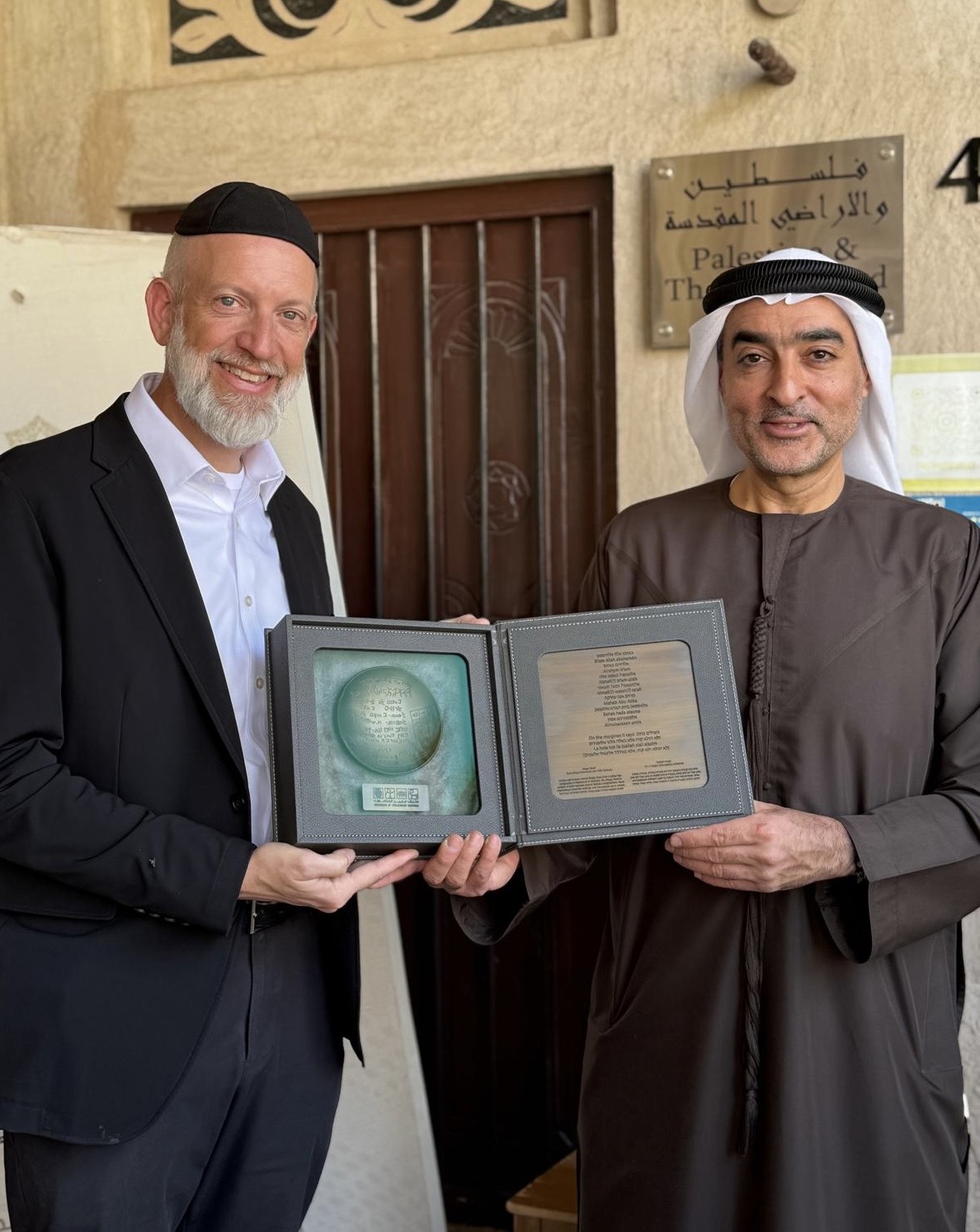
One of the most moving experiences was our visit to the Crossroads of Civilization Museum for a private tour with its founder, His Excellency Ahmed Al Mansoori, former member of the UAE Parliament. The museum celebrates the contributions of many faiths and cultures, and at its heart stands a powerful Holocaust exhibit. In an era of denial and distortion, standing before a Holocaust exhibit in the heart of a Muslim country was deeply meaningful and appreciated. It was a testament to the UAE’s commitment to truth and to the museum’s founder’s commitment to fight hate against all, including and especially against the Jewish People.


The highlight of the trip was an extended glatt kosher dinner hosted by His Excellency Dr. Ali Al Nuaimi, Chairman of the Defense Affairs, Interior and Foreign Affairs Committee of UAE. He described the UAE dream, an open and inclusive country for everyone, pointing to its multinational population. He reminded us that the UAE was the first country to combat Al-Qaeda and sent troops after September 11 to fight alongside the United States because terrorism is a threat to all humanity.


He spoke with conviction about how peace requires investment in people, not just signatures on paper. In the UAE hate speech is a crime. Hateful comments based on religion, nationality, or ethnicity carry legal consequences. He believes this model of coexistence must become the standard throughout the Middle East. He drew a distinction that has stayed with me. The goal should not simply be normalization, which is cold and transactional. The goal should be genuine human connection, friendships between peoples. The UAE does not want others to follow the old model of peace between governments; it wants to model and promote peace between people.


He also shared a concern born of friendship. Before October 7, he warned counterparts in Israel about the dangers of internal division. If you want to get along with those from without, he said, you must get along with those from within.


That lesson pierced. The same phenomenon of demonizing and vilifying those we disagree with exists within the Jewish community itself. We, too, can be quick to judge Jews who are not like us. The Torah tells us that when Yosef approached his brothers, vayir’u oso mei’rachok, they saw him from a distance and began to conspire against him. Distance breeds distortion. Tensions between brothers, and between fellow Jews, arise when we see each other from afar, when we refuse to come closer. Had they seen Yosef up close, had they spoken and listened, their hearts would have softened. Within our own people, we need to listen, to learn, and to find common ground.


This trip was not about tourist sites or luxury hotels. It was a mission to open hearts and minds and to bear witness to a model of coexistence that is not theoretical but real.  There is no doubt it needs work in both directions, as each side is still overcoming stereotypes, deepening connections, reinforcing built bridges and building new ones.


Those bridges should connect us in matters of technology, innovation, economics and more, but as one Emirati pointed out to us, they should also create connection over something even more real, something eternal.  He said that when he has visited Israel and when Israeli leaders have come to the UAE, they talk about Israel as the Start-Up Nation and focus on Israeli innovation, while omitting what makes Israel and the Jewish people uniquely special.  He yearns to hear about the Israel that is the land of Abraham and the Jewish People that gave the world ethical monotheism and Biblical values.


Listening to him, it became clear that while there is a significant role for government, political leaders and titans of industry to play in deepening connections with the UAE and moderates in the Muslim world, there is a critical role for Torah Jews to play as the ambassadors of the Abrahamic legacy and the representatives of living those Biblical values.


We are not so naive as to assume that what we saw in the UAE reflects the majority or even many in the broader Muslim world. We remain acutely aware of the venomous hate that is preached and practiced and of the dangers posed by enemies of our people. But our conclusion from this mission is clear: The same passion we pour into confronting our enemies in the Muslim and Arab world must be matched by the passion to celebrate and elevate our genuine friends from all worlds.


To go is to know and to know is to grow. The mission of our trip was accomplished. But, the larger mission, building bridges of understanding, trust, and genuine human connection, within the Jewish People and beyond, has only just begun. We all must have the courage to keep going, the humility to keep knowing, and the hearts to keep growing.


(Originally featured in Mishpacha, Issue 1091)

Rabbi Efrem Goldberg

Join Our Community

Subscribe to our newsletter or connect with us on WhatsApp.