Learning to Say Genug Shoyn, Enough Already

There is no doubt that Yiddish has exerted an influence on English. There are expressions in English that seem to have been around for a long time but, in reality are relatively modern and originated in Yiddish. For example, “I need something like I need a hole in the head” only began in the early 1950’s. It is a direct translation of the Yiddish expression, “tsu darfn vi a loch in kop.” “OK by me” is also relatively recent and comes from Yiddish.


Another example: The expression “enough already” is constructed very poorly using the rules of English grammar. There’s a good reason for that, since it, too, comes from the Yiddish and is just a translation of the phrase “genug shoyn.”


Genug shoyn is not just an expression, it is one of the most important themes of Pesach, one that can in fact set us free. The Rambam does not have Dayeinu in his Hagaddah, and even Rav Sa’adia Gaon, whose Hagaddah serves essentially as the basis for ours, only includes Dayeinu as an addendum at the end of the Haggadah among those songs that only those who can hold their wine sing.


But for us, it is almost impossible to imagine the Seder night without the singing of Dayeinu. Everyone from young children to octogenarians look forward to this moment during the Seder, not only because it indicates we are finally coming close to the meal, but because it is a centerpiece of the Hagaddah and a highlight of the Seder experience.


Dayeinu’s message is simple; genug shoyn. Enough already! Enough is enough. On this evening during our journey from slavery to liberty, we achieve our very freedom by saying Dayeinu, genug shoyn, we have enough, we experienced enough, we are satisfied enough.


Dayeinu. It is enough to enjoy this moment, to be present in this experience, to savor this gift and to cherish this opportunity without having to already look forward or crave the next one. Of course, each stage and each stanza is incomplete and imperfect, but nevertheless, dayeinu— each is still enough. Enough to say thank you and even enough to make us happy.


Like the stanzas of Dayeinu, our lives are often incomplete, they are imperfect. If we focus on what is missing, what we don’t yet have or may never have, we become debilitated and deprived of happiness. But, if we find the capacity to sing Dayeinu, to focus on what is and not what isn’t, to enjoy what we have and not long for what we don’t, we set ourselves free to find happiness.


Chazal (Koheles Rabbah 1:34) highlight a basic human quality: Mi she’yesh lo mana, rotzeh masayim, he who has one hundred desires two hundred. Ambition, aspiration, and determination are admirable qualities; they push us towards greatness. But they come with a great cost. An insatiable appetite for more, a voracious need for the latest, being unsatisfied without the newest and the best, robs us of serenity, denies us happiness, and often distracts us from what matters the most.


We live with unprecedented freedoms: freedom to practice our religion, freedom of speech, freedom to pursue happiness. And yet, with all this freedom, our generation remains enslaved. We are slaves to “more.” We are dominated by needs. Our need for more money, need for more time, need for more things, need for the latest things, need for a better seat, need for a better room, need for more power, need for more friends, need to have the last word, even our need to be needed.


Our needs, wants, and lack of contentment become our taskmasters. They occupy space in our head and in our hearts, they hijack our thoughts, they dictate to us how to feel, and they command us to say things and do things that are self-destructive.


On Pesach we set ourselves free by singing Dayeinu, by proclaiming genug shoyn, enough. We indeed have enough. We are satisfied with our things. We are happy with our friends. We will make the most with our time. Dayeinu, genug. We are happy to pause with what we have and say thank you.


Moreover, we are so firm in our belief that we have enough that we are even willing to share. We begin the Seder with an apparently disingenuous invitation: kol dichfin…whoever is hungry, come and eat. Our door is locked, our windows are closed, and here we are making this generous offer. Why? Is it not blatantly an artificial invitation? With a different perspective, we can suggest that this statement is not directed at others, it is a statement about and directed to ourselves. We begin the night of redemption by proclaiming we own our things, they don’t own us, and therefore we are happy to share them. We recognize that by giving others we will have more, not less. We start the night by stating that we aren’t enslaved by the need to hold on to what we have, we aren’t imprisoned by the fear that we won’t have enough.


Dayeinu is not just a song, it is a way we emulate Hashem. The Midrash describes that when He created the world, the elements didn’t want to observe limits, and each tried to overstep its bounds and dominate the world. Water wanted to swamp the earth, fire wanted to consume, and the land wanted to encroach on the sea. Each only wanted to expand and Hashem turned to them and said dai – enough! That is why one of His great names is Shad-ai, meaning mi she’amar l’olam dai, Who told the world genug shoyn, enough already, you each have enough, dai.


Hashem showed us this quality in another context. When Hashem solicited for the Mishkan, the people brought, and they brought again, and then they gave even more. Ultimately, Moshe had to stop the campaign, as they had enough:


וְהַמְּלָאכָ֗ה הָיְתָ֥ה דַיָּ֛ם לְכל־הַמְּלָאכָ֖ה לַעֲשׂ֣וֹת אֹתָ֑הּ וְהוֹתֵֽר׃

For the stuff they had was sufficient for all the work to make it, and it was too much.”


Hashem didn’t want too much; He didn’t want more. Dayam, dai, it was enough. The Mishkan was built not out of more, but the building blocks of holiness are made out of “enough.”


Living with limits, finding happiness within what we have, maintain the capacity to say “enough” is liberating, empowering, and enriching. When we always want more, we never pause to enjoy what we have, we forfeit what is in the pursuit of what is next. Tal Ben-Shahar, the Harvard expert on happiness, says, “When you appreciate the good, the good appreciates.”


Hashem told the world dai, enough, Moshe told the people dayam, we have enough and Pesach tells us dayeinu, enough. At attitude of dayeinu is not for Hashem or for anyone else. It is for ourselves, it sets us free: free to feel, free to think, free to dedicate our time not to the pursuit of more, but to the pursuit of that which is more important, more meaningful, even more valuable.


Over this Yom Tov, take a few moments to reflect. Look around your table, take stock of your life and don’t notice what isn’t, what is missing, what you wish was there. Instead, sing Dayeinu, say genug shoyn and say “enough.” These people are enough. These things are enough. This life, no matter how impaired or imperfect, is enough. This Pesach, say, “I have enough” and set yourself free.


Bitter Herbs, Grateful People

While most of the people I encounter this time of year are excited for Pesach, too many confuse eating Marror, bitter herbs on Pesach, with being bitter people about Pesach.  Some complain about having to host family, others are negative about going to family, and there are those that even complain about how much work it takes to pack and go to a hotel for Pesach. How quickly we all forget…


Our Parsha includes the guidelines to bringing a Korban Todah, a thanksgiving offering.  Our rabbis list four instances in which a person should bring this sacrifice: when he has traveled overseas; when he has traveled through the desert; when he has been released from prison; when he has been cured of an illness. Rabbeinu Bechayei adds that all instances of joy, simchas, milestones, successes, are reason for bringing a Korban Todah.


Each day we recite מִזְמוֹר לְתוֹדָה הָרִיעוּ לַה’ כָּל הָאָרֶץ, “A song of thanksgiving; call out to ה’, everyone on earth.” As the name suggests, this paragraph of Tehillim was sung by the Leviim as an accompaniment to a Korban Todah. Indeed, since this mizmor is associated with a korban, it has become our practice to stand while reciting it.


Why does the mizmor begin with one’s personal gratitude, then go on to say הָרִיעוּ לַה’ כָּל הָאָרֶץ, “Call out to ה’, everyone on earth.” Why do all of earth’s inhabitants have to join in gratitude? Why does the whole world have to express gratitude because an individual had something good happen to them?


Rav Chaim Kanievsky zt”l answered this question with a story: One day after davening in Bnei Brak, one of the attendees took out a tablecloth from a bag and spread it on the table. He then placed cake and whiskey on the table and invited everyone in shul to share in his good fortune. Apparently, the day before he had been crossing the highway, and was hit by a car. He was thrown up into the air and landed on his side, but, other than a few slight bruises and a soiled suit, he was fine. He provided cake and whiskey, so that the participants would all have a l’chaim in honor of the miracle he had experienced.


The next day, following Shacharis, another member of the shul took out a small tablecloth, placed it on a table, and proceeded to place cake and whiskey on the table. He invited everyone to share. “What happened to you?” they asked. “Perhaps you were also hit by a car?” “No,” he answered. “Nothing of the sort. It is just that yesterday when I heard that fellow relate how he miraculously escaped serious injury, it dawned on me that I have been crossing that highway for the last 20 years, at the exact same place – and nothing has ever happened to me! Is that not a miracle? I therefore want to thank Hashem publicly for all of His graciousness to me!”


Rav Chaim explained, “מזמור לתודה refers to one’s personal deliverance from ‘what might have been.’ הָרִיעוּ לַה’ כָּל הָאָרֶץ, seeing another person pay gratitude to Hashem should spur one to introspect and realize how much he, too, owes Hashem. True, he may not have experienced any misfortune, but that in itself is a miracle!” We cannot take our good fortune for granted. It is all a gift from Above.  (Rav Chaim’s own son Shlomo was hit by a car when he was six years old and almost didn’t survive.  Perhaps that miracle inspired this insight.)


Pesach is about many themes including freedom, liberty, responsibility, and nationhood. But at its core, Pesach is about gratitude, it is the Torah’s version of Thanksgiving dinner.


The Abarbanel in his Haggadah addresses the questions of Mah Nishtana and zeroes in on the specific question of why on all other nights we eat chametz and matzah and on this night we only eat matzah.  He asks, do we really eat both chametz and matzah the rest of the year? In our experience, most people are all-in on chametz 51 weeks out of the year and barely tolerate matzah for one week, but “chametz and matzah” the whole year?  The Abarbanel explains that to understand the Mah Nishtana questions you need to understand where they are coming from.  All the questions revolve around the Korban Pesach. This korban, he suggests, is essentially a Korban Todah, a thanksgiving offering. 


One was obligated to bring this gratitude korban if they crossed the sea or the desert, was healed from illness or released from captivity. In the Pesach narrative, we fulfilled all four criteria, obligating us collectively to pause and express our profound gratitude. The meat and breads that were to beaten as part of the Korban Todah may not be left over until the next morning and the same is true of the Korban Pesach.  The Todah is classified as a Korban Shelamim and so is the Korban Pesach.  The Todah reflects the gratitude of the individual and the Pesach is a communal gratitude, the appreciation of a nation and a people that have made it to the other side. 


But here is the thing. Normally, as our Parsha explains, a Korban Todah is brought with 40 loaves, 30 of which are matzah and 10 of which are chametz.  This is the question of the child who wonders, mah nishtana: Why, when we normally express gratitude, do we do it with chametz and matzah and yet, tonight, our gathering for gratitude has only matzah, no chametz? 


For the Abarbanel, the connection between Pesach, seder night, and gratitude are so obvious, so clear, so deep and so ingrained, that a young child is stimulated to ask why the Pesach gratitude is different than our normal gratitude. 


We no longer have a Beis HaMikdash, we don’t offer a Korban Pesach or a Korban Todah, but gratitude remains our avodah, the effort, exercise and goal of the night.  It is a night of hoda’ah, an evening of Hallel, a declaration of dayeinu, all introduced with the acknowledgement that שהחיינו וקיימנו והגיינו לזמן הזה, what a miracle that we simply have merited to be alive, to be here, to be together for Pesach.  


Countless studies show that gratitude is good for us in many ways. Studies show that that it strengthens our immune systems, helps us sleep better, reduces stress and depression, and improves relationships. What they also show is that to gain those benefits, one must do more than just feel grateful, one has to express it and show it. The word ‘thanksgiving’ means giving of thanks, an action, not just a thought or feeling.


In addition to the Hallel recited at the Seder, many have the custom of saying Hallel at the end of Maariv in Shul.  Why say Hallel twice in one night? The Imrei Chaim, Rav Chaim Meir Hager of Vizhnitz, says the Hallel we say in shul is for the Hallel we will say at the Seder table.  When davening ends, we are overwhelmed with gratitude, joy and appreciation that we have a home to go to, a seder table waiting, a family to spend the evening with, and that we can celebrate our freedom and so we say Hallel about the fact that we will say Hallel. 


It sounds obvious, but a survey showed that only 52% of women and 44% of men express gratitude on a regular basis.  If you feel and demonstrate gratitude, that alone is a reason to be grateful.  We have a similar idea in Shemonei Esrei.  We say, Modim anachnu lach, we are so grateful to you Hashem…al she’anachnu modim lach, for the fact that we can be grateful to you. 


It is just a few years ago that we spent a difficult and memorable pandemic Pesach divided, distanced, and disoriented.  Like the man who realized the miracle of simply successfully crossing the highway, we who lived through that time must never take Pesach with family, friends, and festivity for granted again. 


Don’t say OCD, Depressed or Anxiety Unless You Mean It

Some people dread Pesach preparation time, but not for the reason you think.   As challenging as it can be to search for and eliminate chametz, chametz isn’t rude, it isn’t insensitive, and it doesn’t hurt feelings. People, on the other hand, often unintentionally, are or do all three.  In conversations, around Shabbos tables, and even from the pulpit, we casually describe ourselves or the atmosphere surrounding Pesach as an “OCD holiday” or refer to “neurotic” people preparing for Pesach. Of course, nobody means harm when using these descriptions and only intend on highlighting the intensity and attention to detail necessary in Pesach preparation.


Yet, I have come to learn that such casual and careless use of language can, even unintentionally, be hurtful and harmful to people navigating clinical OCD and neurosis. Describing the annual process of cleaning and koshering for Pesach as “OCD” diminishes what that diagnosis really means and minimizes the challenge of navigating and living with it.  It can cause those already feeling on the outskirts as even more not understood or supported. 


I recently wrote about the dangers of safe spaces and taking personal responsibility for if we allow other’s words to hurt us.  But make no mistake, that doesn’t absolve us of our obligation to use our words sensitively, to be careful how we speak and the language and terms that we use.


Don’t use terms or expressions like “I’m so OCD,” “I’m depressed,” or “I have anxiety” flippantly or glibly.  These words have real meaning and when we use them out of context or apply them inappropriately, we diminish them and rob the people they apply to of language that captures their story.   


As mental health challenges have proliferated, we have an even greater responsibility to be sensitive, supportive, and steadfast in removing stigma surrounding these issues.  Depression, anxiety, or OCD are no more the fault of the person suffering with it than cancer or Alzheimer’s are the fault of someone suffering with one of those conditions. Just as the patient with cancer cannot simply will his or her cancer away and the individual with Alzheimer’s cannot simply choose to stop forgetting, the person with depression cannot just “decide” to not feel anxious, worthless, or exhausted, the person with OCD cannot simply choose to stop having obsessive thoughts or behaviors.


Having a physical illness can be awkward, but should not be a source of embarrassment or guilt. Similarly, having OCD, depression or anxiety are equally out of one’s control, and should not be a source of shame or inadequacy.


In the winter of 1902-1903, Rav Shalom Dov-Ber Schneerson, the 5th Lubavitcher Rebbe, known affectionally by the acronym Rashab, travelled from Lubavitch White Russia to Vienna to consult with the famous Professor Sigmund Freud. He was accompanied by his son, Rav Yosef Yitzchak Schneerson (who later became the 6th Rebbe), who then told the story of these encounters to his son-in-law, Rav Menachem Mendel Schneerson, the last Lubavitcher Rebbe.  The Rebbe transcribed it and once shared it at a public gathering in 1962.  


The Rashab was forty-two years old at the time and was struggling with depression.  Rav YY Jacobson describes that the Rebbe told Freud after years of working on himself, he hadn’t been successful, “not one faculty have I refined, not one idea is really clear in my mind.”   He had feelings of inadequacy, particularly in comparison to his ancestors.  The Rebbe was in Vienna for more than three months and met with Freud several times. While we know the Rebbe had an impact and influence on Freud, it is also reported that the Rebbe embraced Freud’s treatment and support. 


Recently, Artscroll published “Rav Chaim: The Life and Legacy of the Sar HaTorah,” by Rabbi Naftali Weinberger.  An article in Mishpacha Magazine covering the book and its author noted a significant inclusion in both the new book and the author’s previous biography of Rebbetzin Kanievsky:


Gadol biographies” sometime get a bad rap for portraying the subjects as infallible, perfect human beings, but Rabbi Weinberger took the reality route instead. In one section, he relates how Rebbetzin Batsheva heeded the advice of her physician and took Valium to calm her anxiety when the tragedies of her many visitors and petitioners became too much for her sensitive soul to bear. For Rabbi Weinberger, was there a level of self-censorship?


“The story about the Rebbetzin taking anti-anxiety medication actually appeared in her biography,” says Rabbi Weinberger. “The backdrop for that was an interview I conducted with her daughter and son-in-law, Rav Zelig and Rebbetzin Bracha Braverman. They told me how the Rebbetzin was very proud of her personal example when she occasionally needed the meds — it was an encouragement for others who were told by their own physicians to take medication.


“After that interview, I discussed it further with several other Kanievsky children who told me I should publish it, that the Rebbetzin would surely have wanted it published. And baruch Hashem, there’s been very nice feedback from this — from therapists, and also from people who told me they themselves became more compliant about taking necessary meds after knowing that Rebbetzin Kanievsky also took medication.”


These great people and others weren’t ashamed to get support and neither should anyone else be. 


The Arizal saw the connection between speech and freedom in the very name of the upcoming Yom Tov.  Pesach, he explained, comes from “Peh – sach” – “a mouth converses.”  Part of affirming our freedom on Pesach is affirming the awesome responsibility that comes with freedom of speech. 


Rav Kook (Orot HaKodesh vol. III, p. 285) writes: “As the soul is elevated, we become acutely aware of the tremendous power that lies in our faculty of speech. We recognize clearly the tremendous significance of each utterance; the value of our prayers and blessings, the value of our Torah study and of all of our discourse. We learn to perceive the overall impact of speech. We sense the change and great stirring of the world that comes about through speech.”


Pre-Pesach is a time to be more careful, not callous.  Let’s clean out not only our homes of chametz but also our vocabulary and lexicon of language which harms or hurts and bring the redemption one step closer. 


* The next episode of Out of the Shadows: A Jewish Approach to Mental Health, will be published next week and focuses on OCD and Scrupulosity.

Say His or Her Name

Earlier this week, the 20th of Adar, marked the yahrzeit of the great Rav Shlomo Zalman Auerbach zt”l. In a tribute written shortly after his passing, Rav Aharon Lichtenstein, who shared a very close relationship with Rav Shlomo Zalman, described him as a “Gentle giant.” He wrote:

Reb Shlomo Zalman was endowed, as a lamdan, with a set of qualities which served him, ideally, as a posek. He had encyclopedic knowledge — and he had it, as mechudaddim beficha, at his fingertips. His temperament was remarkably judicious, invariably level-headed, and never pedestrian. He was deferential to the views of others, and yet genuinely self-confident. He could be innovative and even daring.


Rav Shlomo Zalman’s brilliance was undeniable, and yet it was perhaps surpassed only by his humility and sensitivity to all. R’ Chanoch Teller recounts the following anecdote: “When Rav Shlomo Zalman passed away, a beggar in Sha’arei Chesed sobbed in her anguish: “Now who will say ‘good morning’ to me every day?” (Mi yagid li boker tov?)”


While a testament to his unpretentiousness and accessibility, the anecdote has the potential to leave the reader believing that one must be the gadol ha’dor, the greatest of the generation, to be friendly, caring and gracious to all. Indeed, Rav Shlomo Zalman’s greatness was seeing his warmth and friendliness as nothing extraordinary at all, but something that should come naturally and be instinctive.


The Talmud testifies (Berachos 17a) about Rabban Yochanan ben Zakai that no one ever preceded him in a greeting [of Shalom], even a stranger in the marketplace.” The Mishna in Pirkei Avos (4:20) encourages us all, “Hevei makdim b’shalom kol Adam, be the first to greet each person.” The Maharal explains that when you walk by someone without offering a greeting you make him or her feel invisible and insignificant. By making a point of greeting someone you demonstrate that you don’t see yourself as superior or better than another. Rather, by instigating the greeting, you show that you respect that person as an individual and thereby you give them dignity and worth.


In his book, “Reflections of the Maggid, Rabbi Paysach Krohn tells the following story:

In Argentina there was a ritual slaughter complex, comprised of several buildings. There was a building where the animals were fed, a building where they were slaughtered and the meat packed and loaded onto trucks, and an office building with dressing rooms for the shochtim (ritual slaughterers). The entire area was surrounded by a tall chain link fence and everyone entered through a wrought iron gate in the front, near the parking lot.


The owner, Yisrael (Izzy) Nachmal, was a workaholic. He was the first one in every morning and the last one out every evening. He oversaw every aspect of his company, Ultimate Meats, and made it a point to know every worker. The guard at the front gate, Domingo, knew that when Izzy left in the evening, he could lock the gate and go home.


One evening as Izzy was leaving, he called out to the guard, “Good night, Domingo, you can lock up and go.” “No,” Domingo called back, “not everyone has left yet.” “What are you talking about,” Izzy said, “everyone left two hours ago!” “It is not so,” Domingo said, “One of the shochtim, Rabbi Berkowitz, hasn’t left yet.” “But he goes home every day with the other shochtim, maybe you just didn’t see him,” Izzy said. “Believe me, I am positive he didn’t leave yet,” the guard insisted. “We better go look for him.”


Izzy knew that Domingo was reliable and conscientious. He decided not to argue, but instead got out of his car and rushed back to the office building with Domingo. They searched the dressing room thinking that perhaps Rabbi Berkowitz had fainted and was debilitated. He wasn’t there.


They ran to where the animals were slaughtered, but he wasn’t there either. They searched the truck dock, the packing house, going from room to room. Finally they came to the huge walk-in refrigeration room where the large slabs of meat were kept frozen.


They opened the door and to their shock and horror they saw Rabbi Berkowitz rolling on the floor, trying desperately to keep himself warm. They ran over to him, lifted him off the floor and helped him out of the refrigerated room, past the thick heavy wooden door that had locked behind him. They wrapped blankets around him and made sure he was warm and comfortable.


Izzy Nachmal was incredulous. “Domingo,” he asked, “how did you know Rabbi Berkowitz hadn’t left? There are over two hundred workers here every day. Don’t tell me you know the comings and goings of every one of them?”


The guard’s answer is worth remembering. “Every morning when that rabbi comes in, he greets me and says hello. He makes me feel like a person. And every single night when he leaves he tells me, ‘Have a pleasant evening.’ He never misses a night – and to tell you the truth, I wait for his kind words. Dozens and dozens of workers pass me every day – morning and night, and they don’t say a word to me. To them I am a nothing. To him, I am a somebody. “I knew he came in this morning and I was sure he hadn’t left yet, because I was waiting for his friendly good-bye for the evening!”


When you are checking out of a store, make it a point to look at the person’s nametag and use his or her name.  Instead of feeling invisible or anonymous, you will give them a sense of identity and dignity. We may not have encyclopedic Torah knowledge, but every one of us can be extraordinary just by making a point of greeting everyone with a smile.


Win or Learn—Never Lose

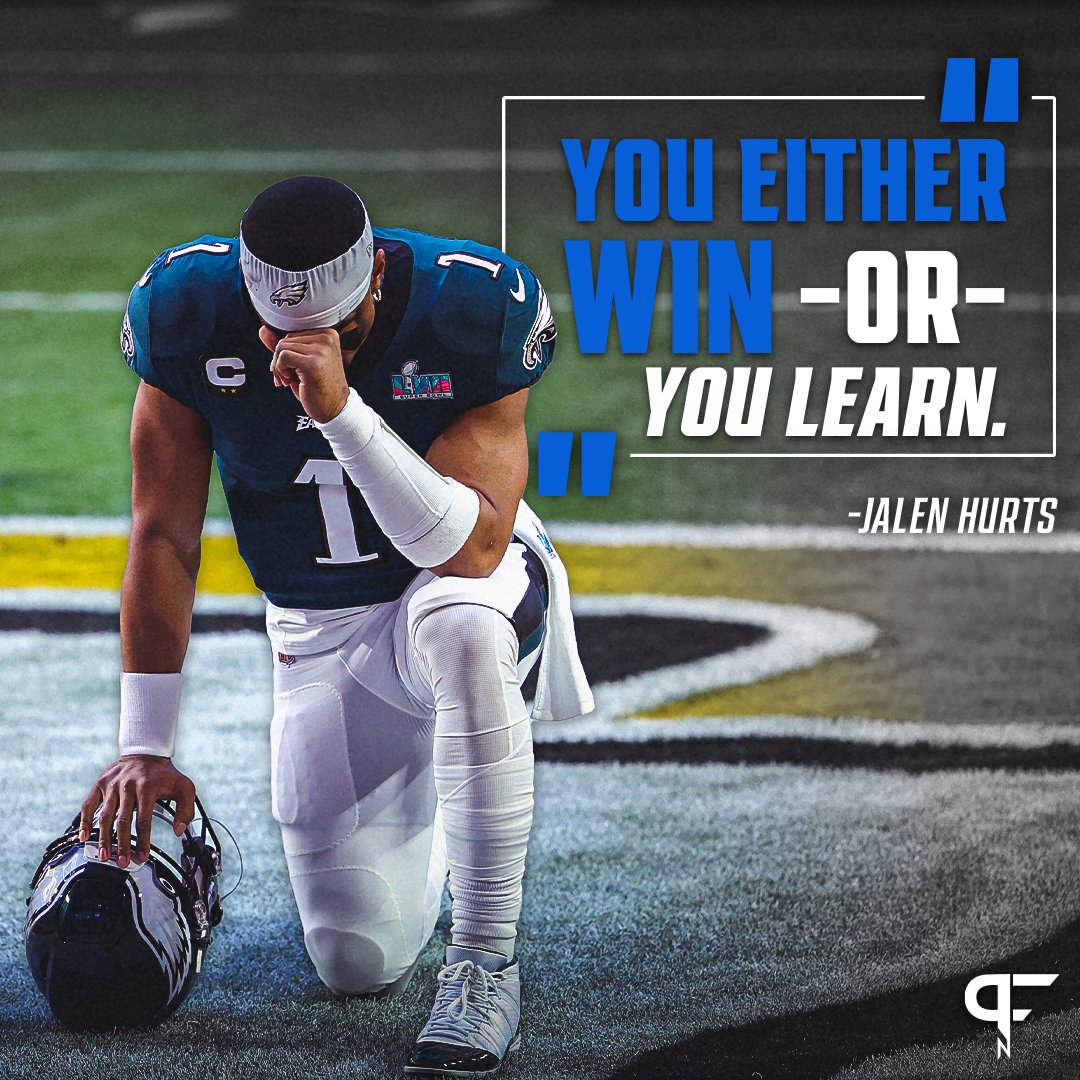
Despite an MVP-like performance by quarterback Jalen Hurts, the Philadelphia Eagles lost this year’s Super Bowl.  After the game, Hurts vowed to use the game as a “teachable moment.” “You either win or you learn,” Hurts declared. “You know, as always, win, lose or draw, I always reflect on the things that I could’ve done better, the things we could’ve done better to try and take that next step. And that’ll be the same process that goes on now… Obviously, we had a big-time goal in the end that we wanted to accomplish, and we came up short. I think the beautiful part about it is everyone experiences different pains, different agonies of life, but you decide if you want to learn from it, you decide if you want to use that to be a teachable moment, and I know what I’ll do.” 


This week’s parsha contains one of the greatest Jewish failures of all time.  When Moshe descends to find the people passionately and enthusiastically worshiping the Eigel, he instinctively and intuitively throws down the luchos and smashes them into pieces.  Note that Hashem didn’t instruct Moshe to break the luchos, he did it on his own.  These luchos were no small matter; they were the handiwork of the Almighty.  They were a miraculous expression of divine intervention; for example, the letters samech and mem had insides that supernaturally remained suspended in air.


God fashioned these tablets and Moshe—in one motion, in a fit of rage—destroys them.  I can only imagine the millisecond of silence when Moshe realizes exactly what he has done and is waiting to see how God will react.  However, we have a tradition that Hashem tells Moshe yasher ko’ach she’shibarta.  Indeed, this is the origin of the expression “yasher ko’ach.”  God gives His consent. 


But what happens next?  Did he get a broom and sweep them up?  Does he step over the shattered pieces to descend further to rebuke the people?  The Torah never tells us what happened to the luchos, but the Gemara does.


The Gemara says “luchos v’shivrei luchos munachin ba’aron,” in fact, the broken, shattered pieces were gathered, collected, and carefully placed in the aron to sit right next to the whole, complete, second set of tablets.


Why were the broken tablets kept?  Why not discard them?  After all, they serve no purpose and have been replaced by new ones?  The real estate of the ark is precious, why take up room with this seemingly superfluous item?


John Maxwell is the author of 24 books on maximizing personal and leadership potential.  In his book “Failing Forward” he argues that “the difference between average people and achieving people is their perception of and response to failure.”   There is no shortage of stories about highly accomplished people who overcame early failures. Abraham Lincoln lost eight elections, failed in business many times, and suffered a nervous breakdown.  The Beatles were turned down for a record deal because they were told their sound wasn’t appealing. Michael Jordan cried when he was cut from his high school basketball team.  These individuals used their failures to launch success.  They didn’t become paralyzed or complacent, but rather regrouped and pressed forward. 


What is the message of the chet ha’eigel?  Why does it play such a prominent role for us in the Torah and even in ritual life?  Why is this the passage we read on fast days?  The Gemara in Avodah Zarah tells us explicitly that the story occurred and is studied to teach of the possibility and power of teshuva.  While we mostly focus and concentrate on how and why they could have worshiped an eigel, I think instead it is worth examining how the Jews recovered from such a massive, collective failure. 


The lesson of the eigel is not that they made a mistake, that they failed.  The lesson is seen through their will, determination and resolve to pick up the pieces, literally and figuratively, and to succeed.


Indeed, Shelomo Hamelech tells us in Mishlei that sheva yipol tzadik v’kam, seven times a tzadik falls and gets up.  The commentaries explain that the tzadik analyzes and studies his failures and failings and when he gets up he emerges a tzadik by correcting his mistakes.  The essence of the tzaddik’s rising again is directly by way of his seven falls, whereas a rasha just falls deeper and deeper.


Luchos v’shivrei luchos munachim ba’aron.  The broken pieces are saved to remind us that our failures and mistakes are not to be discarded, eliminated, and forgotten from our memories.  We can only succeed when we remember the broken experiences and use the lessons learned as springboards to success.


When Thomas Edison invented the light bulb, he tried over 2,000 experiments before he got it to work. A young reporter asked him how it felt to fail so many times. He responded, “I never failed once. I invented the light bulb. It just happened to be a 2000-step process.” Our failures, our broken luchos, are steps to a process of success.


Rabbi Yitzchok Hutner wrote a beautiful letter to a student who was very discouraged:


A failing many of us suffer from is that when we consider the aspects of perfection of our sages, we focus on the ultimate level of their attainments, while omitting mention of the inner struggles that had previously raged within them. A listener would get the impression that these individuals came out of the hand of their Creator in full-blown form.  Everyone is awed at the purity of speech of the Chofetz Chaim, z.t.l., considering it a miraculous phenomenon. But who knows of the battles, struggles and obstacles, the slumps and regressions that the Chofetz Chaim encountered in his war with the yetzer hara (evil inclination)? There are many such examples, to which a discerning individual such as yourself can certainly apply the rule.  The English expression, ‘Lose a battle and win a war’ applies. Certainly you have stumbled, and will stumble and in many battles you will fall lame. I promise you, though, that after those losing campaigns you will emerge from the war with the laurels of victory upon your head. Lose battles but win wars.


While we don’t strive for failure, we embrace it and learn from it.  Winston Churchill said it most succinctly: “Success is going from failure to failure without loss of enthusiasm.”


Michael Jordan, a man associated with success in his field as much as anyone alive, famously said, “I’ve missed more than 9,000 shots in my career, I’ve lost almost 300 games. Twenty-six times I’ve been trusted to take the game-winning shot and missed. I’ve failed over and over and over in my life. And that is why I succeed.” The six-time NBA champion, five-time MVP, and certified athletic legend… attributes all his success to his failures.


Our challenge in life is not to be perfect. That is unattainable and, according to Shlomo Hamelech, it is in some way undesirable, for one cannot become a tzadik without falling.  The challenge is to carry both sets of luchos with us, to take pride in our successes and seek to repeat them and to recall and learn from our failures and be determined to transcend them.

Traveling Out of Your Comfort Zone

Though the word “influencer” has been used in English since the mid-1600s, it has more recently taken on a new meaning.  Though the term can apply to a wide variety of people, influencers, essentially, are people who engage their large social media followings by sharing experiences, knowledge and advice.  Influencers are paid to feature or endorse products, with some making as much as $1 million for a social media post.  Indeed, the Influencer Marketing Industry is set to grow to approximately $21.1 Billion in 2023.


This term has made its way into the Jewish vernacular, including the orthodox community, with those who boast substantial audience often treated like Jewish celebrities. There are some wonderful things that have resulted from this phenomenon, including the sharing of Torah ideas and inspiration, spreading modest fashion trends, promoting kosher recipes, and more, but we must never get confused about who our tradition informs us are the true Jewish influencers.


The Hebrew word for influence is hashpa’ah and those who influence others are mashpi’im.  In Judaism, influence is not determined by social media status, it emanates and flows from being authentic, practicing what one preaches, serving as a role model and example of our values.  The word hashpa’ah, influence, comes from shefa, which means that which flows from the Divine. The greatest influencers in our illustrious history made their difference without ever looking at or caring how viral they had gone.


This week, a group from BRS went on our annual Mevakshim trip to New York and New Jersey to meet with some of our great influencers with the goal of being influenced, challenged, uplifted, and inspired.  You may not have heard of several of them, you won’t find most of them having a large (or any) online following, but make no mistake, they are an enormous source of influence on the Jewish world. 


We began in Lakewood where we met with Rav Yeruchem Olshin, Rav Gershon Ribner, and Rav Simcha Bunim Cohen, and learned with hundreds of ba’al habatim at the extraordinary early morning Kollel Ohr Shmuel at Bais Medrash Lutzk.  We made our way to Yeshiva University where we met with Rav Mayer Twerski, Rav Yaakov Neuberger, Rabbi Dovid Bashevkin and patronized the SOY Seforim Sale.  From there to Monsey, where we davened at the Kever of the holy Ribnitzer Rebbe and Rav Lazer Geldzhaler and then met with Rav Refoel Schorr, Rav YY Jacobson and Rav Ephraim Wachsman. We had breakfast with businessman and Talmid Chacham Reb Dovid Lichtenstein, met with Rav Yisroel Simcha Schorr, and then we went to Brooklyn to meet with Torah V’Daas Rosh Yeshiva Rav Yisroel Reisman.  Our trip concluded at the Lubavitcher Rebbe’s Ohel where we farbrenged and davened with Rav Moshe Weinberger. It was a whirlwind and truly special two-plus days.


The rabbonim we met with are incredibly diverse and distinct in their personalities, constituencies, worldviews, personal practices, and advice they offered.  The goal of our trip each year is to expose our group to a tapestry of Torah views, to draw on what resonates from each, to be challenged, inspired and to come back on fire with practical and sustainable commitments. One thing that always amazes and inspires me is seeing people in our group take advice and gain inspiration from someone they may never have heard of a day earlier or someone who leads an institution they could never imagine feeling connected to.


Each person we met with is unique; however, we noticed some common themes that are worth reflecting on:


Torah is our anchor: From the chassidim to the misnagdim, the more yeshivish to the more centrist, all the Rabbonim we met with emphatically emphasized the critical importance of regular, structured, focused Torah learning.  Torah is core and central, it is the anchor that grounds us, it is the compass that helps us navigate, it is the armor that protects us, it is the fire that fuels us.  There must not be a day without Torah learning, regardless of the particular Torah content. 


It was also emphasized that while learning Torah in any form or fashion allows us to tap into what Hashem laid out in his blueprint for the world, there is no better way to immerse yourself in this beautiful experience than in person. While the last few years have created an expectation of remote working, telecommuting, and distance learning, this cannot be viewed as an ideal way to connect to the Boreh Olam. Our time in a full Kollel Boker humming with the sound of a roaring Kol Torah reminded us that coming to the Beis Medrash and attending shiurim and classes in person is the best way to fully enjoy, pay attention, avoid the distractions and pull of multitasking, and absorb the majesty of Hashem’s Torah.


Think, Then Speak: A recent article in Time Magazine observes, “We live in a world that doesn’t just encourage overtalking but practically demands it, where success is measured by how much attention we can attract: get a million Twitter followers, become an Instagram influencer, make a viral video, give a TED talk. We are inundated with YouTube, social media, chat apps, streaming services… Yet many of the most powerful and successful people do the exact opposite. Instead of seeking attention, they hold back. When they do speak, they’re careful about what they say.”  


Many or most people think and speak in one motion. Great people pause, think, and only speak when they have thought through and formulated what they are going to say.  The great rabbonim we met with were thoughtful; some paused for uncomfortable lengths (as long as 31 seconds) after a question from someone in our group creating both awkward silence but also providing a refreshing example of thinking before speaking. 


Individualize: People today increasingly make broad and blanket statements, overgeneralizing and espousing a one size fits all philosophy to life.  In responding to a myriad of questions, a common refrain from the rabbonim we met with was that it is hard to give one answer, each case is different, each individual needs to explore what is right for them given their specific circumstances. 


Mindfulness: Many of our distinguished speakers emphasized the importance of focus, of being present, of taking everything one minute, one day, one daf, one tefillah at a time. And this was not simply lip service; without exception, every single one of the rabbonim was fully present with us despite the countless responsibilities, obligations, and “day jobs” we were taking them from. Not a single one of them looked at a phone, a watch, or seemed distracted or unfocused. It was so effortless for them that often we did not even notice. In our world of multitasking, of busyness, of constant distraction, we were given a real life lesson in how to truly engage mindfully and meaningfully and make the people you are with feel like the only thing in the whole world.


Humility and Unpretentious: We came to seek their advice, to hang on their every word, to ask difficult and deeply meaningful questions, and yet, rather than exhibit inflated egos, from the gentle way they spoke, to their kind and generous words about our our group and community, to the hospitality some showed in opening their homes or yeshivas to us, the genuine humility and unpretentiousness of these individuals was obvious and inspiring.  


Many of our speakers were reticent to speak at all about themselves. When I asked one particular gadol what sefarim he learns, he responded with a smile, “Not for now.” This particular person is known for being a massive repository of Torah who probably learns more in a week than many learn in a year, yet he was not comfortable talking about himself or his learning habits. The world is increasingly telling us that everything should be shared, should be public, should be fodder for discussion. It was refreshing to interact with people who live with innate modesty and humility and believe in keeping much about themselves only to themselves.


Pain not platitudes: Our trip came in the midst of our community reeling from the loss of our beloved Esti Moskowitz a”h and our sense of profound pain and grief together with her special parents and family.  Our learning and growth throughout the trip were dedicated in her memory.


We were, and are, struggling with deep theological questions and were anxious to seek counsel from these Torah luminaries. What resonated first was their authentic sense of empathy, of feeling the pain of another. Since most of them do not know the Moskowitz family and were not aware of their loss, we had to provide context, and each time you could feel the tangible air of sadness and empathy wash over the room. Their greatness created a true sense of familial love – our loss immediately was their loss.


In addressing our questions and our grief, nobody shared a platitude or pretended they had the answers to unanswerable questions. There was advice, practical lessons in faith and struggle, and importantly, validation to having questions and feeling confused.


Our trip took place over Rosh Chodesh Adar, the beginning of the happiest month on our calendar, which became another theme in many of our conversations.  One of the greatest things we can do to attain happiness is to be a mevakeish, a searcher of truth and seeker of inspiration. 


We say in davening a pasuk that appears both in Tehillim and Divrei Hayamim: “Yismach lev me’vakshei Hashem. Let the hearts of those who seek Hashem rejoice.” The Chafetz Chaim explains that when one seeks and searches for something, we are not satisfied unless we successfully find or obtain that which we were looking for. However, one who is mevakeish Hashem, seeks Hashem, finds great pleasure and joy from the actual search, regardless of its success. The process itself, the exercise of seeking, searching, and yearning gives great satisfaction. Yismach lev mevakshei Hashem – That is Hashem’s promise for the individual who is sincere in his or her quest.


You don’t have to go on a trip or fly-in to be a mevakeish.  You just have to be hungry and driven to grow, and that you can do from anywhere.  If you want happiness this Adar, expose yourself to inspirational people and be open to influence.  Be willing to grow from someone outside your comfort zone. Seek, find, and learn from true influencers.

Traveling Out of Your Comfort Zone

  • Though the word “influencer” has been used in English since the mid-1600s, it has more recently taken on a new meaning.  Though the term can apply to a wide variety of people, influencers, essentially, are people who engage their large social media followings by sharing experiences, knowledge and advice.  Influencers are paid to feature or endorse products, with some making as much as $1 million for a social media post.  Indeed, the Influencer Marketing Industry is set to grow to approximately $21.1 Billion in 2023.
  •  
  • This term has made its way into the Jewish vernacular, including the orthodox community, with those who boast substantial audience often treated like Jewish celebrities. There are some wonderful things that have resulted from this phenomenon, including the sharing of Torah ideas and inspiration, spreading modest fashion trends, promoting kosher recipes, and more, but we must never get confused about who our tradition informs us are the true Jewish influencers.
  •  
  • The Hebrew word for influence is hashpa’ah and those who influence others are mashpi’im.  In Judaism, influence is not determined by social media status, it emanates and flows from being authentic, practicing what one preaches, serving as a role model and example of our values.  The word hashpa’ah, influence, comes from shefa, which means that which flows from the Divine. The greatest influencers in our illustrious history made their difference without ever looking at or caring how viral they had gone.  
  •  
  • This week, a group from BRS went on our annual Mevakshim trip to New York and New Jersey to meet with some of our great influencers with the goal of being influenced, challenged, uplifted, and inspired.  You may not have heard of several of them, you won’t find most of them having a large (or any) online following, but make no mistake, they are an enormous source of influence on the Jewish world. 
  •  
  • We began in Lakewood where we met with Rav Yeruchem Olshin, Rav Gershon Ribner, and Rav Simcha Bunim Cohen, and learned with hundreds of ba’al habatim at the extraordinary early morning Kollel Ohr Shmuel at Bais Medrash Lutzk.  We made our way to Yeshiva University where we met with Rav Mayer Twerski, Rav Yaakov Neuberger, Rabbi Dovid Bashevkin and patronized the SOY Seforim Sale.  From there to Monsey, where we davened at the Kever of the holy Ribnitzer Rebbe and Rav Lazer Geldzhaler and then met with Rav Refoel Schorr, Rav YY Jacobson and Rav Ephraim Wachsman. We had breakfast with businessman and Talmid Chacham Reb Dovid Lichtenstein, met with Rav Yisroel Simcha Schorr, and then we went to Brooklyn to meet with Torah V’Daas Rosh Yeshiva Rav Yisroel Reisman.  Our trip concluded at the Lubavitcher Rebbe’s Ohel where we farbrenged and davened with Rav Moshe Weinberger. It was a whirlwind and truly special two-plus days.
  •  
  • The rabbonim we met with are incredibly diverse and distinct in their personalities, constituencies, worldviews, personal practices, and advice they offered.  The goal of our trip each year is to expose our group to a tapestry of Torah views, to draw on what resonates from each, to be challenged, inspired and to come back on fire with practical and sustainable commitments. One thing that always amazes and inspires me is seeing people in our group take advice and gain inspiration from someone they may never have heard of a day earlier or someone who leads an institution they could never imagine feeling connected to.
  •  
  • Each person we met with is unique; however, we noticed some common themes that are worth reflecting on:
  •  
  • Torah is our anchor. From the chassidim to the misnagdim, the more yeshivish to the more centrist, all the Rabbonim we met with emphatically emphasized the critical importance of regular, structured, focused Torah learning.  Torah is core and central, it is the anchor that grounds us, it is the compass that helps us navigate, it is the armor that protects us, it is the fire that fuels us.  There must not be a day without Torah learning, regardless of the particular Torah content. 

  • It was also emphasized that while learning Torah in any form or fashion allows us to tap into what Hashem laid out in his blueprint for the world, there is no better way to immerse yourself in this beautiful experience than in person. While the last few years have created an expectation of remote working, telecommuting, and distance learning, this cannot be viewed as an ideal way to connect to the Boreh Olam. Our time in a full Kollel Boker humming with the sound of a roaring Kol Torah reminded us that coming to the Beis Medrash and attending shiurim and classes in person is the best way to fully enjoy, pay attention, avoid the distractions and pull of multitasking, and absorb the majesty of Hashem’s Torah. 
  •  
  • Think, Then Speak. A recent article in Time Magazine observes, “We live in a world that doesn’t just encourage overtalking but practically demands it, where success is measured by how much attention we can attract: get a million Twitter followers, become an Instagram influencer, make a viral video, give a TED talk. We are inundated with YouTube, social media, chat apps, streaming services… Yet many of the most powerful and successful people do the exact opposite. Instead of seeking attention, they hold back. When they do speak, they’re careful about what they say.”  

  • Many or most people think and speak in one motion. Great people pause, think, and only speak when they have thought through and formulated what they are going to say.  The great rabbonim we met with were thoughtful; some paused for uncomfortable lengths (as long as 31 seconds) after a question from someone in our group creating both awkward silence but also providing a refreshing example of thinking before speaking. 
  •  
  • Individualize. People today increasingly make broad and blanket statements, overgeneralizing and espousing a one size fits all philosophy to life.  In responding to a myriad of questions, a common refrain from the rabbonim we met with was that it is hard to give one answer, each case is different, each individual needs to explore what is right for them given their specific circumstances. 
  •  
  • Mindfulness. Many of our distinguished speakers emphasized the importance of focus, of being present, of taking everything one minute, one day, one daf, one tefillah at a time. And this was not simply lip service; without exception, every single one of the rabbonim was fully present with us despite the countless responsibilities, obligations, and “day jobs” we were taking them from. Not a single one of them looked at a phone, a watch, or seemed distracted or unfocused. It was so effortless for themthat often we did not even notice. In our world of multitasking, of busyness, of constant distraction, we were given a real life lesson in how to truly engage mindfully and meaningfully and make the people you are with feel like the only thing in the whole world.
  •  
  • Humility and Unpretentious: We came to seek their advice, to hang on their every word, to ask difficult and deeply meaningful questions, and yet, rather than exhibit inflated egos, from the gentle way they spoke, to their kind and generous words about our our group and community, to the hospitality some showed in opening their homes or yeshivas to us, the genuine humility and unpretentiousness of these individuals was obvious and inspiring.  

  • Many of our speakers were reticent to speak at all about themselves. When I asked one particular gadol what sefarim he learns, he responded with a smile, “Not for now.” This particular person is known for being a massive repository of Torah who probably learns more in a week than many learn in a year, yet he was not comfortable talking about himself or his learning habits. The world is increasingly telling us that everything should be shared, should be public, should be fodder for discussion. It was refreshing to interact with people who live with innate modesty and humility and believe in keeping much about themselves only to themselves.
  •  
  • Pain not platitudes: Our trip came in the midst of our community reeling from the loss of our beloved Esti Moskowitz a”h and our sense of profound pain and grief together with her special parents and family.  Our learning and growth throughout the trip were dedicated in her memory. 

  • We were, and are, struggling with deep theological questions and were anxious to seek counsel from these Torah luminaries. What resonated first was their authentic sense of empathy, of feeling the pain of another. Since most of them do not know the Moskowitz family and were not aware of their loss, we had to provide context, and each time you could feel the tangible air of sadness and empathy wash over the room. Their greatness created a true sense of familial love – our loss immediately was their loss.

  • In addressing our questions and our grief, nobody shared a platitude or pretended they had the answers to unanswerable questions. There was advice, practical lessons in faith and struggle, and importantly, validation to having questions and feeling confused.
  •  
  • Our trip took place over Rosh Chodesh Adar, the beginning of the happiest month on our calendar, which became another theme in many of our conversations.  One of the greatest things we can do to attain happiness is to be a mevakeish, a searcher of truth and seeker of inspiration. 
  •  
  • We say in davening a pasuk that appears both in Tehillim and Divrei Hayamim: “Yismach lev me’vakshei Hashem. Let the hearts of those who seek Hashem rejoice.” The Chafetz Chaim explains that when one seeks and searches for something, we are not satisfied unless we successfully find or obtain that which we were looking for. However, one who is mevakeish Hashem, seeks Hashem, finds great pleasure and joy from the actual search, regardless of its success. The process itself, the exercise of seeking, searching, and yearning gives great satisfaction. Yismach lev mevakshei Hashem – That is Hashem’s promise for the individual who is sincere in his or her quest.
  •  
  • You don’t have to go on a trip or fly-in to be a mevakeish.  You just have to be hungry and driven to grow, and that you can do from anywhere.  If you want happiness this Adar, expose yourself to inspirational people and be open to influence.  Be willing to grow from someone outside your comfort zone. Seek, find, and learn from true influencers.   
  •  
  •  

Guidance and Guidelines for Supporting a Grieving Friend

Our community is broken and profoundly pained by the loss of our beloved Esti Moskowitz a”h, a pure and irreplaceable neshama. We are all also desperate to comfort her special family during this time of extraordinary loss and pain. Sensitivity and thoughtfulness are critical. Please consider these suggestions:


  • Show Up: Each person that makes an effort to come to a Shiva home, whether from near or far, close friends or casual acquaintances, provides comfort, love and connection. While we cannot remove or diminish the pain of this unimaginable loss, we can make it just a tiny bit lighter by carrying it together with them, being nosei b’ol im chaveiro.


  • Don’t Overstay: Shiva is a comforting time but also an extremely exhausting one. Countless people love and want to comfort a grieving family. Please be mindful to spend an appropriate amount of time but not to overstay in a way that makes it difficult for others to have time to be menachem. Please respect the shiva hours, no matter how close you may be with the family.


  • Silence is Not Awkward: It is incredibly difficult to know what to say in circumstances where there is an inexplicable loss. Don’t feel obligated to speak or to find the perfect thing to say. Your mere presence at the shiva and the effort you put into being there offers more nechama than any words could communicate.


  • Refrain from Using Platitudes: In the absence of clear, helpful things to say, it is often tempting to share a platitude such as, “Hashem has His reasons even though it’s hard to see them,” “He only gives challenges to people who can handle them,” “Time will heal,” and many others. While those who say such things may have the best intentions, these statements can be hurtful and harmful, the opposite impact of what we are all trying to achieve.   


  • Avoid Intrusive Questions or Personal Experiences: There is never a time, including and especially during shiva, that it is appropriate to ask intrusive questions such as about a medical diagnosis, treatment, or care. It is also not a time to share stories about anyone you know, including God forbid even someone in your family, who went through a similar circumstance. Allow the aveilim to direct the conversation and express what they are comfortable sharing and focusing on.


  • Share Stories: While Esti was only nine years old, she left an indelible impression and impact on those around her. If you or your children had personal interactions with Esti, share those stories and memories with the family; they are often the greatest source of comfort.


  • Coordinated Help: The number of people who want to provide meals and other forms of help is incredible and so generous. Rather than simply dropping off food or gifts, please coordinate through the shul. Here is how you can help: We will be arranging catered lunches and dinners for the family. If you’d like to contribute towards these meals, please go to brsonline.org/meals. The Moskowitz Family will be notified of all who sign up to contribute towards the meals and are so grateful.


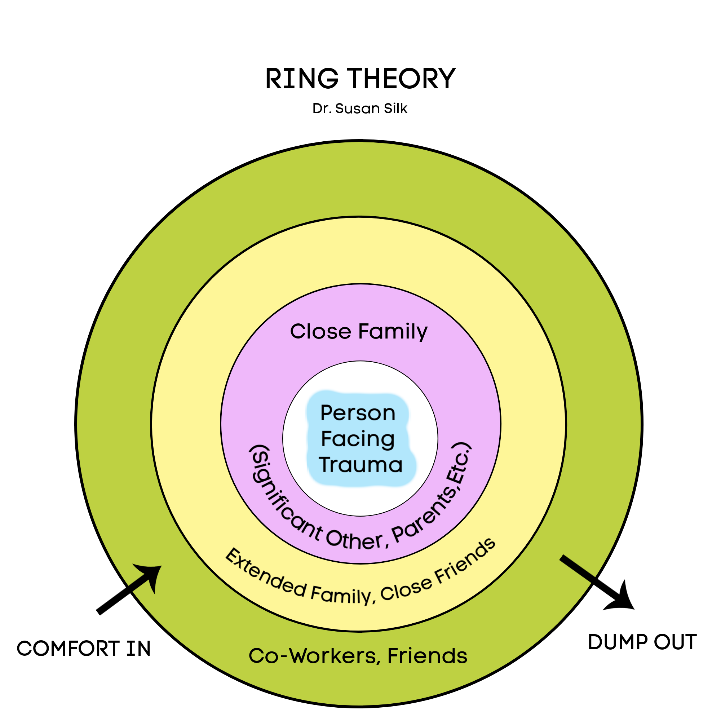
  • Comfort In, Dump Out:  Susan Silk, a clinical psychologist, wrote an op-ed for the LA Times in which she shared her fantastic “Ring Theory” for helping people in crisis:


“Draw a circle. This is the center ring. In it, put the name of the person at the center of the current trauma. Now draw a larger circle around the first one. In that ring put the name of the person next closest to the trauma. Repeat the process as many times as you need to. In each larger ring put the next closest people. Parents and children before more distant relatives. Intimate friends in smaller rings, less intimate friends in larger ones. When you are done you have a Kvetching Order. One of [my] patients found it useful to tape it to her refrigerator.


Here are the rules. The person in the center ring can say anything she wants to anyone, anywhere. She can kvetch and complain and whine and moan and curse the heavens and say, “Life is unfair” and “Why me?” That’s the one payoff for being in the center ring.


Everyone else can say those things too, but only to people in larger rings. When you are talking to a person in a ring smaller than yours, someone closer to the center of the crisis, the goal is to help. Listening is often more helpful than talking. But if you’re going to open your mouth, ask yourself if what you are about to say is likely to provide comfort and support. If it isn’t, don’t say it. Don’t, for example, give advice. People who are suffering from trauma don’t need advice. They need comfort and support. So say, “I’m sorry” or “This must really be hard for you” or “Can I bring you a pot roast?” Don’t say, “You should hear what happened to me” or “Here’s what I would do if I were you.” And don’t say, “This is really bringing me down.”


If you want to scream or cry or complain, if you want to tell someone how shocked you are or how icky you feel, or whine about how it reminds you of all the terrible things that have happened to you lately, that’s fine. It’s a perfectly normal response. Just do it to someone in a bigger ring.


Comfort IN, dump OUT.”


Esti’s loss is unbearably painful for so many including the community as a whole who spent over a year davening, learning, and doing chesed in her merit. Her passing can raise deep theological questions and evoke a wave of pain and emotion in us. It is critical to be mindful of directing our pain and questions not in, towards the family and their closest circle, but out towards others who can comfort us.


Professionals have made themselves available to our community for support and comfort, collectively and individually.  I hosted a conversation with Rabbi Dr. David Fox, Director of Chai Lifeline Trauma and Crisis Services on the topic of trauma and loss. You can find it at youtube.com/rabbiefremgoldberg.


At the moment of crisis, family, friends and community often rise to the occasion. It is critical to remember the positive and helpful role that we can and must play when the acute phase passes. Shiva and shloshim may conclude but the pain of the family lasts well beyond the technical period of mourning. As the Moskowitz family, both parents and children, return to their routines, please make the effort to find the balance between treating them normally, sensitively, and giving them space with remembering their pain and being a comforting presence in their lives. 


Dr. Fox advised that we neither ignore, nor show excessive pity.  We shouldn’t avoid nor smother.  Don’t express greater grief or agony than the grieving family.  Don’t share how difficult this loss has been for you, how much pain you have been in or how many tears you have shed. Welcome them back, express how much they were missed, and reflect back the mood they are showing. 


May all those who are grieving find strength and comfort and may we share only simchas together.

Fan or Player? The Big Game Called Life

Over 208 million viewers tuned in at some point to watch last year’s Super Bowl.  In fact, the big game drew so much attention, that last year a 30 second commercial cost $7 million, or $233,333 per second.   Consider this – In contrast, only 158.4 million people cast a vote in the 2020 presidential election, which was considered an impressive turnout.  Indeed, the last ten Super Bowls attracted more than 150 million viewers while the 2020 election is the only presidential election to hit that mark.  This is not just a statement on the country’s priorities – data also suggests that people like to watch and be spectators to something big.


Vayishma Yisro kohen midyan chosein Moshe eis kol asher asah Elokim l’Moshe u’lYisroel amo, ki hotzi Hashem es Yisroel mi’mitzrayim.  Rashi, quoting the famous statement from the Gemara in Maseches Zevachim, asks, mah shemuah shama ubah?  What did Yisro hear that inspired him to come. Rashi answers he heard about the splitting of the sea and the war with Amalek.


The question of the Talmud is perplexing. What do you mean “What did Yisro hear that made him come,” did the Rabbis not read the end of the pasuk, where it clearly states what Yisro heard? 


But there is something that troubles me much more, that is indeed somewhat staggering.  While we read this week of the impressive arrival of Yisro, how he abandoned all of the other religions and modes of worship to join the Jewish people in the desert, we never find out what actually happens to him.  The pasuk tells us a little later, Vayeshalach Moshe es chosno, vayeilech lo el artzo.  Moshe sends off his father-in-law, and he goes to his land.  Why didn’t Yisro stay, where did he go off to?  What ultimately happens to Yisro?


Indeed, we do encounter Yisro one more time.  He reappears amidst the drama and saga of Jewish History.  In the book of Bamidbar, Yisro reemerges among the nation of Israel, but again seeks to depart back to his home.  This time, in a striking departure from what we would call normal behavior between a son-in-law and father-in-law, Moshe begs, pleads and implores Yisro to stay. 


After a brief back and forth, the discussion ends abruptly and we are again left without knowing what happened to Yisro.  Indeed, the Torah literally leaves it a mystery: did Yisro ultimately reside among the Jewish people or did he move on?  The text is so ambiguous that it leaves room for the commentators to debate the issue.  The Ramban explains that Moshe’s arguments were so cogent and convincing that Yisro yielded to the request and remained among Bnei Yisroel.  The Seforno comments that Yisro followed his earlier pattern and once again split off from the Jewish people and headed home. 


The question for us, though, is why would the Torah omit this seemingly important fact, this very relevant detail?  We heard so much about his arrival, why not include whether or not he stayed?


The answer to both questions, I believe, is the same.  In truth, the Torah is not concerned with what ultimately happens with Yisro.  Where did he live, how many children did he have, what minyan did he daven at, what kind of yarmulke did he wear, all of this is not what we learn from Yisro.  The Torah is most impressed with, and wants to impress upon us, how Yisro did not exist in life as a spectator, an observer, but rather lived by listening carefully and by being moved by what he heard.  He didn’t watch from the sidelines, but he decided to enter the game.


The Talmud wasn’t asking what did Yisro hear that made him come, that’s clear from the pasuk. Look at the language of the question again. The Gemara didn’t ask mah shemuah shama, what did Yisro hear, it asked mah shemuah shama u’bah, what did Yisro hear that made him come, that got him off of his couch, and to live life.


Yisro merits having a Parsha named for him—and not just any Parsha, the one that contains the most seminal event in Jewish History, matan Torah—because he taught us a critical lesson.  We must not live as spectators but we must enter the game.  All of Yisro’s contemporaries heard the miraculous events that occurred to the Jewish people.  We recite every day, Sham’u amim yirgazun, they all heard.  But Yisro didn’t hear as a spectator from the sideline, he really heard the message and was moved to action.


I am a sports fan.  There is nothing wrong with being a spectator at times but we have to distinguish between real life and leisure.    In his book ““The Meaning of Sports: Why Americans Watch Baseball, Football and Basketball and What They See When They Do,” Michael Mandelbaum, a professor at Johns Hopkins, argues that we escape our lives and live vicariously through the athletes we watch when we become spectators.  He writes, “The word sport is related to ‘disport’ to divert oneself.  Baseball, football and basketball divert spectators from the burdens of normal existence…The prominence of the word play in team sports reveals their affinity with drama, the oldest form of which is in English, the play and the participants in which the actors are by tradition like participants in games called players.”


In the 1950s, the Lubavitcher Rebbe zt”l met with a young man who was about to become a Bar Mitzvah. After meeting with him and giving him a bracha, he had one more question for him: “Are you a baseball fan?” The Bar-Mitzvah boy replied that he was. “Which team are you a fan of — the Yankees or the Dodgers?” The Dodgers, replied the boy. “Does your father have the same feeling for the Dodgers as you have?” No. “Does he take you out to games?”


Well, every once in a while my father takes me to a game. We were at a game a month ago. “How was the game?” It was disappointing, the 13-year-old confessed. By the sixth inning, the Dodgers were losing nine-to-two, so we decided to leave. “Did the players also leave the game when you left?” “Rabbi, the players can’t leave in the middle of the game!” “Why not?” asked the Rebbe. “Explain to me how this works.”


“There are players and fans,” the baseball fan explained. “The fans can leave when they like — they’re not part of the game and the game could, and does, continue after they leave. But the players need to stay and try to win until the game is over.” “That is the lesson I want to teach you in Judaism,” said the Rebbe with a smile. “You can be either a fan or a player. Be a player.”


This escape, this notion of living as a fan is perfectly acceptable for windows of time necessary to relax.  The problem is that this mindset, this attitude has pervaded much of our ‘real’ lives. What might be termed a spectator psychology has invaded virtually every area of human concern.  Far too many people sit on the sidelines and contentedly observe others.


People become ‘just spectators’ to their own lives. They therefore cannot act to improve their lives and to change what is going on in their lives any more than they can act to change what is going on in the movies or the soap operas.


In a reality TV, spectator society, it is so easy to sit on our couch and be critical of others.  It is easy to become complacent, satisfied and content watching those around us but not actually seeking to change ourselves, to embrace that which is correct or to make a difference. 


We don’t know what happens to Yisro, but it is unimportant.  What is important is that he taught us how to be a seeker and a searcher.  He taught us how to break the mold of those watching from the sidelines and make the decision to join the game.


Hashem tells Bnei Yisrael, Va’Esa Eschem al Kanfei Nesharim V’Avi Eschem Eilai, I will lift you up on the wings of eagles and I will bring you close to Me. The first move is made by Hashem; I will bring you close to Me. And in the next pasuk the Torah uses the term segulah: V’Heyisem Li Segulah Mikol Ha’Amim, you will be to me more beloved than all the nations.  He makes the first move and we respond. As the pasuk says in the end of sefer Eichah, Hashiveinu Hashem Eilecha V’Nashuva; Return us to You and we will respond with Teshuvah.


In just a few months we will sit at the Pesach seder and when it comes time to welcome Eliyahu HaNavi we will get up and open the door.  Let me ask you an obvious question: can Eliyahu not come through the chimney?  Can’t he crawl through the window or walk through a closed door?  Why do we have to open the door? If we want the geulah, the redemption to come, we can’t remain seated in our chairs as spectators, but we must get up and respond with action.


Are Safe Spaces a Danger?

After three seasons with little flu activity, the dreaded illness came back with a fury.  In the last few weeks, almost every family I know has been hit by either the flu, Covid-19, RSV, or some combination of them, leaving people feeling as sick as they have ever been and taking weeks to recover their strength and shake their cough. 


Why are people, particularly children, getting sick with every virus, all at once?  According to many experts, we are paying back a collective “immunity debt.”  


Though far from accepted by all, according to many, the result of the locking down, distancing, masking and sterilizing surfaces is an immune system that isn’t primed, engaged, and ready to fight what comes its way.  That isn’t to say those weren’t correct policies at the time, rather it is to recognize that there was an unintended consequence, immunity debt that was incurred when we essentially pampered and protected our systems so they were unprepared or primed to withstand the viruses that came their way.  Paying off debt is never fun and it especially hurts when the currency is viruses and respiratory diseases.


When I read about this phenomenon, I thought not about the flu or Covid, but about its implications or analog in the world of our emotions and mental well-being.  

In December, Stanford University’s IT department introduced the Elimination of Harmful Language Initiative with a long list of words and phrases it considers “potentially harmful” and suggestions of an alternative word or term. “Guys” is considered “gender-based” and it groups people into gender binary groups and recommend using “folks,” “people,” or “everyone,” instead.   “American” is discouraged because it “refers to people from the United States only, thereby insinuating that the US is the most important country in the Americas (which is actually made up of 42 countries)”.


Stanford’s committee recommends instead to use “U.S. citizen.”  At Stanford, you can’t “master” your subject, as “historically, masters enslaved people.”  Studies should never be “blind,” they should better be described as “masked.”  Don’t write a “white paper,” since it “assigns value connotations based on color, an act which is subconsciously racialized.”  Stay away from “war room,” which represents the “unnecessary use of violent language.”  Ironically, it suggested not using “trigger warning” because “the phrase can cause stress about what’s to follow.”


Not surprisingly, the list generated significant backlash and pushback causing the university to take down the website a few weeks ago, almost immediately after it had launched.  Steve Gallagher, Stanford’s chief information officer, wrote: “The feedback that this work was broadly viewed as counter to inclusivity means we missed the intended mark. It is for this reason that we have taken down the EHLI site.” 


It turns out that cancelling the use of trigger warning was triggering for those who want to be able to speak freely.  This episode and this failed attempt are a great illustration of the challenge to find the careful balance between promoting and pushing for sensitivity, while not creating an environment with an unintended consequence of over-sensitivity. 


On the one hand, we should be intolerant of abusive, inconsiderate, and insensitive language that unnecessarily hurts and harms people.  But on the other, we need to build people’s resilience and toughness to not be so sensitive to the point they are harmed or injured by words that had no negative intentions. We have made enormous progress in promoting more sensitive language but at the same we must not create such a regulated and sterilized world in which the slightest insensitivity will trigger victimhood and injury.


Are we unintentionally creating an emotional immunity debt that paradoxically puts the very people we are trying to protect in greater danger of being harmed?


Prominent NYU social psychologist Jonathan Haidt recently argued that Gen Z (those born between 1997 and 2012), has been set up for failure due to a confluence of social media, bad parenting, and a culture that emphasizes victimhood.  Gen Z’ers are “fragile,” he says, unable to cope effectively with the normal stresses and challenges of adulthood.


In their book, “The Coddling of the American Mind,” Haidt and co-author Greg Lukianoff coined the expression Safetyism. “Safetyism refers to a culture or belief system in which safety has become a sacred value, which means that people are unwilling to make trade-offs demanded by other practical and moral concerns.” They argue that all this protection, hypersensitivity and “safetyism” is in fact breeding anxiety, depression and the danger of significant mental health challenges.


When it comes to allergies, the thinking used to be the more precautions the better.  More and more schools went nut-free to protect those with dangerous allergies.  But it turns out, studies showed that allergy-free zones were not only ineffective in keeping people safe, they were often counterproductive because allergy sufferers developed a false sense of security.  Researchers noticed that Israel has a relatively low rate of allergies in general and one allergy in particular, peanuts, which is strange considering that not only do Israelis not shield children from peanuts, they bring them up eating them in the form of Bamba.  Ultimately, a study found that 1.9% of children with allergy risk factors who were fed peanuts developed an allergy by their fifth birthday while among children not given peanuts, the figure was 13.9%.  In other words, they found if you don’t want your children to develop a peanut allergy, don’t create an environment free of peanuts, feed them peanuts early and often. 


To be clear, I am not suggesting that we expose children to hurtful and insensitive language early or often so that they don’t later have an allergic reaction when they hear it.  It should be a universal belief that people should always take care with the words and language they use and certainly avoid saying anything to intentionally harm or offend.  People must also understand that sometimes their words can genuinely harm even if they did not intend to.


However, I do believe that our effort to create an environment preventing exposure to anything “triggering” can have the unintended negative consequence of lowering our “immunity” and heightening our “allergic reactions” when something is said or written.  We must not raise an overly delicate and fragile generation who can become emotionally injured or paralyzed too easily.


When Man is created, the Torah tells us, וַיִּפַּ֥ח בְּאַפָּ֖יו נִשְׁמַ֣ת חַיִּ֑ים וַֽיְהִ֥י הָֽאָדָ֖ם לְנֶ֥פֶשׁ חַיָּֽה, “God blew into Man’s nostrils a Soul of life, and he became a living creature.” Targum Unklus explains “living creature” means “a speaking spirit.”  What differentiates people from animals is our power of speech.  Indeed, Shlomo HaMelech (Mishlei 18:21) warns us: מָוֶת וְחַיִּים בְּיַד־לָשׁוֹן, “Death and life are in the power of the tongue.” 


Classically, this is understood as a caution to be vigilant and careful in our use of words and to ensure we don’t harm others with them.  Perhaps, though, it is also a warning not to allow our life or death, or happiness or sadness to be determined by the words of others.  Our job is to both be sensitive with how we speak to, and about others, but also not be overly sensitive regarding how others speak to us.  


We must condition ourselves and our children towards sensitivity while also building our resilience and tenacity.  We must not relinquish our happiness or well-being to the comments or even actions of others.  Let’s not create a collective emotional immunity debt or coddle those around us in a way that unintentionally harms the very people we are committed to protect and keep safe. 

Rabbi Efrem Goldberg

Join Our Community

Subscribe to our newsletter or connect with us on WhatsApp.