Teaching and Embracing the Sounds of Silence

It has been almost two weeks since the mysterious disappearance of Malaysian Airlines Flight 370.   As we follow the story the way we may read an incredible suspense novel – eager to skip to the last chapter to see how the story ends – it is easy to lose sight of how unbearably painful and excruciating every passing moment must be for the families of the 239 passengers on board.  The doubt created by not knowing the fate of their loved ones, and the inability to either begin grieving or rejoicing, must be beyond agonizing.


One of the most remarkable aspects of this story is the realization that despite how advanced our surveillance capabilities have become, and notwithstanding the sophistication of our satellite imagery and radar, we still have no idea of the whereabouts of this large aircraft and those on board.  Over twenty countries have joined the search.  Countless resources, agencies, and experts are working full time on finding this plane.  And yet, with all of that, after almost two full weeks, the one thing we know with certainty is how uncertain we are about what happened to this plane.


But that hasn’t stopped the talking heads and the 24/7 news channels.  From the moment this story broke we have watched, read, and listened to journalists interviewing experts offering conjectures, speculations, and theories.  Their response to the mysterious nature of this episode is to keep talking and speaking, though all the chatter has not yielded any real discovery or breakthrough.


“Vayehi bayom ha’shemini kara Moshe…va’teitze eish milifnei Elokim va’tochal osam vayamusu….vayidom Aharon.”  Aharon must have woken up that morning thinking, “This will be the best day ever.  It simply can’t get any better.”  It was opening day at the Mishkan.  He and his sons would be installed as the Priests and would initiate the very first service in the history of this magnificent edifice.  The nation was there, the elders were gathered, and with the encouragement of his younger brother Moshe, Aharon was ready to begin.


Suddenly, seemingly out of nowhere, Aharon then experienced the absolute worst nightmare of any parent – the loss of his children.  There is no reason given, no explanation and no cause of death.  What began as the best day of his life suddenly was transformed into the worst.


How did Aharon react?  Did he let out a scream?  Did he sob uncontrollably?  Did he challenge God and storm out of the Mishkan defiantly?  Va’yidom Aharon, he fell silent, he was still.  What was the nature of Aharon’s silence?  After all, there are many different forms and causes of silence.  There is the comforting and supportive silence of companionship.  There is the awkward and uncomfortable silence between conversations.  There is the peaceful and serene silence of a moment of tranquility.  And there is the silence of shock, speechlessness, and astonishment.


Our commentators debate and disagree about the nature of Aaron’s silence.  Rashi describes Aharon’s incredible reward for remaining silent and faithful in the face of profound adversity.  The Ramban says originally Aharon was distraught and indeed cried.  However, Moshe provided words of comfort and consolation.  Aharon’s silence was a reflection of the effectiveness of Moshe’s words.  The Seforno says Aharon’s silence reflected his consolation in knowing that his sons had died al Kiddush Hashem, in the sanctification of Hashem’s name.


Interestingly, these commentators all see Aharon’s silence as reflecting that he had nothing to say either because he was comforted or because he fought his desire to scream out.  However, I think there is another way of interpreting Aharon’s silence.  Perhaps by being quiet, Aharon was actually speaking volumes.


Curiously, the Torah does not say “vayishtok Aharon, the more conventional word used for silence, which may have been the more logical choice.  Why does it use the term va’yidom?  I would like to suggest there are two variants of silence.  We all remember hearing as children, sheket b’vakasha – hey.  Sheket, is just the absence of words. Nobody speaking.  Vayidom is so much more:  It is not just a passive absence of words, but is an active state of mind, a way of being, and a loud expression.


Rav Shlomo Wolbe z”tl, the great Mashgiach of Yerushalayim, has a fantastic insight.  He writes – “We teach a child to speak. Once we teach him to speak, this becomes his nature, to speak and to chatter without end.  Do we ever teach this child how to be silent as well? Behold, silence is also a tool.”  In other words, the default should not be that we speak and in between the words there is silence.  Silence is an expression as well.  It is a tool, and through it one makes a statement.  When it comes to children, we must teach and encourage the tool and skill of silence just as we teach the tool and skill of speech.


Silence is not what happens when we catch our breath in between speaking.  Silence itself can be a form of crying out.  Indeed, the Kotzker Rebbe described a certain type of silence that represents yelling quietly.  Dovid Ha’Melech in Tehillim (65) tells God, lecha dumiya tehila,“silence to you is praise.”   Elsewhere, in Tehillim (62) he tells us, “My soul waits in silence only for God; from Him comes my salvation.”


Sometimes more can be said with silence than could ever be articulated with words.  It wasn’t that Aharon had nothing to say and therefore he was silent.  He used a shattering and stunning silence to say so much about himself and his relationship and faith in Hashem.  In fact, the Rambam quotes a reading of the Targum that translates vayidom as u’shavach Aharon, and Aharon praised Hashem through his silence.


Aharon used silence to make a statement of faith in reacting to a horrific tragedy.  But silence can and must also be used to communicate other statements as well.  Silence can express companionship and camaraderie.  Indeed, Jewish law mandates that we may not speak to a mourner sitting shiva until he or she addresses us first.  If in fact he or she prefers to be comforted by our silent presence, such is our sacred duty, despite the awkward or uncomfortable feeling it may generate.


Silence can also express closeness and familiarity.  When strangers spend time together, they feel a need to fill the air with conversation and dialogue.   But when a seasoned couple goes out for dinner or dear friends share a cup of coffee, they are perfectly satisfied with moments or even minutes of passing silence.


Silence also makes room for thought.  When our lives are filled with endless noise, the radio blasting, the TV playing, the phone ringing, or the emails or texts pinging, we don’t have the ability to reflect, contemplate, or think.  We have grown increasingly uncomfortable with silence.  When we get into our car, we immediately turn on the radio.  When we step into an elevator, we instinctively reach for our smartphone.  But silence is critical and indispensable to our mental health and sanity.  We must learn to embrace it and appreciate it.


And lastly, silence can express modesty and humility.  Rebbe Shimon said, “Kol yomai gadalti bein haChachomim, v’lo matzasi l’guf tov m’shtika.  All of my days I grew up among the greatest of Sages and, in observing them, I found nothing better than the art of silence.”  Being silent and letting others speak creates opportunities for us to learn, bond, and connect.   We don’t always have to have an opinion or a response.  It is ok to remain silent and to humbly absorb what others are saying without feeling a need to make them hear our voice.


Though I know it is the job of newscasters and journalists to speak, even as the facts yet unfold, I can’t help but find the media’s endless talk regarding the missing plane and the fate of 239 people distasteful, considering how little we yet know and just how ignorant we remain.


As Rav Wolbe taught, let’s do more to teach and model the wisdom of silence and not just the power of words.  If we feel a need to speak about this plane, let it be to pray for the safety of those on board and that God give strength and courage to the members of their family.


Israel – A Major Part of Judaism

Once again, this year’s AIPAC policy conference proved to be nothing short of extraordinary.  Being together with 14,000 like-minded pro-Israel advocates, people of all religions, ethnicities and backgrounds, united by our shared passion and commitment towards a strong U.S.–Israel relationship, was exhilarating and electrifying.


This year’s goose bump moments for me included observing a showcase of some of Israel’s latest innovations, hearing about Israel’s humanitarian efforts around the world, listening to an African American Pastor who recently accompanied a plane bringing the last Ethiopian Jews to Israel, welcoming Israel’s first female Ethiopian member of Knesset who walked from Ethiopia barefoot at three years old, hearing from a Latina Union Leader who, on an AIPAC-sponsored trip, learned about Israel’s incredible immigration accomplishments and fell in love with Israel, among many other moments.


A wide range of opinions and diverse perspectives on what is best for Israel was represented inside the Washington Convention Center.  We heard from leading Republicans and Democrats, from hardline Minister Naftali Bennett and from the head of the Labor party and opposition leader Yitzchak “Buzi” Herzog.  We were addressed by Prime Minister Bibi Netanyahu and, though unfortunately she was ill and couldn’t attend, Minister Tzipi Livni was scheduled to speak.  I am extremely proud that our local delegation to Policy Conference included almost every Rabbi from Boca Raton, including Reform, Conservative, and Orthodox, all of whom have significantly differing views, but share friendship, mutual respect and a common love of Israel.


Transcending the diverse opinions of the attendees was a unified commitment and devotion to Israel, the eternal homeland of the Jewish people.  Tragically, like every year, across from the convention center there were also diverse groups including Neturei Karta, anti-Israel activists, and even people waving Hezbollah flags, united, not in their love for Israel, but by their hatred of her.  Thank God the snow and bitter cold drove them away after the first day.


On the two sides of the street the line was clear between Israel’s friends and her enemies.  Sadly, in the world at large that line is getting blurrier and blurrier.


In an article entitled “With Sadness, I’m Getting Off the Hillel Bandwagon,” a South Florida retired Rabbi, wrote:


Hillel is no longer the Hillel of yesteryears. In 2010 the national Hillel issued guidelines as to what is permissible dialogue at Hillel — speakers who “delegitimize, demonize or apply a double standard to Israel,” support boycotts, divestments or sanctions against Israel or “foster an atmosphere of incivility” are banned from Hillel. This has essentially banned all liberal Jews who love Israel but disagree with the current Netanyahu government from Hillel involvement…


I’m a Zionist. I love Israel — that’s the reason I’m critical of the current Israeli government and support a reasonable peace agreement with Palestinians. But I refuse to let my Zionism dominate my Judaism. The love of Israel is only a part of Judaism. The Zionist movement is only 150 years old; Israel is only 65 years old. Judaism has existed for thousands of years without both. Unfortunately, for too many years American Jewry has made Israel the major part of its Judaism. It’s a part, but not the major part...I’m not calling for a boycott of Hillel. The only thing I’m boycotting are settlements in the West Bank. (Emphasis mine)


First of all, it is tragically sad that an actress, Scarlett Johansson, displayed greater understanding of the issues and love of all Israel than a Rabbi who should know better. Boycotting the West Bank means boycotting products like SodaStream, which employs a thousand Palestinians who are deeply appreciative for their jobs.  Is the Rabbi calling for a boycott of any other country?  Is he boycotting countries that regularly violate human rights and slaughter their citizens, including children?  Calling only for a boycott of parts of Israel while ignoring corrupt, tyrannical regimes elsewhere, is hypocritical at best and outright anti-Semitic at worst.


But even more significantly, the Rabbi displays incredible ignorance in designating Israel a minor part of Judaism (even if it is minor in reality for too many Jews).  Countless Torah sources indicate Israel’s centrality to our history and destiny, our identity and our practices, our dreams and our longings.  Our prophets describe God’s vision for a united Am Yisroel (Jewish people), living in Eretz Yisroel (Israel), while observing Toras Yisroel (Jewish law).


The Talmud (Taanis 10a) tells us: The Land of Israel was created first and the rest of the world was created afterwards, as the passage states (Proverbs 8:26): “Before He made Eretz (land) and Chutzos (outlying areas).”  This is the source of our practice of referring to the land of Israel as Eretz Yisroel and the rest of the world as “Chutz La’aretz,” outside “The” (singular) land.


Almost all of our Prophets lived in Israel or prophesized about it.  Almost the entire Tanach was written in Israel.  The Ramban (Vayikra 18:25) goes so far as to suggest mitzvos are authentically fulfilled only when observed in Israel.  Outside of Israel, our religious lives are essentially practice for when we eventually return home.  Israel is the only place in the world in which mitzvos (commandments) depend on the land, the earth itself.  Of the 613 commandments, 343 (56%) depend directly on the Land of Israel, such as tithing and the sabbatical year.


Wherever a Jew is in the world, he or she faces Israel during prayer.  Synagogues across the globe are built facing Israel.  Our prayers are replete with references to Israel and Jerusalem.  Both the holiday of Yom Kippur and our Pesach seder conclude with the declaration “Next Year in Yerushalayim.”  Jewish weddings end with the breaking of a glass in fulfillment of the verse (Tehillim 137:5) – “If I forget Jeruslaem, let my right hand be forgotten.”  At Jewish burials anywhere in the world, we sprinkle earth from the Mount of Olives, binding the deceased with the eternal resting place of the Jewish people – Jerusalem and Israel.


From these few sources alone it is clear that the Rabbi could not be more wrong.  It is not American Jewry who has made Israel a major part of Judaism; it is Judaism itself that places Israel at the center of our national identity, religious practices, prayers, lifecycle events and more.


Even if he or others deny the authority of the sources I reference or reject the practices I cite, shouldn’t Israel be central to Jewish life simply because it is the one and only Jewish homeland, a place of refuge, immigration and a source of protection for Jews all over the world?  The rise of anti-Semitism in Europe, coupled with the devastating results of the recent Pew study on the American Jewish community, make it clear that the future of vibrant, strong Judaism is in Israel.  Israel now has more Jews than the rest of the world combined.  That alone makes it worthy of being a “major part” of Judaism.


And if you believe the few sources I quote acknowledge our affection for the land of Israel but not necessarily the State of Israel, I would ask you to consider the following.  What would have happened to the tens of thousand of Ethiopian Jews had the State of Israel not courageously rescued them and transported them to Israel?  What would have happened to the more than one million Jews from the former Soviet Union had they not been welcomed and absorbed into Israel?  Would Torah, Yeshivos and Kollelim have proliferated and thrived in the land of Israel in an unprecedented way without the support and protection of the State of Israel?


It is not just that retired Rabbi challenging the centrality of Israel to Judaism.  An active Rabbi, quoting Prime Minister Netanyahu from AIPAC, posted the following this week:


‘It’s about time the Palestinians recognize Israel as a Jewish state – we have only been there for 4,000 years.’ – Benjamin Netanyahu


The second half of this line is one of the worst arguments for Israel. Please stop making it.


Please don’t stop making it Mr. Prime Minister, because it cuts to the heart of the matter.  We don’t need to remind people we have been there for 4,000 years in an effort to restore the world to the way it looked thousands of years ago.  We need to pronounce our lengthy ties to the land because it challenges a narrative that Israel is a modern invention, a prize to the Jew for surviving genocide and introduced only recently as a major part of Judaism.  In fact, just this week, in comments published by his official WAFA news agency Mahmoud Abbas said there’s “no way” he’ll recognize Israel as a Jewish state.


Thank God, while these two Rabbis don’t “get it,” Senator Robert Menendez, a Democrat from New Jersey who chairs the Senate Foreign Relations Committee, does and stated it articulately at AIPAC, broadcast over C-Span for the world to hear:


I have said many times before and will repeat again today, the Holocaust was the most sinister possible reminder that the Jewish population in exile was in constant jeopardy. It was a definitive argument that anti-Semitism could appear anywhere, and its horrors galvanized international support for the State of Israel. But, while the Shoah may have a central role in Israel’s identity, it is not the reason behind its founding, and it is not the main reason for its existence.


The modern reestablishment of the state of Israel has long and deep roots going back to the time of Abraham and Sarah. There is no denying the Jewish people’s legitimate right to live in peace and security on a homeland to which they have had a connection for thousands of years and that has not changed through the centuries.


Too often the past is, truly, prologue, and next week — March 15th — is the start of Purim, a holiday that marks the deliverance of the Jewish people in the ancient empire of Persia – now Iran. As the story goes, a plot had been hatched to destroy all Jews in the Persian empire, but Mordecai and his adopted daughter, Esther, foiled the plot and the day of deliverance became a day of celebration and feasting – Purim.


The parallel is all too obvious when it comes to the situation today in the Middle East, and the protection of the Israeli people from the threat posed by a nuclear Iran. Let us pray that – if the time should come – together we will be like Mordecai and Esther, we shall foil Iran’s nuclear plot, and deliver the Jewish people again as well as protect the world from a nuclear threat.


Minister Naftali Bennett said it well in a recent interview with the BBC: “We’ve been in this land way longer than America has been in American land, and for that matter longer than the British have in the British land. I do recognize that in our land there are two million Palestinians. They’ve got aspirations—they’re not going anywhere, but we’re not going anywhere. So we’ve got to figure out how to live together, how to work it out.”


If the Rabbi I reference is “getting off the Hillel bandwagon,” let’s fill his seat tenfold with knowledgeable, well-informed, pro-Israel, proud Zionists who will unapologetically play the role of Mordechai and Esther and confront our enemies by standing up for a major part of Judaism, the one and only Jewish homeland – our beloved State of Israel.


Ask What’s Working, Not What’s Broken

Last week, I had the privilege of joining 30 lay and professional leaders from South Florida on the Jewish Leadership Coalition’s 2nd annual mission to Tallahassee. Florida law allows corporations to receive a dollar for dollar tax credit when they donate funds to the Step Up For Students scholarship program, which provides scholarships to children from low-income families.  The scholarship is awarded to the child, not the school, enabling the family to choose the school that is best for their child, be it public or private school.


This academic year, Jewish day schools in South Florida are receiving $4.8 million from the Step Up For Students scholarship program, but the potential exists to receive much more.  Currently, there is a cap to the scholarship fund limiting how many dollars can be donated while getting a tax credit.  Moreover, the current law has a narrow definition of low income that restricts the candidates who qualify for receiving aid.


Our broad and diverse group spent the day lobbying on behalf of proposed legislation currently in the Florida House and Senate that would raise the cap and raise the income level for eligibility.  This proposal specifically, and the goal of school choice in general, has strong bipartisan support in the Florida government including the Governor, CFO, Senate President, and the Speaker of the House.


Our meetings were productive and positive and our message was mostly greeted warmly and enthusiastically.  Irv Slosberg, who represents the 91st District, which includes Montoya Circle,  was non-committal when asked if he would vote in favor of the proposed legislation expanding Step Up For Students.  I urge you to contact his office at (561) 496-5940, communicate how important this issue is to you, and ask him to vote favorably on the pending legislation.


I am deeply grateful to the leadership of Step Up for Students and the Jewish Leadership Coalition for their efforts on behalf of the Jewish day school tuition crisis.  Over the last few years, I have participated in countless conversations, conventions, and conference calls hosted by a number of organizations, all in search of relief for parents suffocating from the burden of high tuitions.  I believe the efforts of the Jewish Leadership Coalition have not only been the most effective to date, but also have the greatest promise in creating at least a partial solution to this problem.


On the plane back from Tallahassee, it occurred to me that while so much time, energy, and money have been invested in addressing the tuition crisis, not nearly the same resources have been poured into addressing a parallel crisis in our Jewish educational system, a crisis that is affecting schools from every segment of the Jewish people.   For all of the sacrifice and money we invest in our children’s Jewish education, are we producing inspired, informed, and passionate Jewish young people?


Many teens, including those currently enrolled in orthodox schools, unabashedly admit to laxity in observance and a general disaffection with the observant lifestyle and its rigorous demands.  Many express a sentiment of, “if these practices don’t ‘do anything’ for me  – and they don’t – why should I observe them?”


For a long time, the term “at-risk teens” referred to young people leaving the traditional Jewish educational system and getting involved with dangerous substances like alcohol or drugs.  Today, “at-risk” can more broadly be used to describe children who are remaining in the system, attending our schools and Shuls and growing up in our homes, but forsaking observance privately, and even publicly.


What can we do to address this crisis, one that is growing?


Two weeks ago, BRS was privileged to host world-renowned “happiness expert,” Dr. Tal Ben-Shahar.  In his seminar, he described how half a century ago, traditional psychology tried to address the at-risk population in inner cities and dangerous areas.  The question they asked was why do so many in these communities fail?  Why do they resort to drugs, why is crime high, etc.?  They came to conclusions and designed programs around attempting to address why so many fail.  In the year 2000, UNESCO did a study of 32 countries to assess the impact of these programs over 50 years.  They concluded that after millions of dollars, countless hours of manpower, and tremendous resources, the net impact of the programs on the at-risk population was ZERO.


In the 1980s, the field of Positive Psychology began and it radically changed the question.  Instead of asking why are so many failing, researchers began to ask, why do some succeed?  What makes some thrive despite their unfavorable conditions and environment?  Dr. Ben-Shahar described that researchers identified the presence of several attributes and practices that were common to those who flourished — including optimism, resilience, volunteerism, identifiable role models, physical activity, and well as others.  They then designed programs for the at-risk population based on teaching and modeling these character traits.  In a very short time, they were able to measure fantastic results and significant impact on the at-risk population.


Dr. Ben-Shahar quoted management expert Peter Drucker who said, “The most serious mistakes are not being made as a result of wrong answers.  The truly dangerous thing is asking the wrong question.”


Drawing from his presentation, it is worth considering that perhaps we are asking the wrong question when it comes to our children.  Instead of examining why some of our children are disenchanted and disillusioned with observant Judaism, let’s identify our Jewishly enthusiastic young people and ask, what’s working, why are they inspired?  I suspect we will find many of the same answers Dr. Ben-Shahar spoke about, but the exercise may reveal other variables that we can incorporate into our Jewish educational institutions and into our homes and Shuls.


Dr. Ben-Shahar described that in the search for happiness we tend to focus on what isn’t working and try to fix it.  We spend too little time examining what is working in our lives and improving and enhancing it.  He encouraged us to ask ourselves — what are we good at? What energizes us?  What are our strengths?  What gives us strength?


Like the tuition crisis, the inspiration crisis won’t be solved overnight.  Unlike the tuition crisis, legislation and the influx of greater financial assistance will not bring a solution.  We must continue to work on communicating the relevance, meaning, and timeless values of Torah to our children and model passion, enthusiasm and devotion.  What I learned from Dr. Ben-Shahar is that in addressing the challenges that we face, instead of focusing on what’s broken alone, we need to focus on what is working and on our strengths, and then leverage the answers to those questions into a brighter future.


Being Selective When Lending our Microphone


Rashid Khalidi, the Edward Said Professor of Modern Arab Studies at Columbia University, is well-known for his anti-Israel and anti-Zionist positions.  He has characterized Israel as a “racist” state and described it as “basically an apartheid system in creation.” In an article in the Chicago Tribune, he wrote, “Israel is a state that has a powerful army with the awful weapons of mass destruction (many supplied by the U.S.) that it has used in cities, villages and refugee camps.”


Khalidi, who once served as a PLO spokesman, dedicated his 1986 book, Under Siege: P.L.O. Decision-Making During the 1982 War, to Yasser Arafat.  He begins the book with a glowing tribute to anti-Israel fighters, individuals whom we would label terrorists.  He has consistently shared anti-Israel vitriol and rhetoric, distorted facts, and even fabricated a quote to paint Israel in a negative light.  He praised a leader of the PLO group that slaughtered Israeli athletes at the 1972 Munich Olympics, saying, “Abu Iyad will be sorely missed by the Palestinian people to whom he devoted his life.”


The fact that Rashid Khalidi, who has made a career out of passing off propaganda as scholarship, serves as a professor at Columbia University should not surprise you.  After all, Columbia’s commitment to academic freedom led them to host Mahmoud Ahmadinejad, the former President of Iran who has publicly denied the Holocaust and called for genocide against Israel countless times.


What you should find incredibly surprising and disturbing is that more than 100 students at one of the most prestigious Modern Orthodox schools in the country have signed an online petition calling on their head of school to allow Rashid Khalidi to speak on their campus.


The petition reads:


“I, an open-minded, intellectually honest, and unprejudiced student of the Ramaz Upper School support The Ramaz Politics Society’s (RamPo) event on the Israeli-Palestinian conflict headlined by Columbia Professor Rashid Khalidi. I believe it is critical that Ramaz students are exposed to different perspectives and that open dialogue be encouraged at Ramaz—not limited. I call upon Head of School Mr. Shaviv to realize how important academic equitability is to the Ramaz community and reverse his prohibition on Professor Khalidi’s address to RamPo.”


I strongly applaud and congratulate Mr. Paul Shaviv and the leadership of Ramaz for denying the student’s request to invite Khalidi.  Their stand is courageous and commendable and they deserve our support and encouragement in the face of this public petition.


To be clear, I have no objection to inviting divergent voices on the Israeli Palestinian issue, including people advocating on behalf of the Palestinian narrative and perspective.  What I do object to is the foolishness of petitioning for an invitation to someone who praises terrorists who wantonly murder innocent people and supports those who seek the complete abolition of the State of Israel.


I have no doubt that the more than 140 signatories to the petition love Israel and care deeply for the security of the Jewish homeland.  They have an outstanding role model of Israel advocacy and support in their esteemed Principal, Rabbi Haskel Lookstein.  The students’ effort is not a reflection on the school, the teachers, or the administration.


To me, it is a sad and sober reflection of how the pursuit of unbridled pluralism and uninhibited academic freedom has penetrated into our Orthodox educational system.  We all know that if our children choose a secular college they will likely engage a campus pregnant with these ideals.  This episode has exposed us to the sad fact that some of our children are already embracing this perspective even while they are yet under our roofs and influence.


What’s remarkable to me is that it isn’t just young, idealistic students whose commitment to diverse views stretches so far as to encourage an Orthodox high school to provide a venue for its students to be exposed to the outrageous arguments and positions of a blatantly anti-Israel personality.  Plenty of adults are egging them on.   For example, one commenter on the petition’s website states, “As a graduate of a modern orthodox high school, I strongly support exposing students to diverse points of view on the Israeli-Palestinian conflict. Failure to do so is academic malpractice.”


Addressing the petition, a blogging rabbi wrote:


If a high school student can learn Gemara and understand the difference between a Hava Amina and a Maskana or see machlokes among tanaim, amoraim, and rishonim then I see no reason they can’t have a speaker present a side of an issue the school does not agree with. Let them rebut after he leaves.


He and these students are dangerously wrong.  Yes, Judaism endorses a level of pluralism.  Proudly, the motto of Boca Raton Synagogue is “Valuing Diversity, Celebrating Unity.”  As Torah Jews, we welcome, honor and respect rigorous debate.  The hallmark of our greatest sages was their willingness and desire to listen to and hear the opinions of one another.  The Talmud (Eruvin 13b) says that we follow the opinion of Beis Hillel over Beis Shammai because the students of Beis Hillel would first listen to and consider the opinion of the students of Beis Shammai before expressing arriving at their own conclusions.


Yes, there are seventy faces to Torah, and yes, the Beis Ha’Mikdash had many entrances corresponding with the diverse legitimate approaches to God.  But the pluralism of the Talmud and the academic freedom of our tradition has limits.  Our sages were eager to dialogue with and debate one another, but they didn’t invite heretical sects like the Sadducees or Karaites to participate.  The Talmud in Chagiga cautions us not to read literature that can persuade us negatively.  Put differently by British author Sir Tery Pratchett, “The trouble with having an open mind, of course, is that people will insist on coming along and trying to put things in it.”


Our great Rabbis certainly knew the difference between a hava amina, an initial thought, and a maskana, a compelling conclusion.  Nevertheless, they understood that pluralism has boundaries and limits and they taught that there are opinions and ideas that simply don’t belong in the conversations we host.   We exclude them not because we are threatened or scared of them or because we lack the confidence that we can provide a compelling rebuttal to them.  We exclude them because they simply don’t deserve the publicity or legitimacy that including them would provide.


Would these students or the rabbi quoted above apply their logic to an Orthodox school hosting a staunch spokesperson for Jews for Jesus?  Would they petition a platform for a vocal Christian missionary to articulate his arguments in favor of conversion of Jews to Christianity?  Would they invite a Holocaust denier to share his perspective or a white supremacist to promote his agenda all in the interest of “open-minded, intellectually honest, and unprejudiced” dialogue?  Clearly, there are voices, positions and arguments that are so outrageous and outside the bounds of reasonable discourse that they don’t deserve our recognition, consideration or audience.  Why are Rashid Khalidi’s views less dangerous, less outrageous or any more legitimate than these others?


Should our Modern Orthodox schools have lower standards than Hillel on college campuses?  After a recent controversy involving the Hillel at Swarthmore University, Eric Fingerhut, president of Hillel International, distributed a letter in which he wrote, “Let me be very clear — ‘anti-Zionists’ will not be permitted to speak using the Hillel name or under the Hillel roof, under any circumstances.”


My objection to Khalidi speaking has nothing to do with fear or hesitation to hear other opinions or perspectives and a lack of confidence in our own. As a person who celebrates terrorists such as the leader of the Munich massacre, to give him a platform undermines the most basic concepts of justice, mercy, fairness and the value of life that our Torah mandates we teach the world. We should no sooner give Khalidi a platform than Al Qaeda supporters, white supremacists, anti Semites, liars, cheaters, embezzlers, terrorists, murderers, pedophiles, etc.  Would anyone sign a petition calling for a vocal racist or anti-gay spokesperson to be invited to speak?


Imagine students at a Jewish high school in Shushan urging an invitation for Haman to speak because it is important to hear other perspectives.  We have nothing to apologize for when we exclude voices and opinions that are outrageously out of the bounds of moral discourse.


We must encourage our young people to study, debate and pursue the diverse pluralism of Torah truths.  We should applaud and support the goal of being an “open-minded, intellectually honest, and unprejudiced student.”


However, at the same time we must teach our students the risk they run if they are not careful; in the words of Arthur Hays Sulzberger, former publisher of the New York Times, “I certainly do not advocate that the mind should be so open that the brains fall out.”


Don’t Just Pursue Happiness, Experience It


When the Founding Fathers included the pursuit of happiness as an American right and entitlement, it is almost as if they conceded that happiness can be pursued, but it is unlikely to ever be attained.  If you look around, you can’t help but notice that for many, the pursuit has grown tiring and indeed, many have given up.  In the last twenty years, there has been an astounding increase in antidepressant use by Americans. One might even suggest that the growing effort to legalize marijuana nationally is driven by a community eager to find pleasure and happiness, even if it is by escaping reality.


In 2006, Harvard psychologist Daniel Gilbert wrote a book called “Stumbling on Happiness.”  In it, he argues that the things and experiences we typically predict and imagine will bring us happiness, rarely do.  Rather, he says, happiness is elusive and we should learn from how others have stumbled upon it.  The first part of his thesis is undeniable.  Study after study has concluded that money, fame, and power not only don’t contribute to happiness, but often are obstacles to and detractors from experiencing it.


As we find ourselves in the first of two months characterized by happiness and in which we are charged to be marbeh b’simcha, increase and expand our joy, it is worth asking ourselves: what are the true keys to happiness?  This Sunday evening, BRS is privileged to host world-renowned happiness expert Dr. Tal Ben-Shahar, who has written best selling books on the topic as well as having taught a course on happiness at Harvard, the most popular class in the university’s illustrious history.  I strongly encourage you to join the over-325 people who have already preregistered for this incredible seminar.


Obviously, Dr. Ben-Shahar does not need my endorsement, nor am I so presumptuous to suggest I can add to his teachings.  However, I would like to share with you three suggestions from Torah sources for finding happiness as a complement to his upcoming seminar.


1)   Happiness is not an emotion; it is a decision.  Stop waiting passively to feel it and start actively choosing to be it.


In Parshas Ki Savo, the Torah says, u’vau kol ha’berachos ha’eleh, v’hisigucha, which literally translates as “All these blessings will come upon you and overtake you.”  What does it mean v’hisigucha, to be overtaken by blessing?  Rav Shlomo Yosef Zevin explains that Hashem gives each of us beracha, blessing in our lives.  That blessing can manifest itself in all types of form – material possessions, meaningful relationships, special skills, wonderful opportunities, family, and the list could go on and on.   The first blessing is the particular gift.  But even more important and an even greater blessing is v’hisigucha…to recognize, appreciate and acknowledge the blessing.


Simcha, happiness, occurs when we make the decision to focus on the blessings in our lives, no matter how challenging or formidable the struggles we face simultaneously.  If our happiness results from the blessings we already have, we can always find happiness because we always have at least something.  But if our happiness is determined by what we don’t have, “If only I had more money, a nicer house, a better job, a more loving spouse, more loyal children, etc.” we will never be happy because we can always have more.  Therefore, by definition, there will always be something we don’t have.


The decision to be b’simcha, happy, doesn’t only affect us but it can positively influence our environment and family. Dr. Nicholas Christakis, a physician at Harvard Medical School, authored a study that concludes that happiness, scientifically speaking, is literally contagious.  The same way a person yawning causes , others to also begin to yawn, when one person smiles or is happy, it is infectious and draws smiles and happiness from others.


It has been suggested homiletically that the etymology of the word simcha comes from sam-mo’ach, focus your thoughts.  Make the decision to be happy and the feeling will follow.


2)   Happiness comes from giving not from getting.  It comes from being a giver, not a taker.


After many years concentrating on what makes people depressed, social scientists are now beginning to study what makes people happy.  Their answer is counter-intuitive.  Paradoxically, it turns out the biggest obstacle to achieving happiness is our own pursuit of it.  When happiness is defined by our needs, our wants, and our desires, it will remain elusive and unattainable for we will never have everything.  Instead, studies show that people report better health and greater happiness when they volunteer for a worthwhile cause or spend time helping others.  Moreover, studies have shown the efficacy of volunteering and helping in combating depression.


Happiness does not result from a focus inward, but it results from the deep satisfaction and profound gratification of imitating God and helping others.  At the end of Hilchos Megillah (2:17), the Rambam makes an incredible comment.  He asks, if a person has limited funds and has to choose between having a more lavish and luxurious Purim meal, more extravagant and impressive mishloach manos, or giving more matanos l’evyonim, money to the poor, what should he do and why?


The Rambam codifies that the resources should be dedicated to helping the indigent and poor because Purim is about simcha and there is no greater happiness than bringing joy to others, especially the underprivileged.


Someone once wrote to the Lubavitcher Rebbe z’l in a state of deep depression and hopelessness.  The letter essentially said, “I would like the Rebbe’s help. I wake up each day sad and apprehensive. I can’t concentrate. I find it hard to pray. I keep the commandments, but I find no spiritual satisfaction. I go to the synagogue but I feel alone. I begin to wonder what life is about. I need help.”


The Rebbe sent a brilliant reply back that did not use even a single word. He simply circled the first word of every sentence in the letter and sent it back. The author of the letter understood, and he was on the path to greater happiness and hope.  The circled word at the beginning of each sentence was ‘I’.


A self-centered person, a taker, can never be happy in life because they could never take enough.  Givers find joy in doing for others and therefore have great access to happiness because there are always ample opportunities to give.


3)   Surrender control and to borrow an expression – let go, let God.


A few summers ago, on a visit to Israel, I decided to go skydiving and to appreciate our homeland from a new perspective.  After a comprehensive five minutes of instruction, I was taken up in a tiny plane that if I wasn’t crazy enough to jump out of, I was crazy to get into.  With a soft helmet on, and goggles on my face, they placed me with my feet dangling off the side of the airplane.  We were 12,000 feet in the air and the beautiful land of Israel was a fuzzy blur.  I vividly remember leaning over and looking down and feeling like I couldn’t breathe.


Before I could have second thoughts, I felt a nudge and out the plane I went.  I was heading towards mother Earth travelling over 130 miles an hour.  The wind was rushing all around me, my arms and legs were extended, and I think I tasted my spleen.  For a brief moment, I felt panicked.  “This is absolutely nuts, what kind of crazy, insane person does this?” I thought to myself.  I started to get scared, worried and anxious and then I remembered.


Immediately behind me, attached by numerous metal latches and clips, was a big Israeli man who trains paratroopers in the Israeli army and who does these jumps around 8–10 times a day.  We jumped in tandem and the moment I remembered that he literally had my back, I felt the biggest relief and was able to enjoy the rest of this remarkable experience.


The difference between a miserable, painful, anxious experience and the experience of my life, was remembering there was someone who had my back and who knew what he was doing.  Six thousand feet and forty five seconds into the jump, he pulled the cord, the chute released, we sat up in the harness and for the next 10 minutes had the most extraordinary ride over Israel, checking out our magnificent homeland from the sky and giving Israel a huge virtual hug.


We need to take initiative, put forth our best efforts, and do everything we can to bring positive outcomes in our lives.  However, believing that we can control and manipulate every outcome and result places impossible stress and pressure that preclude our ability to experience happiness.  There is nothing more liberating, cathartic and joyful than doing our best, and then letting go of our need to control and allowing God do the rest.


No matter how hard we try and what kind of effort we produce, our lives are going to inevitably and invariably throw curveballs our way.  The difference between panicking anxiously or enjoying the ride is our ability to let go.  Perhaps this is what the pasuk means when it tells us, “Ivdu es Hashem b’simcha, serve Hashem with joy.”  The greatest service of Hashem is feeling the simcha that can only come by recognizing that He has our back so we can enjoy the ride.


Happiness is within our grasp if we simply reach for it.  Join us for the brand new BRS Happy Minyan this Friday night and continue to reach for it by not missing a truly special opportunity in our Happiness Seminar with Dr. Tal Ben-Shahar on Sunday night.  Don’t just pursue happiness.   Learn to experience it.


Disagreeing with Dignity – Interfaith Lunch with Secretary Kerry


Embedded image permalink

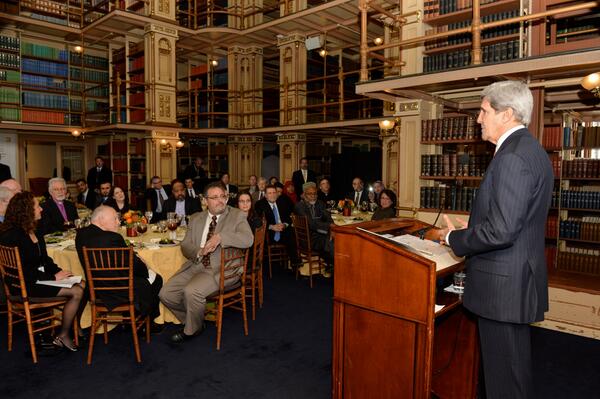
In October, Boca Raton Synagogue adopted a Civility Policy (since renamed Derech Eretz Policy) as an affirmation of our community’s commitment to debate, dialogue and disagree with respect and dignity, always focusing on issues and policies, rather than on people.  Last week, I was reminded of the importance of this commitment when I traveled to Washington D.C. to participate in an interfaith lunch meeting with clergy from Judaism, Christianity, and Islam.  Dr. John J. DeGioia, President of Georgetown University, invited us to meet with Secretary of State John Kerry to discuss the Israeli-Palestinian peace process and to dialogue among ourselves in an effort to build bridges and strengthen relationships.


Following three moving invocations, one from each faith, Secretary Kerry addressed us and shared his perspective on the peace process.  He spoke passionately and enthusiastically as he articulated his argument for why success in the peace process is more important right now than ever and shared why he is so optimistic that the factors are in place to reach a final agreement that will secure a real and lasting peace.  He referenced the concessions on both sides in the form of the Palestinians having held off from pursuing action at the United Nations and Israel having released over 100 prisoners.


In an op-ed in Ha’aretz following our meeting titled, “How John Kerry Won Me Over,” Rabbi Eric Yoffie, past president of the Union for Reform Judaism, expressed why he found the Secretary of State’s words so compelling that day and how, in his words, he “left the meeting convinced that chances for peace are better now than they have been in a very long time.”


Secretary Kerry laid out for us why he believes the status quo is not sustainable, and that what lies ahead for Israel if they cannot arrive at a peace deal is a “boycott campaign on steroids,” arguments he continued to advance in other venues in the days that followed.  Abe Foxman of the ADL, who wasn’t present at the meeting, but was responding to similar sentiments expressed by Secretary Kerry elsewhere, was highly critical of Secretary Kerry’s invoking the threat of a growing boycott movement.  In an open letter to Secretary Kerry, he wrote: “Describing the potential for expanded boycotts of Israel makes it more, not less, likely that the talks will not succeed; makes it more, not less, likely that Israel will be blamed if the talks fail; and more, not less, likely that boycotts will ensue.”


In Israel, rabbis identifying themselves as “The Committee to Save the Land and People of Israel,” in an open letter to Secretary Kerry, wrote this week: “Your incessant efforts to expropriate integral parts of our Holy Land and hand them over to Abbas’s terrorist gang amount to a declaration of war against the Creator and Ruler of the universe.” They compared Secretary Kerry to Haman, Nevuchadnetzar, and Titus and promised Heavenly retribution if he continues his efforts.


The RCA and OU were quick to disassociate themselves from these rabbis who claim to represent “hundreds of other Rabbis in Israel and around the world” by saying: “We, the leadership of the RCA and the OU, repudiate this letter and the rhetoric they have deployed. While the people of Israel and Jews around the world may properly possess serious concerns about proposals Secretary Kerry is putting forth, such concerns must only be expressed with civility and on the substance of the issues, not degenerating into personal venom and threats.”


Listening to Secretary Kerry last week, I heard a genuine and sincere man who sees the implications of his efforts extending far beyond the political and diplomatic spheres alone.  He seemed to be speaking from his heart when he described a vision for bringing a peace that would position Israel as the center of the Middle East for commerce, innovation, trade, travel, and culture.  I personally saw no reason to doubt his sincerity, question his motivation, or be skeptical of his ultimate goal.


That said, unlike Rabbi Yoffie, I was not won over by his argument about the prospects for peace right now, and I continue to have grave concerns for our beloved Israel and her citizens.  Fortunately, I had the chance to voice them in the form of a question I posed to Secretary Kerry.


After thanking him for the opportunity to meet and for his efforts on behalf of peace, I asked, “Mr. Secretary, you say that the status quo is unsustainable and there is no choice but to come to a final status agreement.  But before Oslo, we also heard that the status quo was unsustainable, while in retrospect, the status quo was far better than the thousands of Israeli lives lost post-Oslo.  Before the Gaza withdrawal, we were told the status quo was unsustainable, but in retrospect, it would have been far better than the 40,000 rockets that subsequently rained down on Israel.  Why will this time be different, and how can we be so optimistic and confident that we won’t,once again, end up longing for the status quo even if it was just the lesser of two evils?


“I wish I shared your optimism,” I continued, “but Israel has twice offered 95% of the territory asked for and twice their offer was rejected.  Why, Mr. Secretary, are you so optimistic that this time will be different?  And lastly, you equated not going to the UN with releasing over 100 prisoners, but they are not parallel concessions.  Israel seems to consistently be asked to make concessions for peace that are irreversible and contain extraordinary risks and dangers.  The Palestinians can always decide to go to the UN tomorrow, but land cannot simply be taken back.  Prisoners, many of whom are in fact murderers, cannot just be called to report back to prison.  Wounds, scars, and trauma suffered by those uprooted from their homes and by those tasked with uprooting them, don’t simply heal and disappear.  Please, Mr. Secretary,” I concluded, “I truly want to be more optimistic; help me understand how or why.”


Remarking that he was so happy to be asked that question, Secretary Kerry proceeded to give a very thoughtful answer, one that made some very good arguments that I had not heard or considered before.  Nevertheless, they didn’t fully satisfy or convince me.


But in truth, I am not the one who needs to be convinced or persuaded.  It is Israel’s government and its people who will be forced to live with the consequences of this process and its conclusions.  Their opinion and vote are what counts and what will ultimately shape the future for Israel.  If we truly want our voice to matter on what concessions are made or how far this process goes, we should move to Israel and participate in the public referendum that has been promised before any final agreement is implemented.


Secretary Kerry had to leave the meeting soon after this exchange, but the experience was far from over.  The interfaith dialogue was, in fact, just beginning as members of the clergy – Jewish, Muslim and Christian – stood up one by one and shared their thoughts, impressions, concerns, hopes, and aspirations.  Everyone who spoke did so respectfully, with moderation, and with an apparent commitment to attaining peace and harmony, even if we disagreed on what “peace” means or how it is achieved.


I was struck and uplifted by the level of discourse shared by the diverse religious leadership gathered.  We are all equally passionate about our positions and secure and confident in our analysis and understanding of the situation.  We all entered the conversation unlikely to be persuaded or swayed to change our understanding of history, our people’s narratives or our prescription for what is necessary to bring peace for Israel and her neighbors.  And yet, those differences did not have to create animosity, tension or personal attacks.


Though it likely wasn’t the primary goal, the interfaith lunch meeting accomplished something very significant.  It set an example and model of our capacity to be honest, forthright and direct about our differences, in conversations at the highest level with the Secretary of State and with clergy of other faiths, all with civility, mutual respect and graciousness.  Last week reminded me that we need not be defensive or apologetic for our positions.  We must confidently speak truth to power when given the opportunity.  But we must remain vigilant in maintaining dignity, even as we express our differences.


If every participating clergy member went home and preached about our experience as an example of civil discourse for our communities to emulate, the gathering was valuable and productive indeed.


Facebook and Football, Do Rabbis and Shuls Belong?

Just a few weeks ago, at an “Ask the Rabbi” class, one of our members posed the following question to me: “Rabbi, I notice you are active on social media, including Facebook and Twitter.  What is your thinking?  What are you trying to accomplish?”  Even more recently, in response to the promotion of our BRS Super Bowl Party this coming Sunday night, I was asked, “Why would a Shul host a Super Bowl Party? Does football really belong in a Shul?”


For me, the answer to both questions is articulated well in an observation shared by David Brooks this week in an op-ed in the New York Times.  In his article entitled, “Alone, Yet Not Alone,” Brooks writes:


“There is a strong vein of hostility against orthodox religious believers in America today, especially among the young. When secular or mostly secular people are asked by researchers to give their impression of the devoutly faithful, whether Jewish, Christian or other, the words that come up commonly include “judgmental,” “hypocritical,” “old-fashioned” and “out of touch.””


The question I received at the “Ask the Rabbi” wasn’t one that I anticipated, but my answer was simple.  I explained to the questioner that my goal as a Rabbi is to reach people and generate inspiration, provoke thinking, challenge growth, and to simply connect in a way that I can not only contribute positively to others, but gain from them as well.  I can accomplish this with many people in person at classes, some through email and others on the phone.  However, there exists a population of people, members of our Shul and others, who for the most part don’t engage through traditional avenues, and instead, communicate and connect almost exclusively online.


There is no question that incredible amounts of time are wasted on social media, much of it by individuals who are convinced that every post, comment and “like” has cosmic implications and that the absence of their presence on social media would create a tragic vacuum and catastrophic loss.  If we were honest, we would admit and recognize that much of the time spent on social media is in fact not productive, constructive or fruitful, but rather voyeuristic, narcissistic, mindless, and an escape.  For those in denial of just how much time they waste, Time Magazine created an online app this week that allows you to calculate just how many days of your life have been lost to Facebook and how much time you have wasted since being born into the online social world.


“Why are you active on social media?” my congregant asked.  I explained that as a Rabbi seeking to connect, I can observe the Facebook and Twitter phenomenon and be “judgmental,” “old-fashioned,” and “out of touch.”  I can criticize, dismiss and ignore the vehicle through which many connect today.  Or I can join them, engage them, and be relevant to them and have their opinions and ideas be relevant and informative to me.  I choose to participate, but I am acutely aware of and sensitive to the danger of insufficient self-regulation and the formidable temptation of unfettered engagement.   Therefore, I try to only use social media to share articles, ask thought-provoking questions, link to classes I have given, promote and take pride in the programs in our shul, celebrate the accomplishments and achievements of our members, and distribute articles that I have written.


Why would a Shul host a Super Bowl Party?  Sunday night, the big game will be broadcast to 198 countries in more than 25 languages.  It is anticipated that over 100 million people will watch. Is watching grown men plough into one another, tackle one another, try to rip the ball from one another a good use of our time?  Would we not be better off learning another blatt Gemara, volunteering a few more hours of chesed, catching up with an old friend or even reading a good book?  And what about the commercials?  Most are shamelessly immodest, uncomfortably crude, or grossly inappropriate.


Nevertheless, the reality is that among the 100 million spectators Sunday night will be individuals from every segment of Orthodox Judaism including Chassidim, Litvishe and Modern Orthodox.  We can be “judgmental,” “old-fashioned” and “out of touch.”  We can judge, castigate, scold and even ridicule those that will be watching.  Or, we can acknowledge the value of friends enjoying one another’s company, ensure Mincha and Ma’ariv will be davened, replace the provocative half time show with a thought-provoking Dvar Torah, attempt to censor commercials and provide a venue (not in the Sanctuary) for those who are not invited to any Super Bowl gathering and would otherwise be watching alone.


When Hagar and Yishmael are expelled from Avraham’s home, they find themselves in the desert with nothing to sustain them.  Hagar walks away not wanting to witness her son’s death.  God calls out to Hagar and says, “Don’t fear, Hashem has heard the voice of the na’ar, the young man, ba’asher hu sham, from where he is.”  Later, in Devarim, the Torah tells us, “u’vikashtem misham es Hashem Elokecha u’matzasa, and you will seek from there Hashem, and you will find Him.”  Asks Rav Nachman of Breslov, seek from “sham,” from there – where is there?  He answers, ba’asher hu sham, from wherever you find yourself.


There is no obligation to participate in social media and there is certainly no requirement to attend a Shul Super Bowl party.   Some will see my arguments as simply an exercise in apologetics and take a pass on Facebook and Twitter or  watching the game.  Others will see my explanations as wholly unnecessary and say Facebook and football need no defense or justification.  While clear to others, to be honest, these questions are not so simple to me.


One thing I know is if a community and its Rabbi want to be relevant, compelling and in-touch, they must relate and speak to people ba’asher hu sham, where they are, and help them u’vikashtem misham es Hashem Elokecha, find Hashem from wherever they may be, including on social media or watching the Super Bowl, despite the risks and challenges involved.


Response to the Open Letter from Josh Stadlan

Dear Josh,


I appreciate your response to my recent column and enjoy the opportunity to engage in lively discourse about a topic that is clearly close to your heart.  The passion with which you wrote and the articulateness you bring to your arguments are a testament, I believe, to your family, our Boca schools, and our community.  I can only wish that all of our youth would feel similarly invested in the tradition that we hold so dear and take the time to research a cherished mitzvah and write about it at length, as you did.


In your letter, you wonder why my discussion of mechzei k’yuhara, appearance of religious hubris, was directed at a yeshiva high school’s decision to allow its female students to wear tefillin, rather than “other humrot in our community that violate communal norm.”  Your question is legitimate, and it gives me the opportunity to perhaps refine my original argument.


Indeed, we live in a time when personal stringencies and custom abound, not all of which conform to typical communal practices.  Some of them are clearly praiseworthy, and some of them, as you suggest, may stray into the territory of “mechzei k’yuhara.”  In general, I do not take public stances on them, neither in favor nor against, mostly because I believe these practices are private, delicate issues that are best handled in that realm.


Therefore, I have nothing to say about individual women who have developed a practice of donning tefillin.  I neither endorse them nor condemn them; it is none of my business.  As you effectively point out, I could have been more clear about this in my original column, and I thank you for providing me with the opportunity to clarify now.


I sincerely apologize to the two girls who precipitated this entire discussion for leaving an impression in any way that their motivation or sincerity is in question.  I have no doubt that they are l’sheim shamayim and admire and applaud their enthusiasm for a mitzvah, even if I disagree with the particular observance.  My blog was never directed at them.


Rather, my comments are directed at those who want to make a public endorsement of a particular practice, which, objectively, deviates from the accepted norm for the Orthodox community. It is with the wisdom of this move, and the possibility of “mechzei k’yuhara, appearance of religious hubris” within it, that I took issue.


Josh, despite your carefully reasoned halachic arguments, I maintain my reservations about the need for a new public policy regarding women and tefillin, in the context of the myriad of educational and other communal challenges that currently face us.


Finally, Josh, I have to admit that your letter confused me on one point.  On the one hand, your letter begins with lengthy, impressive segments of deep, Talmudic analysis, including a careful reading of the gemara in Eruvin 96b.  Towards the end of your letter, however, you cite a litany of seemingly embarrassing quotes from the Talmud and other rabbinic literature, including a characterization of Perek “Besula Niseis” that I would rather not repeat here, all of which you clearly distance yourself from.


That leaves me wondering:  Is the Talmud an authoritative text for you or not?  If parts of it are so distasteful to you, then how can you build halachic arguments out of other sections?  If the Talmud and the rabbinic tradition are not authoritative for you, do you derive your conceptions of Judaism from a different source?


I thank you again for the opportunity to participate in this exchange that I know is “for the sake of Heaven.”


Respectfully,


Rabbi Efrem Goldberg


To read Josh’s letter, click here:  Open Letter from Josh Stadlan


Avoiding The Appearance of Religious Hubris

A prominent Modern Orthodox high school announced this week that girls who want to wear tefillin during davening at school would be permitted to do so.  Not to be outdone, a second school quickly proclaimed that they, too, would allow it.  News spread like wildfire and the headlines quickly went from, “Modern Orthodox Girls Fight for the Right to Don Tefillin,” to an editorial entitled, “Why Women Can and Must Lay Tefillin.”


Predictably, the reaction has been mixed with traditionalists rejecting the change and the more progressive segment of orthodoxy celebrating the welcome change.  Noticeably absent from the conversation, at least from my perspective, is an argument about the halachic merits or challenges of the decision.  Instead, the reaction has been largely driven by emotion, ideology and agenda, in both directions.


Many responded by wondering what’s the big deal, after all didn’t Rashi’s daughters wear tefillin.  In an excellent article in Jewish Action, Rabbi Ari Zivotofsky compellingly dispels this historical “fact” as a misconception and myth, though he does point out that Michal, the daughter of King Shaul, did in fact wear tefillin.  Regardless, it is clearly not the prevalent custom for Orthodox women to wear tefillin and so these policy announcements represent a significant shift and change.


The Shulchan Aruch (o.c. 38:3) is clear that as a time-bound mitzvah, women are exempt from tefillin.   Unlike other time-bound mitzvos such as sukkah, lulav and shofar, the Rama, Rav Moshe Isserless, the authority of Ashkenazic Jewry, discourages women from volunteering when it comes to tefillin and in fact says that if they choose to wear tefillin, mochin b’yadam, we should object.  The Gra, also known as the Vilna Gaon, goes even further and says women are outright forbidden from wearing tefillin.


Their positions stem from an unusual requirement when wearing tefillin.  As sacred objects similar to a mezuzah or Sefer Torah, tefillin require a high level of concentration and a pristine physical state.  Maintaining those levels has been determined to be exceedingly difficult today and, therefore, though in previous generations men wore tefillin most of the day, now we wear them for a minimal amount of time.  The authorities that discourage and disapprove of women wearing tefillin do so on the grounds that they are exempt and therefore, should not put themselves in a position to potentially dishonor the tefillin by losing concentration or the proper physical state.


Rabbi Aryeh Kaplan advances a more mystical argument for women’s exemption from tefillin.  He explains that the tefillin box is called bayis, home.  Kabbalah describes the tefillin as symbolic of the womb and the retzuos, the straps, as representing the umbilical cord.   The tefillin bind us to God by reminding us of our obligation to create and to nurture with compassion.  Men need external symbols to remind them, but women, he argues, create and nurture with their bodies and therefore don’t need them.


To be honest, my personal discomfort with the policy decision announced this week has less to do with strict halachic objection for which there are counterarguments, and more to do with an often neglected halachic value called mechzei k’yuhara.


Forget women and tefillin for a moment.  If a man wanted to wear tefillin the whole day as they did in the past, would we encourage him or frown upon the practice?  The Shulchan Aruch Ha’Rav written by the R’ Schneur Zalman of Liadi, the first Lubavitcher Rebbe, says that since today the custom is not to wear tefillin other than during davening, to do so publicly is mechzei k’yuhara, smacks of arrogance and hubris.


There was once a student at YU who would walk through Washington Heights wearing his tallis and tefillin while going to daven.  A concerned individual asked Rav Schachter to intercede and encourage the young man to stop this practice that was drawing negative attention.  Rav Schachter related to us that he didn’t want to embarrass the young man so he told him a story with the hope he would understand.  A man once asked a prominent posek if a particular practice was mechzei k’yuhara, appeared arrogant.  “No,” said the posek, “it is yuhara mamesh, it is actually arrogant.”  Unfortunately, the young man did not get the message.


Mechzei k’yuhara, refraining from unusual and radical practices even though they are otherwise virtuous, is a meta-halachic consideration in many areas.  A simple search for mechzei k’yuhara in the Bar-Ilan responsa project yields dozens and dozens of results in which halachic authorities throughout the ages have rejected halachickly acceptable behavior on the grounds that it is a departure from accepted practice and therefore, mechzei k’yuhara, divisive and promoting superiority.


The mechzei k’yuhara consideration doesn’t judge or question motivation.  Even if the man or woman is purely motivated, if the behavior is an outlier to what is customary, even when it is stricter, it is inappropriate because it smacks of religious superiority.  What everyone else does is not good enough for the individual taking on a practice outside of the norms.  I believe the philosophy of mechzei k’yuhara is that we should embrace and excel at what we are obligated in and what is customary, rather than spiritually one-up those around us.  Mechzei k’yuhara teaches us that the truly pious person doesn’t try to stand out in his religious fervor, creativity or scrupulousness.


Quite the opposite; the truly righteous person blends in and is loyal to the local customs and norms.  Mechzei k’yehura means we don’t seek to be creative, distinctive or unique in the way we observe halacha.  We seek to fit in and conform to the traditions and customs of the community without needing to make a personal statement through our superior practice.  Of course we should strive to grow in our religious experience, level of observance and commitment to Jewish values, but all within the communal religious norms and customs and not outside or above them.


I was talking to a teenage girl and mentioned the new policy at these schools.  Her response was, “Cool, I didn’t know girls can wear tefillin.  I wonder what that is like, I would try that.”  Shouldn’t we encourage our young women to embrace and excel at the laws and customs that are incumbent on them before inviting them to experiment with new spiritual experiences?  Shouldn’t we help them find meaning and inspiration in the traditional observant lifestyle, rather than reinforce the notion that spirituality is found in that which is radical, revolutionary or innovative?  Shouldn’t we be confident that our young men and women are committed to vigilantly observe halacha before granting them license to take on behaviors that their parents and grandparents didn’t feel worthy to perform?


Rather than discuss women wearing tefillin, we should be discussing ways to inspire our young men to maintain a commitment to never miss a day of putting on tefillin, even if they struggle to find it meaningful or uplifting.  Rather than encouraging our young women to wear tefillin, we should be encouraging them to find expression and inspiration in the Torah’s prescription for femininity and womanhood.


Our young people don’t need radical change leaving them as outliers from communal norms; they need to be taught radical commitment to halacha and tradition with fervor, enthusiasm and meaning.


Not All Dreams Are Created Equal

On August 28, 1963, from the steps of the Lincoln Memorial in Washington, Martin Luther King, Jr., whose contributions and influence we will mark this coming Monday, delivered what ultimately became his signature speech.   Many identify that address, delivered to over 250,000 civil rights supporters that had gathered for the March on Washington, as the defining moment in the American civil rights movement.


What many don’t know is that the now-famous “I have a dream” speech was not intended to be given that day.  Dr. King had actually delivered a different speech and was moving to close when a woman called out from the crowd, “Tell them about the dream, Martin!” He then deviated from his original ending, partiallly improvised on the spot, and launched into a vivid and compelling description of his dream of freedom and equality for all.


Due to hard work, resolve and perseverance, MLK’s vision went from a dream to at least a partial reality.  His dream was not about himself, his advancement, or his glory.  He dreamt of a better, more just and fair world in which all are respected, appreciated and treated equally and fairly.


As we mark MLK’s life this coming week it seems appropriate to ask ourselves – what do we dream of?  What do we wish for?  Do our dreams include others or just ourselves?  Do our dreams include a vision for a better world for all or just for ourselves?  How do our dreams integrate with those of our families, our spouses, or our children?  Are our dreams compatible with our realities, our commitments, and our obligations, or do our dreams necessarily require us to abandon them?


Starting in 2024, a new initiative called Mars One will begin sending people to Mars in the hopes of creating a permanent human settlement there.  Missions will leave every two years to bring people.  The decision to go is irreversible, as those that move will have a one-way ticket with no mechanism to come home.  Furthermore, under Martian gravity, a person’s bone density would decrease significantly and he or she would be unable to return to withstand Earth’s gravity, which is far stronger.


The organization publicly invited all those interested to apply for a spot and remarkably, since just April of last year, more than 200,000 individuals have applied.  Last month, 1,058 applicants were contacted and told that they had made it through to the second round.  Among them, is 38-year-old Ken Sullivan, a medevac pilot from Utah who has always dreamt of exploring and inhabiting another planet.  According to the Salt Lake Tribune, there is only one minor problem.  Ken applied without ever consulting his wife Becky, and now the two are struggling with what his dream means for their marriage and family.


“The question is do we get divorced now or get divorced later,” she said. “If I stand in the way of his dreams and passions, then we get divorced now, so I have to be supportive.”  Ken’s dream is not only affecting his wife, but it has unalterable consequences for his four children, ranging in age from 6 months to 13 years old who, if he is selected, stand to never see their father again. The permanent effect on his family is not lost on Ken, who said, “I just hope the family will be able to forgive me down the road.  Hopefully there isn’t too much hatred of my being selfish in pursuing a dream that isn’t theirs.”


If I was one of Ken’s children, I don’t think I could forgive my father for putting his self-centered dream ahead of his loyalty to his family.  You see, there is nothing wrong with having dreams.  Indeed, dreams are wonderful, significant, and important.  They cause us to aspire, to be ambitious and to seek out goals.  Dreams motivate, stimulate and inspire.


But it seems to me that dreams should bring us closer to the people we love, not drive us apart from them.  Dreams should include those that we care about, not marginalize them.  Dreams should be compatible with and reinforce our values, our commitments, and our obligations, not cause us to abrogate, distort, or compromise them.  Dreams should be mature, selfless and meaningful, not childish, selfish or superficial.


I cannot relate at all to the over-200,000 people who are ready to voluntarily leave our planet and all that inhabit it, never to come back here or see those people again.  We likely read the story of Ken Sullivan and think we have absolutely nothing in common with him or his priorities at all.


But the truth is, many of us, like Ken, are putting our dreams ahead of our families.  We may not abandon our spouse and children to go to Mars, but many neglect time with their spouse and children to pursue personal dreams and interests that don’t benefit or advance our family or even help us become better spouses or parents to them.


There is nothing wrong with dreaming of a low golf handicap or competing in a triathlon.  It is wonderful to dream of professional or financial success beyond imagination.  It may even be noble to dream of performing extraordinary amounts of chessed or being the fixture in the Beis Medrash, learning many hours a day.   But these dreams must be pursued in moderation, with the consent and cooperation, hopefully followed by support, of our families, as well as in conjunction with our other responsibilities, not in place of them.   Our dreams must never make us judgmental or intolerant of those who don’t share them. Even the dream of taking on more observance must be pursued carefully, with great sensitivity, moderation and with respect for those around us.


In a 2011 Wall Street Journal article entitled, “A Workout Ate My Marriage: Exercise Can Set Off Conflict About Family and Free Time,” the author writes:


“Commitment to a demanding training schedule cuts to the heart of the issues couples often find themselves fighting about—who does chores, who gets time for themselves and who decides where and how the family has fun.  The threat can go beyond time issues. If one partner gets a new, buff appearance and a new circle of buff acquaintances, romantic possibilities can open up—and give the other spouse good reason to feel insecure about his or her own physique.”


The article coins the phrase, “exercise widow,” and describes the stress on marriages when one partner suddenly decides to pursue a dream of endurance competitions and marathons with rigorous and time consuming training schedules.   Just as there are exercise widows and widowers, there are career widows and football orphans produced when someone prioritizes their dream and desire over their responsibilities, commitments, and obligations.


Not all dreams are responsible or appropriate to pursue.  Someone might dream of owning a yacht, but it would be financially reckless and irresponsible to do so.  Some might dream of fancy luxury vacations, but it would mean taking children out of Jewish day school.   Some might dream of spending Saturdays on the beach or dream of tasting lobster, but it would mean compromising on our heritage and its expectations of us.


Like Martin Luther King, Jr. we should all have dreams and work hard to make them into reality.  But like Dr. King, our dreams should be inclusive, noble, balanced, sophisticated, serve to better the world and bring people closer together.  Most importantly, our dreams should be coordinated with our families and pursued only with their support.


The Talmud in Berachos describes what happened when the sages approached R’ Elazar Ben Azarya to accept the position of Nasi, the head of the Sanhedrin.  He must have been stunned by the invitation and incredibly excited and enthusiastic.  After all, Nasi was the most prestigious and prominent position of the Jewish people and he was only 18 years old at the time.  Nevertheless, R’ Elazar’s response to them is so instructive.  “I have to consult with my wife before I can give you an answer,” he said.  Our commentators explain that while the invitation to become Nasi was an incredible honor and privilege, it would be incredibly demanding and leave R’ Elazar ben Azarya with little time for his family.   Though it would have been a dream come true, he refused to accept the position without the buy-in and support of his wife first.


Ken Sullivan’s application is unconscionable.   Dreams should never hurt, cause pain or create division.   They should heal, unify, and create a better circumstance for ourselves, our families and the world.


Rabbi Efrem Goldberg

Join Our Community

Subscribe to our newsletter or connect with us on WhatsApp.