This Chanuka See What is Right Under Your Nose

A husband and wife are getting ready to go to sleep. The wife is ready to close her eyes and her husband stands staring at himself in the full-length mirror. “What’s the matter with you?” she says. Come to sleep already.” He turns to her and says, “Look at this, I am so depressed. All I see is a receding hairline, a growing gut, and wrinkles under my eyes and what hair I have left is grey. Tell me something positive, something uplifting so I can go to sleep.” She thinks for a moment and says, “Well the good news is your vision is still 20/20.”


There is a very high association between Chanuka and the sense of sight. “HaNeiros halalu kodesh heim, v’ein lanu reshus l’hishtameish bahem elah lirosam bilvad.” As we will begin to sing next week on each night of Chanuka, the candles are sacred, we don’t have permission to benefit from their light, but their purpose is simply to be looked at. Moreover, we have a unique halacha on Chanuka. The Talmud tells us and the Shulchan Aruch records – ha’roeh mevareich, one who can’t light for himself or herself and sees the candles of someone else – nevertheless makes the second beracha, she’asah nissim la’avosainu. When I see someone put on tefillin, take a lulav, or blow shofar, I don’t make a beracha. Only on Chanuka do I make a beracha on seeing someone else do the mitzvah.


The Kedushas Levi, Rav Levi Yitzchak of Berdichev, tells us that Chanuka is the holiday of seeing. The different moadim correspond with our different senses. On Purim our hearing is heightened as we listen to the megilla. On Pesach our sense of taste is sharpened when we eat matzah and marror and on Chanuka, he says, we evaluate our sense of sight, how well do we see.


What kind of seeing are we honing? It is not our physical sense of sight. Indeed, in a sort of paradoxical way, our eyes are a liability. You see, we often feel that “seeing is believing.” If I can perceive and observe it, it is true. If I can’t, it is not real. Following this rule, we have dismissed and disregarded many of the most precious truths and realities in our lives. There are ideas, feelings, thoughts and dreams that are authentic and genuine, despite the fact that they can’t be seen or observed.


Our Rabbis describe the Greek empire and Hellenist influence as choshech, darkness. In expounding on the opening verses of the creation story, the Midrash Rabbah says choshech al p’nei sehom – zu galus yavan, darkness on the vastness, that is the exile of Greece. Moreover, our Rabbis taught that darkening our eyes was the goal of our Greek oppressors – shehechshichu einehem shel yisroel.


What is the difference between a room that is filled with darkness or with light? Is there any actual change to the room itself? Whether the light is on or off in the room, the furniture remains the same, the layout of the room, the placement of the door and the height of the ceiling are a constant. What, then, is the difference whether the light in my room is on or off? The answer is just my perception. The only difference is my ability to identify and see the reality, the truth and that which was right before me all along. Chanuka is about seeing things, people, ideas, and miracles that are really right in front of me, even though I may not be able to visibly see them.


George Orwell once wrote: “To see what is in front of one’s nose needs a constant struggle.” One can live with his eyes open, perfect vision, and the light on and still be cloaked in darkness. On the other hand it can be pitch black all around and yet a person can see absolutely clearly. The Chashmonaim didn’t see their few numbers, weak army, and impossible task. They saw the mighty hand of Hashem, they saw the obligation to fight, and they saw Divine protection that would accompany them.


Chanuka is about lighting the candles and using them to harness our sight, not opthalmologically speaking, but our deep vision of what is true, precious, and dear. When we look at our spouses and children, do we see the amazing blessing of their presence in our lives or do we hear lots of noise, see rooms that need to be cleaned up, and a messy house? When we face a challenge do we see no way out or an opportunity to further lean on our Creator? There are truths all around us; it is up to us to decide what to look at and how to see.


In her “Hasidic Tales of the Holocaust,” Professor Yaffa Eliach shared the incredible story of Chanuka in Bergen Belsen:


It was time to kindle the Chanuka lights. A jug of oil was not to be found, no candle was in sight, and a Chanukia belonged to the distant past. Instead, a wooden clog, the shoe of one of the inmates, became a Chanukia, strings pulled from a concentration camp uniform, a wick, and the black camp shoe polish, pure oil.


Not far from the heaps of bodies, the living skeletons assembled to participate in the kindling of the Chanuka lights. The Rabbi of Bluzhov lit the first light and chanted the first two blessings in his pleasant voice, and the festive melody was filled with sorrow and pain. When he was about to recite the third blessing, he stopped, turned his head, and looked around as if he were searching for something.


But immediately, he turned his face back to the quivering small lights and in a strong, reassuring, comforting voice, chanted the third blessing: “Blessed are Thou, O Lord, our God, King of the Universe, who has kept us alive, and has preserved us, and enabled us to reach this season.”


Among the people present at the kindling of the light was a Mr. Zamietchkowski, one of the leaders of the Warsaw Bund. He was a clever, sincere person with a passion for discussing matters of religion, faith and truth. As soon as the Rabbi of Bluzhov had finished the ceremony of kindling the lights, Zamiechkowski elbowed his way to the Rabbi and said, “Spira, you are a clever and honest person. I can understand your need to light Chanuka candles in these wretched times. I can even understand the historical note of the second blessing, “Who wrought miracles for our Fathers in days of old, at this season.” But the fact that you recited the third blessing is beyond me. How could you thank God and say “Blessed art Thou, O Lord, our G-d, King of the Universe, who has kept us alive, and hast preserved us, and enabled us to reach this season”? How could you say it when hundreds of dead Jewish bodies are literally lying within the shadows of the Chanuka lights, when thousands of living Jewish skeletons are walking around in camp, and millions more are being massacred? For this you are thankful to God? For this you praise the Lord? This you call “keeping us alive?”


“Zamietchkowski, you are a hundred percent right,” answered the Rabbi. “When I reached the third blessing, I also hesitated and asked myself, what should I do with this blessing? I turned my head in order to ask the Rabbi of Zaner and other distinguished Rabbis who were standing near me if indeed I might recite the blessing. But just as I was turning my head, I noticed that behind me a throng was standing, a large crowd of living Jews, their faces expressing faith, devotion, and deliberation as they were listening to the rite of the kindling of the Chanuka lights.


I said to myself, if G-d has such a nation that at times like these, when during the lighting of the Chanuka lights they see in front of them the heaps of bodies of their beloved fathers, brothers, and sons, and death is looking from every corner, if despite all that, they stand in throngs and with devotion listening to the Chanuka blessing “Who performed miracles for our Fathers in days of old, at this season”; indeed I was blessed to see such a people with so much faith and fervor, then I am under a special obligation to recite the third blessing.”


You see, that night in Bergen Belson, Mr. Zamietchkowski only saw what lay before him, dead bodies and terrible suffering. The Rebbe also looked, but he saw another layer of truth that was equally accurate – that there was a gathering of people who maintained incredible faith despite the most horrific circumstances.


As we celebrate Chanuka next week, let us remember that there are truths all around us not visible to the naked eye. Let us use the light of the Chanuka candles to inspire us to see with vision.

 

Celebrating Thanksgiving Each & Every Day


Was it President Lincoln in 1863, President Washington in 1789, or the Pilgrims themselves in 1622? While historians may debate when the holiday of Thanksgiving was first instituted, the practice of giving thanks began much earlier.


We read in Parshas Vayeitzei, that Leah names her fourth son Yehudah from the root hoda’ah out of gratitude to Hashem. Indeed, the Talmud (Berachos 7b) quotes Rav Shimon bar Yochai as teaching that, in fact, Leah was the first person in history to say “thank you” to Hashem.


How could that be? Did Adom Ha’Rishon upon being exiled from Gan Eden and learning about second chances not say “tov l’hodos laShem, it is good to thank the Almighty?” Did Noach and Malki Tzedek not express their gratitude to the Master of the Universe? Did Eliezer not communicate appreciation for divine assistance in fulfilling his mission of finding a wife for Yitzchak? And the list could go on. How could the Talmud make such a bold assertion when it seems from the Torah itself not to be true?


Rav Shmuel Binyamin Sofer of Pressburg offers a beautiful suggestion. Yes, there were individuals prior to Leah who had expressed gratitude. However, their gratitude was always in response to a supernatural phenomenon, to the revealed hand of God in their life. Leah, in contrast, was the first to say thank you for something which others considered completely natural. Her thank you wasn’t the result of being miraculously saved or being given a second chance. Leah expressed deep gratitude to Hashem for the natural, biological experience of having a baby. Her thank you was an implicit acknowledgment that even that which appears natural, regular or ordinary is also the result of the extraordinary hand of the Divine.


As we mark the holiday of Thanksgiving this weekend, it is an opportunity to remind ourselves that the most authentic thanks is for that which we are tempted to take for granted and not even recognize at all. If you woke up this morning and you have all your faculties, you should give thanks. If you have a roof over your head and food to eat, you should give thanks. If you are blessed with a spouse and children, you should give thanks. And as our brothers and sisters in Israel know too well, if when you go to sleep at night, everyone in your family and in your home is as healthy and well as they were when you and they woke up, you should give tremendous thanks.


The great Rav Yeruchem Levovitz offers another answer to our question. He explains that most people say thank you in order to pay off their debt of gratitude. Someone does something nice for us and in a quid pro quo, we say thank you to them to settle the score. Indeed, in each of the incidents that preceded Leah saying thank you, the speaker offered a one-time expression of appreciation and moved on. Leah did something categorically different. She named her son Yehudah. She named him, “I am grateful.” Every time she called out his name – “Yehudah come for supper, Yehudah did you do your homework, Yehudah – what time will you be home tonight,” she reawakened her sense of appreciation. Unlike the others who said thank you and paid off their debt of gratitude, Leah formulated a feeling of thanks that was sustained, perpetual, and that was felt each and every day on a consistent basis.


Rav Yeruchem explains that this is what Leah meant when she gave him his name. “Hapa’am odeh es Hashem?” Should I only thank Hashem this one time and move on? No! I will continue to thank him over and over again. The United States may officially celebrate Thanksgiving one day a year, but to be a Jew, to be the progeny of our Matriarch Leah, is to be overflowing with thanks each and every day.


The Chiddushei Ha’Rim of Ger, Rav Yitzchak Meir Alter, points out that we are called Yehudim after Yehudah specifically because we as a nation are to be characterized by an ever-present sense of gratitude. Though we read of Leah naming Yehudah last week, her message continues to resonate into this week as we celebrate the holiday of Thanksgiving.


Let us live up to our name as Yehudim, and rather than be consumed by only worry and concern, feel deep and profound gratitude for all of the blessings in our lives, particularly those that we too often take for granted and fail to appreciate.


Letter to BRS Following the Funeral of Ezra Schwartz z”l

I wrote the following letter to the BRS family after attending the send off of Ezra Schwartz H’yd at Ben Gurion Airport:


Dear BRS Family,


The term levaya, which we use to describe a funeral service, means to accompany. At Ben Gurion Airport tonight, hundreds gathered to accompany Ezra Schwartz Hy”d to the flight that will bring him back to Boston and to his burial. Though the gathering was not publicized and intended for those who knew Ezra and his family, with the permission of the yeshiva I attended to show support and love to our Boca students at Ashreinu, particularly a precious member of our shul who was in the van when it was brutally attacked.


I feel compelled to share a few thoughts with you, my beloved family, about what was one of the most meaningful and powerful experiences in my life. As the crowd gathered, Ezra’s fellow classmates at Ashreinu and their Rebbeim stood in a large circle, some draped in Israeli flags, swaying back and forth with their arms around one another singing song after song. The songs were of course not about revenge, anger, or violence, but were about emunah, longing for peace, and love of Torah and Eretz Yisroel.


Eighteen-year-old American students are normally carefree, living with little pressure and enjoying a gap year learning, discovering themselves and exploring the beauty of our homeland. This special group of boys has learned a harsh and cruel lesson that is not intentionally part of any curriculum and that we wish and pray is never learned again. Their pure, innocent classmate and friend was murdered for no other reason than being a Jew. As tears flowed down their cheeks, the final song they sang before the short memorial began was Israel’s national anthem – Hatikvah.


The first speaker was the heroic refusenik and Chairman of the Jewish Agency, Natan Sharansky. He described that when he spoke to Ezra’s father, Dr. Schwartz who had just suffered the unimaginable murder of his son, shared his memory of marching on behalf of Soviet Jewry as a student in Ramaz. Mr. Sharansky observed that this terrible loss is a link in the chain of Jewish History that includes the story of Soviety Jewry and now the story of our continued fight to live in peace in our homeland. Ezra is a martyr, one of the kedoshim of which Jewish history is made up. But we are also living Jewish destiny, he said, and part of our response must be to fortify and strengthen our conviction to our homeland and to our people.


His words resonated deeply for me, not just because of their significance, but because I was standing next to Ofir Shaer, the father of Gil-ad Hy”d who was kidnapped and murdered over a year ago. He came to show respect, to honor Ezra z”l, and to give chizuk by his presence. He is one of too many parents who have experienced the incomprehensible murder of their children. This must stop, it must end!


Ezra’s uncle spoke about his incredible eyes, his smile that could light up a room, his sense of humor, his athleticism and his larger than life personality. He read a letter from Ezra’s father, in which he thanked everyone for their help and for this gathering, and spoke about Ezra, but also which said something absolutely incredible. He said that doesn’t regret sending Ezra to Israel and knows that sending him to learn and grow and be part of the people of Israel was the right thing.


Rabbi Yudin, the Rosh Yeshiva of Ashreinu, spoke passionately about Ezra and described that Ezra had made a pledge the morning of his murder to complete the study of Tanach this year. Though he was exhausted and thought about staying back on Thursday, Ezra was determined to participate in the chesed outing that day and so he went with the intention to sleep on the van. He never fully awoke again as he was murdered while on the very way to participate in chesed, loving-kindness.


Rabbi Yudin stressed that the best way to honor Ezra’s memory and our greatest response to both the terrorists who took his life and those that are determined to drive us from our land, is to come to Israel and do the learning and the chesed that Ezra will not be able to complete.


I am currently in Israel for my nephew’s bar mitzvah and to visit with our students who are studying here, but also to see a few seminaries with my 12th grade daughter who will be coming next year. I know that there are parents who have thought about bringing their children home due to this latest wave of terror. I also know that after Thursday, there are parents wavering about signing their children up to come study here next year. God forbid, we should never judge anyone for their personal decisions based on their own calculations and considerations. Everyone has to do what they feel comfortable with and what they could live with.


However, as a parent in that same circumstance, I must tell you why I don’t hesitate for one moment from encouraging my daughter to come next year and why I feel energized by the fact that we will visit schools together tomorrow. The gift and the blessing of the modern State of Israel and the miracles that enabled us to have it are not for our brothers and sisters that live here alone. Israel is the homeland and the responsibility of the Jewish people, wherever we live in the world. It is not simply a place to visit when times are good, or a place to spend Sukkos or vacation when there is calm.


We, and our children, don’t bear the burden of protecting Israel and by extension Jews around the world that know they can turn to Israel for refuge. We delegate that awesome responsibility to our family in Israel who courageously and faithfully serve in the IDF. They risk their lives on the front line of ensuring the safety and continuity of our people and our nation. Our minor role, the small part that we play, is to make sure that they never feel they are doing it alone or that they are abandoned.


If we stop coming to Israel, if we stop sending our children to study here, not only do the terrorists earn a victory, but we have spit in the face of our very family members who have take upon themselves the lion’s share of forging our destiny.


My dear family, we have learned that when evil and wicked men and women are bent on murdering innocent people, it doesn’t matter if you are in the Twin Towers, the streets of Paris, Tel Aviv or Yerushalayim.


Of course we must act prudently and be vigilant and careful about where we go and how we travel, in Israel and around the world. But, we must absolutely not stop coming and sending our children. If you shed a tear over the recent murders, if you have cried out over the plight of what is happening in Israel, if you want those living in Israel to know how much you care, it is simply not enough to post on Facebook, talk about it at your Shabbos table or even open a Tehillim alone.


If you truly care, and you have the resources to make it happen, I cannot encourage you strongly enough to immediately schedule a trip to Israel. Come to visit family, come to tour, come to shop or come for no reason at all other than to make a statement to those that terrorize us that we will not be scared away and those that we love that we will not abandon them and leave them alone.


Come to learn a perek of Tanach or volunteer for the act of chesed that Ezra Schwartz can no longer do. Come to Israel, you will not regret it.


May we all have a Shavua Tov! May the week ahead be much better, more peaceful and more blessed than the week behind.


With a deep pain in my heart and a love for all of you,


Rabbi Efrem Goldberg


Israel Advocacy and Orthodoxy’s Boundaries: Being Right Versus Being Effective

The second of Stephen Covey’s highly acclaimed “7 Habits of Highly Effective People” is to “begin with the end in mind.”   In explaining this habit, Dr. Covey invites us to visualize our own funerals and carefully consider how we would like to be remembered and described by our family, friends, and community. When we have formulated an answer to that question and begin with the end, we will have a vision for how to conduct ourselves, make the choices, and live the life that will indeed earn and elicit the eulogy we aspired to.


Covey’s advice about how to live our lives on the whole strikes me as critically important. Without referencing Covey, my father taught me an invaluable lesson early on in my career that I think about almost every day. Most people walk into a meeting or enter a conversation with a general idea of the subject or agenda, but give very little thought as to what they hope to accomplish or the most effective strategy to achieve that goal.


To be effective and successful, my father taught me, before every meeting you walk into and every professional (and even personal) conversation you enter, take a moment to determine what you are trying to achieve, what is your desired outcome, and what is the best way to achieve that result. For example, he said, when you are out on a date and discussing some subject, telling your date that her position is wrong and relentlessly arguing why your position is right, may allow you to win the argument, but is unlikely to allow you to win the girl. What is the more important outcome for you?


Clearly, knowing what is really important allows you to keep your eye on the ball, execute the strategy effectively, and remain focused throughout, no matter any distractions or diversions. Achieving the goal will sometimes mean swallowing pride, overlooking slights and poor conduct, or reluctantly making a concession or compromise. However, if, in Covey’s language, you always begin with the end in mind, you will be mindful to do everything to achieve the desired end.


While Covey’s and my father’s advice may seem obvious for achieving success, occasionally people seem to put a greater premium on “being right” than on “being effective.” They seem more focused on taking a stand, making a statement, lodging a protest, or articulating an objection than they are on using the power of persuasion to change minds and behavior, or influence policy and practice.


The difference between “being right” and “being effective” has been glaringly evident of late in some of the debates raging in the Jewish community. For example, regarding Israel advocacy, some believe in the importance of issuing strong public statements and condemnations without regard for the continued need for the future support and votes of the very elected officials being targeted. In contrast, others, while equally disappointed in the votes of certain elected officials, recognize that Israel continues to require the support of these same individuals who will almost certainly remain in office and whose future votes matter. Remaining focused on the ends of achieving that long-term support for Israel, they take a much more nuanced and moderate approach to reacting and interacting with those in elected office.


Similarly, when it comes to the question of the boundaries of Orthodoxy and the limits of religious innovation, much effort has been made of late to “be right” using rhetoric, statements, and resolutions. Those advancing such efforts may feel they have won the argument, but have they won the hearts and minds of the silent majority who are still formulating their feelings towards these issues and see  non – nuanced declarations as unconvincing and often offensive?


I sympathize with those who feel compelled to take a stand or make a statement objecting to what they perceive as non-halachic and corrosive behavior and practices. After all, we have a biblical obligation of tochecha (Vayikra 19:19), a mandate to rebuke and constructively criticize others when they have gone astray or are misbehaving. The Rambam (Hilchos Deios 6:7) says, “If someone sees his friend sinning or following an undesirable path, it is a mitzvah to return him to the proper path.” The Talmud (Shabbos 54b) tells us, “Whoever could have protested and prevented a violation and made no protest will be punished for that violation.”


These halachic injunctions would seem to encourage making a mecha’ah, lodging a protest when necessary. And yet, our rabbis did not encourage unconditional tochecha, rebuke. They added the following important caveat (Yevamos 65b): “Just as it is a mitzvah for a person to say something that will be listened to, so to is it a mitzvah for a person to refrain from saying that which will not be listened to.” In essence, our rabbis felt that it was not enough to be right; one also has to be effective.


It seems to me that if you look around, just “being right” is not compelling enough to necessarily be listened to. Not only is much of the rhetoric not swaying opinions, moving the needle, or persuading anyone to change their mind, it seems it is being counterproductive. Our rabbis insist that divrei chachamim b’nachas nishma’in. The words of the wise are most likely to be heard when communicated pleasantly.


Wherever we stand on any particular issue, whether in marriage, at work, on behalf of Israel, or in communal life, we need to begin with the end in mind. We must fashion a strategy that includes an effort to persuade, rather than to just protest; to educate, rather than to indoctrinate; and to always remain civil, not just to be correct.


Granted, “being effective” is much more difficult and challenging than just “being right.” However, if one is truly confident that they are right, they should be willing and able to develop a strategy to also be effective.


Technology – Playing with Fire

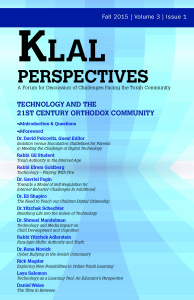
The Fall 2015 issue of Klal Perspectives addresses Technology and the 21st Century Orthodox Community. The following is my article in the journal.


There is no denying that technology has significantly improved our lives. The proliferation and increasing sophistication of appliances, gadgets, electronics, devices and software provide ever-greater convenience, comfort and enjoyment. And technology has enriched our spiritual lives, as well. Torah learning opportunities have exponentially increased, and access and exposure to Torah personalities have blossomed. Technology has enabled immeasurable advances in the coordination of chesed activities and tzedaka projects, as well as facilitated global prayer efforts. Through technology, friends have been reunited, and family members living across the globe can share and participate not only in each other’s lifecycle events but in daily life, as well.


With all of its benefits, however, technology is also replete with dangers, risks and challenges. It is seductive, intoxicating and, for some, addictive. Ideas that are both spiritually and socially destructive are now readily available. Similarly, without much effort and often without even trying, we find lewd images flashing before our eyes, compromising our holiness, as well as the health and integrity of our relationships and our attitudes towards intimacy.


The dangers of technology have been well documented. While internet filters and connectivity time regulators are both imperative and invaluable, internet access poses threats in content and risks of excessive use that no filter or program can eliminate. In fact, even the most noble and virtuous use of technology often presents unintended adverse consequences.


Rejecting technology entirely, however, is no longer a viable strategy. Such rejection would be as practical as eliminating telephone use because it can be the conduit of gossip or vulgar speech, or swearing off cars and buses because they often transport passengers to inappropriate places. While communal calls for the wholesale rejection of technology may be effective in messaging its dangers, these calls surely cannot be undertaken with an authentic aspiration for success. Moreover, if successful, elimination of the use of technology would deprive the Jewish community of enormous advances in Torah, avodah and gemillus chasadim.


The community, thus, confronts a conundrum. The benefits of technology are enormous, but tolerating unbridled and unregulated access by oneself or one’s family is reckless and irresponsible. Car travel is invaluable, but it would be inconceivable for a responsible society to allow everyone, regardless of age or training, to drive anywhere, at any time and in any manner or speed. Non-regulation would be grossly negligent and most certainly result in injuries and worse.


To continue reading, Click Here


Inquiries or Inquisitions: A Rabbi’s Perspective on the Shidduch System

“Do you know if anyone in his family is taking medications and


what those medications are for?”


“Can you give me the name of a friend of her father and a different friend of her mother I can speak to about her?”


“What are the circumstances that led to his parents’ divorce?”


“Is anyone in her family currently receiving counseling or therapy and for what?”


“Does the father come to Shul during the week or only on Shabbos?”


By far, one of the most uncomfortable aspects of being a Shul Rav is fielding shidduch inquiries regarding members of our community of all ages by prospective mates or their parents.  Above are just a few of the actual questions I have received in the last few months alone. Comprehensive investigations are not only taking place in the more “right wing” orthodox communities, but are becoming increasingly customary in modern orthodox circles as well. 


As a parent who wants to protect and guard my children as much as anyone, I can only imagine the desire that will swell up in me when my children are dating, please God, to do forensic detective work and uncover absolutely everything about whomever might win the heart of my child and contribute to the spiritual and physical genetics of my future grandchildren. 


And yet it seems to me that the increasing level of investigation, and some of the latest practices surrounding shidduch dating, are not only failing to yield greater effectiveness or the desired results, but they are compounding some of the existing challenges in the system and are contributing to an inappropriate tone to dating. There is little disagreement that the modern shidduch system is flawed and in some ways broken.  There is an inherent imbalance in the numbers and in the current system, that imbalance favors men and gives them the upper hand and the opportunity to be highly selective.  


While the process of shidduch dating is often filled with disappointment, loneliness, and frustration for both genders, the demographics make it especially difficult and sometimes acutely painful for young women in particular. There is no clear way around the demographics and therefore no quick fix for the system.  But at the same time, we need not compound the problems in the system by asking our eligible men and women to degrade themselves in order to be noticed.  


While admittedly I am neither single nor do I have children currently in the shidduch scene, I do have the perspective of a community rabbi who fields weekly phone calls inquiries and who hears from parents of young people, usually young women, who are struggling with a system that is frequently demeaning and inequitable and often challenges their self-worth. I freely admit that I don’t have radical suggestions or transformative solutions.  I do, however, feel compelled to share a few observations with the hope that we can collectively tweak the terminology we use and the standards we practice as we aspire to raise the bar, not lower it, and as we try to make the most of a difficult situation. 


First things first: It is completely reasonable and understandable to feel entitled to know basic facts about the individual one is being set up with before agreeing to go out.  The question, then, is what is reasonable?  I was recently having a Yom Tov meal at someone’s home when they shared with me the album they curated out of memorabilia from their dating and courtship.  It began with the scrap of paper upon which the now-husband jotted down a few facts he heard from the shadchan about the girl he was being set up with, his now-wife.  Suffice it to say that while it included her education, hobbies and interests, it did not make reference to her medical records or her siblings-in-law. 


In contrast, young people from a similar background as this couple are now told that if they want to enter the shidduch scene, they need to prepare a proper “shidduch resume.” Tips are offered as to how to make the resume look professional and impressive and what must be included, including not only a name, date of birth, height, education, camps, and extra-curricular activities of the prospective mate, but also their parents’ names, birthplace, occupations, and shul affiliation, as well as the siblings’ ages, educational institutions, and spouses’ names, if applicable. 


To be clear, I have nothing against utilizing technology to produce a summary page that can be shared easily and efficiently.  My issue is not with streamlining the information collection process; it is with the level of detail we are demanding and expecting on “resumes.” Why is the sibling’s occupation relevant to whether or not someone is a viable candidate to meet?  Should those who have unemployed siblings, or older single siblings, or siblings who are “off the derech” automatically be rejected?  


If individuals list such information they are at a disadvantage, and if they omit the information, in the current resume climate it raises suspicions about why it wasn’t included. One can’t help but wonder regarding this week’s parsha: Had Eliezer seen Rivka’s “shidduch resume” and investigated her father and brother, would he have gotten far enough or been open to see her extraordinary chessed, or would he have nixed the shidduch from the outset? Scrutinizing shidduch suggestions excessively and performing inquisitions on every recommendation not only precludes and prevents meeting what might have been one’s soulmate, but it does little to ultimately protect oneself or one’s children from someone who on the surface “has everything” going but in reality makes a poor spouse and parent.  


In my experience interacting with hundreds of families, I have come across many individuals who would have had “undesirable” resumes, including families that have dysfunction, illness, or disability, who emerge to become the most amazing, kind, sensitive, thoughtful, loyal and special spouse and parent.  In counseling many couples, I have also discovered many individuals with “perfect” resumes—from the perfect family and with the perfect pedigree, appearance, education, and interests—who turn out to be cruel, selfish, and simply horrible spouses and parents. 


It seems to me that our children don’t need detectives working on their behalf. They need us to model the balance between reasonable research and being nonjudgmental, open-minded, and encouraging.  The demographic problem poses a great enough challenge without making each young woman feel inadequate if her “resume” cannot pass a forensic investigation. 


Additionally, while I recognize that this is not the biggest issue in shidduch dating, nor will it provide a sweeping solution, I believe that language matters, and calling the intake form a “resume” is not only a semantic mistake but it frames dating negatively from the outset.  A resume is what one produces when he or she is the applicant seeking entrance to a school or job.  When one submits a resume, the understanding is that they are the candidate making a case for their worthiness to be accepted by the institution or employer. Do we really want our children approaching dating and courtship as if they are applying and being interviewed for a job?  Don’t we want the tone of their relationships to be defined by two equals engaged in the process of learning about one another through conversation, shared experience, and by observing how they each behave and react in diverse situations? Would they not be better served if we all called them “Shidduch Biographies” rather than “resumes?” 


Dr. John Gottman, a world-renowned authority on healthy marriages and whose insights we have been sharing in our Shalom Bayis series, describes the importance of couples forming what he calls “love maps.”  In his extensive research, he found that emotionally intelligent couples are intimately familiar with each other’s worlds, including their life goals, dreams, worries, hopes, fears, and aspirations.  Love maps never appear on a resume.  They are written and formed when a couple have enough in common to be willing to see if there is chemistry between them that transcends what it says about them on paper. 


Sometimes, when being interrogated about a member of our shul, if I feel it is appropriate, I will stop the conversation and say, “I think he is an incredible young man, and if one of my daughters were old enough, I would be thrilled if she would go out with him.”  It never fails to shock me, and frankly offend me, when the inquirer continues to proceed with their list of questions, revealing that “the rabbi’s” glowing endorsement that he would happily welcome someone into his family is not as important as getting through their often inappropriate questions. 


The latest phenomenon is that many—mostly boys—won’t entertain a resume unless it includes a picture.  Of course, physical attraction is a critical component of a successful marriage.  In fact, the Talmud (Kiddushin 41a) forbids a man from marrying a woman without seeing her first, lest he insult her and hurt her by a lack of attraction. Yet Chazal would never have endorsed the immodest practice of gazing at a still picture to determine attraction as a prerequisite to meeting someone in person.  When asked about this practice, Rav Chaim Kanievsky responded, “that is nonsense!  He will not see anything from the picture.  One must meet her in person.”  Rav Dovid Feinstein responded similarly,  “Why are we making things more difficult? There is a certain chein that young ladies have that often does not come across in a photograph, and can only be seen in person. 


We are making the shidduch crisis worse with these new requirements.” Don’t we owe our daughters, many of whom have a hard enough time with dating already, to not have to suffer the indignity of sweating over producing a comprehensive resume and attaching a striking picture?  Why is it considered acceptable in some circles for the boy or his mother to ask about the girl’s dress size (yes, this happens), but one would be judged negatively for asking about the boy’s pants size or the receding pattern of his hairline, or even about how many masechtos he has completed or exactly how much income he earn? Is it a surprise that in the current system, with the current expectations, one prominent author went so far as to suggest, “Mothers this is my plea to you: There is no reason in today’s day and age with the panoply of cosmetic and surgical procedures available, why any girl can’t be transformed into a swan. Borrow the money if you have to; it’s an investment in your daughter’s future, her life.” Have these boys that are demanding pictures and dress sizes looked in the physical and metaphorical mirror lately?  


The Talmud (Sota 2a) tells us, “ein mezavgin l’adom elah l’fi ma’asav,” we are matched commensurate and in parallel with who we are and what we have to offer. I recognize that like many others, I have highlighted some of the challenges without offering transformational solutions.  I don’t offer them, as others have not, because they are not obvious or easily attainable.  We many not be able to move the needle in large ways, but our sympathy and empathy for those stuck in a challenging system should minimally move us to refuse to participate in some of the latest trends.  The least we can do within the system we are stuck with is preserve the dignity and self-esteem of our children and friends with small gestures such as not labeling their lives resumes, not forcing them to feel they need cosmetic surgery just to provide a picture to make their “resume” more compelling, and by not demanding more information than the FBI and CIA together could uncover. 


Nobody is going to be the one person bucking the system, as repulsive as full participation may sometimes be, because they fear the consequences of being ostracized or ignored. If all of those in the “parsha” of dating, including those single and their parents, collectively refuse to play by the artificial rules, the system can improve. Shadchanim should prioritize the people they are representing by not asking for or providing pictures, and by collecting shidduch biographies, not resumes. 


If rabbis, shadchanim, and friends not only refuse to answer inappropriate questions, but call out and shut down those asking them, we can scale back the inquisitions and return to reasonable research. Perhaps more importantly, if every member of the Jewish community makes it his or her personal mission to advocate for their single friends, people can be set up by those who know them and therefore be more trusting and less scrutinizing. 


The period of dating perhaps provides parents with their final opportunity to model and teach critical life lessons and values to their children while still living under one roof.  If we use the opportunity to encourage them to be open-minded in dating and to bravely be part of a community not willing to stoop or cave to unreasonable pressures, we can not only help our children find appropriate spouses, but we can also help them become better people.


The Hanukkah Tree Topper and the Jewish Future

Two years ago, due to a very rare intersection of the Jewish and Gregorian calendars, Thanksgiving coincided with the first day of Chanukah resulting in a day that was popularly referred to as Thanksgivukkah. This week, similar to last year, a different overlap which occurs much more often will take place as Halloween falls on Shabbos. While Thanksgivukkah was widely embraced and broadly celebrated by many in the observant community, Challahween will go by without recognition or fanfare for what we think are obvious reasons, obvious until we try to articulate them.


In contemporary times, Halloween seems to lack religious significance and serves only as a platform to have fun, dress up and collect candy. What is wrong with putting on a costume, being friendly with the neighbors and satisfying our sweet tooth?


Unlike Thanksgiving, whose origins are consistent with our religious beliefs, Halloween began as the pagan Celtic festival of Samhain, a day on which the devil was invoked for various divinations. Encyclopedia Britannica says, “The souls of the dead were supposed to revisit their homes on this day and the autumnal festival acquired sinister significance, with ghosts, witches, hobgoblins…and demons of all kinds said to be roaming about.”


Today, the overwhelming majority of those trick or treating and dressing up, not only have no pagan thoughts or intent, but don’t even know Halloween’s historical background. So again, if all my children or I want to do is put on a fun costume and knock on neighbors’ door to collect candy with no religious association, what is the problem?


The Torah (Vayikra 18:3) cautions us from imitating chukas ha’akum, foreign practices and customs, not because we discriminate against non-Jews, but rather in an effort to preserve and support Jewish values, ideals and a distinctly Jewish lifestyle with pride.   The Rama, Rav Moshe Isserless, on his gloss on Shulchan Aruch (y.d. 178:1) rules that it is forbidden to observe a custom that has pagan origins, even in a secular context devoid of religious significance and meaning.


Dressing up for Halloween and trick or treating are a perfect example of the Rama’s ruling and perforce are forbidden. The issue is not judging or rejecting the practices of our non-Jewish neighbors as much as seeking to reinforce distinctly Jewish practices and Torah values in our families and communities.


Fascinatingly, despite Halloween’s designation as having pagan roots, several gedolim proudly distributed candy to those who knocked on their door trick or treating. The Artscroll biography of Rav Yaakov Kaminetsky describes how Rav Yaakov cheerfully handed out candy to all those who knocked on his door on Halloween.


Rabbi Akiva Males recounts his father- in- law’s memory of being in Rav Pam’s home on Halloween night.


“When my wife’s older sister became engaged in the 1990s, my in-laws took my (future) sister-in-law and my (future) brother-in-law over to meet Rav and Rebbitzen Pam and receive their bracha and good wishes. What’s the most vivid memory they all have of that evening? It was October 31st. In contrast to the many Jewish homes around the Pams who had turned off their lights to discourage trick-or-treaters, the Pams left their front light on. While they all chatted with Rav Pam in the dining room, his Rebbitzen was in the kitchen working the hot-air popcorn popper and preparing plastic baggies of popcorn to give out with a smile to all the local non-Jewish kids who knocked at their door.”


How do we reconcile the prohibition of observing Halloween with the stories of great rabbis responding so positively to trick or treaters?


Avraham Avinu, the founder of ethical monotheism and the father of our people, when purchasing a grave for his wife, described himself as “ger v’toshav anochi imachem, I am a stranger and a resident together with you.”


Rabbi Yosef Dov Soloveitchik zt”l explains that in this introduction Avraham captured the tension that every Jew is destined to live with forever.  On the one hand, we are toshavim, residents and inhabitants of the great countries in which we live.  We function as active citizens participating in the fullness of the society around us.  And yet, at the same time, we must remain geirim, strangers: different, apart, distinct and dissimilar.  Ger v’toshav – we are to simultaneously be part of, and apart from, the general world around us.  Striking the proper balance and equilibrium between our dual identities and roles is the mission of the Jew at every time and in every place that he or she has ever lived.


There have been periods in our history in which we didn’t need to work hard to remember that we were different.  Through their anti-Semitism, persecution and oppression, our hosts have often reminded us that we were geirim, we were not the same.  As badly as we tried to blend in, as hard as we tried to assimilate and as much as we sought to merge with those around us, we were denied the opportunity to be toshavim, equal residents and citizens.  Indeed, the imbalance which tilted towards being geirim, towards being different, was our default status for the bulk of our history.


And yet, at this moment in history, blessed to live in this great country, a truly exceptional place that has afforded us extraordinary opportunity, once again our balance is off, our equilibrium between ger v’toshav, stranger and resident, is out of alignment. This time, it is in the opposite direction with devastating results, as evidenced by the recent Pew study.


The observant community is not immune from the draw of assimilation and the temptation to do what everyone around us is doing, particularly when it seems as innocuous as dressing up and collecting candy. But it is specifically when things seem innocuous that in some ways they are the most threatening.


As part of a general movement in America away from particularism and towards universalism, there has been a shift in recent years from December greetings of Merry Christmas to a more generic Happy Holidays. At first blush, as Jews one might think we should be grateful for the nonspecific greeting which seems more sensitive to those who don’t practice Christmas.


Hannukah Tree Topper

However, I submit to you that, in fact, changing the greeting to Happy Holidays combined with the overall secularization and commercialization of much of Christmas doesn’t serve the Jewish people; it threatens to blur the lines that we rely on to distinguish us. The more secular Christmas becomes, the more accessible and inviting it will be to Jews who may someday have a tree and leave gifts under it, arguing that it has no religious significance to them.   Disturbingly, Bed Bath and Beyond is selling a Hannukah Tree Topper that it markets as the “#1 interfaith tree topper.”


All one has to do is survey the young people who are struggling mightily with the rigorous expectations of observant Judaism and the traditional viewpoints of Torah towards many social issues of the day to realize how threatening the allure of being a toshav is and its impact on our religious community. Our generation needs to place a greater emphasis on the ger aspect of our identity, not out of a sense of retreat, isolationism or defensiveness, but with pride, excitement and enthusiasm for our Jewish holidays, practices and customs.


Recognizing our role as geirim, different and distinct, Rav Yaakov and Rav Pam most certainly would never endorse or permit Jews to trick or treat or dress up for Halloween. Yet, they understood that, at the same time, our identity as toshavim demands that we not turn out the lights, literally or metaphorically, when our non-Jewish neighbors knock on our door, but instead we greet them with warmth and cheerfulness.


On Challahween this year, I suggest we follow the example of our great leaders. We should graciously give candy to those who knock on our doors, while abstaining from dressing up or trick or treating ourselves.


Let’s use this Shabbos around our tables for a meaningful dialogue about the challenges of being geirim and toshavim at the same time. Let’s share ideas and strategies about how we can best preserve our Jewish identity and practices with pride, without having to forfeit our participation in and concern for the society around us.


(Re-posted with modifications from 2014)


Finish What You Start

The Torah tells us that there was a special person who uprooted his family, took his wife, took Lot, and left his homeland, his familial territory, his place of residence – Ur Kasdim – and began a journey to the land of Canaan, known today as Eretz Yisroel. This special man’s name – Terach. Yes, Terach. If you look at the very end of last week’s parsha, Noach, the Torah describes the journey of Terach which sounds awfully familiar to us as the story of Avraham.


Avraham and Terach seem to take the same path, embark on the same journey, and display the same courage and resolve. Both abandon what they know to leave on a journey to the promised land. Why does Avraham emerge a hero of epic proportions, THE Patriarch not only of our people but of all monotheistic society, a person of unique faith who surpasses his trial of lech lecha…and Terach is remembered as a historical villain??


The answer is as simple as the question but captures an important insight for us all. Yes, Terach and Avraham both walked away from their familiar surroundings, they set their sights on the same goal, they both begin a journey with the same destination in mind. The difference is Terach never got there; Avraham did. When it comes to Terach the Torah says va’yeitzu mei’Ur Kasdim laleches artza Canaan, Terach left Ur Kasdim heading to Canaan, va’yavou ad Charan va’yeishvu sham, but he only arrived to Charan and settled there. With Avraham, the pasuk teaches, va’yeitzu laleches artza Canaan va’yavou artza Canaan, he set out to arrive in Canaan and he succeeded in arriving in Canaan.


Terach and Avraham both took initiative, both had enthusiasm and zeal, excitement and fervor. Both had the same goal. Avraham had the tenacity and resolve to complete what he started and so he is the patriarch of our people. Terach started with a bang, but ultimately failed to finish what he started.


So many of us begin projects, goals, and ideas with tremendous ambition and aspiration. It is not a physical, geographic destination we journey towards but rather the journeys of life. We want to reach a target weight, build or paint a project, work on a character trait, train to participate in a marathon, save a specific amount of money or some other goal. Are we like Terach or Avraham? Do we arrive at our destination or do we find ourselves lost and sidetracked along the way.


What happened to Terach; why did he fail to complete his journey? Perhaps the answer can be found in the pasuk itself. Va’yavo’u ad charan, va’yeishvu sham. Terach and his traveling party take a detour and pass the city of Charan. Charan is not just an ancient Sumerian city. It is a metropolis, a hub of activity, commerce, culture, activity and licentiousness. Charan was a serious distraction and disruption from the journey to the promised land. When we set goals and objectives, we all encounter distractions and disruptions along the way that threaten our success. Avraham, too, lived in Charan and undoubtedly was taken by all it had to offer. Terach, the pasuk tells us, vayeshvu sham, he settled there. He found it comfortable and he literally settled in. He abandoned and aborted his mission because he found a comfort zone along the way that became more appealing.


Avraham’s resolve was so strong he couldn’t be held back. He would not allow himself va’yeshvu sham, to settle in when an obstacle confronted him or a temptation enticed him. Rather, with great perseverance and determination, Avraham arrives in Canaan, reaches his destination.


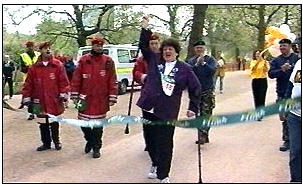
Zoe Koplowitz is an enormous winner despite always losing. When everyone else passes her by, Zoe Koplowitz keeps walking. Koplowitz has completed a total of 25 New York City Marathons, every single one of them in last place. In 2000, she set a world record for the longest marathon time in the history of women’s running at 33 hours, 9 minutes.


Zoe has multiple sclerosis and diabetes and walks all 26.2 miles with crutches. She has written a book called “The Winning Spirit: Life Lessons Learned in Last Place.” After one of the marathons, which she finished a day later than everyone else, Zoe said,–“The marathon is really only a metaphor for life. I am sending a message to everyone that you don’t need to win the race to be a winner in life. Everybody faces marathons each day whether it be looking after kids, parents or at work – it is about finishing what you have started.”


We are blessed that Avraham left us a legacy not only of the promised land but the strength and courage to do what it takes to get there. The promised land is literal and in other ways metaphorical in our lives. Whether it is completing a mesechta of learning, losing a certain amount of weight, or ridding ourselves of a bad habit or routine, we have the capacity like our forefather Avraham to reach the destination.


We May Be In The West, But Our Hearts Are In The East

Friends and family carry the body of Aharon Banita during his funeral at Har HaMenuchot Cemetery in Jerusalem on October 4, 2015, Banita was killed last night by a Palestinian youth in a stabbing terror attack in the Old City. Photo by Yonatan Sindel/Flash90


Almost every time I interact with individuals who have close family living far away who are going through a difficult time, they say something along the lines of, “It is so hard to know they are suffering and to be so far away. I think about them all day and only wish I could be there to show support at this time.” Feeling that way is a reflection of a healthy and close family. Conversely, not feeling that way may be a sign of dysfunction and an indication that the relationship needs work.


Our brothers and sisters in Israel are going through an incredibly difficult time. The “random” acts of terror throughout the country have left Israelis understandably terrorized, filled with angst, anxiety and constant worry.


I have been struggling for the last few days trying to identify what we, the Diaspora Jewish community, can be doing and should be doing to help. Of course we must daven, and our advocacy for a strong US-Israel relationship remains critical, but what can we be doing in this acute situation to ease the pain and provide support for our family going through this horrific period?


Rather than speculate or continue to wonder, I posed this question to members of my family who live in Israel. My sister-in-law Shayna, who lives in Alon Shvut (Gush Etzion) poignantly wrote back the following:


Over the last week I have gotten various emails from family, friends, and students in the US reaching out to tell me that they are thinking of me and my family during this horrible and very difficult time in Israel. It means a lot to me and to everyone here to know that we are being thought about. That other people are thinking about us and thinking about what it must be like to live here right now.  No one here wishes that our loved ones would truly understand what we are going through. But when someone writes and says that it is hard for them to just go about their normal life in America because they can’t stop thinking about the changes in our day-to-day life here in Israel–it means A LOT.  It means that you really care.  It means that you don’t just sympathize but you empathize.  It means that you are really imagining the thoughts that are running though our minds round the clock and the little things that we just can’t believe are part of day to day life right now.


It means you might have realized that:


I drive to work with my doors locked, my windows closed, my cell phone set on the number of the moked (the local security command center) and my pepper spray next to me in the car.


I sleep with a knife in my night table drawer.


I had a conversation with my husband about what should happen with our kids, G-d forbid, G-d forbid… and then wrote it down in my file cabinet because we don’t yet have a formal will. I thought I was crazy until I heard that lots of other people have done similar things.


I was sent a short movie by MDA (Magen David Adom) about how to treat a stab wound.


I watched a video on ynet (Yedidot Achronot) on how to defend yourself against someone stabbing you… and then sent it out to everyone I know.


I was sent protocol from the yishuv about what to do if someone is trying to shoot at your car. (Brake suddenly so that the bullets don’t hit and then do a quick U-turn.)


I haven’t shopped at my typical supermarket in two weeks because I can’t yet bring myself to enter a store where Palestinians shop freely.  I don’t want to pick out my potatoes with one hand on my pepper spray.


I thought twice and three times about whether I should let my third grader go on his class trip today.  I watched him leave my house, gave him extra kisses and had extra kavana in my tefila but I don’t want to raise him to be scared.


I’ve wondered whether the various Israeli Arabs that we have worked with in different capacities over our time here and had such nice relationships with are going to appear in the news any day. We thought they were peaceful until we saw that one of them had a whatsapp picture of the lightrail being stoned.


I had to share with my son more than I would have because Nechemia Lavi was his classmate’s uncle and the school let us know that the psychologist would be meeting with the class.


I have a sister who now has doubled her driving time to Yerushalayim, because the old route she took is more concerning.


I just wish that I could stay in Alon Shvut all day.  Ironically, the well-secured yishuvim are the safest place you can be right now.


And yet if you also thought hard and you know me well you might have also realized that:


I don’t regret our aliya decision for a second.


I feel a zechut to be living in the place where Jewish destiny plays out before our eyes.


I know I am in the place where I am supposed to be.  My kids know it too. They have not once asked to go back. They live with a fierce commitment to the values our ancestors lived and died for. They actually understand the Hebrew words they daven daily and thank us for bringing them here, the place they mention in tefila all the time.


I have bitachon that I am in G-d’s hands.  That He is in control.  That if He wants something to happen or not happen, it doesn’t matter where I am.  That He knows what is best even if we don’t always understand.


I have emuna that eventually things will improve. That this will also pass and that we will wake up to a brighter day.


The people of Eretz Yisrael are strong.


I smiled and then I cried today when I saw two teenage girls standing in the middle of the big traffic circle at Tzomet Hagush– all alone– just swinging huge Israeli flags out there in the exposed open–because they wanted to send a message.


For many of us, it is our kids who keep us strong.  Some of us have kids who are chayalim–who couldn’t come home for Shabbat when they were supposed to because of the matzav yet they go out and serve their country proudly and bravely and without complaint.


I have younger kids but today I heard one kid tell another that we need to be working on our middot so that Hashem looks upon us and all of Am Yisrael favorably.  That gave me chizuk.  It made me feel a little stronger.  It gave me something to do. Because there is not much else we can do.


So if you are thinking about us:


Daven a little harder, learn a little extra, be a little nicer, give a little more tzedaka, work on your middot a little….and let us hope that Hashem looks upon us favorably and says, “Enough is Enough.”


Thank you for thinking about us. It means a lot.


Her answer is both simple and profound. What would you do if your loved one who was far away was God forbid going through a very hard time? You would check in on them as often as you could, remain apprised of their situation, and consistently let them know you were thinking of them.


That is exactly what we need to be doing now as well. We cannot stop knife- and gun-wielding madmen. But even, or especially, from six thousand miles away, we can and must think about our family in Israel often each day and let them know we care as often as we can. Stay closely informed of what is happening in Israel, not because you are a news junkie, but because each update is about members of your family and you should be desperate to know what is going on with them. Reach out to friends and family just to check in. Let them know you are all thinking of them and that as long as their lives are disrupted, so is yours.


As with our immediate family, we hope and pray that our extended family is only healthy, safe, and secure and that we only share good news.


Thinking of Those Not Under the Tallis this Kol Ha’Nearim

The previous Guinness World Record for the longest hug had stood at 24 hours and 33 minutes. This past week, two Iowa State University students shattered that record and maintained a hug for 31 straight hours. When asked what motivated them they explained, “There wasn’t really anything that inspired us; we were just kind of bored during the summer.”


Each morning, when I wrap myself in my tallis before davening, I try to pause for a few breaths and experience the feeling of being wrapped in the loving embrace of the Almighty. In the prayer immediately preceding our donning the tallis, we say, oteh or ka’salma, Hashem spreads out light like a garment. If focused on what we are doing instead of going through a mindless daily ritual, when paused while wrapped in the tallis one can palpably sense the warmth of Hashem’s light and can feel the security of being under His protection. There is no better way to start the day.


Boca Raton Synagogue also set a Guinness World Record this year for a very different type of hug. BRS proudly boasts the world’s largest tallis, measuring forty feet by forty feet. The tallis is made of 49 extra-large, 100-percent wool talleisim sewn together into one huge tallis with tzitzis hanging from all four corners. The tallis will be used once again on Simchas Torah morning during Kol HaNearim, when hundreds and hundreds of children will stand or sit or be held beneath it, and have an aliyah recited on their behalf.  

Watching the Kol HaNarim aliyah each year and seeing so many babies, toddlers, and young kids sitting together reminds me how our community is so incredibly blessed, individually and collectively, to boast close to a thousand children and benefit from the vibrancy, youthfulness, enthusiasm, and nachas they bring. Our hope and prayer on Simchas Torah morning is that sitting under our world-record tallis that contains many of their names, they feel the warm hug of Hashem and the loving embrace of their community.

As we get ready to spread our enormous tallis once again, it occurs to me that during Kol HaNearim we should be thinking about not only the children sitting under the tallis, but also about those absent from that special moment.


Looking at the large gathering of children, one would never know how much intervention was necessary to bring some of them into this world, the level of incredible expenses involved, and the indescribable amounts of pain experienced. While many mistakenly assume that once a decision is made to have a child, a pregnancy and childbirth will then follow easily, the story is often not so simple. There are more than seven million people of childbearing age in the United States currently struggling with infertility. Up to twenty percent of those who do become pregnant experience a miscarriage. Eighty percent of those miscarriages occur within the first trimester, when the couple is unlikely to have told anyone they were expecting and before the woman begins to show. Friends and family members thus might not even know that someone close to them went through this difficult and heartbreaking experience.


BRS has an incredible support group for those struggling with infertility or secondary infertility called Tikvateinu. It is open to the entire Jewish community, meets regularly, and often brings in speakers with either expertise or personal experience. Those with unmet dreams of having a child or more children endure great agony and pain. Our role at the very least is to be sensitive in how we speak and behave, and to try to be as supportive as possible. In that spirit, immediately before the Kol HaNearim aliyah this Simchas Torah we will recite a special Mi Shebeirach prayer for all who are trying to have children. The members of Tikvateinu have given their names to me so I can privately have them in mind. If you would like to submit your name (woman and/or man) or that of a loved one trying to have children, please email me at reg@brsonline.org


There is a second group who will not be present under our gigantic tallis this Simchas Torah morning. They likely have never heard of Simchas Torah, don’t know that day is Yom Tov, and will probably be in school or daycare while Kol HaNearim is taking place. There are approximately 1.2 million Jewish children in the United States. The 2013 Pew Study showed that a growing number of them are not being raised Jewish and as many as 22 percent of their parents identify themselves as having no religion at all. These children have never experienced what it is like to literally or metaphorically be under a tallis. Many are hungry for a hug from Hashem and don’t know where to get one.


We are asking everyone once again to S.O.S. – Share One Shabbos. This Shabbos Chanuka, December 11th, invite someone to your home who has never experienced a Shabbos meal. Invite a co-worker, neighbor, or someone you met at the gym. In the coming weeks we will be sharing with you videos and materials to make you feel comfortable explaining all the components of a traditional Shabbos meal. All around us are Jewish brothers and sisters longing for a hug. All that is missing is an invitation from you.


As we enjoy Kol HaNearim this year, let’s do all we can to make sure nobody is missing from under our world-record tallis. Daven for those who are dreaming of having children and reach out to Jewish families who need a spiritual hug.


Rabbi Efrem Goldberg

Join Our Community

Subscribe to our newsletter or connect with us on WhatsApp.