Their Job is to Look After Israel, our Job is to Look After Them


The emotionally charged expression “Sharing the Burden” means different things in different contexts.  In the context of the Jewish Day School tuition crisis conversation, sharing the burden means helping families find relief from the debilitating levels of tuition. In the presidential election season, sharing the burden is code for raising taxes. When it comes to serving in the IDF, sharing the burden refers to every segment of Israeli society participating in the army.  But sharing the burden when it comes to the IDF means something more and is not just about Israelis.


Israel is not the Israeli homeland; it is the Jewish homeland. The law of return states that all Jews have the right to return to, to live in, and to be a citizen of Israel. Most remarkably, Israel feels a responsibility not only to its citizens and residents, but has exhibited extraordinary steps to help protect and rescue Jews everywhere including Ethiopia, the former Soviet Union, and Argentina. Do we doubt for a moment that if, God forbid, a Jewish community were in danger or at risk anywhere in the world, Israel would step up and do whatever necessary to protect them or us?


Israel belongs to all Jews, not only all Israelis, and all Jews, not only all Israelis, must share the burden of protecting her. The question, then, is what are diaspora Jews doing to share the burden? I am not naïve or foolish. I understand that there are different rights and different obligations for those who live in the land and are legal citizens of it than for those who live outside. Our share in the rights is not as great: we cannot vote, for example. And our share in the burden is obviously not as great, as we in the diaspora are not conscripted into the IDF. However, what is not debatable or deniable, it seems to me, is that we have at least some share of the burden.


The obligation of Jews outside of Israel to share the burden of protecting her is not only a philosophical or ideological statement, it is a halachic one. The Talmud tells us that in the circumstances of milchemes mitzvah, a mandated war, all must participate, even a bride and groom who were standing under their chupa. The Rambam defines a milchemes mitzvah as “war against the Seven Nations, war against Amalek, and assisting Israel in defending herself from the enemy who descends upon them.” (Hilchos Melachim 5:1) His last definition certainly seems like an apt description of Israel’s condition today. The halacha doesn’t differentiate between those that live in Israel or outside her boundaries. Rather, in the circumstance of defending Israel from her enemies, halacha demands that all Jews, wherever they may live, must share the burden and participate in protecting the people. Technically, we should all be drafted into service, no matter where we may live.


And so, while in Israel they debate the question of Yeshiva students exemptions from army service, I propose that we in the diaspora ask ourselves how can we do more towards fulfilling our share of the burden?


The first and foremost suggestion is to consider aliyah. There are legitimate and valid reasons not to make aliyah right now. But, there are no excuses not to consider, struggle with, and plan for a time that we can move to Israel, the Jewish homeland and be part of the Jewish destiny.


Secondly, though we lack a legal obligation to serve in the IDF, we don’t lack a moral obligation to support the members of the IDF in every possible way that we can. I hear regularly from those serving in the IDF whose units have needs that cannot be met by the Army itself. Partaking in a small share of the burden means generously supporting organizations like Friends of the IDF (www.fidf.org) whose motto is “Their job is to look after Israel, our job is to look after them.”


This weekend is our annual Shabbat Ha’Chayal in partnership with Friends of the IDF.  Please consider supporting them directly, or through the Boca Raton based Helping Israel Fund who supports FIDF.  Additionally, while we don’t protect soldiers in the field, we can seek to protect them with our heartfelt prayers by always thinking of them, each and every time we pray.


Thirdly, sharing the burden means advocating for Israel and seeking to influence America’s policy towards Israel on a regular basis and in meaningful ways. Minimally, being a member of AIPAC, (www.aipac.org) and hopefully being active and involved, positions AIPAC to successfully lobby on behalf of Israel’s interests and to be the strongest voice influencing the policies of the US-Israel relationship in the world.


There are countless other ways we can share the burden even from the diaspora, such as by investing in Israel through Israel Bonds (www.Israelbonds.org), supporting organizations that care for IDF veterans (www.zdvo.org), and much more.


As we mark Yom Ha’Zikaron and celebrate Yom Ha’atzmaut this week, let us neither forget nor neglect our obligation to share the burden and let us pledge to do more for Israel this year than ever before.

 

History or Memory: Honoring our Survivors by Attending a Yom Ha’Shoah Program

How many people do you know who fast on the 20th of Sivan?  The likely answer is zero.  It is not one of the minor fast days, and obviously not Tisha B’av or Yom Kippur, so why would anyone fast?


Twice in our history, the 20th of Sivan was designated as a permanent fast day to commemorate massacres against our people.  The first time was by Rabbeinu Tam, Rashi’s grandson in 1171, after 31 Torah scholars were executed as a result of a blood libel in France.  Rabbeinu Tam declared the 20th of Sivan as a day of fasting “greater than Tzom Gedalya, like Yom Kippur,” and instituted special selichos to be recited.  Shortly after, the Crusades expanded and for the next 150 years would bring great devastation of Jewish communities.  It overshadowed the incident of the blood libel and the fast ceased being observed.


Almost 500 years later, from 1648-1649, Polish Anti-Semite Chmielnicki launched a series of pogroms that led do the deaths of tens of thousands of Jews and the loss of hundreds of Jewish communities.  The Shach, Rav Shabbsai Ha’Kohen, instituted the 20th of Sivan as a private fast day for his family to commemorate their great loss.  Soon after, the Council of the Four Lands, the rabbinic authority of Eastern Europe, adopted the fast for all Polish Jewry in commemoration of the tragedies of what became known as Tach V’Tat.


Twice the 20th of Sivan was designated as a day commemorating Jewish tragedies, and twice the observance faded until it is now entirely obsolete.


Learning about the 20th of Sivan, one can’t help but wonder – what will become of Yom Ha’Shoah?  Will it continue to be observed 20 years from now?  Will gatherings, commemorations, ceremonies, and school assemblies be held, or as time passes will Holocaust Remembrance Day fade into oblivion?


Sadly, the likelihood is that Yom Ha’Shoah will go the way of the 20th of Sivan.   While the Holocaust was a defining event and experience for the last two generations, evidence shows that young people today want to “move on,” put it “behind us,” and come “out from under its shadow.”   The younger generation is rapidly seeing the Holocaust in the context of the Crusades, the Inquisition, and the Expulsion from Spain: events that are part of our past, rather than as something that happened to our parents and grandparents, a very real piece of our personal lives.


I don’t know what will happen with Yom Ha’Shoah in the future.  What I do know, is that as long as we are blessed to have our precious and holy survivors, Yom Ha’Shoah is not just about commemorating an event of Jewish history and memorializing the kedoshim, the 6 million who were murdered in our past.  For who knows how much longer, Yom Ha’Shoah is about the present and the opportunity to honor and express our awe at the extraordinary survivors in our midst.


Our survivors have lived through the greatest atrocities and most horrific circumstances in the history of the world.  They endured unimaginable suffering, inconceivable loss, and profound pain.  They rebuilt their lives with deep faith, amazing and inspiring optimism, and in most cases little to no expectation that the world owes them anything in return for what they have been through.


With the Holocaust survivors whom I have been privileged to know, I have found that there is one request they have of us, one wish and hope: they are desperate for us not to forget what they went through.  They reawaken their darkest memories and become traumatized each time they share their horrendous stories.  More than one survivor has told me that for days after telling their story, they cannot sleep, eat, or find a peaceful moment.    Nevertheless, they open themselves up to great pain continue to tell their story with the hope and expectation that we are listening, that we will remember, and that we will continue to tell it long after they are gone.


In his Hagaddah, Rabbi Lord Jonathan Sacks writes:


There is a profound difference between history and memory. History is his story – an event that happened sometime else to someone else. Memory is my story – something that happened to me and is part of who I am. History is information. Memory, by contrast, is part of identity. I can study the history of other peoples, cultures and civilizations. They deepen my knowledge and broaden my horizons. But they do not make a claim on me. They are the past as part. Memory is the past as present, as it lives on in me. Without memory there can be no identity.


Our survivors tell their story and give personal testimony because more than anything they don’t want the Holocaust to be relegated to history; they desperately want it to remain part of our collective memory.


In his article, “Holocaust Commemoration and Tish’a Be-Av: The Debate Over “Yom Ha-Sho’a” published in Tradition 41:2, Rabbi Jacob J. Schacter traces the origins of Yom Ha’Shoah and examines the great debate surrounding its observance.   Whether you feel Yom Ha’Shoah should have been established or you believe Holocaust remembrance should be incorporated into our day of national mourning, Tisha B’av, is academic at this point.  The reality is that the Jewish calendar marks Yom Ha’Shoah and failure to participate in remembering is essentially a slap in the face of our beloved survivors who yearn to know that we have not forgotten their loss and suffering.


Our Yom Ha’Shoah program this year will take place on Wednesday evening beginning with a live presentation via phone from Rabbi Broide and our students participating on March of the Living.  The formal  program begins at 7:00pm and features remarks by Mrs. Tova Friedman and the powerful film, “Treblinka’s Last Witness.”


If you have children of a suitable age, I implore you to bring them.  Older people and adults have lived with and met Holocaust survivors.  It is specifically children who are running out of time and opportunities to meet these extraordinary people whom they will look back at later in life and only wish they could have known better.  Babysitting is available at no charge by registering with Rabbi Gershon Eisenberger at rge@brsonline.org


With all the pressures on our time and the endless list of things that we must get done, I simply can’t imagine a more important place to be on Wednesday evening than with your children at your side honoring the survivors of our community.  What could possibly be more important?


(Reposted with modifications)


Managing Expectations is the Key to a Beautiful Holiday

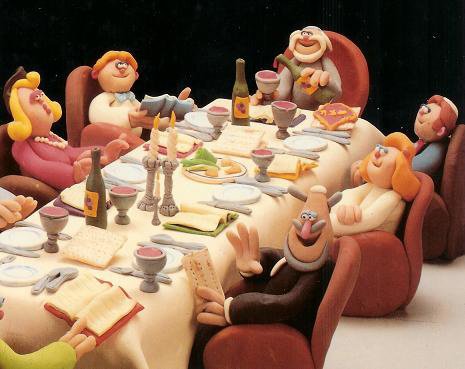
According to the 2013 Pew study, while only 23% of American Jews said they attend religious services at least monthly, 70% reported that they participate in a Seder on Passover. More than any other holiday, Pesach brings family together. These reunions are often filled with promise and hope of quality time that will yield only the most positive memories. In reality, however, it can be difficult to be with lots of people in cramped quarters for numerous meals that go on for hours without some conflict, competition, or quarrels arising.  After all, they say the definition of a dysfunctional family, is any family with more than one member.


An unusual custom regarding matzah is very instructive as to how to prepare for a family Pesach together:


The holiday of Pesach, and the Seder in particular, are brought to us by the number four: four questions, four sons, four cups of wine. And yet, when it comes to matzah, we have three. Why?


Many explanations have been offered:


  • The halachik explanation is that we need to have lechem mishna, two full matzahs, just as we have two challahs every week. Since we plan on breaking one at yachatz, rendering it ineligible for lechem mishna, we need to begin with three.
  •  

  • The matzahs commemorate the three measures of fine flour that Avraham told Sarah to bake into matzah when the three angels were visiting. Rashi points out in his Torah commentary that the angels’ visit occurred on Pesach.
  •  

  • The Magen Avraham, Rav Avraham Gombiner, suggests that the three matzahs represent Moshe, Aharon, and the Jewish people.
  •  

  • One suggestion is that the three are for Chachma, Bina and Da’as, known commonly by its acronym, Chabad.
  •  

  • More popular explanations include – Kohein, Levi and Yisroel, or Avraham, Yitzchak, and Yaakov
  •  


We have come to take it for granted that there are three matzahs, but Sefer Minhagei Yisroel by Professor Daniel Sperber of Bar Ilan references a fascinating custom. In the 17th century, the practice was to have four matzahs at the seder, not three. Rav Yaakov Reischer was a dayan in Prague before being called to the Rabbinate, first in Galicia and ultimately in Worms. In his work, Chok Yaakov, he mentions that the custom in his community is to bake four matzos, in order to have a spare. His commentary, published in 1696, indicates that this was the prevalent custom already at that time in Eastern Europe. In addition, there are mentions of the custom to bake four matzahs in the eighteenth century in England.


This custom was opposed by great halachik authorities, not because they didn’t like the idea, but for a technical reason. They felt the more matzah baked, the more dough necessary and the more dough necessary, the greater the chance of chametz. So, in the end, we only have three matzahs. But I believe the symbolism of the fourth is very meaningful for us as well.


Why have the fourth matzah? It was called the matzas safek. Its purpose was to be a reserve matzah in case one of the other ones breaks. But that explanation raises questions as well. Sure the matzah is delicate, but so is the pittom of an esrog and we don’t say to have an extra esrog handy. We don’t have a spare shofar, or a backup menorah. Why specifically do we have a backup, reserve matzah?


Studies show that depression and anxiety spike during holiday time. “A lot of times it’s the disconnect for many people between what is supposed to be a really warm family gathering and what it’s really like for some families,” says Dr. John Oldham, chief of staff and senior vice president of The Menninger Clinic in Houston.


Shofar, esrog, the menorah, etc. can all be accomplished and fulfilled on one’s own. There is no dialogue, no relationship, and no interaction involved with those mitzvos. The seder, in stark contrast, is characterized by haggadah – a dialogue and conversation. Pesach above all other holidays brings people together. “How many are you having for yom tov” or “How many are you having for the seder” are common questions this time of year.


We bring high expectations to our holiday reunion. This year will be great. Everyone will get along. I won’t have to compete for attention. The kids will be enraptured by the seder and not distracted. Nothing will spill. Perhaps the custom of a fourth matzah originated because we must understand going into the seder that matzah is going to break.  The Torah does not describe a utopian life. The Torah is designed to inspire and enrich our imperfect lives.


The message of the matzas safek, though we may no longer practice it, is to adjust your expectations and set yourself free. Maintaining hope in a perfect experience, relationship or holiday is exhausting and burdensome. Understanding at the outset that things will go wrong and bumps will be encountered along the way is liberating and cathartic.


Part of the seder, the order of life, is preparing for the broken pieces. A chassan and kallah, groom and bride, stand underneath the chuppah and ceremony concludes with breaking glass. It is critical before they even take leave of this most auspicious and special moment that the young man and woman realize that things will break, obstacles will be encountered, and that this is ok. We can’t control other people and we can’t control all events and circumstances. We can control our expectations and, more importantly, how we respond in turn. That ability to control and adjust our expectations is freedom.


May our lives and our matzahs remain whole, but let us be prepared for something to break and know that we have the ability to put it back together again.


Thanking Those Who Packed Our Parachutes, The Essence of Dayeinu

It Would Have Been Enough, Really?

It is almost impossible to imagine the Seder night without the singing of dayeinu.  Young children to octogenarians can be found humming the addictive melody to dayeinu.  Interestingly, the Rambam does not have dayeinu in his Hagaddah and even Rav Saadia Gaon whose Hagaddah serves essentially as the basis for ours, only has dayeinu as an addendum at the end of the Haggadah among those songs that only those who can hold their wine sing.


Yet for us, dayeinu is central, a centerpiece of the hagaddah and a highlight of Seder experience.  The tune is catchy, but the words and theme are frankly bizarre.  Had you taken us from Egypt but not split the sea, dayenu.  Really, would it have been enough?  If you had taken us to Har Sinai but not given us the Torah, dayenu, it would have been enough.  Really, don’t we talk about how the Torah is the air that we breathe, indispensable to our lives and to our very existence?   Had He given us the Torah but not brought us into Israel it would have been enough.  Really?  Wasn’t Israel created before the world because it, the Jewish people and Torah and the three pillars upon which the world is built?


Every commentator and every Hagadda asks the same question:  What do you mean dayenu, it would have been enough?   Most of the discussions of dayeinu, center around an analysis of individual and particular stanzas.  However, I want to share with you an insight that will give you an entirely new way to understand dayeinu. Understanding what dayeinu is really all about and why it is a centerpiece of our Seder requires us to zoom out the lens and instead of investigating specific lines, to look at the poem as a whole.   What do the 15 stanzas have in common?  Why were these events or experiences chosen?


Rabbi Nachman Cohen in his Historical Haggada offers a fantastic insight.   If you look at the Chumash and in Tehillim, chapter 106 in particular you will notice that every stanza of dayeinu corresponds with an incredibly gracious act God did for us and our absolute ungrateful response.


Here are a few examples: We say “had God just taken us out of Egypt it would have been enough.” However, if you look in Deuteronomy 1:27 it wasn’t enough. “Because God hates us, He has brought us out of the land of Egypt to deliver us into the hands of the Amorites to destroy us.”


Another example: we say, “If you just fed us the manna it would have been enough.” But it wasn’t enough. We said, “our soul loathes this bread.” We say, If You just brought us into Israel dayeinu, it would have been enough,” but it wasn’t. It says in Numbers, “[Israel is ] the land that eats up its inhabitants.”


Explains Rabbi Nachman Cohen, dayeinu is our reflecting on our history and repairing the lack of gratitude we exhibited in the past. Seder night we look back on our national history, we review our story and we identify those moments, those gifts from God that we failed to say thank you for. We rectify and repair our ingratitude and thanklessness through the years by saying dayeinu now. In truth, dayeinu, each of these things was enough to be exceedingly grateful for.


Freedom demands gratitude.   If you have are set free, but fail to acknowledge how you attained that freedom, you in fact remain enslaved to your ego and you selfishness.   If you can’t recognize what has been done for you and that you could not have done it yourself, you are not freed from your narrow, self absorbed way of life.  Gratitude is a byproduct of true freedom.


The Midrash describes – He who has no gratitude is like one who negates the existence of God.  If you are so insensitive to those who benefit and sustain you, certainly you will never recognize the blessings which God provides.


Ingratitude is a fatal character flaw individually and nationally.  On the night of Pesach, when we relive the experience of becoming a people and celebrate our national birth we repair the ingratitude of our past with the recognition that we are unworthy and dayeinu, all that God did for us was beyond what we deserved.


Instilling Gratitude in the Home


A couple of years ago the Wall Street Journal had an article entitled, Raising Children With an Attitude of Gratitude, Research Finds Real Benefits for Kids Who Say ‘Thank You’.  The author, Dianna Kapp writes:


“A field of research on gratitude in kids is emerging, and early findings indicate parents’ instincts to elevate the topic are spot-on. Concrete benefits come to kids who literally count their blessings.  Gratitude works like a muscle. Take time to recognize good fortune, and feelings of appreciation can increase.”


The mere act of giving thanks has tangible benefits, research suggests. A 2008 study of 221 kids published in the Journal of School Psychology analyzed sixth- and seventh-graders assigned to list five things they were grateful for every day for two weeks. It found they had a better outlook on school and greater life satisfaction three weeks later, compared with kids assigned to list five hassles.


“The old adage that virtues are caught, not taught, applies here,” says University of California, Davis psychology professor Robert Emmons.  Parents need to model this behavior to build their children’s gratitude muscle. “It’s not what parents want to hear, but you cannot give your kids something that you yourselves do not have,” Dr. Emmons says.


Everyday actions may be even more important than big efforts, researchers say. “Express gratitude to your spouse. Thank your kids,” Hofstra’s Dr. Froh says. “Parents say, ‘Why should I thank them for doing something they should do, like clean their room?’ By reinforcing this, kids will internalize the idea, and do it on their own.”


Seder night is an incredible opportunity to model gratitude for our children, grandchildren and all gathered.  During dayeinu, pause to be appreciative, not only to Hashem for what He has done for our people and for each of us.  Be thankful to those who worked so hard to make Pesach happen.  Someone or someones had to work hard to earn the money to pay for pesach.  Someone had to shop, cook, clean, prepare, set up, clean up, etc.  Don’t just thank your spouse or your parents, but as the article says, thank your children for what they did to pitch in.


Dayeinu teaches that Pesach is not just a time to learn the attitude of gratitude and how to say thank you for the present.  Pesach reminds us that to set ourselves free we need to look back at our lives and identify those who made all the difference and whom we neglected to thank.  Pesach pushes us to make a tikkun, to repair the ingratitude and reach out to say thank you.


Who Packed Your Parachute?


Charles Plum, a U.S. Naval Academy graduate, was a jet fighter pilot in Vietnam. After 75 combat missions, his plane was destroyed by a surface-to-air missile. Plumb ejected and parachuted into enemy hands.   He was captured and spent six years in a Communist prison.  He survived that ordeal and one day, when Plumb and his wife were sitting in a restaurant, a man at another table came up and said, “You’re Plumb! You flew jet fighters in Vietnam and you were shot down!”  “How in the world did you know that?” asked Plumb.   “I packed your parachute,” the man replied,  “I guess it worked!”


That night, Plumb couldn’t sleep while thinking about that man.  He kept wondering what this man might have looked like in a sailor uniform.  He wondered how many times he might have passed him on the ship and never acknowledged him.  How many times he never said hello, good morning or how are you.   You see, Plumb was a fighter pilot, respected and revered, while this man was just a ordinary, lowly sailor.    Now it grated on his conscious.  Plumb thought of the many lonely hours the sailor had spent on a long wooden table in the bowels of the ship carefully weaving the fabric together, making sure the parachute was just right and going to great lengths to make it as precise as can be, knowing that somebody’s life depended on it.  Only now, does Plumb have a full appreciation for what this anonymous man did and he now goes around the world as a motivational speaker asking people to recognize, who’s packing your parachute.


I have a friend who set up a couple 20 years ago.  He told me something incredible.  Every single year on their anniversary, this couple not only get one another gifts but they get my friend, their shadchan, matchmaker, a gift as well.  For their big anniversary they got him a big gift recognizing that the happiness they have together would never have happened without his bothering to set them up.


I know someone who received scholarships from the schools he attended growing up from elementary school through graduate school.  When he became financially successful, the first thing he did was write a beautiful thank you note and make donations to each of the schools that helped give him a chance.


Have we thanked those who contributed to the lives we are blessed to live?  Imagine if our kindergarten teacher got a note from us thanking her for nurturing us with love.  Imagine if our high school principal, our childhood pediatrician, our housekeeper growing up who cleaned our room, out of the blue got a gesture of gratitude showing that we cared enough to track them down and say thank you after all of these years.   Did we ever properly thank the teacher who was patient with us, the orthodontist who straightened out our teeth, the bus driver who drove us?  Did we express enough appreciation to the person who set us up with our spouse, gave us our first job, safely delivered our children?


We all have family, friends, mentors and neighbors, whose efforts are responsible for who we are today.  Freedom means knowing that we didn’t get here on our own.  This Pesach, let’s sing our own personal dayeinu and repair our ingratitude by saying thank you to those who packed our parachutes.


What a Victim of ALS Can Teach Us About Our Power of Speech: Just Shine a Little Light

Imagine being a prisoner in your own body, fully aware, entirely conscious, thinking and emotionally feeling, and yet unable to move or speak at all. For many suffering from ALS, or Lou Gehrig’s Disease, that is exactly what their life looks like day in and day out. Through a couple of viral videos, last week the Jewish world was introduced to an extraordinary individual suffering from ALS.


Rabbi Yitzi Hurwitz and his wife Dina, together with their seven children, were the dedicated spiritual leaders of the Chabad in Temecula, California. R’ Yitzi was always the life of the party, filled with energy, enthusiasm, and love for all people. In 2013, however, his life dramatically changed when he suddenly started slurring his speech and found walking difficult. He was diagnosed with Bulbar ALS and soon after he was no longer able to walk and his voice disappeared entirely.


In a short three years, R’ Yitzi, forty-one years old, has become completely paralyzed and breathes through a permanent ventilator. His only means of connecting with the world is by moving his eyes which allow him to control a screen and choose the letters one by one that spell out words that combine into a sentence and turn into a paragraph. Remarkably, R’ Yitzi publishes a weekly blog (http://yitzihurwitz.blogspot.com/) with a Dvar Torah on the Parsha, which usually contains a message of faith, hope, and optimism. It takes him all day to write the message and leaves him exhausted and spent, but he wouldn’t have it any other way.


He once wrote, “I don’t know why G-d made this happen, but there must be something I can accomplish now, that I wasn’t able to before this. I have always taught others that everything G-d does is for the good although we don’t always see it openly. So now, when this happened to me, I have to live with this same belief and deepen my faith, so that it is not just a matter of words.”


Recently, R’ Yitzi’s family found an old memory card and discovered an original song he had composed called Shine a Little Light. Famous Jewish musicians worked together to produce a wonderful version of the song and music video tribute to him.


In cannot be a coincidence that R’ Yitzi’s story has gone viral during the very weeks that we read about the gift of speech and the power it contains. We must never take for granted the capacity to communicate easily or the potency in that gift. In fact, Shlomo HaMelech, the wisest of all men, teaches us (Mishlei 18:21) “Maves v’chaim b’yad lashon, death and life are in the hand of the tongue.”


Speech can be used to build, to create, to uplift, to encourage, to console and to provide confidence and worth. Or it can be used for what the Torah dedicates two full portions to, namely the consequences of using speech to diminish and destroy, to isolate and to denigrate.


How we use our power and gift of speech says everything about who we are and what we strive to be. Eleanor Roosevelt once said, “Great minds discuss ideas, average minds discuss events, small minds discuss people.”


The Parsha of the metzorah, the one who is stricken with spiritual leprosy after speaking gossip begins by reminding us that the choice of whether to use speech for the purpose of being constructive or destructive is ours: “adom ki yiheyeh b’or b’saro – if a person will have on the skin of his flesh.” A number of commentators ask ,why does the Torah employ the term adom for man? Normally, when the Torah is teaching Jewish law it uses the word ish, why here does it say adom?


Perhaps the Torah uses the unusual term adom at the beginning of the discussion of the metzorah to remind us of the original use of the word adom, in the chapters of creation in Parshas Bereishis: “Vayehi ha’adom l’nefesh chaya, and man became a living being.” This pasuk describes man gaining life and becoming a living creature, in distinction to animals. Unkelus translates the terms l’nefesh chaya as l’ruach melalela, meaning a talking being. According to Unkelus, what distinguishes man from the rest of creation is the ability to talk, to communicate and to express.


Perhaps the Torah chooses to use the term adom in introducing the laws of the metzora in order to remind us of the original adom and that as a ruach m’malela, a speaking being, we have a choice. We can use words to construct or destruct, to build or to destroy. The Sefer HaChinuch writes, “The greatest treasure which the human being possesses is the power of speech, because through this, he is greater than all other creatures.”


Rabbi Emanuel Feldman, formerly a prominent Rabbi in Atlanta, writes in his memoirs of the most difficult question he was asked in his entire rabbinic career. He once received a call from a woman who was desperate to meet with him. When they met, he asked her what is so urgent, how could he help? The woman went on to say, “Rabbi, I have cancer of the larynx and next week and I am having surgery to have my larynx removed.” This was before the advent of the device that when placed next to the voice box emits an electric voice. And so she asked him, “Rabbi, I will never be able to speak again, but I can chose the final words my lips will ever utter, what should they be?” Rabbi Feldman describes this as his most difficult question.


What would you answer and what would you choose? Would your last words be an expression of love to a spouse or children, would they be a statement of your faith, would it be a prayer that you offer or a song you sing? If you could only speak one more time, what would you say? And, if that is what you would say if you had one last chance to speak, why not say it now? Why not value every opportunity to communicate as if it is our last.


Last week’s Parsha, Shemini, discusses the laws of kashrus, of what we eat, consume and ingest. Rav Yisroel Salanter points out that it is followed immediately by this week’s Parsha dealing with lashon hara to remind us that what comes out of our mouth is as important as what goes into it.


Though Rabbi Yitzi Hurwitz is paralyzed and only able to painstakingly communicate through his eyes, he continues to inspire with his indomitable spirit, his courage and faith and his joyful soul. If that is what he accomplishes with the greatest limitations, imagine what we could do if we all used our power of speech to shine a little light.


Give Proportionally to What You Spend on Your Pesach

Since the very creation of the luxury Pesach program, rabbis have been railing against them for their excessiveness, extravagance, and the forfeiting of many of the traditions involved in preparing and experiencing Pesach. Ironically, many of those same rabbis have later “eaten their words” and accepted invitations to serve as scholars in residence, bringing their families to the very type of five-star experience they had long condemned.


But there is a more fundamental reason not to rail against such programs: there is nothing fundamentally wrong with them. True, kashrus can be complicated at these programs, and yes, not all of the environments and activities at every program are appropriate for yom tov, or ever. But these are not intrinsic or inherent deficiencies and just mean that one must choose the program carefully.


Thank God, there are many large Jewish families that, for practical reasons, simply cannot experience a yom tov together if they are not at a program. In addition, there are those who are unable to make Pesach for themselves, don’t have family to go to, and rely on a program in order to experience a proper Pesach. And then there are those that can simply afford to experience the luxury of a Pesach program and, given that they are often equally generous with their support of charitable and communal institutions, why shouldn’t they?


But there is a caveat. There is no Jewish holiday and no Jewish experience that more divides the “haves” from the “have-nots” than Pesach. The contrast between those experiencing Pesach with endless menu options, midnight BBQ’s, quinoa sushi stations, and round-the-clock tea rooms and those who literally don’t know how they will buy matzah or wine, let alone meat, is startling and staggering.


As a community Rabbi, I am exposed to both extremes.  When arranging for the sale of chametz, I like to ask what people’s Pesach plans are.  Often I find myself meeting with someone who, with joy and excitement on his face and great anticipation in his voice, will describe the latest exotic location of the program he is attending this year or the newest amenity or entertainment being offered.  Literally moments later, someone will answer the same question with a tear in his eye and worry on his face and say I have no idea how I am going to afford matzah and wine this year because I am barely covering my bills day-to-day without these added expenses.


The Rambam writes (Hilchos Yom Tov 6:18):


When a person eats and drinks [in celebration of a holiday], he is obligated to feed converts, orphans, widows, and others who are destitute and poor. In contrast, a person who locks the gates of his courtyard and eats and drinks with his children and his wife, without feeding the poor and the embittered, is [not indulging in] rejoicing associated with a mitzvah, but rather in simchas kreiso, the rejoicing of his gut.


Though the Rambam is speaking of every holiday, there is a special practice of providing for others specifically before Pesach. The Rama (O.C. 429:1) quotes from the Talmud Yerushalmi, (Bava Basra 1:4) which states that residents of a city should give wheat or flour for matzah to those in their city in need. This is known as kimcha d’pischa, flour for Pesach, or maos chittim, money for wheat.


And yet, even with the widespread practice of giving to maos chittim, there remain far too many who struggle to keep up with the exorbitant cost of making even a basic, no-frills Pesach (a topic for another time) and are left having to cut back and sacrifice in other areas just to get through what should be a joyous holiday season.


And herein lies the caveat. There is nothing wrong with enjoying and indulging in the luxuries a Pesach program provides, or with making a beautiful, elegant Pesach at home, for that matter, so long as everyone from your community can afford to have the basic necessities. There is no set amount mandated for maos chittim, but I humbly submit the following proposal:


Just as with tzedaka, where we are instructed to give a percentage of our income, so too our maos chittim should be calculated based on how much we spend on ourselves for Pesach. If all of those who attend Pesach programs gave proportionally to maos chittim, we could ensure that all members of our communities have what they need for Pesach without having to compromise or make trade-offs with other basic necessities. And in the spirit of Pesach, v’chol hamarbeh, harei zeh m’shubach – anyone who can and does give more is certainly worthy of praise.


True, many Pesach programs run fundraisers over Yom Tov for all kinds of worthwhile causes, but only a fraction of people participate, and it is too late to help serve this particular need. It is instructive that the practice of giving to maos chittim is quoted in the context of the law that mandates that we begin preparations thirty days before Pesach. Not knowing how one will afford to make Pesach for their family brings incredible anxiety, stress, and worry that compound an already difficult situation. The sooner they can be provided for and have the security that their family will indeed enjoy the amenities of Pesach, the less they will worry and fear.


A woman once approached the Beis HaLevi, Rav Yosef Dov Soloveitchik of Brisk, a few days before Pesach with a strange question. She wanted to know whether one could use milk instead of wine for the four cups of the Seder. The Rav asked her if she was ill, to which she replied that she was perfectly healthy. He then responded by giving her a large sum of money. After she left, the Rebbetzin asked her husband why he had given the woman so much money, when wine costs much less. He responded, “If she is asking about drinking milk at the Seder, it is obvious that she has no meat for Pesach, so I gave her enough to buy both wine and meat for the entire holiday.”


When we sit down for our beautiful, bountiful seder with our loved ones, our simchas yom tov should be enhanced by the knowledge that we have done what we can to ensure that none of our brothers and sisters is sitting down to a bare table where real tears substitute for salt water.


We are already within thirty days of Pesach. Whether you are going to a Pesach program or making Pesach at home, please don’t wait to make sure that everyone can enjoy Pesach. When you are deciding how much to give, please consider what you are spending on your own Pesach for fine wines, delicious meats, and pounds of handmade shmurah matzah, and give commensurately to ensure a beautiful Pesach for all.


The Rabbinic Achilles Heel

When Achilles, the Greek mythological figure, was a baby, it was foreseen that he would die young. In an effort to protect him, his mother Thetis took him to the River Styx, which supposedly contained powers of invincibility. She immersed him into the river, but held him by his heel; as a result, the area under her thumb and forefinger never made contact with the water.


Achilles emerged to be a warrior who was triumphant in numerous great battles. Hector, his archrival, learned about the weak point of Achilles, namely the spot above his heel at the back of his ankle. Hector aimed his arrow directly at this vulnerable spot and when it hit its mark, the great Achilles was brought down and he perished.


I discovered this interesting legend when I ruptured my Achilles tendon earlier this week playing basketball with a young man from the community, and became curious how the longest and one of the most important tendons in our body got its name. For the record, I was winning the game, but it turns out that my body is not as young as my head thinks it is. I vividly remember my mother not letting me play any sports for at least a month before my Bar Mitzvah and, though I am now a grown man, I only wish she had issued the same edict before this big weekend. Now that you know what happened, when you see me in a boot over Shabbos we can skip the questions and focus only on celebrating together.


The Achilles has come to mean more than just a part of the body. The use of the expression “Achilles heel” as a reference to the weak spot that can bring down an otherwise strong person, was first introduced in the year 1810. In an essay by Samuel Taylor Coleridge in The Friend; a literary, moral and political weekly paper, he wrote: “Ireland, that vulnerable heel of the British Achilles!”


We all have strengths and weaknesses. While it is more productive to focus on and grow our strengths, we must remain vigilantly aware of our weaknesses. We would all do well to ask ourselves, what is my Achilles heel?


The holiest vessel in the Mishkan was the Aron, the Ark of the Covenant that contained, among other items, the precious luchos, the stone tablets. The Ark measured 2.5 x 1.5 x 1.5 cubits. Nothing in the Mishkan is coincidental, including the dimensions of its vessels. The Ba’al Haturim, Rabbi Yaakov ben Asher, notes that it is by design that all of the ark’s dimensions – its width, length and height – are fractions and not whole numbers. He explained that those who represent the Ark and all that it contains must never see themselves as whole, as being completed or having arrived. We are a fraction, a work in progress, imperfect and incomplete.


In anticipation of the celebration this Shabbos marking the completion of ten years as Rabbi and Rebbetzin of Boca Raton Synagogue, I have been thinking about the rabbinate and what might be the greatest Achilles heel of our profession from which we need to be guarded and careful.


It is very easy for rabbis to begin to take themselves too seriously and to believe somehow that they are more important, their opinions matter more, and they deserve more respect or honor than anyone else. There is an expression I hear regularly and I shudder each and every time it is said to me.  “Rabbi, thank you for taking the time to call me back,” or “thank you for taking the time to meet with me.  I know how valuable your time is.”  I always respond the same way:  “My time is no more valuable than yours and calling you back or meeting with you is exactly how I want to be spending it right now.”


Many rabbis hear about how valuable their time is and they start to believe it.  They therefore leave people waiting, stand them up, or fail to call them or email them back in a timely fashion.  People come to rabbis with their problems, oftentimes with the expectation that the rabbi can solve them.  This phenomenon can leave the rabbi feeling like he has the answers and access to all of the solutions and he is all-powerful.


With all the heartache, complaints, and gossip about the rabbi and his family that sometimes comes with the job, the truth is that the rabbi gets a lot of kavod, honor.  People stand for him when he enters and wait for him until he is ready to continue certain parts of davening.  He has access to dignitaries and elected officials, he stands in front of the room each week sharing his sermon to an audience eager for his thoughts, and newspapers may call him for his opinion.


The bottom line is that it is extremely easy for all of this to go to a rabbi’s head and for him to start believing the hype.  One of the most disappointing parts of the rabbinate is meeting the other members of the rabbinate, many of whom are arrogant, egotistical, self-absorbed, and self-important.


Our job as rabbis is to understand and accept the awesome responsibility of answering halachik questions, providing guidance and advice regarding issues ranging from life and death to the mundane, and showing up when people need us most, including during life cycle events, times of illness, struggle, or loneliness.  Our mission as leaders is to articulate a vision for our community and to implement the necessary steps to achieving it.


As I reflect on the last ten years as rabbi and last 16 years in avodas ha’kodesh, I feel so incredibly blessed to be surrounded by people who insulate and protect my professional Achilles heel and remind me to take what I do seriously while not taking myself too seriously. I feel so fortunate to be able to count on my Rebbetzin, my family, my rebbeim, and my wonderful community to strike the balance between inspiring leadership in me, and reminding me I am a fraction, not a whole number. They remind me that the measure of a rabbi is not how many comments, likes, or followers he receives online, but rather it is by the personal relationships he is building offline and the lives he is influencing in a meaningful, substantive way.


A breakdown and failure of something small and neglected can throw us off balance and bring us down. When I ruptured my Achilles, I fell to the ground in extraordinary pain. No matter what we have accomplished in our professional or personal lives, if we don’t ask ourselves, what is my Achilles heel, we remain vulnerable to a collapse and painful fall. If, on the other hand, we surround ourselves with support and those who will always help maintain our balance, we can go on to bigger and greater things.


I Don’t Believe in That God Either

Last month marked thirty years since the tragic explosion of the Space Shuttle Challenger. Seven crew members died after the shuttle broke apart 73 seconds after takeoff. As I’m sure is the case with many of you, I vividly remember exactly where I was when this catastrophic event occurred. Along with many American children, my middle school class was listening to a live broadcast of the launch over the class speaker because Christa McAullife, an “ordinary” teacher from New Hampshire was on the shuttle as the first person chosen to participate in NASA’s Teacher in Space Project.


Even as children, when the Challenger exploded we understood that something historically tragic had occurred. We were stunned and searching for a way to understand what we had just heard. Our poor teacher was thrust into an incredibly difficult position with no preparation time or ability to craft a nuanced, sensitive, and meaningful lesson plan.


His words that day were forever seared in my memory because of how much they disturbed me, even at that young age. Without having the chance to process what had just transpired, he turned to us, his students and explained that he thought the Challenger had exploded because man was getting too brazen and encroaching on God’s territory in the heavens. God had struck down the Challenger, he said, because we had violated the boundaries that separate us from Him.


In the town of Berditchev, there was a proud, self-proclaimed atheist who shared with anyone who would listen his problems with a cruel, uncaring God. The great Chassidic Master Rebbe Levi Yitzchak approached him. After the atheist vociferously explained why he doesn’t believe in God, Reb Levi Yitzchak turned to him and said, “You know, the God you don’t believe in, I don’t believe in him either.”


When I heard my teacher describe with full confidence why God blew up the Challenger, I didn’t yet know the story of Reb Levi Yitzchak, but I did intuitively know that I didn’t believe in the God my teacher was describing. Would God really kill seven innocent people in such horrific fashion because they were involved in space exploration? That made no sense to me and I wanted no part of such a God. Looking back, I am tremendously grateful that I didn’t accept his reason and rejected his acting as God’s spokesperson. I rejected it, but it confused me and upset me to the extent that I remember it until this day, thirty years later.


My middle school teacher didn’t have time to formulate his reaction, but sadly, there are rabbis and teachers still today who, with plenty of time and space to prepare, are still presenting themselves as God’s spokespeople, communicating with full confidence the reasons and causes for the world’s catastrophes, natural disasters, and human suffering. One popular outreach rabbi has explicitly claimed in his online classes to know why certain people were killed in the Holocaust and that “blind children are being punished for watching pornography in previous lives” and that “cancer is caused by sin in this life” and “Down syndrome and autism are a result of a sin in a previous life.”


His loyal followers point to his success in attracting students and cite his influence and impact on thousands of people as justification for his method. However, the Torah never measured truth and authenticity by popularity. By that measure, we should have folded to other religions and ways of life long ago.


In next week’s parsha, Moshe pleads to Hashem – hodi’eini na es derachecha, make Your ways known to me so that I know You, so that I may find favor in Your eyes.” Moshe continues, “har’eini na es kevodecha – “Show me now Your glory.” What was Moshe requesting? What was it that he wanted to know?


Even more mysterious is Hashem’s response. “You cannot see my face, for no human can see my face and live… you will see My back, but My face may not be seen.” What is Hashem responding to Moshe?


The Talmud (Berachos 7a) explains that Moshe was requesting from God a window into understanding the meaning and order of the universe. Moshe sought insight into how God runs the world and an understanding of His system of justice. In essence, by asking to see God’s face, Moshe is saying, “God, let me see what you see.” Show me Your perspective of the world and Your system for what happens.


Hashem responds, “Moshe, I cannot show you My face, you cannot see through My eyes, because you are human and you are finite. By definition you are incapable of fully comprehending My system of justice and of appreciating the ultimate meaning and order of the universe. However, you can see the back of My head. Once the event or experience is over, there will come a time, whether in this world or the next, that you will see retroactively why events unfolded the way they did and why ultimately there is meaning and order to everything.”


While this dialogue in particular and the question of why bad things happen to good people requires greater elucidation, one thing is clear from this conversation. We are not empowered or entitled to claim to understand how Hashem runs His world. Indeed, to assert that you know with confidence Hashem’s ways and that you have access to His thinking is an act of heresy.


It is understandable that people who are suffering would try to identify exactly why Hashem is visiting this misery upon them. However, it is an exercise in futility. Our mission is to reflect on our circumstances and be motivated to grow, improve, and find a way to become better as a result. But attempting to uncover exactly why Hashem placed us in the particular position is something unattainable and a poor use of energy and focus.


This week, hundreds of people gathered in Yerushalayim to pay tribute to Dafna Meir Hy”d, who was murdered by a terrorist in her home in Otniel a month ago. Her fifteen-year-old son Akiva spoke and ended by saying:


And now, when everything has been cut down, I stand across from Him, and I am silent. I stand across from the Infinite, and I know that He did this just like He does everything. And suddenly I see a picture that is a little bigger. Bigger than me. Bigger than all of us. Master of the Universe, I want to say one thing to you, just one: Thank You. Despite the difficulty. Thank you for fifteen and a half years of light. Thank You for being with me at the most difficult moments. And that You will be with me during even more difficult moments. And also for all the other miracles which You have performed for me. Thank You. You gave, and You took. May Your name be blessed forever.


Deracheha darchei noam – The Torah’s ways are pleasant.” Hashem wants us to be uplifted and inspired, not feel dejected and beaten down. He wants us to see others who are suffering and be filled with sympathy and support, not with condemnation and judgment. He wants us to bring our fellow Jews close to Torah with humility and intellectual modesty, not bombastic statements and outrageous proclamations.


Thirty years after the Challenger explosion, I continue to reject my teacher’s explanation and I refuse to believe in His God. While I know he meant well that day, our teacher failed us, his students. I implore you to insist on teachers for your children, and leaders for yourself, who understand and present that Hashem is in charge, we are incapable of having access to His secrets and His ways and that “divrei chachamim b’nachas nishmaim – the words of the wise are most effective when delivered with pleasantness.”


Preserving Privacy and Protecting Capacity for Intimacy

Despite what you may have been told as a child, sharing is not always caring.


We are living in a transparent generation where the trend is towards sharing in the extreme. Over coffee with friends, at the water cooler with co-workers, and increasingly on social media, people are revealing more and more about their personal lives, their innermost thoughts and feelings, and their most private experiences.


In theory, the movement towards greater sharing should yield better relationships, closer connections, and improved capacity for emotional intimacy. After all, being open with a person is a fundamental part of connecting with that person. And yet, more and more research confirms that in fact it is doing the opposite. An obsession with sharing and a proclivity for being revealing actually damages relationships, hurts self-esteem, increases anxiety, lowers self-control, and breeds narcissism.


In Judaism, the more valuable and treasured something is, the more private and protected we keep it. The more it is accessible, revealed, and exposed, the cheaper it becomes. Indeed, the Torah’s perspective is that genuine intimacy is achieved when something is private, exclusive, and inaccessible to others. This is true physically, emotionally, and spiritually. The less we practice privacy and modesty in each of these arenas, the greater the challenge we have achieving authentic intimacy in them.


A New York Times article on privacy and sharing on the Internet began, “Imagine a world suddenly devoid of doors. None in your home, on dressing rooms, on the entrance to the local pub or even on restroom stalls at concert halls. The controlling authorities say if you aren’t doing anything wrong, then you shouldn’t mind. Well, that’s essentially the state of affairs on the Internet. There is no privacy.”


The article continues by quoting research that confirms what the Torah has known all along: “The problem is that if you reveal everything about yourself or it’s discoverable with a Google search, you may be diminished in your capacity for intimacy. This goes back to social penetration theory, one of the most cited and experimentally validated explanations of human connection. Developed by Irwin Altman and Dalmas A. Taylor in the 1970s, the theory holds that relationships develop through gradual and mutual self-disclosure of increasingly private and sensitive personal information.


‘Building and maintaining an enduring, intimate relationship is a process of privacy regulation,’ said Dr. Altman, now an emeritus professor of psychology at the University of Utah. ‘It’s about opening and closing boundaries to maintain individual identity but also demonstrate unity with another, and if there are violations then the relationship is threatened.’”


Our parsha, Terumah, introduces us to the layout and floor plan of the Mishkan, the holy Tabernacle. The outer courtyard hosted the altar where sacrifices were offered. The Kodesh, or the holy section, housed the menorah and the shulchan. The last section was the Kodesh Ha’Kadashim, the Holy of Holies that housed the Aron and was only entered by the Kohen Gadol on Yom Kippur. Our sacred ark which held our sacred luchos and the original Torah scroll was in the most private and inaccessible part of the Mishkan.


Rabbi Soloveitchik suggested that we model our personal lives after the structure and layout of the Mishkan:


From the time I was young, I learned to restrain my feelings and not to demonstrate what was happening in my emotional world. My father would say that the holier and more intimate the feeling, the more it should be concealed. There is a hidden curtain that separates between one’s interior and the exterior: “and the dividing curtain shall separate for you between the Holy and the Holy of Holies.” What location is more sanctified than the inner sanctum of one’s emotional life?


In this world “devoid of doors” we need to be all the more mindful to keep our paroches, our curtain up, and protect the Holy of Holies of our lives. This is not to suggest that one should not share his or her emotions and feelings at all and keep them bottled up; obviously that is unhealthy and potentially dangerous. But the Holy of Holies was seen by a selective audience, only the Kohen Gadol.


Share your strong feelings, innermost thoughts and personal emotions with your spouse, or a family member you trust, or a close friend or confidant. But, not every thought or feeling needs to be made public. Not every personal experience or event merits sharing. Not every moment of frustration or point of pride with your job, with your children, or with your experience at a restaurant needs to be fodder for Facebook or with friends.


Failing to be judicious and thoughtful in what and how we share profanes our lives and makes achieving intimate relationships difficult. Preserving our paroches, maintaining the capacity for privacy and mystery, ultimately protects our Holy of Holies and elevates all the relationships in our lives.


What is the Measure of a Great Community?

What is the measure of a great community? What are the metrics and tools we use to evaluate the success of a society?


In this week’s parsha, Mishpatim, the Torah tell us that we must not cause pain or suffering to a widow or orphan. So strict is this law, that God promises that one who aggrieves the widow or orphan will evoke His anger, and in turn, God will strike down the insensitive person, causing his wife to be a widow and his children to be orphans.


While Parshas Mishpatim is replete with mitzvos and laws, this one stands out. The Chizkuni, a 13th century French Rabbi, points out that all of the other commandments in our parsha, from civil law, jurisprudence, laws of loans, damages, shabbos, holidays and more, are all written in the singular. The commandments and obligations of Mishpatim are directed at individuals who must each feel the mandate and imperative to live inspired, ethical and moral lives with a loyalty and fidelity to Jewish law. The obligation to show kindness and sensitivity to the widow and orphan, however, are an exception as they are written b’lashon rabim, in the plural. Why, wonders the Chizkuni, should this mitzvah specifically stand out?


On April 12, 1999, Holocaust survivor and Nobel Laureate Elie Wiesel gave an impassioned speech in the East Room of the White House as part of the Millennium Lecture series:


What is indifference? Etymologically, the word means “no difference.” A strange and unnatural state in which the lines blur between light and darkness, dusk and dawn, crime and punishment, cruelty and compassion, good and evil.


Of course, indifference can be tempting — more than that, seductive. It is so much easier to look away from victims. It is so much easier to avoid such rude interruptions to our work, our dreams, our hopes. It is, after all, awkward, troublesome, to be involved in another person’s pain and despair. Yet, for the person who is indifferent, his or her neighbor are of no consequence. And, therefore, their lives are meaningless. Their hidden or even visible anguish is of no interest. Indifference reduces the other to an abstraction.


In a way, to be indifferent to that suffering is what makes the human being inhuman. Indifference, after all, is more dangerous than anger and hatred. Anger can at times be creative. One writes a great poem, a great symphony, one does something special for the sake of humanity because one is angry at the injustice that one witnesses. But indifference is never creative. Even hatred at times may elicit a response. You fight it. You denounce it. You disarm it. Indifference elicits no response. Indifference is not a response.


The Chizkuni explains that evil is not necessarily perpetrated actively. There is such a thing as passive, non-aggressive malevolence. This commandment to be sensitive and kind to the orphan and widow is written in the plural because while there is a directive to the individual, the entire community is measured by this mitzvah. This mitzvah is written in the plural because the community is measured by the standard it sets and the environment it tolerates. Even those individuals not directly, actively guilty of oppressing the less fortunate are culpable because of their indifference and apathy.


Rav Yaakov Zvi Mecklenburg, author of the Ksav V’Kabbalah, explains that the Torah doesn’t limit this mitzvah to the orphan and widow. The almanah and yasom are simply symbolic of those that are missing something, those that don’t quite fit the mold and therefore may feel isolated, alone, and unnoticed. The word almanah comes from al-manah, missing a portion. In every community there are people that don’t fit the mold, they are al-mana, missing something.


Ultimately, as a community and as a society we are judged and measured by our sensitivity, kindness, awareness and inclusiveness of people who feel invisible. “Indifference is not a response.” We must never be indifferent or apathetic, but as a community, we must always seek ways to make everyone feel included and cared for. That is the mark of a truly great community.


Rabbi Efrem Goldberg

Join Our Community

Subscribe to our newsletter or connect with us on WhatsApp.