667 Days Without a Day of Their Own: Building B’Yameinu

667 days.  


Of course, we daven from the bottom of our hearts that by Tisha B’Av the hostages will all be home, our soldiers will all be with their families, and our enemies will all be defeated. 


But if not, Tisha B’av will mark 667 long days since October 7.  667 days in which innocent people, guilty only of the crime of being in Israel, will have been held by cruel, evil terrorists.  667 days that heroic IDF soldiers have been fighting on several fronts, leaving their families and risking their lives for our people and our land.  667 days with an entire country of 10 million people constantly remaining aware of where a bomb shelter is and needing to think about it each time they leave their home.  


For 667 days—granted in very different ways—hostages, soldiers and the people in Israel have not been able to call any day fully their own. 


The Talmud (Yerushalmi, Yoma 5) tells us Kol dor she’eino nivneh b’yamav, ma’alin alav k’ilu hu hecherivu, any generation in which the Beis HaMikdash isn’t built in its days, it is considered as if that generation itself destroyed it. 


Why didn’t the rabbis just say kol dor she’eino nivneh, any generation in which the Beis HaMikdash isn’t built? What is added by the word b’yamav, in their days?   We use this same word daily in our davening when we ask Hashem u’vnei osah b’karov b’yameinuAgain, why not just ask Hashem to build Yerushalayim and the Beis Ha’Mikdash, what is added by b’yameinu, “in our days,” when this is inherently the request?


In his Zera Kodesh, the first rebbe of Ropshitz, Rav Naftali Tzvi Horowitz, explains that “B’yameinu” isn’t a prayer for when we want redemption and rebuilding, it is the formula and blueprint for how to bring it.  The letter Beis, when used as a prefix, can mean two different things. B’yameinu can mean in our days, but it can also mean with our days. 


The building blocks, the materials for a generation to build the Beis HaMikdash and bring redemption, is “b’yamav,” to use its days meaningfully, productively and as fully as possible.  Doomscrolling, mindless binge watching, criticizing, fighting and sowing division are exercises in squandering our days.  If we waste them, misuse them, fail to appreciate the gift of “our days,” it isn’t only that we failed to rebuild the Beis HaMidkash, but by destroying our most precious commodity, our days, k’ilu hechrivo, we destroyed what we could have done with them, what we could have built with them. 


For 667 days the hostages haven’t had “y’mayheim.”  Their days haven’t been their own.  They haven’t had control over their time or their lives. They haven’t had their freedom or seen their families.  Maybe they haven’t even seen the light of day. For 667 days they haven’t been able to decide for themselves what they want to do, where they want to be, what they want to achieve. 


We daven daily that Hashem finally changes our condition in the world, that He brings a genuine and lasting peace, that He builds the Beis HaMikdash b’karov. How? B’yameinu, by using our days to heal instead of harm, to create connection instead of separation, to compliment instead of criticize, to build instead of destroy, to unite instead of divide.   


In Eicha we describe the unbearable pain of yashva badad, of feeling alone, a malady and condition that too many continue to suffer from today.  If loneliness is the problem, the antidote and the answer is to be nosei b’ol im chaveiro, to bear the burdens of our friends and our people, to feel their pain, to empathize with their plight and to become part of their suffering. 


To be nosei b’ol im chaveiro means to not only feel bad for, but to feel pain with those who are struggling and to focus on filling our days with providing relief, support, and love. 


If we want to change what is happening to us in the world, we have to be thoughtful and mindful of what we do to and for each other.  We must fill yameinu, our days, with standing with and davening for the hostages, our soldiers, and all our brothers and sisters in Israel.  We must ensure nobody is dreading the countdown to Shabbos wondering if they will get invited or will once again be eating alone.  We must make sure that nobody in our community can’t sleep at night because they aren’t confident they will cover their bills.  We can’t allow an Agunah to feel she is all alone or a victim of trauma or abuse has been abandoned. 


If you own and control your days, you are not only blessed but bear an awesome responsibility to fill it with meaning, purpose, care, and concern.  If we use the days leading up to Tisha B’Av well, we will merit to no longer sit on the floor and mourn but to celebrate the building of the Beis HaMikdash, constructed b’yameinu, with our days. 

The Pulpit Must Not be a Political Podium… Most of the Time

The IRS announced it will break with a long-standing rule and now allow houses of worship to endorse candidates for political office without losing their tax-exempt status.  Since 1954, a provision in the tax code called the Johnson Amendment mandates that nonprofit organizations could lose their tax-exempt status if they participate in or intervene in “any political campaign on behalf of or in opposition to any candidate for public office.”


The rule was violated regularly in some houses of worship, but the IRS rarely enforced it. In explaining the change, the agency advised that when a house of worship, “in good faith speaks to its congregation, through its customary channels of communication on matters of faith in connection with religious services, concerning electoral politics viewed through the lens of religious faith,” it neither participates nor intervenes in a political campaign.


This means rabbis can now legally endorse candidate from the pulpit.


But should they? 


I don’t believe so.  In many or even most elections, reasonable people can come to a reasonable conclusion in either direction.  Sure, it is fair, maybe even constructive at times, to try to persuade others to see things as you do, but if you can’t, the best practice is to acknowledge that not only is the other person entitled to his or her perspective, but their opinion is reasonable, legitimate, and fair. The fact that they arrived at a different conclusion, even one you are convinced is wrong, doesn’t mean they have corrupt character, less patriotism, compromised commitment to Israel, or less devotion to Torah.


Rabbis and shuls should be spaces where people with diverse opinions can congregate, connect, learn together, daven together and work together on the issues that unite us.  If rabbis begin to offer public endorsements, especially from the pulpit, will those who disagree with his conclusion still feel comfortable being part of that shul?  What will the impact be on public discourse and debate within the community if the rabbi publicly weighs in endorsing one side, particularly invoking his Torah authority in doing so? 


Will those who disagree with the rabbi’s endorsement and choice continue to turn to him for direction, guidance, and support?  Will they ask him their halachic questions, want him to officiate at their simchas and lifecycle events, trust him to advise on sensitive matters?  


If the answers to these questions is no, even if it is a small percentage of the shul/community who will feel alienated, is the endorsement worth it?  Rabbonim are shepherds, charged with loving and caring for their flock.  If some will be driven from the herd or who walk away feeling unwanted, the shepherd has failed in his mission. 


Ultimately, as Shlomo HaMelech taught (Misheli 21:1) “פַּלְגֵי־מַ֣יִם לֶב־מֶ֭לֶךְ בְּיַד־ה’ עַֽל־כּל־אֲשֶׁ֖ר יַחְפֹּ֣ץ יַטֶּֽנּוּ – The heart of a king is like a stream of water in the hand of God, wherever He wishes, He will direct it.”  We say every single day in our prayers, “Al tivtechu b’nedivim, don’t place your faith and trust in princes and diplomats.”


As God-fearing Jews, we recognize that it is the Master of the Universe who orchestrates domestic, foreign, and of course all policies and their consequences. To be a student of Torah and of Jewish history is to recognize the Almighty’s guiding hand. His hand guided our history and ultimately, it is His hand that is guiding our destiny.


I said above that in most elections reasonable people can come to a reasonable conclusion in either direction, but like almost every rule, there are exceptions and we are living through one.


One group of clergy didn’t wait for the IRS to change its rule before making a public endorsement.  In an article titled, “We are NYC rabbis who support Zohran Mamdani – Here’s why,” they write:

My co-authors (listed below) and I are among many New York City rabbis who voted for and proudly support Zohran Mamdani in the race for New York City mayor. Our religious tradition calls us to pursue justice and invokes our responsibility to bring it into the world. For many of us, the campaigns of Mamdani and mensch co-endorser Brad Lander marked the first time in a long while that we witnessed the Jewish call for justice clearly reflected in the platforms and character of mayoral candidates. We are confident that Zohran will carry those values forward – we hope, all the way to Gracie Mansion.


Supporting Zohran and Brad was, for us, an explicitly Jewish act, and we’re kvelling over our contribution as Jewish New Yorkers to Mamdani’s historic victory…


We believe that rent is too high, buses are too slow, and New York should be a welcoming, safe home for everyone – no matter where we came from or how long we’ve been here. Like Mamdani, we believe…that the Israeli government’s treatment of Palestinians in Gaza and the West Bank is horrific and cannot be ignored. These convictions reflect a shared political ethic – not identical political beliefs – and they are strong enough to support both real coalition and real community.


The blatant smear tactics we see used against Mamdani are frequently deployed against Muslim elected officials and leaders of color who dare to criticize Israel. These accusations are not about protecting Jews. They are about shutting down necessary reckoning with our city and country’s complicity in Israel’s occupation…


We believe that Jewish safety will not be secured by demanding unconditional support for Israel or imposing litmus tests on public officials around language. It will be secured through effective policy, education, solidarity, and shared struggle. That is what Mamdani offers…


Absurd, dangerous, and deeply disturbing articles like this one make this New York mayoral election an exception in which reasonable people should not be able come to certain conclusions and rabbis should be vocally opposing this article and this candidate.  But let’s be clear about the parameters. Mamdani’s socialist views, calls to defund the police and dishonesty on his college application don’t, in my opinion, justify rabbis issuing an endorsement for his opponents. We should, however, call out and voice opposition to a candidate who is openly against Israel in the clearest possible terms and who proudly stands with antisemites.


I recognize that people will disagree about where to draw the line and when to make the exception, but I hope that reasonable people can agree that stopping the election of a candidate who is undeniably and objectively anti-Israel and by extension antisemitic is not a violation of a rabbi’s responsibilities but the fulfillment of it. 


Mamdani has refused multiple times to recognize Israel’s right to exist as a Jewish state, and he has supported the BDS movement against Israel. While he hasn’t himself used the phrase, “Globalize the Intifada,” he has refused to condemn those who do and defends their right to use the expression.  As the intifada is actually being globalized with Jews suffering attacks around the world in growing numbers, in no place more than New York City, defending the expression is egregious and incites violence against Jews. The founder of the Students for Justice in Palestine (SJP) at his alma mater, Mamdani has accused Israel of “genocide” and “apartheid,” and has vowed that as mayor he would arrest Benjamin Netanyahu.  


Despite the IRS’s rule change, don’t expect to see political endorsements from the BRS pulpit. But stopping Mamdani isn’t a question of politics, it is about self-preservation and the safety and security of the Jewish community. 

Antisemitism Uncensored: Let Them and Let Us

Last week, Piers Morgan, whose show has over 4 million subscribers on Youtube, hosted virulent and unapologetic antisemite Candace Owens.  Seething with hate for the Jewish state and the Jewish people, Candace opened by calling Israel a terrorist state and falsely accusing Israel of perpetrating a genocide and a holocaust by indiscriminately and intentionally murdering innocent children in Gaza.  She described AIPAC as owning American policy and claimed that American soldiers have died and will continue to die for Israel. 


“I would say as an American that if we’re going to get behind a regime change it should be in Israel first… I think [that would be] the position of a lot of people who are waking up to the fact that Zionism has brought us nothing but grief in America.  Can you name one positive thing that Zionists have contributed to America?”


At the conclusion of the interview, Piers closed by saying, “Candice, always good to have your views on Uncensored. You know that I appreciate you coming on.  Thank you.”


Good to have your views?! Would it be good to have the views of a white supremacist, a member of ISIS, a blatant racist, or anyone else filled with hate for a particular people and lies about an entire nation?


Someone shared this clip with me and I only watched a few moments, but it was enough to make me want to jump through the screen, correct the lies, and set the record straight to both the antisemitic guest and the host who has sold his soul for views by platforming such heinous individuals. Hearing them even for such a brief period of time, and then catching that conclusion about it being “good” to have her views, made my blood pressure rise, my pulse quicken, and my stomach turn.


When I calmed down it quickly struck me – why in the world did I watch that?  Why did I allow them to take up space in my head and heart?  They certainly didn’t impact my beliefs or opinions an iota and obviously, being a passive spectator, I didn’t influence their views either.  All that was accomplished was giving them another online “view” and causing me to get terribly upset.   In retrospect, there couldn’t be a worse use of time.


Hearing the distortions, lies, hate, and fake news about Israel on podcasts, viral clips, social media and even some mainstream news programs is infuriating, maddening, and ultimately unproductive.  If we care about our beloved people and our people’s homeland, the truth is that there are much better ways to use our time.


In her bestselling book, “The Let Them Theory,” Mel Robbins describes an almost universal phenomenon of wanting to control everyone and everything around us.  We want to dictate what people say, believe, and do, and when we can’t, it frustrates us enormously often leaving us feeling stuck.  The Let Them Theory teaches how to stop wasting energy on what you can’t control and start focusing on what you can: YOU.


The theory is made up of two parts, Let Them and Let Me.  When you find someone speaking, behaving, or believing things that bother you, frustrate you or disappoint you, say to yourself – Let Them.  Let them think that, let them say that, let them do that.  Let them.  But the theory only works when followed by Let Me.  Let Me focus on myself, my life, my happiness, what I can control, what I am supposed to do, who I am supposed to be. 


Robbins writes: “When you say Let Them, you make a conscious decision not to allow other people’s behavior to bother you. When you say Let Me, you take responsibility for what YOU do next.”  Let Them: Have their opinions, judge your choices, think what they want, talk behind your back. Let Me: Live authentically, focus on growth, find happiness.  The brilliance of the theory is its simplicity and in the book she provides science-backed evidence for why it works. 


Reflecting on the recent Israeli triumph over Iran and its success fighting on seven fronts over the last almost two years, one marvels at Israel’s capacity to practice Let Them and Let Me.  Shutting out all the noise from around the world, Israel has focused on what it needs to do and the results are stunning.  By saying “Let them,” let the haters make noise and “Let us,” let us eliminate our enemies, neutralize existential threats, and take a leadership role in providing security for the Middle East and the world, Israel has earned both the fear and respect of unlikely sources.  We hope and pray that it comes to fruition but even the prospect and rumor of several countries that were previously hosts to Israel’s enemies now open to joining the Abraham Accords is welcome great news. 


Rav Soloveitchik commented that slavery and subjugation come in two different forms – both the physical component and also a mentality.  Physical slavery means that a person is literally under the control of somebody else who decides what he can and cannot do.  The Jewish people who were under the rule and control of the Egyptians were released from this form of bondage at the time of Yetzias Mitzrayim.  Nevertheless, they still were not freed from their slave mentality.  They still felt inferior, subservient to the opinion and perspective of other people.  They not only assumed that others viewed them as “grasshoppers,” as small and inferior, they allowed that projection to overwhelm them with fear, hold them back, and ultimately keep them from the Promised Land.


For 2,000 years we have been fighting to survive, subjugated by our host countries who orchestrated pogroms, attempted to exterminate us, or expelled us.  Today, with endless gratitude to Hashem, though we remain in a state of galus, we are physically and religiously free.  Yet, the long conditioned galus mentality breeds a feeling of inferiority, a concern for what others think of us.  We seek validation for something as simple as a right to exist.  The truth is, the opinion we should be most obsessed about is that of Hashem and the question of if we are fulfilling His vision and mission for us. 


In the beracha with which we conclude the maggid section of the seder on Pesach, we express our hope to experience our final redemption, when we will praise Hashem al ge’ulaseinu v’al pedus nafsheinu – “for our redemption and the redemption of our souls.”  Rav Soloveitchik explained that we anticipate the time when we will experience not only ge’ulaseinu, physical redemption, freedom from those who oppress and exert control over us, but also pedus nafsheinu – mental freedom, the freedom from our insecurities and our sense of inferiority, so that we will have the confidence to act as we are supposed to act without worrying how we will be perceived and what others are thinking and saying.


When Hashem summoned Moshe back to the top of Mount Sinai to receive the second set of tablets, He commanded, v’ish lo ya’aleh imach – “and no man shall ascend with you” (Shemos 34:3).  The Degel Machaneh Efrayim, grandson of the Ba’al Shem Tov, comments that whenever we “ascend,” seeking to grow and lift ourselves higher, we should not bring anyone else with us; we should not be worrying about what other people are thinking or saying about us.  What others think about us is their problem, not ours.  We should live with the freedom to “climb the mountain,” to rise to the greatest heights we can, without worrying at all what people are thinking.


It is true that we rely on the help and support of others and therefore it is critical to engage in lobbying and advocacy with those in elected office. If we are in a position to have our voices heard, we must use those voices as much and as loudly as possible. But when it comes to watching, listening and reading the news, we must be judicious and mindful in distinguishing between staying informed and aware of the news, and becoming aggravated and infuriated by the lies.  


Let them! Let them make noise and spew hate. 


And let us!  Let us climb higher and higher in our unity, our love, or faith, fighting for our people and spreading Hashem’s light. 

The Triumph of Israel and the Spirit of the Jewish People

Israelis, Jews, and decent people around the world breathed a great sigh of relief and were filled with euphoria at the news that the spectacular American military, at the courageous order of President Donald Trump, had bombed and obliterated Iran’s nuclear program.  As of now, the 12-day war with Iran has reached a ceasefire with a stunning Israeli military victory, one that experts already say surpasses the Six Day  war.  We would all be remiss if we didn’t follow the example of President Trump and Prime Minister Netanyahu, who both publicly and proudly thanked God for the success of their efforts. 


It is truly extraordinary that for nearly fifty years, an evil regime, the world’s largest state sponsor of terror, has wreaked havoc, murdering innocent Americans and Israelis while threatening its Arab neighbors.  The danger and threat to the world of a nuclear Iran has been articulated by the last five American presidents and by countless world leaders.   


History will show that President Trump and the United States didn’t just talk about eliminating that threat, they acted.  But the US, the world’s greatest superpower, didn’t do it alone, they had the help of only one other country.  If you looked only at a comparison of countries by populations, land mass, economy, how long they have existed, their role among nations, would you ever guess that the other country that not only assisted but paved the way and set the stage was smaller than New Jersey, is only 77 years old and has a total population of just 10 million? 


I got goosebumps when President Trump thanked Israel: “I want to thank and congratulate Prime Minister Bibi Netanyahu. We worked as a team like perhaps no team has ever worked before, and we’ve gone a long way to erasing this horrible threat to Israel. I want to thank the Israeli military for the wonderful job they’ve done.” 


The role and contribution of the State of Israel in protecting the world and keeping it safe is nothing short of a Kiddush Hashem, a fulfillment of the Jewish people’s mission in the world. 


I was sitting at a beautiful Chuppah on Sunday, thinking about and reflecting on this achievement.  The seventh beracha was recited and the Chuppah was about to conclude but instead of turning to the singing of Im Eshkacheich, we were all invited to rise as something else was sung first, the Mi’Shebeirach for Tzahal, the prayer for the IDF.  I have attended dozens of weddings since October 7, and at every one of them, a prayer for our brothers and sisters in Israel and for the heroic and courageous members of the IDF was included, sometimes as the IDF prayer and other times as Tehillim.


As we all stood and focused on the heartfelt Tefillah, a thought occurred to me.  In America’s wars, in Afghanistan, Iraq and elsewhere, was any wedding of the average American interrupted to include a prayer for the American military?  Were the weddings of any Americans paused to pray for American troops? Unless an immediate family member of the bride or groom was serving in active duty, I can’t imagine a prayer was included, even right here in America.  And yet, for the last year and three quarters, around the world, thousands of miles from Israel, Jews everywhere have refused to celebrate without also pausing to pray for the IDF.  The Jewish people are unique in this way.  Wherever we are around the world, we feel connected, and our wellbeing is intertwined.


In several places (Yevamos 61a, Bava Metzia 114b, Kerisus 6b), the Gemara says, “You, the Jewish people are called אדם, Odom, but the nations of the world are not called Odom.”  Read simply, it sounds like a terribly prejudiced and biased statement. 


Rav Frand shares a story that offers a deeper understanding:  In 1912, in Russia, Mendel Beilus was accused of killing a Christian child and using his blood to bake Matzahs. This slander or variations of it were unfortunately prevalent in Europe for many, many years. They were known as blood libels. Beilus’ lawyer was afraid that to buttress their case, the accusers would make the argument that Jews considered non-Jews less than human. He was in fact afraid that they would cite the above-quoted Talmudic reference to prove this very point.


The lawyer therefore visited the Chortkever Rebbe and asked him how he could respond if the opposing lawyers would throw that Gemara at him. The Rebbe said as follows: If an Italian was seized and put on trial, we would not witness a scenario where all Italians were congregating in their churches to pray for this one Italian. The same can be said about the French for a Frenchman, and so too about all other nations. However, when a Jew is seized and put on trial, the solidarity that Jews have toward each other will make every Jew throughout the world stop and pray for the welfare of that other Jew.


This is how the Chortkever Rebbe explained Chazal’s statement that “You are called Odom.”  The Hebrew language is extremely precise in terms of the different connotations of apparent synonyms.  Other words for “man” has a singular and a plural – ish, anashim, gever, gevarim.  However, the word Odom is the same whether  referring to one or many.  The singular term “Odom” fits the Jews. All Jews are considered as a single entity. There is no dichotomy. We are all in this together. The reason why the word “Odom” is employed referring to Jews is because this is the only term for humanity that has no plural and the Jewish people are a singular people.


This is not a racist or bigoted interpretation. It is a unique attribute of the Jewish people that has been demonstrated time and time again in ancient times and we are experiencing it right now.  If one Jew is held hostage, Jews around the world feel the pain and storm the heavens.  When heroic soldiers of the IDF are fighting, Jewish weddings around the world are interrupted with a prayer on their behalf. 


With Israel’s victory against Iran, we hope and pray that Hamas surrenders, releases the hostages, and Jewish people around the world can live with the peace and tranquility we deserve.  But until they do, we will always feel a sense of responsibility for and oneness with one another.

A Nation Rising and Roaring Like a Lion

Several times over the last few days, I was talking to someone in Israel—my daughter, sister or a friend—and they nonchalantly interrupted to say, “I need to hang up, the sirens is sounding and we need to head to the bomb shelter.”  To be clear, though this is commonplace, there is absolutely nothing normal about ever having to utter the sentence, “I am gathering my family and going to a bomb shelter because ballistic missiles are headed our way.” 


Is it really any wonder that Jews suffer disproportionally from gastrointestinal disease?  How could the stress, anxiety, and trauma of two thousand years of running and hiding from pogroms, attempted exterminations, and expulsions not be absorbed into our people’s kishkes?


Eighty years after the Holocaust, Jews are once again running to take shelter from those attacking them.  In Gaza and Lebanon, our heroic soldiers have been on the front lines risking their lives for the future of our people.  But in this war with Iran, all of Israel, 10 million people, find themselves on the front lines, running for shelter and bracing for potential impact.  This includes waking sleeping babies, carefully escorting the elderly, stocking up space, packing people in, and going long periods without sleep. 


Mi K’amcha Yisroel – Nobody Like the Jewish People


I am in absolute awe of my family, friends and all in Israel whose lives have stopped and have been turned upside down.  Many are doing it with spouses serving in miluim or stuck out of the country or without family around to help them.  The entire country is now bearing the brunt of the hatred of Iran who want to wipe out the whole Jewish nation globally but are taking it all out only on those in Israel.  And yet, somehow, our people carry on with positivity, faith, hope, tenacity, resolve, and a healthy sense of humor.


This is the story of our people.  They, our brothers and sisters in Israel, are why we are unstoppable and undefeatable. 


There is much uncertainty that remains, but as of now we know that Israel has pulled off an operation that makes the Hezbollah beeper episode look modest and, according to some experts, is on par with the miracle of the Six Day War.   On June 13, 6/13, an auspicious date, Israel launched a pre-emptive strike to take out Iran’s nuclear capability, a country that has pledged to destroy Israel and wipe out the Jewish people. Earlier that same day, the Prime Minister davened at the Kotel, a seemingly innocuous gesture as he hosted a foreign leader.  Together with the announcement he was going on vacation and attending a celebration, and the coordinated statements by President Trump, Secretary Rubio, and Steve Witkoff telling Israel not to attack, Iran was caught by surprise. 


Mindbogglingly, the Mossad had been operating in Iran for years, setting up a base with drones that were smuggled in. Having eliminated the air defense, Israel’s extraordinary air force operated with impunity, flying more than 1,100 miles to relentlessly pound missile sites, attack nuclear sites and, in pinpoint strikes, eliminate Iranian nuclear scientists and military leaders all while brazenly refueling over Iran.


Israel orchestrated events that they knew would cause Iranian military leadership to gather and then took them out. Israel is the size of New Jersey and has 10 million people. Iran is more than twice the size of Texas and has 93 million people.  We are witnessing nothing less than a modern-day version of David defeating Goliath. 


This courageous action, in defiance of some world opinion and world leaders, is a gift to the world, just like it was when Israel took out Iraq and Syria’s nuclear programs. Thankfully, despite the public posture designed to distract, in truth, President Trump and the United States stand with Israel, are coordinating with Israel and are helping defend Israel.


Gratitude and Angst


On Thursday night, when Israel launched its preemptive strike, we were filled with gratitude and elation, pride and joy in the unprecedented and heroic success.  But those feelings were quickly tempered as Iran began to retaliate and launch waves of barrages of ballistic missiles, most of which have been intercepted but too many of which have gone through, taken lives, and caused scores of injuries.


There have been countless, extraordinary miracles and achievements.  As this war with Iran continues to unfold, we are filled simultaneously with boundless gratitude and pride on the one hand but also profound concern, worry, and angst on the other.  How do we balance these conflicting feelings?


Once, in the early years of his leadership, Rabbi Shneur Zalman of Liadi told his chassidim: “One must live with the times.” What he meant is that every day a Jew should “live with” and interpret everything happening through the messages and prism of Torah.  The timing with which we read the weekly Parsha is not random but by design from Above and there is always a connection.


It is no coincidence that Israel courageously attacked Iran in the week the Torah portion tells us: “When you are at war in your land against an aggressor who attacks you, you shall sound short blasts on the trumpets, that you may be remembered before your God and be delivered from your enemies.”


This is the same Parsha that contains the promise: “Va’yehi binsoa ha’Aron…v’yafutzu oyvecha, v’yanusu misanecha mipanecha.  When the Ark was to set out, Moshe would say: Advance, Hashem! May Your enemies be scattered, And may Your foes flee before You!”


Rashi explains: “Your enemies,” a phrase we address to Hashem, means that anyone who hates the Jewish people hates the Creator of the universe. Iran has targeted the Jewish people and in so doing has targeted our Father in Heaven. Iran has started up with the wrong enemy.  


When the Aron sets out, when the Torah leads us, when we are proud Jews, God makes a promise that He will help us defeat our enemies. When the Prime Minister, the political leader of the Jewish state, the Commander in Chief of the Israeli military, goes to the Kotel to pray before launching an attack, the Ark is leading, our fighting is informed and inspired by our faith.


When the government chose a name for the operation, they didn’t use a military code word or a reference to a weapon, they quoted a pasuk from our sacred Torah – Hein am k’lavi yakum, we are a nation that rises like a lion.  That is leading with the Aron, fighting for our people and our Torah. 


With Faith and Fortitude


The Gemara (Berachos 12b) relates that at one time our rabbis contemplated adding the parsha of Balak, which includes the words of the wicked Bilam, into the seder to be said together with Shema.  Why would we think it appropriate to quote daily a villainous prophet who hated our people, and why would we couple it with the iconic and central words of the Shema? 


The Gemara itself tells us that what makes the words of Bilam so special are that they contain a pasuk comparing the Jewish people to a fearsome lion:  “The Jewish people crouches; he lies like a lion and a lioness. Who dares rouse him?” 


Rav Kook in Ein Aya explains that Bilam poetically compared the Jewish people first to a lion that rises and then to a sleeping lion that none dare disturb. Everyone who sees it rise and roar then fears the formidable powers of this majestic creature, even when it sleeps.   Our people have survived against all odds, defying all the laws of history.  We rise and rest like a lion so that we can continue to declare Shema.  When we accept the yoke of Heaven, when we declare the unity of Hashem, we are indestructible. 


In a world of variables, there are two constants.  In a world that is temporary, there are two things permanent: Hashem as expressed through Shema, and the Jewish people, the lion who roars and rises when awake and who remains and is even feared when asleep. 


We feel boundless gratitude to Israel’s heroic soldiers and the members of Israel’s air force.  We recognize the selfless dedication of the Mossad agents who have lived for years in Iran undercover, forfeiting their Jewish identity and Jewish practice to protect the Jewish people.  We appreciate the courageous leadership of Prime Minister Netanyahu.  They all deserve credit, praise, admiration, and gratitude. Yes, they have dismantled Hezbollah, Hamas and pulled off amazing feats against Iran.  But none of them could or would succeed without Hashem leading the way. We must never forget or fail to credit God with our survival, our existence and our future.


And that is why we can simultaneously be grateful to God and His agents for the success so far and also manage our concern and worry for the future. When we recognize and realize that God got us here, He enabled and empowered our success and He promises us that we will be here forever, that we will persevere and triumph, that He is fighting by our side.


Our people have not only survived but thrived against all odds, against the laws of history, despite countless attempts to annihilate and exterminate us.  We have persevered with faith and fortitude, resilience and resolve. When our enemies try to destroy us, we our protected by Hashem.


To our lions in Israel, not only the courageous members of the military but each and every one of the 10 million living on the front line – we are giving you the biggest hug, sending the greatest love, and thanking you from the bottom of our hearts. 


What They’ll Never Understand About the Jews

Chaim Lindenbaum, a 77-year-old man from Haifa, was diagnosed with aggressive leukemia in 2022. Doctors said the grandfather could only survive with a life-saving bone marrow transplant. Dr. Daniel Levi had signed up to be a bone marrow donor after moving to Israel from Peru and he came up as a match for Lindenbaum, even though they were not related. After finding out he could be a donor, Levi had about one week to prepare for the urgent stem cell transplant, which was arranged through Ezer Mizion, the world’s largest Jewish bone marrow registry. The transplant was a success, and the older man wanted to thank his benefactor. But donor rules forced the men to wait a year before the donor’s identity could be revealed.


A year later, Chaim Lindenbaum and Daniel Levi were anxious to finally meet each other.  They scheduled to meet after the Jewish holiday season that ended with Simchas Torah on October 7. But that meeting never happened. Daniel Levi and his young family lived in Kibbutz Be’eri and on October 7, when terrorists infiltrated the kibbutz, he answered the frantic calls from the medical clinic. He ran into the trouble, racing to treat the severely injured.  As his wife Lihi, 34, daughter Emma, 5, and son Liam, 2, were hiding in a safe room for seven hours, Levi calmly texted her, “I love you” while Hamas terrorists opened fire.  After treating many people and saving lives, Dr. Daniel Levi was killed on October 7.


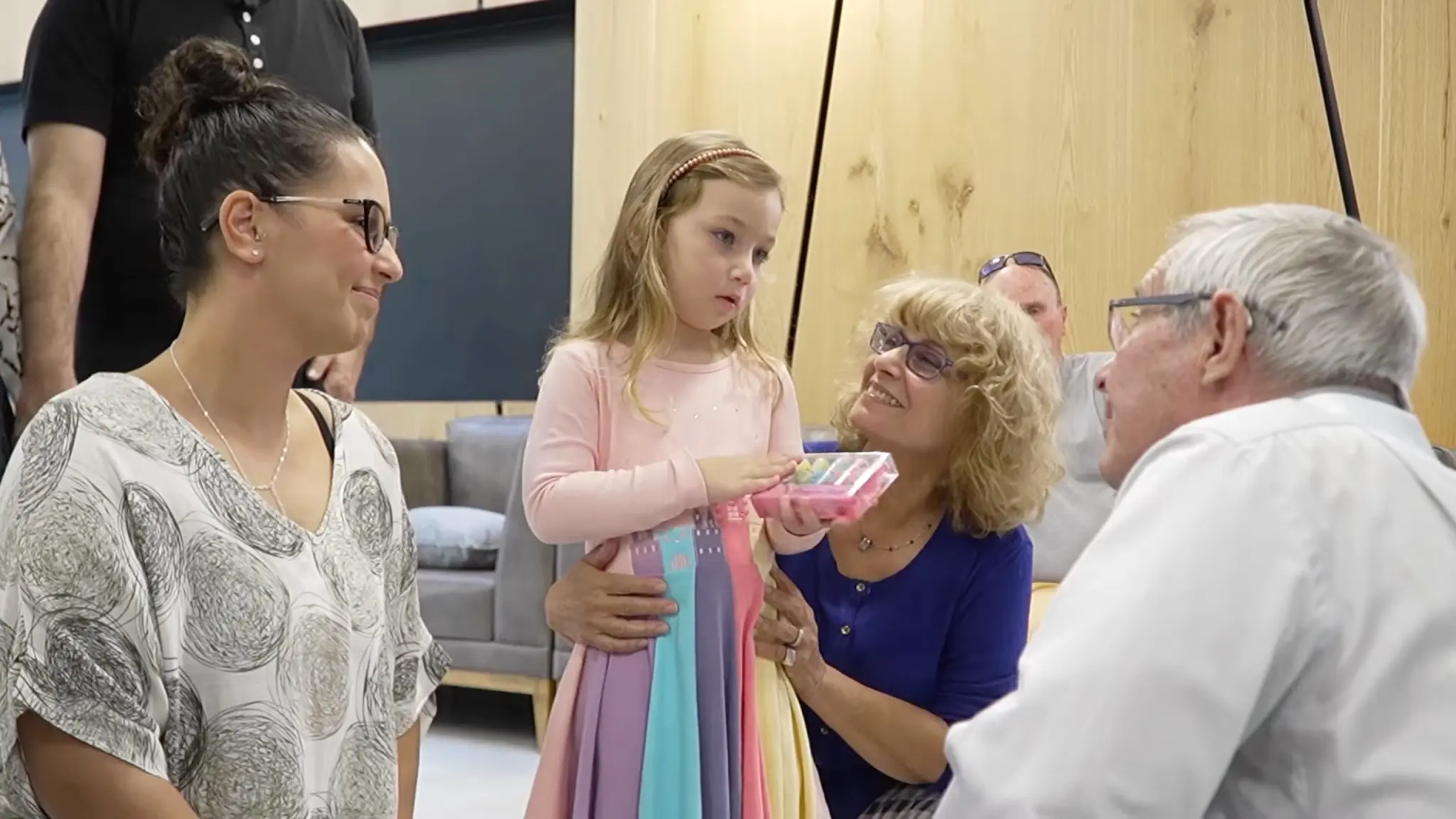
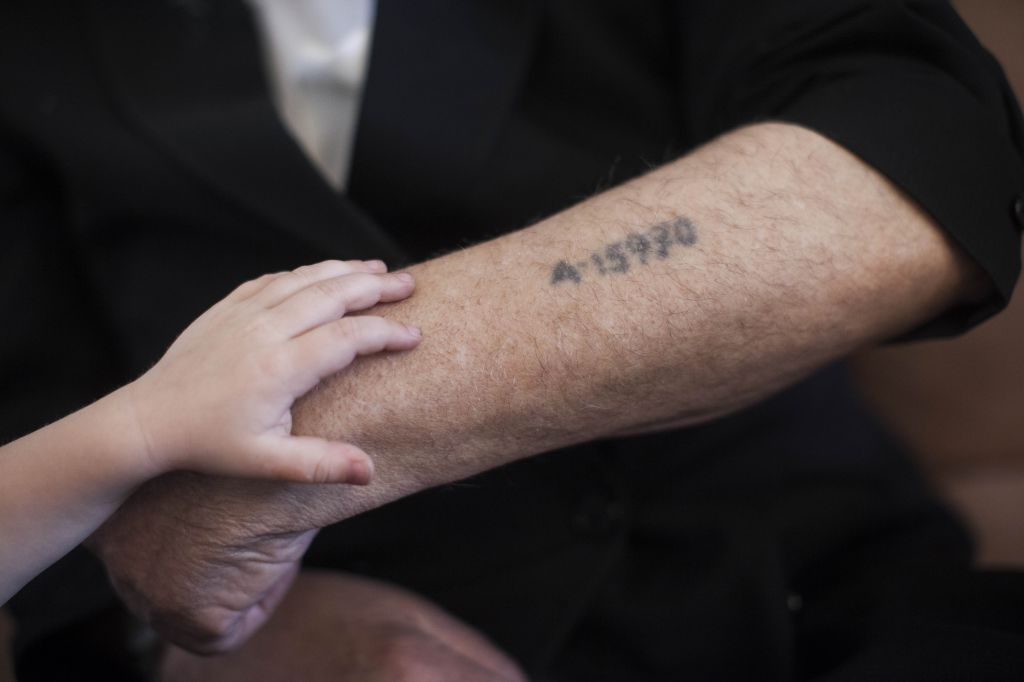
Lindenbaum never did get to meet the man who saved his life, but he did get to meet his family.  A few weeks after the horror at Be’eri, someone from Ezer Mizion was trying to arrange the meeting and kept called Levi but didn’t hear back. She looked at his file and saw he was from Be’eri.  She did more research and learned he had been killed.  She decided to call Lihi nonetheless to see if a meeting could be arranged. During an “exciting and emotional” meeting  for the two families, Daniel Levi’s widow got a chance to do what her husband dreamed of doing for more than a year, hug his bone marrow recipient.


Bending down to little Emma, Lindenbaum explained, “I was very sick – my blood was sick. And today I’m healthy, thanks to your daddy’s blood.” He continued: “I was very sad, I wanted to thank him. His blood system is in my body. In compatibility we were like brothers.” He added that a part of Levi still lives on in him: “He left, aside from his two beautiful kids, his blood, which is my blood.”


The truth is this principle is not limited to Chaim Lindenbaum and Daniel Levi, but all Jews are brothers and sisters, we must work to be perfectly compatible. 


In describing the most seminal moment in history, the revelation at Sinai, the Torah tells us: Va’yachanu ba’midbar, vayichan sham Yisrael neged ha’har, they encamped in the desert and the Jewish people camped opposite the mountain. Rashi famously comments on the change in tense—from the plural “Vayachanu” to the singular “Vayichan”—that we stood “k’ish echad b’lev echad, like one person with one heart.”  The Ohr HaChaim writes that this mindset was from “ikarei ha’hachana l’kabbalas ha’Torah” a critical part of preparing to receive the Torah. It was then, and it is again now, as each year we accept the Torah together anew


The simple understanding of this concept is that we were united, cooperative, caring and loving of one another.  We were a family, a community, a people instead of just a gathering of disparate individuals.  But the idea is deeper.  Indeed, we can’t fully observe and keep the totality of Torah unless we are united and as one.  We are all obligated in Taryag mitzvos but yet can’t observe every one of them because we can’t simultaneously be a man, woman, Kohen, levi, Live in Israel and outside of it, during the Beis HaMikdash and without it, etc.   The Kiryas Sefer explains that only through the principle of Kol Yisroel areivim zah la’zeh can we fulfill the entire 613 commandments.  By being guarantors one for the others, we can be motzei each other and thereby all fulfill it all.  It is not a coincidence that areivim is the same word as ta’aroves, a mixture.  When we guarantee one another and have each other in mind, we become a mixture together. 


The Baal Shem Tov understands this idea in an even deeper way.  The only way to fulfill Taryag Mitzvos, he says, is to not only exist independently, but also to see ourselves as part of one organic, integrated whole, one unit.  קיום תרי״ג מצוות אינו אפשרי אלא ע״י שכל אחד כולל עצמו בתוך כלל ישראל באהבה ואחוה ע״י זה יש לכל אחד חלק בתרי״ג מצוות.  This is why Chassidim say before each mitzvah they perform, “בשם כל ישראל”. 


But perhaps there is yet another explanation. We all know the name of the mountain the Torah was given on is Har Sinai.  The Gemara (Shabbos 89a) tells us the etymology of the name Sinai.

דְּרַב חִסְדָּא וְרַבָּה בְּרֵיהּ דְּרַב הוּנָא דְּאָמְרִי תַּרְוַויְיהוּ: מַאי ״הַר סִינַי״? הַר שֶׁיָּרְדָה שִׂנְאָה לְאֻמּוֹת הָעוֹלָם עָלָיו.

It is called Har Sinai because it is the mountain from which sinah, hatred descended against the Jews.  While countless explanations have been offered for antisemitism, the world’s oldest hatred, there is no unifying explanation because it has reared its ugly head in times of prosperity and poverty, in times of assimilation and strong Jewish identity, throughout history and across the globe, when we have been in our homeland and when we were dispersed in galus. 


Ultimately, our rabbis taught, we are hated because we stood at Sinai and accepted a great role and responsibility, a mission to be models and examples, to improve and repair the world. Subjective cultures and systems of morality challenge the objective moral timeless truths of our Torah, but they don’t endure.  We are meant to be the moral conscience of the world, an example of creating an ethical and holy society and community, and the people of the world don’t like that.


The sinah, the hatred of the Jew, goes all the way back to Har Sinai when we stood at the mountain, three thousand, three hundred and thirty-seven years ago and accepted to live lives informed, inspired, and guided by the Torah.  We have faced discrimination, bias, double standards, tropes and hate since the very moment we began.  We have been forced to live with and navigate sinah since we first stood at Sinai. 


How? How has our people not only survived this sinah but thrived despite it throughout the millennia?  What is the explanation for our endurance, resilience, strength and capacity to still be here standing, to be back at that same mountain that brought this hatred?


The answer, the secret to our surviving the sinah, also goes all the way back to that mountain and the way we gathered there.  כאיש אחד בלב אחד, we stood together as one: undivided, invincible, ready to confront and overcome whatever sinah would come our way. 


A study released on friendship in 2008 by professors from four universities in the Journal of Experimental Social Psychology found something remarkable about companionship and community.  Participants in their studies were asked to estimate the incline of a hill in front of them. Over and over again, those who were accompanied by a friend estimated the hill to be less steep than participants who were alone. The researchers concluded that the more one is connected with others, the more we are part of a community, the more we feel we can climb whatever mountain is in our way.


Long before researchers, our Torah understood this.  The Navi Yeshayahu (41:6) said:אִ֥ישׁ אֶת־רֵעֵ֖הוּ יַעְזֹ֑רוּ וּלְאָחִ֖יו יֹאמַ֥ר חֲזָֽק׃ , Each one helps the other, saying to his fellow, “Take courage!”    We have overcome the sinah since Sinai because we stood and we stand together k’ish echad b’lev echad, as one, turning to each other over and over and saying, “Chazak! Be strong.”  We have not just stood united, we have become united, like one, laughing together, crying together, davening together and feeling together with our lev echad, one heart.


As we prepare to stand at the mountain again to reaccept the Torah, the sinah from Sinai continues to rage in Israel, on college campuses, in some offices of Congress, and in too many countries around the world.  Our response now must be as it was then, to turn to one another with a sense of unity, love and oneness and to wish each other chazak.  If we are going to not only survive but thrive, we must be in compatibility like brothers and sisters, like one. 

One Bite of a Mitzvah – What Dave Portnoy Got Wrong

Dave Portnoy is a successful businessman with a large following online.  He sold the company he founded, Barstool Sports, for $500 million, and bought it back a few years later for $1.   Millions follow him on social media and watch his daily pizza reviews around the country, including a review of matza pizza right here in Boca Raton.


Portnoy is Jewish, something he doesn’t hide but also doesn’t regularly reference or promote.  He has occasionally displayed his Judaism, such as when Chabad put Tefillin on him or more recently, when he celebrated the defeat of an MMA fighter who had praised Hitler by putting on a yarmulka and waving an Israeli flag in the front row of the match.  Soon after October 7, he spoke out in support of Israel and has since then publicly defended Israel’s right to exist and to defend itself. 


Yet, nothing has made Portnoy as outspoken about his Jewishness or aggressively stand up for the Jewish people like the antisemitic incident that happened at his Philadelphia bar a couple of weeks ago.  Customers who order bottle service there are offered customizable letter boards, which they can ask staff members to arrange with messages of their choice.  A student or two from Temple University who visited the bar asked staff members to arrange the letters on his sign into an antisemitic message including an expletive directed at the Jewish people.  The incident was a staff breakdown and, more importantly, an expression of hate. 


Portnoy took to his social media to communicate his outrage.  “I’ve been shaking I’ve been so mad.  I’m gonna make it my life mission to ruin these people, like I’m coming for your throat.”  However, a few hours later, he posted another video saying he had reconsidered his approach, and instead had decided to send the young men responsible for the hate speech on a tour of Auschwitz to learn about the impact of hate. 


He explained: “My initial reaction was like I’m going to burn these people to the ground, their families, everything, and it’s like you know what? Maybe that’s not the best course of action.  Maybe I can use this as a teaching moment, and like before, people just are like the Jews or any group, and the hate, let’s try to like turn a hideous incident into maybe a learning experience, as cliche and very unlike me. But I talked to both the culprits, who I know are super involved in it, talked to the families. I’m sending these kids to Auschwitz. They’ve agreed to go, that’s of course, the Holocaust concentration camps…and hopefully learn something. And maybe like their lives aren’t ruined, and they think twice, and more importantly, other people like see it’s not just like words you’re throwing around. So to me, that’s a fair outcome of this event.”

Pennsylvania Senator Dave McCormick applauded Portnoy for addressing the “horrific display of hate” and using it as an opportunity to educate about anti-Jewish violence, saying, “Antisemitism needs to be identified, called out, and crushed.” 


A few days later, Portnoy gave an update saying he had “revoked” the trip to Poland because at least one of the people involved “is no longer taking responsibility” for the sign.


Though he didn’t end up sending the perpetrators to tour Auschwitz, the strategy of responding to antisemitism by sending antisemites for a Holocaust education is nothing new.  In 2006, Mel Gibson spewed antisemitic remarks during a DUI arrest.  Though not mandated by a court, Gibson met with Jewish leaders and visited the Simon Wiesenthal Center’s Museum of Tolerance in Los Angeles.  In 2014, two British teenagers vandalized a synagogue with antisemitic graffiti. As part of their community service, they were sent to visit Auschwitz.  In 2018, Nick Conrad released a controversial music video titled “Hang White People”, which contained antisemitic undertones. A French court ordered him to visit the Holocaust Memorial in Paris as part of a court ruling. 


The examples could go on and on but the question is, should they?  Certainly, Holocaust education is important.  Keeping the legacy of 6 million martyrs alive and relevant, teaching the truth about this historically unique genocide matters.  But is it the proper or effective response to contemporary antisemitism? 


Dara Horn, the author of “People Love Dead Jews,” thinks not.  In her article, “Is Holocaust Education Making Anti-Semitism Worse? Using dead Jews as symbols isn’t helping living ones,” she writes: “I have come to the disturbing conclusion that Holocaust education is incapable of addressing contemporary anti-Semitism. In fact, in the total absence of any education about Jews alive today, teaching about the Holocaust might even be making anti-Semitism worse.” 


She writes: “The Holocaust educators I met across America were all obsessed with building empathy, a quality that relies on finding commonalities between ourselves and others. But I wondered if a more effective way to address anti-Semitism might lie in cultivating a completely different quality, one that happens to be the key to education itself: curiosity. Why use Jews as a means to teach people that we’re all the same, when the demand that Jews be just like their neighbors is exactly what embedded the mental virus of anti-Semitism in the Western mind in the first place? Why not instead encourage inquiry about the diversity, to borrow a de rigueur word, of the human experience?”


This article was published in May of 2023, five months before the most murderous day of Jews since the Holocaust, and I fear her thesis has only been strengthened.  Teaching only about the Holocaust without teaching about the Jewish people, Jewish values and ideals, Jewish contributions to the world, Jewish culture and practice only focuses on Jews as victims.  But today’s antisemite learns about the Holocaust and sees the Jewish people as the committer of a current genocide instead of the victim, as perpetrating a Holocaust instead of experiencing one.


Another famous Jew has been targeted with hate for his Judaism, but he has responded in a very different way.  Michael Rapaport is an award-winning actor, comedian and podcaster. Since October 7 he has not only visited Israel countless times, he has relentlessly dedicated his online influence to advocating for Israel and the Jewish people.  Asked about how October 7 impacted him, he said, “My Judaism has changed 100%. I am more in tune with it. I’m more proud, I’m more aware, I’m more educated. I’m more proactive in every single way possible and I’m really glad about that.”


Asked how his belief in God has changed, he answered: “I believe in God in a different way. I believe in Hashem in a different way. I celebrate and understand him in a different way. I think we have nothing but faith. You have to have faith. That’s been one of the good things that has come from this last year for me personally.” Michael Rapaport now wraps tefillin and says about it, “Every single time is a blessing, every single time is a Mitzvah.”


Certainly, we must confront antisemites, hold them accountable, throw the book at them and, when possible, seek to reform them.  Educating may be a first step, but it cannot be the whole strategy.  The answer is to not focus on their education, like Dave Portnoy did, but to focus on ours, as Michael Rapaport is.  Our response to acts of antisemitism must be more Jewish pride, more Jewish practice, stronger Jewish identity, increased Torah observance. 


Rather than reward the hateful hoodlums with a trip to Poland, Portnoy should announce he is going to Israel.  He should put on a Magen Dovid necklace if not a yarmulka, hang a mezuzah on his home and office, engage his Judaism and Jewish learning in a meaningful way.


When doing one of his famous pizza reviews, before he takes a bite and gives a score, Portnoy proudly announces “one bite, everyone knows the rules.”  But the truth is, while everyone may know the rules, he does not follow them: he doesn’t take one bite, he takes several and when the pizza tastes particularly good, he can’t help himself from finishing the whole slice.


Describing a relationship with Hashem, Dovid HaMelech (Tehillim 34:9) taught, Ta’amu u’ru ki tov Hashem, taste and you will see that Hashem is good.  Why does he employ the word taste, why not just say see that Hashem is good? Faith begins with practice. You can’t just listen, read about or think about Hashem, you must engage, act and then you will see with clarity a life of meaning, purpose and eternity.   It begins with a taste, a little something and you will want more. 


We must confront antisemitism but not just with stories or tours of Jewish victimhood. Instead of focusing on educating others, educate yourself, your children and Jews all around us to be living richly proud and practicing Jewish lives.    


Start with one thing.  Just one bite of a mitzvah and you will want more and more. 

Called Up Yet Again

This past week, tens of thousands in Israel received the message from the IDF that they are being called up, yet again, not for a few days, but for several weeks or months.  Children will have to adjust again to being without parents.  Spouses will have to manage households by themselves.  Parents will again have sleepless nights. Employers will again struggle to manage without key personnel. And tens of thousands will again put their lives on the line and live in challenging, difficult and dangerous conditions.  While there are efforts to persuade reservists to protest and not answer the call, yet again, overwhelmingly, our heroic soldiers are showing up and doing so in record numbers, again. 


When the war began over a year and a half ago, Jews and Israel supporters in the United States and around the world responded by raising significant funds, sending supplies, organizing missions, tying tzitzis, sponsoring BBQs, writing letters and more.  Over time, these efforts dissipated as cease fires were observed and for many, fatigue set in. 


Our soldiers have been called up and despite their true exhaustion and very real emotional fatigue, they are showing up, and so must we, in our own small and modest ways.  If we care, if we are connected, we must answer in our own record numbers to resume the coordinated efforts and show of support, to get back to planning trips, to dig deeper to send more funds, to do more to help bear the pain and struggle.


This week we will read Parshas Kedoshim and be reminded of the obligation to love our fellow Jew as ourselves, v’ahavta l’rei’acha kamocha.  What does it mean to love fellow Jews?  R’ Moshe Leib Sassover used to tell his chassidim that he learned what it means to love a fellow Jew from two Russian peasants.  Once he came to an inn, where two thoroughly drunk Russian peasants were sitting at a table, draining the last drops from a bottle of strong Ukrainian vodka.  One of them yelled to his friend, “Do you love me?” The friend, somewhat surprised, answered, “Of course, of course I love you!”  “No, no”, insisted the first one, “Do you really love me, really?!”  The friend assured him, “Of course I love you. You’re my best friend!”  “Tell me, do you know what I need?  Do you know why I am in pain?”  The friend said, “How could I possibly know what you need or why you are in pain?”  The first peasant answered, “How then can you say you love me when you don’t know what I need or why I am in pain.”


R’ Moshe Leib told his chassidim, he learned from these peasants that truly loving someone means to know their needs and to feel their pain.  Real love is not lip service, it is not just tolerating one another.  Love is noticing someone is having a bad day, it is feeling their pain, it is showing someone you care, even when that person is someone you barely know or don’t know at all. 


The morning blessings of Birchos HaShachar are said in the plural – פוקח עורים, מלביש ערומים, etc.  There is one exception – שעשה לי כל צרכי , thank you God, who fulfills all of my needs.  Why is this blessing written in the singular?


The same R’ Moshe Leib Sassover who taught us what it means to love a fellow Jew explains that when it comes to ourselves, we should have an attitude of “I have everything I need”.  We should feel content and satisfied.  However, when it comes to others, we must be thinking – he or she don’t have everything they need.  What are they lacking?  How can I help them?  What can I do for them?


Loving our brothers and sisters in Israel means recognizing their sacrifices on behalf of our people and stepping up in our own small ways to show gratitude, display support, provide relief, and do all we can to help. 


The great Arizal suggested that before beginning davening in the morning, one should say: הריני מקבל עלי מצוות עשה של ואהבת לרעך כמוך, I hereby accept upon myself the positive commandment to love your fellow as yourself.”  Based on R’ Moshe Leib Sassover’s insight, we can understand this to mean that before we can pour out our hearts to Hashem for all of our needs, we must pause to think about our fellow brothers and sisters and their needs.  Before we ask Hashem to be there for us, we must commit to be there for others. 


As you think about upcoming trips or vacations, consider going to Israel to volunteer.  As you review your finances and tzedakah opportunities, consider how you can contribute to help the physical, mental and emotional well-being of the soldiers and their families.  When you feel love for fellow Jews, express it by identifying with their pain and doing what you can to make it go away. 

Running Out of Time: Why Talking About the Holocaust Now Matters

According to the recently released Anti-Defamation League (ADL) report, antisemitic incidents broke a record for 4th straight year in 2024. Last year, they identified 9,354 antisemitic incidents, a 5% increase from 2023 and a staggering 926% increase since it began tracking in 1979. There were more than 25 “targeted anti-Jewish incidents” per day in 2024, more than one every hour.  Eighty years after the Holocaust, instead of “Never Again,” attacks on Jews are now occuring once an hour. 


This week, we mark Yom Ha’Shoah, Holocaust Remembrance Day. Nations around the world are called on to remember that hate led to the extermination of six million innocent people, among them one million children. The Holocaust erased two thirds of Europe’s Jewish population, one third of the Jewish people on the globe. 


While the Holocaust is obviously not the only tragic event in our history, it is by far the most heinous and devastating. Consider how devastating October 7th was and is for our generation and yet, all of the victims of that horrific attack and the war since were the casualties of one hour in a death camp.  But the Holocaust much more than just a tragedy of the greatest magnitude, it is the symbol and the synonym for antisemitism and in that one word conveys a warning for how the world’s oldest hatred can lead to a democratically elected, “civilized” nation carrying out a genocide.  While Jews were not the only victims of the Holocaust, the term should be reserved specifically to invoke hatred directed towards the Jewish people.  That is why it is so offensive and dangerous when it is invoked flippantly and casually and when it is used in grossly inappropriate contexts and comparisons. 


Just this week, in an effort to criticize fellow comedian Bill Maher for recently having dinner with President Trump, Larry David authored a satirical essay in The New York Times titled: “My Dinner With Adolf.  David wrote from the perspective of a “vocal critic” of Hitler who is invited to dinner with the Nazi dictator and finds him to be surprisingly warm and personable. He writes: “Two hours later, the dinner was over, and the Führer escorted me to the door. ‘I am so glad to have met you. I hope I’m no longer the monster you thought I was.’ ‘I must say, mein Führer, I’m so thankful I came. Although we disagree on many issues, it doesn’t mean that we have to hate each other.’ And with that, I gave him a Nazi salute and walked out into the night.” 


One can disagree vehemently with President Trump on policies and even see them as bigoted or dangerous or one can  be a great critic of his character and even see him as repulsive, but to compare him or his policies to Hitler to make a point, even satirically is deeply misguided and offensive and yet another shameful decision of the New York Times.


We must continue to confront antisemitism, and Holocaust education to the general public is one critical component. We must create a culture in this country of the same intolerance, hypersensitivity and opposition to antisemitism, Jew hatred, and Holocaust appropriation as we do other forms of hate, bigotry, and racism. “Ugly Jew” should be taken as seriously as the N-word: triggering, traumatic, and simply unacceptable and intolerable. Good-hearted people—not just Jews—must never allow this country to become a place where Jews cannot comfortably and safely walk around in a visibly identifiable way. 


Some argue that Jews should be defended because we are the proverbial canary in the coal mine. When Jews are allowed to be attacked, it is a sign of the collapse of the society. German pastor Martin Niemöller famously wrote: “First they came for the Socialists, and I did not speak out — Because I was not a Socialist. Then they came for the Trade Unionists, and I did not speak out — Because I was not a Trade Unionist. Then they came for the Jews, and I did not speak out — Because I was not a Jew. Then they came for me–and there was no one left to speak for me.”  In her book “People Love Dead Jews,” Dara Horn, a past guest on Behind the Bima, argues that we should not be grateful for this quote or way of thinking, rather we should be offended.  This sentiment essentially suggests that the only reason to care when Jews are murdered is because it is a warning that later, actual people might be attacked or killed. We obviously should not accept this argument and certainly should not perpetuate it.


But there are two other reasons Holocaust education is vitally important within our Jewish community. When we reference the Holocaust, we are often referring to the millions of martyrs, the victims who were murdered. But there is another population who should come to mind, maybe even first: our Holocaust survivors. 


The Holocaust is not just a part of history like the Crusades or Inquisition. Holocaust survivors may be the most heroic population of all time. Their resilience, strength, fortitude, and faith may be unparalleled. There has never been a group more entitled to be bitter, resentful, to feel entitled, or to give up on the world and on people. But instead, overwhelmingly, survivors rebuilt, they worked hard, they maintained positivity, optimism, and hope. Most exude deep faith, determination and a selfless devotion to Jewish continuity, to Jewish community, and to the Jewish state.  


However, time is running out for the world to engage with Holocaust survivors. A report published this week by the Claims Conference projects that of an estimated 211,300 Holocaust survivors alive in the world today, almost half will no longer be with us in seven years. By 2032, there will be fewer than 100,000 living survivors remaining in the world.


Though we are more prosperous than ever and have more comfort and conveniences than those who have come before us, many are still struggling with finding happiness, hope, meaning and purpose. Find a survivor. Latch on. Draw from their energy, ride their enthusiasm, be carried, and lifted by their heroism. If you struggle with faith, piggyback off their unwavering emunah, be inspired by their dedication to Torah and mitzvos.


We can learn much from the six million martyrs who lost their lives in the Holocaust, but we can learn even more from the 3.5 million who survived and then built thriving, rich Jewish lives.


Lastly, I believe we should use Holocaust education and current campaigns against antisemitism as outreach opportunities. While the majority of American Jews believe that the Holocaust is essential to their Jewish identities, only 15% said that observing Jewish law is an essential element of what being Jewish means to them personally. 


With the rise in antisemitism, the world is presenting us with the opportunity to remind our fellow Jews about why Judaism matters, what it means, and why they should care. With people increasingly hating us for being Jewish and once again excluding us for being Jewish, we should double down on Jewish pride, Jewish practice, Jewish continuity, and a Jewish lifestyle.


We say at the seder, v’hi she’amda la’avoseinu v’lanu, and it has stood for our forefathers and for us. What is the v’hi, what is it? The Netziv, Rav Naftali Tzvi Yehuda Berlin, answers, it is that b’chol dor vador amad aleinu l’chaloseinu, that in every generation they have risen to attack us. While we do not welcome or want antisemitism, it often takes our enemies’ reminder that we are Jewish to inspire us to fight for our people.


A non-observant Jew told me that when there was an antisemitic event at her son’s college, her son, who previously had little to no interest or investment in his Judaism, put a mezuzah on his door and hung a Magen Dovid around his neck. While we confront and combat antisemitism, let us simultaneously leverage it to remind and inspire our fellow Jews about their Judaism.


Continue to study and speak about the Holocaust, not as the central part of our identity as Jews, but as an important way to honor our survivors, to motivate us to fight antisemitism and as an opening to engage unengaged Jews to learn more about why being a Jew matters. 


The Man with the Golden Arm Who Saved Millions

Tara Delia/Australian Red Cross Blood Service

“Thank you for donating almost $7 million to our Boca Raton Synagogue community.”  Chaim didn’t know what I was talking about when I called him to thank him.  $7 million?  He had made a generous contribution but only a fraction of that enormous amount.  Why was I thanking him for something he didn’t give?

Two months earlier, Chaim was visiting Boca Raton and made an appointment to meet with me.  Before we began discussing the topic he had come to meet about, he casually asked me about the BRS campus expansion. “Why is there no energy or excitement, where is the publicity and active campaign?”  I shared that we had been successful raising a significant amount but had hit a wall and encountered some challenges that were holding us back.  “Why not do a matching campaign?  Raise new money from matchers who give on condition that the local and global community respond generously and match it.”  I reflexively shot him down and told him we don’t do those kinds of things, that will never work, it isn’t for us.  He made one more push, explaining why he thought it was a good idea, and we quickly pivoted to his topic.


For the rest of that day, I couldn’t stop thinking about what he said.  Maybe we could do a matching campaign.  Maybe it would create an energy, buzz, community buy-in, and excitement.  Surely it was worth a try.  Fast forward less than two months and not only did we meet our goal of $6 million, we Baruch Hashem blew past it and are so grateful that people continue to give, as our work is not yet done.


Chaim had “randomly” come to Boca and “coincidentally” chose to meet when he spontaneously, “happened” to raise the idea of a matching campaign and the result was an influx of almost $7 million towards helping us build a center of Jewish life and learning from which to share Torah light and inspiration to the world.  Had I not alerted Chaim, he would come upstairs after 120 and Hashem would say, yasher koach on raising almost $7 million for a community in Florida you don’t even live in.


One person can make an enormous difference with the right word in the right moment and we never know which word and which moment. 


Esther didn’t want to go to Achashveirosh without being invited, she hesitated to reveal her true identity and wanted to continue to keep it a secret.  Esther preferred the passive route, the spectator position.  But thanks to Mordechai’s encouragement and power of persuasion, she mustered the courage and conviction to enter without invitation, to speak despite the risk. The result was one woman saved an entire nation.  The story of Megillas Esther and the power of Purim is the story and directive to go from passive to active, from bystander to bringing about redemption.  Never underestimate your power to positively impact the world when you simply care enough to step up instead of sitting back. 

In 1951, a 14-year-old Australian boy named James Harrison had major surgery to save his life, the removal of one of his lungs.  He was alive, thanks in large part to a vast quantity of transfused blood he had received.  He was hospitalized for three months but when he came out, he was determined to pay it forward by donating blood himself.  The problem was Australia’s laws required blood donors to be at least 18 years old. After turning 18, Harrison made good on his promise, and despite a fear of needles, he began to donate blood regularly.


At the time, doctors in Australia were struggling to figure out why thousands of births in the country were resulting in miscarriages, stillbirths or brain defects for the babies.  In 1967, they discovered the babies were suffering from Haemolytic Disease of the Newborn, or HDN. The condition arises when a woman with an Rh negative blood type becomes pregnant with a baby who has Rh positive blood, and the incompatibility causes the mother’s body to reject the fetus’s red blood cells.


Doctors in Australia discovered that a very rare antibody in blood called Anti-D could be used to make a lifesaving medication that when given to mothers whose blood is at risk of developing HDN would keep the baby safe.  Researchers scoured blood banks to see whose blood might contain this antibody and found a donor in New South Wales named James Harrison.  Scientists asked him to participate in an experimental Anti-D program that turned out to be effective in saving these babies.

For more than 60 years, Harrison donated blood every single week and his plasma was used to make millions of Anti-D injections.  Every ampoule of Anti-d ever made in Australia has a piece of James in it. Because about 17% of pregnant women in Australia require the Anti-D injections, the Australian blood service estimates that Harrison has helped 2.4 million babies in the country. 


After donating 1,100 times, at 81 years old, despite wanting to continue, James Harrison was forced to retire from donating blood.  James Harrison, appropriately nicknamed “The man with the golden arm,” passed away last month at the age of 88, one person who without exaggeration saved millions of lives.


Don’t underestimate your ability to impact others.  Chaim contributed millions of dollars to our community without even knowing it.  James Harrison saved millions of babies in Australia.  Queen Esther, with one act of sacrifice and courage, saved the Jewish people. 


To the world, you may be one person, but to one person, you may be what saves their world. 

Rabbi Efrem Goldberg

Join Our Community

Subscribe to our newsletter or connect with us on WhatsApp.