Facebook and Football, Do Rabbis and Shuls Belong?

Just a few weeks ago, at an “Ask the Rabbi” class, one of our members posed the following question to me: “Rabbi, I notice you are active on social media, including Facebook and Twitter.  What is your thinking?  What are you trying to accomplish?”  Even more recently, in response to the promotion of our BRS Super Bowl Party this coming Sunday night, I was asked, “Why would a Shul host a Super Bowl Party? Does football really belong in a Shul?”


For me, the answer to both questions is articulated well in an observation shared by David Brooks this week in an op-ed in the New York Times.  In his article entitled, “Alone, Yet Not Alone,” Brooks writes:


“There is a strong vein of hostility against orthodox religious believers in America today, especially among the young. When secular or mostly secular people are asked by researchers to give their impression of the devoutly faithful, whether Jewish, Christian or other, the words that come up commonly include “judgmental,” “hypocritical,” “old-fashioned” and “out of touch.””


The question I received at the “Ask the Rabbi” wasn’t one that I anticipated, but my answer was simple.  I explained to the questioner that my goal as a Rabbi is to reach people and generate inspiration, provoke thinking, challenge growth, and to simply connect in a way that I can not only contribute positively to others, but gain from them as well.  I can accomplish this with many people in person at classes, some through email and others on the phone.  However, there exists a population of people, members of our Shul and others, who for the most part don’t engage through traditional avenues, and instead, communicate and connect almost exclusively online.


There is no question that incredible amounts of time are wasted on social media, much of it by individuals who are convinced that every post, comment and “like” has cosmic implications and that the absence of their presence on social media would create a tragic vacuum and catastrophic loss.  If we were honest, we would admit and recognize that much of the time spent on social media is in fact not productive, constructive or fruitful, but rather voyeuristic, narcissistic, mindless, and an escape.  For those in denial of just how much time they waste, Time Magazine created an online app this week that allows you to calculate just how many days of your life have been lost to Facebook and how much time you have wasted since being born into the online social world.


“Why are you active on social media?” my congregant asked.  I explained that as a Rabbi seeking to connect, I can observe the Facebook and Twitter phenomenon and be “judgmental,” “old-fashioned,” and “out of touch.”  I can criticize, dismiss and ignore the vehicle through which many connect today.  Or I can join them, engage them, and be relevant to them and have their opinions and ideas be relevant and informative to me.  I choose to participate, but I am acutely aware of and sensitive to the danger of insufficient self-regulation and the formidable temptation of unfettered engagement.   Therefore, I try to only use social media to share articles, ask thought-provoking questions, link to classes I have given, promote and take pride in the programs in our shul, celebrate the accomplishments and achievements of our members, and distribute articles that I have written.


Why would a Shul host a Super Bowl Party?  Sunday night, the big game will be broadcast to 198 countries in more than 25 languages.  It is anticipated that over 100 million people will watch. Is watching grown men plough into one another, tackle one another, try to rip the ball from one another a good use of our time?  Would we not be better off learning another blatt Gemara, volunteering a few more hours of chesed, catching up with an old friend or even reading a good book?  And what about the commercials?  Most are shamelessly immodest, uncomfortably crude, or grossly inappropriate.


Nevertheless, the reality is that among the 100 million spectators Sunday night will be individuals from every segment of Orthodox Judaism including Chassidim, Litvishe and Modern Orthodox.  We can be “judgmental,” “old-fashioned” and “out of touch.”  We can judge, castigate, scold and even ridicule those that will be watching.  Or, we can acknowledge the value of friends enjoying one another’s company, ensure Mincha and Ma’ariv will be davened, replace the provocative half time show with a thought-provoking Dvar Torah, attempt to censor commercials and provide a venue (not in the Sanctuary) for those who are not invited to any Super Bowl gathering and would otherwise be watching alone.


When Hagar and Yishmael are expelled from Avraham’s home, they find themselves in the desert with nothing to sustain them.  Hagar walks away not wanting to witness her son’s death.  God calls out to Hagar and says, “Don’t fear, Hashem has heard the voice of the na’ar, the young man, ba’asher hu sham, from where he is.”  Later, in Devarim, the Torah tells us, “u’vikashtem misham es Hashem Elokecha u’matzasa, and you will seek from there Hashem, and you will find Him.”  Asks Rav Nachman of Breslov, seek from “sham,” from there – where is there?  He answers, ba’asher hu sham, from wherever you find yourself.


There is no obligation to participate in social media and there is certainly no requirement to attend a Shul Super Bowl party.   Some will see my arguments as simply an exercise in apologetics and take a pass on Facebook and Twitter or  watching the game.  Others will see my explanations as wholly unnecessary and say Facebook and football need no defense or justification.  While clear to others, to be honest, these questions are not so simple to me.


One thing I know is if a community and its Rabbi want to be relevant, compelling and in-touch, they must relate and speak to people ba’asher hu sham, where they are, and help them u’vikashtem misham es Hashem Elokecha, find Hashem from wherever they may be, including on social media or watching the Super Bowl, despite the risks and challenges involved.


Response to the Open Letter from Josh Stadlan

Dear Josh,


I appreciate your response to my recent column and enjoy the opportunity to engage in lively discourse about a topic that is clearly close to your heart.  The passion with which you wrote and the articulateness you bring to your arguments are a testament, I believe, to your family, our Boca schools, and our community.  I can only wish that all of our youth would feel similarly invested in the tradition that we hold so dear and take the time to research a cherished mitzvah and write about it at length, as you did.


In your letter, you wonder why my discussion of mechzei k’yuhara, appearance of religious hubris, was directed at a yeshiva high school’s decision to allow its female students to wear tefillin, rather than “other humrot in our community that violate communal norm.”  Your question is legitimate, and it gives me the opportunity to perhaps refine my original argument.


Indeed, we live in a time when personal stringencies and custom abound, not all of which conform to typical communal practices.  Some of them are clearly praiseworthy, and some of them, as you suggest, may stray into the territory of “mechzei k’yuhara.”  In general, I do not take public stances on them, neither in favor nor against, mostly because I believe these practices are private, delicate issues that are best handled in that realm.


Therefore, I have nothing to say about individual women who have developed a practice of donning tefillin.  I neither endorse them nor condemn them; it is none of my business.  As you effectively point out, I could have been more clear about this in my original column, and I thank you for providing me with the opportunity to clarify now.


I sincerely apologize to the two girls who precipitated this entire discussion for leaving an impression in any way that their motivation or sincerity is in question.  I have no doubt that they are l’sheim shamayim and admire and applaud their enthusiasm for a mitzvah, even if I disagree with the particular observance.  My blog was never directed at them.


Rather, my comments are directed at those who want to make a public endorsement of a particular practice, which, objectively, deviates from the accepted norm for the Orthodox community. It is with the wisdom of this move, and the possibility of “mechzei k’yuhara, appearance of religious hubris” within it, that I took issue.


Josh, despite your carefully reasoned halachic arguments, I maintain my reservations about the need for a new public policy regarding women and tefillin, in the context of the myriad of educational and other communal challenges that currently face us.


Finally, Josh, I have to admit that your letter confused me on one point.  On the one hand, your letter begins with lengthy, impressive segments of deep, Talmudic analysis, including a careful reading of the gemara in Eruvin 96b.  Towards the end of your letter, however, you cite a litany of seemingly embarrassing quotes from the Talmud and other rabbinic literature, including a characterization of Perek “Besula Niseis” that I would rather not repeat here, all of which you clearly distance yourself from.


That leaves me wondering:  Is the Talmud an authoritative text for you or not?  If parts of it are so distasteful to you, then how can you build halachic arguments out of other sections?  If the Talmud and the rabbinic tradition are not authoritative for you, do you derive your conceptions of Judaism from a different source?


I thank you again for the opportunity to participate in this exchange that I know is “for the sake of Heaven.”


Respectfully,


Rabbi Efrem Goldberg


To read Josh’s letter, click here:  Open Letter from Josh Stadlan


Avoiding The Appearance of Religious Hubris

A prominent Modern Orthodox high school announced this week that girls who want to wear tefillin during davening at school would be permitted to do so.  Not to be outdone, a second school quickly proclaimed that they, too, would allow it.  News spread like wildfire and the headlines quickly went from, “Modern Orthodox Girls Fight for the Right to Don Tefillin,” to an editorial entitled, “Why Women Can and Must Lay Tefillin.”


Predictably, the reaction has been mixed with traditionalists rejecting the change and the more progressive segment of orthodoxy celebrating the welcome change.  Noticeably absent from the conversation, at least from my perspective, is an argument about the halachic merits or challenges of the decision.  Instead, the reaction has been largely driven by emotion, ideology and agenda, in both directions.


Many responded by wondering what’s the big deal, after all didn’t Rashi’s daughters wear tefillin.  In an excellent article in Jewish Action, Rabbi Ari Zivotofsky compellingly dispels this historical “fact” as a misconception and myth, though he does point out that Michal, the daughter of King Shaul, did in fact wear tefillin.  Regardless, it is clearly not the prevalent custom for Orthodox women to wear tefillin and so these policy announcements represent a significant shift and change.


The Shulchan Aruch (o.c. 38:3) is clear that as a time-bound mitzvah, women are exempt from tefillin.   Unlike other time-bound mitzvos such as sukkah, lulav and shofar, the Rama, Rav Moshe Isserless, the authority of Ashkenazic Jewry, discourages women from volunteering when it comes to tefillin and in fact says that if they choose to wear tefillin, mochin b’yadam, we should object.  The Gra, also known as the Vilna Gaon, goes even further and says women are outright forbidden from wearing tefillin.


Their positions stem from an unusual requirement when wearing tefillin.  As sacred objects similar to a mezuzah or Sefer Torah, tefillin require a high level of concentration and a pristine physical state.  Maintaining those levels has been determined to be exceedingly difficult today and, therefore, though in previous generations men wore tefillin most of the day, now we wear them for a minimal amount of time.  The authorities that discourage and disapprove of women wearing tefillin do so on the grounds that they are exempt and therefore, should not put themselves in a position to potentially dishonor the tefillin by losing concentration or the proper physical state.


Rabbi Aryeh Kaplan advances a more mystical argument for women’s exemption from tefillin.  He explains that the tefillin box is called bayis, home.  Kabbalah describes the tefillin as symbolic of the womb and the retzuos, the straps, as representing the umbilical cord.   The tefillin bind us to God by reminding us of our obligation to create and to nurture with compassion.  Men need external symbols to remind them, but women, he argues, create and nurture with their bodies and therefore don’t need them.


To be honest, my personal discomfort with the policy decision announced this week has less to do with strict halachic objection for which there are counterarguments, and more to do with an often neglected halachic value called mechzei k’yuhara.


Forget women and tefillin for a moment.  If a man wanted to wear tefillin the whole day as they did in the past, would we encourage him or frown upon the practice?  The Shulchan Aruch Ha’Rav written by the R’ Schneur Zalman of Liadi, the first Lubavitcher Rebbe, says that since today the custom is not to wear tefillin other than during davening, to do so publicly is mechzei k’yuhara, smacks of arrogance and hubris.


There was once a student at YU who would walk through Washington Heights wearing his tallis and tefillin while going to daven.  A concerned individual asked Rav Schachter to intercede and encourage the young man to stop this practice that was drawing negative attention.  Rav Schachter related to us that he didn’t want to embarrass the young man so he told him a story with the hope he would understand.  A man once asked a prominent posek if a particular practice was mechzei k’yuhara, appeared arrogant.  “No,” said the posek, “it is yuhara mamesh, it is actually arrogant.”  Unfortunately, the young man did not get the message.


Mechzei k’yuhara, refraining from unusual and radical practices even though they are otherwise virtuous, is a meta-halachic consideration in many areas.  A simple search for mechzei k’yuhara in the Bar-Ilan responsa project yields dozens and dozens of results in which halachic authorities throughout the ages have rejected halachickly acceptable behavior on the grounds that it is a departure from accepted practice and therefore, mechzei k’yuhara, divisive and promoting superiority.


The mechzei k’yuhara consideration doesn’t judge or question motivation.  Even if the man or woman is purely motivated, if the behavior is an outlier to what is customary, even when it is stricter, it is inappropriate because it smacks of religious superiority.  What everyone else does is not good enough for the individual taking on a practice outside of the norms.  I believe the philosophy of mechzei k’yuhara is that we should embrace and excel at what we are obligated in and what is customary, rather than spiritually one-up those around us.  Mechzei k’yuhara teaches us that the truly pious person doesn’t try to stand out in his religious fervor, creativity or scrupulousness.


Quite the opposite; the truly righteous person blends in and is loyal to the local customs and norms.  Mechzei k’yehura means we don’t seek to be creative, distinctive or unique in the way we observe halacha.  We seek to fit in and conform to the traditions and customs of the community without needing to make a personal statement through our superior practice.  Of course we should strive to grow in our religious experience, level of observance and commitment to Jewish values, but all within the communal religious norms and customs and not outside or above them.


I was talking to a teenage girl and mentioned the new policy at these schools.  Her response was, “Cool, I didn’t know girls can wear tefillin.  I wonder what that is like, I would try that.”  Shouldn’t we encourage our young women to embrace and excel at the laws and customs that are incumbent on them before inviting them to experiment with new spiritual experiences?  Shouldn’t we help them find meaning and inspiration in the traditional observant lifestyle, rather than reinforce the notion that spirituality is found in that which is radical, revolutionary or innovative?  Shouldn’t we be confident that our young men and women are committed to vigilantly observe halacha before granting them license to take on behaviors that their parents and grandparents didn’t feel worthy to perform?


Rather than discuss women wearing tefillin, we should be discussing ways to inspire our young men to maintain a commitment to never miss a day of putting on tefillin, even if they struggle to find it meaningful or uplifting.  Rather than encouraging our young women to wear tefillin, we should be encouraging them to find expression and inspiration in the Torah’s prescription for femininity and womanhood.


Our young people don’t need radical change leaving them as outliers from communal norms; they need to be taught radical commitment to halacha and tradition with fervor, enthusiasm and meaning.


It’s None of Our Business

According to the National Center for Missing and Exploited Children, approximately 800,000 children younger than 18 are reported missing each year.  That means close to 2,200 children a day or 91 children every hour are reported missing in the United States.  And yet, I don’t remember a story catching the attention of the Jewish community like the report that this past Monday, 16-year-old Caleb Jacoby from Boston was missing.


By the time Caleb was found on Thursday night, the news had spread to Jewish communities across the globe that had been praying for his safe return.  Jewish organizations and Synagogues sent out email alerts asking people to look for him.  The report of Caleb’s disappearance united incredibly diverse segments of the Jewish community who rarely come together in such a cohesive way.  People from all different ages, backgrounds, denominations and levels of observance shared in the pain of the Jacoby family and expressed it by posting the missing person poster on their Facebook statuses and tweets.


The unusual reaction to the missing Jewish teen was not lost on the Brookline Police Department.  The Atlantic described, “Police have told Maimonides parents that they’ve never seen this degree of interest in a missing person. They’ve received calls from strangers in Israel who are ready to fly over and carefully comb the streets of Brookline with the Maimonides classmates who are searching for him, house-to-house, in below-freezing weather.”


The fact that Caleb is the son of Jeff Jacoby, a prominent conservative columnist for the Boston Globe, certainly added to the intrigue of the story, but I would like to believe the same attention and efforts would have be extended to the news of any Jewish child who had gone missing.


The news that Caleb had been found spread just as quickly as the news of his disappearance.  Jewish communities everywhere breathed a collective sigh of relief that this story has a happy ending.  Hearing Caleb is safely back with his family should be more than enough for us to close this story out, but remarkably, most people are not satisfied.


“What happened?” you saw people post moments after the news of his being found was announced.  Did he run away from home?   Who found him and how did he make his way to New York City?  What will his parents say to him when they first see him?  Will he be in trouble?  Somehow, people feel entitled to know the answers to these questions and that they deserve an explanation of what happened.


But the truth is, it is absolutely none of our business!


Caleb Jacoby’s disappearance was not some episode of a reality TV show.  It was a horrific ordeal for a wonderful family who were tortured for four days not knowing where their precious son was and what his fate would be.  We cannot imagine the acute pain, anguish, fear, worry or doubt they were forced to endure.   Though we all were moved by their pain and offered our prayers, ultimately this is their story and their experience.   The answer to the question of what happened belongs to them, and them alone.   It is absolutely none of our business and we are not entitled to find out, no matter how desperately curious we may be.


If there is something we can learn from what happened to better protect our children, we can be confident the family will let us know.  If they choose to go public with what happened, that is certainly their prerogative.  In the meantime – he was missing and now he is safe is all that we need to know, if our concern was really about him.


In fact, being satisfied with knowing he is ok versus expressing a desire to find out exactly what happened reveals whether this issue was really about Caleb or more about us, and our voyeuristic spectatorship all along.  If we genuinely care about someone who was missing, all we need to know is they are now safe and healthy.  The craving for salacious details and the appetite to know the entire story emanates from a terribly unhealthy sense of nosiness, inquisitiveness and our insatiable need to be in the know.


This phenomenon expresses itself in many scenarios.  When some hear about a couple getting divorced, their first response is “what happened?” as if they are entitled to a report about the most personal and private details of a couple and often children going through a difficult time.  Many pay a shiva call and feel a need to ask, “How did he or she die?”  Certainly the mourner is free to volunteer the cause of death if they like, but is it really our business and do we truly need to know?  When we ask, “Why did he lose his job?” or “why did they break their engagement?” or “why is she still single?” are we asking because we care about them, or is finding out somehow satisfying something in ourselves?


For some, the “need to know” stems from a sense of “information is power.”  Information is social currency and the more we know, the richer and more powerful we are.  For others, the “need to know” stems from an inability to live with tension or mystery.  And yet, for others, the “need to know” is similar to whatever draws us to slow down and look at the accident on the highway even though it has nothing to do with us at all and only creates traffic for others.


The Torah places great value on people’s right to privacy.  Jewish law demands that we conduct ourselves with the presumption that all that we are told even in pedestrian conversation is to be held in confidence unless it is explicitly articulated that we are free to repeat what we heard.   The laws of hezek re’iyah forbid a person from looking into his or her neighbor’s property in a way that violates their privacy.  We are instructed not to speak lashon ha’rah or rechilus and spread gossip, even if the information is absolutely true and entirely accurate.  The Talmud (Bava Metzia 23b) goes so far as to tell us that we are permitted to distort the truth in circumstances that someone is prying for information that is none of their business and that they are not entitled to have.


Soon after Caleb was found, a member of our Shul emailed me the following: “Baruch Hashem.  This is one time when we don’t need details.  We need to follow up with thanks to the Almighty. The experience has ended positively for Caleb and his family and has created an increased sense of oneness and faith among Jews.”


I couldn’t agree with her more.  The greatest respect we can show the Jacobys now is to give them the privacy they deserve as they are undoubtedly continuing to go through a difficult time.  Let’s make this unfortunate episode productive and meaningful by channeling our “need to know” into a need to thank Hashem that Caleb is alright.


Anything more than that is simply none of our business.


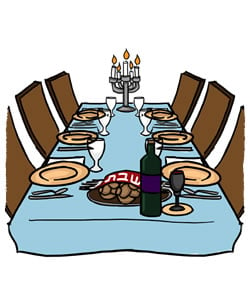
Simplifying Shabbos Meals

I recently spent a couple of days at Disneyworld with my sister and brother and their families, who were visiting from Israel.  As we walked through the parks, a few of my nephews and nieces independently shared the same observation: “Why are people in America so fat?”  While their comment may not be politically correct or sensitively articulated, it is accurate.  According to the Center for Disease Control and Prevention, over one third of adults in America are clinically obese.


In fact, a few years ago Disney had to shut down its signature “It’s a Small World” ride for major renovations.  Interestingly, when it reopened, it looked exactly as it had beforehand.  So what did they renovate?  It turns out, Disney had to widen the boats and deepen the ride’s channel in order to accommodate for the weight increase in the average visitors to Disney.


The ride was originally designed and built in 1963 on the statistics of the time that indicated an average adult male rider would weigh 175 pounds and a female rider 135.  However, with the increase in fast food, junk food, and “super-sized” food, adults today frequently weigh north of 200 pounds.  Increasingly, over-weighted boats would get to certain points in the ride and bottom out, becoming stuck in the flume.


Forbes magazine reported at the time that, ironically, customers whose boats got stuck and whose rides needed to be aborted were given free vouchers for the food court to compensate them.  It may be a small world after all, but we, the inhabitants of that world, are getting larger and larger, heavier and heavier, every single day.


Safeguarding our health and preserving our wellbeing are fundamental Torah values.  “V’nishmartem m’od l’nafshoseichem.” Though the verse in context is actually referring to something else, our Rabbis have encouraged us to interpret it to mean, “be exceedingly cautious regarding your well-being.”  The Rambam (Hilchos Dei’os 4) writes: “For the body to be healthy and wholesome is among the ways of Hashem…therefore a person must distance himself from those things that cause his body damage.”


Many explanations and reasons are suggested for the Torah’s kashrus laws, though ultimately they remain a chok, a divinely ordained diet.  Whatever the reason, it is clear that a commitment to a rigorous kosher lifestyle is to ingrain within us a sense of discipline, self-control, restraint, and the capacity to honor limits and boundaries.  These are the exact same attributes and qualities necessary to have healthy eating habits.


It is ironic, therefore, that many of us who are strict and disciplined adherents to the laws of kashrus, struggle greatly to apply the same vigilance and mindfulness to portion control and eating only healthy foods.  I know first hand the challenge of healthy eating habits as I have struggled personally and every time I think I have changed my eating lifestyle permanently, I find myself reverted back to bad habits and bulging belt.  My intent is not to be judgmental or critical.  For some, weight is a function of genetics and factors beyond just self-control.  I am also very sensitive to the issues of body image and eating disorders and the danger of overemphasis on weight and diet.  I am simply trying to call our attention to an unintended consequence of elaborate and endless shabbos and yom tov meals.


This week, our local JCC and Winn Dixie supermarket hosted Susie Fishbein, author of the Kosher by Design cookbook series.  The room was overflowing for her demonstration as her fans turned out in droves to learn more about her techniques, recipes and presentations.  The event was a phenomenal success and we are indebted to her for coming down to promote kashrus in our community.  In 2008, the Forward listed her as one of the 50 most influential Jews in America.  There is no doubt that Susie and authors of cookbooks of a similar genre have done a great service to our community by raising the level of sophistication of Kosher recipes and food.  However, I worry that there is an unintended consequence of advances in kosher recipes also raising the levels of expectation, competition, effort, cost, and consumption at today’s typical Shabbos and yom tov meals.


Do you remember when a shabbos meal consisted of a piece of fish or a slice of melon, or a bowl of soup followed by one main dish, one side dish, and one kugel and ending with dessert of fruit or one cake?  Now our meals have endless courses, multiple main dishes, countless side dishes, and practically a Viennese table of dessert.  Our Bubbie’s gefilte fish, chicken and matzah ball soup and simple recipes are not sophisticated enough for us.  We need tri-colored gefilte fish, tri-colored matzah balls, and menus that would challenge the Next Iron Chef.


Of course I am not blaming Susie Fishbein or authors of similar kosher cookbooks.  To her credit, Susie has written a cookbook on healthy living called Kosher by Design Lightens Up.  The Kosher by Design series is an indispensable part of every kosher cook’s library and Susie deserves to be commended and praised for what she has provided us.  She gave us incredible recipes.  How many of them we make at a time, the portions of them that we eat, the money we spend on them is entirely up to us.  Scaling back Shabbos and yom tov meals, is our responsibility and changing the culture of expectation and competition lies solely with us having nothing to do with her.


Ultimately, the responsibility falls to us to limit our menus, choose healthy recipes and bring the same mindfulness to the health impact of what we eat that we do to the kashrus of what we eat.  Together, we can create a new culture of simplified meals presented in a healthier fashion.  It begins in our homes, at our kitchen and dining room tables, but it extends to the menu and options at kiddushes at shul and the snacks we provide through the youth department.


Fewer courses and fewer options at our Shabbos meals will lessen the financial burden, physical drain and even emotional stress on those shopping for and preparing the meal. Setting food up on a buffet rather than leaving it on the table will eliminate mindless nibbling and noshing at endless meals. Being forced to get up to get more food will likely increase thoughtfulness about whether or not we are really still hungry.  Even if we enjoy spending all evening or afternoon with friends, we should bentch as soon as the meal is done and enjoy each other’s company on the couch or around an empty table, rather than sit there and continue to eat, even though we are beyond full.


This past Sunday, our wonderful BRS Sisterhood sponsored an incredible Women’s Health and Halacha Day.  Close to 150 women from all over South Florida gathered to address topics such as genetic testing, birth control, the agunah crisis, domestic violence and intimacy.  Programs such as this can effectively inspire our community to elevate our commitment to living healthier lives.  We are already working on next year’s program that will focus on nutrition, raising healthy children, health challenges of aging and more.


A good friend, Rabbi Zvi Engel recently wrote a message to his congregation about Friday’s fast, Asara B’Teives.  He began:


“A friend recently sent me the following line now making the rounds:  Black Friday: Because only in America do people trample over others for sales, exactly one day after being thankful for what they have.


Tomorrow we observe a Black Friday of another kind, as we recall the dark day when the Babylonians laid siege to Yerushalayim, a precursor to what we would soon lose with the churban, the destruction of the First Beit HaMikdash. If we ever take Yerushalayim for granted, this date calls us to remember a time when our nation was on the brink, about to lose its central address as a people, and to recognize that a Yerushalayim isolated and besieged ought to cause us discomfort, an awareness of hunger in an empty stomach that longs for sustenance.”


Upon seeing the message, a mutual good friend, Rabbi Shalom Baum remarked, “And how will we behave at kiddush the day after our black Friday.”  The truth is, we don’t even need to wait until Kiddush on Shabbos morning to determine if we have retained the lesson of Friday’s fast.


Changing eating habits is incredibly hard if we do it alone.  However, if we work together to create a culture of simplicity and healthy choices at our shabbos and yom tov meals, we can radically improve the well-being of our community.  At dinner tonight, after breaking our fast, which was designed to remind us that we can live without food, let’s show that for now on we eat to live instead of living to eat.


History or Memory? Knowing Our Story

How do you say the word history in Biblical hebrew? What word does the Torah use for history? It doesn’t, and there is none. We have a word in modern Hebrew – historia, but there is no Biblical word for history. Instead, the word the Torah uses is zecher – memory. The pasuk in Ha’azinu reminds us: zechor y’mos olam, remember the days of old. Elsewhere it says, Zachor eis asher asah l’cha Amalek, remember what Amalek did to us. In fact, while there is no Biblical word for history, the term zachor in one form or another appears in Tanach 169 times.


What is the difference between history and memory; is it not just semantics? In his haggadah, Rabbi Lord Jonathan Sack suggests that history is “his story” – an event that happened sometime else to someone else. Memory, is about me, my story – something that happened to me and is part of who I am. History is information. Memory, by contrast, is part of identity. I can study the history of others, but it is academic and has no impact on me. Memory is not about the past, but it is about the present.


This Shabbos, Boca Raton Synagogue celebrates our 30th Birthday and there is no better way than by invoking our memory. Jewish holidays have taught us that we can have memory of events from centuries or millennia ago, memories of events and places we never were. When we identify as part of a special group and see ourselves as full members of a community, history is transformed into our collective memory.


Please take a few moments over this celebratory weekend to review our important history and have it become part of your memory. Share our story with your children, talk about it with your friends, and most importantly, join with us in recognizing and appreciating the incredible people whose vision, hard work and generosity gave us the wonderful community we benefit from today.


THE HISTORY OF BOCA RATON SYNAGOGUE


historycol

The story of Boca Raton Synagogue begins in May 1983, when three couples had a vision. Issy and Riwella Bruk, Albert a”h and Tamar Nawy, and Neville and Britt Ziff met to explore the possibility of establishing an orthodox synagogue in Boca Raton.


By the fall, other key founders joined in these discussions. They included Leonard and Trudy Sponder, Jonathan and Marion Santhouse, Stephen and Linda Marcus, Walter and Lillian Gettinger, Louis and Sylvia Thaler, Jerry and Gail Herbst, David and Carol Sclove, William and Debbie Rand, Yacov and Linda Shamash, and Jonathan and Patricia Stein.


On October 23, 1983, the first general membership meeting took place with some 60 people in attendance. Dr. Issy Bruk was named president, Neville Ziff, vice president and Jonathan Santhouse, treasurer.


Chanukah 1983 marked the official opening of the Boca Raton Synagogue. Its first service was held on Friday, December 2, 1983, with 21 member families at the South County Jewish Community Day School. The original Sefer Torah used was loaned to BRS from Temple Beth El by Rabbi Merle Singer. The service was followed by a family Chanukah party on December 4 at the home of the Ziffs.


In 1984, Rabbi Mark Dratch, from Yeshiva University, was hired to become the first Rabbi of BRS and moved to Boca Raton with his wife, Sarah a”h. This was his first pulpit and he began from scratch without even a Shul building. He initiated weekly study groups and weekly Talmud classes.


The first High Holiday services were held in the Boca Teeca clubhouse with rooms available to stay next door at the hotel. Approximately 150 people attended. Martin Judovits and Joseph Rath led the services with Rabbi Dratch presiding.


With a significant number of families committed to the growing Synagogue, Issy Bruk and Neville Ziff decided to explore options for buying land. This was an enormous and ambitious undertaking for such a small group.


What a deal they bargained for! Though Lago Del Mar land had just sold for $250,000 an acre, the Shul land was purchased from Texaco for only $150,000 for all 5 acres. Signing as guarantors for the land were Issy Bruk, Neville Ziff, and Jonathan Santhouse. Steven Marcus provided significant legal support for the land purchase. We are indebted to them today for their foresight, vision, and generosity.


In order to encourage people to buy homes near the future Shul on Montoya Circle, during the next few years, Shabbat services were held at the homes of Gary and Mindy Lieber, Rick and Sue Andron, Steve and Linda Marcus, and Ella Samuels and Yaakov Kronfeld. Shabbat services were also held in the Verde Elementary School. Albert Nawy prepared the laining of the Torah almost every Shabbat. High Holiday services continued to be held at the Boca Teeca Club house and at a model home in Montoya Estates. Holiday services and celebrations, such as Purim, were also celebrated together. 1984 also marked the year when the BRS Chevra Kadisha was formed, with Martin Judovits serving as its first chairman.


March 31, 1985, marked the historic groundbreaking ceremony for the first Orthodox Synagogue in Boca Raton. After securing the land, Issy Bruk, Neville Ziff and Albert Nawy formed a committee to draw up building plans for the synagogue, choose an architect, obtain a mortgage, and raise the funds to build. They raised $60,000 and obtained a mortgage for the remaining $100,000. However, it took 20 months, due to zoning issues and approvals from numerous agencies, to complete the process.


In February, 1987, BRS moved into its first building at 7900 Montoya Circle. This original building is now known as the “old shul” and is now utilized by the Sephardic Minyan, WYHS, and the Shul offices. There was no furniture, not even a chair to sit on. Leonard and Sima Rubin came to the rescue and donated 150 chairs. A small portable Torah ark was given to BRS from Anshei Emuna which was used until the funds were raised for an ark designed by Martin Judovits.


The dedication of BRS’s campus included a Torah procession from Captiva to the Shul with dancing and singing. Prominent rabbis from South Florida such as Rabbi Yochanan Zweig were present for this dedication ceremony.


In the spring of 1987, Rabbi Dratch moved on from BRS to pursue other endeavors. Today, Rabbi Dratch serves as the Executive Vice President of the Rabbinical Council of America (RCA). Dr. William Rand was elected president and assisted the Shul through some significant financial challenges. In August of that year, Rabbi Mordechai Winiarz was hired as rabbi for the High Holidays. In 1988, he was hired as Rabbi of BRS and remained only until early 1989.


In February 1989, Chani Salamon, Rick Andron, and Michael Friedson began the process of obtaining an eruv for the Boca Raton community. After much work, the eruv was first utilized on Shabbat Nachamu, the first Shabbat after Tisha B’Av, in August 1989. Since that time the eruv has been expanded several times as the community has grown. Rabbi Blumenkranz z”l was instrumental in the design and supervision of the eruv.


In August 1989, during the presidency of Dr. Aaron Kaweblum, Rabbi Mordechai Neuman became the third rabbi of BRS. In the summer of 1990, Rabbi Neuman left BRS to continue his advanced education. Today, he is a prominent psychotherapist and counselor who has written numerous books and has appeared regularly on Oprah.


In the summer of 1990, a rabbinic search committee was formed with Jeffrey Klein and Jack Berkowitz as co-chairmen. After losing three Rabbis in just six years, the search committee worked diligently to find BRS a Rabbi who could lead them for the long-term. During the year the search was conducted, several retired rabbis, including Rabbi Meyer Strassfeld and Rabbi Gene Klein z”l, provided the necessary rabbinic leadership.


In June of 1991, Rabbi Kenneth Brander was hired and he moved to Boca with his wife, Ruchie and their two children, Tuvia and Yoni. Rabbi Brander came to BRS after serving in Lincoln Square Synagogue in NY as the Assistant Rabbi and later Acting Rabbi.


With 85 families in the Shul, he immediately set out to transform BRS into a community that would attract people both locally and from around the country. During Rabbi Brander’s tenure the community grew tremendously, both in membership numbers and in breadth of programming.


The Helen and Julius Reiter Institute of Judaic Studies was formed, offering classes and programs, as well as bringing in Scholars in Residence from around the country and around the world. To further adult education, Rabbi Brander, together with a group of lay leaders, formed the Boca Raton Community Kollel which became home to a number of Rabbis who taught classes, learned with BRS members, and were involved with Outreach Initiatives. During the years of its existence, the Kollel served as a “farm system” that brought Rabbis and Rebbetzins who would go on to serve the community in other capacities such as in Jewish education and in the pulpit. Many of them continue to serve our community today, including Rabbi Ben Sugerman, Rabbi Efrem and Rebbetzin Yocheved Goldberg, Rabbi Moshe and Mrs. Michal Schochet, Rabbi Allan Houben, Rabbi Chaim and Mrs. Rina Lanner.


In 1998 The Weinbaum Yeshiva High School (WYHS), the first Jewish High School between North Miami Beach and Atlanta, Georgia, was formed. In partnership with Rabbi Brander as Dean, Rabbi Perry Tirschwell worked tirelessly to found the school and to grow it into a thriving center for Jewish education. Rabbi Tirschwell left the school in 2012, and now serves as the Executive Vice President of the National Council of Young Israel. Still housed on the campus of Boca Raton Synagogue, WYHS today has more than 250 students and is led by its second Head of School, Rabbi Jonathan Kroll.


Under Rabbi Brander’s vision, coupled with the hard work of community leaders, the Shul membership was rapidly growing and it was evident that a new building addition would be needed. Thanks to the generosity of Billy and Debbie Rand, on September 20, 1992, the ground-breaking for the new Rand Sanctuary took place. Martin Judovits was the Chairman of the building committee and Elaine Trachtenberg headed the effort to chose the décor and supervise the building process.


The Boca Raton Community Mikvah, the first Mikvah complex in Palm Beach County which includes a Women’s Mikvah, a Men’s Mikvah, and a Keilim Mikvah, was built at the same time.


The Hahn Campus was dedicated on February 21, 1999, when Jerry a”h and Lynn Hahn donated one million dollars to BRS in order to “burn” the mortgage. To accommodate the tremendous growth of the community youth, Lenny a”h and Sima Rubin and Merv and Elaine Jacobs graciously donated the Youth and Senior Center in 1999. We are grateful to Elie a”h and Guila Berdugo who built the wing and graciously dedicated the Berdugo Beit Midrash. In 2004, the second floor known as the Education Center was added to the Youth and Senior Center. We are grateful to Hommy Tannenbaum for his help and supervision in the construction of the second floor, and he was ably assisted by Esther Gomlin and Daniel Katz.


BRS’s first Youth Director was Avi Frier, who was hired in 1992 with his wife Sharon. The Youth Department has grown tremendously over the years, under the leadership of Youth Directors – Yocheved Hande, Laura Welch, Joseph Stansky, David Orbach, Zvi Goldfischer, Cheryl Mirsky, Rabbi Josh and Simone Broide, Tziporah Gelman, Rabbi Yaakov Green, Betty Maikhor, and Gwenn Lerman. Today, the BRS Teen and Youth Department is led by Rabbi Uri and Aliza Pilichowski.


The Sephardic Minyan was first organized in 1993 by a diverse group from Iran, Iraq, Yerushalayim, Morocco, and more. The Sephardic minyan has grown and today has two daily morning minyanim, an evening minyan, and two minyanim on Shabbat morning. Moshe and Gali Nadav came in 2008 from Israel; Moshe serves as the Chazzan of the BRS Sephardic Minyan.


The Hashkama Minyan was initiated by Dr. Roni Raab on Shabbat Bereishit, October 1993, for those looking to learn, spend time with their children or work at Youth Groups. The Hashkama Minyan has grown rapidly and today enjoys a weekly Kiddush, followed by a weekly men’s Chaburah organized by Rabbi Chaim Lanner.


In 1999, a young Kollel Rabbi, Efrem Goldberg launched the Lome Explanatory Service. It was an incredible opportunity for people of all backgrounds to learn about Tefilla: the meaning behind the words, and to enjoy a slower paced service with singing, divrei torah, and of course, its own Kiddush at the end. After Rabbi Goldberg became Assistant Rabbi it was led by Rabbi Yechiel Morris, Rabbi Avi Heller, Rabbi Shanan Gellman and today it has morphed into Friday Night Live, led by Rabbi Josh Broide.


In 1998, it was determined that BRS needed an Assistant Rabbi. Rabbi Josh Fass, one of the Kollel rabbis at the time, emerged as the clear choice. Rabbi Fass, together with his wife Batsheva, took on a large role within the community and touched many lives. In 2002, he realized his own dream and launched the now-famous Aliyah organization Nefesh B’Nefesh with his partner, BRS member Tony Gelbart. Since that time, NBN has helped over 30,000 people make Aliyah.


Following Rabbi Fass, BRS has been blessed to have many outstanding Assistant Rabbis who have each contributed in their unique way to our community. Rabbi Efrem Goldberg followed Rabbi Fass and today serves as BRS’s Morah D’Atra. After serving as Assistant Rabbi, Rabbi Aaron Levitt taught at Hillel Day School and today serves as Assistant Principal at the Robert M. Beren Academy in Houston, Texas. Rabbi Ovi Jacob served as Sephardic Rabbinic Intern before becoming Assistant Rabbi and today is an entrepreneur working in New York. He was succeeded by Rabbi Barak Bar Chaim, who now serves as the Rabbi of the Daniel Abraham Synagogue in Palm Beach.


We take special pride in our Satellite Minyan, BRS West. The synagogue, located on the Hillel Day School campus, was organized by Hindy and Zev Friedus, Steven Berkeley, and small group of lay leaders in 2002 in coordination with Boca Raton Synagogue; conducted its first weekly shabbat minyanim in 2003; and has since quadrupled in numbers. In 2005, the Shul hired Rabbi Avi Heller to serve as the Rabbinic Intern and in 2006 hired Rabbi and Rebbetzin Mordechai and Hadassah Smolarcik to lead the congregation. Rabbi and Rebbetzin Smolarcik continue to serve this growing synagogue that now proudly offers all shabbat and yom tov ser-vices; youth programming; daily daf yomi classes; a womens’ shiur; and shabbat divrei torah and classes.


In 2005, Rabbi Brander left BRS to assume the position of inaugural Dean of the Center for the Jewish Future at Yeshiva University. In appreciation for his vision and leadership during a transformative time, the Board bestowed Rabbi Brander with the title of Rabbi Emeritus.


Rabbi Efrem Goldberg, who had been serving as Assistant Rabbi and oversaw much of the daily operation of the Shul at the time, assumed the position of Senior Rabbi for one year. Midway through that year, the Congregation voted unanimously to bestow a five year contract to its new young Rabbi.


Under Rabbi Goldberg’s leadership, BRS continues to grow, having gone from 450 families to over 700. Our motto “Valuing Diversity, Celebrating Unity,” was developed and continues to inspire the programs, activities, and philosophy of our community. The Adult Education program has expanded and today offers incredible programs such as “People of the Book,” advanced Chaburas, three daily Daf Yomi’s, and much more. The Chevra Kaddisha, led by Yvette Kaweblum, has over fifty volunteers and provides tahara needs at two local funeral homes.


In 2010, Rabbi Philip Moskowitz joined BRS as Assistant Rabbi. Together with his Rebbetzin, Arielle, the Moskowitzes play an invaluable role in our community and have contributed greatly to our growth and programming.


BRS has had numerous administrators through the years, including Hommy Tannenbaum, who faithfully filled that position voluntarily for four years. In 2010, Matthew Hocherman joined the BRS team as the Synagogue Administrator.


In 2010, under the leadership of Alan Berger, the K.A.D.I.S.H. (Keeping Alive with Dedication the Interest in, and the Study of the Holocaust) committee completed the building of a Holocaust Memorial, designed by Martin Judovits. The dedication was attended by hundreds of people and was highlighted by a keynote speech from Chief Rabbi Yisroel Meir Lau.


Rabbi Goldberg’s Shabbos Shuva Derasha in 2010 launched the BRS commitment to help create an Outreach Revolution in Boca Raton through the first annual “Share One Shabbos.” With the leadership and support of Rabbi Broide’s Boca Raton Jewish Experience, BRS members are active in reaching out to the greater Jewish population in our area and spreading the message and values of Torah.


BRS has become a flagship AIPAC Synagogue, bringing a large Synagogue delegation to AIPAC’s Policy Conference each year. Additionally, Boca Raton Synagogue is proud to host annual partnership weekends with the Orthodox Union (OU), Yeshiva University (YU), AIPAC, Friends of the IDF, and Yachad. In an effort to grow larger and smaller at the same time, the BRS Chevras program began. Today, the Empty Nesters, Mommy and Me, Zumba, Music Chevra, Sunrise Minyan at the Beach, Maimonides Society, and more all meet regularly and enjoy belonging to a small group within a large community.


Stan Smith began the Bikur Cholim Society to allow dozens of BRS members to visit Jewish patients at Boca Regional Hospital daily. In 2010, the Shabbos Room was dedicated at the hospital so that observant family members have a place to stay and their food needs met over Shabbos and holidays. The Chesed committee led by Michal Marcus serves the Chesed needs of the community including providing bereavement meals, new baby meals, rides to doctors and more.


Under the leadership of Rabbi Simcha Freedman and Sarah Brudnoy, the BRS Social Action Committee has been active and vocal in advocating for Israel through programs, rallies and letter writing campaigns. In 2008, the BRS Men’s Club held its first annual Hodu Bowl flag football tournament. The Sisterhood contributes greatly through organizing the annual Mishloach Manot, providing Bar and Bat Mitzvah gifts, and running social and educational programs.


While the history of Boca Raton Synagogue is relatively short in years, it is long in accomplishments. We are all deeply indebted to our past Presidents, Officers, Board Members, Committee Chairs, and Pillar Society Members who have made it all possible and whose commitment makes our future so promising.

 

Should We Judge Judaism By the Jews?

This week brought the latest in the string of scandals among so-called Orthodox Rabbis.  The former Chief Rabbi of the State of Israel was arrested for committing fraud, bribery, money laundering, breach of trust, witness tampering, and obstruction of justice.  A few days later, a Chassidic Rebbe from Yerushalayim was arrested in New York for not revealing on his visa application that he had previously been convicted for abusing a child relative.


As I have written about in the past (http://rabbisblog.brsonline.org/state-of-the-rabbinate/), one can’t help but read these stories and wonder if there are any Rabbis left worth admiring and holding in high esteem, or whether it is only a matter of time before their skeletons come out of the closet.  Some have a tendency to learn about these individuals and to lose their faith in leadership and religious personalities altogether.


In watching the reaction on social media and blogs to the latest revelations, it seems to me the most dangerous and, frankly, self-damaging response is sarcasm.  One person linked to the story of the Chief Rabbi on Facebook with the comment, “But he has a white beard and learns.”  Another wrote, “but at least he wears a black hat.”  Just because someone who happens to have a beard or wears a hat turns out to be a corrupt, dishonest crook, doesn’t mean that these religious traditions are meaningless, or that all who follow them are likely criminals as well.  To cynically draw either conclusion is unfair to others and serves as a tremendous obstacle to religious growth for the one who says it.


Human beings are and have always been imperfect, and vulnerable to temptation.  Great individuals, too, are not immune to struggling and wrestling with their inclinations and urges.  In fact, the Gemara teaches us that ha’gadol mei’chaveiro, yitzro gadol hei’menu, the greater a person is, the greater the inclination he must struggle with.  All people are still human and rabbis, too, are susceptible to judgment being impaired and character becoming corrupt.


Frankly, while disappointing and deeply disturbing, we should not be surprised that these scandals occur.  The truth is, the likelihood is that they have always occurred throughout our history, but most people simply didn’t hear about it or find out the details.  Today, with the proliferation of the internet, blogs and social media, news travels fast and the more scandalous and salacious the information, the faster and more widespread it travels.  In some ways the advent of these media allow corruption to be exposed and injustices to be held accountable and for that it is an important tool.  However, to the extent it is a platform to gossip, lament, gloat, blame or excuse, it is dangerous and destructive.


To be clear, there is no excuse or justification for people in positions of influence and leadership who are corrupt, dishonest, or abusive.  They must be held accountable and there must be consequences for their poor judgment and poor character.  However, to draw generalizations or perpetuate stereotypes of all religious people, or people who have a similar appearance, is destructive, divisive and most of all, damaging to one’s self.


The worst response to rabbinic scandal is to allow cynicism to disturb our own personal observance or religious ambition.  There seems to be a tendency to point to the rabbinic scandal and use it as a justification and excuse for laxity in observance.  It is tempting to see the hypocrisy and duplicity of supposedly observant individuals and cynically conclude that Torah and its values are not in fact authentic, binding, or valuable.  Those who have already abandoned observance or a religious lifestyle for different reasons altogether will often revel in a frum scandal and gleefully and gloatingly bring the scandal as evidence for the ineffectiveness and inauthenticity of a rigorous religious life.


Such reactions are foolish and self-destructive.  Imagine you go to the gym to exercise and work out because you are determined to improve your health and physical well-being.  You then discover some of the people that you most admired and looked up to for their commitment to healthy living eating donuts and cake.   Even if you discovered your trainer himself, the role model and teacher of proper nutrition, eating unhealthily, it would be foolish to declare, “That’s it, I am done working out and eating right.  This whole thing is a sham and pointless.”  A much more appropriate and productive reaction would be to find a new gym, hire a new trainer, and surround yourself with people who are committed, consistent, and genuine.


Judaism is the framework for us to pursue spiritual and emotional wellbeing.   The Shul is our spiritual gym and our rabbis and teachers are our trainers.  It would be foolish upon learning of their hypocrisy to declare that spiritual wellbeing is itself meaningless and Torah must not be the authentic mechanism to achieve it.  Instead, we should find a shul and rabbis and teachers who are consistent, genuine, and dependable.  The Navi Malachi (2:7) says, “Ki sifsei Kohen yishmeru daas v’Torah yevakshu mipihu, ki Malach Hashem tzivakos hu.” The gemara learns that if your Rebbi is like a Malach Hashem, an angel of God, then you should learn from him, but if he is not like angel, you should not seek to learn from him.


We should specifically participate in a minyan and community of those truly working on themselves to achieve the desired spiritual results and that are not ‘cheating’ when they are out of the spiritual gym.  At the same time, we must recognize that nobody is perfect and when we encounter those who disappoint us with their behavior, we must not use it as an excuse to lose our inspiration or to stop frequenting the “gym.”


Perhaps there is nobody in our history who was more entitled to walk away from Judaism than Yosef Ha’Tzadik.  Think about it.  Yosef was raised with his brothers in his father’s home.  Together, they learned about ethical monotheism and moral living from their father Yaakov and from their grandfather Yitzchak.  These brothers were to be the transmitters of a sacred tradition that would contain God’s plan for the world.  And what did these brothers do?  They threw him in a pit and ultimately sold him into slavery.


Living in Egypt, Yosef would have been entirely entitled to say, “My brothers’ behavior was scandalous, hypocritical, and disgraceful.  They are supposed to stand for this new philosophy and improved worldview called Judaism., and look how they behaved  Forget about it, I want absolutely nothing to do with this.”  It would be perfectly understandable for Yosef to fully embrace and assimilate into the Egyptian lifestyle and way of thinking and to abandon the experiment of his father, grandfather, and great-grandfather.


But Yosef doesn’t walk away just because he is disappointed by the behavior of those he trusted and admired.  He saw the benefit and truth of a life committed to God and His values, regardless of whether the other supposed adherents were in fact consistent and reliable or not, and so must we.


It has often been said, “Don’t judge Judaism by the Jews.”  This statement is only partially true.  Of course we can’t help but react when we are either impressed or disappointed by fellow Jews.  Their and our behavior speaks volumes about the efficacy of Torah in shaping us to be good, moral, kind and religious people.  Judaism and God are very much judged by the Jews and how we behave, and that is an awesome responsibility.


However, at the same time, we cannot allow the scandals in the “frum” community to influence our religious identity and growth.  Like Yosef Ha’Tzadik, we are best served by embracing the truth and the Torah, despite, not because of some of its other so called adherents.


Quieting the Noise in our Lives to Find what Really Matters: My Reflections from the Rebbitzen’s Yarchei Kallah

yocheved.jpg

Guest Post: Rebbetzin Yocheved Goldberg


“Quieting the Noise in our Lives to Find what Really Matters: My Reflections from the Rebbitzen’s Yarchei Kallah”


This past week I attended the annual Yeshiva University Yarchei Kallah conference for Rebbetzins.  Each year, I cherish the opportunity to gather with women from around the United States and beyond, and work together to grow in our roles in the community as Rebbetzins. As I interact with the other women and hear about their challenges and frustrations, I am reminded of how fortunate and truly blessed I am to be part of our wonderful BRS community, one that I am extremely proud to represent each year at the conference.


The theme of this year’s two-day gathering was, “Nurturing the Private ‘I’ to Better Serve in the Public Eye.”  Sessions ranged from “Instilling positive self-esteem in our teenage girls,” to “Making decisions efficiently, effectively, and peacefully.”  There were lively discussions on the challenges of the Rebbetzin’s role and the difficulty in balancing communal leadership with private responsibility.


Two sessions in particular really resonated with me and inspired me in a way that I hope will be meaningful to you as well.  It is clear that we live in a world filled with much noise and commotion.  We are bombarded by the sounds of the phone ringing, email alerts beeping, music blaring, our children interacting, or simply the internal humming of the to do list that never seems to end.  The combination of the outer noise and inner noise, the total lack of silence in our lives, has the serious consequence of preventing us from knowing and being comfortable with ourselves.  We are too occupied with absorbing the sounds from all around us that we fail to discover and cultivate our true selves.


When Yaakov goes back to retrieve the vessels he had forgotten in this week’s parsha, he encounters the angel with whom he wrestles.  According to many, the angel was none other than himself, his alter ego. Yaakov struggles and emerges triumphant.  What allowed for Yaakov’s growth at that particular moment?  Vayivaser Yaakov levado – it was the fact that Yaakov was alone, in the quiet of his own mind, truly by himself, that allowed him to wrestle with himself.


At the conference, Dr. David Pelcovitz gave a powerful lecture on “The Elusive Search for Spirituality: Practical Tips to Use and to Share.”  In it he explained that in a survey he conducted on the greatest impediments to spirituality, he found that number one on the list was our lack of stillness.  We are always rushing and we never have time to reflect and to think about our priorities, our values, and what’s important in our lives.  In essence, in today’s world even when we’re alone, we’re really not alone because we are still connected to our technology and surrounded by noise.


It’s impossible for us to truly connect to Hashem and to ourselves when connected to our smartphone, a friend, a song, or the Internet.  Dr. Pelcovitz mentioned that in Shema we say, “Ve’avadtem mehaira,” literally translated as, “you will quickly be abandoned.” The Ba’al Shem Tov interpreted those words not as a threat but as a command: “get rid of the rush in our lives.” Please Hashem, take away the chaos and constant noise, and enable us to refocus and turn our attention to our relationship with you, Hashem, and with what’s truly important and matters most.


There was another speaker, Judge Danny Butler, who delivered such a moving speech that there was not a dry eye in the room.  He spoke about his son Mikey, who died a few years ago at the age of 24 from the terrible disease cystic fibrosis that he had been fighting his entire life.  Mikey and I overlapped on a Yachad Shabbaton when I was an advisor and we connected through the fact that we both play the drums.  I remember then being amazingly impressed by his courage and faith, but what I learned about from his father regarding the last few years of his life truly blew me away.


Mikey Butler did not have one normal day in his life.  Every day he struggled to breathe and both he and his family never knew if it would be his last.  His motto was to live every day to the fullest and always chase after your dreams because you never know if it will be your last day on earth.  His father ended his speech with three messages that life with Mikey taught them all.


First is to always make a Kiddush Hashem, which the Butler family did throughout the hospital stays and other difficult situations they had to deal with.  Second is to always reach out to your fellow Jews and do whatever you can to enhance their lives.  Chessed brings the Jewish community together and helps relieve the pain and suffering of a fellow Jew.


Third and most importantly, is to just be happy for simply having a normal day. If you stop to think about it, we are so busy running around and dealing with the chaos in our lives, that we never realize just how lucky we are to be alive and, moreover, to just have a day in which nothing catastrophic happens and in which we functioned normally and made it through without crisis.  An uneventful day is not something we should ever take for granted and we should appreciate each day that is in fact normal and routine.


What I took away from Dr. Pelcovitz and Judge Butler’s talks was not to get lost in the momentum and chaos of life.  Pause, reflect, be grateful, take stock, and make space to think, grow, set goals, and become a better person.


For me, attending the Rebbetzin conference was an opportunity to get off of the roller coaster ride that is my life, and reflect upon my goals and aspirations as a mother, wife, Rebbetzin, and woman. It was a welcomed time to take a step back, out of the chaos and craziness that each day brings, and reconnect with what matters most in my life and how to step it up a notch and do it even better than before.  Whenever I leave the conference, I always feel so grateful for what I have and what I can accomplish and I feel empowered and inspired to try to do more.


I hope everyone in our wonderful BRS community knows that I am here for you and I truly love and value the role I play.  It’s not a bother when you call and I’m never too busy for any of you.  You are important to me and I want to be a part of your lives.  However, I must balance my desire to be the most accessible and available Rebbetzin with my obligations and responsibilities to my children and family. Please forgive me if I have missed an important occasion in your life or did not show up at your simcha, shiva, or event.  Part of this balancing act is going to include making tough decisions and prioritizing.  As I wrote last year, there will be times that I am in a rush and don’t engage in conversation with you at the supermarket or I’m busy running around shul gathering up my children and don’t acknowledge you at the Kiddush. It’s certainly not because I don’t care about you.  I’m just “juggling” and trying to do the best I can without dropping any of the balls.


May we all be zoche to find the right balance in our lives of spirituality, chesed, gratitude, closeness to Hashem, and closeness to one another.


Shabbat Shalom!


Roll Calls and Life’s Calling

aipac rabbis

For most of our history, the expression “roll call” did not have positive connotations for the Jewish people.  Daily roll call during the Holocaust, for example, meant standing still, possibly for hours, and wearing a thin uniform, often in freezing conditions.   Today, there are two annual roll calls that I try to listen to and they both literally give me goose bumps as they exhibit just how far our people have come.


AIPAC’s annual Policy Conference attracts thousands of pro-Israel activists.  Attending a conference for a few days with such diverse people united by their passion for a strong US-Israel relationship is nothing short of exhilarating.  By far, the peak of the annual experience is the roll call at the gala event on the final evening of the conference.  The names of all Senators, Congressmen, Ambassadors, and members of the Administration in attendance are proclaimed loudly as those gathered cheer on these dignitaries’ support of Israel.  It is said that AIPAC’s policy conference is the largest gathering of members of Congress each year, other than the State of the Union.


The magnitude of support reflects the tireless work of AIPAC advocates and our capacity to truly influence policy towards Israel.  That influence may be more necessary now than ever.  As the international community seems poised to strike a deal with Iran that would ease sanctions, Iranian State Television took the opportunity to broadcast a simulated strike against Israel.  Prime Minister Netanyahu is emphatic that this is a historically bad deal with potentially catastrophic consequences.   Now is when loyal Israel activists will need to use all of our influence to encourage Congress not to accept a sanctions reduction, but instead to turn up the pressure in an effort to persuade Iran to cease its path to nuclear weapons.


The second roll call may be even more impressive than the first.  Every year Chabad Shluchim (emissaries) gather from around the world for a conference.  It, too, culminates with a banquet and a Shluchim roll call welcoming the emissaries from all corners of the globe.  While I have not yet had the privilege of attending this dinner in person, I make an effort to watch it online each year and to listen to the often far and exotic locations where the 4,500 Chabad Shluchim faithfully serve.


I was incredibly inspired and moved this week by a meeting with Rabbi Yisroel Hahn.  Rabbi Hahn not only has close connections to our community, but also has become a dear friend and colleague.  A few years ago, he and his family moved to Spokane, Washington, to create the Chabad of Spokane.  I remember asking him then why he chose Spokane and being blown away by his reply.  He explained that there is a waiting list to go out and open a new Chabad house.  One jumps at the first opportunity given to him without hesitating or asking questions.


Rabbi Hahn shared with me the incredible progress he has made in the short time that he is there, including creating a Shul with a beautiful Adult Education Program, starting a small pre-school and building a Mikvah, since the closest one otherwise would be hours and hours away.   Hearing of the remarkable accomplishments, I asked him, how many Jews are there in Spokane?  His response was shocking.  There are 1,000–1,200 Jews.  Not 1,000 families, but 1,000 Jews.  I was flabbergasted and asked, why in the world would he be exerting such effort and making such extraordinary personal sacrifices to be in a place with a whopping total of 1,000 Jews?


His answer touched me in a way that I will not soon forget.  He explained that when the opportunity came up to go to Spokane, he recognized it as his mission in life.  Life is not about serving our happiness, our pleasure or ourselves.  Life, he quoted the Rebbe as teaching, is about identifying our mission and our purpose and pursuing them with everything we’ve got.


To be clear, taking one’s observant family to Spokane Washington for a few years is a tremendous act of mesirus nefesh, selflessness.  Moving there permanently is an act of literal self-sacrifice, sacrificing one’s pursuit of his lowly self in order to perform a mission and actualize a higher self.  You see, when a Chabad emissary accepts a shelichus, a mission, they buy a one-way ticket to their new destination because they are there for good.  It makes no difference that there is no Kosher food available, or that their children have to be home-schooled to get a Jewish education, or that there is often no mikvah, no eruv, and only a handful of other shomer Shabbos people.  It doesn’t deter them that there is no endowment, or consistent membership dues, and that if they are going to keep the lights on it is up to them to raise the funds to do so.


The Rebbe, Rabbi Menachem Mendel Schneerson, of blessed memory, had a vision that has changed the Jewish world.  Go almost anywhere in the world on business, vacation, or to live and you will find a Chabad house welcoming you and providing for your Jewish needs.  He created an army that works together across the world to spread the light of Torah and to extend a loving hand to Jews no matter where they are found.


Rabbi Hahn explained to me that the Rebbe believed in sending a shliach to any place that has even one Jewish resident.  At first I thought this to be  inefficient, but after further consideration I realized, would we not go anywhere in the world to show love and concern for even one of our children no matter where he or she may be found?  To the Rebbe and to his loyal Chabad shluchim, every Jew is a precious child deserving of mesirus nefesh, selfless dedication and devotion.


After trying to absorb some of Rabbi Hahn’s excitement, enthusiasm, and fervor I asked him – where do you think you got this commitment from?  Who imbued you with the willingness to negate your self-interests in order to pursue a sense of mission?  He thought for a moment and while he couldn’t identify a particular person, it was clear, he said, that it is the result of the culture and philosophy of Chabad, communicated through word and example, and celebrated at every opportunity.


As I sat across from Rabbi Hahn, he, the leader of a community with a maximum potential of 1,000 people and me, the Rabbi of a Shul with over 700 families and 1,000 children alone, I felt terribly small and insignificant.  Rabbinic greatness is not measured by the size of one’s membership list, the expanse of one’s campus, or the scale of one’s budget.   It is defined by the calling towards selfless dedication and the noble devotion to serve God’s children faithfully, wherever they may be.


To me, producing generations of followers, eager to suffer mesirus nefesh in order to answer a divine calling, is the Rebbe’s greatest achievement and legacy.  Such devotion is unparalleled in Rabbinic circles among any other denomination or any other segment of orthodoxy.  The 4,500 Chabad shluchim are the unsung heroes of our people: manning positions and strongholds in places we may visit, but we would unlikely ever be willing to live.  They sacrifice greatly in order to show love and be a resource for Jews, no matter where they may be.


As our ancestors stood at the roll calls of their oppressors, they never could have imagined what roll calls mean to us today.  The roll calls at AIPAC and the Shluchim Conference, display strength and influence in the physical and spiritual realms alike.  Let’s not take either for granted, and instead let’s continue to show steadfast support to both so that we can benefit from their impact on Am Yisroel and Eretz Yisroel, values that matter so much to us all.


Kosher Competition

Can a community ever have too many Kosher restaurants?  Is there a point in which the market is saturated and the addition of another establishment will hurt the viability of the existing ones?  Should the local Kosher supervising agency legislate issues of competition, or should they allow a free market in which the consumer determines which establishments survive?

These are some of the most difficult questions that often confront any Va’ad Ha’Kashrus (Kosher Supervising Agency).  Among my many responsibilities, I have the privilege of serving as co-chair of the ORB Kashrus, the Orthodox Rabbinical Board of Broward and Palm Beach Counties, one of the largest community-based, non-profit kosher va’ads in the country, providing supervision to over 100 restaurants and caterers.


On the one hand, we feel a tremendous loyalty and responsibility to the owners and proprietors of the establishments we supervise. As a non-profit enterprise, we seek to minimize the expense of keeping Kosher by providing Mashgichim in the most affordable and efficient way we can.  Our goal is to support our establishments in any way possible, including providing useful feedback and helping promote them.  The restaurant and catering businesses are among the hardest and most demanding in general, but being Kosher adds an additional degree of difficulty and overhead.   We should all express our gratitude and appreciation to them for their risk and hard work in providing us wonderful Kosher options in our community.


However, on the other hand, we feel a tremendous loyalty and responsibility to the Kosher consumers, for ultimately we represent them and serve their interests.  Most of the time, the interests of the owners and consumers are aligned, but there are times in which they come in conflict.  Owners want the fewest competitors while consumers value having many options and choices.


South Florida has seen an incredible amount of turnover in Kosher establishments.  Every few months we hear of new places opening and existing places that are closing their doors.  Proprietors argue that there are simply too many options and the market is so diluted that nobody can do well.  Many forget that when they opened for business, there was an existing establishment advancing the exact same argument against our allowing them to open.  We are regularly encouraged to call a moratorium and not provide supervision to any new restaurants.  What should we do?  Is there merit to their argument?


Jewish law recognizes hasagas gvul, literally, infringement of boundary, as an unethical, predatory business practice that is forbidden.  The Talmud (Bava Basra 21b) cites the example of a person who sets up his fishing net adjacent to someone else’s net such that he catches all the fish that were headed to the first person’s net.  While it is considered halachikly wrong and actionable to directly “steal” income, the Talmud and later authorities are less clear if a person introduces competition to the marketplace that doesn’t directly take or appropriate costumers, but simply provides the consumer with an alternative.


The application of the laws of hasagas gvul are very complicated and complex.  Rav Moshe Feinstein (Igros Moshe, Choshen Mishpat 1:38) quotes the Chassam Sofer and agrees that one may not open a business if it will destroy someone else’s livelihood, defined as removing his ability to put food on his table.  This ruling is not limited to kosher restaurants, but is directed at all businesses, thereby restricting someone from opening a car leasing business, graphic design, a legal practice, or a cell phone accessory store if it will destroy the parnasah of a fellow Jew in the same neighborhood.  Rabbi Soloveitchik had a much more liberal view of hasagas gvul and, for reasons that are not entirely clear, ruled that in America there are no restrictions on competition and no application of the laws of hasagas gvul, in kashrus or any other business.


Even if one adopts the position that hasagas gvul applies in contemporary circumstances, there are a few cases in which all authorities agree it is not judicable.  For example, the Rama, Rav Moshe Isserles, the authority for Ashkenazim rules (Chosen Mishpat 156:7) that if the new competitor will provide the consumer with a better price or better quality product, there are no restrictions to his opening.


I am very sympathetic to the owners’ position and am committed to do whatever I can to help them.  That said, however, my personal view is that the ORB should not legislate competition.  Our mandate is limited primarily to supervising the kashrus integrity of the food.  Of course we are involved in the appropriateness of the environment (For example, we wouldn’t supervise a night club even if all food was technically kosher) as well as the proper treatment of all staff, health guidelines, etc.


I believe we should leave the question of hasagas gvul to the jurisdiction of Beis Din, the Rabbinical court.  If a particular owner feels that a new competitor is “stealing” his livelihood, I would encourage him to take the competitor to a din Torah, just like I would encourage a person in any other business that feels threatened by the unethical business practice of a competitor.


Just because we happen to supervise the kashrus, why should the Kosher business be more protected or guarded from competition than any other.  Just as other businesses operate in a free-market environment forcing them to provide the best service and the best product at the best price, so too the Kashrus industry is best served with a healthy portion of competition.  If the competition grows unfair or unjust, in my opinion the address to protest is Beis Din, not the ORB.


As I said earlier, the ORB is a non-profit organization and my co-chair Rabbi Davis and I do not receive one penny for the time, energy, and aggravation we expend on its behalf.   One of the benefits of being non-profit and community-based is that we don’t personally stand to gain whatsoever by having more supervisions and we don’t forfeit any money by losing an establishment.  All of our decisions are guided by the consideration of what is best for the consumers and communities whom we represent while at the same time seeking to support the wonderful owners who tirelessly work to provide kosher establishments for all of us.  I pray that our decisions and policies are appropriate and correct.


Rabbi Efrem Goldberg

Join Our Community

Subscribe to our newsletter or connect with us on WhatsApp.